 Ομοιοπαθητική Βιβλιοθήκη
Aconitum Napellus
Dewey - Essentials of Homoeopathic Materia Medica · Willis Alonzo Dewey · 5,473 χαρακτήρες
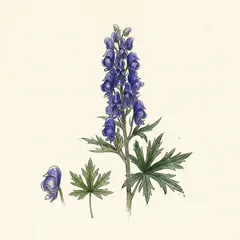 Όλα τα βιβλία για Aconitum Napellus →
Αντιδοτείται απόAcetanilidumAceticum AcidumActaea RacemosaAlcoholArnica MontanaBelladonnaBerberisBerberis VulgarisCaladium SeguinumCantharis Vesicatoria
Όλα τα βιβλία για Aconitum Napellus →
Αντιδοτείται απόAcetanilidumAceticum AcidumActaea RacemosaAlcoholArnica MontanaBelladonnaBerberisBerberis VulgarisCaladium SeguinumCantharis VesicatoriaGeneral EN
Where are the original pathogeneses of Aconite to be found ?
In Hahnemann's Materia Medica Pura . It was also proved by the Austrian Society of Provers.
See also Millard's Monograph, Reil's Essay , and Hartmann's Practical Observations. Allen's Encyclopaedia. Hempel's Materia Medica .
Where does Aconite grow, and what is its common name ?
On the higher Alps of Central Europe, in damp, shady fields, along brooks and streams. Monkshood .
Name some other varieties of Aconite.
Aconitum Stoerkianum, Aconitum lycoctonum, Aconitum ferox, Aconitum variegatum .
What is the name of its Alkaloids, and what is the allopathic dose ?
Aconitine or Aconitia ; dose, one-hundredth to one-sixtieth of a grain. (1/100 to 1/16.)
From what part of the plant do we make our mother tincture ?
From the entire plant, except the root, gathered at the time of flowering.
How is the tincture prepared ?
Chop and pound the entire fresh plant to a fine pulp. Enclose in a piece of new linen and press out juice. Mix with equal quantities of alcohol. Pour in well stoppered bottle and stand for eight days in dark, cool place, agitating it daily and then filter. Drug power, 1/2. An imported tincture.
What, in brief, is the general physiological action of Aconite ?
It affects the sensory nerves, causing tingling , followed by numbness. It accelerates the heart's action, causes a rise in temperature, with chills, fever and sweat ; large doses producing paralysis of the heart and nerves, with collapse. Mental distress is an invariable concomitant condition.
Why do we not give Aconite merely to diminish the frequency of the pulse and thereby lessen the temperature ?
Because it is not Homoeopathy, but treating single symptoms ; there is just as much reason for giving a remedy to move the bowels, another to improve the appetite, another for headache, and still another for the liver, instead of giving the drug for the totality of the symptoms which it produces.
How does Aconite differ from Veratrum viride in fevers ?
Veratrum viride has more arterial but less nervous excitement than Aconite , and a characteristic of Veratrum viride is a bright red streak through the center of the tongue.
When should Aconite be given in neuralgias ?
When the parts are violently congested, hot and swollen ; when brought on by exposure to dry, cold winds ; and when the pains are tingling, with numb sensations ; driving the patient to despair. Pains worse at night.
What are the abdominal symptoms of Aconite ?
Shooting pains all over abdomen, which is very tender to touch ; beginning of inflammatory processes.
What are the stools of Aconite ?
In dysentery ; frequent scanty with tenesmus ; especially in autumn, when days are warm and nights cold. Diarrhoea of inflammatory origin from cold drinks or checked perspiration ; stools watery, slimy and bloody.
Differentiate Aconite from Gelsemium in fevers.
Aconite - hard, quick, bounding pulse.
Gelsemium - soft, flowing, compressible pulse.
Aconite - restless, anxious, tossing about.
Gelsemium - drowsy, quiet, tendency to stupor, countenance suffused.
What is the first of Aconite ?
Unquenchable thirst for cold water ; large drinks at long intervals, or drinks little and often.
What are the heart symptoms of Aconite ?
Pain in the heart extending down the left arm, with numbness, palpitation and lancinating stitches, full, hard and rapid pulse ; uncomplicated hypertrophy of the heart.
In what class of patients and diseases is Aconite found to be most useful ?
In he young and plethoric, who are attacked suddenly with illness of an acute character, such as sudden congestions, violent fevers, acute colds, desperate pains, benumbing tingling neuralgias, etc.
Why is Aconite more suitable for acute than for chronic diseases ?
On account of the suddenness of its symptoms and the short duration of its action.
Give four characteristics of Aconite.
1. The terrible anguish and fear of death ; the patient even predicts the day of his death ; with extreme restlessness and tossing about.
2. Complaints brought on by exposure to dry, cold winds, or from a sudden checking of perspiration.
Hard, Full, Frequent Pulse EN
4. The symptoms are worse in the evening and at night ; come on suddenly and violently.
Give in brief the indications for Aconite in fevers.
Sthenic fevers, with chilliness on the slightest movement ; dry heat of skin, thirst, red cheeks, quickened respiration ; scanty urine and constipation ; full, bounding, rapid, tense pulse, with mental anxiety and aggravation towards evening. Every motion makes the patient chilly ; he is at the same time very restless from the mental anxiety.
When does Aconite cease to be of use ?
In the second stage of inflammation ; when it has localized itself.
What other drugs have numbness and tingling of the left arm in heart disease ?
Kalmia and Rhus tox .
In what affections about the chest is Aconite especially apt to be indicated ?
Pulmonary congestions, with hard, dry, painful cough, anxiety and restlessness, and perhaps a little blood-streaked expectoration.
Differentiate Aconite and Belladonna in congestions.
The cardinal points of Aconite are increasing restlessness and great anxiety.
Those of Belladonna are flushed face, delirium, throbbing carotids and bounding pulse.
What would indicate Aconite in suppression of the menses ?
When it occurs in plethoric patients from fear or fright, or after exposure to cold.