 Ομοιοπαθητική Βιβλιοθήκη
Ignatia Amara
Dunham - Lectures on Materia Medica · Carroll Dunham · 9,021 χαρακτήρες
 Όλα τα βιβλία για Ignatia Amara →
Αντιδοτείται απόAceticum AcidumActaea RacemosaAmbra GriseaAngustura VeraArnica MontanaCaladium SeguinumCamphoraChamomillaCoca Erythroxylon CocaCocculus Indicus
Όλα τα βιβλία για Ignatia Amara →
Αντιδοτείται απόAceticum AcidumActaea RacemosaAmbra GriseaAngustura VeraArnica MontanaCaladium SeguinumCamphoraChamomillaCoca Erythroxylon CocaCocculus IndicusGeneral EN
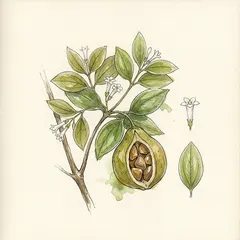
STRYCHNOS IGNATIA. FABA SANCTI IGNATII. ST. IGNATIUS' BEAN.
THE seed of a large tree, a native of the Phil- ippine Islands. It contains strychnine, and in poisonous doses its effects are regarded as identical with those of Nux vomica.
The seeds are used in medicine. They are bruised and triturated.
By allopathic writers Ignatia is classed among the spinants, as acting exclusively upon the spinal cord. Containing strychnine, it is regarded as identical in action with Nux vomica.
We shall see that, however great the similarity, there are yet great, and to us, as therapeutists, most valuable differences between these drugs. This is not the first instance in which a superficial use of chemistry has led to error.
GENERAL ANALYSIS.
Much of what was said of Nux vomica is cer- tainly applicable also to Ignatia. Yet it appears
IGNATIA AMARA. 1 23
that Ignatia acts less than Nux vomica upon the organic substance of the body, producing appre- ciable changes in the tissues, and much more exclusively upon the vital power.
Upon the vital power its action is not so much exalting or depressing, although in certain organs each of these varieties of action is distinguishable ; but rather disturbing, destroying the harmony of action between different portions of the organism, perverting the co-ordination of functions. Thus, where we find heat of the body, and should anti- cipate such a condition of the nervous system as would make cool air agreeable, the contrary condi- tion obtains ; where we should, from the fever existing, expect thirst, we find none, and vice versa. The great sensitiveness of the surface, instead of being aggravated by contact and by pressure, is relieved by it, etc., etc.
Now, it would seem as though such results from provings might be fanciful, were they not corroborated by too many witnesses to admit of the idea being entertained.
And yet, singular as this state of things is, it finds its analogy in the natural history of disease. For if you analyze the phenomena of hysteria, you will find this "perversion of the co-ordination of functions " to be the fundamental principle of the malady. And of all our remedies none so com- pletely corresponds to hysteria, and so often cures it, as Ignatia.
In the words of Dr. Wurmb the whole charac-
124 IGNATIA AMARA.
ter of Ignatia may be expressed in two words: " Entgegengesetzte nebenbeschwerdeny
Accessory or concomitant phenomena which are contradictory to or inconsistent with each other.
SPECIAL ANALYSIS.
Head, The headache of Ignatia is aggravated by talking or listening or paying close attention to anything, but not by independent mental action. It is a sensation of heaviness, as if congested, relieved by stooping and leaning forward, not therefore a real congestion (here is a contradic- tion). There is sometimes a semi-lateral throbbing, sometimes a throbbing over the orbits.
The most characteristic pain is that as if a nail were driven into the head. It is generally in the parietal or vertical region. Thuja has a similar pain in the occiput. This calls to mind the clavus hystericus, in which Ignatia is very useful.
Eyes EN
The affection of the conjunctiva is mod- erate.
There is but little congestion.
On the contrary, photophobia is sometimes intense, though capricious.
The vision is affected in this way : on one side of the axis of vision is observed a zigzag, white flickering.
Ears EN
Ringing and noises in the ears are observed.
Face EN
The muscles of the face and the lips often twitch and are convulsed.
IGNATIA AMARA. 1 25
Teeth EN
It is noted of the Ignatia toothache that though it consists chiefly in a soreness and tenderness of the teeth, it is felt more in the inter- val between meals than when eating. (Another contradiction.)
Throat EN
The sore throat of Ignatia, which is a sticking sensation, is felt more when swallowing than when the throat is at rest.
The digestive organs are much modified in action.
The mouth is full of mucus.
The taste is flat ; food has a bitter, repulsive taste.
There are fanciful aversions to special articles of food.
There is sometimes craving for a particular article, and then, after a small portion has been taken with great enjoyment, a sudden and great aversion to it.
Frequent regurgitation of food and of a bitter liquid.
Vomiting at night of food taken in the evening.
Empty retching relieved by eating.
(Contradiction.)
Distention of the abdomen after eating.
Sour eructations.
Salivation copious, frothy, sour.
Hic- cough.
In the region of the stomach great emptiness and qualmishness and weakness, with a flat taste in the mouth. Characteristic,
(The above three paragraphs are very important, applying to vomiting in pregnancy.)
There are sticking and soreness in the epigas- trium, and moderate flatus, with cutting and griping.
The stool is but little affected. There is a tendency to frequent but scanty stool, as in Nux
126 IGNATIA AMARA.
vomica ; but Ignatia acts less on the substance of the rectum and more on its nerves.
Thus in the rectum we have a distressing contraction and con- striction of the sphincter, most painful after a stool, and when walking and standing, and relieved by sitting.
(Contradiction.)
These are very important symptoms ; violent stitches shooting from the rectum upward and forward into the abdomen. Along with these soreness, constriction and blind or bleeding haemor- rhoids, worse after a stool.
Besides these symptoms of haemorrhoids and of proctalgia, itching and creeping at the anus indi- cate the presence of ascarides.
The chief symptoms of the urinary system are an increased secretion of clear, lemon-colored urine. (Hysteria.)
Menstruation is too frequent and too copious, and for this state of things, other symptoms cor- responding, Ignatia is a remedy.
Respiratory Oi^gans. With regard to the respi- ratory organs, besides the itching of the nose and disposition to ulceration around the anterior nares, I call attention only to the cough.
This is characteristic of Ignatia.
It arises from a feeling of constriction in the trachea or larynx, as if drawn together, then a tickling as if feather dust were in the throat ; the cough is dry, violent, shattering ; the shocks come in quick succession ; the tickling irritation is not relieved by coughing.
On the contrary, it becomes worse the longer the
IGNATIA AMARa. 1 27
patient coughs, and is only relieved by a resolute suppression of the cough.
(A marked contradiction, this ! ) The cough occurs chiefly in the evening, after lying down.
This cough is unlike that of any other drug ; the contradiction is the character- istic feature.
There is occasional spasmodic dyspnoea.
In the trunk various tearing pains, and lassitude.
There are jerkings and twitchings in the ex- tremities, especially after lying down at night, and startings when just falling asleep.
Sleep is sometimes deep and irresistible, some- times the patient is wakeful. It is disturbed by dreams.
The fever is partial in all its stages.
The peculiarity of the chill is that it is relieved by external heat, and that it is accompanied by exces- sive thirst ; whereas the fever, which is partial, is not attended by thirst.
(Contradiction.)
The symptoms of the mind are most important.
Anxiety, as though something terrible had hap- pened; he cannot speak because of it, Hurry, fearfulness, terror, alternating with irresolution and inertness.
Fixed ideas ; the prover sits still and broods over thoughts and griefs.
PRACTICAL APPLICATION.
Ignatia is indicated:
I. When the bad effects of anger, of grief, and of sudden mental shocks produce still grief,
128 IGNATIA AMARA.
or a disposition to brood over sorrow instead of giving way. But when these emotions and shocks make the patient superciHous or crazy, give Pla- tina ; when boisterous and wild, Belladonna.
In Convulsions EN
In epileptic attacks, with consciousness ; in convulsions from grief ; from den- tition ; from labor, when without fever or cerebral congestion ; not, therefore, where Hyoscyamus or Belladonna is required.
3.
In intermittent fever, when there is chill with thirst or fever without.
Distinguished from Ipecac- uanha, Eupatorium, Rhus toxicodendron.
4. In dyspepsia, for weakness in the epigastrium.
5. In proctalgia, after the stool ; it is distin- guished by stitches up into the abdomen ; it is not indicated in fissure of the anus, which calls for Nitric acid and Plumbum.
For Ascarides EN
8. For the vomiting of pregnancy, if appetite, salivation, copious lemon- colored urine, etc., be present, and clavus hystericus.
In Spasmodic Cough EN
Note the sensation of constriction felt in the rectum and in the trachea.
Ignatia has a general correspondence to hys- teria ; to the form characterized by a mental character, which is mild, gentle, yielding though whimsical (else it were not hysteria), and intro- verted. There is another form represented by Platina, which drug will be the subject of the next lecture.