 Ομοιοπαθητική Βιβλιοθήκη
Digitalis Purpurea
Farrington - A Clinical Materia Medica · Ernest Albert Farrington · 18,455 χαρακτήρες
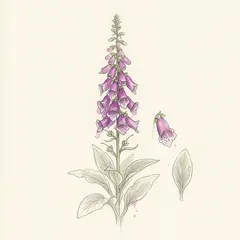 Όλα τα βιβλία για Digitalis Purpurea →
Αντιδοτείται απόApis MellificaCalcarea CarbonicaCamphoraChloralum HydratumCinchona OfficinalisEtherumMyrica CeriferaNitricum AcidumNux VomicaOpium
Όλα τα βιβλία για Digitalis Purpurea →
Αντιδοτείται απόApis MellificaCalcarea CarbonicaCamphoraChloralum HydratumCinchona OfficinalisEtherumMyrica CeriferaNitricum AcidumNux VomicaOpiumGeneral EN
Digitalis contains among other ingredients two substances, one known as Digitalin, the other as Digitoxin. The latter is found in larger quantity than the former. Digitalin has been proved separately from the Digitalis. Its symptomatology, however, is, like most other active principles, very nearly identical with that of the original drug.
Digitalis produces, very early in the proving or in poisoning cases, among other symptoms, the most distressing nausea and vomiting. This emesis is often accompanied by a deathly faint, sinking sensation at the pit of the stomach. The surface of the body is often cold, and sometimes covered more or less with cold sweat. The pulse is irregu- lar. These early symptoms of Digitalis remind one of several other drugs, notably, Antimonium tartaricum, Tabacum and Lobelia. It is
388 A CUNICAI, MATERIA MKDICA.
probable that these drugs and Digitalis all cause this nausea and vom- iting by affecting the base of the brain, acting there upon the pneu- mogastric nerves as they leave their origin. Such symptoms as this deathly nausea and vomiting might suggest the use of Digitalis in the vomiting attendant upon cerebral disease; in meningitis, for instance, whether the meninges of the cerebrum alone, or of the cerebrum and cord combined, were involved in the inflammation.
The drug may even be used in the nausea and vomiting of preg- nancy, and in the incipiency of abortion. One of the provers, a preg- nant woman, took an overdose of Digitalis, and in consequence was seized with this same deathly nausea and a flow of blood from the vagina.
We may also study Digitalis in its action on the heart. Through irritation of the pneumogastric nerves we have inhibition of the heart's action. As a consequence of this effect of the drug, the pulse becomes slow. Arterial tension is greatly increased, probably owing to the action of the drug on the vaso-motor centre, which is supposed to be at the base of the brain; the pulse is, therefore, primarily slow and strong.
In addition to the effect of the drug on nervous structure, we must remember that it also affects muscular tissue, both of the striated and non-striated varieties. Thus it causes weakness of the cardiac tissues. This weakness varies in intensity from simple weakness to complete paralysis of the muscular fibre. Consequently, we may very soon have added to these other symptoms, weakness of the pulse.
Every little extra exertion, such as that incurred while rising from a sitting to a standing posture, increases the rapidity of the pulse, but the force of the beat is diminished. This quick pulse may become irregular and even intermittent. With this view, then, of the physi- ological action of the drug, you may understand the following symp- toms of the heart and respiration connected therewith.
But first let me here give you a word of caution respecting the use of Digitalis in heart affections. The tendency of this drug, like that of Lachesis and Arsenicum album, is downward. You must not use it, therefore, indiscriminately or carelessly, but only when you are guided to its selection by the symptoms of the case, or you will certainly make your patient worse. In organic diseases of the heart, Digitalis must be used with extreme caution, because it may hasten the period when nature is no longer able to compensate by hypertrophy of the heart- muscle for the interference in the circulation.
Nature thus may be
SCROPHULARIACE^. 389
compelled to give out. Then the heart yields to the pressure of the blood within its cavities and begins; and we shall have the train of symptoms which I intend to describe to you shortly, as belonging to Digitalis. This warning is particularly applicable to the use of the drug in large doses. Given thus it may relieve for a time, but it only hastens the fatal end. With this word of warning I now proceed to give you in detail the heart symptoms of Digitalis.
The heart feels as though it stood still, and this sensation is attended with great anxiety. There is a sort of indescribable uneasiness in the cardiac region, which may be expressed as a sense of oppression or tightness about the heart, or as an uneasy feeling with weakness and numbness in the left arm. There is a feeling of goneness or sinking at the epigastrium. This is sometimes relieved by eating, but often comes on worse after eating, particularly after breakfast.
There are sharp sticking pains in the region of the heart. Sometimes there is choking when trying to swallow, from reflex spasm of the glottis. The pulse is slow, often slower than the beating of the heart. In these cases the heart beats so imperfectly that some of its pulse waves are not transmitted appreciably to the radial artery at the wrist.
Any movement such as rising from a chair, getting out of bed, or increas- ing the speed in walking, increases the rapidity of the pulse but causes no increase in the force of its beat. The irregular distribution of the blood caused by these alterations in the heart's functions is exhibited in a variety of sympjtoms. In extreme cases, for instance, we find even cyanosis, which suggests Digitalis as a possible remedy for cyano- sis neonatorum. The child turns blue and falls into a syncope on the slightest motion, or else it becomes deathly sick, as you see from the expression of the face and from the involuntar}^ gagging.
If you can feel the pulse, you will find it irregular both in rhythm and volume; the surface of the body is cool. The borders of the lips are blue or purple. The child is blue around the eyes. The veins wherever they show through the skin are seen to be dark.
Other and more common illustrations of the irregular distribution of the blood may be shown in the sleep. The patient's sleep is un- comfortable and restless. He dreams a great deal; he starts up from sleep dreaming that he is falling from a great height. Sometimes he awakens with an anxious or distressed feeling, which he may be unable to locate, but which results from the cardiac affection. Men- tally, the Digitalis patient, besides being anxious, has those gloomy
39° A CUNICAI, MATERIA MKDICA.
forebodings incident to heart disease. He has an apprehensive feel- ing, ill-defined it is true, yet none the less terrible. He is apt to be sad and depressed, as well as anxious. The respiration is of course affected by this action of the heart.
We frequently find the breathing deep, sighing and slower than normal. This symptom is almost pa- thognomonic of heart affection. There is often a desire to take a deep breath, but an attempt to do so seems to result in only half-filling the lungs, which do not expand to their full capacity. This is often at- tended with dry cough, which seems to be excited by deep inspiration.
The deeper he attempts to breathe, the more likely is he to cough. This is altogether a bronchial symptom, and comes on from an over- filling of the blood-vessels there. Suffocative spells with painful con- striction of the chest, as if internal parts of the chest were grown together, are not uncommon. Sometimes these attacks force the patient to sit up in order that he may breathe.
If these cardiac symp- toms are present you will find Digitalis indicated in several varieties of disease starting remotely from the heart, and yet depending for their existence either directly or indirectly upon the disease of that organ.
In almost all the affections in which Digitalis may be used there is present either a slow pulse or a feeble pulse, becoming irregular or quick.
For instance, dropsy may call for Digitalis. This dropsy is not of renal origin. You would hardly think of Digitalis in dropsy resulting primarily from a liver or kidney disease, but in that form occurring primarily from cardiac debility, it is at times an invaluable remedy.
Digitalis may be used with profit in a number of forms of dropsy. You may give it in anasarca when the surface of the body is bluish, rather than of the alabaster-like appearance characteristic of renal dropsies. Local dropsies, too, are present. Thus you find Digitalis indicated in hydropericardium, and even in hydrothorax and ascites, if they are connected with heart disease.
In dropsies of the chest there is a remedy that is often forgotten, and that is the Sulphate of Mercury or Mercurius sulphuricus. Especially is this remedy useful when the chest-dropsy occurs from heart or liver disease. When the drug acts well it produces a profuse watery diarrhoea, with great relief to the patient. A very common form of dropsy calling for Digitalis, is infiltration of the tissues of the scrotum and penis.
We may even use Digitalis in hydrocele when the cardiac symptoms calling for the remedy are present. The urine is often suppressed or very scanty.
SCROPHULARIACK^. 391
This deficiency in the renal secretion depends upon disordered circu- lation, and not upon primary disease of the kidneys. The urine may be dark red or albuminous.
We find Digitalis causing some liver symptoms which are worthy of notice. I think, however, that Digitalis has no direct action on the hepatic cells; it does not appear to affect the bile secretion directly. But in jaundice, in which the primary trouble is a cardiac disease of the type already mentioned, with ashy white stools, Digitalis certainly acts admirably. The liver is enlarged and feels sore, as if bruised.
Objectively examined, it is found to be somewhat indurated. With this symptom we have jaundice. The taste is bitter, or at other times, sweetish. The tongue may be perfectly clean, or it may be whitish- yellow.
The pulse is slow, even slower than the beating of the heart. Drowsiness may supervene and even increase to stupor. The stools are of the character above mentioned. The urine is high-colored from admixture of bile pigment.
The jaundice calling for Digitalis is not that which follows retention of bile or is caused by catarrh of the duo- denum or by some obstruction of the biliary ducts, but it is due to an actual functional imperfection of the liver, that organ not taking from the blood the elements which go to form the bile.
A remedy which here compares favorably with Digitalis is Myrica cerifera, which has the following symptoms. First, despondency, which depends upon the disordered condition of the liver. The symp- toms of Myrica are similar to those of Digitalis because in each case the jaundice is due to the imperfect formation of bile in the liver, and not to obstruction of the flow. But the two remedies are ver}^ different in their absolute effects on the system.
With Digitalis, the jaundice is traceable to the condition of the heart. With Myrica, the case seems to be functional rather than organic. For some reason the bile is not properly formed, and therefore its elements remain in the blood. The heart is affected secondarily, slowness of the pulse thus being pro- duced.
The S3'mptoms calling for Myrica are these: Despondency, dull, heavy headache, worse in the morning; the eyes and sclerotic have a dirty, dingy, yellowish hue, the lids themselves being abnor- mally red; the tongue is coated a dirty yellow. Weak sinking feeling in the epigastrium after eating. The patient is weak and drowsy, and complains of muscular soreness and aching in the limbs. The pulse is slow but intensified.
The stools are ash colored. The urine is dark and turbid. You recognize at once the resemblance to Digitalis;
392 A CLINICAL MATERIA MKDICA.
but it is more superficial in its action than is that remedy, and would not be suitable for so violent a case as the latter.
In heart affections you may compare Digitalis with a number of remedies, notably, with Kalmia, Arsenicum album, Helleborus and Conium.
Kalmia latifolia is a drug which belongs to the order Ericacecs, with Rhododendron, Ledum palustre and other remedies. It is a valuable rem- edy in rheumatism when it affects the chest. The pains in the Kalmia affection of the heart are sharp, taking away the breath; the patient almost suffocates, so severe are they. The pains shoot down into the abdomen or stomach; the pulse is slow, almost as slow as that calling for Digitalis.
Kalmia is especially useful when gout or rheumatism shifts from the joints to the heart, especially after external applica- tions to the joints. I refer here especially to the application to the joints of substances that are not homoeopathic to the case. If you were giving Arnica internally and applying it locally, and if it were the indicated remedy, there would be no danger of metastasis. But if some one were to apply the tincture of Aconite to the affected joint there would be danger of the inflammation travelling to some more vital part.
The Kalmia rheumatism, unlike that of Ledum, usually travels downward, thus following the direction of its pains.
Helleborus is similar to Digitalis in the slowness of the pulse. The respiration is also slow and the temperature of the body is greatly diminished, often being as low as 950 or 960 F. There is generally cerebral disease.
Spigelia also must be compared with Digitalis. It has the follow- ing symptoms. Sharp pain shooting through the heart to the back, or radiating from the heart and down the arm or over the chest and down the spine; great oppression or anxiety about the heart; palpita- tion of the heart worse from any movement of the arm or body; thrill- ing or purring sensation felt over the cardiac region (this is just such a thrill as you feel when stroking a cat's back when the animal is purring); blowing sound over the heart.
You will find Spigelia indi- cated when these heart symptoms accompany other affections, for in- stance, neuralgia, particularly if it affects the left side of the face, commencing in the occiput and settling over and in the left eye. That is the Spigelia headache. Its aggravation follows the course of the sun. It commences in the morning, reaches its acme at noon, and diminishes toward night.
You may also use it in ciliary neuralgia
SCROPHU^ARIACE^. 393
with these accompanying sympathetic symptoms of the heart. Sharp pain shoots through the eyeball and radiates in all directions, almost driving the patient mad. At other times there is a sensation as if the eye were being squeezed in a vise or as if it were enormously enlarged and were being pushed out of the head. It is one of the chief reme- dies to be thought of in iritis with excessive pain.
I wish also to mention a symptom for Spigelia that the late Dr. Jacob Jeanes con- firmed many times, and that is intermittent pulse. He prescribed this remedy as an intercurrent, in many varieties of disease, when the pulse assumed this character.
Convallaria majalis presents heart symptoms associated with uterine symptoms; soreness in the hypogastrium; pain in the sacro-iliac syn- chondrosis, extending down the leg. Itching of the meatus urinarius and vulva.
Another remedy is Magnolia gra7ialiflora , which has sadness; nerv- ousness; weak heart, with sensation of constriction in the cardiac region; worse on walking fast; and at times the sensation as if the heart stopped beating.
It will not be unprofitable for us next to study the action of Digitalis on the brain. It causes symptoms which are very much like those of meningitis, even meningitis with effusion, or of hydrocephalus, and also of cerebro-spinal meningitis. The symptoms from which you will have to decide are these: there is throbbing headache, which is re- ferred to the forepart of the head; delirium, which may be so violent as to simulate mania; decided errors in vision; bright balls of fire ap- pear in the field of vision, or, like Santonin, objects appear of various colors, as yellow or green.
Still later, as the trouble progresses, men- tal confusion increases and amaurotic congestion of the retina takes place; the pupils become dilated and fail to respond to light, and finally coma appears. There is great general prostration with cold- ness of the body, which is covered with a cold sweat. Even in these forms of cerebral disease, when Digitalis is to be your remedy, the pulse comes in as your chief guide. If the symptom, buzzing in the ears, should suggest Cinchona, I entreat you not to give it after Digi- talis, for Hahnemann tells us that, although there is a similarity in the cerebral symptoms and in the weakness, yet the drugs are inimical.
Lastly we shall speak of the action of Digitalis on the urethra and genital organs. Digitalis produces a catarrhal irritation of the blad- der, particularly about its neck. There are strangury and frequent
394 A CLINICAL MATERIA MEDICA.
urging to urinate, especially when the patient is standing or sitting; pressure on bladder not relieved by urinating. The patient may also have frequent urging to urinate at night. The urethra is inflamed so that we have burning in the urethra with purulent discharge, thick in character and bright yellow in color. Now, if you combine these symptoms with another one, namely, that the glans penis becomes in- flamed with copious secretion of thick pus over its surface, you have a perfect picture of Digitalis in gonorrhoea.
This form of the trouble, Digitalis will cure, whether the pulse be slow, fast, soft, weak, or what not. Often, too, when Digitalis is indicated in this trouble, you will find the prepuce puffed up and infiltrated with serum. Let me say, in passing, that if the prepuce becomes indurated, Digitalis will do no good, but Sulphur will.
The nearest remedy to Digitalis in gonorrhoea is Mercurius. This is a good remedy for gonorrhoea associated with inflammation of the prepuce, but with less oedema and more dark purplish swelling of the parts with phimosis or paraphimosis.
Mercurius corrosivus is good in these cases when the glans has a dark red or gangrenous appearance.
In the beginning of these cases of paraphimosis, we may give Colo- cynth, which will sometimes relieve the spasm and enable the prepuce^ to be drawn forward over the glans.
Petroselinum is to be thought of as an intercurrent remedy in gonor- rhoeal affections when the neck of the bladder is involved, and there is sudden urgent desire to urinate. It seems as if the patient can hardly retain his urine until he gets to a convenient place.
Digitalis also produces violent erections, even chordee. It is one of our best remedies for involuntary seminal emissions during sleep, even without dreams. The emissions are followed by great weakness.