 Ομοιοπαθητική Βιβλιοθήκη
Euphrasia Officinalis
Farrington - A Clinical Materia Medica · Ernest Albert Farrington · 4,386 χαρακτήρες
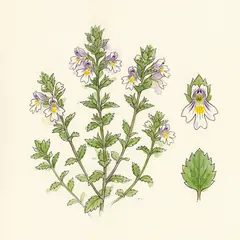 Όλα τα βιβλία για Euphrasia Officinalis →
Αντιδοτείται απόCamphoraCausticumHydrophyllum VirginianumPulsatilla Pratensis
Όλα τα βιβλία για Euphrasia Officinalis →
Αντιδοτείται απόCamphoraCausticumHydrophyllum VirginianumPulsatilla PratensisGeneral EN
Euphrasia is particularly of use to us as a medicine acting on mu- cous membranes, especially the conjunctiva and the nasal mucous membrane.
It has long been known as a remedy in affections of the eyes. First it produces an inflammation of the eyelids, a blepharitis. The eyelids become reddened and injected, particularly on their inner surface. They become puffed, red or even dark red; ulceration takes place, giving us a discharge which is thick and excoriating.
The tears themselves are profuse and excoriate the cheeks. There is marked photophobia; the patient cannot bear sunlight, but even more objec- tionable to him is artificial light. It has been urged by some physi- cians that it is "splitting hairs" in attempting to differentiate between aggravation from sunlight and that from artificial light. I cannot see where this objection has any force, for sunlight and artificial light are very different in their compositions.
SCROPHULARIACE^. 397
Belladonna has aggravation from artificial light, and Aconite from sunlight.
In conjunctivitis, Euphrasia is sometimes indicated in scrofulous cases. Little blisters or phlyctenulae form on or near the cornea; the discharges from the eyes are acrid and purulent and a film of mucus seems to collect over the cornea, causing a difficulty in vision. This blurred sight is relieved by wiping the eye or by winking.
We find Euphrasia indicated also in conjunctivitis of traumatic origin, when the above symptoms are present. Arnica, which is more of a remedy for bruises, has no application to this acrid discharge or to the formation of these little blisters; so when these form after an injury, Euphrasia is the preferable drug.
Although Euphrasia affects principally the superficial structures of the eye, we find it indicated in rheumatic iritis. If you examine the eye, you find that the iris reacts very tardily to light, and the aqueous humor is cloudy from the admixture of the products of inflammation. The pains are burning, stinging, shooting in character, are worse at night, and are attended with this acrid lachrymation.
Euphrasia is indicated in coryza which is perfectly bland with lach- rymation which is excoriating.
If we compare it with its concordant remedies we find, beginning with the eye symptoms, that it is a close ally of Mercurius solubilis. Both remedies have this well-marked blepharitis and conjunctivitis coming from cold. But under Mercurius the discharge is thinner than under Euphrasia; moreover Mercurius has marked aggravation from the heat of the fire, and in damp weather.
Next we find Euphrasia similar to Arse?iicum album. Both have the acrid discharge and the formation of phtyctenulae on the cornea, and both are indicated in scrofulous cases. But Arsenicum has more marked burning — burning like fire, especially after midnight. This symptom is frequently though not always relieved by the application of hot water. Nor have we in Euphrasia the marked restlessness we have in Arsenicum.
Another similar drug is Rhus toxicodendron, which has profuse gush- ing tears, excoriating the check; profuse purulent discharge from the eyes. But the pus is thinner under Rhus than it is under Euphrasia. Rhus more often attacks the right eye; Euphrasia attacks either eye. Rhus has pains in the rheumatic iritis, darting from the eye through to the occiput, with a great deal of restlessness, agony, tossing about at night, and relief from motion and applied heat.
398 A CUNICAI, MATERIA MBDICA.
In studying the coryza we are accustomed to associate Euphrasia with Allium cepa. We make this differentiation between the two remedies: Cepa has excoriating coryza and bland lachrymation; Euphrasia, bland coryza and acrid lachrymation.
There is still one other application we may make of Euphrasia, and that is in paralysis of the third pair of nerves, causing ptosis, espe- cially when caused by catching cold, in rheumatic patients.
The allies here are Rhus toxicodendron and Causticum, both of which have exactly the same symptom. This gives you very nearly the pre- cise position of Euphrasia in the treatment of catarrh of the eyes and nose.
We may also make use of the drug in the treatment of condylomata. It is useful in broad, flat condylomata of the anus, of course of sycotic origin. Usually there is some oozing of moisture about them.
LECTURE XXXVIII.
BAPTISIA TINCTORIA.