 Ομοιοπαθητική Βιβλιοθήκη
Pulsatilla Pratensis
Pulsatilla · Farrington - A Clinical Materia Medica · Ernest Albert Farrington · 15,034 χαρακτήρες
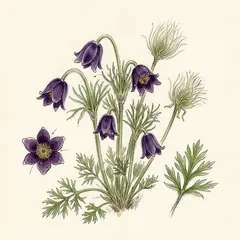 Όλα τα βιβλία για Pulsatilla Pratensis →
Αντιδοτείται απόAconitum NapellusActaea RacemosaAmbra GriseaAngustura VeraAnthracinumAntimonium TartaricumArgentum NitricumArum TriphyllumAsaf EtidaBelladonna
Όλα τα βιβλία για Pulsatilla Pratensis →
Αντιδοτείται απόAconitum NapellusActaea RacemosaAmbra GriseaAngustura VeraAnthracinumAntimonium TartaricumArgentum NitricumArum TriphyllumAsaf EtidaBelladonnaGeneral EN
> Pulsatilla.
Sulphuric acid is indicated when the patient is hasty, quick and rest- less in his actions, sometimes, too, when there is the opposite condition, one of great depression, as in typhoid states. He answers questions slowly and with great difficulty, just as does the Phosphoric acid patient. You find that there is a general sensation of trembling in the Sulphuric acid patient. He feels as if he were trembling from head to foot, although there is no sign of it on the surface.
The face in these con- ditions is rather peaked and is apt to be pale with blue rings around the eyes. Sometimes there is a feeling as though white of egg were dried on the skin. The patient is particularly weak about the digestive organs ; thus there is a cold, relaxed feeling about the stomach, mak- ing the patient long for some strong or stimulating drink, as brandy, and this, too, in persons who are not addicted to drink. So weak is the stomach they vomit all food ; the ejected matters are very sour.
You will find Sulphuric acid indicated especially for inebriates who are on their "last legs." They have run down completely, and have long since passed the Nux vomica condition. You find them pale, shrivelled-looking and cold ; their stomachs so relaxed as not to be able to tolerate any food. They cannot even drink water unless it contains whiskey. The liver is enlarged.
They have a dry stomach cough, often followed by belching, the act of coughing hurting the liver. The diarrhoea is watery and offensive, and is accompanied by excessive irritability of mind. ' They have a quick, hasty manner of doing every- thing. There is always dampness or oozing of moisture from the rectum. They frequently suffer from piles which burn, and are so large that they fill up the rectum.
These cases are relieved by Sul- phuric acid.
There is another use we may make of Sulphuric acid, and it is derived from its power of modifying the thirst for spirituous liquors. You
532 A CLINICAL MATERIA MKDICA.
should take two or three drops of the pure acid and dissolve them in a glass one-half full of water. Give it to the inebriate every two or three hours in teaspoonful doses, and it will overcome the physical craving. Give it until he gets well, even if it produces a sore mouth. Should it produce diarrhoea, Pulsatilla is the proper antidote.
Another effect of Sulphuric acid is its action in aphthous sore mouth occurring in debility from protracted disease, or in children with summer complaint or marasmus. The mouth is filled with yellowish aphthous spots. There is a profuse flow of saliva. With this there is apt to be vomiting of sour milk or sour mucus.
The child smells sour despite the most careful washing. The stool is yellowish or slimy, having the appearance of chopped eggs. The child is very apt to have a cough, which is very likely a stomach-cough, with belching of wind after the cough.
You may think of Sulphuric acid also in diphtheria. The tonsils are bright red and quite swollen, so swollen in fact that liquids escape through the nose. The child is deathly pale, so pale that it looks like a corpse. It is inclined to drowsiness or somnolence. It can hardly breathe or talk, or make any noise on account of the abundance of membrane.
Sulphuric acid is also useful as a traumatic remedy. It may be used for bruises of soft parts after Arnica; in bruises of glands after Conium ; in injuries of bones after Ruta. Particularly may it be used when there are long-lasting black and blue spots with soreness and stiffness.
Again, Sulphuric, more than any other acid, is useful in hsemor- rhages. It causes haemorrhage from every orifice of the body, the blood being dark and thin.
You may differentiate Sulphuric acid from Carbo veg. in the dyspepsia of drunkards by the fact that Sulphuric acid is more of a " sour remedy ' ' and Carbo veg. a "putrid remedy."
LECTURE LI.
NITRIC, HYDROCYANIC AND PICRIC ACIDS
f Exhaustion.
Paralysis.
Nerves EN
< .
bpasms.
^ Neuralgia.
Mucous membranes.
Fevers.
Organs.
Stan?ium is a drug that has not many symptoms; hence it can be disposed of very quickly. Its complement is Pulsatilla.
The Sta?i?ium patient is usually sad and lachrymose, just like Pul- satilla.
Crying usually makes the patient worse.
This low-spirited- ness is found in the lung troubles for which Stannum is your remedy.
This is rather different from the usual mental state of consumptives, who, you all know, are generally hopeful, almost to the last hour of life.
Stannum is particularly indicated when they are low-spirited, hence it is rarely indicated in true tuberculosis.
The woman for whom Sta?mzim is indicated is also nervous and weak; so nervous, irritable, and weak is she, that she becomes anxious and has palpita- tion of the heart, even from so little exertion as giving directions con- cerning her household affairs.
She complains of a sensation of gone- ness in the stomach and chest.
This nervous exhaustion is exhibited in various ways; it is particularly induced when the patient goes down stairs, more than when ascending.
She feels as if she could not walk down stairs, or as if she had not sufficient strength in her limbs.
624 A CLINICAL MATERIA MEDICA.
This exhaustion may be exhibited in another way: the patient does not complain much about walking, but on trying to sit down she fairly drops into the chair.
This is not an imaginary symptom.
You will meet it in uterine affections.
In the mental symptoms you may compare Stannum with Natrum mur., Pulsatilla, and Sepia.
Natrum mur. has melancholy, sad, weep- ing mood, but consolation seems to aggravate.
On trying to comfort him, he becomes enraged.
The Pulsatilla patient is of a mild, tearful, yielding disposition.
She rather likes consolation.
She has scanty, delayed menses, while Stannum has the opposite.
The Sepia patient has sadness concerning her own health, while she exhibits great indifference to her family. She is easily offended and is inclined to be vehement.
In this relaxation of tissue, producing goneness or weakness, we have several remedies. First of all, when you find patients are weak from talking, compare: Cocculus, Veratrum alb., Phosphoric acid, Sul- phur, Sulphuric acid and Calcarea ostrearum.
For the functional paralysis that may come from fatigue or from mental emotions, compare with Stan?ium, Cocculus, Ig?iatia, Phospho- rus, Natrum mur. and Collinsonia.
The Stannum patient is troubled with disordered digestion, other- wise called dyspepsia.
There are nausea and vomiting in the morn- ing, or, as in Colchicum, the odor of cooking causes vomiting.
This last symptom is a particularly strong indication for Stannum, espe- cially in women.
There is weak, gone feeling in the stomach, as in Sepia ; also bitter taste in the mouth.
The rectum is inactive.
Much urging is required to evacuate even a soft stool.
The face is apt to be pale and sunken, with dark rings around the eyes.
These symptoms indicate debility, with which women suffer, and they may call for the exhibition of Stamium when worms are present.
Even when con- vulsions result from the irritation of these parasites, Sta?inum is still the remedy if other symptoms agree, thus placing it alongside of Cina, Artemisia, etc.
Men may require Stannum when they are hypochondriacal.
They have gastralgic pains, which compel them to walk about for relief, and they are so weak that this exercise is very fatiguing to them.
The tongue is coated yellowish.
The Sta?inum patient suffers from prolapsus uteri. This prolapsus
STANNUM. 625
so often calls for Stannum, that Dr.
Richard Hughes generally finds this remedy useful for simple prolapsus uteri.
You will find, too, that under Stannum the vagina is prolapsed.
These prolapsus symptoms are worse during stool.
The menses are always profuse.
The leucor- rhcea corresponds with the prevailing character of the drug.
It is yellowish or else it is clear mucus, and is always associated with un- bearable weakness.
The patient is so weak that she can scarcely move about.
The prostration is so great that, on dressing in the morning, she has to sit down several times to rest.
There is trem- bling of the arms and legs.
The limbs feel as heavy as lead.
This weakness is always worse when descending, as when going down stairs or assuming a sitting posture.
These uterine symptoms may be associated with weak or gone. feeling in the chest.
The patient feels so weak she can scarcely talk.
As somewhat similar to Stannum in prolapsus uteri, with aggrava- tion of symptoms during* stool, you may remember Podophyllum, which has prolapsus uteri with diarrhoea. The stool is usually green, and comes with a rush.
Calcarea phosphorica, Nux vomica, Pulsatilla should also be studied in this connection.
As you might expect, a patient, so thoroughly weakened as to the nervous system as is the Stannum patient, must suffer from neuralgia.
The general characteristic guiding you to its use is, the pains increase and decrease slowly.
They are especially liable to occur in the course of the supra-orbital nerve.
With this character to the pain, we find Stannum useful in prosopalgia following intermittent fever and abuse of quinine.
In these pains that increase and decrease slowly, the nearest rem- edies are Platina and Strontiana carb. Spigelia, Kalmia and Natrurn mur. also have the symptom, though perhaps less markedly.
Epilepsy has been treated with Stannum, particularly when reflex from abdominal irritation, as from the presence of worms in the intes- tinal canal.
The patient has a pale face and dark rings around the eyes, and colic, which is relieved by pressing firmly on the abdomen.
If the child is old enough to describe his sensations, he will complain of a sweetish taste in the mouth.
It is also useful in epilepsy with sexual complications; opisthotonos; clenching of the thumbs.
Hysterical spasms may also call for Stannum, especially when asso- ciated with pain in the abdomen and diaphragm.
626 A CLINICAL MATERIA MEDICA.
Next, the action of Stannum on mucous membranes.
When it is the remedy, you find that there is copious secretion from the mucous membranes.
This is bland and unirritating, and is yellowish or yellowish-green; hence it is a muco-purulent secretion.
Sometimes, although not so often, this mucus is tenacious, viscid and intermixed with blood.
It accumulates in the throat and is detached with great difficulty, even exciting vomiting.
The mucus collects very rapidly in the chest and is quite easily expectorated, with great relief to the patient.
The oppression, the weakness, and the tightness of the chest are all relieved when this sputum is raised.
The voice, which is husky and hoarse, seems to be raised in pitch by this expectoration.
Dyspnoea, too, is decidedly better after expectoration.
The cough is very annoying and teasing.
It is worse at night, and is excited by talking and walking rapidly.
The patient, in addition, complains of that weakness of the chest.
It seems as if he had no strength there whatever.
Dyspnoea comes on, worse towards evening.
Now these are the symptoms w7hich indicate Stannum in cases of neglected cold.
They also suggest the drug in what has been very properly termed catarrhal phthisis.
There is marked hectic fever.
The chills come characteristically at ten o'clock in the morning.
To- wards evening the patient becomes flushed and hot, with aggravation of his symptoms on any exertion.
At night he has profuse sweat, which is particularly worse towards four or five o'clock in the morn- ing.
L,et me say here that in this hectic fever, with chill at ten o'clock in the morning, I have several times tried Natrnm mur.} but without obtaining any benefit from it.
Stannum is a remedy which you must select with great care, or it will surely disappoint you.
This symptom of weakness must be pres- ent if you expect results.
When you find Stannum insufficient in catarrhal phthisis, you may think of the following remedies:
Silicea is indicated in catarrhal as well as in true tubercular phthisis when there is cough, which is increased by rapid motion.
There is copious rattling of phlegm in the chest.
The expectoration is more purulent than that of Stannum.
There are usually vomicae in the lungs.
You will find Silicea frequently indicated in the catarrhal phthisis of old people.
Phosphorus must often be carefully compared with Stannum, as the two remedies are frequently misused for each other.
Both have hoarse- ness, evening aggravation, weak chest, cough, copious sputum, hectic, etc.
Phosphorus has more blood or blood-streaks, tightness across the
STANNUM. 627
chest, aggravation from lying on the left side and thirst for ice-cold water.
Se?iega is a drug which produces great soreness in the wTalls of the chest and great accumulation . of clear albuminous mucus, which is difficult of expectoration.
These symptoms are often accompanied by pressure on the chest as though the lungs w7ere pushed back to the spine.
It is especially indicated in fat persons of lax fibre.
This Senega contains Senegin or Polygalic acid, which is identical in com- position with Saponin, the active principle of the Quillaya saponaria.
This also produces the same kind of relaxed cold as the Senega does.
Coccus cacti is useful in whooping cough, with vomiting of great ropes of clear albuminous mucus. It may be useful in catarrhal phthisis when, with this ropy phlegm, there are sharp stitching pains under the clavicles.
Balsam of Peru is indicated in catarrhal phthisis by copious puru- lent expectoration.
We know but little concerning this drug.
We must, therefore, adopt the expedient of selecting it by a process of ex- clusion.
Yerba sa?ita or the Eriodiction Californicum is indicated when there is asthmatic breathing from accumulation of mucus. There are con- siderable emaciation and fever.
Among other remedies with much phlegm on the chest are Anti- monium crudum and tartar icu?n, Ckamomilla, Belladonna, Calcarea ostrearu?n, Calcarea phosphoidca and Ipecacuanha (in children), Lyco- podium, Sulphur, Phosphorus, Balsam of Peru (purulent sputum), He- par, Scilla, Yerba santa (fever, emaciation, asthma from mucus), Co- paiva (profuse greenish-gray, disgusting-smelling sputa); Illicium anisatum (pus, with pain at third cartilage, right or left) ; Plx liq : (purulent sputum; pain at left third costal cartilage); Myosotis (copi- ous sputa, emaciation, night sweat).
In pleurisy you find Stannum indicated by sharp, knife-like stitches, beginning in the left axilla, and extending up into the left clavicle.
Sometimes they extend from the left side down into the abdomen.
They are worse from bending forward, from pressure and on inspira- tion.
Stannum is sometimes used in functional paralysis arising from onanism or from emotions.
Sometimes persons of the weak, nervous temperament I have described are so affected by emotions as to lose the power of motion.
Here Stannum compares with Staphisagria and Natrum mur.
LECTURE LXL
CUPRUM AND ZINCUM.