 Ομοιοπαθητική Βιβλιοθήκη
Thuja Occidentalis
Farrington - A Clinical Materia Medica · Ernest Albert Farrington · 17,189 χαρακτήρες
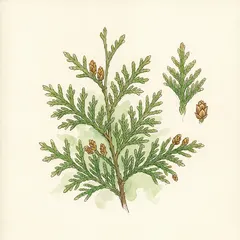 Όλα τα βιβλία για Thuja Occidentalis →
Αντιδοτείται απόBryonia AlbaCamphoraCastor EquorumChamomillaCocculus IndicusColchicum AutumnaleMercurius SolubilisNux VomicaPulsatilla PratensisRicinus Communis
Όλα τα βιβλία για Thuja Occidentalis →
Αντιδοτείται απόBryonia AlbaCamphoraCastor EquorumChamomillaCocculus IndicusColchicum AutumnaleMercurius SolubilisNux VomicaPulsatilla PratensisRicinus CommunisGeneral EN
The remainder of the hour will be devoted to Thuja occidentalism the last member of this group, and we shall consider it fully. The history of the introduction of this drug is somewhat novel. Hahnemann re- ceived in his office on one occasion a patient who complained of some symptoms about the genital organs, which were, to say the least, sus- picious. There was a thick purulent discharge from the urethra, with burning on urinating.
There were also small pimples, attended with itching, about the glans penis, and some swelling of the parts. Hahne- mann charged his patient with having contracted gonorrhoea. This was stoutly denied by the patient, who, by the way, was a theological student. However, on the principle prevailing in every court to con- sider a man innocent until he has been proved guilty, Hahnemann determined to give the young man no medicine, and directed him to report in three days.
At the end of that time he came back well. Hahnemann was puzzled. He questioned the patient closely, but found no cause. Then the young gentleman remembered that as he sauntered through a garden a few days before he picked some leaves of the arbor vitae and chewed them.
This led Hahnemann to inves- tigate the properties of Thuja, when he discovered that the theological student had told the truth.
Do not think, however, that Thuja has no other field of usefulness than in sycosis, because it has several interesting actions on the sys- tem, especially upon the nervous system. While you must remember that these nervous phenomena may rest on a sycotic basis, you should also know that they may exist without the presence of any such taint. Grauvogl tells us of the ' ' hydrogenoid constitution," in which the poison of gonorrhoea acts most virulently. If one with this con- stitution contracts the disease, he is more apt to retain the con- stitutional taint.
This constitution, we are told, may exist with- out any sycotic taint. In those who are afflicted with it, vaccination is most injurious. When you find a patient suffering from vaccination, the virus being pure, you may set that patient down as belonging to the hydrogenoid constitution. We have two antidotes to these bad effects of vaccination: Silicea, which suits almost any of the symptoms, even convulsions, and Thuja, which is especially suitable if diarrhoea results and the vaccine pustules are very large.
It was on account of this last-named symptom that Boenninghausen recommended Thuja in
308 A CUNICAIv MATERIA MEDICA.
variola. He gave it just as soon as the vesicles began to turn into pustules, and he claimed to have thereby prevented scarring.
But to return to a study of the action of Thuja on the nervous sys- tem. The patient exhibits a manner which is hurried and impatient. He talks hurriedly. His movements are unnaturally active and hur- ried.
His temper is easily aroused. Even trifles make him angry and excited. Some of the gentler emotions also are awakened. For instance, music causes weeping and trembling of the feet.
There is a form of insanity or mania in which you will find Thuja the only remedy, and that is one in which there is the fixed idea in the patient's mind, that he is made of some brittle substance, and he will not per- mit himself to be approached for fear that he will be broken. This is not the Antimonium crudum condition. It is not an irritability of mind that drives any one and every one away, and will not permit one's self to be even looked at, but it is a symptom that comes from some fixed delusion as to his bodily composition.
Or he thinks that his body and soul are separated or that a stranger is by his side.
Another singular characteristic of Thuja is one that was first met with in an old maid. She experienced a sensation as though a living child were in the abdomen. This symptom has suggested the use of Thuja in pseudocyesis.
Accompanying these symptoms of the nervous system indicating the drug in melancholia, and other forms of insanity, we find many disturbances in the circulation, such as ebullitions of blood, pulsations all over the body, and precordial anxiety. The action of the drug on the nervous system is further shown in various forms of neuralgia. Thus it is indicated in the form of headache known as clavus, in which the patient has a sensation as though a nail were being driven into the vertex, or into one of the frontal eminences.
Thuja may also be used in neuralgia affecting either the head or the face or both. The pains are of an intense stabbing character, and are well-nigh unbearable. If the patient sits up these pains almost drive him to distraction; they may even produce unconsciousness. He therefore maintains the hori- zontal posture.
The pains seem to begin about the malar bones and eyes, and go back toward the head. They may be due to a suppressed eruption. This neuralgia reminds us of Mezereum and Spigelia, but we distinguish it from that of the last-named remedy by the direction of the symptoms; in Spigelia the pains begin in the back of the head and come forward.
CONIFER^. 309
After detailing to you these unique nervous symptoms, I pass to the application of the drug to sycosis. Remember that these nervous phenomena may or may not have a sycotic basis. Thuja is a remedy which tends to alter the sycotic constitution, to change the soil in which this poison grows. There are two elements which make up disease; they are the elements of the disease itself, and those of the constitution in which it grows.
The sycotic constitution to which I have referred modifies every subsequent disease, and that, too, whether there be any urethral discharge or not.
In gonorrhoea you may use Thuja when the discharge is thin and greenish, and there is scalding pain during urination. After urina- tion there is a sensation as if a few drops of urine ran down the urethra. Warts or condylomata appear on the genitals, at the anus, about the perineum and upon mucous surfaces. I have treated one case in which the wart formed on the centre of the tongue.
This was speedily cured by Thuja. These warts may have a seedy look, or they may be of a cauliflower shape. Cauliflower-like excrescences are especially apt to grow from the cervix uteri. In other cases, these warts are moist and ooze a glutinous, foul-smelling fluid.
Sometimes we find ulcers about the genitals, and these have very much the ap- pearance of chancroids; they have a dirty yellow base with hard edges. Very characteristic are such ulcers if they seem to have origi- nated from warts. Sometimes we note fissures, or furrows about the anus, on the perineum, scrotum or glans penis. These are deep and are covered with pus.
There is sweetish-smelling sweat about the genital organs. The inner sides of the thighs are red and excoriated. The testicles are often involved, one or the other of these organs being drawn up in consequence of contraction of the cremaster muscle. The testicle is swollen and aches as if bruised.
There may be balanorrhoea, that is, a purulent inflammation of the inner surface of the prepuce and of the sulcus behind the corona glandis.
In the female organs we find the cauliflower excrescences which I have already mentioned; fungous growths of venereal origin about the genitals; and condylomata with thick green leucorrhoea, correspond- ing to the thin greenish-yellow gleet of the male.
Again, if a gonorrhoea be checked by injection, by cold or by any other influence, constitutional symptoms may arise which call for Thuja. Especially is this remedy indicated if the complication be articular rheumatism, or prostatitis; the hair dries and splits at the
3IO A CUNICAI, MATERIA MKDICA.
ends; the scalp becomes scaly and covered with dry scurf; iritis ap- pears, accompanied by condylomata on the iris; the eyelids are in- flamed and become warty. Ozsena may be an additional complication, with a discharge that is thick and green. The teeth decay at the root, the crowns being apparently normal. Other symptoms worthy of mention are pustules, which have considerable resemblance to those of Tartar emetic; chilliness during urination; nervousness and restlessness during both night and day; otorrhcea; foul breath; hoarseness.
Thuja has the singular property of softening hard tissue, tissue natur- ally hard, as the nails. Herein lies the explanation of the ability of the drug to remove warts; it softens them and causes their absorption.
The drug has a specific action in sclerotitis.
The cough of Thuja is worse during the day; seldom occurring at night. The sputum is like old cheese.
Thuja is a remedy in scrofula and marasmus. Such cases are not necessarily sycotic, but they have just such constitutions as favor the growth of this taint. The stools are watery, gurgling, forcibly ex- pelled, and are daily worse after breakfast, and accompanied by much loud flatus; tinea ciliaris, with dry bran-like scales; irregular and im- perfect eyelashes; children are pot-bellied; they scream on awaking, and are a long time becoming fully awake.
I propose now to devote the remaining moments of the hour to a consideration of the remedies similar to Thuja in the above-mentioned conditions. One of the nearest allies to Thuja is Pulsatilla, in that it has ozsena with thick greenish discharge. In gleet, also, the reme- dies have the same discharge, it being thicker under Pulsatilla. Then, too, gonorrhceal rheumatism, orchitis and prostatitis, are just as char- acteristic of Pulsatilla as of Thuja.
Kali bichromicum is useful in ozsena occurring in sycotic constitu- tions, the discharge being yellowish or more often greenish. The nose feels unnaturally dry. Dark greenish plugs are hawked from the post-nasal space.
Nitric acid resembles Thuja in the condylomata or warts. It is also of use in ulcers, when they are ragged in outline, and in enlarged ton- sils, whether these affections be of syphilitic or of gonorrhceal origin. Nitric acid also has moist fissure of the anus (which is also present, as you know, under Thuja), balanorrhcea and thin greenish leucorrhcea. Nitric acid has, however, to distinguish it from Thuja, more aching pains in the bones, especially in those localities devoid of muscular tissue covering, as along the tibia, and over the sternum and cranium.
CONIFER^. 311
Staphisagria suits long filiform condylomata. The system generally is depraved, as shown in the sallowness of the face, the dark rings about the eyes, the spongy gums, the yellowish- white skin, and the great debility. It is especially indicated when there has been previous mercurialization. There is generally induration of one or the other testicle.
I would like to mention here Jacaranda. This is a South American plant that was first proved by Muir. It is an excellent remedy for balanorrhoea, and for red chancroid or chancroid-like sores about the penis. It has been proved conclusively to be a good remedy.
Corallium rubrum is an excellent remedy for chancre-like sores that are very red.
Mercurius resembles Thuja in the iritis, the balanorrhoea, the green urethral discharge and the rheumatism. The difference lies here: in Mercurius, sweating aggravates the symptoms, as does also the warmth of the bed. Thuja has a symptom which is not often met with, but which saved a life for Boenninghausen, namely, sweat upon uncovered parts of the body only.
Sabina is useful for condylomata which itch and burn, especially in women.
Euphrasia is called for when the condylomata are large and look like a cock's comb.
Cinnabaris is an excellent remedy when there is a combination of syphilis and sycosis. The figwarts are apt to be fan-shaped. There is a great deal of itching, especially about the joints.
The complement of Thuja in these sycotic troubles is Natrum sulph.
Sarsaparilla is indicated when there is a sycotic eruption consisting of little spots scarcely raised above the skin, often scaling a little, but looking like the roseola of syphilis, itching intolerably, and develop- ing an aggravation in the spring; also when a moist eruption appears on the scalp, the pus from which causes inflammation of any part which it touches. Sycotic headache is found under Sarsaparilla. The pain begins in the back of the head, and comes forward and settles at the root of the nose, with swelling of the nose; moist eruption about the genitals, or between the scrotum and the thighs.
Petroleum also has this last-named symptom; and in addition an- other, namely, membranous shreds about the anus.
312 A CLINICAL MATERIA MEDICA.
EUPHORBIA CE^E.
The members of the Euphorbiacece contain an acrid principle which in some cases is oily in character, in others resinous; in the latter case, the juice escapes from the plant as a milky fluid, which dries into a gum. These oils or gums have two properties. If applied to the skin they produce redness and vesication. The vesicles fill with yellowish- white serum, and may even suppurate and form scabs of a honey color.
They all act more or less intensely as purgatives, producing a watery diarrhoea, associated with colic, tenesmus, flatulence, burning, nausea and vomiting. The medicines which we derive from this order are Croton tiglium, Jatropha curcas, Yucca ftlame?itosa, Euphorbium officinarum, Euphorbia corollata, Mercurialis peremiis, Hippomane man- cinella and Ricinus com?nunis.
Croton tiglium, Etc
This remedy produces a diarrhoea with yellowish watery stool pour- ing out like water from a hydrant, often associated with nausea and vomiting. This nausea is of a very aggravating character, and is attended by faintness and loss of sight. Colic appears and is better from warm drinks. The stool returns with any effort to eat or drink.
The nearest analogue to Croton tig. is Jatropha curcas, which pro- duces a perfect picture of cholera Asiatica, with great prostration and simultaneous vomiting and purging. The vomited matters look like rice-water or the white of an egg. There are also cramps in the calves and coldness of the body.
The next similar drug is the Euphorbia corollata. This produces vomiting and purging, just like the previous remedy, with cold sweat all over the body. It has more markedly than the other members of this group a peculiar mental state — the patient wants to die.
Cascarilla or Sweet-bark has abdominal symptoms relieved by warm drinks, but it seems to be useful in a different class of cases from the foregoing remedies. We use it when there are knotty stools covered with mucus, like Graphites, and associated with colic and burning just like the other remedies of the group. Cascarilla also has frequent pale red haemorrhages from the bowels. These haemorrhages do not consist of a simple oozing of blood, such as often follows a stool when haemorrhoids are present, nor is it a haemorrhage from the bowels from hepatic disease, but it comes from disease of the blood-vessels.
EUPHORBIACK^. 313
Yucca jilamentosa has a predominance of the bilious symptoms over the gastric and intestinal. It has frontal or temporal headaches, fre- quent flushing of the face, yellow or sallow face, tongue coated yellow or yellowish- white, and taking the imprint of the teeth. There are also dull aching about the centre of the liver, poor appetite, distended abdomen which is sensitive to the touch, colic or colicky pains, tenes- mus with frequent passage of flatus, and frequent watery or yellowish- brown stools.
Now let us study the action of these remedies on the skin. When Croton tiglium is applied to the skin it produces an erythema, soon fol- lowed by a group of vesicles which are almost confluent, and which burn and itch intolerably. If the action of the drug is allowed to con- tinue, these vesicles form a yellowish scab much resembling that of milk-crust, in which disease it may be indicated, especially when the bowel symptoms suit.
Hippomane mancinella was first proved by Dr. Muir. Its power of producing vesicles has been utilized in scarlet fever. Its symptoms are these: delirium; sore throat, with inability to swallow on account of the constriction in the throat and oesophagus; burning of the eyes, made worse by closing the lids.
Yucca produces an erythematous redness of the skin. In two provers it produced a burning and swelling of the prepuce with redness of the meatus urinarius. An examination of allopathic text-books will show you that Yucca has been recommended for gonorrhoea.
Euphorbium officinarum differs somewhat from the others. Like them, it produces an erythematous and vesicular eruption. Its chief value, however, arises from its action on the bones. It is used in dis- eases of these structures with burning pains, especially after the abuse of mercury.
Ricinus communis, or Castor oil, has the effect of increasing the quantity of milk in nursing women. It is here similar to Urtica urens, which is an excellent remedy for absence of milk after confinement. Castor oil, when abused, is antidoted by two remedies, Bryonia and Nux vomica. Bryonia is useful on account of a specific relation to the symptoms of Ricinus, and Nux on account of its relation to drastic remedies in general.
LECTURE XXXI.
RANUNCULACE^.
Ranunculacese.