 Ομοιοπαθητική Βιβλιοθήκη
Aconitum Napellus
Hempel - Materia Medica and Therapeutics · Charles Julius Hempel · 222,323 χαρακτήρες
 Όλα τα βιβλία για Aconitum Napellus →
Αντιδοτείται απόAcetanilidumAceticum AcidumActaea RacemosaAlcoholArnica MontanaBelladonnaBerberisBerberis VulgarisCaladium SeguinumCantharis Vesicatoria
Όλα τα βιβλία για Aconitum Napellus →
Αντιδοτείται απόAcetanilidumAceticum AcidumActaea RacemosaAlcoholArnica MontanaBelladonnaBerberisBerberis VulgarisCaladium SeguinumCantharis VesicatoriaGeneral EN
AOOWITUM KAPELLUS.
[MONKSHOOD. NAT. ORDER, RANUNCULACE^E. J
This remedy constitutes the back-bone, as it were, of our materia medica. In analyzing the effect of this heroic agent upon the living organism, I shall be enabled to show you that there is hardly an acute disease where this medicine is not required more or less. Even in many chronic diseases aconite may prove an useful, yea, an indis- pensable agent. The English name of this plant is wolfsbane and also monkshood ; wolfsbane because it proves exceedingly poison- ous to wolves ; and monkshood because the beautiful blue flower of this plant resembles the hood which monks used to wear.
This plant was known to the ancients, for we find its name men- tioned by Theophrastus, Dioscorides and Plinius. These ancient authors inform us that the extraordinary poisonous properties of this plant were attributable to its origin ; they supposed that this plant had been created by Hecate, the goddess of the infernal regions ; according to another myth it arose from the froth of Cerberus, the monster dog that watched at the gate of hell. All that the ancients knew of this plant was, that it was very poisonous. It was not until the year 1524 that Matthiolus, physician to Pope Clement VII., instituted the first experiment with this plant with a view of investi- gating its poisonous qualities.
On account of the beauty of its flowers and leaves, we cultivate this plant in our gardens as an ornamental shrub. We prepare a tincture and an extract from this cultivated plant. It is possible that, in the course of time, these cultivated medicinal plants may have to be used exclusively, the natural plants failing us or becoming too expensive for importation.
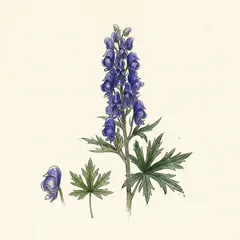
This plant belongs to the family Ranuncnlacece, a family of plants characterized by acrid properties. It attains a height of from two to three feet, has a glabrous or smooth stem which is moreover ramose or full of branches, and cylindrical ; the leaves are green and shining, petiolate, (endowed with leaf-stalks,) incised, having five or six lobes, linear, (by which we mean narrow and flat lobes, having parallel margins,) expanding at the upper extremity and marked with a line.
The plant has beautiful blue flowers in long terminal spikes, forming racemes with sessile flowers. The root constitutes a rhizoma or root-stock resembling a small turnip. Hence the surname
ACONITUM NAPELLUS. 151
napellus, from napus which is the Latin for turnip. The generic name aconitum is supposed to be derived from the Greek word akonw which signifies " rock." The plant is a native of the mountainous regions of the north and middle of Europe, Jura, Germany, Switzer- land, the mountains of Tyrol and Bohemia, etc.
Linne states that horses eat the dry leaves of napellus without injury. Dogs, wolves, cats and rats are killed by this plant.
We have several species of aconite, the principal of which are aconitum napellus, neomontanum, cammarum, ferox, variegatum, etc. Opinions as to what species Hahnemann used in his provings have differed. It seems generally conceded, however, that it was the species napellus, though this is not very material ; for, according to the late experiments of Professor Schroff, which were conducted with the most exemplary devotion by himself and his disciples, the different species of aconite are all poisonous, though not equally so. There seems to be no difference whatever between the poisonous properties of neomontanum and napellus, and it is almost certain that it is these two species that were used by Hahnemann and by his predecessor, Baron Stoerck.
First Case. — A boy ate some of the leaves instead of parsley. Two hours after, he complained of a burning sensation in the mouth, throat and stomach, followed by swooning and death. A post- mortem inspection showed that the cerebral vessels were enormously distended with a dark-colored fluid ; a deep inflammatory blush extended over the whole mucous surface of the stomach, with dark- colored patches.
The symptoms of this case show that a most violent congestion of the brain had taken place and that death may have resulted from this cause. The acute congestions caused by aconite are the result of the paralyzing action which this poison exercises upon the capil- lary nerves. We find also present symptoms of acute gastritis.
Second Case. — Another interesting case of poisoning by aconite is reported in the Dublin Med. Jour., 1842.
A young man ate the leaves of aconite by mistake. Two minutes after eating the leaves, the patient experienced burning heat in the mouth, throat, gullet and stomach, with sensation of swelling of the face, general feeling of numbness and creeping of the skin, restless- ness, dimness of sight, stupor and partial insensibility and death.
This case again shows that aconite has a powerful effect upon the
152 ACONITUM NAPELLUS.
cerebral and ganglionic system of nerves, and through it upon the capillary vessels.
One of the most constant and most characteristic effects of aconite is to cause a burning sensation or even a burning pain in the mouth, throat, oesophagus and stomach. This symptom is one of great practical importance and of frequent occurrence in angina faucium, acute tonsilitis, heartburn and in dyspepsia as well as in neuralgia. We shall have occasion to call your attention to the great curative power of aconite in these conditions.
You will also observe in this case, the presence of cerebral conges- tion which is indicated by the sensation, as if the face were swollen, by the dimness of sight, the stupor and the partial insensibility. These and the accompanying sensation of numbness and of formica- tion are frequently the forerunners of an apoplectic or paralytic stroke, a condition which may be promptly removed by the timely exhibition of aconite.
Third Case Pereira relates the following case of poisoning by aconite in his Elements of Materia Medica : " A man, his wife and child, ate some roots at dinner by mistake for horse-radish. The greater portion was eaten by the man, at about two o'clock in the afternoon. Three-quarters of an hour after eating the roots, the man complained of burning and numbness of the lips, mouth and throat, which soon extended to the stomach, and was accompanied by vomiting of his dinner and afterward of a frothy mucus.
His extremities were cold, but his chest was warm ; his head was bathed in a cold sweat ; his eyes were glaring ; there was excessive trembling and violent pain in the head ; the lips were blue ; there were no spasms, cramps or convulsions ; his breathing was not affected ; he died apparently in a fainting state about four hours after dinner.
" The woman was similarly affected : the same burning and numbness of the lips, mouth, throat, stomach ; violent vomiting ; curious sensation of numbness in the hands, arms and legs ; she lost the power of articulating ; her attempts to speak were attended with unintelligible sounds only ; she experienced great muscular debility, was unable to stand ; some of the external senses were disordered ; though her eyes were wide open, her sight was very dim, and sur- rounding objects were seen indistinctly ; sensibility greatly impaired ; face and throat almost insensible to the touch ; she was very dizzy, but neither delirious nor sleepy ; body and extremities cold ; she frequently pulled her throat, but knew not why ; five or six hours afterward she began to recover.
" The child was similarly, but slightly affected ; like the others, she was constantly putting her hands to her throat."
ACONITUM NAPELLUS. 153
This case of poisoning likewise yields a good deal or valuable instruction to an homoeopathic physician. Let us analyze the phys- iological character of these symptoms, and range them in parallel lines with the pathological conditions to which they point.
In the case of the man we have several interesting symptoms. First, the burning which large doses of aconite always cause in the mouth and fauces ; next we have vomiting of frothy mucus and symptoms of violent cerebral congestion, which seems induced by capillary torpor ; the symptoms indicating this congestion are : blue lips, profuse secretion of cold sweat about the head ; violent pain in the head. Another important symptom is the trembling of the head, which shows that the nervous equilibrium of the supporting muscles of the head must have been considerably disturbed.
This trembling of the head is worthy of notice, for we shall afterward find that aconite is one of our great agents for the cure of chorea, spasms and tetanic convulsions. This case likewise affords evidence of the depressing or paralyzing action of aconite upon the heart ; the fainting and coldness of the extremities bear witness to this relation of aconite to the central organ of the circulatory apparatus.
In the case of the woman we have striking evidences of the paralyzing action of aconite upon the capillary system of nerves. This case shows, for instance, that aconite is capable of paralyzing the organs of speech ; we find likewise incipient paralysis of the lower extremities, incipient paralysis of the sense of vision ; this paralyzing action had even invaded the sphere of sensations, for we are told that sensibility was greatly impaired, and that her face and throat were almost insensible to the touch. We are told that she was dizzy, but neither delirious nor sleepy, from which we may infer that inasmuch as her consciousness seemed to have remained unimpaired, the aconite had simply induced a state of purely nervous irritation in the brain, without any of those violent congestive conditions which terminated fatally in her husband's case ; an irritation giving rise to a condition described as nervous vertigo.
Aconite induces a sense of constriction or strangulation in the throat ; these symptoms, accompanied by a want of sensibility in the part, account for the fact that both mother and child were contin- ually pulling at and feeling about the throat. These symptoms lead us to infer that aconite is a curative agent in paralytic conditions, in pure and simple irritations of the cerebral nerves, and in spasmodic affections of the throat, among which we may class that peculiar
154 ACONITUM NAPELLUS.
spasm of the glottis to which children are liable and which is described by pathologists under the name of asthma millari.
Fourth Case In the year 1524, on the 15th of November, Claudius Richard gave one-eigth of an ounce of aconite-root to a criminal condemned to death. It was the fashion in those times to experiment upon criminals with unknown poisons whose virtues some prominent physician wished to investigate. If the criminal outlived the experiment, he recovered life and liberty as a reward for his bold- ness.
In the present case, the experiment was made in order to test the antidotal virtues of bezoar, a calculous concretion found in the fourth stomach of the gazelle of India ; it was supposed to be an irresistible antidote to poisons, and was so named ivom pa, (against,) and zahar (poison).
Immediately after taking the poison, the man complained of the following symptoms : Oppression on the . chest ; pain in the stomach ; obscuration of sight, with dizziness ; no alteration in the pulse ; he became very feeble and called for help. Five grains of bezoar were given him, after which he felt relieved, vomited, experi- enced anxiety, complained of some strange stuff accumulating in the region of his stomach ; he felt a pain at the occiput and nape of the neck, was delirious, whistled on a leaf.
The delirium soon ceased ; he complained of pains in the stomach, head, jaws, chest and now in one joint, then in another ; after the lapse of seven hours, all his joints pained him ; the abdomen began to swell as in dropsy ; the sides were distended, painful, hard ; he experienced stitches in the kidneys, retention of urine ; one upper and one lower extremity were paralyzed ; the pulse frequently intermitted and became feverish ; on the same day he vomited several times, had several stools, complained of pressure and coldness in the stomach, as from a stone.
Finally he was attacked with frightful ophthalmia and lippitudo (blear- eyedness,) so painful that he preferred death to so much suffering. This continued for eight hours. At the end of this period all the symptoms ceased, he had a good appetite for supper and felt quite well on the morning following.
The effects of aconite as depicted in this case, point to a variety of important affections in which this great agent may prove curative, Let us analyze the symptoms in their order, and see with what path- ological lesions they correspond.
The patient became delirious and whistled on a leaf. This symp- tom points unequivocally to acute mania. The delirium was accom- panied by pain in the occiput and nape of the neck, which would seem to show that the cerebellum was irritated and most probably congested.
After the delirium ceased, he complained of pains in the stomach,.
ACOXITUM NAPELLUS. 155
head, jaws, chest and joints. The universality of these pains shows that the ganglionic system of nerves, or the great sympathetic as it is called, must have been deeply invaded by the action of the poison. In some forms of rheumatism, pains of the same nature occur. Common arthritic and articular rheumatism is characterized by pains of this kind.
The fever is not always very high ; nor are the ex- ternal signs of inflammation, such as swelling and redness, always strikingly developed. Hence it is in rheumatic affections of this order that aconite shows specifically curative virtues.
The pains here indicated may likewise occur in certain forms of bilious remittent fever. Considering that aconite seems to derange the bilious functions to their very foundation, as may be inferred in the present as well as in other cases from the repeated vomiting and the precordial anxiety, we may justly recommend aconite as one of our important agents in bilious remittent fever. We shall afterward see that aconite answers to all the characteristic symptoms of fever.
We are told that the abdomen began to swell as if dropsical, and that the sides became distended, painful and hard. Hence we infer that aconite may prove useful in acute dropsy. In a case of anasarca, induced by fright, aconite effected a cure. In a case of hydrothorax superinduced by a cold, aconite likewise effected a thorough and permanent cure.
Aconite exerts a disorganizing influence upon the blood, the arterialization of which it has a tendency to retard. The continued use of aconite makes the blood watery and causes a dim- inution of fibrin.
Aconite is evidently in therapeutic rapport with congestion of the kidneys ; the stitches in the kidneys, the swelling and the retention of urine point to this affection.
Paralysis of the muscular fibres of the bladder may be inferred from the retention of urine.
Paralysis of the extremities, both upper and lower, may be suc- cessfully treated with aconite.
The pressure and coldness in the pit of the stomach as from a stone, is a symptom which occurs in many severe forms of dyspepsia and chronic congestion of the stomach. It may result in hsemate- mesis or vomiting of blood. Aconite will relieve this symptom.
The last symptom which this case developed is ophthalmia, accom- panied by a profuse discharge of acrid and burning tears. This very painful symptom is frequently present in scrofulous ophthalmia, and we may therefore recommend aconite for this disease.
156 ACONITUM NAPELLUS.
Fifth Case. — In 1561 Matthiolus made the following experiment, in Prague: "A criminal took one drachm of aconite (stem, leaves, blossoms and seeds of the plant) ; three hours after, ulcerative sen- sation in the whole body ; prostration of strength ; weight about the heart ; cold sweat on the forehead ; pulse almost imperceptible ; after taking bezoar, his eyes became distorted, the mouth was drawn to one side, the nape of the neck was stiff, he fainted and would have fallen unless held ; he passed several stools ; after conscious- ness had returned he was put in bed, complained of chilliness, threw up foul, black bile, then turned to the left side, became speechless, and died after his face had become blue as if he had been choked. Death seems to have occurred from apoplexy and paralysis of the heart."
Regarding this ulcerative sensation all over the body, we may ob- serve that it seems to arise from a general bilious congestion of the capillary vessels. This symptom sometimes occurs in certain forms of remittent fever, either purely rheumatic or bilious rheumatic ; among a group of aconite-symptoms, this one constitutes a char- acteristic indication.
The symptoms of cerebral apoplexy and paralysis of the heart are so characteristically developed that it seems hardly necessary to dwell upon them.
Sixth Case To another criminal Matthiolus gave a mixture of aconite ; the patient fancied it contained pepper. One hour after taking the poison, he experienced the following symptoms : vomiting of green bile ; sensation as if a ball were ascending from the pit of the stomach, spreading a cool current across the vertex and occiput. After a longer interval he was attacked with complete paralysis of the left arm and leg, except the hand which was still a little move- able.
As soon as the left side was restored, the right side was affected in the same way ; finally he was again able to lift up both hands. He then complained of every vessel in the body becoming congealed ; he was attacked with vertigo, burning in the head as if the head were full of boiling-hot water, convulsions of the eyes and mouth, violent pain in the jaws as if they would drop off, protrusion of the eyes, blueness of the face, black lips ; the abdomen became distended as if full of water, pulse and spirits changed according as the symptoms were more or less violent ; at times he despaired of his life, at others he thought he might be saved; at times he was rational, at others delirious ; at times singing, at others weeping ; he lost his sight completely three times during this time, and thought himself dying ; always had full use of his voice ; all symptoms dis- appeared in seven hours ; the pulse became normal and he recovered.
This case presents an interesting group of symptoms. The first
ACONITUM NAPELLUS. 157
symptom to which our attention is directed is the vomiting of green bile ; we will note this symptom, for it appears as a constituent ele- ment in more than one group of pathological phenomena denoting a deep-seated derangement of the bilious secretions.
2. We have sensations as if a ball were ascending from the pit of the stomach spreading a cool current across the vertex and occiput ; this symptom is characteristic of hysteria, the globus hystericus, hysteric ball, a spasmodic and congestive sensation which causes a £ood deal of distress to some women.
3. Alternate paralysis of the extremity of the left and right side. „4. Bilious congestive headache, as indicated by the burning and
seething- sensation in the head ; these bilious congestive headaches are generally accompanied by vomiting of green bile, a sense of stupor or excessive sensitiveness to noise and light.
5. Neuralgic pain in the jaws, with sensation as if they would drop off ; this kind of neuralgia may be induced by a cold.
6. Apoplectic congestion of the brain, as indicated by the intense distress in the head, as if the head were full of boiling water, pro- trusion of the eyes, blueness of the face and blackness of the lips.
7. Dropsical distention of the abdomen ; we have seen in a former case that acute dropsy may be cured by aconite.
8. Fitful mania characterized by opposite states, such as, despond- ency even unto dread of dying, and hopefulness ; singing and weep- ing mood. These alternate states are likewise characteristic of hysteria, in which affection aconite may be depended on as a most admirable curative asrent.
9. We have complete amaurosis ; in amaurosis caused by exposure- to the sun's rays, accompanied with sudden rush of blood, distress in the head and more particularly in the frontal region, buzzing in the ears, irregularity and depression, or heaviness and sluggish hardness of the pulse, you will find aconite an effective remedy.
Seventh Case. — Vincent Bacon relates the following case of poison- ing in Vol. xxxviii, page 287, of the Philosophical Transactions:
In the night of February 5th, I was called to J. Orampler, a cane- maker ; he was in bed, his eyes staring, the jaws spasmodically closed, the hands, feet and forepart of the head covered with cold sweat ; pulse imperceptible ; respiration hurried and scarcely audible. He took supper at eight, and had eaten salad bought in the market, mixed with celery from his own garden ; feeling sick, he took an emetic and threw up the larger portion of his meal ; the symptoms increased in intensity until I arrived ; his head was drawn backward*
158 ACONITUM NAPELLUS.
his mouth was opened by force, spirits of hartshorn were poured into him which excited cough and vomiting. During moments of con- sciousness, he had to drink carduus-tea, which caused vomiting ; the vomiting was followed by fainting ; then came several stools and more vomiting ; the bowels and stomach felt easier, but the head was heavy, strength and spirits exhausted ; he had to lie down ; the pulse returned, but remained intermittent and irregular, sometimes two or three beats in rapid succession, then making a stop of as long a period ; after an hour or two he felt chilly ; was covered up warmly, perspired, slept, and finally recovered.
He then stated that immediately after partaking of the root, he felt a tingling heat in the tongue and jaws, as if the teeth would fall out. His cheeks were so irritated that his face felt to him twice as large as it rea^y was. This tingling sensation gradually spread through the whole body, especially the extremities ; he felt an unsteadiness in the joints, especially the knee-joints and feet ; also a twitching in the tendons so that he was scarcely able to walk ; he fancied that the blood had ceased to circulate in his limbs ; from the wrists to the tips of his fingers, and from the tarsus to the tips of the toes, he experienced no sensation at all ; after vomiting, he felt giddy, his sight was misty, his look wandering, he heard a buzzing-whizzing noise in his ears until he fainted.
This is a most instructive case of poisoning, showing that aconite exerts a paralyzing influence upon the capillary nerves and conse- quently upon the movements going on in the capillary vessels, and that this depression may gradually lead to paralysis, apoplexy, asphyxia and death, unless, as in the present case, the capillaries are relieved from their embarrassment, and vital re-action triumphs.
The leading features in this case are the precursory symptoms of paralysis, which has been commented upon in our remarks upon a previous case. We must also note the intermissions and irregu- larities of the pulse and the spasmodic closing of the jaws ; we find the former a common symptom in heart-diseases, the latter in tetanus ; both of these disorders come within the curative range of aconite, especially if the disease originated in rheumatic exposure. This case illustrates also the action of aconite upon the articulations in the unsteadiness of the joints produced and we may note the buz- zing and whizzing in the ears, which finds its counterpart in rheum- atic deafness, which frequently yields to the exhibition of the remedy.
Eighth Case. — Dr. Watzke, one of the editors of the Aicstrian Jour, of Horn., reported the following case extracted from Otto's Travelss:
Giuseppa Vigano di Bussero, an Italian girl, twenty-seven years old, of a bilious and robust constitution, was admitted to the hospital
ACONTIUM NAPBLLUS. 159
of Turin on the 3d of August, 1815. She was suspected of having venereal disease. She looked well, the skin had a dingy color; her appetite was good ; all the vital functions and the pulse were normal ; the nipple a little sore. She was put on spare diet, a half a pound of bread and two eggs. 4th
Took extract of aconite, two drachms, together with twelve pills of the powder of aconite. 5th Same dose. 6th Same dose ; three drachms of extract with powder. The affection remained local. 7th
Took half an ounce of extract. 8th The patient has little appetite, skin and eyes are rather yellow. 9th The jaundice is more developed. Took a whole ounce of the extract. 11th
Nausea at night, vomiting and delirium ; expression of face altered ; the look is extinct, voice scarcely audible; half an ounce of extract. August 12th. — "Restless night ; the patient left her bed several times, was unable to lie down without help ; they bound her ; she experienced great anxiety ; took no medicine. In the evening, loss of speech, stupor, her eyes were closed, the facial muscles spasmodically convulsed ; lockjaw set in ; her breathing became slow, labored ; the pulse quick and irregular ; the skin burning-hot.
The patient was bled one pound. August 13th The jaundice is less, but the other symptoms worse ; the abdomen is distended ; the blood which had been drawn has a yellow appearance at the surface, with a soft crust. Bled again; barley soup, six grains of tartar emetic, and two injections each con- taining twenty grains of tartar emetic.
In the evening the symp- toms are worse. Bled again one pound. 14th — Torpor, labored breathing, with rattling. Again barley soup and tartar emetic, but the patient died. A post-mortem examination showed engorgement of the cerebral vessels ; the stomach was covered with blackish, gangrenous spots.
This case shows that aconite is capable of producing jaundice, even a most malignant form of jaundice. The gangrenous degen- eration of the mucous coat of the stomach may have been owing to the corroding action of foul and acrid bile. Hence we may infer that in black vomit aconite may prove a most valuable remedy. You recollect the case of Matthiolus' criminal, who ejected masses of a foul, blackish substance from the stomach a few hours before his death.
I look upon the case before us as a tolerably fair representation of a group of yellow fever symptoms, which justifies the use of aconite in yellow fever as an homoeopathic agent. The curative virtues of this agent in yellow fever have been abundantly tested by Drs. Holcombe and Davis, and other homoeopathic practitioners.
Ninth Case. — Baldriani, district physician at Brescia, Italy, relates the following case in a letter to Professor Giacomi, of Padua :
On June 11th, twelve patients, some of whom were affected with
160 ACONITUM NAPELLUS.
scurvy, others with pellagra, and who had been taking for some days the recently expressed juice of Cochlearia or scurvy grass, in doses of three ounces, complained of feeling sick an hour after taking the medicine. These complaints were not heeded. A patient, sixty years old, and who had scurvy, was most affected. The phy- sician, who had not the least suspicion that the patients had, by mistake, been given the juice of aconite, instead of Cochlearia, found great anxiety and dyspnoea, with inclination to vomit; think- ing that these symptoms arose from some gastric irritation, he prescribed a good dose of castor oil, and had a large blister applied to the chest.
The anxiety now increased enormously, and the prostra- tion of strength soon terminated in death. At the same time two women who were about fifty-five years old, and who were in the asylum for mania and pellagra, likewise took the juice of aconite. They soon felt sick, dyspnoea set in, then convulsions, followed by paralytic debility and death.
A post-mortem examination yielded the following results : Abdo- men distended, excessive blueness of the finger and toe-nails, the fingers and toes were somewhat contracted. The vessels of the brain, especially of the pia mater and the arachnoid, were engorged, with effusion of serum under the membranes, and at the base of the brain ; no eff usion in the ventricles. The lungs, especially the lower lobes, were filled with black blood ; the heart was relaxed, contain- ing a small quantity of black, fluid blood ; the large vessels were almost empty ; liver normal ; gall-bladder contained a small quantity of watery and yellowish bile ; spleen relaxed and friable.
The stomach, which was distended, contained a moderate quantity of a viscid, blackish-green substance ; the lining membrane of the stomach was red here and there, especially at the fundus and large curvature. The duodenum and small intestines contained the same blackish-green substance, and likewise exhibited red patches. The bladder was almost empty ; the kidneys somewhat engorged.
This case yields important practical information to an homoeopathic practitioner. We learn from it, that aconite may induce dyspnoea and even apoplexy of the lungs ; these patients evidently died from pulmonary apoplexy, and paralysis of the heart, to which must be added signs of inflammation of the lining membrane of the stomach and bowels. The other patients recovered ; tartar emetic was given and powerful stimulants were resorted to ; nevertheless some marked symptoms of aconite-poisoning were observed, such as, rapid sinking of strength and spirits, striking paleness of the face, with alteration of the features ; blue rings around dull eyes ; dilatation of the pupils ; vertigo, with tensive, dull headache, especially in the occiput; somewThat painful tension in the abdomen, with borbo- rygmi ; vomiting of quantities of a greenish substance, and in one
AC0N1TUM NAPBLLUS. 161
of the patients, greenish diarrhoea; sense of oppression and anxiety on the chest ; general and increasing coldness, especially of the ex- tremities, with circumscribed blueness of the finger and toe-nails ; cramp in the calves; pulse small, feeble, in some patients hardly perceptible.
From these cases we learn that aconite depresses the bodily strength and spirits, and that it has a specific power of disturbing the biliary secretions ; hence the vomiting of green bile, and alvine evacuations of the same character. Note this symptom, Gentlemen : it tells you that aconite is a remedy for diarrhoea, if the stools con- sist of green bile, bilious diarrhoea j also for cholera morbus, where green discharges from the bowels and green vomiting are often present ; in bilious fever, or in rheumatic fever, with discharges of green bile, aconite is indicated.
Nothing depresses the action of the lungs more intensely than the presence of bile in the pulmonary capillaries ; hence this agonizing dyspnoea which aconite is capable of producing, and which it will of course be able to remove. Taking the whole group of these symptoms in their complex, prostration of strength and spirits, vomiting and alvine discharges of green bile, agonizing oppression on the chest, bine nails, cadaverous coldness of the extremities, collapse of pulse ; I say, taking these symptoms in their complex, you have as complete a group of symptoms indicative of cholera morbus as you can find recorded under any drug.
Even Asiatic cholera, in the first invasion, frequently presents this group of symptoms; with a few doses of aconite you will often succeed, if these symptoms are present, in arresting the development of this frightful disease, and bringing about a triumphant reaction.
Tenth Case. — Dr. Shervin reports the following case of poisoning by aconite, in the London Lancet. He had been macerating one and a half pounds of aconite root in one gallon of alcohol, and left it within reach of the servant girl. Two days after he had mixed his ingredients together, he was suddenly called home — the girl had been taken ill.
He found her lying on her back, with staring looks, contracted pupils, livid complexion, rigid jaws, cold extremities, collapse of pulse, short, imperfect, labored respiration, feeble beating of the heart. At times she would sigh, throw her arms about, and a rattling noise and vibratory motions of the trachea were perceived. It appears that the girl had put some of this tincture in her mouth for a toothache, and afterward had swallowed it. The doctor gave her half a drachm of
VOL. I. — IO.
162 ACONITUM NAPELLUS.
sulphate of zinc, to vomit her ; after which the pulse returned and she was better able to see. After a while, bilious vomiting took place, which was accompanied by collapse of pulse ; the patient com- plained of violent pressure in the head and in the precordial region. Symptoms of cerebral congestion being apparent, the patient was bled from the jugular vein, twenty ounces of blood being drawn ; she felt easier, it seemed to her as though she had been transported from a narrow, dark and hot room into a light chamber.
After the venesection she had several more but less violent attacks of vomit- ing, the pulse became fuller, fifty-eight per minute, but intermitted after every fourth beat ; the praecordial anxiety was less. The pulse gradually rose up to seventy and, toward evening, up to one hundred, the skin being hot and dry. Next day the pulse remained small ; she had slept bat little ; her tongue was coated, she complained of headache ; the hands felt numb. On the day following she was well again.
After swallowing the tincture, she experienced the following symptoms as reported by herself : " First I felt a prickling in the arms and fingers, numbness in the shoulders, tongue and mouth, and finally in the legs and feet ; after this, a sense of swelling in the face and constriction of the throat ; I looked in the glass, and my face looked blue and disfigured, I made an effort to go to bed, but my strength gave out and I fell down." It was at this stage that the doctor saw her.
This is likewise an instructive case ! We learn from this case, be- side the usual symptoms which we have noticed in other cases, that aconite, during the period of reaction, by which we mean the period when the vital forces begin to react against the depressing effects of the drug, induces a state of inflammatory fever, with full and rapid pulse, hot and dry skin, headache, coated tongue, etc. ; hence we infer that aconite is a remedy for inflammatory fever, characterized by similar symptoms, such as dry and hot skin, full and rapid pulse, headache, etc. Now, if you remember, Gentlemen, that aconite causes bilious vomiting, vomiting of green bile, you have an excel- lent group of indications for bilious fever, with hot and dry skin, full pulse, coated tongue, bilious vomiting ; or for gastric fever, which differs from bilious fever more by the apparent symptoms than by the actual character of the disease.
The remarkable influence which aconite seems to have over the action of the pneumogastric nerve, and which is characterized in this and in other cases by imperfect and labored respiration, a rattling noise and vibratory motions of the trachea, and other symptoms, should never be lost sight of in asthma and in such affections of the respiratory organs as are characterized by dyspnoea, feeble beating of the heart, feelings of anxiety.
ACOfcUTUM NAPELLUS. ICj.)
Eleventh Case. — Dr. Pereyra reports the following case of poison- ing by aconite in the Gazette des llopitaux, March 20, 1839 :
In May, 1838, a man of forty-five years was attacked with acute rheumatism, and was received in the St. Andrew Hospital of Bor- deaux. On the 19th of December, seven months after his reception in the hospital, the man was still affected with rheumatism. Every possible remedy had been tried in vain.
The patient was placed under the care of Dr. Pereyra. The disease seemed to have princi- pally localized itself in the knee-joint. The patient had to walk on crutches, dragging himself along with great difficulty.
Dr. Pereyra o-ave him the alcoholic extract of aconite. He commenced with two-grain doses, which he gradually increased to five-grain doses morning and evening. The patient had taken already twenty doses of aconite, was much improved and began to walk.
The medicine having given out, a new supply had to be ordered. This new extract was given to our patient and to various other patients in other wards. Next morning it was found that several persons had been poisoned. Our patient had taken five grains of the new extract at five o'clock in the morning.
In a quarter of an hour he experienced as usual a certain tremor and tingling in the limbs, which was accompanied with stinging pains. While taking the former extract, these symptoms used to disappear in about half an hour after taking the medicine, but now the stinging pains become worse and worse, and the tremor increased to convulsions. In the mouth and throat the patient experienced a sensation as if he had swallowed strong pepper. Soon after, he vomited up all the contents of the stomach.
During the convulsions the patient lost his consciousness. As often as consciousness returned, the sight was dazzled. He complained of a seated pain in the head, as if the head was encircled by a hot iron. Pulse irregular and slow.
These symptoms were sought to be anti- doted by coffee. At ten o'clock, five hours after the patient had swallowed the aconite, Dr. Pereyra observed the following symptoms: pale face, showing an expression of anguish and restlessness ; great mobility of the eyes ; the patient is restless, tosses about and likes to change his position ; contrary to his habit he seems fond of talking a good deal and hurriedly ; cold tongue as in the case of cholera- patients ; sense of burning in the fauces and oesophagus ; vomiting of mucus ; orthopncea, twenty-five inspirations per minute ; pulse fifty-four, irregular, soft and full, as if the volume of blood did not fill up the arteries; auscultation revealed natural breathing in front, and a mucus rale posteriorly.
The heart showed several striking symptoms. The apex of the heart beat only once against the wall of the thorax, whereas three pulsations were distinctly felt at the wrist. The beats of the left ventricle were svnehronous with the beats of the radial pulse. The right auricle seemed to be convulsed ; its movements were rapid, irregular, and bore no proportion to the beats of the ventricles.
Gradually the extremities began to grow cold. No
164 ACONITUM NAPELLUS.
alvine discbarges. Neither sinapisms nor warm glass-cups could restore the vital heat of these parts. Dr. Pereyra regarding this group of symptoms as an exact representation of Asiatic cholera, he gave his patient an infusion of guaco which he had found an exceed- ingly efficacious remedy during the paralytic stage of the cholera ; this infusion was given for the purpose of stimulating respiration and the beats of the heart ; two drachms of liquor ammonias were likewise given ; frictions with the tincture of cantharides were made upon the precordial region and back.
Toward evening reaction set in, and next morning the patient was well ; his rheumatism was gone, not a trace of it had remained behind.
One of the other patients who had taken of the same preparation died after the lapse of four hours ; death, it appears, took place through suffocation, and a general collapse of the circulation. The principal symptoms of poisoning in this case were excessive burn- ing pain in the throat, vomiting, afterward cold sweats, oppressive anxiety, an agonizing tossing about, fainting fits, gradual sinking of the respiration and circulation, collapse of pulse, death. A post- mortem examination showed the following results : Continued ex- pression of terror in the face ; injected condition of the cerebral vessels ; the cerebral substance was dotted with blackish points ; the parenchyma of the lungs was engorged with blood, and almost ceased to crepitate ; the left ventricle was found empty ; the right ventricle was filled with a jelly-like bloody coagnlum ; the stomach exhibited traces of considerable congestion ; the kidneys, urinary bladder and spinal marrow were not examined.
Now, Gentlemen, let us review the symptoms which these two cases of poisoning offer for our consideration :
Trembling and tingling in the extremities, accompanied by sting- ing pains. Convulsions of the extremities, with loss of consciousness, and followed by return of consciousness with dazzling of the eyes, and profuse sweat. Headache, as if the head were encircled with a red- hot iron. Excessive restlessness with great mobility of the organs of speech.
Cholera-coldness of the tongue. Burning in the oesophagus. Orthopnoea (suffocative constriction of the chest), with hurried respiration. Diminution and irregularity of the heart's action.
Utter extinction of the rheumatism. Expression of agony in the features. Excessive sanguineous engorgement of the lungs.
Twelfth Case. — The following exceedingly interesting case of poisoning by aconite has been reported by Dr. F. Devay, supple- mentary physician to the Hotel Dieu of Lyons in France, in the Medical Gazette, Paris, Jan, 5, 1844:
On the 26th of October, 1843, about 8:30 p. m., Charles Grimaud,
ACONITLM NAPELLUS. L65
assistant in the pharmaceutical laboratory of an apothecary of Lyons, while eating his supper, swallowed about thirty-two scruples of the tincture of aconite, which he had poured into a dark bottle on the morning of the same day, and had placed by the side of another similar bottle that contained the wine which he was to drink at supper. Immediately after swallowing the tincture, he experienced a sensation of warmth and constriction in the 'throat. Having dis- covered his mistake, he took about a grain of tartar emetic dissolved in a large quantity of water.
This, however, did not excite any vomiting. His restlessness now became excessive ; he was utterly unable to remain quiet, and complained about his throat and of a burning in the oesophagus. As soon as the apothecary returned home, Dr. Devay was sent for.
It was half past ten. The patient was thirty-five years old, of a lymphatic sanguine temperament, robust constitution, and begging for help in a state of the utmost fright. His anxiety was so great that he Avas utterly unable to remain quiet. I asked him to sit down, but he immediately rose up again.
I had to walk up and down the room with him, in order to ask him questions and obtain a knowledge of his symptoms. His mental and sensual functions were undisturbed ; the tongue ex- hibited a whitish coating ; he complained of nausea. No colic. I observed that the lirst effect of the poison had been to attack the organs of locomotion, especially the lower extremities, which the patient moved incessantly, even while sitting on a chair.
While walking about the room, his legs trembled. This gave to his gait the appearance of staggering. I gave him an emetic composed of nearly two and a half grains of tartar emetic, sixteen grains of powdered ipecacuanha, the whole in four ounces of water. The patient swallowed it hurriedly.
He complained of an acute pain in the fauces and oesophagus, and showed excessive restlessness and dread of death. In about seven or eight minutes copious vomiting took place. About 11 o'clock in the evening, the patient was unable to remain standing ; he was attacked by a peculiar sort of convul- sions ; the upper and lower extremities were turned inward, the lingers were clenched and the thumb turned inward, so that it was impossible to open his hand. There was no concussion.
His face was covered with a cold, clammy sweat. The eyeballs were rolled upward, so that only the whites could be seen. The expression of the countenance was frightful. The pulse at the wrist and temples had entirely vanished.
This paroxysm of convulsions lasted about three minutes, and was succeeded by prostration. The patient com- plained of experiencing extreme anguish ; he felt that his end was approaching. His consciousness wras not disturbed, although the patient seemed every now and then to lapse into a state of stupor, from which he however speedily roused himself in order to call for help. He would close his eyes, with his head hanging down, after which he suddenly raised it again like one who, having fallen asleep standing, or sitting on a chair, is suddenly roused from his slumber.
166 ACONITUM KAPELLUS.
His visual power had become extinct ; he was unable to distinguish either persons or other surrounding objects. He had to vomit sev- eral times after this, and every attack of vomiting was followed by a paroxysm .of convulsions. About half past twelve the symptoms continued the same ; the anguish and agony of the patient were ex- treme. Alternate paroxysms of convulsions and nausea.
Another emetic was given, and water and vinegar ordered as a beverage in table-spoonful doses. About one o'clock the sight returned, but the paroxysms of convulsions were as frequent as before and more violent ; the temperature of the skin became less and less. The patient began to shiver and finally became cold as ice ; his counte- nance assumed the expression which we characterize as hippocratic ; his head was powerfully drawn backward ; during the spasms his joints would creak.
The breathing became stertorous ; the mucous rale was audible at a distance. In spite of this agonizing condition he understood everything that was told him, nor did he experience any colic. Even after the first convulsive paroxysm the palms of his hands had lost the faculty of sensation so completely that he did not feel the prick of a needle, even if it pushed pretty deeply into the flesh. The abdomen remained warm.
Sinapisms were applied to the whole body, except the abdomen, and a solution of iodine in water was administered, four grains of iodine, forty-eight grains of the iodide of potassium, dissolved in eight ounces of water. About 3 o'cock in the morning, up to which hour there was no change in the symptoms, the beats of the heart again became perceptible ; the pulse could be felt again ; the warmth of the skin returned and the patient felt more comfortable. An infusion of mint was adminis- tered with forty-eight grains of the spirits of mindereri, or the well- known acetate of ammonia, first described and introduced into medical practice by Boerhaave.
About 4 o'clock the patient began to look better ; a copious, warm sweat broke out ; the pulse had risen up to 1 25 beats ; the palms of the hands had recovered their sensi- bility ; the breathing was natural. The patient was now given an infusion of couch-grass or triticum repens, with nitre and syrup. At 6 o'clock, he slept for half an hour. On waking he complained of feeling sore and bruised all over.
An injection brought away a mass of black and exceedingly fetid stool. A small quantity of urine was passed, which looked cloudy. The abdomen was painless and soft ; tongue moist and coated white. During the two days following, there were no new symptoms.
The sleep was rather rest- less. On the 29th, the patient was able to leave his room ; his appetite had returned ; barring an expression of fright and imbecility which was still perceptible in his countenance, all the other dreadful symptoms had entirely disappeared.
This case of poisoning, Gentlemen, is of the highest importance in a therapeutic point of view. An alloeopathic physician may perhaps derive no further benefit from the perusal of such a case than a
ACONITUM NAPELLUS. 1G7
knowledge of the fact that aconite is an acrid poison, and has to be used with great care ; but how instructive must such a case be to an homoeopathic physician ! How many therapeutic indications of the highest interest and importance does it furnish to the attentive ob- server of the physiological effects of this wonderful, and most comprehensive and intensely-acting agent upon the living tissues I Let us review the symptoms which this case offers.
First we have the usual warmth and constriction in the throat.
Secondly, excessive restlessness, the patient was unable to remain quiet ; he had to be in constant motion ; especially the lower ex- tremities were continually agitated, trembling, staggering.
Third symptom : Excessive pain and burning in the oesophagus.
Fourth : Epileptiform convulsions ; the fingers were spasmodically closed ; the thumbs clenched, and the legs drawn in ; these convul- sions occurred in paroxysms at more or less regular intervals and were accompanied by mucous rale and stertorous breathing, symp- toms that are usually present in this form of convulsions. Now, Gentlemen, this symptom shows the great power which aconite must necessarily possess in the treatment of convulsions ; but remember, they must be convulsions where the brain is only secondarily affected. In the present case we have seen that the patient retained his con- sciousness and remained in full possession of his intellect from first to last ; hence the brain could not have been primarily affected by the poison, and the convulsions must have been the result either of some secondary irritation of the brain, such as might have been in- duced by violent sanguineous engorgements of the cerebral vessels and consequent pressure upon the brain ; or they must have resulted from some direct lesion of the functional equilibrium of the periphe- ral system of nerves. We have several convulsions of this kind which we are often called upon to prescribe for, such as epileptiform convulsions, where the neck, trunk, or extremities may be tetanically convulsed, rigid and distorted, and where the fingers are spas- modically closed and the thumbs clenched ; the eyeballs may like- wise be frightfully rolled about in their sockets, sideways, upward or downward, and froth may appear at the mouth.
Another class of convulsions, to which the present paroxysm points, are puerperal convulsions or eclampsia; these convulsions sometimes occur to parturient women, and as far as we may be guided by post-mortem appearances and by the symptoms existing during the life-time of the patient, these convulsions result, not
168 ACONITUM NAPELLUS.
from a primary derangement of the cerebrum, but from some secondary irritation of this organ, more particularly from capillary engorgement induced by the deficiency of animal energy which is more specifically generated by the cerebellum. The development of the foetus is essentially an animal function, a function pertaining to the animal sphere, of which the cerebellum is the central organ ; if the cerebellum is unable, in consequence of some inherent weakness, to respond to the stimulating action of the cerebrum, what must be the inevitable consequence of this want of harmonious equilibrium between the two central organs of vitality?
The inevitable conse- quence must be that the cerebellum, being unable to properly use the supply of blood which the cerebrum, in its capacity of supreme guardian and preserver of vitality is continually sending to the uterine organs, permits the vascular engorgement thus established to react upon its source, the cerebrum, and to occasion an engorgement of the cerebral capillaries which must inevitably lead to convulsions, and unless this engorgement is removed by some means or other, to the rupture of the capillaries, effusion into the cerebral tissue, and consequent death of the patient.
Old-school physicians endeavor to relieve the brain by bleeding or by extracting the foetus by artificial means ; but in our practice we may resort to the use of aconite, which is endowed with a specific power of developing, by its peculiar action upon the cerebellum, precisely such a train of symptoms as we find described in the books under the appellation of eclampsia and as we are often called upon to treat in the sick-room. Mark this well, Gentlemen, that aconite exerts its specific action in the animal econ- omy not upon the cerebrum, but upon the cerebellum, and, that the cerebral symptoms which indicate tne use of aconite, are indications of some secondary or sympathetic irritation of the cerebral organ.
If you keep this distinction in view, and if, by observation and thought, you endeavor to acquire a more and more lucid, positive, and I might say, intuitive perception of this and similar facts, you will find that medicine is not necessarily and constitutionally, as it were, an uncertain and vague science ; you will find that, where the mere symptomist sees nothing but symptoms, darkness and con- fusion, the philosophical homoeopathist, who knows how to interpret the meaning of symptoms and determine their character and value, and their relation to the central organs of life, sees light, order and beautiful harmony in the midst of the desolating processes exhibited to his view by the organism of a suffering creature.
ACONTIUM NAPBLLUS. 169
Yon will not understand me as recommending aconite as a panacea for puerperal convulsions. These convulsions may proceed from some primary lesion of the cerebrum, a deficiency of cerebral inner- vation, in which case medicines that act directly upon the brain, such as opium, hyoscyamus, etc., may be required.
Our next, and a most interesting symptom, is the condition of the pulse which rose up to one hundred and twenty-five beats. .Most of you are doubtless acquainted with the fact that we prescribe aconite as a remedy for simple inflammatory fever, and this symptom show- that such a prescription is in strict accordance with the specific action of aconite upon the human system. In the present case, the patient's pulse was in the first place depressed even to complete col- lapse, and the skin was icy-cold.
This icy-coldness of the skin was ushered in by a well-marked chill. This is the primary effect of aconite upon the circulation ; depression and even collapse of the pulse, diminution of the temperature of the skin, accompanied or preceded by a chill, a sense of cold creeping, shivering. The reaction which the organism sets up against these symptoms, is marked by opposite conditions, heat, increased rapidity and fulness of the pulse, sometimes rising, as in the present case, up to one hundred and twenty-five, and even to a larger number of beats.
These two conditions, although they seem to be antagonistic to each other, yet come both of them within the curative range of aconite. These two conditions, the previous depression and subsequent exalta- tion of vitality, constitute two phases of one and the same functional process, just as the violent contractions and subsequent atony of the uterus constitute two phases of another functional process to which I shall direct your attention when speaking of secale. The previous negative and the subsequent positive condition of the circulatory sys- tem make up the sum total of the vital energy normally belonging to it, and all that wre have to do, in order to restore the harmonious movements of this system, is to give a remedy that shall free the capillaries from their torpor and thus enable the column of blood to flow through the body from one ventricle to the other with undis- turbed rhythmical ease.
This purpose is accomplished by means of aconite which, if it should be found inadequate to a complete removal of the difficulty, will, at any rate, pave the way for the ex- hibition of the next remedial agent. If we prescribe aconite during the chill, it will not only hasten the febrile reaction, but will likewise shorten its course ; and if we prescribe aconite during the febrile re-
170 ACONITUM NAPELLUS.
action, the therapeutic effect will be the same, viz., the restoration of the natural rhythm of the pulse, and the normal temperature and secretions of the skin.
We should not omit to notice another symptom, which does not seem of great importance, but which sometimes occurs in catarrhal and rheumatic fevers, and which affords an additional indication for the use of aconite in these affections ; I allude to the feeling of sore- ness of which the patient complained after his short nap, a sensation as if the whole body were bruised. As I have stated on a previous occasion, this symptom is often present in rheumatic fever; so is the next symptom, the Mack and fetid stool. The turbid urine likewise points to the fact that aconite is a curative agent in inflammatory conditions of the organism.
And lastly we are told that an expression of terror and imbecility remained in the patient's countenance some time after the other symptoms had disppeared. Gentlemen, one of the most remarkable effects of aconite upon the mind is to induce this state of terror and imbecility. In a former case we were told that aconite induced a state of mania, characterized by fitful changes of mood, such as alternate singing and weeping, lowness and exaltation of spirits, alternate delirium and rationality.
Here we observe that aconite causes a state of fright and an appearance of imbecility. This effect of aconite upon the mind is one of the most characteristic indications for its use, and whenever, in certain forms of mania or dementia, a state of fright and imbecility is a characteristic symptom, aconite will prove an invaluable auxiliary to the cure.
A careful examination of the cases of poisoning given you and a study of the experiments made upon animals bring out points of great interest concerning the action of this powerful drug upon the animal economy. While it is not necessary to make an extensive study of the experiments and an exhaustive investigation into the speculations in which the authorities of the physiological school spend their energy, vainly hoping to arrive by such means alone at an intelligent understanding of the proper uses of medicinal agents, it is absolutely necessary that we should know something of the manner in which a drug-force produces the peculiar train of symp- toms, by which we recognize its presence. It is of the utmost im- portance to be intimately acquainted with the pathogenetic symptoms of a drug ; a knowledge of these symptoms alone may be sufficient,
ACONTIUM napellus. 171
iii many cases, to prescribe with a fair degree of success; but these very symptoms gain ten-fold in importance and value from the moment that we understand the manner in which they are produced by the force of which they are an expression. The more earnestly we enter upon a thorough study of the grand truth which forms the corner-stone of our faith, the more fully do we realize, that the most exalted use which can be made of symptomatology consists in inter- preting, by its means, the essence of the drug-force, and that the highest skill of a practitioner does not so much consist in a mechan- ical comparison of an infinite number of symptoms, but is found in his ability to grasp the individuality of a drug-force by means of a comprehension of its manner of action, and by his power to establish a homoeopathicity or similarity between this and the manner in which the morbific force produces a similar train of symptoms.
Different causes may produce similar results or symptoms. To establish a true homoeopathicity, there must be not only a similarity between the symptoms produced by the drug-force upon the healthy and those produced by the morbific force, but there must also be a similarity in the manner of action upon the organism between the drug-force and the morbific agent. To this end an understanding of the physiological action of drugs becomes of the greatest importance.
Aconite affects principally the circulation and the nervous system. The burning and tingling in the throat are the first noticeable symp- toms ; the pulse soon falls in frequency and it becomes intermittent, irregular and at length imperceptible. This fagging of the circula- tion seems to be due, in part, to a direct action of the poison upon the heart. Not only is the force of the heart-beat lessened in cases of poisoning, but the heart-muscle fails to respond, after death, to galvanic irritation.
Experiments with the hearts of some of the smaller animals have shown that the poison, if applied to the organ even after its removal from the body, produces very decided and similar effects. Boehm and Wartmann attribute the disturbance in the circulation to a gradual paralysis of the peripheral vagi.
A very interesting feature, which we may mention in connection with this subject, is the violent congestion to various parts of the body which is produced by aconite. This is evidently due to serious disturbance in, and a temporary arrest of, the capillary circulation, which causes a correspondingly active engorgement of the arteries in different organs. You have noted such conditions in the cases of poisoning brought to your notice.
172 AC0X1TUM NAPELLUS.
The action of aconite upon the nervous system, although not fully understood, is worthy of note. It is not probable that the spinal cord is directly or primarily affected. When we remember that in- sensibility to pain was found to exist in animals within a very short time after the introduction of the poison, and that other well-marked disturbances of the sensory nerves showed themselves within a short space of time, it seems very possible that French authorities are cor- rect in their conclusion that aconite paralyzes (1) the perceptive centres; (2) the peripheral extremities of the nerves, and (3) the nerve-trunks themselves.
While the sensory nerves suffer more particularly from the effects of the poison, the action of the motory nerves also becomes seriously •disturbed. The loss of sensibility accounts in part for the paralysis of the limbs in animals, but it has been shown that aconite, if directly applied to motor nerve-trunks, destroys their conducting power and that after death they, like the heart-muscle, lose their sensitiveness much earlier than usual. The fact that in many cases of poisoning we have found violent spasms, has not escaped you ; it is another evidence of the preference of aconite for the sensory nerves.
The action of aconite upon the various organs of the body is lim- ited. As already stated, it affects the heart and heart-tissue ; it pro- duces also a severe inflammation of the structures of the joints ; it causes inflammation of the pleura and of the peritoneum, and a severe congestion to the eyes.
The physiological school uses aconite mainly when it becomes de- sirable to depress the pulse. For that purpose unreasonably large doses are constantly prescribed to the great disadvantage of the jmtient. Of late it has been recommended in the treatment of neuralgia, especially of a rheumatic type. Its external use for the relief of pain has been in vogue for some time.
In the hands of the homoeopathic physician aconite becomes a most precious remedy. It is applicable to a large number of diseases and seldom fails to act promptly, when skillfully used. When we recom- mend it to you in the treatment of various forms of congestion, inflammation or fever, we do not however hold ourselves responsible for the consequences of an indiscriminate use of the drug. We do not advocate routine practice, and desire to state in the most em- phatic manner that, while aconite is a remedy of first importance in
AlCOSTCTUM NAI'KLLUS. 173
a state of active congestion, of great arterial excitement or of an inflammation not fully localized, a thorough study of the totality of symptoms must ever determine the choice of the remedy ; the mental symptoms, consisting of great restlessness, anxiety, constant change of position, anticipation of coming evil, etc., are among the most reliable indications. The presence of fever, per se, is by no means sufficient to warrant the selection of aconite, for many other reme- dies have decided fever-symptoms ; nor can the plea be allowed, that a few doses of the remedy will do no harm, since the administration of any drug, not demanded by the condition of the patient, results in the loss of valuable time and must, of necessity, do the patient an injury. On the other hand, we are forced to express our firm belief, that even at this date, a small proportion of homoeopathic physicians realize the great scope and the exceeding value of this remedy.
Having then given you the coarse outlines of the drug-picture of aconite, we will endeavor to supply you with its finer shading by a study of the symptoms, obtained by systematic provings upon the healthy.
Hahnemann has given us a very full and suggestive record of pathogenetic effects of aconite in his Materia Medica Pura. The Vienna Provers' Union re-proved the drug in the most systematic and thorough manner ; sixteen men and two women took an active part in the experiment, using doses of the mother tincture ranging from five to one hundred and thirty drops.
One of the provers, Dr. Arneth, first took ten drops of the tincture, and in a few hours fifteen drops more. The result was a burning sensation on the tongue.
On the 2 1 st of February, a few days after the former proving, he again took fifteen drops of the tincture. Immediately after taking them, he experienced a burning sen- sation on the tongue and a violent pressure and rather deep-seated stitches in the anterior portions of the eyeball.
On the 22d, early in the morning and evening, he took twenty drops of the tincture and on the 23d, at noon, thirty drops. Immediately after swallowing the drug, he experienced the same symptoms as before. He discontinued the medicine for some six days. On the 26th he experienced the following symptoms : violent coryza, shiv- ering over the back, especially toward evening, slight difficulty of breathing, with slight pressure behind the sternum, occasional flashes of heat, accelerated and rather full pulse.
The nights were very restless, and he had vivid dreams of what he had been doing the day previous.
On the 28th, morning and evening, twenty-five drops, followed by slight increase of the above symptoms. On the 29th, forty drops. Beside the former symptoms, he experienced, immediately after taking the medicine, some pinching around the navel, followed soon after by a painless diarrhoea ; afterward he felt a painful pressure in the region of the left eyebrow; toward evening the febrile symptoms increase!. Not
174 ACONITUM NAPELLUS.
knowing what drug he was proving, and in order to moderate the increasing violence of the fever, he took a few pellets of aconite. The following night he was very rest- less and dreamed about a patient who interested him very much. On the 30th, not perceiving any abatement in the symptoms, he took a few more globules of aconite. The febrile excitement continued until the 8th of March, without any abatement.
On the 7th of March, the dyspnoea was worse ; there was great oppression in the region of the heart, accompanied by intermittent pulse. There were five hard, full, quick beats, and the sixth beat intermitted both at the heart and wrist. This symptom continued all day ; the prover looked pale and thin ; his gait and whole appearance were those of a sick man ; he experienced a burning sensation in the urethra when urinating. »
On the 9th of March, a sense of contraction in the hamstrings, with pain in the left patella as if he had knocked it against something. These symptoms continued on the 10th and nth of March. On the I2th, the prover experienced for about ten minutes a peculiar sensation in the eyes ; sense of warmth and an undulating feeling with involuntary half closing of the eyelids ; although the room was very bright, yet he fancied that the darkness was so great that he would hardly be able to discern printed type. He tried a book and found that he had his sight ; this last symptom continued for some time ; when amaurosis first sets in, patients sometimes experience just such a symptom.
On the 13th, slight drawing in the right shoulder, which passed off toward noon; this was followed by a drawing and tearing, with a feeling of lameness in the articular extremity of the left upper arm, for two days.
On the 15th, sense of contraction in both tendines Achilles; he found it difficult and painful to stand erect without his knees shaking ; these symptoms continued for about three weeks, during which time the use of the drug was discontinued.
On the 5th of April Dr. Arneth resumed his proving. He now selected for his experiments the third, second, and first attenuations. The nights were restless, he dreamed of things that had occurred years ago, so vividly that the event seemed quite recent even after waking; he experienced some dulness in the head and blew a little blood from the nose.
On the 20th of April he took fifty, and on the 21st, sixty drops of the concentrated tincture. This caused discharge of blood from the nose and an aching pain in the whole head.
On the 22d of April, eighty drops of the tincture. He had a restless night, and a vesicular eruption made its appearance on the temples.
On the 23d, one hundred drops, followed by discharge of blood from the nose, violent twitchings of the extremities, when on the point of falling asleep, so that it woke him ; restless night. This day and the day before he experienced, immediately after taking the drug, a violent desire to vomit, which was only slightly moderated by eating his simple breakfast (bread and milk).
On the 24th of April, one hundred and thirty drops of tincture. Immediately after taking the dose he experienced a violent inclination to vomit, with violent tightness and dulness of the head. This terminated the present proving; the Doctor con- cluded that the susceptibility to the action of aconite had been too much impaired to enable him to elicit any new or striking results.
The other provings were all conducted in the same heroic manner, and yielded most brilliant and invaluable results. There is a symp-
ACONITUM NAPELLUS. 175
torn in the former proving, which alone would have compensated the Doctor for the trouble he took in instituting his experiment ; it ia the sensation of contraction in the tendons of the flexor muscles. Jikeumatic inflammation and contraction of the tendons is an exceed- ingly troublesome affection, and how beautifully does this proving show us that aconite is a remedy for this condition !
Among these systematic provings of aconite there is one other which I will briefly relate to you ; it was instituted by a student of medicine, and exhibits an enthusiasm worthy of such a noble and useful cause.
Our prover was twenty-three years old, of sanguine temperament, slender make, and had had an attack of palpitation of the heart during the previous year, which had at once yielded to the third attenuation of aconite. Since then his health had been perfect. During the space of sixty days, he took 2,386 drops of the saturated tincture of aconite.
He commenced his proving on the 14th of February. On this day, and on the 15th and 1 6th, he took each day, morning and evening, ten drops; on the 17th he took fifteen drops, morning and evening; from the 1 8th to the 22d he took twelve drops each day twice, and from the 22d to the 27th he again took fifteen drops morn- ing and evening ; from the 28th of February to the 3d of April he took twenty drops. These doses induced the following symptoms : scraping sensation in the fauces, smarting and biting on the lips, congested condition of the palate and tonsils, tearing pain during the whole extent of the right forearm, wrist joint and fingers.
On the 5th of April he took twenty-four drops. After this, tearing in the right upper arm and in the upper third of the right thigh.
On the 6th of April, twenty-four drops early in the morning; this dose was repeated every day, sometimes once and sometimes twice, until the 15th of the same month. On the 6th he experienced a scraping sensation in the throat, and the capil- laries looked injected ; toward evening he felt a tearing pain in the right upper arm, extending toward the elbow-joint, and also in the thigh, toward the knee-joint; on the 7th he suddenly felt a tearing pain in the left knee-joint. On the 8th and 9th he compLined of a violent tearing felt alternately in the right and left thigh, in the right knee-joint and right forearm. On the 9th, scraping in the throat and violent conges- tion about the uvula and right tonsil.
On the loth, an hour after taking the drug, as he walked out into the open air, he was attacked with violent palpitation of the heart which continued for fifteen minutes. The same attack was experienced after the evening potion of aconite. The tearing in the extremities had left him. On the nth, the same paroxysms of palpitation were experienced, but no tearing in the extremities.
The heart beat more rapidly and more vigorously than usual. He slept soundly and without dreams as usual. The disappearance of the tearing pains in the limbs, and the appearance of the palpi- tation of the heart, which evidently developed itself as a substitute for the pains, show that this palpitation was of a rheumatic character, and hence pointed to a rheumatic irritation of the heart.
On the 12th, he felt a violent tearing in the right arm, as before, and the beats of the heart had again become normal ; the tonsils and uvula looked inflamed, with scraping in the throat.
176 ACONITUM ^"APELLUS.
On the 13th, palpitation of the heart, for about half an hour, accompanied by a sen- sation as if the thorax was narrower than usual. In the evening, between five and six o'clock, he felt a tearing in the left shoulder-joint.
On the 14th, palpitation of the heart, but no tearing pain. The bowels had been confined for three days ; after the lapse of this period he had a hard stool.
The proving was now discontinued until the 17th of April. On the evening of this day our prover again took twenty-four drops of the tincture. Two hours after taking the drug he experienced a violent and rapid beating of the heart for about half an hour.
On the 1 8th and 19th he took twenty drops early in the morning. On the 18th he experienced a tearing pain in the whole forearm; on the 19th the tearing disappeared, but a violent beating of the heart set in in its place.
On the 20th, in the forenoon, the palpitation of the heart was more violent than ever, accompanied by great anxiety and impeded respiration. In spite of the intensity of these symptoms he again took twenty drops about 12:30 P. M. of the same day; the beating abated afterward, but continued the whole day and evening; moreover he felt a tearing and a sensation of formication in the right arm.
On the next three succeeding days, he took twenty-four drops each day, and not perceiving any striking effects from these doses, he concluded to increase them, and from the 23d to the 26th of March he took forty drops every morning, and, for thirteen days following, fifty drops of the tincture every day, with the following result :
On the 23d, in the evening, he complained of a tearing in the bend of the arm. On the 26th, violent tearing for half an hour. On the 27th, a quarter of an hour after taking the drug, confused formication along the left arm. On the 28th, between eleven and one in the forenoon, he was attacked with violent palpitation of the heart ; short-lasting coldness, a sort of momentary shaking or chill ; this was followed by heat and immediately after, sweat.
On the 29th, tearing in the bend of the left arm for about ten minutes, and a sudden, although short, but violent and compressive pain in the upper margin of the right orbit. On the 31st the same symptoms as on the 29th, but late in the evening; moreover pressure on the left eyeball as from a heavy weight* The tearing in the orbital margin continued for several days. On the 2d of April, on going out, violent palpitation of the heart, without any further difficulty. On the 3d, in the forenoon, he felt the same tearing-pressing pain in the left orbit, and a sense of constriVHon as if the eyeballs would be pressed out.
On the 5th and 6th these symptoms were again felt after having intermitted during the whole of the 4th. On the 7th, early in the morning, about a quarter of an hour after taking the medicine, violent palpitation of the heart continuing for about half an hour, with great anxiety and dyspnoea ; the pain in the right orbit continued. After walking for an hour very slowly, the muscular energy of the lower extremities was exceedingly diminished, and continued to decrease after an afternoon walk.
During an interval of rest after the walk, he was attacked with a chill which lasted for some ten minutes ; this was followed by intense, although short-lasting heat and profuse sweat, accom- panied by heaviness of the head and a sense of dizziness and shaking of the head.
On the 9th of April, at 7:30 A. M., he took seventy drops of the tincture. In a quarter of an hour he felt violent palpitation of the heart and great oppression on the chest ; moreover a sensation of pressure in the right orbit and heaviness of the head ; he felt like one intoxicated and was utterly unable to pursue his studies.
On the ioth of April, at 7:30 A. M., fifty drops of the tincture. Soon after, palpita- tion of the heart, with great oppression of the chest ; during the day the head felt
ACONITUM NAPELLUS. 177
heavy, dizzy; whizzing in the head and ears which was made worse by reading some light article ; he had to give up his reading and to rest ; he staggers about like one who is intoxicated.
On the nth, fifty drops. Tearing in the right forearm which was more violent than ever, and lasted from 12:30 to 5 P. M. ; the vertigo and staggering of the pre- vious day continued.
At 9:30 P. M., the same dose. The tearing comes on again with the same intensity, and continues until midnight.
On the 1 2th, he took one hundred drops, without experiencing any remarkable effects.
On the 13th, one hundred and twenty drops of the strong tincture. From 11:45 to 5:30 P. M., he experienced an uninterrupted feeling of tearing in the whole of the left forearm, and in the left hand and fingers. The same symptom occurred about the same period on the day following with equal intensity, but only in the forearm, and only lasted until 3 P.
M. The beats of the heart were rapid and the breathing labored. There were no morbid symptoms during the day. The difficulties about the heart and lungs were likewise experienced on the 16th in the forenoon.
On the 17th, from 10 A. M., he felt a painful pressure over the whole skull as if the whole of it were uniformly compressed on all sides ; sometimes this painful pressure was felt most intensely in the left orbit. This pain continued until I P. M., returned on the following day, about the same hour, with increased intensity, decreased about noon, and disappeared entirely about I P.
M., during dinner, and returned again at 3 P. M. with the former intensity. In the forenoon this pressure about the head was accom- panied by tearing in the forearm, great anxiety and dyspnoea ; the beats of the heart were not perceptibly increased.
On the 19th, 20th and 21st there were no symptoms.
After irregular intervals of three, four and five days he had during the day slight paroxysms of tearing in various parts, but most generally in the left forearm, which gradually decreased in intensity. The palpitations which troubled him every now and then, finally ceased entirely. These tearing pains, of which he had never expe- rienced the slightest trace previoife to his proving, came on occasionally even weeks after the proving had been entirely discontinued.
In this remarkable proving the alternate appearance and disappear- ance of the tearing pains in the left arm and of the palpitation of the heart, is a most interesting and instructive phenomenon. These tearing pains were evidently of a rheumatic character, and hence we conclude that the affection of the heart which, whenever it set in, absorbed these pains, as it were, must have likewise been of a rheumatic character. And, hence, again we may conclude that in rheumatism of the heart, whether acute or chronic, aconite must be a great, if not our greatest remedy.
But, Gentlemen, let me assure you, that in acute rheumatism of the heart, you have to operate with large doses. Your safest plan is to give the aconite in the lower attenuations, one or two drops in a tumblerful of water, and to con- tinue this prescription until the disease is thoroughly banished and all danger of disorganization is gone.
VOL. I. — II.
178 ACONITUM NAPELLUS.
If these tearing pains in the left arm and the palpitation are accompanied by irregularity and intermission of the pulse, sallow complexion, sense of fright, depression of spirits, etc., and if the stethoscope confirms our suspicion that there is organic disease of the heart, aconite may still prove a useful palliative, together with digi- talis and other drugs. The painful pressure over the cranium points to rheumatism of the scalp, which aconite will likewise cure.
There are more provings of aconite, but time will not permit me to review them all. Nor does this seem necessary. From these few cases of proving, and from the cases of poisoning which I have related to you, you must have obtained a pretty accurate knowledge of the curative sphere of aconite. I have endeavored to impress upon your minds the remarkable fact that aconite is our great antiphlogistic agent, that is, our great means of combatting acute inflammation.
We know from actual experiment that aconite is endowed with a specific capacity of inducing a torpor of the capil- laries. Now, if the capillaries are torpid or semi-paralyzed, what must be the effect of such capillary stagnations upon the general circulation? The necessary and unavoidable consequence must be to induce arterial engorgements. The arterial ramifications, as they approach the capillaries, swell up in consequence of this afflux of blood, which is deprived of its natural outlets, and we have precisely such a condition as we term congestion.
In proportion as this stag- nation of the capillaries is more or less complete, we have as a symp- tom of reaction, either a state of simple passive plethora, or of more or less acute congestion, or inflammation.
And you will understand, Gentlemen, that this arterial engorge- ment may exist in any part of the system. It may exist in the special organs of sense, in any of the internal viscera, in the brain, in the fibrous tissue, in one word, it may exist in any part of the system which is provided with capillaries. This accounts for the fact that, although there may not be among the provings of aconite the counterpart of every form of acute inflammation, aconite is nevertheless adapted to acute inflammation, no matter what organ it may have invaded.
Acute or true phlegmonous inflammation will always yield to aconite, more or less, and will, in almost every case, become more manageable, even if other medicines have afterward to be resorted to. If the part is swollen, hot, painful and red, and if the constitutional symptoms of inflammatory fever are present, give your aconite. If the pulse is hard, bounding and full, as it necessa-
ACONITUM NAPELLUS. 179
rily must be, do not think of bleeding your patient ; give your aconite. Do you not see how easily we may account for this bound- ing of the pulse? Here is this capillary torpor which the heart has to overcome by its vis a tergo, as it were. The heart propels the col- umn of blood, or, at all events, seeks to propel it, with unabating energy.
Now, if the blood cannot pass through the engorged capil- laries, and the undiminished column of blood is propelled again -t them with the usual vigor of the central regulator of the circulation, must not a tumult ensue in the larger vessels r" Must not the pulse become full, hard, and bounding ? Give your aconite, and as soon as the medicine begins to act upon the capillaries, they will recover their elasticity, the column of blood will again pass through these delicate channels with its usual rhythmical ease, the pulse will come down, the heart will be quieted, and the cutaneous exhalations which had been interrupted for the time being, will not only be restored, but will be carried on much more profusely than before, in order to make up for past deficiencies.
The same process will take place in all such congestions as aconite possesses the power of curing, more especially rheumatic congestions. But you must not forget that these diseases generally run a course ; that they are characterized by periodical exacerbations which seem inherent in the remittent type of all febrile conditions, and that, on this account, you may have to continue your aconite until the disease has reached its termination. Whether it is pneumonia or orchitis, erysipelas or inflammatory rheumatism, you may give aconite, whenever and wherever phlegmonous inflammation has set up its dangerous action in the organism, and you will do your patient far more good by this simple proceeding than by resorting to any of those devastating and murderous processes which an old- school physician is compelled to use.
I have shown you so far, that aconite is our specific remedy for acute or phlegmonous inflammation, no matter what organ may be the affected part. I have shown you, moreover, that the phenomena by which we recognize inflammation, arise from a torpid condition of the terminal capillary tissue, the necessary consequence of which must be arterial engorgements characterized by such symptoms as these : Sense of fulness or swelling in the part, or actual swelling ; increased temperature of the part ; pain in the affected region, such as aching, stinging, shooting, beating, burning pain ; redness of the part and accompanying these symptoms, general inflammatory fever
180 ACOKITUM NAPELLUS.
ushered in by a more or less violent chill which is" soon succeeded by heat and dryness of the skin, thirst, a hard, full and bounding pulse and whatever may be the other symptoms characteristic of acute inflammation.
I have likewise shown you that this stagnation or torpor of the terminal capillaries may lead to acute congestion in the part where this derangement exists. In simple congestion of the part there is less danger of the disease terminating in disorganizations than there is in acute inflammation ; and, in the hands of a thoroughly experi- enced practitioner, aconite is often sufficient, in true rheumatic con- gestion, to restore the normal condition of the part, although it is perfectly legitimate and may be necessary, in many cases, to use some other drug beside aconite, in such dangerous affections.
And in passive plethora, which is generally a constitutional weak- ness of the capillary system, aconite will likewise prove useful. Passive plethora is a moderate arterial engorgement depending upon a natural inability of the terminal capillaries to expand and contract with appropriate regularity. In consequence of this weakness, a general and more or less permanent engorgement of the superficial arterial capillaries must necessarily take place.
If you have well understood the action of aconite upon the ter- minal capillaries, which is, to cause a torpor of these delicate vessels, you will find it an easy business to account for a variety of morbid phenomena which might otherwise seem obscure and even unintelli- gible. How would you manage, for instance, to account for and successfully treat, what is termed a rush of blood, if you were un- acquainted with the action of aconite upon the terminal capillaries ? This so-called rush of blood is not an actual rushing of the blood.
Suddenly, by some cause or other, the capillaries become torpid in a certain locality, and the immediate consequence of this capillary stagnation is an engorgement of the arterial ramifications through which the blood courses toward the affected part. The suddenness of this phenomenon makes it appear as though the blood were actually rushing to the vessels, whereas the opposite is the case ; the blood, so far from rushing, is arrested in its course, and this sudden arrest of the circulating fluid gives rise to a variety of phenomena which differ according as one or the other locality is the seat of this weakness.
A rush of blood to the brain may lead to vertigo, dimness and even momentary loss of sight, buzzing in the ears, sense of fulness
ACONITUM NAPELLUS. 181
in the head, throbbing in the head, heat about the head, sensitive- ness of the scalp to pressure, and other symptoms.
If the heart is the seat of the trouble, the symptoms will neces- sarily be a sense of weight about the heart, palpitation, and some- times a feeling of soreness, and, accompanying these symptoms, very often a feeling of fright and anxiety, despondency, and forebodings of death.
A rush of blood to the lungs would be characterized by oppression, a desire to take a deep breath and to expand the chest.
A rush of blood to the stomach would induce a feeling of fulness and weight in the stomach, soreness or sensitiveness to pressure, nausea, inability to retain food.
A rush of blood to the bladder might be characterized by soreness in the region of the bladder, a feeling of warmth and fulness in this organ, continual urging to urinate, sometimes with discharge of a clear, light-colored urine, although the urine may likewise be more or less highly-colored and cloudy.
The phenomena by which a rush of blood to certain parts is characterized, may easily be determined with a little reflection ; they are necessarily depending upon the locality and functions of the part. But wherever this rush of blood may take place, it is in- variably treated with aconite as its true specific remedy. You will perceive, Gentlemen, that a rush of blood, passive plethora, conges- tion and inflammation are analogous conditions and that there is prima facia evidence, as it were, of the homoeopathicity of aconite to any of them.
If we now succeed in accounting for the chill in fever, we shall possess a pretty correct philosophy of the action of aconite upon the living organism. It is generally conceded that the oxygenation of the venous blood serves as a means to the vital force of developing and preserving the normal temperature of the body. This process of oxygenation is carried on in the capillaries of the lungs and as long as it goes on harmoniously and without any interruption, the natural standard of animal heat is preserved. But if, from some cause or other, the supply of venous blood in the pulmonary capil- laries should be suddenly checked or only diminished, a chill takes place which continues more or less until the arterial re-action has become fully established.
The supply of venous blood in the lungs may be interfered with by an embarrassment in the capillary circulation being set up in
182 ACONITUM NAPELLUS.
any locality. Aconite affecting the living organism in just such a manner, by embarrassing the capillary circulation, must be capable of producing that whole series of phenomena which characterize in- flammatory fever, and we have seen from our provings that it does produce the chill and the subsequent heat and sweat in regular suc- cession. The animal as well as the organic sphere, may become subject to the action of aconite. Wheresoever the cranial, the spinal or the sympathetic nerves send their terminal fibres, there an inflam- matory action may be set up which may require to be combated by aconite.
Our last provings have even revealed to us the interesting fact that aconite may be given in chronic diseases. In one case, the ' rheumatic tearing pain in the arm, which the prover experienced, continued even weeks after the proving had ceased. As regards the dose, I may offer you my own opinion which is, of course, based more or less upon experience, without, however, expecting to settle this question. Aconite may be given from the strong tincture up to the 200th potency.
But let me assure you that, as a general rule, it is far safer, in all acute diseases, to give the lower than the higher attenuations of this agent.
The tincture of the root, if properly made, is more powerful than the tinctures made from the leaves and flowers of the aconite-plant ; it is supposed to have six times the strength of the ordinary tincture.
In dropping a drop of a strong tincture from the root into a tumblerful of water, you see an acrid resinous substance diffusing itself over the surface of the water. In the tincture from the leaves this substance is not so apparent. It is in this resinous principle that the more active powers of aconite reside.
An alkaloid is obtained from aconite, termed aconitine. This is supposed to be the active principle of aconite, and if suitably pre- pared, is the most active poison known, hardly excepting hydrocyanic acid. Mr. Morson's aconitine is so powerful that 50 of a grain came very near destroying the life of an individual.
The effects of aconitine upon the skin are the same as those of the aconite root ; if a small quantity of an aconitine solution or ointment is rubbed upon the skin, a violent burning and tingling are experienced, and the part becomes numb ; these symptoms continue for from twelve to eighteen hours.
In a case of poisoning by aconite, the first thing to be done is to remove the poison from the stomach by means of an emetic. Stim-
ACONITUM NAL'ELLUS. 183
ulants have to be resorted to, such as warm brandy and water, and a powerful infusion of black coffee. Frictions with hot oil and mustard may be likewise employed.
INFLAMMATORY GROUP.
FEVER You will recollect, Gentlemen, that aconite produces
true inflammatory fever. This may exist with or without local in- flammation. In all acute diseases which are ushered in by a true inflammatory stage, aconite is generally the first remedy indicated. It makes no difference in what part this inflammatory process is going on, whether in the meningeal membranes, the organs of special sense, the muscles, serous or mucous tissues, the glandular system or any of the internal viscera.
Whenever the local disturbance is accompanied by a full, hard and bounding pulse, dry and hot skin, coated and dry tongue, restlessness, thirst, and if the patient had ex- perienced a more or less marked chill previous to the supervention of the febrile reaction, aconite is to be carefully studied as a possible curative agent.
In all pure, synochal inflammations, aconite will prove useful and in most cases a specific remedy. In
METRITIS, VAGINITIS, VULVITIS, aconite, especially in the lower attenuations, will speedily relieve the burning, stinging and shooting pains and the discharge of purulent mucus and blood from the vagina. In
OVARITIS it is indicated by soreness, aching, dragging, heavy pain in the ovary, aggravated by motion ; full, hard pulse ; dryness of the skin ; great restlessness.
"What better remedy could we use in
INFLAMMATORY DYSENTERY than aconite? To be sure, there is no well marked group of symptoms among the pathogenesis of aconite which points to acute dysentery; but have we not a right to infer from the general inflammatory action which we know, by positive experiments, that aconite is capable of setting up in the organism, that the curative action of this great drug will likewise extend to inflammatory dysentery? But let me entreat you, Gentle- men, not to dilly-dally with 30th or 200th potencies in a disease of this kind, at such a remote point from the great centers of life, and in a part that seems naturally slow to react against disease. There may be cases where you may get along with such infinitesimal quan- tities, but it would be exceedingly unsafe to rely upon them, as a
184 ACONITUM KAPELLUS.
general rule, in the treatment of dysentery ; the lower potencies not only hasten the reaction, but they sustain it more vigorously than the higher and lead the disease to a favorable termination without any of those distressing and dangerous sloughing processes which so often set in, in dysentery treated with the higher potencies or by allceopathic physicians.
Do not forget aconite in acute affections of the respiratory organs, laryngitis, bronchitis, and pneumonia. In
MEMBRANOUS LARYNGITIS OR CROUP, aconite is often sufficient to arrest the inflammatory process which is going on in the lining membrane of the larynx, and either to prevent the effusion of coagulated lymph or to promote its absorption. More than one symptom of aconite points to its use in croup as a specific remedy. Among the aconite symptoms we have hoarseness ; croaking voice ; feeble voice ; complete loss of voice ; sensitiveness of the larynx to the inspired air, as if the mucous membrane were deprived of the epithelium ; sensation as if the sides of the larynx were pressed together.
These and similar symptoms, together with the dry, hard and tearing cough which aconite excites, and the raw feeling in the larynx during the paroxysm of cough, are strikingly characteristic indications for the use of aconite in croup. In
ACUTE BRONCHITIS no better remedy can be used than aconite. What are the pathognomonic signs of acute bronchitis ? Beside the inflammatory fever, which is present in all acute inflam- mations, we have paroxysms of a dry and tearing cough which sometimes seems to start from some definite point behind the sternum, from the point where the trachea bifurcates or from the terminal ramifications of the bronchi in the thorax. Sometimes the cough excites a sensation in the air-passages as if knives were plunged through them ; at other times the patient complains of a burning in these tubes.
There is great difficulty of breathing ; the passage of the air through the air-passages causes a feeling of raw- ness and a tickling sensation in the larynx which excites a constant desire to cough. At first the patient hawks up a little frothy mucus which is sometimes tinged with blood, but at a later period of the disease a purulent matter, which often resembles green bile, is dis- charged. The chest feels sore, the respiratory muscles feel sore, as if they had been violently strained, and the patient complains of aching pains in various parts of the chest, often penetrating the thorax from the anterior to the posterior wall.
Now, all these symp-
ACONITUM NAPELLUS. 185
toms are almost literally reproduced in our aconite provings. Even the constitutional symptoms in bronchitis, the nausea and vomiting during a paroxysm of cough, the frontal headache, the coated tongue, loss of appetite and constipation, and the general prostration of strength, have their exact counterpart among the symptoms of aconite. I need only mention such symptoms as these : Hoarseness ; croaking voice ; short and dry cough arising from a tickling in the larynx, with constant inclination to cough, especially at night when the paroxysms set in every half hour ; pressure and burning pains along the trachea, down to the pit of the stomach ; roughness ex- tending along the trachea and inducing frequent coughing, cough which is occasioned by an irritation in the larynx and is accom- panied with expectoration of a gelatinous mucus ; when coughing, the chest feels sore and the larynx raw ; cough with a fluid, frothy expectoration ; rattling and vibratory trembling of the trachea ; sense of weight behind the sternum, preventing a deep inspiration ; mucus rale, which can be heard at a distance.
PNEUMONIA And do not the chest symptoms of aconite de- lineate pneumonia ? The dry and tearing cough, the dyspnoea and orthopnoea which aconite excites ; the stitches in the chest, especially during an inspiration and when coughing, accompanied by a plaintive and whining mood, anguish and ill-humor and by oppression of breathing ; the sense of weight and feeling of fulness in the chest, with sensation as if the lungs would not expand sufficiently, obliging the prover to frequently take a long breath ; the painful pressure from the sternum to the vertebral column ; the feeling of weight in the chest, accompanied by a number of fine but violent stitches in the left half of the thorax ; the feeling of burning heat in the lungs, as if some hot fluid would rise into the mouth ; the soreness behind the sternum as if the parts had been bruised, and a similar sore and bruised feeling in the muscular coverings of the thorax ; do not these and a variety of other similar symptoms justify the teaching that aconite is homoeopathic to pneumonia ? If we add to these symptoms the post-mortem appearances of an aconite poisoning in the lungs, viz., excessive vascular engorgement, we certainly have a right to expect great results from the exhibition of aconite in the first stage of pneumonia.
PLEUKISY — And why should we not look upon aconite as a sovereign remedy in acute pleurisy? "Stitches of various degrees of intensity in the chest and sides of the chest, especially during an
186 ACONITUM NAPELLUS.
inspiration and when coughing, frequently accompanied with a plaintive and whining mood, anguish and ill-humor, or with oppres- sion of breathing." If these symptoms are accompanied by inflammatory fever, bloody cough, headache, have we not a well- defined group of symptoms of pleuritis ? Aconite will eifect a speedy change in these symptoms. Nor is it necessary to give mas- sive doses of this drug. I have seen the 30th potency even act with wonderful power.
In the case of a powerful man, but sensitive to the action of medicine, I effected a cure of acute pleurisy in three days by means of the 30th potency. I saw him in the evening, and found him in great distress. His pulse was up to 140, full and hard ; he complained of distressing headache, especially in the frontal region, vomiting of bile, acute stitches in the left side, near the apex of the heart, and rendering it impossible for the patient to expand his chest ; he had a racking cough, and expecto- rated blood and mucus.
This was a fully developed case of acute pleurisy. I put the patient on aconite30, and on the third day after this treatment commenced, he was out, attending to his business, without the least cough, pain or difficulty of any kind remaining. Such an extraordinary result is undoubtedly of rare occurrence, but it shows the power of reasonably high potencies of aconite to effect a speedy and thorough cure in acute inflammations of the pleura.
Even in protracted cases of pleurisy, which had been under alloe- opathic treatment, and where effusion and partial adhesions have taken place, aconite is still chiefly to be depended upon at the com- mencement of our treatment. And, Gentlemen, I would extend this remark to all cases of acute inflammation which pass into your hands out of the hands of alloeopathic practitioners. If the patient had been bled a great deal, give your aconite high, lest the reaction should be too violent. A single dose of aconite, opportunely given, may bring you a number of new patients.
I once treated a patient for pleuro-pneumonia who had been in the hands of botanic practitioners for nearly six weeks. Having been given up by his physicians, who told the family that he could not live until morning, I was requested to take charge of this case. I found the patient speechless, in a state of sopor ; his breathing was exceedingly superficial, the pulse about 140, empty and compressible, and a con- stant hacking cough with expectoration of blood and pus ; the skin felt clammy and hot about the thorax, the lower extremities were icy-cold.
I gave the patient the 1 8th potency of aconite. When I called the next morning, my patient met me with a smile. He was able to sit up in bed, his pulse was down to 75 ; they had been obliged to change his soaking linen some six times that night, whereas the other doctors had not been able to make him perspire once. The cough was loose, the bloody expectoration and the acute stitches in the lungs had entirely ceased, and, although of a consumptive habit, he was entirely restored in a fortnight after I first saw him.
In another case of pleuro-pneumonia the patient had been bled ten times,
ACONITUM NAl'ELLUS. 187
and the physician threatened to bleed him again for the sore, aching, sticking pains in the chest of which the poor patient was still complaining. His cough likewise Continued troublesome. The 18th potency of aconite restored him to perfect health in about a week.
Never give the tincture of aconite to patients who have been fre- quently bled for pneumonia or pleurisy, and who pass into your hands in this stage of extreme debility, with an empty, fluttering pulse, a cold and clammy skin, depression of spirits and other signs of ataxia. The violence of the reaction may frighten your patient away from you and destroy his last hope, and indeed his last chances of recovery. In
INFLAMMATION OF THE ABDOMINAL ORGANS aconite is of an inestimable value. In that form of gastritis, where aconite is indicated, the pulse is hard, jerking, hurried ; the patient com- plains of a burning pain in the stomach, with excessive soreness in the epigastrium ; vomiting of the ingesta, mucus, bile and even blood ; excessive thirst, although every drop of liquid is ejected again as soon as it gets into the stomach. Aconite may be of great use in this dis- ease, and is undoubtedly a specific remedy if the muscular coat of the stomach is the seat of the trouble ; but in mucous gastritis, or in- flammations of the mucous coat of the stomach, you may have to resort to arsenic at the very onset of the disease.
MUCOUS ENTERITIS— The same remarks apply to mucous enteritis where, beside aconite, colocynthis, arsenic and a few other drugs, will prove capital remedies. The homceopathicity of aconite to inflammations of the abdominal viscera will become apparent if you consider the symptoms which characterize the action of aconite upon these organs : vomiting of mucus, bile and blood ; burning, tearing, drawing pains in the bowels ; excessive sensitiveness of the abdomen to the touch ; tumefaction of the bowels ; scanty and loose stools, with tenesmus ; watery diarrhoea, white stools, with red urine ; discharge of black, fetid, fecal matter. These and other similar symptoms indicate aconite as a great remedy in abdominal inflam- mations. In
ACUTE PERITONEAL INFLAMMATION, which is charac- terized by tympanitic distention and excessive painfulness of the abdomen, costal breathing, flexion of the thighs upon the abdomen, heat and dryness of the skin, small, hard, jerking and quick pulse, aconite may be administered during the first stage of the disease. In incipient
PUERPERAL PERITONITIS, when the secretion of milk is
188 AGONITUM NAPELLUS.
arrested, the pulse hard, full and hurried, and the fever is sometimes so intense that the heat of the skin amounts to a stinging as with nettles, a good dose of aconite will sometimes prevent the complete outbreak of this dreadful disease.
STRANGULATED HERNIA— On this occasion let me not for- get to recommend aconite in strangulated hernia ; if the constricted portion is inflamed, painful, hot, and constitutional fever has devel- oped itself, give your aconite. Let me recall to your mind the extraordinary property of exciting spasms which aconite possesses ; aconite and nux vomica more perhaps than any other medicines, will prove able to remove the stricture and to pave the way for an easy and natural reduction of the hernial sac.
HEPATITIS Who would not think of aconite in hepatitis ? Our provings and toxicological records show most conclusively that aconite exercises a specific action upon the functions and tissue of the liver. Aconite causes jaundice, one of the pathognomonic signs of hepatitis, if existing in conjunction with acute fever.
Aconite likewise causes bilious vomiting, and a foul bilious coating upon the tongue — other symptoms of hepatitis. Aconite causes a variety of symptoms which point to inflammation of the liver, among which we notice the following : • Painful feeling of swelling in the pit of the stomach, accompanied with want of appetite, and paroxysms of shortness of breath. Violent constriction, tightness, pressure, ful- ness and weight in the hypochondria. Tensive, painful swelling under the ribs.
Shocks and pressure in the region of the liver, with oppression and arrest of breathing. Prickings in the liver and bowels. Constrictive pain in the region of the gall-bladder, arresting the breathing. The abdomen is distended and swollen as in dropsy.
There are some forms of inflammation which require special men- tion; they are erysipelatous, rheumatic, neuralgic or arthritic, scrofulous and diphtheritic inflammations.
ERYSIPELATOUS INFLAMMATIONS, or inflammatory erysip- elas, may affect the skin and serous membranes generally in any part of the body. This form of inflammation, when developed upon the skin is characterized by redness and shining appearance of this organ, tumefaction, sense of tension and paiu. If affecting the in- ternal serous membranes, lancinating stitches as with knives are experienced by the patient, and if the meningeal membranes are invaded, as is very apt to take place in erysipelas of the face, the pain is most agonizing, more particularly if the inflammation spreads
ACONITUM NAPELLUS. 189
along the inner ear or eye. The burning sensation in the brain, and the sensation as if the brain were cut up with knives ; the agonizing throbbing in the head, the excessive soreness of the scalp, the sensi- tiveness to noise, the stupid condition of the patient except when roused by a paroxysm of intense suffering, and the frightful and dis- figuring swelling of the whole head, present a most woeful picture of distress. Such forms of erysipelatous inflammation, even when pre- senting this high degree of intensity, have often been cured with aconite without the use of any other agent.
In rheumatic inflammations, aconite exhibits most striking thera- peutic powers.
INFLAMMATORY RHEUMATISM is a well-known form of inflammation, against which aconite has proved a true specific. No agent in our materia medica is more adapted to the treatment of pure, uncomplicated rheumatism of the joints than aconite. Rheumatism of the muscles and muscular sheaths, when character- ized by tearing or stitching pains, heat, redness and swelling, finds its remedy in aconite. Tearing, drawing, aching, stitching, laming, bruising and burning pains are characteristic of the action of aconite upon the extremities.
Rheumatic inflammations of the extremities and of the muscular tissue generally, are known by such pains, and it is more particularly in the joints that aconite develops such symptoms.
Among the symptoms of aconite we meet with many symptoms like these : Pain in the shoulder and hip joints as if contused ; pain in the shoulder as if it would drop off ; tearing and laming-drawing pain in the shoulder, elbow and wrist-joints ; drawing, tearing pain in the knee-joints ; unsteadiness' of the knees, so that he staggers when walking ; stitches in the knee, and a variety of other symptoms, all of which point to inflammatory rheumatism of the articulations.
ACUTE RHEUMATISM Among these rheumatic symptoms of aconite there is one which requires particular notice, it is this : swelling of the deltoid muscle, which, when touched, feels painful, as if bruised. This symptom points to acute rheumatism of this part. Aconite seems to be in some specific relation to this muscle.
I once treated a middle-aged lady for acute rheumatism of the deltoid mus- cle ; it was very much swollen, sore, red, and the arm was perfectly immovable. I gave her the 30th potency of aconite, and the inflam- mation disappeared entirely in the space of three days.
Inflammatory rheumatism may affect any of the internal organs.
190 ACONITUM NAPELLUS.
the meningeal membranes, the lungs, heart, liver, stomach, bowels, urinary and sexual organs. There is a difference between rheumatic and true phlegmonous or synochal inflammation, as it is termed. In rheumatic inflammation the fever is not as high as in synochal in- flammation, nor is the danger of a fatal termination as imminent in rheumatism as in the last-named disease. The symptoms are not generally as violent, nor is the pain as severe in rheumatic as in synochal inflammation. In
KHEUMATIC INFLAMMATION of the meningeal membranes, for instance, the pulse may be up to 90 or 95, the skin may be mod- erately hot and dry. The fever is preceded by a sense of coldness, creeping, shivering or chill. The patient complains of a violent, stupefying headache, and, may be, of a violent pressure on the head, dizziness, etc. Sometimes the eyes or ears are involved in the in- flammatory process.
All these symptoms may likewise exist in true meningitis, except that they are far more violent, and the constitu- tional disturbance is far more marked and general. In the rheum- atic variety of meningitis, aconite would be of little use ; belladonna, or some other similarly-acting drug, would have to be employed. In
RHEUMATIC PNEUMONIA the patient complains of dyspnoea, a tearing cough ; aching and burning, and even stinging-sore pains in the chest ; but the essential characteristics of true pneumonia are wanting. In rheumatic pneumonia the patient may perhaps cough up pure blood, although he generally raises a frothy mucus, but the rusty sputa which is one of the pathognomonic signs of true pneu- monia is wanting in the rheumatic form. If the character of rheumatic inflammation is once impressed upon your minds, you will never confound it with ordinary acute inflammation.
Rheumatic pains are generally sticking, aching, tearing, laming, burning ; if the mucous membrane is affected, the pains are generally of a burning character ; if the fibrous tissue is the seat of the disease, the pains are tearing and aching ; and if serous membranes are involved, there are sticking or sore and stinging pains. In
RHEUMATIC INFLAMMATION OF THE BLADDER we have stinging soreness, heat and a sense of swelling in the region of the bladder, or this region may be actually distended and sore to contact. Of course there is inability to void the urine, except per- haps a small quantity which passes off with difficulty. In
ACUTE CYSTITIS these symptoms are far more intense ; the burning, the shooting pains, the agonizing dysuria or rather ischuria
ACONITUM NAPELLUS. 191
(a complete retention of urine), and the inflammatory fever often drive the patient to despair. A beginner in practice is apt to be con- founded by the symptoms before him. If he is well posted up in the use of his drugs, he will always feel at home in the presence of the enemy. Aconite will act upon any inflammatory group of symp- toms, no matter in what organ or tissue they may present them- selves. In
URETHRITIS, for instance, not every physician would think of giving aconite. But if he recollects that aconite causes a burning sensation in the urethra, from one orifice to the other ; shooting stitches in the urethra, when walking ; burning urine which deposits a bloody-looking or brick-dust sediment ; and various other symp- toms characteristic of acute urethritis, he will find it indispensable to exhibit aconite in this disease.
We have seen that aconite is homoeopathic to rheumatic inflamma- tions, and that they embrace a very wide scope. Besides being in homoeopathic rapport with rheumatic inflammation of the internal viscera, it is likewise adapted, as has already been shown, to
ACUTE RHEUMATISM OF THE JOINTS ; which may be inferred from the manner in which aconite affects these parts. It causes pain in the shoulder, as if it would drop off ; drawing-tearing pain in the shoulder-joint ; drawing pain in the elbow-joints ; prickings in the joints of the forearm ; tearing and laming-dr awing pain in the wrist-joints ; when bending the fingers, violent stitches dart through the wrist-joint to the elbow-joint ; unsteadiness of the knees, they totter and give way when walking ; pain in the tarsal joints, attended with despairing thoughts, and the dread of death ; drawing pains in the lower extremities, especially in the joints ; drawing-tearing pain in the knee-joint ; stitches in the left knee ; icy-coldness of the knees, alternating with shooting stitches.
But not only in the joints is the homceopathicity of aconite to rheumatic affections visible ; this agent is likewise in curative adapt- ation with rheumatic affections of the muscular and fibrous tissue of the extremities and trunk. Look at the varied effects of aconite in this direction :
Upper Extremities. — The arms feel chillv and insensible ; tear- ing in the arm from the shoulder to the wrist-joint and fingers, scarcely ever felt except during movement, with blueness of the hands during the paroxysm of pain ; pain as if contused in the shoulder-joint, only felt during movement ; stitches in the shoulder
192 ACONITUM NAPELLUS.
and upper arm ; pain in the forearm as after a violent blow ; draw- ing-tearing and stitching pain, in the forearms and their bones, the pain is excited by motion ; feeling of lameness in the right forearm and hand, going off by moving the limb briskly ; crampy, con- tractive pain in the hand and fingers, sometimes accompanied by stitches ; swelling of the hands, with frequent paroxysms of cough, and good appetite ; drawing-jerking pains in the thumbs ; pain in the thumbs as if sprained and lame; acute pain in the right fore- arm, along the tendon of the flexor digiti minimi, increased by motion.
Lower Extremities. — The pains are in all respects similar to those which the aconite-provers have experienced in the upper ex- tremities, affecting the same tissues and characterized by the same sensations. In the
Back and Sacral Region we may notice a few pains which furnish useful indications for the employment of aconite in several more or less important and troublesome rheumatic affections of these parts. We have the following records : Pains in the loins •> pains in the loins like labor-pains, when walking ; aching pain in the left side of the small of the back ; paralytic pressure in the sacral region, relieved by movement and by stooping forward.
These symptoms indicate aconite in
RHEUMATIC BACKACHE, and likewise in
LUMBAGO, with excessive soreness, lameness, rigidity, aching pain in the small of the back.
Other symptoms are soreness, feeling of stiffness and as if bruised between the scapulae or in other parts of the back ; sensitiveness of the lumbar region when stepping ; sensitiveness of the region of the kidneys ; numbness of the small of the back, extending as far as the lower limbs ; prickling in the sacrum ; formication over the back, upper arms and thighs ; feeling of stiffness and as if bruised in the left side of the neck, extending beyond the left shoulder-joint, and a portion of the dorsal muscles, worse when lying down, less during motion ; when moving the neck, single muscles of the posterior region feel weak and as if bruised, especially in the evening and at night.
Among these symptoms some refer to rheumatism of the muscles of the back, both of the congestive and neuralgic order ; others to rheumatism of the posterior cervical muscles or crick in the neck; others again to rheumatism of lateral muscles of the neck, among
AC0N1TUM NAPELLUS. 193
which we may include rheumatism of the sterno-cleido muscle or wry neck, torticollis; the muscle becomes stiff, hard, swollen and in- flamed, the neck inclining to the affected side in order to avoid pain by the extension of the muscle. Under allceopathic treatment, this muscle may remain permanently contracted. For such contractions it is proper to use aconite, from the 3d to the 12th attenuation.
TORTICOLLIS. — There is a spasmodic form of torticollis which it is important to mention. It may arise from an irritation of the pneumo-gastric or spinal accessory nerve, fibres of which dip into the substance of the sterno-cleido-mastoideus muscle. I treated a very interesting case of this kind some time ago :
A little girl had had a fall on the back of the head from a height of some three or four feet. A few days after this fall the head began to incline toward the right shoulder, and was resting upon the shoulder when the child was brought to me. We diagnosticated irritation of the cranial nerves, either the spinal accessory or pneumo- gastric, or both, in consequence of the concussion experienced by the fall, and treated the child persistently with the tincture of aconite, interpolating every now and then a dose of iodine.
We may state moreover, that the least attempt to raise the child's head was attended with excruciating pain within the cranium, in the region of the base of the skull. Under the treatment adopted, the little patient recovered very gradually, but steadily, and was completely restored within six weeks.
RHEUMATISM OF THE ABDOMINAL MUSCLES— In this affection aconite is not without great curative power. It causes "sensitiveness of the abdominal walls," which mav result from rheumatic congestion of these parts.
RHEUMATISM OF THE SCALP.— I have alluded on a former occasion to this trouble, characterized by a sensation as if the scalp were drawn tightly over the head, tearing, lancinating and burning pains, stupefying headache ; all these symptoms are covered by corre- sponding symptoms among the provings of aconite. In
RHEUMATISM OF THE HEART, or rheumatic endocarditis as it is termed, aconite will prove an invaluable agent. In one of our last provings the symptoms of rheumatic endocarditis were de- veloped with tolerable accuracy: violent palpitation of the heart, dyspnoea, sense of suffocation, anxiety, irregularity and intermission of the beats of the heart, and corresponding rheumatic tearing pains in the limbs. In this affection aconite will always prove a reliable friend, even in cases of organic malformations which are so apt to remain behind under old-school treatment.
I would recommend the use of the lower potencies in this affection. You need not even hes- itate to use the tincture. Under the use of the higher potencies rheumatism of the heart may undoubtedly disappear, but it is not at all certain in my mind whether fibrinous concretions in the cavities of
VOL. I. — 12.
194 ACONITUM NAPELLUS.
the heart, or enlargement of its substance can be as effectually pre- vented by the higher as they can by the lower attenuations or by the tincture of aconite.
PERICARDITIS. — Aconite may prove an invaluable remedy, whether pericarditis occurs as a complication of rheumatism or not. A repetition of symptoms is unnecessary. It is of great value in sev- eral morbid conditions of the arteries and veins. It may be used in
ANEURISM OF THE LARGER ARTERIES, depending upon a weakened or relaxed condition of its fibres, and in
CYANOSIS, arising from non-closure of the foramen ovale, result- ing from a permanent rigidity of the septum or a. lack of irritability of the fibres. If cyanosis is the result of fright, aconite becomes at once a most important remedy.
HAEMORRHAGE. — Aconite should be consulted in the treatment of haemorrhage, characterized by a full, hard and bounding pulse, flushed countenance ; dry, hot skin, and even partial loss of con- sciousness. These symptoms occur more particularly during pul- monary haemorrhages. The blood sometimes issues from the mouth in copious quantities, fluid blood mixed with coagula.
In epistaxis or nose-bleed, pneumorrhagia or pulmonary haemor- rhage, hcematuria or haemorrhage from the urethra, etc., aconite will prove sufficient to arrest the flow of blood, provided the haemorrhage is accompanied by marked symptoms of vascular excitement, or by the opposite condition of vascular depression, small, weak, even filiform pulse ; coldness of the extremities, collapse of features, ex- pression of anxiety, etc.
METRORRHAGIA We may single out a form of haemorrhage where aconite is of paramount importance ; it is metrorrhagia, more particularly during pregnancy. In women of a bilious and plethoric habit, many a time miscarriage has been prevented by the timely administration of the tincture of aconite, one or two drops in a tumblerful of water. If blood begins to show itself in the vagina ; if the patient complain of sickness at the stomach, dizziness, frontal headache, throbbing in the head, palpitation of the heart, creeping chills, followed by flashes of heat ; flushed face, rising of the pulse, coldness of the extremities, violent dragging and bearing-down pains, give aconite without losing a moment's time ; keep your patient perfectly quiet, repeat the medicine every ten or fifteen minutes, and you may often be able to avert the danger, and save a human life.
In menstrual metrorrhagia, and in metrorrhagia setting
ACONITUM NAPELLUS. 105
in after a miscarriage, or parturition at full term, aconite may like- \\ ise be the best therapeutic agent.
PHLEBITIS A most important and dangerous disease, to which aconite is homoeopathic, is phlebitis or inflammation of the veins. The pathognomonic signs of this disease indicate aconite. The patient experiences a burning pain along the course of the vein ; the part is swollen, dark, red, inflamed (provided, of course, it is a cutaneous vein) ; abnormal infiltrations take place in the subcutaneous cellular tissue and mucous membrane.
These symptoms of inflammation are always accompanied by signs of bilious derangement, which are the more marked the nearer the inflamed vein is to the liver ; the right hypochondrium is distended and painful ; the tongue is coated, the taste in the mouth bitter, the patient complains of sickness at the stomach and vomiting. If the inflamed vein is above the dia- phragm and near the heart, the right ventricle shows signs of inflammation ; there is violent palpitation under the ensiform carti- lage, apnoea, great restlessness, disposition to fainting, great prostra- tion.
The accompanying fever is of a typhoid character, which seems to be owing to the fact that a purulent secretion from the inner coat of the vein becomes mixed up with the general circulation, thus occasioning a poisoning of the blood which older pathologists were in the habit of characterizing as putrid fever.
In all inflammations of serous and fibrous membranes aconite is a capital remedy. In
PERIOSTITIS, when occasioned by exposure to a keen wind, suppression of the perspiration, or by standing upon damp ground or cold stones, aconite is often sufficient to effect a radical cure. The pains are of a tearing character, accompanied by a sensation of burning. These pains were experienced by several of our aconite provers, and clinical experience has abundantly shown that inflam- mation of the periosteum may be controlled by aconite, and that, even in cases where an exudation had taken place between the peri- osteum and the substance of the bone, aconite will effect an absorption of the fluid and restore the normal condition of the parts.
Aconite may become of great value in ophthalmia, acute inflamma- tion of the eye ; otitis, acute inflammation of the ear ; glossitis, acute inflammation of the tongue ; nasitis, acute inflammation of the nose.
Nasitis. — The inflammation was intense, the nose swelled up to the size of a child's fist, and a phagedenic ulcer had developed itself at the tip of the nose which dis- charged a quantity of fetid green pus ; the case yielded to the tincture of aconite completely, inflammation, swelling, ulcer and all, in one week.
196 ACONITUM NALULEPS.
Iritis The curative virtue of aconite in iritis was fully tested in a case which I treated with Dr. Dixon. The Doctor had couched a cataract for one of my patients.
Our agreement was, in case iritis should set in, and my treatment should not produce a favorable impression upon the disease within six hours, the patient was to be bled and put upon the use of calomel. The operation was performed in the afternoon, and next morning we visited our patient at an early hour. Iritis was fully developed. We found the pupil considerably elongated, with uneven edges.
The frontal head- ache was agonizing. I put the patient upon the tincture of aconite, five drops of a rather weak tincture of the leaves in a tumblerful of water. Within three days every trace of inflammation had disappeared, and the pupil was restored to its natural dimensions. The Doctor admitted that he had never seen a case of iritis cured in this off-hand way.
ADENITIS, or acute inflammation of glands, finds its remedy in aconite. Even in chronic adenitis, when the gland is hard, painful and hot interiorly, aconite will often effect a resolution of the dis- organizing process. But you have to use it in large doses, one or two drops of the first attenuation or even the tincture, in a tumbler- ful of water, a spoonful every two or three hours.
MESENTERIC GANGLIONITIS There is one form of scrof- ulous glandular inflammation which should be noticed here ; I allude to mesenteric ganglionitis or inflammation of the mesenteric glands. The febrile dryness of the skin and the fever which is more or less constant, the diarrhoea or the alternate diarrhoea and constipation, the abdominal enlargement, the alternate loss of apjDetite and canine hunger, the fitful mood of the little patient, or his habitual fretting and his depression of spirits, his peculiar restlessness and the nightly exacerbation of the symptoms ; all these signs indicate aconite as a proper remedy in this disease.
In
TUBERCULOSIS aconite is of importance by virtue of the power which it possesses to stimulate the absorbent vessels and, by this means, not only to remove the tuberculous infiltration but to restore the normal state of the tissue itself, whether serous, muscular or other. The symptomatic indications must, as a matter of course, decide in the selection of the remedy. The lower attenuations will be found of particular value. Never give more medicine than is necessary to cure your patient ; but do not give any less either.
Aconite has been mentioned, incidentally, as curative in
SCROFULOUS OPHTHALMIA, with a rose-colored inflamma- tion of the conjunctiva, profuse discharge of acrid tears, swelling of the lids and excessive photophobia ; also in
RHEUMATIC CONTRACTION OF THE TENDONS, which may be looked upon as a species of neuralgic rheumatism. Both of these conditions were produced in provings.
MYELITIS. — There is an important form of inflammation which
ACONITUM NAPELLUS. 107
it is proper to class in the category of nervous or neuralgic inflam- mations ; I allude to myelitis or inflammation of the spinal marrow.
The following symptoms of aconite point to irritation of the different portions of the spinal column : Burning-gnawing pains near the dorsal vertebrae; violent sticking, digging pain all along the spine, aggravated by an inspiration ; boring pain in the sacral region, left side ; crawling sensation in the spine ; feeling of weakness in the nape of the neck, with sensation as if the flesh were loose, and sting- ing in the nape of the neck, when moving the head ; stitches in both sides of the nape of the neck.
Accompanying these symptoms, we have soreness in the whole or in parts of the spinal column ; soreness of the vertebral processes ; soreness of the spinal marrow which may only be felt when making pressure with the finger.
Spinal irritation gives rise to a number of constitutional symp- toms, such as drawing and tearing pains in the extremities ; violent rush of blood, headache ; oppression on the chest, palpitation, cough ; soreness and spasmodic pains in the bowels, constipation or diarrhoea ; numbness, deadness, coldness or heat of single parts; stitches through the joints, and many others which will be all found enumerated among the provings of aconite.
RHEUMATISM OF THE HIP-JOINT.— Among the symptoms of aconite there is one of great pathological importance ; it is this, "weakness in the region of the head of the femur, and inability to walk, owing to an indescribable, intolerable pain, as if the head of the femur had been crushed, particularly after lying down and sleep- ing." This symptom shows that aconite may be depended upon as a most useful agent in various important affections of the hip-joint ; it shows us that aconite may be used in acute or chronic rheumatism of the hip-joint, and in that dangerous disease
SCROFULOUS INFLAMMATION OF THE HIP-JOINT or coxarthrocace, which is so insidiously inclined to terminate in sup- puration and destruction of the joint.
CARBUNCULOUS INFLAMMATION should be treated with the lower attenuations or with the tincture of aconite. The inflam- mation involves the muscular tissue, which is hot, red and sore and, after a while, sloughs off. Aconite will not only diminish the consti- tutional fever, but bring this painful process to a speedy termination.
Some time ago I had an opportunity of witnessing the curative powers of aconite in acute carbunculous inflammation. It commenced with a black point in the upper part of the thigh, whence the disease spread with astonishing rapidity. In twenty-
198 ACONTIUM NAPELLUS.
four hours a large portion of the thigh was hard, excessively painful, and exhibited a shining redness. The fever was very high. I put the patient on the tincture of aconite. The inflammatory process was speedily arrested, the fever subdued, the in- flamed parts sloughed off, and the patient was restored in ten days.
ACUTE STOMACACE, with heat in the mouth and sloughing of the lining membrane, no better remedy can be used than aconite. The so-called diphtheritic inflammation of the mouth and throat, when the throat is studded with numberless little ulcers of the size of a pin's head, excessively stinging and painful, with hard, inflamed borders and secreting a whitish, cheesy matter, aconite is a true specific in every case where the disease has a rheumatic origin and the constitutional fever is more or less developed.
ACUTE CONGESTIONS.— What I have said of inflammation, likewise applies to acute congestions. Every acute congestion is ushered in with a chill, followed by inflammatory fever. The well- managed use of aconite will often conquer these serious disorders.
PASSIVE CONGESTION may frequently find its remedy in aconite. This condition is characterized by many symptoms which correspond very strictly with the effects of aconite. These are a sen- sation of fulness and swelling, and a feeling of soreness in the parts where this sensation of fulness and swelling is experienced. A feel- ing of heat may likewise be complained of in these parts.
CEREBRO-SPINAL GROUP.
It seems needless to dwell upon the cerebral and nervous affections with which aconite is in curative rapport. You recollect that by virtue of the manner in which it affects the brain, this agent must be a great remedy in cerebral apoplexy and in congestive headaches. In order to render the indications in these affections still more defi- nite, we will point out the most important symptoms bearing upon these conditions which have been developed by our provings.
SANGUINEOUS APOPLEXY The symptoms which point to sanguineous apoplexy are varied. We have stupefaction of the senses and giddiness as if intoxicated. Crampy sensation in the forehead or above the root of the nose, with a feeling as if one would lose one's reason.
Kush of blood to the head, with heat and redness of the face. Throbbing of the temporal arteries ; swelling of the jugular veins. These are some of the more prominent head-symp- toms indicating aconite in sanguineous apoplexy. Among the fol- lowing headache-symptoms we shall discover several which likewise point to aconite in this affection. •
CONGESTIVE HEADACHE comprises a group of symptoms
ACONITUM NAPELLUS. 199
like the following, to be found among the positive provings : Ful- ness and weight in the forehead, with sensation as if the brain and eyes would start out, or as if the brain were pushed against the fore- head. The head feels tight and constricted. Orampy sensation behind the orbits, or as if in the bones, or over the root of the nose, with sensation as if one would lose one's reason. Shooting, throbbing headache, particularly when walking, abating when sitting down.
Distress as if the brain were moving up and down ; it is aggravated by movement, or by talking. Pain as if the head were compressed with equal force on all sides. These forms of congestive or apoplectic headache may sometimes be so violent as to deprive the patient of consciousness. The extremities feel cold, the pulse is small and often scarcely perceptible ; the features denote anguish and suffer- ing; the face exhibits a death-like pallor, or else looks bloated, mottled or dark red.
In some of these headaches aconite will act even in a highly attenuated form ; in other cases the strong tincture has to be used.
BILIOUS HEADACHES Bilious or bilious congestive head- aches are characterized by many of the symptoms which we have enumerated in the previous paragraph. In addition to these, we may mention a few others, such as burning distress in the head, as if the brain were moved by boiling water. Headache as if the head were encircled with a red-hot iron. Stupefying pain on the top, or on one side of the head, with excessive sensitiveness of the scalp, throbbing and stinging pain in the head, as if needles were stuck through the brain.
HYSTERIC HEADACHE, with sensation as if a ball were ascending in the brain, spreading a coolness through the brain ; diz- ziness, obscuration of sight, stinging, aching and throbbing pain in one side of the head, in the temples, forehead or on top of the head, finds its remedy in aconite.
RHEUMATIC AND CATARRHAL HEADACHES, with tight feeling in the head, sensitiveness of the scalp or of one particular spot in the scalp ; heat in the head, soreness of the eyes, lachryma- tion, sneezing fits, chilliness, etc., may readily yield to aconite.
NEURALGIA. — We may allude to the wonderful powers which aconite possesses of curing neuralgia. Aconite is not a panacea for neuralgia ; but if properly used, sometimes internally, and at other times both internally and externally, it may prove a most wonderful deliverer from this most distressing malady. If you look at the
200 ACONITUM NAPELLUS.
symptoms of aconite, you will find those burning, boring, stinging, jerking, screwing, aching, lancinating, wrenching and other pains, which constitute so many therapeutic indications for the use of this drug.
Neuralgic pains may occur in any part of the human body, al- though they are met with in some parts more frequently than in others. The face, scalp, liver, womb, bowels, and rectum are most generally invaded by this kind of suffering.
PAKALYSIS. — Before concluding, we will advert to the great curative powers of aconite in paralysis, where the symptoms obtained by our pro vers most pointedly indicate its use. Aconite causes numbness of the small of the back, extending to the lower limbs ; formication over the back, upper arms and thighs ; numbness in the shoulders ; numbness and lameness of the left arm which scarcely permits one to move the hand ; weight and debility of the forearms which feel as if asleep when taking hold of anything; numbness, icy coldness and insensibility in one hand ; tingling pain in the fingers, even while writing ; stinging and prickling in the arms and fingers ; hot prickings in the tips of the fingers.
Similar symptoms are experienced in the lower extremities. All these symptoms are more or less characteristic of an attack of paralysis. These symptoms, in conjunction with the toxicological effects of aconite which have been fully described on previous pages, show that this remarkable agent must be of eminent use in paralysis.
A man, about forty years old, of good constitution, rather phlegmatic temperament, in good circumstances and not much oppressed with care, had a paralytic stroke and for some six weeks was treated by a botanic physician without the least benefit. When I saw the patient the following group of symptoms presented itself: The patient was hardly able to stagger about the room ; his sight which was naturally very good, was so impaired that he was unable to read the largest sign across the street; his memory was likewise damaged ; though naturally intelligent, there was an ex- pression of imbecility in his features ; he was only able to stutter out a few words ; when attempting to count, he would skip two or three numbers, I, 2, 5, 6, 9, etc.
When attempting to read, he would sometimes commence in the middle of a line, or he would skip two or three lines, or read one word for another, good for great, etc. Sometimes he would only see the half of a word. His appetite was poor, tongue coated white, foul taste in the mouth, fetid breath, pulse exceedingly irregular, inter- mittent and rather depressed. I put him on the use of aconite, and in about three weeks the patient's health was completely restored, and he was able to walk about three miles down town to his place of business.
Another case was that of a lady of fifty, of stout make and florid complexion, short and thick neck and bilious temperament. She had an apoplectic fit, and was bled by a physician who was called there by some friend in a hurry. I saw her about half an hour after. She was comatose, almost unconscious, her face looked reddish- brown, one pupil was exceedingly contracted, and the other pupil widely dilated and insensible to the light ; this was the pupil of the left side, the whole of which side was paralyzed.
Her features showed signs of terror. The pulse was heavy, slow and hard. I put her on the use of aconite, and in about a fortnight she was entirely
ACONITUM NAPELLUS. 201
well and able to resume her usual domestic duties. For a month or two she com- plained of feeling weaker than usual after making a bodily exertion ; this, I suppose, was owing to the bleeding rather than to her attack.
In a case of paralysis of the oesophagus, aconite saved the patient's life. The patient was a lady of about fifty-five years, of a paralytic habit of body, and had had one severe attack of paralysis which I cured with aconite. For months she enjoyed perfect health, as good as ever she did; care and grief brought on another attack of paralysis, and this time the part affected was the oesophagus. The condition of the patient seemed really frightful ; an expression of fright and agony in her features, constant fear of death by strangulation ; desire to swallow and yet inability to bring down a drop of liquid of any kind without choking.
The aconite was held to the tongue every now and then, and a very small powder was deposited upon the tongue every ten or fifteen minutes. In this manner the contractile power of the muscular fibres of the oesophagus was soon restored, and in about a week the patient's health was as good as usual. On looking at this patient, you would have said that she was designed, as it were, to have paralytic strokes. I treated her four or five times for paralysis, but the last attack carried her off.
Paralysis of the heart set in, and although the heart's action became somewhat regular again under the use of aconite, yet after having lingered for a week or so, the patient died very gradually.
In another case I restored the motor power of one half of the face with aconite. One side of the face was useless, and drawn down or rather hanging down, the muscles of the cheek and jaws had become paralyzed in consequence of exposure to a draught of air. This is rheumatic paralysis, as it is termed. Aconite restored the patient's health very speedily.
NERVOUS TREMOR.— Another affection to which the provings of aconite point, is nervous tremor, which may befall persons who have worked too hard, especially women whose constitutions are not very robust, and whose nervous energy has been exhausted by exces- sive muscular exertions, nightly watchings and the like. Aconite causes symptoms like these : Trembling of the arms and hands ; trembling of the lower extremities; the lower extremities totter, they are in constant motion.
CHOREA MINOR. — This trembling is described by some pathol- ogists as chorea minor or muscularis ; it may sometimes occur as a symptom of hysteria.
ORBITAL GROUP.
The curative virtues of aconite in ophthalmia have been explained. Aconite is one of those drugs which is in therapeutic rapport with every form of this disease. Conjunctivitis, sclerotitis, iritis, retinitis, may yield to aconite either partially or completely. Or, if we prefer, we may apportion aconite to the different forms of ophthalmia, as established by pathognomonic differences, catarrhal, rheumatic, arthritic, scrofulous. Even purulent and syphilitic ophthalmia may be advantageously treated with aconite.
The fever which accompanies acute ophthalmia in cases where aconite is indicated, is generally very intense, although not necessa- rily so in the milder forms of conjunctivitis. In acute sclerotitis
202 ACONITUM NAPELLUS.
the fever runs high ; this is particularly the case in acute iritis and retinitis.
It may not be improper to remark that if, under the action of aconite, a reaction should have been established, characterized by profuse perspiration, it is of the utmost importance not to check this cutaneous action by exposure to a draught of air or by any cause whatever. Such an accident might be followed by a return of the acute distress in the orbital region, which indeed might be much worse than before. If such a suppression should take place, we have to resort to every possible means of restoring the cutaneous exhala- tions as speedily as possible.
The aconite should be repeated at shorter intervals, and the patient may be enveloped in hot blankets on the bare skin ; we have found this one of the most efficient and speedy means of re-exciting suppressed perspiration. In
TRAUMATIC OPHTHALMIA aconite supersedes the necessity of bleeding from a vein or by the application of leeches. We have shown before, that it will even cure iritis. The milder forms of in- flammation resulting from the irritating presence of a foreign body in the eye, sand, dust, etc. ; or inflammation caused by wounding the eye with a pin, nail, lime, red-hot cinders, etc., may be and most frequently should be treated with aconite.
Our provings inform us that aconite causes yellowness of the sclerotica. This symptom indicates the twofold use of aconite in jaundice, and likewise in acute irritation of the eyes, or
SUBACUTE OPHTHALMIA, when complicated with, or in a measure arising from hepatic derangement. Persons who are troubled with torpor of the liver, are likewise frequently subject to
WEAK OR SORE EYES, with burning and smarting of the eyes and lids, sensitiveness to the light, inability to use the eyes with- out fatiguing or irritating them ; the eyes frequently assume a jaundiced appearance.
BLEPHAROPHTHALMIA is distinctly deliniated by our prov- ings. We have soreness and itching of the eyelids ; painfully-tensive red, hard swelling of the lids, especially early in the morning ; prick- ing and smarting in the eyelids as when a cold is setting in.
AMAUROSIS. — Aconite is in homoeopathic rapport with amauro- sis. Among the symptoms of aconite a number of symptoms may be found all pointing to this disease. We quote the following: Obscuration of sight ; complete blindness ; she sees as through a gauze ; warm and undulating feeling in the eyes, with sensations as.
ACONITUM NAPELLUS. 203
if there were not light enough to read by ; he sees sparks and mist ; flashes and scintillations.
AUKICULAE, GKOUP.
Aconite has caused tingling and roaring in the ears. The ears feel stopped up, with a sensation as if the vibrations of the air were prevented from impinging upon the tympanum. Tearing in the ears, or tickling as from a little worm crawling about in the right ear. Burning in the left ear.
EARACHE. — We may use aconite as a remedy in earache, otalgia, caused by exposure to a keen wind or sudden checking of the perspiration.
OTORRHGBA, caused by the suppression of a rash behind the ears or from exposure ; the discharge looks yellow and has a yery offensive smell.
OTITIS of a rheumatic origin and in persons of a scrofulous taint. Inflammation of the internal and external ear. The patient complains of a distress as if the ear would be torn out of the head ; a violent throbbing, burning, lancinating, dragging pain ; excessive soreness, sensitiveness to noise ; the ear-passage looks swollen, red, shining. If the inner ear is much inflamed, the brain may be dis- turbed ; the patient may complain of violent throbbing or shooting pain in the head, dizziness ; he may even be out of his senses.
Blood and a thin watery fluid may be discharged out of the ear. The parts around the ear may either be swollen or else feel so. Acute inflammation of the ear is always attended with fever ushered in with a chill or chilly creepings along the back and extremities.
FACIAL GROUP.
The changes which aconite effects in the color of the face, are characteristic of its power to affect the nervous system and the capil- lary circulation. Among the recorded provings we notice the fol- lowing symptoms : Bloating of the face, or sensation as if the face had grown larger, with redness and heat of both cheeks. Hot face, with coldness of the hands and feet. Redness of one cheek, and simultaneous paleness of the other.
Sweat on the forehead and upon the cheek, upon which one is lying. These symptoms occur in simple irritative, catarrhal, or rheumatic fever, or in any form of inflammatory fever where aconite is required as a specific homoe- opathic agent.
Other symptoms show the deep influence which aconite exercises
204. ACONITUM NAPELLUS.
upon that portion of the nervous system which constitutes the con- necting link between the mind and the face. This agent causes an expression of terror and imbecility in the countenance. Hippocratic countenance, and alteration of the features generally. These symp- toms refer to mental disorders, or they may imply the existence of utter prostration in acute attacks, such as cholera, spasmodic or in- flammatory colic, etc.
Other symptoms show that aconite has a local action upon the trigeminus, and may therefore prove of service in pathological con- ditions to which the face is specially liable. These symptoms are tingling pain in the cheeks, and sensation as if they were swollen. Ulcerative pain in the region of the malar bones. Sensation as if the face were swollen and hot.
RHEUMATIC INFLAMMATION.— These symptoms, in con- nection with the general fever-symptoms, which aconite excites, point to this agent as a remedy for rheumatic inflammation and swelling of the face, to which sensitive individuals of a plethoric habit and with a scrofulous diathesis, or who are afflicted with bad teeth, are more or less liable unless they have the means of avoiding exposure.
HYSTERIA — It may be proper to record here the following symptom expressive of the peculiar action of aconite upon the olfac- tory nerve : " The sense of smell is very sensitive ; disagreeable odors affect him a great deal." This symptom may indicate aconite for an abnormal sensitiveness of the olfactory nerve generally, and for hysteria in particular, in which affection this peculiar sensitive- ness to odors sometimes constitutes a prominent symptom.
DENTAL GROUP.
Aconite affects the teeth and jaws with more or less intensity. It causes symptoms like the following: Pain in the articulation of the jaws when chewing. Sudden shocks of a burning, tingling and lancinating pain in the lower jaw. Penetrating pain in the lower jaw as if it would drop. Sticking and drawing pain in the left upper and lower jaw. The lower jaw is involuntarily pressed against the upper. Rigidity of the jaws. Lockjaw.
RHEUMATISM OF THE JAWS— These symptoms point to aconite as a remedy for rheumatism of the jaws, where these laming, drawing, stitching and tearing pains occur. They also show that aconite is one of our great agents in
A.C025TTUM N'APBLLUS. 205
TRISMUS, whether idiopathic or traumatic. I am not aware that aconite is used much by homoeopathic physicians in this affec- tion, but allow me to impress its efficacy upon your minds if you have to combat trismus resulting from rheumatic exposure or from a shock of the nervous system in consequence of an injury. In
TOOTHACHE aconite is a most useful agent. It causes in per- sons in health a sensation as if the teeth were loose, with a burning and tingling sensation in the jaws and tongue. Stinging in the teeth. Pressure in the upper teeth. The teeth are sensitive to the air. The teeth are set on edge. These symptoms show that aconite may be of great use in toothache caused by exposure to a current of air, a keen wind, or by any rheumatic exposure whatever.
Toothache, curable by aconite is of the congestive kind, with throbbing, stinging pain, or a hard aching, pressing pain as if the tooth would be shattered to pieces ; inflammation of the gums, rush of blood to the head, headache, chilliness, sensitiveness to the open air, nervousness and restlessness. Aconite is particularly suitable to sensitive women, persons with a plethoric habit of body, high livers, individuals addicted to the use of spirits, or leading a sedentary life, taxing their brain, having a good deal of mental anxiety, grief.
The symptomatic provings likewise show that in
RHEUMATIC INFLAMMATION OF THE GUMS aconite may prove a valuable remedy. The gums look swollen, dark-red, inflamed ; they are exceedingly tender to the touch, bleed readily ; the patient complains of a burning, creeping pain in the gums. In scrofulous individuals this form of inflammation may very speedily adopt a scorbutic character. Fever-symptoms, chilliness followed by, or mingled with, heat and dryness of the skin, headache, dizziness, are generally present. Salivation may likewise exist.
BUCCAL GROUP.
Aconite causes a variety of symptoms in the lining membrane and nervous tissue of the mouth which render it a valuable agent in sev- eral harassing affections. It causes : sensation of dryness or actual dryness of the. mouth and tongue. Stinging and burning of the dorsum of the tongue ; the tongue feels swollen. Paralysis of the tongue, which lasts only a short time.
Soreness of the orifices of the salivary ducts, as if corroded. Ptyalism, with stitches in the tongue. Coldness of the tongue. The lips are burning and feel swollen.
Burning of the tip of the tongue. Numbness of the
206 ACONITUM NAPELLUS.
tongue. The tongue feels like leather. Inability to speak. Spas- modic sensation in the region of the root of the tongue. Vesicles on the tongue which burn a good deal.
To anyone who has studied the character of the affections to which the mouth is liable, these symptoms must prove highly sug- gestive. Some of these symptoms refer to the state of the mouth and tongue such as may exist in some forms of acute remittent fever, more particularly in gastric and bilious fever.
The burning on the tongue, and the soreness and smarting at the tip of the tongue may occur in acute dyspepsia.
NURSING SORE MOUTH— Aconite is a remedy for nursing sore mouth and cancrum oris. In these affections the following symptoms constitute characteristic indications: The mouth is studded with aphthous ulcerations causing much stinging and burn- ing pain ; they are surrounded with inflamed borders, or the whole of the mucous membrane may look inflamed, with patches of whitish disorganizations spread about here and there. Ptyalism is a promi- inent symptom. This condition of the mouth is frequently met with among nursing women of a scrofulous or scorbutic diathesis.
In
CANCRUM ORIS, where the disorganizing process emanates from rheumatic inflammation of the gums or lining membrane of the cheeks, with intense stinging and burning pain, hot mouth, secretion of ichorous, bloody pus, ptyalism, dark redness of the parts, aconite will be found eminently useful, if given in doses of from one to two drops of the tincture in twelve table-spoonfuls of water, a teaspoonful every hour or two hours after an improvement once begins to be perceived.
COLDNESS OF THE TONGUE occurs in Asiatic cholera and in a few other affections.
GLOSSITIS, or acute inflammation of the tongue, is distinctly indicated by the above-mentioned symptoms. The tongue is swollen, excessively sensitive, has a dark-red appearance, inclines to bleed ; the patient complains of a burning heat in the tongue, stinging and shooting pains are likewise experienced in it ; if the inflammation is badly managed, it is apt to assume a dangerous character, and is always attended with a high fever.
PHAKYNGEAL GKOUP.
In both acute and chronic affections of the throat aconite proves a most efficient remedy. Among the symptoms recorded by the
ACONITUM NAPELLUS. 207
provers of aconite, the following are the most noteworthy : Scraping in the throat, with difficulty of swallowing. Stinging and choky feeling in the throat, especially when swallowing or talking. Burn- ing and stinging in the fauces. The throat feels swollen and full.
Sensation as of a body with sharp edges and points being lodged in the throat. Prickling burning in the palate, throat, and along the trunk of the Eustachian tube, with increased secretion of saliva. The saliva which he spits up, is mixed with clear blood, accompanied with sweetish taste in the mouth.
These symptoms are of high therapeutic import to an homoeopathic practitioner. The burning and stinging distress and the sense of fulness indicate aconite as a remedy for
ACUTE ANGINA FAUCIUM, when the throat, (the velum, fauces, uvula and tonsils) looks dark-red, with almost complete ina- bility to swallow, heat and dryness of the throat which feels very sore and raw ; the tonsils look swollen like lumps of raw flesh ; the patient complains of stitches flying through the throat, sometimes along the Eustachian tube to the ear. This form of angina is always attended with fever, creeping chills, followed by heat and dry- ness of the skin. Throbbing headache, dizziness and rheumatic pains in the extremities, soreness of the muscles, etc., may likewise be present.
In acute angina the patient may hawk up some blood. Aconite is adapted to acute inflammation of any part of the throat; hence we may prescribe it in angina uvularis, pharyngea, tonsillaris, etc.
TONSILITIS. — In angina tonsillaris or tonsilitis, the rational use of aconite may save the patient a good deal of suffering. Under the common treatment of old-school physicians, this inflammation gen- erally terminates in suppuration causing excessive distress to the patient until the abscess is lanced or discharges spontaneously. This difficulty is avoided by the timely use of aconite which scatters the engorgements.
DIPHTHERIA. — In the first stage of diphtheria, before plastic exudation has taken place, if the fever runs high, and the inflamma- tion of the throat either presents an equally diffused appearance, or occurs in erysipelatous patches irregularly traversed by streaks of a deeper redness, some homoeopathic physicians prescribe aconite ; if no improvement sets in very soon after the use of aconite, other rem- edies had better be given.
The inflammation, instead of being located in the pharynx, may
208 ACONITUM NAPELLUS.
involve the oesophagus, producing oesophagitis. The pain may be felt under the sternum, or near the cardia, etc., according as one or the other portion of the oesophagus is inflamed. If it is an aching, burning and shooting pain with a sensation of rawness when the food passes over the inflamed surface, on which account emollient drinks should be principally used, aconite should be given as in angina of the throat.
CHYLO-POIETIC GROUP.
Not all homoeopathic physicians seem to be aware of the compre- hensive range of action peculiar to aconite in this direction. Few drugs in our materia medica affect the liver as characteristically as aconite ; hence few drugs have it in their power to develop such marked changes in the condition of the chylo-poietic organs as this extraordinary agent.
The effects of aconite upon these organs may be conveniently grouped under the following heads :
Nausea And Vomiting EN
5. Abnormal sensations during or after a meal.
6. Abnormal sensations without reference to the use of food or drink.
Pains In The Bowels EN
8. Alvine evacuations ; exudations from the anus ; haemorrhoids \ worms.
Taste EN
Aconite alters the taste in various ways ; it causes a bitter taste, or else a putrid taste ; also a flat taste, or a taste as of fish or rotten eggs.
The taste in some instances is nauseous, causing* a feeling of loathing; it disappears somewhat while eating, but reappears shortly after.
Aconite causes a smarting sensation on the tongue, and hence a taste as of pepper in the mouth.
These altera- tions of the taste may be of great use to us in various fevers and gastric derangements, to which particular reference will be made in subsequent paragraphs.
Appetite EN
Aconite causes loss of appetite, also with a sour taste in the mouth. This symptom may be present in certain forms of dyspepsia, where we have often had occasion to combat it especially in the case of women of a nervous-bilious temperament.
ACONITUM NAPELLUS. 209
Aconite also causes a form of nervous irritation of the stomach, characterized by canine hunger: "Intense feeling of hunger which continues even after a meal." This symptom inidcates aconite in
BULIMIA, a constant and insatiable craving for food, in spite of which the patient may grow thin. This bulimia sometimes amounts to a simple hungry gnawing which troubles one either more or less continually or in paroxysms, a condition of the stomach for which the French use the very expressive a*nd pointed term " agacement." The middle attenuations, from the 6th to the 12th, will relieve it.
Aconite also causes a turning, unquenchable thirst. This symptom may occur in many acute affections, where this agent is indicated.
Abnormal Gastric Secretions EN
Among these we distinguish the following characteristic effects of aconite : Sensation as if the whole mouth became filled with air and rotten eggs.
Rising of sweetish water to the mouth, like waterbrash, sometimes accompanied with nausea.
Scraping sensation from the pit of the stomach to the throat, with nausea, qualmishness, and a sensation as if water would rise.
Empty eructations, or ineffectual desire to eructate.
Burning sensation from the stomach to the mouth, through the entire tract of the oesophagus.
Heartburn.
HEARTBURN
These symptoms show how useful aconite may be in heartburn, when characterized by the rising of sweetish water to the mouth, a burning sensation along the oesophagus, and a feel- ing of qualmishness at the stomach.
Homoeopathic physicians are very much in the habit of associating arsenic with burning pains.
Both the provings and the toxicological effects of aconite show that a burning sensation, or the rising of a burning fluid in the oesophagus, may constitute a characteristic indication for aconite.
Nausea And Vomiting EN
Aconite causes loathing, qualmishness, nausea and inclination to vomit, especially in the pit of the stomach ; afterward this nausea and inclination to vomit are sometimes experi- enced in the region of the sternum, and in the throat, sometimes while walking in the open air ; sometimes these sensations are worse when sitting still, and abate again during a walk. Nausea which is relieved by eating. Inclination to vomit, as after eating anything sweet or fat. Vomiting with nausea, thirst, general heat, profuse sweat and enuresis : — of a greenish-gray, watery liquid ; — of green bile ; — of blood and mucus ; — of blood ; — of lumbrici ; — accompanied by anxiety.
VOL. I. — 13.
210 ACONTIUM NAPELLUS.
These symptoms are of the utmost importance as therapeutic indi- cations, and may be turned to excellent account by an intelligent homoeopathic practitioner.
NERVOUS NAUSEA. — Who does not see that aconite may prove an excellent remedy for nervous nausea of an uncertain, wandering order, caused by emotion, fright or any sudden shock or cause which tends to disturb the nervous equilibrium.
NAUSEA OF PREGNANCY, especially in hysterical women, when attended with dizziness, rush of blood, palpitation of the heart, rising of sweetish water and vomiting of bile.
BILIOUS NAUSEA, accompanied by fulness in the head, dizzi- ness, coated tongue, bad taste in the mouth, sickness at the stomach, great thirst, feverishness, sallow complexion and vomiting of bile.
ELEMATEMESIS
Vomiting of blood or hsematemesis may be arrested by aconite.
It may occur in consequence of a strain or blow upon the stomach, in which case arnica may be required.
But if the discharge of blood should be attended with much anxiety, pal- pitation of the heart, soreness of the epigastric region, dizziness, paleness or violent headache, aconite should be given.
Vomiting of arterial blood, with sweetish taste in the mouth, swelling of the region of the stomach, bubbling sensation and sore- ness in this region, precordial anxiety, coldness of the extremities, small, hurried pulse, pale face, requires aconite. A drop of the tincture or a few drops of the 1st attenuation in a tumblerful of water may be given, a teaspoonful every five or ten minutes, until reaction is established, the pulse bounds up, the skin becomes warm and the face looks red ; after which aconite may be continued at longer intervals.
Among the symptoms of aconite there is one which bears upon this condition very characteristically; it is this: "Sensation as of a cold stone lying in the stomach, notwithstanding repeated vomitings and frequent stools." This symptom very often precedes an attack of haematemesis. After the vomiting of blood has once commenced the coldness may give place to a burning sensation in the epigastric region.
5.
Abnormal Sensations during or after a Meal
In this respect the action of aconite upon the digestive organs is characterized by some interesting symptoms, among which we distinguish the follow- ing: While eating, the prover experiences a violent pressure in the stomach, as if he had eaten something indigestible, accompanied by
ACONITUM NAPELLUS. 211
a feeling of warmth and sensitiveness in the pit of the stomach. Singultus, especially in the morning, or else after eating or drinking.
DYSPEPSIA. — These symptoms may characterize a peculiar form of dyspepsia, with which aconite will be found in curative homoeopathic adaptation ; a feeling of weight and fulness at the stomach, a sensation of warmth, and sensitiveness to pressure in the epigastric region, a raising of wind, and such symptoms of gastric derangement as have been indicated under the previous heading.
Many of the symptoms of gastric derangement to which aconite is homoeopathic, are relieved for a period by eating or drinking ; they return again one or two hours after.
This peculiar change may be considered as characteristic to some extent of the homceopathicity of aconite to these gastric affections.
In
ACUTE INDIGESTION, aconite will prove indispensable.
It is attended with a good deal of vascular engorgement of the inner coats of the stomach, and hard, aching, burning pains, great soreness to contact, violent nausea, generally resulting in vomiting and hard straining to vomit.
All this distress is most readily and permanently relieved by a few doses of aconite.
6. Abnormal Sensations Without Reference to the Use of Food or Drinh. — Aconite causes a series of abnormal sensations in the region of the stomach, among which we distinguish the following : Pressure in the stomach and pit of the stomach as from a load or stone, with a feeling of repletion ; this pressure is sometimes increased to asthma, or it shifts to the back, occasioning a crampy sensation in that part, and accompanied with a feeling of stiffness as one experi- ences after having raised too heavy a load.
This symptom is significative of congestion which may first affect the stomach and then shift to the back, or even crowd upward toward the lungs. We sometimes meet with organisms where these engorgements or congestions of the capillary system occur as habitual constitutional conditions. The congestion may shift to various tissues or organs ; to the back, causing a sensation as if the muscles were strained ; to the legs, causing a feeling of weariness and soreness ; to the soles of the feet, causing a velvety feeling or a sen- sation as if one were walking on pins ; and to internal organs.
These congestions are specifically acted upon by aconite. Indviduals of a paralytic constitution are very frequently troubled with them. This passive congestion of the stomach, which is the peculiar form with which we have to deal here, manifests itself by a variety of sen-
212 ACONITUM NAPELLUS.
sations, such as a feeling of roughness in the stomach. This very unusual sensation is generally attended with symptoms of bilious derangement, sallow or even jaundiced complexion, coated tongue,, foul taste, loss of appetite, weariness.
Flatulence EN
This feeling of roughness may be accompanied by a feeling of fulness and oppression, and likewise by a sensation as if the stomach were generating a quantity of wind ; hence for wind or flatulence on the stomach aconite may have to be given as before. Sometimes the wind is rolled off unceasingly ; the least pressure on the region of the stomach will bring up quantities of wind.
This flatulent congestion of the stomach may be distinguished by paroxysms as if the stomach were swelling up and sinking again; this sensation may be accompanied by shortness of breath, dizziness, as may be inferred from this symptom recorded by the pro vers of aconite : " Painful feeling of swelling in the pit of the stomach, accompanied with want of appetite and paroxysms of shortness of breath."
WEAKNESS OF THE STOMACH.—Another important symp- tom among the aconite-provings is the following : " Sensation as of a cold stone lying in the stomach." This sensation may characterize a peculiar condition of weakness of the stomach, and it may likewise be the precursor of vomiting of blood.
CABDIALGIA. — Another symptom is contraction of the stomach as by astringents, and feeling of weight in the stomach, with con- striction in the throat and nausea. Hence we use aconite in cardial- gia, when the stomach feels spasmodically contracted, with hard, pressure as from a stone, excessive hard aching pain, soreness ; relief is had by belching up a quantity of wind ; nausea and even retching and vomiting of mucous and bile may be present.
Pains In The Bowels EN
Aconite is specifically adapted to the treatment of certain forms of
BILIOUS OOLIO. In this form of colic the bowels feel as if twisted up in a knot ; they feel extremely sore, the patient complains of a burning, tearing distress in the bowels, with nausea, vomiting of bile, dizziness, coldness of the extremities, chilliness, quick and small pulse, succeeded by heat and dryness of the skin, dark flushes on the cheeks, full and bounding pulse, meteorism, constipation, dark, foul and turbid urine. All these symptoms characterize the action of toxicological or medicinal doses of aconite.
SPASMODIC COLIC. — This agent is likewise adapted to spas-
ACONITUM NAPELLUS. 2\-\
modic or inflammatory colic, with drawing pains in the bowels, or pinching, griping and tearing pains ; or also cutting and burning- pains, soreness of the integuments, hot flatulence, rumbling and fermentation in the bowels. The alvine evacuations are more or less interfered with, dysenteric urging or constipation and distention of the bowels.
UMBILICAL COLIC
A peculiar form of this colic is a colic which might be termed umbilical colic, consisting in a most painful sensation as if the navel were drawn in.
This kind of colic is very pointedly hinted at in the following symtoms: Eetraction of the umbilicus, especially early in the morning before breakfast.
An af- fection of this kind is not common, but it does occur occasionally.
Alvine Evacuations EN
We have seen that aconite causes and is therefore in curative rapport with bilious diarrhoea and dysentery, even when the discharges consist of black and fetid stools, for aconite causes " black, fetid stools." This agent is also useful in common
OATAEEHAL DIAEEHCEA, when the stools have a watery con- sistence ; the discharges may either be painless or accompanied with more or less pinching or griping pain.
In this sort of diarrhoea the bowels may feel weak as they do after taking a cathartic.
In
EHEUMATIC DIAEEHCEA, with frequent, scanty and loose stools and a good deal of straining or urging, aconite may prove in- dispensable. It is likewise adapted to
NEEVOUS DIAEEHCEA or cholerine, with nausea and sweat, either before or after the evacuation. This kind of diarrhoea may even occur after an emotion, fright, chagrin.
Aconite causes white stools, with red urine ; hence in diarrhoea with deficiency of the bilious pigment, such as may occur when in- durations of the liver are present, or during jaundice, aconite may prove indispensable.
Aconite causes diarrhoea with enuresis and colic ; hence in diarrhoea caused by worms, or in diarrhoea such as may trouble hysteric women, aconite may be depended upon as one of our most reliable agents.
CHOLERA INFANTUM.— We should not forget aconite in cholera infantum and in the diarrhoea of dentition, with straining, excoriation of the anus, heat of the body, much thirst and rest- lessness.
DIAEEHCEA FEOM INDIGESTION.— We may also use it in diarrhoea from indigestion, where the discharges are watery or con-
214 ACONITUM NAPELLUS.
sist of a mixture of mucus and fecal matter, are offensive and are yellow, dark or black.
CHRONIC DIARRHOEA with frequent urging, occasional traces of blood in the passages, soreness of the bowels, with a feeling of warmth in them.
CHOLERA MORBUS
The passages are green ; bilious vomit- ing ; cramps in the calves, headache, dizziness, burning in the epigastric region and intense thirst and restlessness.
In these cases the lower attenuations should be used.
ASIATIC CHOLERA
You will recollect that in one case the patient exhibited all the signs of an attack of Asiatic cholera.
The characteristic symptoms of this case were the coldness of the tongue, collapse of pulse, cramps in the legs, vomiting and diarrhoea, and so forth.
The attack resembles cholera so closely that Dr.
Pereyra con- cluded to give his patient guaco which he had found an efficient remedy during the paralytic stage of cholera.
I have often found aconite eminently usuful during the first invasion of the disease, in restoring the pulse and rousing the vital reaction generally.
Verat- rum, camphor, arsenic, or perhaps some other remedy may be appropriately used after aconite.
WORM AFFECTIONS.— Aconite has caused vomiting of lum- brici. This symptom, together with other symptoms characteristic of worms, indicate aconite as a remedy in worm affections, more particularly when the following symptoms prevail : Feverishness, flow of water from the mouth, nausea, sensation as of something crawling up the oesophagus ; ravenous hunger, itching at the nose and anus ; burning and smarting sensation at the anus ; frequent desire to urinate, nocturnal enuresis ; tympanitic distention of the bowels ; alternate constipation and diarrhoea ; involuntary passages of feces.
Aconite causes momentary paralysis of the anus and stinging and pressure of the anus ; painful contraction around the anus. These symptoms may lead us to prescribe aconite in
STRICTURE OF THE ANUS, and in
PROLAPSUS OF THE ANUS, especially, if caused by the violent straining which so often occurs during an attack of dysentery.
HAEMORRHOIDS. — Aconite causes the following symptoms, pointing to its use in haemorrhoids : Burning or sensation of heat in the hemorrhoidal vessels ; sensation as of a warm liquid being discharged from the anus; flow of white mucus from the anus, with itching ; flowing piles.
ACONITUM NAPELLUS. 215
Violent haemorrhage from the hemorrhoidal vessels is frequently- arrested by aconite. The so-called
WHITE PILES, or a continual discharge of white mucus from the anus may be removed by means of aconite.
Aconite will counteract the consequences of sudden suppression of piles and of diarrhoea, which often show themselves in dangerous congestion about vital organs.
Aconite will also heal soreness and excoriations around the anus, with stinging, smarting and burning pains, exudation of serum, even when of sanguineous character. The bowels are generally con- stipated, and the parts around the anus may even be studded with little boils or inflamed tumors.
CONSTIPATION. — Few homoeopathic practitioners are aware that aconite is a remedy for constipation ; yet among the symptoms of aconite we have "hard stool passed with hard pressing;" and as one of the curative effects of aconite we have this record in Jahr's Symptomen-Codex : "retention of stool in acute affections."
Aconite is of especial value, when constipation occurs as a symp- tom of some catarrhal or rheumatic fever, or upon some liver diffi- culty to which aconite is homoeopathic.
A single dose of aconite, ist to 6th attenuation, is sometimes sufficient to induce a discharge from the bowels, after rhubarb, jalap, calomel had failed.
We once were called to such a case, where a woman who had a common rheumatic fever, had taken a whole lot of cathartics and drastics for the purpose of procuring stool.
These drugs had remained inoperative.
We found the bowels enormously distended and utterly torpid ; not the remotest disposition to have a discharge.
A single dose of aconite excited the peristaltic motion and procured complete relief, besides inducing copious perspiration and effecting a perfect cure of the fever.
Under the allceopathic treatment of acute rheumatic fevers, the bowels are very apt to remain torpid.
We once cured a constipation of this kind, where the patient, a lady of seventy-five years, had not had a passage from the bowels for twenty-one days.
A single drop of aconite, 18th potency, was sufficient to move them ; she dis- charged a hard, dry substance, which looked like burnt peat.
The bowels remained regular after this one evacuation.
The character of such a black looking discharge corresponds with the following aconite-symptom : " Discharge of black, fetid, fecal matter, which may be either soft, diarrhceic, or hard and burnt like coal."
In some forms of spinal irritation, when that portion of the column which supplies nerves to the liver, is the seat of the trouble, the bowels are very torpid, and what passes the bowels looks dark and burnt like coal. Aconite is the remedy for this sort of torpor.
URINARY GROUP.
We have shown in former paragraphs the homoeopathicity of aconite to cystitis and urethritis. Among the provings of aconite we read the following symptoms which unequivocally point to such
216 ACONITUM NAPELLUS.
affections : Eetention of urine, with pressure in the bladder, or stitches in the region of the kidneys ; burning and tenesmus of the neck of the bladder, between the acts of micturition ; single shooting stitches in the urethra, when walking ; burning in the urethra from one orifice to the other, during micturition ; brown, burning urine, with brick-colored sediment.
CYSTITIS may occur in consequence of rheumatic exposure, or of an injury to the bladder ; urethritis may take place from the same causes. In
DYSURIA or even ischuria, aconite may prove a sovereign rem- edy. A cold on the bladder may induce this affection ; there is a constant and most painful urging to urinate, with discharge of a drop of urine every now and then, or an utter inability to urinate. Besides the above mentioned symptoms, the following symptom like- wise indicates aconite in this affection : " Difficult and scanty emission of urine, with frequent urging, and sometimes accompanied with piuching around the umbilicus."
PARALYSIS OF THE BLADDER.— Aconite causes momen- tary paralysis of the bladder, with " involuntary emission of urine." It acts curatively in paralytic conditions of the bladder in old people, if brought on by rheumatic causes ; if paralysis of the bladder develops as the sequela of an operation, aconite becomes a most im- portant remedy.
P rovers have also recorded enuresis, sometimes accompanied with profuse sweat, or with diarrhoea and colic ; or likewise with distortion of the eyes and contraction of the feet.
Painful, anxious urging to urinate, which is sometimes excited by merely touching the abdomen and at times results in the frequent discharge of a watery urine.
Shaking sensation in the region of the bladder during urination.
The bladder feels painful when walking.
ENURESIS. — Depending upon these symptoms we may use it in enuresis brought on by exposure, fright and in children who are troubled with worms,
IRRITABLE BLADDER, especially of hysteric women, and pos- sibly in
ALBUMINURIA, during the first stage of the disease, when the deposit consists of glucose and the urine looks watery.
RENAL CALCULUS. — Aconite mav likewise be used in a case of renal calculus, for the purpose of relieving the spasm excited by the passage of the calculus through the ureter or urethra.
ACONITUM NAPELLUS. 217
ACUTE GONORRHCEA Let us not overlook the eminent use
of aconite in acute gonorrhoea, with burning pains which cause the patient to faint, inability to urinate, discharge of blood from the urethra ; aconite given in one or two drops of the tincture in a tumblerful of water, will afford great relief. It is more particularly indicated, if the sudden arrest of the discharge in consequence of exposure to catarrhal or rheumatic causes, should lead to agonizing distress ; haemorrhage from the urethra.
Dr.
Helmuth has mentioned a case of gonorrheal urethritis where the discharge being suddenly arrested, a most agonizing, burning pain was experienced by the patient.
This pain was attended with haemorrhage from the urethra.
After trying cantharides and other medicines without any result, the tincture of aconite root was given in drop doses, a few doses being sufficient not only to quiet the pain and arrest the haemorrhage, but to remove the whole trouble.
In the January number of the Liverpool Medico-Chirurgical Re- view, 1858, the following interesting cases of stricture are reported, evincing the sedative properties of aconite in spasm and inflammation in a most satisfactory manner :
"I had recently under my care at the Infirmary," says Mr. Long, " at the same time, three cases of irritable and almost impermeable stricture of the urethra ; in all of which it was impossible to make any progress by dilatation, in consequence of the severe rigors which ensued after each attempt to pass the catheter. Finding that the ordinary appliances did not prevent the occurrence of the rigors, and that the intro- duction of the instrument could not be attempted oftener than three or four times in a fortnight, in consequence of the severe local and constitutional irritation which fol- lowed its use, I adopted the following plan: I gave two minims of Fleming's tincture of aconite, in an ounce of water, immediately after the introduction of the instrument.
The result was as follows : In one case the tincture was given without any omission, after every introduction of the instrument ; no rigors occurred, and the treatment progressed without any interruption to a favorable termination. In the second case the same result occurred. On one occasion the tincture was omitted as an experiment, and a rigor occurred, followed by its usual consequences. The tincture was resumed, and no rigor again occurred, though the instrument was allowed to remain in the stricture for half an hour or longer.
This case did well, but the man left the Infirmary before the dilatation was fully completed.
In the third case, which was the most severe, no rigor occurred whilst the tincture was given, and the case was progressing favorably. The aconite was, as in the second case, omitted for the sake of experiment, and two introductions of the instru- ment were effected without the occurrence of rigor. On the third occasion, however, so severe a rigor, and such untoward local and constitutional symptoms were experi- enced, that up to the present moment no further use of the instrument could be attempted. I conclude that in the above cases, the tincture of aconite, by its direct sedative power, exerted a powerful influence in preventing the occurrence of rigors, and that in similar cases it may become a valuable addition to the means usually em- ployed."
The sedative power of aconite, here alluded to, depends upon its spasm- and inflammation-exciting properties. We know that large doses of aconite will excite spasms and inflammation in the healthy, and we therefore infer — and experience justifies this inference — that these symptoms, when occurring as signs of a natural malady, will disappear under the use of the same agent.
218 ACONTIUM NAPELLUS.
In a case of urethritis which I treated some time ago, I had striking evidence of the necessity of conducting the medical treatment of a case in accordance with the dictates of a sound pathology, and not to the delusive light of purely symptomatic in- dications. The patient, a man of about fifty, had been exposed to a violent draught of air, the consequence of which was an acute inflammation of the mucous lining of the uretha. A profuse discharge of purulent mucus soon set in, which was considered as an indication for cannabis, and other medicines among the symptoms of which " discharge of pus or mucus from the urethra " may be found.
Of course, such treat- ment was utterly unavailing, and after having been trifled with for weeks, his recoveiy did not take place until, by my advice, he put himself on the use of aconite. The purulent discharge was the inevitable consequence of the vascular engorgements in the urethra, which furnished an exorbitant supply to the secretory action of the lining membrane. And, reasoning a little further, we readily perceive that the secreted mucus must be thick and purulent, just as water which is deprived of motion, will be- come foul, muddy and offensive. '
SEXUAL GKOUP.
In many derangements to which the sexual organs are subject, aconite is an eminently useful and indeed indispensable agent. Many of these derangements have already been pointed out ; we will now complete the list and endeavor to establish the homoeopathicity of aconite to these affections by referring them to the physiological effects which this drug has developed by provings.
BALANITIS
Aconite causes a few symptoms denoting inflam- matory irritation, such as : Itching of the prepuce ; stinging and pinching in the glans when urinating.
These symptoms may occur in balanitis, especiaily when arising from cold.
ORCHITIS
Aconite causes a pain in the scrotum as if contused.
This symptom may point to the use of this agent in orchitis, or in- flammatory conditions of the scrotum, such as may develop them- selves in consequence of retrocession of gonorrhoea, contusions, rheumatic inflammation.
Aconite affects the sexual instinct as well as the sexual power.
It causes amorous paroxysms or else a diminution of the sexual desire, or an increase of the sexual desire, alternating with sudden relaxation of the penis.
It also causes a drawing up of the scrotum, and frequent involuntary nocturnal emissions.
Here we have a series of effects showing that aconite affects the nervous life of the sexual organs as it is affected by
SELF-ABUSE or excessive sexual intercourse. Young men who are addicted to this vice, often complain of a weakness of the sexual organs characterized by spasmodic but speedily exhausted erections, ending in sudden relaxation of the penis and sometimes attended with spasmodic retraction of the scrotum.
INVOLUNTARY EMISSIONS arising from such a cause, are advantageously treated with aconite. There is a constant tendency
ACONITUM NAPELLUS. 219
to vascular engorgements of the sexual organs which result in these extremely weakening losses.
Aconite affects the sexual life of women with a peculiar intensity and varied power. It causes a profuse discharge of the menstrual fluid amounting even to haemorrhage ; hence we find aconite specifi- cally adapted to
METRORRHAGIA, when the blood is bright-red, and a certain order of constitutional symptoms is present, such as : dizziness, rush of blood to the head, palpitation of the heart, feeble and nervous pulse, with coldness of the extremities, sickness at the stomach, bearing down pain or weight in the uterine region. Even in simple
EXCESSIVE MENSTRUATION, when similar symptoms are present, more particularly in the case of nervous, sensitive, plethoric women, aconite will be found eminently useful.
AMENORRHCEA or menstrual suppression in consequence of ex- posure to wet, or similar rheumatic causes, may yield to aconite. The patients may feel weary and heavy, the bowels may feel sore and disturbed, and troublesome symptoms of congestion about the head, lungs, heart, liver or small of the back may show themselves.
We have explained, on previous occasions, how it is that the same medicine may be in homoeopathic rapport with two apparently an- tagonistic conditions. Large doses of aconite may induce uterine haemorrhage, small doses would bring about menstrual suppression, although moderate doses of aconite repeated for a sufficient length of time, may develop a congested and relaxed condition of the uterine vessels which must inevitably lead to abnormal discharges of blood.
Aconite not only causes profuse menstruation, but the flow may be accompanied with spasmodic pains in the bowels ; violent drag- ging pains in the uterine region, nausea, headache, paleness of the face ; hence in
DYSMENORRHEA where these symptoms are present, aconite proves a very useful agent. We have often relieved in a very short space of time the most intense distress.
LEUCORRHCEA
Aconite causes a copious, tenacious, yellowish leucorrhoea, which may sometimes exist in the place of, or after the termination of, a menstrual discharge, more particularly in the case of plethoric individuals.
A few drops of the German tincture or of the first three attenuations of the root are appropriate doses in these affections.
220 ACONTTUM NAPELLUS.
PUERPERAL MANIA
Aconite causes "frenzy on the appear- ance of the catamenia." May we not avail ourselves of this symp- tom as an indication for aconite in puerperal mania and convulsions?
It is more especially, if symptoms had occurred during pregnancy to which aconite is homoeopathic, that this agent will prove useful in those dreadful disorders.
Among these symptoms we distinguish apprehensions of death; frequent congestions about the head ; fitful mood, alternate depression of spirits and extreme mirthfulness.
An attack of this kind may likewise set in in consequence of a sud- den fright, with suppression of the lochial discharge or milky secretion.
GALACTORRHCEA
Aconite causes "Increase of milk in the mammae." This symptom indicates the use of aconite in galactor- rhcea, in the case of plethoric women with highly sensitive constitu- tions and nervous temperaments.
Per contra, we may use aconite for the purpose of stimulating the secretion of milk in
AGALACTIA, or deficient secretion of milk, especially in the case of anaemic women who are habitually cold, or in the case of nervous, delicate women whose lochial discharges are excessive. It will like- wise promote the flow of milk in the case of plethoric women whose breasts are turgid with milk, but where the irritability of the galact- iferous vessels seems inadequate to the business of excreting the fluid.
CATAREHAL GROUP.
In this range aconite proves a most important agent. Its action upon the Schneiderian membrane is characterized by the following symptoms : violent sneezing, with pain in the abdomen, or in the region of the left ribs ; coryza, headache, humming in the ears and ■colic ; complete dryness of the nose ; discharge of a clear liquid from the nose.
Aconite also causes a stupefying pressure over the root of the nose, and bleeding from the nose.
COLD IN" THE HEAD. — Here we have a group of exceedingly characteristic symptoms which point to an irritation of the Schnei- derian membrane, such as may occur in a common cold in the head, catarrh, influenza, especially if this pressure over the root of the nose is present, or a weight in the frontal region, indicating engorge- ment of the frontal sinuses which is sometimes relieved by nose-bleed.
A catarrhal affection of this kind may come to us after it has been neglected either by a complete absence of treatment or by treatment of a wrong kind. A thick, purulent mucus is discharged from the
ACONITUM NAPELLUS. 221
nose ; the nose may feel painful even up the cribriform plate ; the suppurative process and consequent soreness may even extend throughout the whole tract of the frontal sinuses, causing a great deal of distress, stupefying dullness and heaviness in the forehead, inability to think clearly and coherently, and even constitutional dis- turbances of a more or less marked character. Again and again have we seen such difficulties yield to the steady use of aconite.
CHRONIC CATARRH, where the nose seemed stopped up, and where the patient is frequently troubled with discharges of pus and blood, or even thick mucus from the nose, having an offensive smell, and culminating every now and then in acute paroxysms, with tight feeling in the frontal region, aching pains in the forehead, sense of swelling in the nose, sneezing and other symptoms of an acute catarrh, aconite is an indispensable agent both for the purpose of controlling the paroxysm, and as a neutralizer of the chronic taint. Aconite is homoeopathic to
DRY CATARRH, an affection which may befall both, full-grown persons and children, and is sometimes very annoying, especially to infants at the breast and to larger children. The nose seems stopped up, a difficulty which is more particularly apparent when children are asleep ; they have to breathe with their mouth wide open. The following symptom among the provings points to this condition : "The breathing through the nose is interrupted especially when asleep."
SPASMODIC SNEEZING.— The violent sneezing which aconite causes, points to the use of this agent in the spasmodic sneezing to which some individuals are subject. The spasmodic irritation of the Schneiderian membrane is sometimes so violent that the patient seeks relief by artificial means. The anti-spasmodic virtues of aconite point to this agent as one of the means of quieting the spasm, especially if the sneezing is attended with a sensation as though the head would fly to pieces, or if it jars the abdomen caus- ing painfulness of the abdominal integuments and internal tissues.
The peculiar action of aconite upon the windpipe and bronchial passages is characteristic of catarrhal irritation of various forms and degrees of intensity.
Aconite causes, among other symptoms, the following series of more or less important therapeutic indications : Attacks of catarrh and coryza, sometimes accompanied with head- ache, colic, humming in the ears and coryza.
Hoarseness early in the morning.
Croaking voice.
Sensitiveness of the larynx to the
222 ACONITUM NAPELLUS.
inspired air, as if the mucous membrane were deprived of its epithe- lium.
Feeble sound of the voice.
Sensation as if the sides of the larynx were pressed together.
Pressure and burning pains along the trachea, down to the pit of the stomach.
Eoughness extending along the trachea, and inducing frequent coughing fits.
Sensation as if the trachea had gone to sleep.
These symptoms indicate the use of aconite in common
INFLUENZA with chilliness, weariness, soreness of the flesh.
CATARRHAL HOARSENESS with dryness in the throat, or a feeling of roughness, warmth, fulness in the throat ; there must also be present an acceleration of the pulse and an increase of the tem- perature of the body.
APHONIA, especially from a mechanical injury of the larynx.
CHRONIC BRONCHITIS
Aconite is of great service in chronic bronchitis, of which disease hoarseness is frequently one of the first symptoms.
Aconite covers also other symptoms, such as a sensation as if the trachea had gone to sleep ; pressure and burning pains along the trachea, down to the pit of the stomach ; sensation of roughness down the trachea, inducing frequent coughing.
The "sensitiveness of the larynx to the inspired air, as if the mucous membrane were deprived of its epithelium," is a distinct in- dication for aconite in deep-seated inflammatory affections of the larynx, which, if of a chronic character, are likely to terminate in disorganization of the lining membrane, more particularly in
LARYNGEAL PHTHISIS ; or we diagnosticate ' from this symptom
LARYNGITIS, either acute or chronic, which may prove a curable malady.
If I recommend aconite in this affection, you at once per- ceive that my recommendation is based upon the results of positive experimentation.
Nor will it be necessary to resort to the tincture ; the first six attenuations will be found amply sufficient to effect curative results.
In
CROUP, aconite is likewise indicated by this symptom. If used in time, it may prevent the formation of a false membrane. The symptoms which characterize the inflammatory stage of croup, in- flammatory fever, hoarseness, shrill and cracking sound of the voice, redness of the fauces and velum extending down the throat as far as we can see, with sounds of incipient exudation on the inflamed parts, correspond with the physiological action of aconite upon the throat and larynx.
ACONITUM NAPELLUS. 223
Among the symptoms of aconite there is one which deserves par- ticular mention ; it is this: "Paralytic weakness of the epiglottis, causing the ready passage of food and drink into the larynx during deglutition, which induces a suffocative sensation, with cough." This weakness may occur as an actual morbid condition, and is gen- erally represented pathologically by congestion and consequent tume- faction of the epiglottis. A change of this kind may likewise constitute a prominent feature in
LARYNGISMUS STRIDULUS or asthma millari, in which affection aconite is eminently specific ; the affection is characterized by violent paroxysms of suffocative breathing which often rouse the child from its slumber with a shrill cry ; the pulse becomes small and hurried, the face looks congested, purplish, the lips are blue, swollen, the eyes express agonizing distress.
Cough EN
The action of aconite upon the air-passages is charac- terized by cough which has a catarrhal or rheumatic character. According to our recorded provings, aconite causes a dry and hard cough ; violent, dry cough, with spasmodic constriction of the anus ; short and dry cough arising from a titillation in the larytfx ; the cough is particularly excited by smoking, or after drinking, or at night ; cough which is worse at night, when the paroxysms set in every half hour ; cough, with a fluid, frothy expectoration ; when coughing, the chest feels sore, and the larynx raw.
These different forms of cough occur more particularly in conse- quence of a cold on the chest.
Cough to which aconite is homoe- opathic, has a more or less spasmodic character.
It is a fatiguing, wearing cough, as if the chest would be torn to pieces or as if the brain would be shattered by the concussion.
The cough may seem to proceed from a sore spot in the air-passages, or even from the larynx, the bifurcation of the trachea.
Pulmonary engorgements are always present in cough which requires aconite for its remedial agent ; a certain order of pains corresponds with these engorgements, such as aching, sore, shooting, sticking pains.
Several of these aconite symptoms point very clearly to
PLEUROPNEUMONIA or pleurisy ; they are "stitches of various degrees of intensity, in the chest and sides of the chest, especially during an inspiration and when coughing, frequently accompanied with a plaintive and whining mood, with anguish and ill-humor, or with oppression of breathing." Another symptom reads "lancina- tions in the region of the heart, apparently in the pleura costalis,
224 ACONITUM NAPELLUS.
hindering respiration and the erect posture, with a sensitiveness to pressure in this portion of the thorax."
The congestion which aconite excites in the lungs, is marked by a series of peculiar pains and abnormal sensations generally. We have aching, oppressive and constrictive pain in the chest or side of the chest ; pain in the chest as if the sides of the chest were drawn toward each other ; feeling of weight in the chest as if it were com- pressed on all sides ; sobbing inspirations owing to a retarded circu- lation of the blood, and a distinctly-felt congestion of blood in the lungs ; weight and a feeling of fulness in the chest, with sensation as if the lungs would not expand sufficiently, which frequently obliges one to draw a long breath ; oppression of the chest, increased by a deep inspiration ; aching pain in the upper and left region of the chest ; the place is painful when touched ; feeling of weight be- hind the sternum, preventing deep inspiration ; painful pressure from the sternum to the vertebral column ; weight in the chest, accompanied by a number of fine, but violent, stitches in the left breast, ^from without inward ; violent darting stitches in the chest ; soreness behind the sternum as if the parts were bruised ; feeling of heat in the lungs ; burning sensation in the lungs as if some hot fluid would rise into the mouth.
ANAEMIA OF THE LUNGS— Some of the symptoms which the provings of aconite have yielded, show its relation to a state of passive congestion or anaemia of the lungs ; among these symptoms we distinguish for instance the following : " Creeping and crawling in the chest as of beetles ; sobbing inspirations ; feeling of fulness and weight in the chest ; the chest feels weary and exhausted." This creeping and crawling sensation in the lungs we have often known to occur in the case of individuals whose lungs feel ex- hausted, emptied out as it were ; in the case of women, for instance, whose chests have become worn out by excessive nursing. Aconite, 3d or 6th attenuation, will re-excite the process of innervation, and this stimulating effect of the drug is generally marked by a creeping or crawling sensation through the lungs. Most homoeopathic phy- sicians, who are simply guided in the use of drugs by the reminis- cences of the past, consider aconite homoeopathic only to states of hyperemia, such as occur in acute congestions or inflammations. It is only the new and progressive minds of our school who seem to be aware of the fact that aconite is likewise homoeopathic to the
ACONITUM NAPELLUS. 225
opposite states of anc&mia, more particularly when induced by such draining processes as bleeding, nursing, or even when merely symp- tomatic of a chlorotic diathesis, or of tuberculosis resulting from a chlorotic condition of the symptom. If losses of the vital fluids are the cause of anaemia, aconite should be administered in small doses, hardly ever below the 6th attenuation, lest the subsequent reaction should be too violent. If a chlorotic or tubercular diathesis is the constitutional cause or rather the determining condition of anaemia, aconite may very frequently be given in the lower attenuations.
CATARRHUS SENILIS Among the chest-symptoms of aconite there is one which deserves particular mention ; it is this: "Mucous rattling which can be heard at a distance." I desire to invite your attention to this symptom. You may hear this rattling, as if the air-passages were full of loose mucus, in the catarrhus senilis, or the bronchial catarrh of old people which is so apt to terminate in par- alysis. We also hear it in the catarrh of children who seem to be choked by this rattling mucus without being able to hawk it up.
We are here reminded by our provings that, if this symptom should occur in catarrh which has assumed a predominant nervous form, aconite is one of the medicines which is in homoeopathic rapport with the disease.
MUCOUS PHTHISIS.— We have to single out another symptom which we have met with in mucous phthisis; it is this: "when breathing, the air-passages feel distended, so that the air passes with extreme facility in and out." When occurring as a natural symp- tom, it seems to imply a thinness of the mucous lining in conse- quence of the excessive waste, and must therefore be looked upon as an unfavorable indication. In the course of mucous phthisis, aconite may be resorted to every now and then, but it should not be administered in too low a dose.
TRACHEAL PHTHISIS-— The symptom "Rattling and vibra- tory trembling of the trachea," which we find recorded among the provings, has been known to occur in the course of tracheal phthisis ; it evidences greatly impaired innervation of the affected part, and therefore calls for the occasional exhibition of a dose of aconite.
WHOOPING COUGH. — The spasm-exciting properties possessed by aconite render it valuable in whooping-cough, especially during the first stage, when the cough is dry, spasmodic, attended with a good deal of wheezing, fever, burning pain in the larynx and trachea, vomiting after the paroxysm.
VOL. I. — 14.
226 ACONITUM NAPELLUS.
SPASMODIC COUGH. — For the spasmodic cough which some- times remains after measles, with soreness in the chest, titillation in the larynx, expectoration of a frothy or a glassy mucus, aconite is one of the remedies.
HAEMOPTYSIS
Aconite has caused cough, with expectoration of blood ; hence in haemoptysis, or bloody cough, we shall find aconite not only useful but in many cases an indispensable specific.
We have already alluded to this fact when speaking of haemorrhage.
This kind of cough may occur in consequence of various causes, a strain, a concussion of the chest, an habitual disposition to pul- monary plethora, a neglected catarrh, tuberculosis, suppression of the menstrual or haemorrhoidal discharge.
In one case the patient was a pregnant woman ; there was no pain, but nightly anguish, constant moaning and lamenting, tendency to start, redness of the face, improvement in a recumbent posture.
A very common cause of haemoptysis is pulmonary tuberculosis.
In consequence of a cold, a tuberculous portion of lung may become irritated, the tubercles may become softened, and a cough may ensue attended with discharge of the softened tuberculous mass and a greater or less quantity of blood.
This form of haemoptysis is very often the beginning of consumption.
The patient complains of a sore aching pain at a certain place in the chest, more particularly in the upper lobes, from which the paroxysms of cough emanate.
The cough is of a spasmodic character, exhausting, generally worse at night.
For an acute cough of this kind we can safely recommend aconite as one of our most reliable therapeutic agents.
Our distinguished countryman, Benjamin Bush, regarded blood- letting as the chief remedy for pulmonary phthisis.
At the same time he stated it as his belief, that if there were a medicine in nature capable of superseding the use of the lancet, he should accept this medicine as a remedy for pulmonary phthisis.
If Dr.
Rush had been acquainted with the physiological action of aconite, he would probably have recommended this agent as a substitute for blood- letting in phthisis pulmonalis.
Although not a panacea, yet it is undoubtedly one of our most efficient and therefore most important remedies in this disease.
ASTHMA
Judging by the physiological effects of aconite upon the respiratory organs, we may recommend this drug for asthma of various degrees of intensity.
We find it indicated in asthma with a spasmodic contractive sensation across the chest, and a feeling of
ACONITUM NAPELLUS. 227
oppressive anxiety. Also in asthmatic complaints of sensitive pleth- oric young women who lead a sedentary life, or when the attack is brought on by the least excitement. Asthmatic complaints of full- grown people, especially when the attack is brought on by the spontaneous retrocession or violent suppression of an acute rash upon the neck or chest, or when it is accompanied by violent congestion of blood to the head, vertigo, a full and strong pulse, or even ha3inoptysis.
ANGINA PEOTOKIS. — We may find aconite useful in angina pectoris, for it causes "paroxysms of suffocation, with anxiety."
The action of aconite upon the heart is very marked, pointing to the use of this agent in various important affections to which allusion has already been made in previous paragraphs. Among the heart symptoms of aconite we may distinguish the following : Compres- sion of the chest in the region of the heart; slow shocks in the region of the heart, from within outward ; palpitation of the heart with great anguish. In three pulsations the apex of the heart beat onlv once against the wall of the chest ; the beats of the left ventricle are isochronous with the pulse ; the right auricle appeared to be permanently convulsed ; the movements of this auricle were quick, irregular, and not proportionate to the beats of the ventricles.
The beats of the heart are distinctly perceptible, taking place in rapid succession, the pulse being slow and intermittent and the patient having a momentary attack of debility. Oppressive aching pains in the region of the heart. Sensation in the region of the heart as if a heavy body were lying in its place ; this sensation changes to an oppressive burning, accompanied with a flash of heat over the back.
Here we have a group of symptoms characteristic of
CONGESTION OF THE HEART, whether purely rheumatic or bilious ; the congestion may affect the various parts, auricles, ven- tricles or coronary arteries. It may be more or less temporary or permanent, with hypertrophy of the auricles or ventricles resulting from rheumatic inflammation or valvular disease.
PALPITATION OF THE HEART
Our provings show the great use of aconite in palpitation of the heart which may be a symptom of a purely nervous irritation of this organ.
It may char- acterize a paroxysm of hysteria.
SPASMS OF THE HEART come within the curative range of aconite.
The provings show that aconite convulses the heart.
This spasm may be characterized by a sense of suffocation in the region .
228 ACONITUM NAPELLUS.
of the heart, sensation as if the heart had ceased to beat, excessive- anxiety as if death were impending, coldness of the extremities, col- lapse of pulse, deathly pallor of the face.
SYNCOPE
These sudden congestions of blood about the heart are frequently attended with syncope or fainting, with collapse of pulse, paleness of the face, staring look.
If this attack occurs as a symptom of hysteria, it may be sufficient to hold a vial of hartshorn, or the spirits of camphor under the patient's nose.
If treatment should be required, a few doses of aconite, 1st or 2d attenuation, at a few minutes interval, may be sufficient to stimulate the heart's action.
EEVER GROUP.
INFLAMMATORY FEVER
We have shown on previous pages that aconite is in specific curative rapport with simple inflammatory fever, no matter by what cause it may be immediately excited.
These causes may be exceedingly varied : a wound may occasion it \ dentition, a fright, worms, an indigestion, exposure to a draught of air, wet feet, suppression of the perspiration, may constitute so many exciting causes of fever.
Inflammatory fever may be symptomatic of other acute diseases,, eruptions, local inflammations. In such cases aconite is likewise to be administered ; the middle or higher attenuations up to the 30th will very frequently be found sufficient to effect a radical change in the pulse and even to scatter the local congestion or inflammation.
Aconite may not only be homoeopathic to the pure synocha, when the pulse is hard, full, rapid and bounding ; but likewise to a state of vascular erethism termed synochus, when the pulse is moderately excited, the temperature of the skin slightly raised, and even the cutaneous exhalation not entirely suppressed.
In some acute eruptions, a few doses of aconite may be sufficient to control the fever and to remove the eruption at the same time. Acute nettlerash, measles, purple-rash, eczema and other eruptive disorders may come under this head.
It is not only in inflammatory fever, characterized by the full vigor of constitutional reaction, but likewise in
ADYNAMIC FEVERS, with cold and clammy skin and de- pressed or even collapsed pulse that aconite may be of essential benefit. Our provings indicate "small and feeble pulse," or likewise "gradual collapse of pulse," and "cold sweats, or night-sweats." A condition of this kind may occur as the result of previous inflamma-
ACONITUM NAPELLUS. 229
tion, more particularly under alloeopathic treatment, in consequence of frequent venesections. Or it may occur as the natural develop- ment of an acute fever for which no treatment has been instituted. Aconite may rekindle the depressed temperature of the body, raise the pulse and generally restore the condition of things which existed as to the general features during the period of the previous organic reaction. If the adynamic condition was caused by previous loss of blood, the middle or higher attenuations may suit the patient best; if, the natural result of neglect or inadequate treatment, the lower preparations and even the tincture may be required.
GASTRIC FEVER. — Aconite may be employed in gastric fever with whitish, grey or yellowish coating upon the tongue, foul taste, hawking up of mucus, nausea, soft bowels, constipation, or occasional diarrhoea, with stools consisting of foul-smelling mucus and ill- digested food.
BILIOUS FEVER, with symptoms similar to those of gastric fever, except that the bilious symptoms predominate.
MUCOUS FEVER, with full, bounding pulse ; the tongue has a grayish-white coating ; the patient hawks up a great deal of foul mucus, especially in the morning and after taking a nap.
TYPHOID FEVER, in exceptional and recent cases, presenting the characteristic indications of aconite, especially great thirst, great restlessness ; depression and irritability of mind.
HECTIC FEVERS— We wish to direct your attention to the fact that aconite causes a profuse secretion of moisture upon the skin, and that it may therefore be eminently adapted to feverish con- ditions where profuse perspiration is a leading symptom. In certain lentescent or hectic fevers, with profuse and weakening night-sweats, aconite may prove an excellent remedy, provided these fevers are not symptomatic of some incurable disorganization.
SWEATING FEVER.— We have arrested the so-called sweating fever with aconite.
An interesting case of this disease occurred some time ago in our dispensary.
A woman of fifty had taken cold, the consequence of which was that the subcutaneous adipose tissue seemed to melt away in unceasing perspiration, which gave the skin an appearance as if it were covered with liquid fat.
The pulse was feeble and slightly irritated.
Aconite was our main reliance in this case, and in all similar cases, if the disease has a purely rheumatic origin.
YELLOW FEVER The homoeopathicity of aconite to yellow
fever, even in the stage of black vomit, has been shown before.
CONGESTIVE FEVERS— In the violent bilious congestive fevers, with agonizing distress in the head, vomiting of bile, extreme
230 ACONITUM NAPELLUS.
heat and dryness of the skin, full, hounding and rapid pulse, paroxysmal exacerbations at certain hours of the day, aconite may be one of the means of cure. In all these violent fevers the lower attenuations are generally required.
EXANTHEMATOUS GROUP.
The action of aconite upon the skin, and its therapeutic virtues in acute eruptive diseases are very characteristic. In measles, purple and scarlet-rash, rubeola, acute eczema and impetigo, acute zona, and in any other eruptive disease which sets in with synochal fever, aconite may always be resorted to for the purpose of moderating the fever and facilitating the appearance and full development of the eruption. The various kinds of acute rash, nettlerash, purple and scarlet rash, measles, eczema and other eruptions very frequently dis- appear with the fever under the use of aconite. In all the uncom- plicated cases of these eruptions I advise you to give a dose of aconite every now and then until the eruption has fairly run its course.
PRURIGO
Aconite may help us in prurigo, for it causes a burning-itching of the whole body.
In
SCARLET EFFLORESCENCE induced by a cold, we have seen aconite dissipate the whole difficulty in the course of a couple of days.
Sometimes this efflorescence has an hemorrhagic appearance without any actual effusion having taken place.
In
HIVES, with which children are so frequently troubled, aconite is an excellent remedy for the purpose of allaying the itching and burning.
DENGUE may perhaps be properly classed among the eruptive fevers.
We find this disease fully described in Professor Dickson's Practice of Medicine.
According to this author the name dengue is a corruption of the English word dandy, the disease being named dandy-fever by the English negroes of the island of St.
Thomas on account of the stiff and affected gait of the persons who are laboring under it.
The disease is ushered in with febrile symptoms of an inflammatory character, accompanied by pain in the joints and muscles.
In the course of this fever gastric symptoms appear, and on the sixth day minute red papulae, slightly elevated and dis- tributed in irregular patches, break out upon the skin, first upon the face and trunk and gradually invading the extremities.
The full development of the eruption is accompanied by severe arthritic and muscular pains ; the eruption itself terminates hi a few days in
ACONITUM NAPELLUS. 231
desquamation of the cuticle. A disease of this kind would un- doubtedly require aconite.
SCROFULOUS ULCER— Aconite might prove not only useful but indispensable in inflammatory sores, with a good deal of itching, stinging and burning pain. Among these sores we may rank the acute scrofulous ulcer when it develops itself suddenly from a small pimple or vesicle ; the bottom of the sore is lined with a greyish mucus, the edges look angry, inflamed, bleed readily ; the ulcer is surrounded with an indurated border, and inflamed pimples start up in its neighborhood, forming the nuclei of ulcerative processes which gradually coalesce in one large sore. The burning, stinging and itching are sometimes intolerable. Aconite is one of the most efficient agents to strike down the inflammatory action ; sulphur may afterward be required to extinguish the scrofulous taint.
I must not forget to point out to your attention the importance of aconite in the treatment of injuries, fractures, dislocations, sprains.
Aconite will check the traumatic fever, and control the inflamma- tion which may develop itself in the dislocated joint.
In
SPRAINS, homoeopathic physicians generally use arnica, although aconite is most frequently required in order to scatter the san- guineous congestion consequent upon a sprain. For this purpose, aconite may be used both internally and externally ; internally in the attenuated form, and externally from twenty-five to thirty drops of the strong tincture in eight table-spoonfuls of water.
DROPSY
We have shown in a former paragraph the homce- opathicity of aconite to jaundice, and likewise to dropsy.
There are several symptoms among the provings of aconite which indicate very clearly its specific character as a curative agent in the last-named disease.
They are the folloing : Sensation in the skin as if the epidermis were separated from the cutis by some intermediate sub- stance, a sort of erratic creeping over the whole body, accompanied with an unpleasant feeling of shivering.
A sensation in the whole body, and especially in the left side, as if swelling up ; this sensation gradually changes to a feeling of numbness, and is attended with a pain in the muscles as if bruised, and a sense of weariness in the bones.
Sensation in many parts of the body as if they were swelling up, generally accompanied with shivering, coldness or chilliness.
The pathological condition corresponding with these symptoms is a plethora of the capillary vessels which may very soon lead to exuda- tions and fully developed anasarca.
We can affirm from abundant
232 ACONITUM NAPELLUS.
experience that these symptoms occur in practice. In one case a lady who had exposed herself to a draught while the skin was cov- ered with moisture, complained of a sensation of swelling up like a balloon. These symptoms are generally accompanied by gnawing, pinching, stinging sensations in the skin, or even by numbness of the skin, all of which constitute symptoms which have been repro- duced by the provers of aconite ; we may mention, pinching, press- ing and gnawing in the skin, here or there, as if occasioned by a powerful electro-magnetic battery.
Numb feeling extending from the face over the whole body. Stitches in various parts of the body as if electrical sparks were drawn from the forehead, back, sides of the chest, fingers, dorsum of the hand, and from various other parts of the body. Stinging or stinging-burning pains in several parts of the skin, sometimes accompanied with a feeling of weight, numbness or swelling.