 Ομοιοπαθητική Βιβλιοθήκη
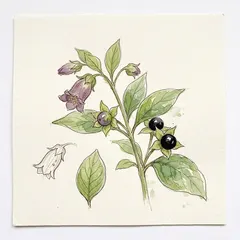
Belladonna
Hempel - Materia Medica and Therapeutics · Charles Julius Hempel · 101,871 χαρακτήρες
 Όλα τα βιβλία για Belladonna →
Αντιδοτείται απόAceticum AcidumAconitum NapellusAngustura VeraAurum MetallicumBerberisCamphoraCitrus LimonumCoffea CrudaCoffea TostaColchicum Autumnale
Όλα τα βιβλία για Belladonna →
Αντιδοτείται απόAceticum AcidumAconitum NapellusAngustura VeraAurum MetallicumBerberisCamphoraCitrus LimonumCoffea CrudaCoffea TostaColchicum AutumnaleGeneral EN
[ATROPA BELLADONNA, DEADLY NIGHT-SHADE. NATUEAL ORDER,
SOLANACE^E.]
A native of the south of Europe, where it grows in mountainous regions on eminences covered with forests, also in damp and shady places. The plant growing in mountain-forests is much more vigor- ous than the artificially reared, or that which grows in damp or shady places. It was probably known to the Greeks; hence the name Atropa from atropos (inexorable) ; hence it was also termed Solanum lethale. Belladonna is the Italian for "beautiful lady"; the Italian ladies use the distilled water of belladonna leaves as a means of beautifying their complexion ; hence the name solanum cosmeticum.
Belladonna seems to act primarily upon the cerebro-spinal system of nerves, and to affect the vascular system secondarily. The most characteristic symptoms of poisonous doses of belladonna are : dry- ness of the mouth and fauces, difficulty of swallowing, constrictive spasms of the fauces, inflammation of the fauces, dilatation of the pupils (mydriasis), presbyopia or long-sightedness, with obscurity of vision, or amaurosis ; optical illusions (phantasms), suffused eyes, singing in the ears, numbness of the face, giddiness, delirium and intoxication, sopor, scarlet eruption on the skin.
Dr. Pereira reports seven cases of poisoning with belladonna, two of which proved fatal ; they occurred in the London hospital. The following symptoms attracted the Doctor's special attention : 1. Dry- ness of the fauces, causing excessive difficulty of swallowing and alteration of the voice. 2. Scarlet eruption on the arms and legs.
BELLADONNA. 561
Mydriasis And Presbyopia EN
According to Dr.
Pereira the amau- rotic weakness which belladonna is said to produce, is chiefly owing to presbyopia. 4.
Delirium, phantasms
The delirium was of the cheerful or wild sort, amounting in some cases to actual frenzy.
In some of the patients it subsided into a sort of sleep, attended with pleasant dreams which provoked laughter.
The delirium was attended with phantasms, and, in this respect, resembled that caused by alcohol; but the mind did not run on cats, rats, and mice, as in the case of drunkards.
Sometimes the phantasms appeared to be in the air, and attempts were made to chase or catch them with the hands ; at other times they were supposed to be on the bed.
One patient (a woman) fancied the sheets were covered with cucumbers. 5.
Convulsions ; paralysis; sopor or coma.
In most of the cases, the power of the will over the muscles was so far disordered, that the muscular movements were somewhat irregular, causing a kind of staggering or jerkings, but actual convulsions were not general. ' There was sopor which terminated in coma, with a weakened or paralytic condition of the muscles.
Mueller gives an interesting description of five persons in one family who had eaten of the berries of belladonna. Two of the children (boys) having eaten a good quantity of the berries, were attacked with the following symptoms : They attempted to get from their beds and were with difficulty restrained ; continual motion of their hands and fingers, and desire to lay hold of the coverlets or other objects within reach ; thrusting the fingers up the nostrils ; acute delirium; vision nearly gone, but both patients at the same time fancied they saw a number of objects ; great dilatation and in- sensibility of the pupils ; eyeballs alternately fixed and rolling ; spas- modic action of the muscles of the face ; grating of the teeth ; yawning, etc. ; voice hoarse and weak ; slight swelling of the left side of the throat, and burning sensation in the oesophagus ; decided aversion to all liquids ; and spasmodic attacks whenever they were forced to swallow anything.
Six individuals, the mother, four children and a servant, ate a few berries of belladonna at supper.
The mother and servant each ate about six.
They were attacked with nausea, diplopia, constrictive sensation in the throat, vertigo and drowsiness.
Next morning the servant girl, who had vomited previously, only had headache, with languor, dilatation of the pupils, redness of the face, pulse somewhat accelerated.
A girl of four and one of eight years, staggered about the room as if intoxicated, were delirious ; face red, eyes protruded, pupils dilated, with staring look, increased heat of the skin, pulse very much accelerated.
The mother spent a restless night, and toward morning became a perfect maniac, trying to bite and strike
VOL. I. — 35.
562 BELLADONNA.
her attendants ; the delirium was at times interrupted by loud laugh- ter and grating of the teeth; her head was hot, face red, look wild and staring, tongue dry, abdomen somewhat distended, pulse small and very frequent. Two children, one of two years and a half, and the other of six, who had eaten the largest quantity of the berries, were soporous, with violent spasms of the extremities; head hot, face red, eyes protruded, pupils very much dilated, look staring, tongue dry, abdomen distended and very hard, pulse very frequent and small, grating of the teeth and croupy cough. All were saved.
Dr.
E.
Koch (Halm.
Monthly, Oct., 1866,) relates a case of poison- ing with belladonna, which presents many of the characteristics of the drug in a remarkably clear manner:
L., male, aged twenty-six years, confined at the hospital to break up a passionate habit of using spirituous liquors, and particularly of morphia eating, to which latter he became so accustomed that he had already taken sixteen grains of morphia without fatal conse- quences; sent for me one night at 11 o'clock and complained in a hardly audible voice, of a pain in his eyeballs, as if they were pressed out of their sockets, and of a tightness over the temples; after rising from the chair, he had an uncertain gait, similar to a person afflicted with general progressive paresis, besides complaining of giddiness; his voice commenced to leave him more and more, and the words seemed to choice him, while he suffered, according to his own account, of a dull pain in the throat, with a feeling as if all the muscles of that region were drawn up into a lump, with continual inclination to stoallow.
Upon my examining his fauces, I found them peculiarly shaped and somewhat congested', the uvula, as well as the half-arches were retracted; upon the posterior part of the pharynx two oblong tumors, one on each side, were visible, which performed a kind of peristaltic movement, and which were doubtless the stylo-pharyngeal muscles bulging out; the pupils were considerably dilated, and the eyes glazy, pulse slow and full. * * * (The patient confessed to having taken poison (belladonna) equal, in the estimation of Dr.
Koch, to at least forty-live or fifty grains of the powdered drag.) An hour had elapsed since he had taken it, making an emetic useless. Opium, in one dose of eight grains was given, which the patient swal- lowed with great difficulty, on account of the constriction of the pharynx and oesophagus. In the meantime his symptoms became worse every minute. He gradually lost all consciousness, became in- sensible to pain upon pinching the skin, his eyes were staring and almost motionless, while he would sometimes suddenly strike out with his hands, as if ivanting to catch imaginary objects in the air; great restlessness follotved, patient would get out of bed, picked at the bedcover, like one who looks for insects or small objects ; complete delirium now set in, and the pulse became weaker and weaker, while it ran up in fre- quency to one hundred, so that I despaired of his life.
This state continued about fifteen miuutes, when all the symptoms, except
BELLADONNA. 563
the unconsciousness gradually decreased, and in about half an hour after he had taken the eight grains of opium he fell into a sound sleep.
The pulse become less frequent and fuller, and upon my ex- amining his pupils, which disturbance did not awake him, I found them to be normal, rather contracted.
The only symptom of im- portance was the saliva, which continually trickled from his mouth, but this also gradually disappeared.
I now left the patient, believing Mm to be safe, and returned at 2 a. m. when I found his neck and face covered with the characteristic belladonna rash, of a lighter shade of red than the scarlet rash, and mixed with minute sudamina.
He still continued to sleep soundly.
At 6 a. m.
I visited him again, and found that my entering the room had awakened him.
Upon my question, how he was, he answered somewhat incoherently, and complained of my allowing the nurses to come into his room and threaten to kill him with knives, forks, etc., showing that he must have had vivid dreams, while his mind was not yet capable of discernment.
The rash had almost vanished.
He again went to sleep, awaking at noon, talking quite rationally, and feeling only a slight nausea in the stomach.
Beside the nausea, the onlv remain- ing symptom was, that he saio all objects framed ivith the rainbow-* colors, as if he looked at them through a glass prism, which optical illusion continued three days.
The recollection of what had passed was entirely gone ; lie recollected nothing of his own state.
Otherwise he continued well, and his secretions, which were suppressed, re- turned in abundance, particularly that of the kidneys.
These few cases of poisoning show us the great power possessed by belladonna over the functions of the cerebro-spinal axis, and tesify to the therapeutic virtues which belladonna must evince in some of the most formidable cerebral diseases. It is not only from cases of poisoning, however, that these virtues are inferred ; they have like- wise been made apparent by systematic provings upon the healthy.
CEPHALIC GROUP.
In looking at the symptoms which Hahnemann has recorded as the result of the action of moderate doses of belladonna upon the brain, we shall find that various forms of headache are distinctly delineated by these symptoms. Some of the most characteristic are :
Pressure in the brain, with sopor and vomiting ; headache, especially in the forepart of the head, worse during motion and when stooping ; continuous and forcible dilatation of the whole brain sensation as if the sutures of the skull were pressed asunder ; fueling in the head as if a lever were applied for the purpose of break- ing it asunder; headache above the orbits as though the brain would be pressed out, obliging him to keep his eyes closed, with contraction
564 BELLADONNA.
of the pupils ; pressure In the head, extending over a large surface ; sensation in the forehead as though the brain were ascending and descending ; pain as if the head were screwed together from side to side ; violent throbbing pain in the forehead, as if the bone were raised ; throbbing from before backward, externally the throbbing terminates in stitches ; we have also painful pressure in the head, especially in the lower part of the forehead, directly above the nose, intolerable on stepping or walking ; stabbing pain, as if with a knife, from one temple to the other ; sharp, cutting pain on the right side of the head, from the frontal to the occipital region, becoming gen- eral and at last settling in the right parietal bone. The head feels heavy as from intoxication ; vertigo, when stooping or rising from a stooping posture ; vertigo, with vanishing of sight; throbbing and beating in the head and carotids.
Headache EN
These symptoms indicate belladonna in headache of a congestive, nervous, rheumatic or catarrhal form.
The headache of belladonna is frequently right-sided ; it is usually very violent and the symptoms of congestion to the brain are well marked ; vertigo, stupefaction and partial loss of sight are frequent concomitants.
Useful in headaches from exposure to the heat of the sun.
The attacks are apt to come on or to get much worse in the middle of the afternoon and to last until toward morning.
Aggravations from noise, light, walking, jarring, motion of the eyes, touch, stooping, lying down, heat of bed.
Ameliorations from quiet, sitting in the chair, dark room, strong pressure on the forehead.
A girl, twenty-five years old, has suffered for eight years with periodical headaches.
Nearly every eighth day, in the morning, she has a chilly sensation on the back and shoulders, severe nausea and vomiting, violent pressing, tearing pain in the head, especially in the forehead ; the slightest motion, even of the eyes, increases this pain to the last degree ; the bed seems too hard ; perfect quiet only gives some relief.
The pain then centers in the forehead; a very hot spot can be felt on the forehead and there is some pain in the nasal bones.
She is obliged to remain in a dark room, since every ray of light irritates the eye and increases the headache.
General lassitude, violent beating of the heart; every beat of the pulse seems to produce a jar in the head.
Cured by belladonna24 and belladonna30, one dose of each.
(Hartmann in Arch. d.
Horn.
Heilk, vi., 3, 84.)
Vertigo EN
Belladonna is a prominent remedy in the treatment of vertigo. It is called for when the vertigo is attended with nausea, as is experienced when turning quickly around in a circle or when waking from a morning sleep, after spending a night in revelry ; dull- ness of mind ; luminous vibrations before the eyes, loss of conscious- ness, falling; vanishing 0f sight; tendency to fall backward or to the left side ; relieved in the open air, aggravated in the room.
BELLADONNA. 565
1\I., strong, large, twenty-six years old, has suffered for three days from a threaten- ing vertigo, with fogginess of vision upon rising from sitting or lying down, brought on by motion of the head or of the eyes, and by rising from a stooping posture.
Feebleness of the extremities, with trembling when walking; fulness in the head and stitching pains in the chest.
Slow pulse.
Belladonna, 9 and 12, cured permanently.
A boy, fourteen years old, had been for ten days a convalescent from a violent typhoid fever; he now suffers from dizziness after each meal, as if intoxicated; as long as he remains in bed he feels all right, but as soon as he rises, and especially when he stands on his feet, he suffers from vertigo ; he staggers to and fro.
The pupils are enlarged.
Ext. belladonnse 1-100 gr. cured in a few hours after preceding aggravation of symptoms.
(Gauwerky in Allg.
Horn.
Zeitg., xliv., 229.)
APOPLEXY. — In some cases of poisoning, belladonna has caused great slowness and fulness of the pulse, or else a contracted, hurried and intermitting pulse; some patients have lost their consciousness, with sudden falling down, and paralysis of the lower extremities. An old farmer, who had eaten a considerable quantity of the berries, was seized with profound coma and obstinate constipation. Bella- donna causes dilatation and insensibility of the pupils; bloating and glowing redness of the face, purple spots in the face, protrusion and injected condition of the eyeballs; deep, stertorous, rattling breathing, burning heat of the skin ; in short, a group of symptoms which are eminently characteristic of apoplexy.
A woman of forty-five years.
Symptoms : After the seizure, loss of the power of motion and of sensation on the right side of the body.
Loss of speech, vision and smell.
The mouth is drawn toward the ear.
Consciousness undisturbed.
Convuls- ive movements of the face and of the left arm.
Difficult deglutition.
Salivation.
Thirst.
Bloated appearance of the countenance.
Congestion and protrusion of the eyes.
Constipation.
Belladonna24 cured.
(Ruckert, i, $J.)
A Roman Catholic priest, thirty-three years old, of lymphatic temperament, very corpulent.
Symptoms: Weakness of the mental faculties, with uneasiness about his condition.
Mental confusion; exhaustion from the slightest movement, heaviness of the head, especially in the forehead, as if it would fall oft"; vertigo ; uneasiness in the stomach, extending to the head.
Fogginess, as if drunk.
Noise and beating in the head ; sleepiness during the day ; pale and bloated face.
Dilatation of the pupils, photo- phobia, squinting of the right eye, with lachrymation and constant winking.
Loss of sensation and of motion of the right side of the face, with feeling of crawling and pulling.
The mouth is drawn toward the left side ; cannot retain the food in the mouth; difficult mastication ; cannot keep a cigar between the lips: bites his tongue when eating; swallows with difficulty.
Labored and heavy speech.
Great thirst; pasty taste in the mouth ; loss of appetite.
Bloated condition of the bowels.
Oppression of the chest ; difficulty of breathing.
Stool difficult.
Internal haemor- rhoids.
Stiffness in the joints of the legs; weakness of the right side.
Prescribed belladonna2000.
A few hours after rousing, there was tearing pain in the shoulders, as if the head were being drawn backward, with returning clearness of the mind.
During the next few days these symptoms all disappeared and he made a complete recovery.
(Nunnez in Allg.
Horn.
Zeitg., xxxiv., 152.)
CONGESTION OF THE BRAIN— All the prominent symptoms in a case of poisoning by belladonna show that sanguineous engorge- ment of the cerebral vessels is one of the most marked effects of this drug. The face looks bloated, red; the carotids throb violently; the jugulars are swollen; the skin is burning and dry; the patient
566 ;-ELLA DONNA.
lies in a state of sopor, from which he wakes every now and then with a start; the eyes look blood-shot and seem to protrude from their sockets; the pupils are excessively contracted, or this excessive contraction may alternate with extreme dilatation. No agent cor- responds with such a group of symptoms more accurately than belladonna.
INFLAMMATION OF THE BRAIN.— In this disease bella- donna is one of the main supports of the homoeopathic physician. It is indicated by the pains, tearing, lancinating, throbbing and deep- seated aching pains; by the signs of vascular engorgement, swelling of the head and face, burning recto ess of the face, protrusion and con- gested appearance of the eyes, purple spots in the face, heat of the head, throbbing of the carotids and temporal arteries ; by the fever, pulse full, hard and tense, skin burning and dry, excessive thirst during the moments of consciousness ; by the delirium, which is generally of the violent kind, the patients howl, kick, tear and strike about with an extraordinary power of resistance ; by the condition of pupils, they are contracted and exceedingly sensitive to the light ; by the consensual phenomena and phenomena of the ganglionic system, such as deafness and blindness, or excessive sensitiveness to noise, sudden changes of color in the face from red to pale, starting of the extremities and subsultus tendinum, sopor, and lastly by the charac- ter of the secretions ; the urine looks red and the bowels are constipated.
Belladonna affects the brain and nervous system generally in a pre- cisely similar manner, hence the remarkable control which belladonna has over inflammation of the brain in all curable cases where these phenomena constitute characteristic indications.
HYDROCEPHALUS. — Belladonna is even homoeopathic to hydrocephalus or dropsy of the brain, when resulting from previous inflammation. Belladonna has all the symptoms which generally mark the setting in of effusion into the ventricles, gritting of the teeth, frequent changes of color, sudden and extraordinary dilatation of the pupils, tetanic convulsions, coldness of the skin, slowness and sinking of the pulse, which, gradually changes to a quick, small and compressible pulse, and at times even involuntary discharge of stool and urine.
ENOEPHALOMAOIA, or softening of the brain, belladonna is, so far as we know, an agent that may prove of importance. The symptoms which characterize this disease point to a condition of the
BELLADONNA. 567
brain such as may develop itself under the paralyzing action of bella- donna.
Loss of memory, epression of the sensorial functions, vertigo, blackness of sight, hardness of hearing, deep-seated aching pain in the head, difficulty of articulating, dragging gait, until par- alysis finally sets in.
During such an attack, the patients do not altogether lose their consciousness.
They look pale and their features are disfigured, the pulse is small, feeble, filiform, the brain seems anaemic rather than engorged with blood.
Nevertheless, a post-mortem examination in the earlier period of the disease, shows the brain dotted with a numberless multitude of bloody points, probably effusions from the mouths of the capillary vessels. At a later stage, the brain is found reduced to a soft pulp, which is sometimes so little coherent that under the least pressure it will diffuse itself like a liquid mass. Wibmer mentions the case of a man of sixty-two years who was poisoned by the berries of belladonna, and whose brain seems to have undergone a similar change of putrid softening.
MANIA-A-POTU
The homoeopathicity of belladonna to some forms of this disease is self-evident.
The patients fancy themselves assailed by robbers, or threatened by mice, rats, cats and other forms of animals from which they endeavor to escape.
The delirium is of a furious kind, pulse full, hard and bounding ; face bloated and red, or with purple spots ; eyes glistening and staring, at times gorged with blood.
Such patients are troubled with all sorts of hallucina- tions ; they imagine that somebody is calling them.
Trembling of the extremities is a common symptom ; the urine looks red, the feces have a dark and burnt appearance, and the skin, although warm, yet may be drenched with sweat.
The principal indications for belladonna in this disease are the character of the delirium, and the signs of cerebral congestion which are undoubtedly present in mania-a-potu.
TYPHUS
The homoeopathicity of belladonna to typhus is substantiated by a number of symptoms characterizing the action of belladonna upon the cerebral tissues.
In all forms of typhus to which belladonna is homoeopathic, the cerebral symptoms are most marked.
No matter in what organ or tissue the inflammatory process first manifested itself, belladonna may be used in any form of typhus where the delirium and the typhoid symptoms generally are strictly analogous to those which belladonna is capable of causing.
These are:
568 BELLADONNA.
Pains in the head, such as may be occasioned by belladonna, par- ticularly a violent beating in the head ; distress as if the skull-cap would fly off ; feeling of heat in the head. Expression of distress and suffering in the countenance. Glistening and staring, also blood-shot eyes, also with spasmodic rolling of the eyeballs upward or laterally, and alternate contraction and dilatation of the pupils. Thickness and heaviness of the tongue, almost amounting to paralysis, so that the patient is only able to utter inarticulate sounds ; the tongue looks and feels like scorched leather, is covered with a thick, glazed, brown or blackish looking coating.
Unquenchable thirst, sometimes attended with spasmodic constriction of the throat and intense burning in the fauces, so that the least attempt to swallow a drop of liquid causes suffocating spasms of the throat and general tetanic convulsions. Typhomania, alternate coma and delirium which is at times bland, at others furious ; the patient can hardly be held on his bed, he wants to get away, strikes about, uses profane language, etc. Optical phantasms and hallucinations, which will be described in the optical group.
Picking at the bed-clothes and catching at flocks.
In the first stage of typhus the pulse may be undulating and soft, but somewhat accelerated. As the disease progresses, the pulse in- creases in frequency, becomes smaller and more compressible. When the paralytic stage is approaching, the contents of the bowels and bladder pass off involuntarily, and the skin becomes covered with a clammy sweat. Belladonna may be indicated even in this stage for our provings and the effects of poisonous doses show, that this agent causes a paralytic relaxation of the sphincters, dryness, brittleness and increased warmth of the skin, with partial clammy sweats, and a hurried, feeble, vibratory pulse.
NERVOUS GROUP.
The action of belladonna upon the ganglionic system is marked by the most extraordinary phenomena. We may consider it under the different heads of neuralgia, rheumatism, spasms and convul- sions, and paralysis.
NEUKALGIA
Many of the symptoms obtained by the provers of belladonna point to its power of causing neuralgia of various nervous centres or ramifications.
In neuralgia of the nerves of the face, belladonna has proved an eminently useful agent.
We have swelling and inflammation of one side, or of the whole face ; burn- ing, creeping, cutting, tearing, drawing, lancinating and stinging
BELLADONNA. 509
pains in the face ; these pains may be accompanied by irritation and inflammation of the eyeballs, headache, etc.
A gardener, twenty-seven years old, of robust constitution and sanguine tempera- ment, who was bled several times a year for violent headache, was attacked with exceedingly violent pains in the right frontal region, involving at the same time the right eye.
This happened on a cold December morning, after he had been working for a long time in the open air.
The pains came on at 5 A.
M., and continued till 9 or 10 P.
M.
The paroxysms commenced with a prickling sensation, followed by lancinating pains, redness of the eyeball, with lachrymation and excessive sensi- tiveness to the light ; the pupils were exceedingly contracted, and the distress was truly agonizing.
The pulse and other bodily functions were perfectly natural.
After the violence of the pains had subsided, a feeling of dullness and stupefaction remained.
The temples and the parts adjoining the base of the orbit were fomented with a solution of one drachm of the extract of belladonna in an ounce of distilled water; on the third day all his sufferings were ended.
For three months subse- quently, when the case was reported, he had been perfectly free from pain.
In this case, if the medicine had been given internally as well as externally, of course in appropriate doses, the cure would most probably have been achieved in a still shorter period.
In Baldinger9 s Magazine the following beautiful cure of rheumatic prosopalgia is reported :
A plethoric girl of twenty-four years was attacked one evening, without any appar- ent cause, with spasms of various kinds, convulsions, tetanus, opisthotonos, empros- thotonos, trismus.
Bleeding relieved her at the time.
A relapse took place six weeks afterward, after which she had a paroxysm every few weeks for a whole year.
In the month of August she was attacked with rheumatic prosopalgia, after which the spasms ceased.
The pain was seated in the right zygomatic process near the tempo- ral bone, became more intense from day to day, and became more violent from 5 p.
M. until midnight.
She took seven grains of the powdered leaves of belladonna in the evening before bedtime.
This dose caused a burning in the throat, some nausea and slight stupefaction.
Three doses sufficed to perfect a cure.
RHEUMATISM
The rheumatic pains, which belladonna is capable of exciting, are of various kinds, such as painful swelling and stiffness in the nape of the neck.
Lameness of the upper limbs, or lameness and pressure of the arms, with weakness.
Creeping along the extremities, as from a fly crawling over them, also with in- numerable stitches.
Cutting pains along the bones in the extremities, also with tingling.
Pain in the long bones as if bruised, and as if they would crumble like decaying wood ; the pain is a fine stinging and gnawing pain in the long bones, and sometimes accompanied by violent tearing in the joints.
Drawing, cutting, teariug pains, either in the joints or along the long bones or phalangeal bones.
In a case of poisoning, related in Frank's Magazine, the patient complained of pain in all his joints, and of a painful sensation of chilliness in the parts down to the ends of the toes and fingers.
This last-mentioned symptom shows that belladonna may be a specific remedy in certain forms of articular rheumatism, especially when accompanied with chilly oreepings in the limbs and symptoms of incipient paralysis.
570 BELLADONNA.
Belladonna being in marked and specific rapport with the brain, it may be specifically indicated in articular rheumatism with super- vention of typhoid symptoms. In these forms of rheumatic inflam- mation, we must never expect to find the pulse full, hard and bounding, as it is in cases where aconite is indicated. The pulse is accelerated and somewhat fuller and larger than in the normal con- dition, but not hard or resisting.
In a case of neuralgic rheumatism of the right upper extremity, with lancinating pain from the top of the shoulder to the wrist when attempting to make the least motion, intensely distressing, crawling sensation in the humerus, and sensation as if the bone would crumble to atoms, a drop of the tincture of belladonna in a tumbler- ful of water effected a prompt and radical cure.
SPASMS AND CONVULSIONS-— The spasms which bella- donna is capable of exciting, are various.
In one case of poisoning, the patient sat in his bed, expressing great anxiety and restlessness, and turning his head continually to and fro.
In another case, the muscles of one side of the face were convulsively agitated.
In one case it is stated that the patient indulged in the strongest gesticula- tions, and performed the movements of the body with the greatest agility.
In another case, the power of belladonna to excite chorea, was strikingly evidenced.
A boy of four years, who had eaten several berries of belladonna, was seized soon after with sardonic laughter.
After a while the child commenced to turn about in a circle and, after several gyrations, would undoubtedly have fallen unless supported by others.
He was seized with spasms; fever super- vened ; the extensor, flexor and pronator muscles of the upper and lower extremities, and, indeed, the muscles of the whole body were by turns agitated without interruption by spasmodic con- tractions causing frightful contortions.
The convulsions of the obicularis oris, of the muscles of the eye and face caused horrid grimaces.
The pulse was small, contracted, hurried, intermittent and jerking.
In chorea where belladonna is indicated, we may find symptoms of cerebral congestion or of cerebral disease, impaired mental power, even amounting to imbecility. An excessive uneasiness in the ex- tremities may likewise induce chorea-like movements of the parts. In one case, this uneasiness in the arms and legs, especially in the hands and feet, and also in the head, obliged the patient to move these parts continually, and even to shake the head convulsively to and fro.
A girl of nineteen years had been laboring for some time under severe mental affi.ction in consequence of which she was attacked with spasmodic twitchings of a
15ELLAD0NNA. 571
number of muscular bundles, except tbe muscles of the face.
Pressure upon the abdomen induced opisthotonos.
No convulsions during sleep.
P'auces very much inflamed, and covered here and there with a layer of mucus.
Pulse accelerated, full; skin inclined to perspire.
The patient had been put on the use of ignatia — a most uncalled-for prescription, and determined by that single symptom, spasm, without any inference whatever to the character of the pathological process.
Of course, this drug proved of no use whatever.
Belladonna6 effected a perfect cure in a few days.
( Vierteljah ressch rift) .
The convulsions of belladonna are generally accompanied by pecu- liar distinguishing phenomena, as may be seen from the following series :
Convulsions which are renewed by the least contact, with hiccough, weariness and anxiety.
Convulsions, with screams and loss of con- sciousness.
Convulsions, with delirium and laughter.
Convulsions, with rolling of the eyeballs.
Convulsions, with startings of the hands and feet, with insensibility and rattling breathing.
Convul- sions alternating with complete immobility.
Tetanic spasms, opis- thotonos, spasmodic inclination of the head and body to the left side.
Hysteric convulsions, with risus sardonicus, heat of the head, sudden changes of color in the face.
Convulsions of the abdominal muscles in hysteria.
Paroxysms of rigidity and immobility of all the limbs or of a single limb only, sometimes accompanied with insensibility, distention of the cutaneous veins, red and puffed face, full and quick pulse, and profuse sweat.
Epileptic spasms.
Convulsions from teething, with gritting of the teeth.
In
PUERPERAL CONVULSIONS, belladonna may prove eminently useful if the existence of cerebral congestions, bloating and redness of the face, protrusion and suffusion of the eyeballs, dilatation and insensibility of the pupils, sometimes alternating with extreme con- traction, coldness of the hands and feet, and a small, jerking, hurried and perhaps intermitting pulse, justify the use of the drug.
HYDROPHOBIA. — Belladonna has always been considered a sort of specific for hydrophobia. We know that no known drug has the power of simulating hydrophobia to the same extent as belladonna. In a case reported in the " Oestreichische Jahrbucher " (Austrian Annals of Medicine), two little boys who had been poisoned with the berries of belladonna, exhibited, among other symptoms, a remark- able aversion to liquids; as soon as a spoon or a glass containing a liquid was put to their lips, the boys cried out vehemently, clenched their teeth spasmodically, and the liquid had to be forced down their throats, after which they were seized with spasms.
The following case is reported in Rust's Magazine: Four weeks ago, a woman had been bitten by a mad dog. The wound not bleeding, and the epidermis being
572 BELLADONNA.
only a little scratched, no attention was paid to this accident.
After the lapse of four weeks, the woman suddenly lost her appetite, she became restless, spent a sleepless night, absorbed in anxious reveries, felt still more anxious and restless during the next day, and was moreover attacked with vertigo and constriction of the fauces.
After these dangerous symptoms had developed themselves, she received five grains of the powdered leaves of belladonna at a dose.
After taking two grains, the symp- toms had entirely disappeared.
A few more doses were given, and the patient remained well.
The profuse perspiration and the swelling of the injured part, which generally follow the use of belladonna, were not observed in this case.
EPILEPSY In epileptic convulsions, belladonna has proved use- ful, especially in those forms of epilepsy which Schoenlein designates as peripheral, testicular and hysteric epilepsy ; also in the so-called idiopathic or cerebral, where the preliminary and the convulsive stages coincide, and where the aura, the globus or spark remains un- perceived. by the patient. In the peripheral form, the attack is apt to commence with a crawling sensation under the skin. In epilepsia testiculars, where the preliminary irritation is first perceived in the testicles, with violent sexual excitement, involuntary emission of semen, and in epilepsia hysterica, where the irritation seems to pro- ceed from the womb, and is perceived like a ball ascending toward the brain, more particularly in the case of plethoric women, bella- donna may prove one of the useful remedies to be employed.
It has afforded relief in various cases of idiopathic epilepsy, complicated with symptoms of mental derangement, imbecility or idiocy.
Dr.
J.
Martine Kershaw, relates this interesting case in the Med.
Investigator, March, 1874.
M.
A., a girl of fourteen years, dark hair and complexion, was first affected with epilepsy at the age of twelve years.
She was usually attacked during the afternoon, preceded by sleepiness and sullenness of disposition.
There was no aura epileptica ; but she gave the usual shriek, and fell to the floor convulsed, with great tossing about, rolling of the eyes, and snapping of the teeth, so that the tongue was frequently lacerated.
One symptom was constantly present : the right hand persistently clutched at the throat.
I commenced giving the patient belladonna3 twice a day, and con- tinued for about a month.
I then changed to belladonna30, once every three days; and after three months treatment with these potencies, gave her belladonna200 after every severe attack.
The improvement under this remedy was marked from the beginning.
The attacks first began to diminish in severity, then in frequency, and in one year they had ceased altogether.
The menses came on in due time, and although at first very painful, the remedy seemed to influence them in the direction of health to such an extent, that in time they caused no inconvenience.
PARALYSIS
We know from numerous cases of poisoning that belladonna may cause paralysis of the lower extremities.
The par- alysis may be complicated with excessive trembling of the limb ; or the patient may complain of a feeling of chilliness in the limb, with sharp pains in the affected part ; or the limb may feel numb, cold and the pulse may be weak, empty, hurried and intermitting.
We may therefore find belladonna indicated in paralysis after
BELLADONNA. 573
apoplexy, either of one side or both sides of the body, ox partial par- alysis of one extremity or of one side of the face, or of the organs of speech. The pulse which indicates belladonna in this disease may be slow and full, but not hard or bounding; generally it will be found small, hurried, weak or perhaps somewhat jerking and inclining to intermit. The paralysis may be complicated with symptoms of cere- bral derangement, vertigo as if the patient were turning in a circle, appearance of fright and imbecility, paralysis or paralytic weakness of the sphincters, with involuntary discharge of urine and feces, dila- tation or alternate dilatation and contraction of the pupils.
We have adverted to the power possessed by belladonna of curing paralysis of the sphincters of the bladder and anus, with involuntary and unperceived discharge of urine and feces. These paralytic con- ditions may be caused by rheumatic exposure, and may also be entailed upon a patient as the consequence of some mismanaged acute disease, such as typhus. Paralysis of the optic and auditory nerves from similar causes may likewise yield to belladonna, provided the affection is curable.
INFLAMMATORY GHOUF.
Belladonna causes inflammation by first depressing the brain, after which the functional power of the ganglionic system becomes simi- larly but secondarily affected. It affects the brain primarily and the ganglionic system incidoitally, whereas aconite affects primarily the ganglionic system and incidentally the brain. The first effect of belladonna upon the brain is to depress or unhinge its functional power and incidentally the functional power of the ganglionic sys- tem ; the stage of organic reaction is characterized, as in the case of aconite, by capillary engorgements, a full, rapid and bounding pulse, glowing redness of the face, protrusion and suffusion of the eyes, heat of the skin, etc.
But in the case of belladonna, the antagonism seems to be between the capillaries and the central point of the ner- vous system, the brain ; whereas, in the case of aconite, the antago- nism is between the capillaries and the terminal ramifications of the ganglionic system. Hence, in the case of belladonna, the antagonism is marked by more obstinate, more deep-seated and more dangerous symptoms than in the case of aconite. If, in a case of inflammation, the capillaries, under the stimulating effects of aconite, persist in remaining engorged ; if the redness, swelling and heat continue ; if the cutaneous exhalations show no signs of return ; if the brain con- tinues to feel dull, weary, torpid, we may rest assured that the
574 BELLADOHNA.
primary seat of the inflammatory process is not in the ganglionic system, but in the brain itself and that belladonna is required.
PHLEGMONOUS INFLAMMATION
Some of the most im- portant organs are liable to attacks of acute inflammation.
Inflam- mation of the brain (phrenitis, meningitis, encephalitis) has already been considered under the head of cephalic group.
We will here add that belladonna may be in therapeutic rapport with inflammation of any part of the brain.
It may be homoeopathic to
MENINGITIS and arachnoiditis, with sopor, excessive dizziness, heat of the head, deep-seated, tearing, lancinating pains in the head, aggravated by motion, violent congestion to the head with throbbing of the carotid and temporal arteries.
Pulse hurried, but not hard and bounding ; rather soft.
Dry and brown-looking tongue (at times white or yellowish), contraction of the pupils, sensitiveness to light.
SUNSTROKE
We may also mention the use of belladonna in sunstroke.
The patients are seized with violent dizziness, they fall down, unless supported.
In violent cases they are suddenly deprived of consciousness and fall down as if struck by apoplexy.
Other symptoms are: violent stupefying pain in the head, nausea and even vomiting, white-coated and dry tongue, loss of sight and hearing, stupor and even coma.
Pulse accelerated, not hard.
Diminished secretion of feces and urine,
MYELITIS of the chronic form, especially if caused by the retro- cession of an eruption, symptoms of marasmus and of exhaustion of the brain, accompanied by characteristic symptoms of belladonna.
CARDITIS AND PNEUMONIA may demand its exhibition, when the brain becomes involved, presenting symptoms which estab- lish the homceopathicity of the remedy to the case.
In carditis we find also a feeling of agonizing distress in the region of the left ven- tricle, as from a red-hot coal ; the pulse is small, jerking and inter- mitting, while the heart thumps violently against the thoracic wall.
In pneumonia there is drowsiness, the tongue is dry and brown, the lips parched, the skin dry, the pulse small, compressible, intermitting.
It is called for in
METRITIS in consequence of menstrual suppression, or after con- finement.
The patient complains of burning pains high up in the vagina, and if the peritoneum is involved, the hypogastric region is painful and somewhat distended.
Frequent and difficult urination.
Drowsiness, stupor, delirium.
Nervousness.
Fetor from the uterus, slight oozing of fonl blackish and fluid blood.
BELLADONNA. 575
PERITONITIS, with burning-tearing crampy pains at a certain spot, usually near the navel, extending from there over the whole abdomen.
Distention of the abdomen, tenderness to touch ; fulness and hardness of the pulse, from 100 to 110 beats per minute; tongue coated white, urine hot and excoriating, bowels constipated, face flushed.
Characteristic brain symptoms.
In inflammation of the abdominal viscera, of the pancreas, omen- tum, colon and in enteritis proper, belladonna may be highly service- able. The local symptoms are marked by keen, sharp, pinching pains, with tenderness of the parts to pressure, meteorism, constipa- tion or diarrhoea and, most important of all, primary cerebral engorgement, with full, bounding pulse, flushed face, etc., followed by profound cerebral depression, as shown by stupor, hippocratic countenance, stertorous breathing and threadlike pulse. In
OESOPHAGITIS of an intense and malignant character, with great pain in the oesophagus, and agonizing distress when the least attempt at swallowing is made, belladonna is a prominent remedy.
ANGINA FAUOIUM. — The following pathogenetic symptoms define its use in angina faucium: Intense redness of the throat; excessive dryness and heat ; stinging, lancinating pains when swallow- ing; swelling of the internal parts, uvula, tonsils, back part of the tongue ; sensation as if the fauces were constricted, and as if the passage of even a drop of liquid would be impossible ; feelings of excoriation in the throat ; the tongue looks inflamed, and is lined with a thick, yellowish, brown coating, feels dry; discharge of a thick, viscid, ropy phlegm from the mouth; haemorrhage from the throat; foul taste in the mouth; swelling of the neck, with throb- bing of the carotids; these symptoms are accompanied by creeping chills followed by heat and dryness of the skin, irritated, hard, hurried pulse, dizziness and violent pain in the frontal region or temples, red urine, constipation. In
PUTRID SORE THROAT or diphtheritic inflammation of the pharynx and even in certain stages of true diphtheria, belladonna may be called for by the symptoms of the case. The following symptoms were recorded by pro vers and serve as indications:
Pappy taste, with white coating of the tongue.
Dryness of the mouth and fauces, with excessive thirst, causing him to pant for liquids.
Redness and burning heat in the fauces.
Tongue cleaving to the palate.
Exudation of a white, tenacious, viscid mucus in the buccal cavity, with frequent spitting.
Fetid odor from the mouth.
576 BELLADONNA.
ADENITIS, inflammation of glands, requires belladonna, regard- less of their location.
The glands become hard, shining, rose- colored ; there is sharp, stitching pain in them and a tendency to an erysipelatous inflammation may develop.
It is of great value if the disease is acute, resulting from exposure, in scrofulous subjects; it is also of use in chronic cases.
Parotitis of six years' standing has been cured by belladonna.
In the treatment of
MASTITIS this remedy is very valuable.
The pain is pulsating, running in various directions from one common center.
Feeling of heaviness in the breasts.
CONGESTIONS
Belladonna is also a valuable remedy in con- gestions, acute and chronic, of the brain, lungs, air-passages, bowels, spleen, liver, uterus.
It is of particular value in acute forms, accom- panied by symptoms of violent congestion, full, bounding pulse, and other characteristic symptoms of the drug, among which the mental and nervous symptoms deserve especial attention.
ERYSIPELATOUS INFLAMMATION
Belladonna is very use- ful in phlegmonous erysipelas of various parts, face, chest, bowels, etc.
The skin is intensely red, thick, hot and painful.
The parts are swollen, pulse large and rather accelerated, but soft undulating.
The patient feels drowsy, thirsty, tongue coated yellowish or white, with unpleasant taste in the mouth.
The hands and feet, or only the feet, may be cold.
The belladonna erysipelas is disposed to strike in, as it is termed, and to invade an inner tissue.
Erysipelas of the face is apt to spread to the brain, erysipelas of the abdomen to invade the bowels.
We also have erysipelatous inflammation of the mammae, of the peri- toneal membrane.
RHEUMATIC INFLAMMATION— In the nervous group we have already alluded somewhat extensively to the power inherent in belladonna of curing rheumatism.
It remains for us to record the fact that belladonna will cure a certain form of rheumatism described in the books as rheumatismus vagus, or wandering rheu- matism.
According to Dierbach, Dr.
Osborn in Hseser's Repertory, recommends belladonna for wandering rheumatic pains, which dis- appear as by magic under the influence of belladonna, whereas seated rheumatic pains remain unaffected by it.
Pains which follow the track of muscles seem to be astonishingly controlled by belladonna.
SCROFULOUS INFLAMMATION. — We refer the reader to adenitis, to scrofulous ophthalmia, etc.
BELLADONNA. 577
GANGRENE
Gangrene, where belladonna is applicable, is a termination of an inflammatory process, and is, therefore, not strictly speaking, curable.
If gangrene supervene in a case of inflammation where belladonna had been given, we cannot hope for much good from this drug ; arsenicum, secale, etc., will have to be resorted to.
If no belladonna had. been previously used, yet seemed indicated by the original symptoms, it may prove an efficient means of arresting the gangrenous disorganization.
CANCERS — We may take this opportunity of indicating the use of belladonna in cancerous disorganizations.
In scirrhus of the breasts, belladonna has manifested curative powers.
We are not prepared to assert that it will effect the reso- lution of scirrhous indurations, if given in very high potencies.
Nodous indurations that had resulted from stagnation of milk or from contusions of the mammae, have been removed by small doses of belladonna and other agents.
A woman of sixty-three years was afflicted with scirrhus of the breast, that was on the point of breaking.
She received an infusion of belladonna, of which she took two cupfuls a day, at the rate of two grains of the leaves to a cup.
This treatment was continued for eight days.
The lancinating pains, heat and swelling had much decreased.
She now drank three cupfuls a day.
This caused dryness of the mouth for which she took a solution of gum, mulberry syrup, etc.
Three weeks after this period, the gnawing pain in the breast had entirely disappeared, and the swelling seemed softer and flatter ; the urine was hot and excoriating.
Three months after this, the tumor had gone down one-third, and had separated into a number of glan- dular bodies.
In six months, the tumor had dwindled down two-thirds, and nine months after the beginning of the treatment, it had almost entirely disappeared.
The infusion was continued three months longer, three cupfuls every other day.
At the •termination of twelve months, every trace of the scirrhus was completely removed, and two years after the cure, the patient's health continued perfect.
We may add that, when the bowels were constipated, the patient loosened them by taking a, little rhubarb.
In scirrhus in the neck of the womb, belladonna has been of great use, used both externally and internally.
Other similai cases are on record.
The power of belladonna to disperse glandular swTellings of the mesentery is admitted by Hufe- land.
Blackett testifies to its usefulness in scirrhous indurations of glands ;
Dr.
Scheuler cured a case of what seemed a scirrhous ulcer of the lip, with small doses of belladonna.
It is of importance to test the resolvent virtues of belladonna in scirrhous disorganizations of glands, without overlooking the brilliant results old-school phy- sicians profess to have achieved with very large doses.
FACIAL GROUP.
The action of belladonna upon the face is in many respects svmp- tomatic of other more deep-seated derangements, particularly of
VOL. I. — 36.
578 BELLADONNA.
cerebral congestion. But the face may also be affected specially, or idiopathically, as it were, although a close examination of these affections will invariable show that the brain is affected more or less, were it ever so slightly.
Belladonna causes heat, redness and swelling of the face, which is sometimes hard.
It also causes a bluish and purple swelling ema- nating from one spot and gradually spreading over the whole face.
Hence we may find belladonna indicated in
INFLAMMATION AND SWELLING OF THE FACE, of a catarrhal, erysipelatous, and more or less malignant nature. Even if caused by exposure to intense cold or keen cutting winds, bella- donna may prove of benefit.
NASITIS. — Belladonna likewise causes a burning redness of the tip of the nose ; hence in nasitis, or inflammation of the nose, this great agent may be of use, especially in the case of drunkards, scrof- ulous individuals, and persons having a delicate, sensitive and irritable skin. If the inflammation is attended with extreme sensi- tiveness of the smell and tingling in the tip of the nose (effects of belladonna) belladonna is the more specifically indicated.
ORBITAL GROUP.
INFLAMMATION Belladonna is homoeopathic to very many forms of ophthalmia, involving nearly every part of the eye. We may mention sclerotitis, keratitis, iritis, retinitis, conjunctivitis, choroiditis, chemosis, pannus, staphyloma, etc. It is a valuable rem- edy in catarrhal, rheumatic, arthritic, scrofulous and purulent ophthalmia.
The following symptoms will indicate the sphere of the curative action of belladonna in these diseases : Bright redness of the globe of the eye ; vascularity of the parts ; feeling of heat in the eyes; sensation as if the eyeball were enveloped in hot vapor ; severe pain, especially at night ; stinging, darting, tearing pain ; pulsating pain ; intense, maddening pains in the eye ; beating, throbbing headache with characteristic symptoms ; optical phantasms ; intense sensitive- ness of the eyeball to motion or contact ; lachrymation ; photo- phobia ; contraction (dilatation) of the pupils.
AMAUROSIS
The paralyzing action of belladonna upon the optic nerve and retina is substantiated by a number of cases of pois- oning.
The first effect of large doses of belladonna upon the pupil is to dilate it and diminish its sensitiveness to light.
Occulists avail themselves of this property for the purpose of obtaining a fuller and more correct view of the interior of the eye, and likewise for the
BELLADONNA. 579
purpose of facilitating the operation for keratonyxis.
Dimness of sight and even complete blindness have been occasioned in connection with dilatation and insensibility of the pupil.
Hence we may pre- scribe belladonna for amaurosis.
By amaurosis we generally understand blindness, which may be complete or partial.
This affection may be occasioned by various causes, deficient enervation, rheumatic exposure, injuries, etc.
The sensitiveness of the eye to external stimuli need not be destroyed.
On the contrary it is some- times abnormally increased.
Heat and dryness of the eyeball, muscce volitantes, spectra of various kinds, lancinating, boring pains in the eyeball and distressing, aching pains in the head may trouble the patient.
These symptoms strongly indicate belladonna.
Partial amaurosis will yield to belladonna.
AMBLYOPIA, or amaurotic dimness of vision, may require bella- donna. Our provings show that dimness of vision is one of the most characteristic effects of belladonna.
HEMERALOPIA AND NYCTALOPIA come under this head.
The former, where the patient is blind from sunset to sunrise, has often been relieved by belladonna.
Valette's case is quoted in Frank's Magazine, who cured a number of soldiers afflicted with hemeralopia, by dropping a few drops of a solution of the extract of belladonna in the eye.
The internal use might perhaps have proved equally effectual.
BLEPHAROPHTHALMIA, inflammation of the lids, may find its remedy in belladonna. Our provings show, that inflammatory redness and swelling, wTith suppuration, are effects peculiar to belladonna.
BLEPHAROSPASMS will vield to belladonna, for this substance causes constant and painful twitching of the lids, a sort of spasm.
SPECTRA OR PHANTASMS
These spectra are of various kinds: sparks (scotopsia) ; colors (chromatopsia) ; rays (photopsia).
Some of the more prominent optical illusions occasioned by bella- donna, some of which denote the approach, or characterize the presence, of amaurosis, are : When reading, the letters look like black rings surrounded by white margins.
Rings around the flame of a candle.
Seeing sparks resembling the sparks from an electric battery.
He sees a white star at the ceiling, or silvery clouds hover- ing in the air.
Seeing things upside down or double.
DIPLOPIA. — This last symptom shows that belladonna produces and therefore cures diplopia, a symptom which sometimes occurs in amaurotic conditions of the eyes, or is preliminary thereto.
580 BELLADONNA.
Some of the symptoms enumerated are only valuable as elements of a higher group. For instance, the staring and sparkling of the eyes; the spasmodic rolling and squinting of the eyeballs ; their pro- trusion and redness, may characterize typhus, meningitis, mania, etc.
HAEMORRHAGE from the eyes, a sort of oozing of blood, is cured by belladonna.
The patient was a child, three weeks old; the eyelids were agglutinated, and whenever an attempt was made to open them, the blood oozed out of the eyeball.
The oozing was greatest when the child cried.
Belladonna30 arrested the difficulty in two days.
(Hartmann in Stapfs Archiv., vi, 40.)
AUDITORY GROUP.
Belladonna causes symptoms suggesting its use in various inflam- matory conditions of the organ of hearing.
It causes sounding and buzzing noises in the ears, shooting stitches through the ear, sensi- tiveness to sounds, tearing pain in the inner and outer ears, purulent discharge from the ear.
Hence we recommend belladonna for
OTITIS, inflammation of the ear, especially if the brain is in- volved, as seen by distress in the head, dizziness, signs of cerebral congestion, flushed face, noises in the head ; the ears look dark-red, swollen, discharge pus and blood.
OTALGIA, earache, if the symptoms correspond with those ob- tained by the proving of this drug, such as, sensation as if the ear would be pulled out ; paroxysms of sharp, crampy pain in the inner ear ; boring pressure in the meatus, as if by a ringer. In a case of otalgia, where the inner and outer ear looked dark-red, swollen, with discharge of blood and pus from the ear, pain as if the ear would be torn out of the head, intense aching pain in the ear, belladonna effected a perfect cure over night. The patient had not had a wink of sleep for three nights on account of the pain. If an affection of this kind should remain after scarlatina or measles, belladonna is is undoubtedly indicated.
DYSECOIA, deafness, hardness of hearing, may require bella- donna, especially if caused by suppression of an acute scarlet or measle-eruption.
The patient complains of buzzing, wind rushing out of the ears, loud reports in the ears as from a gun.
In
OTORRHCEA we may find belladonna indicated, for this drug has caused " discharge of a puriform liquid for twenty days." The dis- charge may likewise consist of fetid mucus and blood.
DENTAL GROUP.
RHEUMATIC LOCKJAW.— Among the symptoms of this group
BELLADONNA. 581
we distinguish several of importance in a therapeutic aspect.
Bella- donna causes an inability to open the jaws on account of a painful rigidity in the muscles of mastication.
This symptom indicates bella- donna in rheumatic lockjaw, when the rheumatic irritation affects the muscles which control the motion of the jaws.
Belladonna causes various kinds of rheumatic pains in the teeth and gums, such as: tearing, drawing and digging pains in the teeth ; ulcerative pains in the gums and roots of the teeth, as if they would break oft' ; itching and throbbing in the gums. We therefore pre- scribe belladonna with success in
TOOTHACHE characterized by similar symptoms, particularly if the pain is attended with symptoms of cerebral congestion, redness and heat of the face, heat, redness and swelling of the gums, which, moreover, incline to bleed, beating in the head.
BUCCAL GROUP.
Many of the symptoms which distinguish the action of belladonna upon the tongue, lining membrane and secretions of the mouth occur in the course of functional disturbances of a high order. Belladonna causes a sensation on the surface of the tongue as if it had gone to sleep, as if it were dead, like fur or cotton ; the tongue has a white coating upon it, or it is covered with a quantity of yellowish- white, tenacious mucus ; the papillae are bright-red, inflamed and swollen ; the tongue is sore and painful to the touch ; bad smell from the mouth, early in the morning on waking ; the mouth feels parched, .as if the skin had been destroyed by something acrid or corrosive ; he is almost unable to swallow on account of the dryness of the mouth, nose and fauces. These symptoms may occur in fever, more particularly in typhoid and mucous fevers.
Belladonna causes the secretion of a quantity of tenacious mucus in the mouth. It also causes profuse pytalism, soreness of the inner side of the cheek, especially in the region of the orifice of the sali- vary duct, which feels as if corroded. Under the action of bella- donna the mouth becomes filled in the morning with a quantity of putrid saliva ; the saliva which is secreted by belladonna is thick, tenacious, white and sticking to the tongue like glue ; it may some- times be seen hanging out at the mouth in long strings. These various symptoms may likewise occur in fever, more particularly in typhoid fever, with predominance of gastric, mucous and bilious symptoms; as well as in common agina faucium, and in angina diphtheritica or in putrid sore throat.
582 BELLADONNA.
MERCURIAL PYTALISM.— The pytalism and soreness of the mouth justify the antidotal use of belladonna in mercurial pytalism and in rheumatic as well as scrofulous stomatitis, even in that form of the disease which is generally described under the name of can- crum oris, gangrenous inflammation of the mouth.
Belladonna exercises a remarkable influence over the powers of speech. It has the following symptoms in this direction : Stammer- ing weakness of the organs of speech, with unimpaired consciousness and dilatation of the pupils ; paralytic weakness of the organs of speech ; speechlessness, he does not utter a sound ; he has great difficulty in talking ; his voice is a whistling and nasal voice.
PARALYSIS OF THE TONGUE
These symptoms commend belladonna to our attention in paralysis of the tongue, whether occur- ring idiopathically or as a sequela of some cerebral lesion, apoplexy or typhus.
Belladonna likewise causes a swelling of the tongue, a symptom which may characterize a case of paralysis to which bella- donna is homoeopathic.
In
GLOSSITIS, or rather glossoncus, belladonna may be of use, if the affection is of a chronic nature. Belladonna causes swelling, redness and soreness of the tongue, such as may occur after mercu- rial poisoning, or as a consequence of acute inflammation.
PHARYNGEAL GROUP.
CHRONIC SORE THROAT— We have already alluded to the curative relation of belladonna to acute inflammation of the throat and to its power of exciting hydrophobic spasms. It remains for us to state that this agent is likewise eminently useful in chronic sore throat, when the throat feels as if excoriated ; it is dry, and the patient may even complain of a burning sensation in the throat ; the throat feels as if contracted, the tonsils seem enlarged. This kind of sore throat may remain after measles, scarlatina, or it may occur in consequence of a mismanaged angina, or as a symptom of con- stitutional scrofula.
SWELLING OF THE TONSILS
A chronic swelling of the tonsils may constitute a prominent symptom of sore throat.
Bella- donna causes swelling of the tonsils, and is therefore depended upon as a remedy in this affection.
CHYLO-POIETIC GROUP.
TASTE, APPETITE, THIRST.— Belladonna causes loss of taste ; insipid and also foul taste in the mouth ; slimy taste in the mouth ;
BELLADONNA. 5S3
it may also cause a flat, sweetish taste.
This alteration of the taste may occur in fevers to which belladonna is homoeopathic.
Bella- donna affects the taste of food and drink.
Bread, for instance, tastes and smells sour.
The smell of milk is repulsive to her ; it has a somewhat bitter and sour taste which disappears after drinking a little more of the milk.
In the evening bread and butter taste very sour to him ; this is generally followed by heartburn continuing for two hours.
Belladonna causes a complete aversion to all sorts of nourishment or drink, to coffee, beer, meat, acids.
These indica- tions render it valuable as a remedy in gastric derangements where such symptoms occur.
They likewise point to belladonna as a rem- edy for hysteria, which is very frequently characterized by such capri- cious alterations of the taste as belladonna seems capable of occa- sioning.
Belladonna causes dryness of the mouth, violent, burning, suffo- cative, unquenchable thirst, with inability to swallow the least drop, or with great aversion to drink. This aversion seems to arise in some measure from the sense of suffocation which the patient expe- riences when swallowing liquids.
Belladonna may likewise cause a complete absence of thirst or adipsia, occasioned by a paralytic torpor of the secreting membrane.
This dryness of the mouth and fauces may sometimes be so violent as to render deglutition impossible.
Hence in dysphagia, from such a cause, we may rely upon belladonna as one of our chief remedies. • ABNORMAL SENSATIONS
Belladonna causes putrid, or also burning eructations ; acrid sour fluid rising to the mouth, with a kind of choking, heartburn.
These symptoms may occur in typhoid and gastric fevers, or severe gastric derangements.
Belladonna likewise causes spasmodic hiccough, or spasmodic eructations resembling hiccough, or hiccough succeeded by violent thirst, redness and heat of the head. Hence we recommend this agent for spasmodic singultus, whether symptomatic of nervous irrita- tion of the oesophagus or stomach, or if occurring from some other cause, as a symptom of organic or functional disease of the stomach.
Belladonna causes nausea and vomiting.
This vomiting may be a vomiting of bile and mucus ; or it may be a mere retching which is so violent that the face turns blue, and may be attended with the breaking out of sweats as from anguish.
This violent irritation of the nerves of the stomach may occur idiopathically as a symptom of acute ifidigestion, or it may exist as a sympathetic affection develop-
584 BELLADONNA.
ing itself in consequence of some primary lesion of a central vital organ, such as the brain or womb.
Among the gastric symptoms of belladonna, the following is deserving of particular mention : Nausea and inclination to vomit as if proceeding from the throat, with occasional bitter eructations, in the evening. This peculiar form of nausea may occur as a symptom of hysteria, or in the course of pregnancy, in consequence of some incipient degeneration of the pharyngeal mucous membrane.
PAINS. — Belladonna causes a certain order of pains in the stomach, which may render it useful in certain forms of cardialgia ; it causes, for instance, a hard and painful pressure in the region of the stomach, or a spasm of the stomach which always occurs during a meal ; it also causes burning and lancinating pains in the region of the stomach. The burning which belladonna causes, may amount to actual gastritis, which is accompanied by nervous symptoms, red- ness and bloating of the face, gradually changing to the opposite condition, pale and hippocratic countenance, vomiting and horrid retching, thirst, foul taste, inflamed and thickly-coated tongue, small and quick pulse, cold extremities, and most frequently muttering delirium.
Belladonna causes and will therefore cure colic, more particularly spasmodic, flatulent, congestive.
The symptoms which indicate belladonna in that affection, are the following: Colic, with consti- pation, enuresis, eructations and inclination to vomit.
Colic, with spasmodic tension from the chest to the abdomen, so violent that he is unable to move his body.
Cramjj-like, constrictive pain in the lower intestines, alternating with dull stitches or jerks in the direction of the perineum.
Constriction of the abdomen around the um- bilicus, as if a ball or lump would form.
Colic as if a spot in the abdomen were seized with nails, a griping clutching distress.
Violent contractive, griping pain in the right side of the abdomen when walking, accompanied by sharp stitches darting from that side through the right side of the chest and the axilla.
Pinching colic ; he is obliged to sit with his body bent double, with unsuccessful in- clination to diarrhoea and subsequent vomiting.
These pains may occur more or less paroxysmally, at intervals, characterizing a nervous affection of the bowels which might be designated as colicodynia, to which the following symptoms may like- wise refer : Violent lancinations between the right hip and the umbilicus, as if a dull knife were thrust in. Heat, with anxietj in
BELLADONNA. 585
"the abdomen, chest and face, with obstruction of the nose.
Heat from below upward, with sweat as from anguish ; afterward nausea with horrid anguish, the nausea descending more and more in the abdominal cavity.
Long-lasting painfulness of the whole abdomen, as if it were sore and raw.
Rumbling and pinching in the abdomen.
ALVINE SECRETIONS
Small doses of belladonna cause con- stipation, with distention of the bowels, heat of the head ; large doses cause diarrhoeic stools with more or less tenesmus, or even -paralysis of the sphincters.
Among the belladonna-symptoms belong- ing to this group, we notice the following : Desire for stool, with sensation in the abdomen as if diarrhoea would come on, accompanied by heat in the abdomen.
Papescent stool mixed with mucus.
Heat in the head alternating with diarrhoea.
Diarrhoea with inclination to vomit and pressure in the stomach.
Several watery stools, imme- diately after profuse sweat.
Small diarrhoeic evacuations accom- panied and succeeded by tenesmus.
The tenesmus which belladonna excites, may be accompanied by colic and succeeded by vomiting.
Tenesmus, with constant pressing and bearing down toward the anus .and genital organs, alternating with painful contraction of the anus.
Contractive pain in the rectum, followed by soreness in the epigas- trium, sudden diarrhoeic stool and lastly tenesmus.
These few symptoms point to belladonna as a remedy for certain forms of diarrhwa, dysenteric diarrhoea, where this agent may be required botli when the disorder occurs as an idiopathic affection or as .a symptom of some more deep-seated derangement, enteritis, periton- itis, typhus.
A woman of a gentle, melancholic temperament complained of tearing, con- tractive, cutting pains in the lower abdomen ; violent pain in the back, pressure in the stomach after the moderate use of food, eight or ten evacuations from the bowels each day, discharge of a small amount of white slime, followed by tenesmus and burning at the anus ; nearly constant but ineffectual attempts at stool, alternate shivering and heat while at stool.
Thirst.
She is very irritable and weeps constantly about her illness.
Cured by belladonna.
(Knorre in Allg.
Horn.
Zeitg, Vol. v., 68.)
A strong man, in the prime of life, has had dysentery for several days.
Symptoms : He is at stool constantly, moaning with suffering from agonizing pains ; the only dis- charge consists of a few drops of blood ; with it, there is coldness of the hands and feet, the face is remarkably haggard, the voice somewhat hoarse ; constant eructations and vomiting of green slime, which aggravates the pain in the bowels.
Prescribed belladonna2 every hour.
After twenty-four hours considerable improvement set in, and frequent diarrhceic stools, slightly mixed with blood.
Belladonna every two ■hours.
Cured in five days.
(Ruckerf s Klinik, Vol. i., 863.)
PROCTALGIA. — We may not overlook the fact that belladonna is useful in proctalgia, where it is indicated by the following svmp- toms : Pressure in the rectum, toward the orifice, and likewise, .sudden lancinations in the rectum, during motion.
586 BELLADONNA.
STRICTURE OF THE ANUS— The provings likewise show that belladonna causes and may therefore cure this affection, the rec- ord being, "violent itching and constrictive sensation at the anus."
PARALYSIS OF THE SPHINCTERS of the rectum and anus, which is indicated in the following record, " Involuntary discharge of feces from paralysis of the sphincter ani," may likewise yield to belladonna.
ILEUS
The spasm-exciting virtues of belladonna render it a valuable and efficient agent in ileus and strangulated hernia.
It is particularly useful in inflammatory ileus, with heat in the bowels, tenderness to pressure, flushed and hot face, obstinate constipation.
The trouble arises in consequence of indigestible food, rheumatic exposure ; or, in the case of hernia, in consequence of a badly adjusted truss, violent efforts, and other causes.
The curative results of belladonna in this affection are not due to its narcotic properties, but to its purely dynamic action upon the nervous derangement.
A girl, about thirty years old, hysterical and suffering from a pelvic tumor, which could easily be felt by an examination per anum, ceased to have natural stools and was obliged to evacuate the rectum with the fingers. Injections increased the trouble and she was glad when the stools were hard. If she went without an evacu- ation for several days, she hiccoughed enormously and vomited finally thin, brown fluid of fecal odor, and vomiting of exclusively fecal matter seemed imminent.
Upon examination I found the rectum in a normal condition, but there was a protrusion of a pear-like sac into it, with an opening at the smaller extremity, large enough to admit the index-finger, much like the os uteri. It could not be denied that 1 had to deal with an intussusception, probably caused by a stricture of the rectum higher up and through the pressure of the stool downward, by peristaltic force. What could I do? Internal medication could do nothing, for the stricture was not a spasmodic, transient condition, but probably an organic trouble, a sequence of chronic inflammation, co- existing with the tumor.
Introduced suppositories containing from one-third of a grain to one grain each of the extract of belladonna. Nausea and retching dis- appeared soon. The symptoms of belladonna were at first very weak; sleep at night somewhat heavy, considerable excitement during the day, the eyes looked often wild, she seemed constantly hurried, and, during the last few days, there were visions of frightful spectres. Dilatation of the pupils did not show itself until after she had used one-half grain suppositories. [Dr.
Ruckert gave, during the first four days, one sup- pository each day, containing one grain of extr. belladonnas ; for next seven days, one each day containing extr. belladonnas one-half gr.; for next three days, one each day containing extr. belladonnas one-third gr.; on the next day one containing extr. bella- donnas one-half grain Ed.] On the fifteenth day I gave her nux vom.30, which relieved the appearance of spectres. The patient was kept on a scanty diet, such as weak broths, etc.
She had but one stool, being obliged to relieve herself in the usual manner. On the nineteenth day she had a copious and natural stool, preceded by a terrible tenesmus. Seemingly, belladonna had now commenced to act upon the muscular fibre of the rectum, as it produced also the relaxation of the muscles' of the iris, Two years have gone, the pelvic tumor has continued to grow, but the stools have been perfectly natural. (Ruckert.)
Belladonna should not be lost sight of in scrofulous affections of the glandular system generally, and of the mesenteric ganglia in particular.
BELLADONNA. 587
URINARY GROUP.
Belladonna, if administered in large doses, increases the urinary secretion. Small doses of belladonna retard the secretion of this fluid ; the provers of belladonna report : suppression of stool and urine, accompanied by profuse sweat.
HYSTERIA. — Belladonna alters the color of the urine; it may be a gold-yellow or red color; it may likewise be pale and watery, a con- dition which recommends belladonna to our attention in spasmodic disease, more especially when of the character of hysteria, hysteric spasms or convulsions, for which belladonna has been recommended in a previous paragraph.
The reddish color of the urine may occur in such inflammatory diseases as may require belladonna ; A reddish sediment is sometimes thrown down by it.
RETENTION OF URINE, to which belladonna is homeopathic, does not often occur as an idiopathic affection ; it may be sympto- matic of some cerebral disease, of inflammatory fevers, more particu- larly of typhoid and mucus fevers.
NEPHRITIC COLIC— We cannot close this chapter without alluding to the benefit which we may derive from belladonna in the treatment of nephritic colic when caused by the passage of a calculus through the ureters. Belladonna may relieve the spasmodic irrita- tion of the walls of the ureters, particularly if the presence of violent cerebral congestions, flushed and jaundiced face, nausea and vomit-
ing, indicate its use.
SEXUAL GROUP.
The action of moderate doses of belladonna upon the sexual organs seems to be characterized by spasm and congestion. It causes: Repeated paroxysms of a tearing pain in the left spermatic cord, in the evening while in bed, previous to falling asleep; retrac- tion of the prepuce behind the glans, causing a disagreeable sensation in the denuded glans ; lancination along the urethra, from the bul- bus to the orifice, when walking; drawing in the spermatic cord when urinating ; lancination in the testicle, it is drawn up ; violent pressing toward the sexual organs, worse when sitting bent forward, relieved by straightening himself.
These symptoms indicate the use of belladonna in congestive and spasmodic affections of the male organs, among which we may single out: phimosis, where it may be necessary to use belladonna both
588 BELLADONNA.
externally and internally; urethritis, more particularly if the bulbil s •of the urethra is inflamed ; spasmodic irritation of the spermatic cord, -with tearing and drawing pains ; orchitis, with lancing pain in the ^testicle, it is hard and drawn up. Belladonna is more particularly indicated in the congestive or subacute form, with tendency to per- manent enlargement and induration ; the cord may be involved.
NOCTURNAL EMISSION Belladonna weakens the sexual
powers and depresses the desire for sexual intercourse. It causes : Nocturnal emissions, while the penis remains relaxed ; discharge of the prostatic fluid, without erection ; the sexual appetite seems to be completely extinguished.
In accordance with these symptoms we may recommend belladonna for nocturnal emission, discharge of the prostatic fluid and
SPERMATORRHEA when arising from weakness of the seminal vesicles, with sweating of the parts, pressing and lancing pains in the parts.
The female organs are likewise powerfully acted upon by bella- donna.
Here too this agent seems to induce spasm and congestion.
Moderate doses induce marked signs of organic reaction, larger doses depress and disorganize the sexual functions of the female, retard .and alter the quantity of the menstrual discharge, arrest the flow of milk, and weaken the uterine vitality generally.
One of the woman pro vers of belladonna reports the following symptom.: "Distention of the abdomen, with pressing toward the pudendum, followed by discharge of white mucus from the vagina." This symptom, in connection with the fact that belladonna retards the appearance of the menstrual secretion, may render this agent useful in
AMENORRHCEA or dysmenorrhoea, where the catamenia are either preceded or superceded by a leucorrhoeal discharge, bearing- down pains, flushed countenance, symptoms of cerebral irritation, phantasms, scintillations, etc. In
DYSMENORRHCEA to which belladonna is homoeopathic, rheu- matic symptoms may develop themselves. Greding reports among his cases : nightly yawning and creeping chills over the back during the catamenia, and Hahnemann's provers report: crampy tearing, at one time in the back and at other times in the arms.
Evers, in his Berlin Collections, reports "fetid metrorrhagia" as one of the effects of belladonna. This symptom may suggest the use of belladonna in affe tions where the sanguineous secretions of the
BELLADONNA. 5801
uterus are correspondingly altered.
The lochial discharge, if foul and fetid, may be corrected by belladonna.
The menstrual discharge, if consisting of dark, foul blood, may be improved by belladonna if the other symptoms justify its exhibition.
The power which belladonna possesses of disorganizing the uterine secretions, arresting the flow of milk and disturbing the functional powers of the brain, renders it valuable in diseases arising from, or, at any rate, co-existing with suppression of milk after parturition. "We may mention
PUERPERAL FEVER during the congestive stage, with determi- nation of blood to the brain, throbbing headache, stitches through the brain, flushed and bloated countenance, glistening and staring eyes, dizziness, occasional delirium, nausea and vomiting, furred tongue, dry and sticky mouth, foul taste, soft, quick pulse, diarrhoea or constipation, red urine.
PUERPERAL MANL1 may likewise occcur, and require the use of belladonna if the mania is of the furious, ludicrous or muttering order.
NYMPHOMANIA — Whether this agent is required in nympho- mania depends upon the accompanying cerebral symptoms, the char- acter of the delirium, and general condition of the uterine functions.
AGALACTIA
In treating the diseases which may arise from suppression of milk, we of course treat this difficulty itself.
In aga- lactia, or suppression of milk, belladonna may afford us great aid.
We know that belladonna, if applied to the breast, will suppress the secretion of milk ; hence, if this suppression should occur as a natural disorder, in the case of delicate, sensitive, scrofulous women, with tendency to cerebral congestions, we may expect much from the curative action of belladonna.
GALACTIRRHCEA.— On the other hand, small doses of bella- donna may cause an increased flow of milk, a species of galactirrhcea, for which small doses of belladonna may be given with good effect, even when occurring in women who are not pregnant.
A partial or total suppression of the milky secretion may lead to the formation of nodosities in the breast, for which belladonna is sometimes given with good effect. It may often be advisable to give the drug both internally and externally.
PROLAPSUS. — The tendency to sanguineous engorgement which characterizes the action of belladonna upon the womb, may be accom- panied by prolapsus or falling of the womb, or with a sensation as if
590 ^ BELLADONNA.
the womb had descended, although there may not be any actual descension. The patient experiences a dragging, heavy pain in the uterine region, which generally disappears when lying down.
Another result of these uterine engorgements may be
ULCERATION OF THE NECK OF THE AVOMB, with con- sequent discharges from the vagina. The neck of the womb is swollen, sensitive, with an increased temperature of the part.
SWELLING AND INDURATION OF THE NECK OF THE WOMB may require the internal and external use of belladonna. The induration may even be of a scirrhous nature, with lancinations in the indurated portion of the uterus.
STRICTURE OF THE OS UTERI.— Belladonna seems to have a marked effect upon constriction of orifices, and has been used with success in stricture of the os uteri, more particularly when occurring during labor.
A case is reported in Siebold's Journal for Female Diseases, where these anti- spasmodic virtues of belladonna were strikingly manifested.
A robust, middle-aged woman had been in labor for twelve hours.
The pelvis had the normal dimensions; it was a transverse presentation.
The os uteri was only dilated to the size of a twenty-five cent piece, and otherwise perfectly rigid, not being in the least affected by the increasing pains.
The pulverized root of belladonna was given in half-grain doses, and some of the ointment of belladonna was applied to the os uteri directly, although very imperfectly.
In an hour and a half the os uteri was sufficiently dilated to enable the accoucheur to introduce his hand and turn.
In another case of stricture of the os uteri belladonna was used in a similar manner and with the same success.
HOUR-GLASS CONRACTIONS OF THE UTERUS, where secale may likewise be very efficient.
PRURIGO OF THE VAGINA
In conclusion, I desire to call your attention to this affection, which is sometimes very troublesome to young women in their first pregnancy.
The mucous lining of the vagina looks irritated, somewhat inflamed, studded with fine vesicles which discharge an excoriating, smarting, itching and burn- ing moisture.
Belladonna may be used with benefit.
C ATA UREAL GROUP.
Belladonna affects the lining membrane of the nose and of the bronchial passages in a more or less marked manner. Among the recorded symptoms we distinguish the following :
Fluent coryza of one nostril, with smell as of herring-brine.
Rough and hoarse, or shrill sound of the voice, with wheezing.
Aphonia, with sensation of weakness in the larynx.
Violent cough, about noon, several days in succession, with discharge of a large quantity of tena- cious mucus.
Violent dry cough in the forenoon as if a foreign body had got into the larynx.
Itching titillation in the back part of the
BELLADONNA. 591
larynx, in the evening when in bed, causing an irresistible dry cough.
Sensation as if a dry catarrh had become settled in the chest, which continually excites a dry cough.
Dry cough, day and night, excited by a titillation in the throat-pit, with headache and redness of the face.
Cough, with discharge of a purulent substance from the upper part of the trachea, resembling old catarrhal mucus, early in the morning.
Cough with a bloody taste in the mouth.
Expectoration of bloody mucus, early in the morning when coughing.
Cough pre- ceded by weeping.
Cough with shooting stitches in the side, under the left rib.
Violent cough, with pressure in the nape of the neck as though it would break.
CATARRH
These physiological effects of belladonna enable us to prescribe this agent in neglected catarrh of the nose, if the secre- tions of the Schneiderian membrane have become vitiated, and smell and taste like brine.
In an affection of this kind, the irritation will most probably invade the mucous lining of the respiratory organs, causing a cough of the character above described.
In
HYSTERIA, this alteration of the nasal secretions may likewise occur.
APHONIA will yield to belladonna, if it is symptomatic of a chronic irritation of the lining membrane of the larynx, or
CHRONIC LARYNGITIS, with sensitiveness of the larynx to pressure, paroxysms of dry cough, determination of blood to the head. In
PHTHISICKY COUGH, with wheezing, weakness of voice, expec- toration of bloody mucus, particularly early in the morning, bella- donna may afford much relief, more especially if the cough comes in paroxysms and is of a spasmodic character. In
WHOOPING COUGH, this agent has been used with considerable success during the spasmodic stage. A few doses are sufficient in many cases to check the violence of the paroxysms or even to arrest them altogether.
A scrofulous infant, six months old, had whooping-cough.
The paroxysms came on repeatedly during the day, became more and more spasmodic and each attack ter- minated in vomiting of tough, milky, copious mucus.
Cheerful between the attacks.
After a week he had less appetite, fever, heat in the head, beating of the carotids ; the paroxysms came on every hour, leaving him in a state of stupor.
Pulse hurried, tongue coated yellowish white, action of the heart quickened.
Prescribed belladonna1, five times per day.
Cured in three days ; appearance of a belladonna- rash.
(Mueller in Hygea, xi., 104.)
A scrofulous girl, a year and a half old, has had whooping-cough for three weeks.
During the frequent paroxysms the child turned almost black in the face, vomited blood, was feverish, ate little.
Aside from the paroxysms of cough, there developed a spasmodic affection of the trachea, general convulsions and a dirty-whitish ulcer on
592 BELLADONNA.
the lip of the tongue.
China, chamomilla and ignatia failed to relieve.
One dose of. belladonna cured in a few days.
(Schindler in Prakt.
Beitrcege, i., 18.)
THORACIC GROUP.
Belladonna causes a variety of stinging pains in the lungs ; it also causes oppression and irregular breathing.
Its acti(n upon the heart is likewise marked ; it causes a tremor of the heart, with anguish.
It also causes pressure in the region of the heart, with anguish and short breathing.
These symptoms may occur in hysteria, during a paroxysm of hys- teric spasms affecting particularly the heart and lungs.
In congestion of the lungs and heart they may likewise be present more or less.
FEVER GROUP.
Belladonna may be adapted to fevers of an intermittent as well as of a remittent type. General indications for belladonna in fever are : cerebral congestions, flushed and puffed face, sparkling or staring eyes, headache, restlessness, drowsiness, starting of the limbs, nausea, dry and sticky mouth, sensitiveness to light and noise, etc.
Belladonna may be indicated in simple catarrhal, congestive, typhoid and rheumatic fevers. The homoeopathicity of belladonna depends: (a.) Upon the condition of their aim pain, dizziness, sopor, delirium, (b.) Upon the appearance of the face: bloated, flushed face, glistening or staring eyes, expression of distress and agony in the fea- tures, (c.) Upon the condition of the tongue and mouth: thickly- furred tongue, grayish, brown, blackish coating upon the tongue ; soreness of the edges and tip of the tongue ; profuse secretion of tenacious, stringy saliva in the mouth ; foul taste, absence of taste ; thirst on account of dryness of the mouth and tongue, (d.) Urinary and divine secretions : yellow-colored or red urine, retention of urine or inability to retain it ; diarrhoea or constipation, the bowels being soft, with pinching, spasmodic pains in the bowels, ulcerative pain in the ileo-coecal region at a later stage of the fever ; the discharges have a foul smell, (e.) Upon the pulse: soft, rather full and hur- ried, (f.) Upon the temperature of the shin: dry and warm, or irregular temperature, cold feet and knees while the rest of the body is warm ; chilly creepings or internal chilliness with warmth of the skin, or paroxysms of profuse sweat preceded by excessive rest- lessness and anxiety, (g.) Upon the general condition of the nervous system : startings, spasmodic twitchings, sopor or stupor, wakefulness,. horrid dreams, rapid loss of strength, emaciation. In
BELLADONNA. 593
ERUPTIVE FEVEKS, belladonna occupies a prominent rank as a remedial agent. It causes measle-shaped eruptions, and may there- fore be useful in
MEASLES, if the brain has to be assisted in bringing the erup- tion out. We may infer the existence of this necessity from various symptoms : sopor or even stupor, convulsive startings, flushes in the face or changes of color in the face, hurried and irregular pulse.
Belladonna likewise causes scarlet-spots or a scarlet-redness in the face, on the ncek, chest, abdomen, hands, sometimes accompanied with hot swelling of the parts, small and quick pulse, asthmatic dyspnoea, violent cough, delirium, rubbing of the nose, dilatation of the pupils. This effect of belladonna upon the skin has led to its use in
SCARLTINA LAEVIGATA, or the smooth Sydenhamian scarlet fever, as a sort of specific for this very formidable malady. Even alloeopathic practitioners recommend its curative virtues in this disease.
Hahnemann recommends the prophylactic virtues of belladonna in scarlet fever. Evidence on this point is exceedingly contradictory.
EXANTHEMATOUS GKOUP.
We have mentioned the use of belladonna in inflammations, acute and chronic, of the glands of the body, and have stated that it may even be of use in scirrhous indurations of the mammae and of other glandular bodies. It is also recommended in ulcers of a scrofulous or mercurial nature, readily bleeding and covered with a blackish crust.
Belladonna causes drowsiness and even stupor. Persons poisoned with belladonna lie in a state of stupor ; their breathing is stertorous, they lie motionless ; at times they raise their eyes, stare, look around wildly ; while in this state of stupor, the tendons twitch, the face looks pale ; the face and hands are cold, the pulse is hard, quick and small ; on waking, the mouth is dry, the tongue cleaves to the palate, the breath has a foul odor.
Instead of stupor the opposite condition may set in, excessive wakefulness, utter inability to sleep in consequence of excitement of the fancy, all sorts of visions and hallucinations crowding upon the mind. The sleep is interrupted by frequent startings, screams, moans as if the person were in great distress, frightful dreams about robbers, ghosts, fire. The sleep is not refreshing; on waking one feels exhausted, weary, sick all over.
These various characteristics may occnr in fevers and mental dis-
VOL. I. — 37.
eases to which belladonna is specifically adapted, and constitute so many confirmatory evidences of the homoeopathicity of belladonna to the case before us.
MENTAL GROUP.
The effects of belladonna upon the mind are very striking.
This drug causes a variety of mental derangements : Delirium of various kinds, muttering, loquacious ; lascivious talk, insulting language.
Craziness, she feels of those around her, acts as if she were counting money.
In another case, the persons undressed themselves, ran through the streets, gesticulating in a strange manner, dancing, laughing aloud, and uttering and demanding foolish, things.
Other patients would clap their hands.
Other patients uttered horrible shrieks, with trembling of the hands and feet.
Some patients are averse to company ; they cannot bear the least contradiction ; they howl and shriek if refused anything.
Some are attacked with rage, they tear their clothes, kick, bite, attempt to jump out of bed, run away.
Others are troubled with phantasms, ghosts, beasts (dogs, bats, wild beasts) ; one patient fancied his nose was transparent.
Complete loss of memory, stupor, loss of consciousness, may befall many.
Some become shy, serious, melancholy, of a changing mood.
TYPHOID FEVERS.— These effects of belladonna upon the mind and sensorium may occur as abnormal states in typhoid fevers, and in
MANIA, craziness, no matter from what cause the mental disorder may emanate. In certain specific cases, specific remedies may be applicable ; for instance if the disorder arises from the violent sup- pression of an eruption to which some peculiar medicine was adapted; in cases of syphilitic metastasis ; nevertheless, even in such cases it may be wise to use belladonna.
MELANCHOLIA
In several types of melancholia belladonna acts curatively, especially in those cases which can be traced back to an abdominal difficulty and which are characterized by spasmodic action in the throat and bladder and by gastric disturbances.
It may also be recommended in mania connected with love affairs and exaltation of the sexual apparatus, in homesickness with weakened memory, in the melancholia of pregnancy and after confinement.
Frequently it is useful in foolish or in violent mania.
(Hartmann in ArcJiiv. d Horn.
Heilkst., xi, 2, 84.)
A strong, healthy primipara, of twenty years, was taken with violent mania on the fifth day after confinement and was treated antiphlogistically for nine days. Symp-
BELLADONNA. 595
toms: She talks incessantly all sorts of confused and ridiculous stuff, is excited, pas- sionate, quarrelsome, attempts to destroy whatever she can get hold of, cries, scolds, spits, strikes, laughs and weeps.
She consigns her husband to the utmost depth of hell, because of faithlessness to her.
Fourteen days after her confinement she received belladonna8.
She was more quiet on the second day and inquired after her child on the third.
Continued belladonna, twice each day.
Discharged cured in three weeks.
(Mayrhofer in Hygea, xx., 233.)
A young peasant, seventeen years old, has been demented for four weeks.
Symp- toms : Has not slept for five days and five nights; sits up all night, singing or crying ; talks about soldiers and war; imagines himself chased by soldiers or by a steer, hides through fear, so he cannot be found ; does various odd things, stands as if he were going to shoot ; quarrels and strikes his brothers.
Frequently he limps or walks siooping, presses his hat over the eyes, eats very little and refuses to work.
Dilata- tion of the pupils, with a confused, yellow, bloated appearance.
Three doses of bel- ladonna30, at intervals of one week, cured him.
(Attomyr in Archiv. fuer d.
Horn.
Heilkst, xii., 3, 79.)
ANTIDOTAL TREATMENT.— In a case of poisoning we first withdraw the poison by means of an emetic, for which purpose from twenty to thirty grains of the sulphate of zinc may be administered; after which we resort to such antidotes as strong lemonade, strong black coffee, cold affusions, mustard -draughts to the feet and stomach, etc.
Atropia (atropine) is the so-called active principle of belladonna.
It occurs in pure, white, transparent, silky prisms or in needles, not unlike the sulphate of quinia.
It is odorless and has a very bitter, acrid, somewhat metallic taste.
Pereira states, that it is soluble in two hundred parts of cold or in fifty-four parts of hot water ;
Dr.
H.
C.
Wood says, it is soluble in three hundred parts of cold and fifty- eight of boiling water, forty of benzole, thirty of ether, three of chloroform and eight of alcohol.
The sulphate of atropia resembles atropine in its physiological action, but it is more frequently used on account of its greater solu- bility in water. Authorities of the physiological schools teach that atropine is the sole active principle of belladonna or, in other words, that atropine represents all the medicinal properties of bella- donna and may be used in place of belladonna, whenever the latter is indicated. The greater energy of action and the greater cleanli- ness of atropine (a point of some importance in the topical use of the drug) are considerations of no small importance.
This plausible statement has been accepted in good faith by many physicians of our school, who have advised the use of atropine whenever belladonna, though well indicated, fails to relieve. Viewing the subject in the light of the physiologico-chemical school, this proposition can be sus- tained ; the homoeopath, however, should never forget that the individuality of a drug depends upon something more than can be
596 BELLADONNA.
expressed by a chemical formula, and that no one part of a drug, no one constituent, can truly represent the entirety of the action of the whole.
According to Lusanna, the physiological effects of atropine, when taken continuously and in increasing doses are as follows : Dilatation and immobility of the pupils.
Disturbances of sight; objects seem to be enveloped in a fog; this may increase to perfect blindness.
Somnolence and confusion of ideas.
Hallucinations of the sense of hearing.
Hallucinations of the sense of sight, with appearance of phantoms, quick rotation and duplication of objects.
Anaesthesia, the sense of touch being little affected.
Dryness of the mouth and fauces, without thirst.
Loss of appetite.
Difficulty of utterance.
Delirium, usually of a petulant, cheerful character, followed by or alternating with, stupor.
Dysphagia.
Redness of the skin (not always present).
Torpor and paralytic trembling, subsultus and con- vulsions (from large doses).
Paralysis of the sphincters vesicas et ani.
Dr.
Michen concludes that atropine and its salts act especially on the cerebro-spinal system.
They depress successively, but not synchronously, the functions of the different parts of this system.
They affect the motor nervous system before the sensitive ; the organs which minister to the intellectual and moral faculties are attacked last.
The effect of atropine on the nervous system is exhib- ited in convulsions, which, like those of epilepsy, almost always begin in the muscles of the neck and face.
The paralysis, however, begins always in the iris, and passes on successively to the muscles which minister to deglutition, vocalization, pronunciation and the movements of the eyeball.
Atropine in the hands of the homoeopathic practitioner, has been found of particular benefit in diseases which involve the nervous sys- tem and are characterized by convulsive action.
One of the most constant effects of atropine is dilatation of the pupil of the eye, probably caused by paralysis of the peripheral ends of the oculo-motor nerve and by a stimulating effect upon the peri- pheral ends of the sympathetic.
Given internally, it acts similarly, being taken to the eye after absorption into the blood (see H.
C.
Wood, Therapeutics, etc.) This effect of atropine makes it a valu- able auxiliary in the treatment of, and operations upon, the eye.
One grain of atropia dissolved in four hundred grains of water, and a few drops of this solution applied to the eye, is usually sufficient to produce mydriasis.
Little wafers, containing atropine, directly applied
BERBERIS VULGARIS. 597
to the eye serve the same purpose admirably.
Atropine is used, in- ternally and topically, in all inflammations of the cornea, in ulcera- tions of the same structure and in iritis.
Extreme intolerance of light, with burning and smarting in the eyes as the light strikes them, tenderness from pressure and deep-seated soreness in the eye are characteristic of atropine.
The long-continued application of atropine to the eye is harmful . It is stated, upon the authority of von Grasfe and others, that its use has produced acute glaucoma ; hence it is contra indicated in eyes predisposed to glaucomatous conditions.
Atropine is exceedingly poisonous.
The one-hundredth part of a grain produces marked physiological effects.
Hypodermic injections of one-sixteenth of a grain produce dryness of the throat and other characteristic effects.
It should always be used with caution and for internal administration never in the lowest triturations.