 Ομοιοπαθητική Βιβλιοθήκη
Calcarea Carbonica
Hempel - Materia Medica and Therapeutics · Charles Julius Hempel · 9,820 χαρακτήρες
 Όλα τα βιβλία για Calcarea Carbonica →
Αντιδοτείται απόActaea RacemosaAntimonium ChloridumArgentum NitricumBismuthumBryonia AlbaCamphoraCinchona BolivianaCinchona OfficinalisGraphitesHepar
Όλα τα βιβλία για Calcarea Carbonica →
Αντιδοτείται απόActaea RacemosaAntimonium ChloridumArgentum NitricumBismuthumBryonia AlbaCamphoraCinchona BolivianaCinchona OfficinalisGraphitesHeparGeneral EN
•
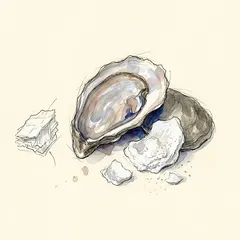
Oalcarea carbonica is found in nature, in form of chalk, marble, marl, plaster, crustaceae, mother-of-pearl, red and white corals, snail-shells, egg-shells, oyster-shells, and crab's eyes and claws of crabs. Crab's eyes are two hard pale-red bodies on the sides of the stomach. Physicians of the dominant school use chalk, conchae praeparataa and crab's eyes.
' Oalcarea acts upon definite systems, enveloping membranes ; upon the fibrous, mucous, serous, osseous, cutaneous, and abdominal nervous systems ; it is adapted to abnormal conditions of repro- duction; hence it is useful in scrofulosis and rachitis ; it is suitable for lymphatic constitutions, veuous-haemorrhoidal, plethoric individ- uals, and for such as are subject to blenorrhoea, glandular swellings, enlargement of the abdomen, profuse menstruation, hysteria, melan- cholia. It is more adapted to children and women than to men.
CEREBRO-SPINAL GROUP.
Dr. Schreter has cured chronic headache in the case of a scrofu- lous patient ; the headache was worse during exercise in the open air, by change of weather and by some violent emotion.
HYSTERIC HEMICRANIA, with eructations, nausea and feel- ing of coldness in the head.
MENSTRUAL HEADACHES, with pallor of the face and cold- ness in and on the head ; throbbing headache, headache extending from the occiput to the vertex, worse from exertion, stooping, walk- ing; relieved by external pressure and the application of cold ; empty eructations, nausea, profuse menstruation. It is useful in the treat- ment of
HYDROCEPHALUS in scrofulous, badly nourished children of
CALCAREA CARBONICA. 6^3
light complexion, with open fontanelles, heavy perspiration on the head and face, often saturating the covering of the pillow. During dentition.
ORBITAL GROUP.
Oalcarea has caused a pressure and burning in the eyes, with red- ness and sensation as of a foreign body in the eyes. Swelling and redness of the eyelids, with ulceration and suppurative aggluti- nation over night. Profuse lachrymation in the open air (epiphora). Photophobia, dimness and specks of the cornea (leucoma).
SCROFULOUS OPHTHALMIA. — In accordance with these effects of calcarea this agent has been used in scrofulous ophthalmia with lachrymation, eruptions around the eyes, photophobia, aggluti- nation of the lids, stinging pains, twitching of the lids. It has also been used for
SCROFULOUS BLEPHAROPHTHALMIA, with swelling, red- ness and scurfmess of the lids; leucoma of the cornea, specks of the cornea, photophobia ; epiphora, profuse lachrymation in the open air.
In these affections, old-school oculists have used lime-water on account of its astringent properties. On this account Richter recom- mends it for hypopyon (purulent eye), and Beer used injections of lime-water in fistula lachrymalis.
AMBLYOPIA. — Calcarea has likewise been useful in amblyopia, amaurotic weakness, with dimness of vision, sparks, presbyopia.
A woman of sixty-six years, who had been troubled with weakness of sight for some years past, accidentally got some lime-water into her eye. Very soon after this accidental medication, she fancied she saw more light ; she therefore continued the use of the lime-water, and her sight improved so that she was able to use her eyes without experiencing the blurs which had troubled her so much,
AURICULAR AND FACIAL GROUPS.
SCROFULOUS OTORRHCEA.— ^Egidi has used calcarea in scrof- ulous otorrhoea and for deafness setting in after suppression of fever and ague.
SCROFULOUS NASITIS.— Calcarea is recommended for a variety of affections of the nose, where it has effected total or partial cures. Scrofulous nasitis, with swelling, redness and painf illness of the nose ; ozoena, with discharge of green and yellowish pus from the nose ; anosmia, loss of smell, with dryness of the Schneiderian membrane.
DENTAL AND BUCCAL GROUPS.
TOOTHACHE. — We use calcarea for toothache of pregnant women.
624 CALCAREA CARBONTCA.
DIFFICULT DENTITION".— Calcarea causes heat and swelling of the gums, with throbbing and sensitiveness to contact ; ptyalism.
CHYLO-POIETIC GROUP.
Eichter, Vogt and Huf eland testify to the fact that 'the use of the carbonate of lime causes loss of appetite, and from my own experi- ence I can assert that it causes a rising of an acrid alkaline fluid off the stomach. It also causes distention of the bowels ; large doses cause constipation ; small doses may loosen the bowels as a sign of organic reaction.
In accordance with these indications we give calcareafor
ANOEEXIA, as a sign of scrofulosis, particularly in the case of young girls; they manifest a perfect indifference to food, a complete atony of the mucous membrane of the stomach, with depression of spirits, loss of flesh, debility ;
PYEOSIS, acrid rising off the stomach, of an alkaline character;
CAEDIALGIA, with pressure at the stomach, vomiting of food, burning at the stomach;
VOMITING OF MILK, in the case of little infants; the milk comes np again curdled ;
STATUS GASTEICUS, with slimy mouth, slimy coating on the tongue, insipid taste in the mouth ;
OHEONIC CONSTIPATION, with swelling of the bowels ;
DIAEEHCEA, slimy, badly-smelling, particularly in the case of children during dention ;
COLLIQUATIVE DIAEEHCEA in consumption, gastromalacia ; here it may act as a palliative.
URINARY AND SEXUAL GROUPS.
Calcarea seems to excite the sexual desire, cause erections, nocturnal emissions; hence we use it for such weaknesses. We have also treated with it
BUENING ULCEES OF THE GLANS, stitches in the glans, inflammation of the prepuce, with heat and pain.
LEUCOEEHCEA. — In the diseases peculiar to women, calcarea carbonica plays an important role. It causes leucorrhoea, burning and itching, and moisture about the genitals. The discharge is milky or albuminous; there may be emaciation, weakness in the chest, too early and too profuse menstruation, scrofulous diathesis, damp feet, relaxation of the entire system.
METRITIS. — Eaue recommends it in metritis of fat persons with
CALCAREA CARBONICA. 625
characteristic menstrual derangements; they sweat easily about the head, and are troubled constantly with cold and damp feet. Chronic affections of the womb. The same author gives the following as indicative of its use in
UTERINE DISPLACEMENTS: pressing on the uterus; aching of the vagina; stinging in the os uteri ; menses appear too soon and are too profuse ; milk-like leucorrhcea ; inclination to perspire easily about the head; great liability to strain a part by lifting; easily tired by bodily exertions ; dizzy and easily exhausted by walking up-stairs; even talking weakens her ; great susceptibility to catch cold; the feet feel most of the time damp and cold, or else the soles of the feet are burning hot; great desire for hard-boiled eggs; big-belliedness; scrof- ulous diathesis.
In the various menstrual derangements, at any period of life, this remedy may be used to the advantage of the patient. The symptoms which indicate its use are: too early, too long and too profuse mens- truation; cold and damp perspiration of the feet; of especial value in fleshy women of light complexion.
RESPIRATORY GROUP.
Calcarea' causes a feeling of roughness of the larynx; in phthisicky patients, large doses of calcarea tighten the cough and cause oppres- sion. It also causes a painful sensitiveness of the chest, oppression, dyspnoea, cough, with yellow or green fetid pus, haemoptysis, a tuber- culous and purulent condition of the lungs. Gmelin says, in his History of Mineral Poisons, workers in lime have pleurisy, spitting of blood, slow phthisis and ulceration of the lungs ; and Stenzel writes, women who were employed in scratching lime from walls, were attacked with chlorosis, pulmonary phthisis and induration of the intestines.
"I prefer this remedy (calcarea carbonica) in cases of women who, up to the time of development of phthisis, have been troubled with irregular menstruation, the discharge coming on too early and every two weeks, and lasting too long, at the same time being too profuse. If the patient is up and about, she cannot ascend the stairs without getting completely out of breath and becoming dizzy. The patients who require calcarea carbonica lose flesh rapidly, and there is constant tendency to looseness of the bowels, attended with prolapsus recti.
She is also troubled with hoarseness, especially in the morning; it is painless, but she cannot speak, the voice is lost. The whole chest is intensely painful to touch. On waking up in the morning she feels
VOL. I. — 39.
626 CALCAREA PHOSPHORICA.
exhausted, and continues to doze even after getting up on her feet. There is also present melancholy in the highest degree." (Dr. 0. 0. Smith in Medical Investigator, Dec, 1873.)
EXANTHEMATOUS GROUP.
Oalcarea may be found useful in chronic urticaria. Tinea capitis, with failing off of the hair. Chronic rash and eczema, with burning, which Hufeland cured with an ointment consisting of equal parts of lime-water and almond oil. Gutta rosacea in the face, complicated with dyspepsia.
Orusta lactea, having assumed a chronic form. Humid scurfy eruptions and herpes, with burning distress, exudation of a sero-albuminous fluid ; eczema impetiginosum and pemphigus, when accompanied by derangements in the urinary system. Oalcarea has likewise been given for panaritia, soreness of children, boils, scrofulous ulcers, scrofulous ulceration of the hip and knee-joints, steatomata, encysted tumors, and glandular enlargements.
FEVER GROUP.
In hectic fever with night-sweats ; more particularly as an accom- panying symptom of phthisis, calcarea may diminish the exhausting sweats. In the affections to which calcarea is homoeopathic, the presence of a depressed condition of the mind is an additional indi- cation for its use.