 Ομοιοπαθητική Βιβλιοθήκη
Digitalis Purpurea
Hempel - Materia Medica and Therapeutics · Charles Julius Hempel · 42,846 χαρακτήρες
 Όλα τα βιβλία για Digitalis Purpurea →
Αντιδοτείται απόApis MellificaCalcarea CarbonicaCamphoraChloralum HydratumCinchona OfficinalisEtherumMyrica CeriferaNitricum AcidumNux VomicaOpium
Όλα τα βιβλία για Digitalis Purpurea →
Αντιδοτείται απόApis MellificaCalcarea CarbonicaCamphoraChloralum HydratumCinchona OfficinalisEtherumMyrica CeriferaNitricum AcidumNux VomicaOpiumGeneral EN
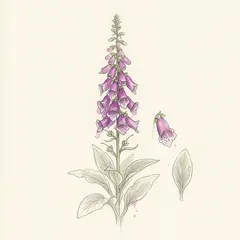
[PUEPLE FOX-GLOVE. NATURAL ORDER, SCROPHULARIACE^J.]
Stem from three to five feet high, upright, leafy, roundish, pubes- cent or downy. Leaves alternate, between egg-shaped and spear- shaped, crenate, downy, veiny, of a dull-green above and whitish underneath ; flowers large and handsome, in long terminal spikes or clusters, pendulous and leaning all one way ; corolla of one petal, purple, sometimes white, marked on the inside with blood-colored spots and hair.
It is commonly found in pastures, woods and on banks, in a gravelly or sandy soil. From the leaves we prepare a tincture of a dark brown-green color, nauseous, slightly acrid.
We use the leaves of the second year, which are gathered previous to the period of flowering. •
According to Noack and Trinks, digitalis affects principally the sympathetic nerve and the cardiac plexus. We obtain from it an alkaloid : digitaline.
It is a well-known fact that digitalis affects the pulse in a remark- able manner. According to some it depresses, according to others
DIGITALIS PURPUREA. 61
it stimulates the pulse; it likewise causes an intermission in the beats of the pulse. After relating some of the most characteristic effects of digitalis, I will endeavor to account for this apparent antagonism.
In the Edinburgh Medical and Surgical Journal, vol. viii., p. 148, the following case is reported by Dr. Henry :
Dr. W. Henry was called, in October, 1 800, to assist a woman who had taken an over-dose of a decoction of fox-glove. It was prepared by boiling two handfuls of the leaves in a quart of water, and then pressing the mass so as to expel the whole of the licpior.
Of this she drank two teacnpfuls at 7 a. m., amounting in the whole to not less than ten ounces by measure. Before eight o'clock she began to be sick, and vomited part of the contents of her stomach. Enough, however, was retained to excite vomiting and retching throughout the whole of that and the following day, during which every thing that was taken was instantly rejected. In the intervals of sickness, she was excessively faint, and her skin was covered with a cold sweat.
The tongue and the lips swelled, and there was a continual How of viscid saliva from the mouth. Very little urine was voided on the day she took the digitalis, and on the following days the action of the kidneys was entirely suspended. When Dr. Henry saw her, which was forty-eight hours after she had taken the poison, the tongue was white, the ptyalism continued, though in a less degree, and the breath was fetid.
The pulse was low, irregular (not exceed- ing 40), and after every third or fourth pulsation, an intermission occurred for some seconds. She complained also of general pains hi the limbs, and cramps in the legs. By the use of effervescent draughts, and ether, with ammonia, she gradually recovered her im- perfect health. This patient had not taken any mercury, so that the ptyalism was entirely attributable to digitalis.
These effects of digitalis bear strong evidence of the acrid and narcotizing virtues of this drug. Its irritating action upon the digestive organs is evidenced by the swelling of the tongue, and the vomiting, by the Avhite coating on the tongue, the flow of saliva and the fetid breath. Its depressing action upon the ganglionic system by the faint feeling, and the pains in the limbs and cramps in the legs. Its paralyzing action upon the heart by the slow and inter- mittent pulse ; audits remarkable action upon the urinary organs by the entire suppression of their habitual secretions.
All these symptoms constitute precious indications for the use of digitalis in several important disorders.
In another case, six ounces of a strong decoction were taken as a laxative early in the morning. Vomiting, colic and purging were
62 DIGITALIS PURPUREA.
the first symptoms; in the afternoon lethargy supervened; about midnight, the colic and purging returned ; afterward general con- vulsions made their appearance. At an early hour of the succeeding morning, the patient was found violently convulsed, with the pupils dilated, and insensible, and the pulse slow, feeble and irregular; coma gradually succeeded, and death took place twenty-two hours after the poison was swallowed. The post-mortem appearances are very imperfectly recorded in this case.
This case, which has been extracted from Christison's work on Poisons, shows the acrid and narcotizing virtues of digitalis in a most marked manner; the principal symptoms in this case being: vomiting, colic and purging; convulsions, with dilatation of the pupils, insensibility, slow, feeble and irregular pulse, and gradual supervention of coma.
Another interesting case is recorded in a French medical journal by Dr. Bidault de Villiers :
A Pole, fifty-five years of age, afflicted with humid asthma, took about one drachm of digitalis by mistake, instead of a grain of the powdered leaves. An hour after, he ate some soup, which he imme- diately vomited. The vomitings continued, accompanied with vertigo, so that he could not stand upright nor distinguish objects. The whole day he had violent bilious and mucous vomitings, accom- panied with great depression and abdominal pains, which were dimin- ished by two emollient injections.
These symptoms continued the whole of the next day and night. The patient was still further depressed ; the pulse was slow and intermitting : and this symptom continued with but little alteration to the ninth day, when it disap- peared. At this time, the vision was still confused, the fire appeared to him of a blue color ; and on the fourteenth day this symptom ceased. The cough and asthma left him.
In this case we again distinguish, as in the former cases, the remarkable effects of digitalis upon the brain, the bilious and di- gestive functions, upon the pulse, and likewise upon the sense of vision. We have bilious and mucous vomitings, and abdominal pains ; ver- tigo, prostration of strength, slowness and intermission of the pulse, confusion of sight, blue color of the fire.
Blackall, in his Observations on the Nature and Cure of Dropsies, reports the following case of poisoning with digitalis :
A man, sixty years old, was subject to irregular gout and dyspepsia, considerable dyspnoea, legs oedematous and spotted with a few pe- techias. Half an ounce of the tincture of digitalis was given daily for some time, and then in lesser quantities. During the use of no
DIGITALIS PURPUREA. 63
more than two drachms of the infusion daily, a pain came over one of his eyes. He complained of great disturbance of his brain, which he himself referred to the draughts, and within twenty-four hours this symptom was followed by a watery, exhausting 'diarrhoea and low delirium. General convulsions speedily ensued, in which there was complete insensibility, and foaming at the mouth, with an almost total cessation of the action of the heart. From this state he was recovered by an opiate injection.
Similar paroxysms returned two or three times during the next three weeks. In the intervals, he became forgetful, delirious, and felt much pain in his head. The anasarca totally disappeared, discovering the most ex- cessive emaciation ; his posture in bed became nearly natural, and in one of these convulsions he expired.
In this case, digitalis developed more intense effects in the brain for the reason, probably, that the general vitality of the patient was at a low ebb. The complete absence of nervous reaction is exhibited by the almost total cessation of the beats of the heart, by the exhausting, watery diarrhoea, by the low delirium ; and it is more- over evident, in this case, that digitalis produces its constitutional effects by acting upon the brain, so much so that the patient him- self was conscious of this circumstance.
Professor Jcerg subjected the fox-glove to a series of interesting experiments. He was assisted in his experiments by seven male members and one female member of his Pro vers' Society. In all of them, the drug affected the brain, causing a vertigo somewhat resembling intoxication, a feeling of dullness, a sort of stupefaction of a milder form, and in most of them an headache in the region of the occiput, vertex, forehead and temples. In some of them this headache was very distressing and lasted for several days.
In one case the pain amounted to a stitching.
Another remarkable effect of the powdered leaves was a peculiar alteration in the pulse. The pulse was not slow and intermittent, but rather accelerated and small ; only in the case of one of the pro vers who seemed to be exceedingly sensitive to the action of the drug, the frequency of the pulse was temporarily diminished. The experiments were conducted with one, two and three-grain doses of the powdered leaves. Small quantities of the drug do not seem to develop its primary action upon the pulse, which consists in depress- ing the heart's action ; this effect can only be reached by massive doses of from thirty to fifty grains, except in very sensitive indi- viduals.
Hence so far as the pulse can yield therapeutic indications,
64 DIGITALIS PURPUREA.
digitalis is indicated either by a slow, undulating, intermittent, or by an accelerated, small and rather unequal pulse.
Hervieux found that digitalinum, the active principle of digitalis, affects the pulse in a remarkable manner. If the pulse is regular, it causes irregularity of the pulse. If the pulse is irregular, it removes the irregularity, substituting regularity in its stead. < And if the pulse intermits irregularly, at one time intermitting after the sixth, at another after the eighth, and then again after the fifteenth beat, it regulates the intermissions, causing them to take place at fixed intervals.
Another remarkable effect of digitalis developed by Jcerg's provers, was an increased secretion of urine. In almost all of them the quantity of urine secreted in a given time exceeded considerably the normal standard. In some, the bladder always felt full, a sensation that would persist even after an emission. The urine was watery and light-colored, except in the case of one prover, where the urine looked darker and deposited a red sediment, the nature of which is i.ot indicated.
In the case of the woman, this profuse flow of the irine was attended with a stitching pain in the region of the kidneys.
Another very remarkable effect of the drug was to cause an extra- ordinary excitement of the sexual organs, which was accompanied in one case with itching of the glans penis and distressing erections. This sexual excitement became so troublesome to one of the provers that he had to discontinue the trial for a few days.
The gastric functions were likewise affected. In one case, the drug caused thin diarrhceic stools ; in several provers the craving for food was abnormally increased ; in one, whose extraordinary sensi- tiveness to the action of digitalis I have already alluded to, it caused loss of appetite, complete anorexia, which constitutes one of the primary effects of fox-glove. Eructations, rumbling in the bowels and colicky pains were likewise complained of. Burning in the oesophagus, sometimes emanating from the stomach, was a common symptom.
In some of the provers, this burning was accompanied by a scraping sensation. Joerg experienced a sensation as if the upper part of the pharynx were swollen, or pressed upon the tonsils. He felt this burning in the oesophagus very keenly ; in his case this burning and scraping invaded even the air-passages.
Lastly, we have to allude to the remarkable manner in which digi- talis affected the sense of vision. In all of them it caused a dimness,
DIGITALIS PURPUREA. 05
objects looked blurred. Some experienced a sensation as if objects were not seen in the right light. Others saw sparks flying through the air. Diplopia or doublc-sightedness was likewise developed. A very common effect of digitalis upon the retina is to cause a sensa- tion of dazzling, similar to what is experienced when suddenly look- ing out of a dark room into bright daylight. This sensation was felt by one of the provers.
Upon analyzing the effects of digitalis as far as they have been presented, both from large and small doses, we cannot fail to be struck by the fact that they all seem more or less connected, and traceable to a common origin. Digitalis first acts upon the organ- ism where the brain, in its inmost principles of quickening vitality, connects itself with the ganglionic system of nerves. We notice a remarkable similarity between the action of digitalis and aconite. Both digitalis and aconite depress the pulse, irritate the urinary organs or arrest the flow of urine, cause cerebral congestions, disturb the intestinal secretions, the functions of the liver.
Yet there is a vast difference between these two agents. Aconite affects the organs directly through the ganglionic system ; digitalis reaches them from a more remote, as it were, though deeper, more interior point. Aconite acts from some point in the periphery of the organism ; digitalis from some point near the centre of the vital forces. Hence it is that the action of digitalis is more permanent, because more searching, than that of aconite.
Hence again, the signs of reaction, in the case of aconite, are more violent, for the time being, than those of digitalis ; they are seen on the surface, and soon spend their force. Aconite depresses the pulse and even disturbs its rhythm, causing irregularities and intermissions ; so does digitalis. But during the reaction, the aconite-pulse becomes full, strong, rapid and bounding, whereas the digitalis-pulse simply increases in frequency, but remains weak and unequal. Aconite never destroys life sud- denly, digitalis may strike down a man predisposed by disease, with the suddenness of a flash of lightning.
CEREBRO-SPINAL GROUP,
Digitalis has caused: Weakness of memory; mental depression; apprehensiveness ; drowsiness. Vertigo, with trembling, with anxiety as though fainting would occur, with very slow pulse. Throbbing headache in the forehead ; pressive pain in the forehead, occurring m paroxisms ; headache with fulness and weight, as if caused by
06 DIGITALIS PUEPUEEA.
congestion of blood to the head. Sudden cracking noise in the head. Severe stitching pain in the head. We may use digitalis in various forms of
HEADACHE, with similar symptoms. The remedy is quite apt to act promptly when well-marked gastric disturbances exist or when we find profuse and frequent urination. The heart-symptoms (i. e., irregular, slow, intermitting pulse or else small, unequal and very rapid pulse, excited by the least movement) are of the greatest value.
VERTIGO with momentary loss of consciousness, heat in the face and head ; slow and intermitting pulse.
FAINTING TURNS with vertigo, pale and bloated face, charac- teristic heart symptoms.
SPECIAL SENSES.
The action of digitalis upon the sense of vision is exceedingly marked and varied. We see it stated that digitalis causes, "an in- flammation of the Meibomian glands." We might recommend digitalis for
GRANULAR OPHTHALMIA, also with smarting lachrymation and painful pressure in the eyeballs.
The inflammatory action of digitalis upon the eye is compara- tively unimportant ; the alterations which this agent causes in the functions of the retina, are far more interesting.
The members of Joerg's Pro vers Society were all more or less affected by the fox-glove in this direction ; they experienced dimness of sight ; sensation as if objects were not seen in their right light ; sensation as if sparks were flying through the air; diplopia; dazzl- ing, as when suddenly looking out of darkness into bright light.
Hahnemann has recorded a number of remarkable symptoms showing that digitalis powerfully affects the sense of vision.
In several cases digitalis has caused
AMAUROSIS, with excessive dilatation of the pupils. This symptom is more particularly valuable in cerebral affections where digitalis may seem indicated, such as dropsy of the brain.
DIMNESS OF SIGHT or amblyopia, is a common effect of digitalis. Objects look misty, as if seen through a cloud.
MUSCLE VOLITANTES, an amaurotic symptom, constitute one of- the effects of digitalis.
OPTICAL PHANTASMS and illusions of color or chromatopsia
DIGITALIS PURPUREA. 07
are likewise common. On awakening in the morning, lie fancies that everything is covered with snow. Objects look green, red or yellow; this symptom is even perceived in the twilight. The faces of people look pale like those of dead persons.
LUMINOUS BODIES are seen dancing before the eyes when covering them with one's hands. All these symptoms are valuable as characteristic features in amaurotic conditions of the eyes. It is doubtful whether in cases where digitalis may be required, they will ever be found to exist without some strikingly corroborative alter- ation in the pulse.
Purkinge experienced a peculiar sensation, a sort of optical phos- phorescence, as when lines are drawn with phosphorus in the dark, wln'ch are vibrating toward each other and increasing or decreasing at intervals, as regards intensity. The experimenter argues that these phenomena are sympathetic in their nature, and should be attributed to a primary irritation of the pneumogastnc nerve.
THORACIC GROUP.
Hahnemann reports : Hoarseness ; bloody cough ; feeling of raw- ness and stitches in the chest ; painful, suffocative constriction of the chest, as if the internal parts were all adhering. Jcerg gives : Roughness and smarting sensation in the trachea. We have also : Painful shortness of breath ; contractive pains in the region of the sternum ; tickling, dry, spasmodic cough, with thick, slimy expecto- ration.
COUOH. — We may then prescribe digitalis for cough with hoarse- ness and expectoration of thick, slimy mucus, of sweetish taste, like boiled starch ; hollow cough, with roughness in the throat and raw- ness and stitches in the chest ; night-sweats ; cough after eating ; great prostration ; loss of appetite. In I
PNEUMONIA digitalis has been extensively used by old school
practitioners. The following interesting case has come under our
notice :
A lady of thirty years had been troubled with a hacking cough for several months. One morning she exposed herself to a keen blast from the northwest, and shortly after was seized with a succession of chills, which proved to be the beginning of an attack of compound pneumonia. The lady was afflicted with dilatation jf the right ventricle; her pulse was habitually weak, slow, irregular and intermittent. After the pneumonia had fully set in, the pulse changed to a rather full and tolerably hard pulse, and became more regular, numbering about ninety beats in a minute.
She suffered a great deal of acute distress in both sides of the chest ; dyspncea was ex- treme ; she raised small quantities of rusty sputa after every paroxysm of cough, which was exceedingly painful and of a phthisicky chai-acter, as if the lungs would be torn to pieces. The patient was put on the use of digitalis, five drops of the
68 DIGITALIS PURPUREA.
tincture in a goblet of water, of which solution a dessert spoonful was given every hour ; the quantity of the tincture was gradually increased to ten drops in the same quantity of vvater. On the ninth day resolution set in with a drenching perspiration, and a return of the pulse to its habitual soft, weak and intermittent character. Tartar emetic was now substituted for digitalis and the patient made a perfect re- covery.
The effects of digitalis upon the heart are of the greatest practical interest. The following summing up of its physiological action is given by Dr. H. 0. Wood (Therapeutics, Mat.
Med. and Toxicology, page 134) : Digitalis in moderate doses stimulates the musculo- motor portion of the heart (probably its contained ganglia), increases the activity of the inhibitory apparatus, and causes contraction of the arterioles probably by an action on the vaso-motor centres in the cord. As a consequence of the first action, the cardiac beats become much stronger ; as the result of the last, there is narrowing of the blood-paths, and to the passage of the vital fluid an increased resist- ance, which, acting on the already excited inhibitory system, aids in the slowing of the pulse.
Toxic doses of digitalis paralyze or weaken, more or lesr completely, eacli of the three systems, and cause rapidity of the pulse and falling of the arterial pressure. According to my own experience, decided therapeutic doses of digi- talis, in man as in other mammals, produce great reduction and sometimes dicrotism of the pulse, and increase the size and force of the wave ; at the same time the arterial tension is augmented. Poisonous doses induce, after a time, increase of the pulse-rate, with smallness and weakness of the wave and lowered arterial pressure.
In the Journal Universel, the case of a lady is reported who was under treatment for epilepsy, and who took several pints of an infusion of digitalis. Among other symptoms the medicine caused : a feeling of embarrassment behind the sternum gradually increasing to an oppression that became more and more distressing ; ver- tigo, inability to continue a conversation that had been jegun; blackness of sight; beats of the heart large, fill, energetic, shaking the chest, slower than usual ; or else the beats became suddenly more frequent and in this case less violent than before.
Dyspnoea constantly increasing, excessive paleness of the face, feeling of coldness and aumbness in the extremities, uncontrollable desire to inhale fresh air. The patient complained neither of nausea nor thirst. In a few hours after taking the drug, the patient was able to indicate the number of the heart's contractions within a given time. For five or ten minutes the heart beat forty or forty-two, and then again one hundred and twenty or one hundred and twenty-five times a minute; the inspirations amounted to forty or forty-eight in the minute.
The pupils were dilated, but their contractility was not impaired. The respiratory murmur was universally feeble and incomplete, resonance of the chest normal, sounds of the heart audible over the whole region. The patient was only able to lie on her back with her head very much raised, violent headache, but her understanding perfectly clear. In the epigastric region the patient felt very large and strong pulsations, probably emanating
DIGITALIS rUEPUKEA. GO
from the coeliac artery ; two inches below the region where these pulsations were felt, they seemed much weaker, but they increased in volume and strength in pro- portion as the beats of the heart became slower and stronger. Her desire for open air became more and more urgent. A few hours after, her breathing was very short, more frequent, all 'he inspiratory muscles were laboring tumultuously (the patient stated afterward, it had seemed to her as if the quantity of air that entered* the lungs was n»t sufficient and that she would not be able to live if this condition con- tinued). The beats of the heart became alternately slow and frequent; the dyspnoea continued ; she obtained most relief from fanning
A lady of twenty- eight years was under treatment for pneumo-phthisis. She took considerable quantities of digitalis, and one morning exhibited the following symp- toms, which were distinctly attributable to the drug : sensitiveness of the stomach, especially to external pressure ; frequent nausea and one turn of vomiting ; sensation of pressure and drawing arising from the pit of the stomach toward the throat ; change of color in the face almost every second, from deathlike paleness to rose- color ; the tip of the nose, forearms, hands and fingers were quite cold ; respiration re?narkably slozv and occasionally intermingled zvith deep moans ; the expired air seemed quite cool ; no cough ; pulse 30, and exceedingly irregular, sometimes inter- mitting and then again bounding, jerking, sometimes filiform, but always soft.
Among the most reliable symptoms which indicate the use of digitalis we may mention : Strong, almost audible beat of the heart, with anxiety and contractive pains under the sternum. When raising the body, he feels a tension in the left side of the chest, as if these parts were contracted. Decrease of the frequency of the pulse, very great upon rising up to sit, after lying on the back. Soft, irregular, small, scarcely perceptible pulse.
Sudden sensation as though the head stood still, with great anxiety. Great weakness, even to fainting. The pulse is usually small, slow and irregular,, becomes accelerated and full from motion and intermits on the third, fifth and seventh beat. As concomitant symptoms we usually find : Oppression, difficult breathing, anguish ; painful constriction of the chest, irregular and difficult respiration, wTith tension in the chest and pressure in the pit of the stomach, frecpiently obliging the patient to draw a deep breath ; contractive pain in the sternum, aggravated by bending forward the head and the upper portion of the body ; dry, spasmodic cough ; sharp stitches in the right side of the chest, a little above the pit of the stomaoh.
DISEASE OF THE HEAET We find digitalis of the greatest
value, as a therapeutic agent, in the treatment of various diseases of the heart characterized by a group of symptoms which resembles those just described. Not only is the remedy frequently called for in functional derangements of the heart, but its use is often followed by remarkable improvement in organic diseases of the heart, when
70, DIGITALIS PURPUREA.
there exist the proper indications for the use of the remedy. Digi- talis may then be called for in the treatment of palpitation of the heart ; plethora of the heart, valvular diseases of the heart, dilata- tion of the ventricles of the heart ; hypertrophy of the heart ; and even in aneurism of the aorta, always provided that the characteristic indications for the remedy are present.
Mrs. B., a young married lady, had always enjoyed good health to within a year of my acquaintance with her, during which period she had been subject to frequent attacks of palpitation of the heart. About September I, 1853, having been exposed to cold and wet, she was taken with an acute pain in the hip-joint, which lasted about twelve hours, and then, as she expressed herself, " went to her heart," and for the fol- lowing six or eight weeks, she was afflicted with angina pectoris, and the following were her symptoms ;
Constant pain or anguish in the region of the heart, with more or less palpitation, at times the pain and palpitation were greatly aggravated, exercise of body and emotion of the mind caused an aggravation of her sufferings, but at times they were greatly increased without any apparent cause, while sitting perfectly at rest — such paroxysms were accompanied by sinking sensations ; her face becom- ing purple, and ending in syncope, she would assert that she was dying. She had constant dizziness of the head and ringing in the ears.
Sharp pain in the left shoulder and in the left arm, tingling in the arm and fingers; creeping all over her skin. Sometimes such paroxysms come on in the night, when it seems as if she were suffocating, wakes up in great anguish ; has also terrifying dreams. Bowels and menstruation regular; appetite good. After the use of spigelia, she received digitalis24 with immediate benefit and perfect relief in two weeks.
Physical exami- nation of the heart gave no evidence of organic disease or of functionary disturbance, except excessive action. (Dr. A. S.
Ball in the N. A. your, of Horn., Feb., 1857.)
A woman, aged twenty-five years, mother of six children, had been considered consumptive about ten years ago and received medical care in accordance, has suf- fered for five years as follows: sudden, violent motions, especially of the arms up- ward, are followed by an immediate sensation, as if the heart were fluttering to and fro or as if it had been torn loose ; this is followed by a few violent beats, then the pulse seems to stand still, and again it becomes hurried and irregular.
With it, she experiences an horrible consciousness of dying with fainting, but without loss of con- sciousness. Aside from these attacks the heart presents nothing abnormal. The pulse is usually 100, easily affected and excited. The sounds of the heart are per- fectly distinct, the movement of the heart can hardly be felt.
Otherwise she feels well. The attack is followed with lassitude which lasts about one day. The par- oxysms come on at odd times, no oftener than five or six times each year. After the use of various remedies she received for three weeks every other evening one grain of digitalin*.
Since then no return of the attacks. (Btehr on Digitalis, p. 218.)
A woman, aged forty-one years, has hypertrophy of the heart with dilatation of the right ventricle and insufficiency of the bicuspid and of the tricuspid. For some years menstruation has been irregular and often hemorrhagic; with it, great weakness, cachectic appearance, dropsy, etc. Slight hypertrophy of the liver. The movement of the heart can be clearly seen, fairly shaking the thoracic wall ; the first sound is strong, instead of the second there is a loud murmur, clearest at the base of the heart.
Arsenic and china relieved. Two years later: the last menstrual period has con- tinued from the first of June until the middle or July. The patient is obliged to keep an upright position. The countenance looks anxious, yellow, waxy and is expressive of suffering.
Breathing is heavy and somewhat hurried. Speech is almost inaudible and very exhausting. Pulse scarcely perceptible, very rapid. Extreme prostration, icy coldness in spite of the heat of summer and of warm covering.
Entire loss of appetite, extraordinary thirst. Slight lessening of the quantity of urine voided. For some clays frequent, watery stools. Violent pains, which cannot be located, in the entire body.
Constant uneasiness, apprehension of death. Almost complete sleep- lessness. Considerable general dropsy, so great in the labia that the escape of urine is almost prevented. Violent pulsation in the jugular veins; loud venous murmurs.
DIGITALIS rURPUREA. 71
The movement of the heart seems more like a stormy heaving than like separate beats. No sound of the heart can be distinguished ; in their place exist loud mur- murs. Prescribed digitalin8, one grain each day. After two weeks treatment the patient felt well and was able to do her own work. Two subsequent, similar attacks were also cured with digitalin. (lxehr in HirscheT 's Nenc Zeitschrift, vol. ii., 49.)
A very fat man, who had taken mercury very freely, became suddenly unconscious ; his face was distorted, somewhat cyanotic ; coldness of the face, tongue, hands and forearms as also of the forehead ; his features are distorted as if dying; one spell is followed by another ; he only whispers, " my heart, my heart " ; the heart beats are tremulous, feeble, intermitting. Aside from an enlargement of the heart, nothing abnormal could be discovered. Fatty derangement of the heart. Digitalis cured promptly.
(Bcenninger in Pr. M. S., vol. ix., 149.)
CYANOSIS. — Digitalis is also an excellent remedy in cyanosis, especially of small children, accompanied by orthopnoea ; chilliness, coldness, hoarseness, dry congh, bine color of the skin, especially of the eyelids, lips, tongue, nails ; motion brings on nausea, vomiting, fainting.
HYrDROTHORAX, depending upon organic lesion of the heart or accompanied by such heart-symptoms which point to digitalis.
DROPSY OF THE PERICARDIUM as a sequela of scarlatina or a symptom of cardiac disease.
ANASARCA with pale face, great weakness, intermitting pulse, cyanosis, asthma, difficult and scanty urination.
According to Dr. Withering who has treated upwards of an hun- dred cases of anasarca with digitalis, " it seldom succeeds in men of great natural strength, of tense fibre, of warm skin, of florid com- plexion, or in those with a tight and cordy pnlse ; on the contrary, if the pulse be feeble or intermitting, the countenance pale, the lips livid, the skin cold, the swollen belly soft and fluctuating, or the anasarcous limbs readily pitting under the pressure of the finger, we may expect the diuretic effects to follow in a kindly manner." These are pretty good homoeopathic indications for an allceopathic authority.
ASCITES with similar symptoms, especially if the disease depends
upon vascular derangements, such as menstrual irregularities, pain
and palpitation of the heart, spitting of blood, etc.
In the case of a lady, where the disease had reached a very high degree of develop- ment, of four months' standing, the abdomen being enormously swollen, with oedema of the lower extremities, pulse very thin and rapid, (about one hundred and twenty in the minute,) discharge of a sanguinolent serum every few weeks from the vagina, a radical cure was effected within three weeks by giving her five drops of the tincture of digitalis in twenty-four hours, and gradually increasing this quantity to fifteen drops. The menstrual discharge became perfectly regular and the dropsy disap- peared permanently.
ASTHMA accompanied with the characteristic pulse of digitalis,
72 DIGITALIS PURPUREA.
intermitting at the third, fifth or seventh beat; characteristic heart- symptoms ; slow respiration ; paroxysms come on in the morning, especially in cold weather.
CHLOROSIS with well-defined heart-symptoms pointing to digi- talis ; the urine is either scanty, containing a deposit of albumen, or else it is profuse and clear. Venous murmurs
CHYLO-POIETIC GROUP.
Digitalis exerts a marked effect upon the digestive apparatus. It causes: insipid, slimy taste; loss of appetite, nausea, sickness at the stomach with faintness, thirst for sour drinks ; extreme thirst ; sali- vation, nausea, retching, spasmodic hiccough ; contraction from the cardia to the middle of the oesophagus, preventing even the passage of liquids beyond this point ; the passage of liquids from the mouth to this point in the oesophagus was accompanied by a sensation of coldness in those parts.
Deathly nausea, accompanied by extreme anxiety and sensitiveness in the epigastrium. Vomiting of food, slime and large quantities of bile ; eructations of sour taste : rumbling in the bowels, accompanied with griping pains in the bowels. Constipation, followed by diarrhoea of ash-colored, slimy, greenish stools. 'These symptoms are accompanied with great weak- ness, faintness,* prostration and the characteristic heart-symptoms.
PYROSIS. — Digitalis may be of use in the treatment of pyrosis, dysphagia and
GASTRIC DERANGEMENTS characterized by a train of symp- toms, resembling those already described. Usually Ave find in cases where digitalis is indicated an irritation of the urinary or circulatory apparatus ; the condition of the heart (pulse) deserves especial attention.
In June, 1867, I was called to visit a lad of sixteen years of age. He had been sick about a year. Three or four physicians in turn had treated him, but with no benefit. He was slender and very much emaciated, though able to dress himself and walk about.
The case presented the following symptoms : Some appetite for food, but as soon as he ate, no matter what, it soured and regurgitations commenced. lie spit it up by mouthfuls, as he expressed it, "sourer than any vinegar." After his stomach was emptied, he had a terrible pain and uneasiness in the stomach, which lasted one. or two hours. Every time he ate, there was the same repetition of symp- toms. The bowels were not seriously constipated. I gave calcarea, carbo veg., acid, sulphuricum, sulphur, and other remedies in succession for four or five weeks, with no benefit.
The boy was growing weaker and I began to despair of curing him. I now observed his pulse was very slow, and he had a cold and blue look, and the surface and extremities were cold. This led me to prescribe digitalis. The remedy acted like a charm.
In a week he was nearly well ; in six weeks he was strong, healthy and fleshy, and remained so. He is now a strong, healthy man. (Dr. J.
L. Gage in the American Homccopathist, February, 1878.)
MERCURIAL PTYALISM, with discharge of ropy saliva, swell-
DIGITALIS PURPUREA. 73
ing of the tongue, fetor of the mouth, sensation as if the walls of the pharynx were swollen.
CARDIALGrIA, with abnormal craving for food, or complete ano- rexia ; crampy or pulling pains in the stomach ; heat in the stomach ; sensation of weight in the stomach, with prostration and faintness, which may become extreme ; eructations of sour fluid ; vomiting of bile.
DIARRHlEA with white-coated tongue, faintness at the stomach, pinching pains in the bowels, characteristic heart-symptoms.
^NTEIUTIS with excessive tormina, discharge of mucus and blood, violent tenesmus; feeble, small, unequal and soft or full, but soft, intermittent, irregular and slow pulse.
JAUNDICE is one of the remarkable effects of the peculiar action of digitalis upon the liver. The stools look ash-colored and may either be perfectly dry, like the excrements of dogs, ,or liquid and papescent. In jaundice where digitalis is indicated, we shall again find that the pulse shows symptoms of intermission and abnormal frequency. The patient complains of a bitter taste in the mouth, headache, dizziness, nausea ; the urine is thick and has a brownish appearance.
In a case of so-called "black jaundice" a brilliant cure was effected with the fluid extract of digitalis. The patient was a middle-aged man, whose father had recently died ol cirrhosis. The patient had the appearance as if he had been painted from the vertex to the soles of the feet with a dark-yellow paint ; even his tongue had this remarkable appearance. The urine looked like a mixture oi dark -yellow loam and water; the pulse numbered from thirty -five to forty beats in the minute; it was inter- mittent, very full, but undulating.
The patient took dessert-spoonful doses of a mixture of ten drops of the fluid extract of digitalis in a pint of water, one dose every hour; the quantity of the extract was gradually increased until he took fifteen drops in a pint of water. Perfect recovery took place in three weeks.
URINARY AND SEXUAL GROUP.
TRe following symptoms are especially worthy of note : Frequent urging to urinate, with scanty discharge of dark, turbid urine and bearing down toward the bladder ; increased urinary secretion with cutting sensation in the bladder ; urination with scalding ; frequent and very copious urination.
ENURESIS. — This remedy may be useful in enuresis with char- acteristic gastric derangements and pulse.
INFLAMMATION OF THE NECK OF THE BLADDER, with strangury, burning, scanty, turbid urination ; deposit of a thick blood-red sediment.
DIABETES INSIPIDUS with frequent voiding of large quan- tities of clear, pale urine ; heavy specific gravity of the urine ; char-
74 DIGITALIS PURPUREA.
acteristic pulse and gastric derangements ; great debility upon the slightest exertion ; heaviness in the head, vertigo.
Small doses of digitalis cause violent sexual excitement; large closes depress the sexual power. In men we find: erections, emission of semen or of prostatic fluid; pain in the testicles; in women: bearing-down uterine pains, premature menstruation.
AMENORRHCEA. — Digitalis has been employed in amenorrhcea with characteristic gastric disturbances; anasarca; scanty urination and voiding of dark, turbid urine; dry, spasmodic cough; character- istic pulse.
UTERINE HAEMORRHAGE (PASSIVE), of women who have been ailing for a long time with heart-trouble, which point to digi- talis; mental and physical depression; vertigo; characteristic gastric derangements; waxy color of the face; emaciation; difficult breath- ing ; swelling of the feet with scanty urination.
FEVER GROUP.
Digitalis has caused: Coldness of the limbs. Internal coldness in the whole body. Coldness of the fingers, palms of the hands and soles of the feet, or first of the arms and hands, then of the whole body. Extreme sensitiveness to cold.
Chilliness, mostly in the back. Feverish shivering, followed by heat, after which profuse perspiration. The pulse, which had become slower, is accelerated again by the slightest movement of the body. Sweat during sleep.
Slight sweat all over, on waking in the morning. Warm sweat in the palms of the hand.
Digitalis is of value only in the treatment of fevers which accom- pany some acute inflammation and have the characteristic digitalis- pulse.
INTERMITTENT FEVER.— It is also, occasionally, indicated in intermittent fever, with the characteristic pulse, great coldness and sensitiveness to the cold, heat without thirst, sudden flushes of heat followed by weakness of all the parts, heat in one hand and coldness in the other, sweat immediately after the chill, night sweat, cold sweat on the body and warm sweat on the palms of the hands. The tongue is clean or coated white. Loss of appetite. Desire for sour drinks.
MENTAL GROUP.
We have, under digitalis, a mind desponding and fearful. Auxious- ness, with great apprehension of the future, greatest in the evening (six o'clock), with sadness and weeping, which relieve. Internal
DIOSCOREA VILLOSA. 75
anguish, as if he had committed a crime. Fear of death. Gloomy and out of humor. Inclination to solitude. Great irritability ; the smallest trifle is capable of driving him to despondency and despair. Secondary effect: Peaceful, calm mood. Weakness of memory; dullness of the head, with very limited power of thinking, or as if one had been intoxicated, with increase of cerebral action. Vertigo after rising from a seat. Vertigo and trembling. These symptoms indicate digitalis in
HYPOCHONDRIA, which may even amount to
INSANITY. "We use it mostly when the patient is in a dull, lethargic condition; the pupils are dilated to their widest, yet all sensibility to light or touch seems lost ; the pulse is full, regular, or but slightly intermittent, and very slow. The slow pulse is the grand characteristic, and upon this indication digitalis may be given with much assurance that relief will follow speedily, if relief be pos- sible. We notice that the digitalis patient, when rallying from his melancholic stupor, often moans a good deal, and his eyes are all afloat in tears.
Relief, however, speedily follows this bursting of the lachrymal fountains." (Dr. S. H. Talcott, Horn.
Times, April, 1879).
In a case of poisoning with digitalis we evacuate the stomach and bowels and then stimulate the patient with alcohol or ammonia. Rest in the horizontal position is to be insisted upon. Tannic acid may be freely used.