 Ομοιοπαθητική Βιβλιοθήκη
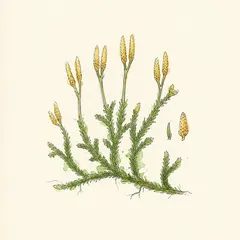
Lycopodium Clavatum
Hempel - Materia Medica and Therapeutics · Charles Julius Hempel · 44,528 χαρακτήρες
 Όλα τα βιβλία για Lycopodium Clavatum →
Αντιδοτείται απόAconitum NapellusActaea RacemosaAllium SativumArgentum NitricumCamphoraCausticumChamomillaChlorumCinchona OfficinalisCoffea Cruda
Όλα τα βιβλία για Lycopodium Clavatum →
Αντιδοτείται απόAconitum NapellusActaea RacemosaAllium SativumArgentum NitricumCamphoraCausticumChamomillaChlorumCinchona OfficinalisCoffea CrudaGeneral EN
[club-moss, wolf's claw, natural order, lycopodiace^e.J
This plant is found in Europe and North America, growing on stony, hilly forest land. The stem trails along the ground for several feet ; the leaves are crowded, small, linear-lanceolate, of a deep-green color. We use the pollen or powder, technically described as sporules. It forms a fine, soft inodorous, tasteless powder which adheres to the fingers, but repels water.
It burns rapidly and is frequently used by stage managers for making artificial lightning. This powder has been considered inert; it is inert in the crude state, but when properly triturated with sugar of milk, medicinal powers of considerable importance are developed. The microscope has demonstrated the existence of oily matter in these sporules and it is possible that the medicinal action of the remedy depends, to a large extent, upon peculiar properties of this oily matter.
The stems and leaves of the plant have also been used for medicinal purposes by physicians of the physiological schools.
Provings of lycopodium have been made with the crude substance and with various triturations, both high and low. The former have given us mainly the effects of the drug upon the urinary apparatus ; the latter those upon the alimentary tract and upon the mucous membrane of the respiratory organs.
The remedy is used in acute aud chronic diseases ; it is of partic- ular value in tedious diseases, rivaling sulphur, calcarea carbonica and others in its large sphere of usefulness.
CEPHALIC GROUP.
Lycopodium is credited in Allen's Encyclopaedia with nearly throe hundred head symptoms alone. The following are of particular interest : Pressing and throbbing pains in various parts of the head ; pressing headache on the vertex, worse from stooping ; dull pain in the forehead, as if the head were being compressed ; pain on the right side of the head or in the (right) temple. Confusion and heaviness of the head ; dullness of the head. Headache above the eyes in the morning.
The hair becomes very gray and comes out.
Headache EN
Lycopodium has been found useful in headache, based upon gastric or bilious disturbances. The type of the head, ache is given in the above symptoms, to which we may add: head-
LYCOPODIUM OLAVATUM. 317
ache from chagrin ; dull pain in the forehead as if the head were being compressed ; headache as if the bones of the skull were being driven asunder, and as if the brain were vacillating.
Aggravations from physical or mental exertion ; from stooping ; from reading ; from heat of a warm room or of the bed.
Relief in the cool, open air ; from lying down.
The symptoms are all worse from 4 p. m. to 8 p.
M.
A careful study of this remedy shows that it may become a rem- edy of value in several serious disorders of the brain.
"It is a great remedy for overworked brains and where brain-trouble, for instance, softening, threatens from overwork or from metastasis of ulcers suddenly healed ; see the torpor ; the use of wrong words ; failure to collect and to command the thoughts, etc." (Dr.
Dunham.)
Lycopodium should be consulted in the following :
ANAEMIA OF THE BRAIN with delirium and convulsions in consequence of loss of blood ; vertigo, worse between 4 p. m. and 8 p. ir. or in the morning ; better after eating and when lying down ; fan-like motion of the alse nasi ; old people and young children.
HYDROCEPHALUS SENILIS, or of young, anaemic children ; convulsive motions of the head, face and extremities; coldness of the body; great torpor; cannot collect his thoughts nor use the right words.
MENINGITIS with terrible, stupefying headache, which extends down the neck ; exaltation of the sense of hearing and of smell ; drum-like bloating of the abdomen, with flatulency ; brick-dust sed- iment in the urine ; sopor ; dropping of the lower jaw.
I cannot refrain from calling your attention to a symptom, which seems character- istic of- lycopodium.
It is the partial opening of the eye-lids during sleep ; the conjunctiva is then dry and purulent-like and the cornea is hidden under the upper eyelid.
It sometimes presents itself with the prostration and convulsive contractions of the muscles of the eyes, of the face and limbs, in meningitis and hydrocephalus, which often terminates in death.
A child, after vomiting a few times, was taken with a violent fever, total loss of consciousness, drowsiness, insensibility and convul- sive contractions of the eyes, limbs and face.
Aconitum and belladonna, given for twenty hours, had done nothing toward changing this condition and a disastrous termination seemed imminent, when the condition of the partly- opened eyelids made me think of lycopodium.
In less than one hour after the administration of the first dose, I was able to discover a slight improvement.
The next day the child was out of danger.
(Dr.
Roosvelt, Am.
Homxopath, July, 1879.)
CATAKRHAL GROUP.
"Lachrymation.
Swelling and redness of the nose, which is sen- sitive to touch.
Inner surface of the nose ulcerated and covered with a scab, which, if removed, speedily forms again.
Increased
318 LTCOPODIDM CLAVATUM.
secretion of mucus in the nose.
Frequent sneezing.
Profuse mucus discharge from the nose.
Acrid, excoriating discharge from the nose, making the upper lip sore.
Violent stopped nasal catarrh.
Flueut coryza with frequent cough.
Nosebleed.
Dryness anil com- plete stoppage of the nose.
Increased acuteness of the sense of smell, at times perverted."
CORYZA
The remedy may be of service in coryza, with heavy frontal headache, acrid discharge from the nose or thick mucus dis- charge.
Cannot breathe through the nose; nose swollen and internally sore.
CHRONIC CATARRH with similar symptoms and frequent, persistent dryness of the nose high up, with periodical expulsion of elastic plugs.
INFLUENZA with catarrhal symptoms as given; bronchial irri- tation ; loose cough, with expectoration of yellow matter ; pain in the right side. Gastric derangements ; hoarseness, with dryness in the trachea.
RESPIRATORY GROUP.
Among the pathogenetic symptoms we find: "Dryness in the windpipe with hoarseness.
Irresistible itching-tickling in the larynx which compels a forcible cough.
Feeling of rawness and of scratch- ing in the trachea.
The tone of the voice seems muffled, though just as strong as ever.
Irritation to cough from deep breathing, from stretching out the throat.
Cough, with difficult respiration, and stitches in the right side of the chest, constantly increasing in the evening, with great chilliness and trembling of the limbs, oblig- ing him to go to bed ; on stooping, the pain in the chest could scarcely be endured, the breath was short and difficult ; worse on motion and lying on the right side ; better from keeping quiet.
Night cough, affecting the stomach and diaphragm, mostly before sunset.
Short, dry, hacking cough, especially in the evening and in the morning.
Cough, with thick, heavy, granular expectoration.
Tickling cough, as from sulphur fumes in the larynx, witli gray, salty expectoration.
Expectoration of thick, yellow mucus.
Ex- pectoration of bright, red blood.
Shortness of breath ; difficult, respiration; dyspnoea, as if the chest were constricted by a cramp.
Stitches in the chest, especially upon deep inspiration.
Tearing stitches under the clavicles and sternum.
Lycopodium is frequently called into requisition in the following :
LYCOPODIUM CLAVATUM. 319
COUGH, with indications given above.
The remedy is of partic- ular value in chronic cough of old people, whose lungs have been weak for a long time aud who have had repeated attacks of pneu- monia.
The expectoration is heavy, yellow and profuse.
Hectic fever.
Brick-dust sediment in the urine.
Fan-like motion of alse nasi.
BRONCHITIS of children and old people ; the cough is short, worse during sleep and increased by motion or exertion ; loud rattling of mucus in the chest : cough worse during the latter part of the afternoon (4 to 8 p. m.). Cannot lie on the back or on the right side.
PNEUMONIA, with constant cough, worse at night, provoked by tickling in the throat ; raising of large mouthfuls of mucus, of light, rusty color, or of yellow, purulent matter; cough loose, full, hollow ; night-sweats ; circumscribed redness of the face ; sweat without relief ; fan-like motion of the alse nasi ; pneumonia of old people ; typhoid or neglected pneumonia ; stage of hepatization.
PHTHISIS, with constant cough, day and night; expectoration of very large quantities of pus, usually of foul odor; hectic fever; circumscribed redness of the cheeks; great exhaustion; occasional sharp, stitching pains in the chest; night-sweats; brick-dust sedi- ment in the urine ; symptoms worse from 4 to 8 p. m.
HAEMORRHAGE from the lungs ; in cases where the haemor- rhage depends upon a pathological conditiou, to which lycopodium is homoeopathic. There will be much pressure in the chest; dyspnoea ; stitching pains in the chest ; fulness in the throat ; flatulency.
Unless lycopodium is well indicated by the totality of symptoms which characterize that pathological state of which the bleeding forms only one stage of progressive development, other remedies must be chosen.
Mr.
B., aged forty years, has been exposed to the night air for years.
He was suddenly roused from his afternoon nap by copious spitting of blood.
By the use of powerful astringents the haemorrhage was checked after he had lost about half a pint of blood.
On July 20th I was called and found him feverish, restless and weak.
Prescribed aconite2 every two hours.
In the evening I was called again; he had then raised about one pint of bright-red blood.
The fever was much more severe and he was quite weak.
Millefolium3 soon arrested the haemorrhage.
Aconite and millefolium were then given in alternation.
When the fever had abated and danger from haemorrhage had passed, he was to take one dose of china3 every two hours.
July 2ist
On examination, the upper portion of both lungs disclosed dullness, on percussion, with some bronchial respiration and mucus rale.
The dullness was mainly on the left side, while the soreness was principally in the right side.
There was constant hacking cough with bloody sputa.
Prescribed ipecacuanha* every two
y^U LYCOPODIUM CLAVATUM.
hours.
The condition of the patient demanded frequent change of remedies ; the symptoms improved until August 5th, when they grew more violent and alarming.
During the month of September, lycopodium200, arnica, kali carbonicum, arsenicum were given, but without relief.
October 1st
He has had calcarea phosphorica by advice of counsel.
The prognosis both from myself and my medical adviser was very unfavorable.
He is now daily losing flesh ; appetite very poor ; much pain in the lungs, severe hacking cough; eyes bright and glassy ; sunken cheeks ; paroxysms of fever, with bright, red spots on the 'cheeks ; very restless at night ; profuse night- sweats ; dull sound on percussion of the upper lobes of both lungs.
At 4 P.
M. each day, he has a fever and is much worse generally.
Prescribed lycopodium200 every two hours.
October 2d
He had a better night; perspiration less; feels much better every way.
From this date the improvement was so rapid, that at the sixth visit I suspended all medicine.
Now five months have passed and he has been able to be out in all weather ; but, by advice, takes care to guard against the influence of sudden changes.
(Dr.
A.
M. dishing, New Eng.
Med.
Gazette, May, 1873.)
Lycopodium has been recommended in croup and in whooping- cough.
I see no homoeopathicity of the remedy to those diseases ; after either of these diseases has run its course, a cough may remain to which lycopodium may be homoeopathic.
(See cough.)
CHYLO-POIETIC GEOUP.
The following are pathogenetic : Aching pressure in-the stomach, epigastrium and liver, with pain on pressure and deep respiration.
Bitter taste in the mouth.
Excessive appetite, followed by disten- tion of the abdomen ; hunger remains after eating, though the stomach and abdomen are full and sour.
Loss of appetite.
Empty, sour eructations, with gulping up of digested food.
Much thirst.
Nausea with oppression of the chest ; qualmishness, with tremulous weakness of the body.
Rumbling in the stomach ; feeling of empti- ness in the stomach, though without hunger.
Constriction and cramp in the stomach.
Distention of the stomach, with pressure in the epigastrium ; sensitiveuess to pressure.
Pain and tension in the hepatic region, with tenderness to pressure.
Griping pains in the bowels, with fulness and distention of the abdomen ; great flatulency.
Pressing colic, with sensitiveness to pressure.
Rumbling, pressing, drawing, stitching pains in the hypogastrium and iliac regions.
Diarrhoea, with griping and with much flatulency.
Constipation.
Stool small, hard and passed with much difficulty and burning in the rectum.
Great bloating of the entire abdomen.
Lycopodium acts curatively in the following conditions: CARDIALGIA
It suits persons suffering from hypochondria, hemorrhoids, rheumatism, scrofulosis, of lymphatic constitution, or persons liable to exanthemata.
Passing, contracting pains ; the stomach is always full and bloated, excessively distended.
Acidity; pyrosis, flatulency in the stomach and abdomen, relieved by emis-
LYCOPODlUiM CLAVATUM. 321
sious of flatus ; the tongue is coated, slimy ; flat, pappy, sour taste ; loss of appetite, with aversion to food or canine hunger ; ptyalism ; sour eructations ; the pains radiate to the chest, the hack, or down- ward toward the umbilicus. Dyspnoea ; emaciation ; sleeplessness ; scanty urine, often with brick-dust sediment.
DYSPEPSIA with constant eructations of tasteless gas from the stomach ; bloating of the stomach and abdomen ; palpitation of the heart ; acrid eructations ; constipation, without experiencing relief from stool ; desire for food, but the patient cannot eat enough to satisfy his hunger.
Mrs.
L., aged fifty-eight years, has been troubled for the past three years with dys- pepsia, characterized by an accumulation of gas in the stomach, giving rise to a distended, full feeling ; the gas seemed to be generated immediately after breakfast and dinner, followed by almost constant eructations of tasteless gas, resulting in an exhausted condition of the whole system; urine profuse and light colored.
Pre- scribed lycopodium', three drops before retiring at night and twenty minutes before meals ; the symptoms have not returned since she took the first dose of medicine, more than two months ago.
(Dr.
A..
B.
Avery, Am.
Homceopathist, December, 1878.)
COLIC from incarcerated flatus ; distention of the whole abdo- men ; pains running upward and downward, depending upon the flatulence.
The remedy is often of great use in wind-colic of chil- dren, where the pain is sufficiently severe to cause spasms.
Brick- dust sediment in the urine.
Mr.
D. had suffered day and night, with short intervals, for six weeks with severe colic.
The pain was constant most of the time, with paroxysms of great severity, when it seemed as if the intestines were grasped with two hands and drawn into a knot in the umbilical region, and then slowly torn asunder.
During these paroxysms he was drawn forward and would lie across the end of a lounge with his arm between it and his abdomen, as it seemed to relieve the pain.
Alternate diarrhoea and con- stipation.
Constant feeling of fulness, which was increased to repletion after eating a few mouthfuls.
Loud rumbling in the left side of the abdomen.
Emission of flatus was followed by relief.
Pain and feeling of fulness was always worse about supper-time.
Prescribed lycopodium200, one dose.
The pain began to lessen soon after the dose was taken and disappeared within a few hours.
A relapse was cured by one dose of lycopodium5000.
He has been well since.
The relief of pain from pressure seemed to call for colocynth, but the feeling of repletion, the loud rumbling in the left iliac region and the time of aggravation made the selection of the proper remedy an easy matter.
(Dr.
E.
A.
Ballard, Med.
Investigator, December, 1872.)
DIARRHOEA of brown, thin stools, containing hard lumps of fecal matter ; flatulency ; dyspepsia, with constant fermentation in the abdomen.
CONSTIPATION, especially of aged people of sedentary habit ; contraction of the rectum ; protrusion of the sectum ; there is a sensation as if all the stool had not been passed. Eruption and itching at the anus ; hsernorrhoidal tumors, with frequent, profuse discharge of blood.
VOL. II. — 20.
322 LYCOPODIUM CLAVATUM.
CHRONIC INFLAMMATION" OF THE LIVER, with sore- ness, aching and tension in the liver, which is sensitive to the touch ; dropsy ; bloating and coldness of the feet.
After the abuse of alcohol ; in aged people.
Gall-stone colic ; nutmeg liver.
URINARY GROUP.
The urinary symptoms of lycopodium are of particular importance, not only because they indicate the use of the remedy in various diseases of the urinary apparatus, but because no other character- istics of the remedy are more uniformly present in conditions which demand the exhibition of lycopodium. The peculiar brick-dust sediment in the urine, due to an excess of lithic acid, is one of the best indications known.
Lycopodium has caused : Pressive pain and stitches in the region of the bladder, sometimes in the anus at the same time.
Discharge of mucus from the urethra; burning in the urethra while urinating; frequent desire to urinate ; amount of urine first diminished, then increased.
Urine scanty, high colored ; urine dark, with reddish sediment.
Strong odor (at times ammoniacal) of the urine; urine turbid ; red sand in the urine, which remains rather clear.
Lycopodium will prove serviceable in the following :
CYSTITIS with a tendency to retention of urine ; the urine is milky, flocculent, with thick, purulent sediment of nauseous odor; scanty urine, of strong odor, with brick-dust sediment; suitable for children, old people and persons of a lithic diathesis.
DIABETES, in persons of a lithic diathesis; in patients who have weak lungs, hectic fever, great emaciation and general ex- haustion. Flatulence; constipation; depression of mind.
DROPSY, following long, tedious diseases, which have left the patient in a state of great and general debility, as intermittent fever, liver affections, etc. ; also abuse of alcohol ; sores on the lower ex- tremities, with oozing out of water; constipation; rumbling in the bowels ; lithic diathesis.
GRAVEL in persons of a lithic diathesis, with characteristic urinary symptoms.
HAEMORRHAGES from the passage of gravel, with dark-red scanty urine, voided with much difficulty ; brick-dust sediment.
STRANGURY, especially of children during dentition or as a symptom of gravel.
Iti the former the symptoms are: violent cry- ing; contortions of the limbs and trunk.
The urine is discharged in drops; sometimes, after the child has been crying a long time,
LTCOPODIUM OLAVATUM. 323
the urine will flow suddenly with much freedom, after which the little one feels easy.
A man of sixty-four years had been suffering from dysentery for about a week ; at this period he was attacked with complete retention of urine and violent pains at the neck of the bladder.
On the first day it was still possible to introduce the catheter, but on the next day this was rendered impossible in consequence of the spasmodic constriction of the neck of the bladder.
The bladder swelled up enormously.
Lyco- podium at once restored the urinary flow.
(Frank's Magazine.)
SEXUAL GKOTJP.
Men
Sexual desire and power are both diminished.
The penis is small, cold and without erections.
Sticking pains in the testicles.
Women — Violent burning in the vagina d firing and after coition.
Transient cutting, extending from the abdomen into the genitals.
Stitching and swelling of the pudendum.
Profuse, milky leucor- rhoea.
Leucorrhoea, blood-red in color, with cutting pains going across the body from right to left.
LEUCORRHCEA
Lycopodium acts curatively in leucorrhoea of thick, yellow or reddish appearance, accompanied with much itching of the genitals, rumbling in the bowels from accumulation of gas ; sensation of fulness ; urinary derangements with brick-dust sediment in the urine.
Cutting pain in the abdomen, from right to left.
Discharge of wind from the vagina.
Large, heavy women of leuco- phlegmatic temperament.
Mrs.
A., aged thirty-three years, red hair, ruddy complexion, slightly freckled, complained that for several months she had been suffering with a leucorrhceal dis- charge, which had become unbearable.
The discharge was profuse, greenish, thick, corrosive, offensive; was very difficult to wash off, as it would form crusts, causing a distressing, burning-itching.
Frequent urination ; the urine being scanty, scalding and strong-smelling.
Throbbing as if in the womb.
The menses were scanty.
Hot flushes; occasional discharges of wind from the vagina.
Her appetite was fair, but the least quantity of food filled her up to the throat.
The feet were usually cold, but at times the soles would burn like fire.
Prescribed lycopodium200, three powders to be taken on successive evenings.
The whole condition was completely cured in two weeks.
(Dr.
J.
P.
Mills, Am.
Homaopathist, January, 1878.)
PHYSOMETRA (emphysema uterinum) with ovarian irritation ; weakness of the whole body ; dull heavy ache in the back, constipa- tion ; dryness and sensitiveness of the vagina ; thick, milky or bloody leucorrhoea ; flatulency ; dropsical difficulties.
OVARIAN IRRITATION with much abdominal pain from right to left; flatulency; pain in the back; leucorrhoea; urinary derangements.
VAGINISMUS with violent burning in the vagina during and after an embrace ; sensation of chronic dryness in the vagina; flatu- lence ; urinary derangements.
324 LYCOPODIUM CLAVATUM.
PRURITUS VULVAE with great dryness and itching of the parts, especially during and after the menstrual flow. Leacorrhoea.
Lycopodium may also be of service in other derangements of the genital organs of women, such as amenorrlicea, excessive flooding, in the vomiting of pregnancy and in various disorders incident to preg- nancy and labor. The totality of symptoms will point out the remedy.
A lady, pregnant some five or six months, has been greatly weakened by frequent vomiting all this time ; feels especially weak in her knees and down the legs to the joints of her feet : as soon as she eats anything, she experiences great burning in her throat, which is followed by vomiting ; the vomiting is attended with great straining, causing pain in the head and back ; there are also small, red spots, bloody extravasa- tions scattered here and there around the eyes.
After vomiting she has cramps in abdomen; what she vomits tastes bitter ; she has a great deal of wind in the stomach and bowels, which causes a crampy sensation upward toward the chest ; brandy brings on belching and relieves the cramps; she is always thirsty, but drinking frequently brings on vomiting; she complains of frequent spells of nausea, as if caused by wind in the stomach, smothering her and making her feel very weak; her bowels are con- stipated; in the open air she feels best.
Lycopodium, high, one dose, relieved her entirely.
(C.
J.
Raue, Am. your.
Horn.
Mat.
Med., vol. iv.)
INFLAMMATION OF THE PROSTATE GLAND.— Lyco- podium is also used in inflammation of the prostate gland, when there is " pressing on the perineum near the anus, during and after micturition ; stitches in the neck of the bladder and anus at the same time ; urging to urinate, must wait long before it passes ; in- continence of urine." (Lilienthal's Therapeutics.)
CHANCRE
It is recommended in the treatment of indolent chancre, with raised edges, thick, round margins and flabby granu- lations, condylomata and other expressions of sycosis.
There is, however, nothing in the very extensive pathogenetic record of the drug which, in the writer's estimation, justifies the use of the rem- edy in venereal diseases, especially of a well-marked syphilitic nature.
BUCCAL GKOUP.
Provers have recorded: various kinds of toothache.
Gums swollen, hot and tender.
The tongue is coated white; numeixms blisters on the tongue which have a burning pain ; soreness of the tongue.
Great dryness in the month, with or Avithout thirst.
In- creased flow of saliva of a salty or metallic taste.
Accumulation of mucus in the throat.
Pain in the throat, with a sensation of con- striction in the region of the submaxillary glands.
Burning in the throat ; choking in the throat, provoking constant swallowing.
Swelling and elongation of the uvula; ulceration of the tonsils; ulcers in the tonsils like chancres.
Inflammation, of the whole fauces with pressive, sticking pains.
Heat and burning in the
LYCOPODIUM CLAVATUM. 325
fauces and pharynx. Swelling of the glands of the neck, with sticking pain upon swallowing and tenderness to touch.
TOOTHACHE
Lycopodium is of service in toothache, brought on from trifling causes, such as "the slightest touch" or from the shock of coughing.
"Relieved by warmth.
TONSILLITIS of scrofulous persons ; the disease begins on the right side and goes to the left. The tonsils are studded with small ulcers.
SORE THROAT, with much pain upon swallowing, but not very marked symptoms of inflammation ; glandular enlargement and tenderness.
A lady called to get relief for sore throat, which had troubled her some two mouths.
An inspection of the throat revealed a slight, dark redness of the right anterior pillar of the fauces.
She said swallowing was very painful on the right side of the throat only, the pain extending up to the ear.
I could see little visible evi- dence of inflammation or swelling.
She also stated that a little food would always fill her up so that she could not eat any more, and there was much rumbling and gurgling in the abdomen, chiefly in the left hypochondrium.
A few doses of lyco- dium4000 and 5000, eventually cured the case.
(Dr.
H.
V.
Miller, Hahn.
Monthly, February, 1 87 1.)
DIPHTHERIA. — The throat looks brownish-red ; the right side is principally affected ; the nose is plugged up and the patient has the mouth wide open to breathe ; irritable and cross ; twitching and jerking of the lower limbs ; swelling of the cervical glands ; wing- like motion of the alas nasi ; scanty urination, with brick-dust sedi- ment in the urine. Patient swallows with difficulty and warm drinks seem to aggravate the throat-trouble.
Several years ago I had a very severe case of diphtheria, affecting both the throat and nares.
Counsel was called.
We found the symptoms to correspond to the fol- lowing symptoms under lycopodium in Raue on " Pathology and Therapeutics," page 119: Worse on the right side; the nose is stopped up, and the patient cannot breathe with her mouth shut; she keeps her mouth constantly open, slightly projecting her tongue, which gives her a silly expression.
Lycopodium30 acted like magic.
I had cured three or four other, nearly similar cases. * * * More recently I have tried it in several cases of diphtheria in the nose, that did not have " projecting tongue and silly expression," as only one nostril was stopped up at a time, and it failed to act.
(Dr.
E.
C.
Price, Hahn.
Monthly, October, 1876.)
FEVER GROUP;
Provers have recorded a vast array of fever symptoms.
The fever produced by lycopodium is not yery active : the cold stage pre- dominates and there is little heat; perspiration is scanty.
The different stages are not very well marked : there are flashes of heat, followed immediately by a chilly sensation, and frequently the cold stage is followed at once by the- sweat, which is apt to be most pro-
326 LYCOPODIUM CLAVATUM.
fuse on the chest aud trunk.
There is with these a great deal of indifference about external things, and frequently a great fear of being left alone.
Lycopodium is used in
INTEEMITTENT FEVER of a chronic form; dyspnoea; pal- pitation of the heart; circumscribed redness of the cheeks ; deranged digestion; rumbling of flatus in the bowels; constipation.
The patient feels worst from 4 to 8 p. m.
Stages not clearly defined ; the sweat is sour, foul-smelling and profuse, followed by thirst.
Scanty urination.
TYPHOID FEVER with sopor and muttering delirium.
Twitch- ing of the lower extremities ; yellowish, dirty-looking countenance, with circumscribed redness on the cheeks ; stupid expression of the face; dropping of the lower jaw; fan-like motion of the nostrils.
He does not pronounce correctly.
His sleep is restless ; he awakens with a start, as if frightened at something, and is cross, irritable and does not want to be left alone.
Tongue red and dry.
The bowels are distended with accumulated flatus ; constipation ; scanty urina- tion, with the characteristic deposit; extremities cold; one foot hot and the other cold.
(Typhus : large quantities of fluid blood are discharged even with the soft feces.
Dr.
Ad.
Lippe.)
PERITONITIS with strongly -defined hepatic complications; when lying on the left side, a feeling as if a hard body were rolling from the navel to that side; characteristic gastric and intestinal symptoms ; constipation.
HECTIC FEVERS, presenting the frequently-repeated charac- teristic indications of the remedy, as : dry and red tongue ; irritabil- ity ; circumscribed redness of the face ; constipation, etc.
NIGHT-SWEATS, "cold, clammy, sour, fetid, bloody, smelling like onions." (Lippe.)
INFLAMMATORY AND NERVOUS GROUPS.
Lycopodium has caused various tearing, aching pains in different parts of the body. Hence it is used in
RHEUMATISMUS, of a chronic form, in old people and in per- sons of a lithic diathesis.
There is much stiffness in the limbs and joints, with drawing and tearing in the limbs toward evening and at night; somewhat relieved by motion and heat, worse in wet weather.
Rheumatismus of the finger-joints; pain in the right shoulder.
Con- sult also gastric and urinary symptoms.
The symptoms may recur regularly every other day and are usually worse from 4 to 8 p. m.
LYCOPODIUM (JLAVATUM. 327
Lycopodium lias been employed, with good results in some dis- eases, which involve the osseous structure.
RACHITIS, or rickets. The patient is of a scrofulous diathesis, which shows itself in glandular swellings, emaciation, tendency of slight injuries of the skin to suppurate and to heal slowly ; softening of the bones ; nightly bone-pains ; hectic fever.
I.
M., aged four years, suffered since his birth with soreness between his thighs, so that he never yet attempted to walk.
He was scrofulous in the highest degree.
Never had the least desire to drink ; between 3 and 4 p.
M., irritability of the whole nervous system with crying spells on account of pain in the left ankle.
The bones of the ankle were softened and discharged a saffron-yellow water, with a tendency to suppuration.
His face was literally covered with freckles.
Everything tasted salty to him.
I ordered cold water ablutions at bed-time and, internally, lycopodium30, five pills twice a day on the tongue, for four days, followed by lycopodium12, three drops in six ounces of water, a teaspoonful every four hours.
The secretion be- tween his thighs increased for the first few days, then stopped entirely with increased urinary secretion.
Improvement continued steadily under sacharum lactis, and in four weeks he was able to take exercise.
(Dr.
Marweg, North Am. your, of Ho?7i., August, 1863.)
HIP DISEASE, depending upon a scrofulous taint; stage of suppuration, with discharge of unhealthy, sour-smelling pus from the wounds, in which there is much soreness and burning; the patient is irritable, has violent jerking of the limbs, is worse from 4 to 8 p. m., does not want to be left alone and may present other characteristic indications.
Lycopodiirm has caused palpitation of the heart, sudden, violent or tremulous ; anxious palpitation at night, on turning over in bed ; stitches in the precordial region ; acceleration of the pulse. Hence we may often use it in
CARDIAC IRRITABILITY AND HYDRO PERICARDIUM with trembling palpitation; palpitation at night, when in bed; acceleration of the pulse, with coldness of the face and hands ; feel- ing as if the heart would cease to beat; flatulency; indigestion.
PARALYSIS of old people, who suffer greatly from flatulency and general prostration ; formication of the affected parts ; lithic acid deposits in the urine.
EX ANTHEM ATO US GROUP.
Lycopodium has produced many and varied effects upon the skin of provers.
It has produced : burning, itching eruptions on the different parts of the body, the scalp included.
Often red blotches appear on the face as well as elsewhere, suppurating freely.
We note also a fine eruption about the mouth and on the chin ; warts ; irritating eruptions ; rough, sore places under the arms, between the thighs and on the scrotum.
328 LTCOPODIUM CLAVATUM.
You will consult lycopodium in the treatment of the following :
TINEA CAPITIS; thick crusts, which hleed easily; a fetid moisture is discharged ; glandular enlargements.
ECZEMA AND IMPETIGO
Fine vesicles appear, which soon become dry and burn and itch, especially in a warm room.
As they are scratched, they bleed and discharge an irritating, foul moisture, which spreads the disease to the healthy tissue.
Thick crusts, which crack.
After the abuse of mercury.
Lycopodium is, in the fullest sense of the word, adapted to persons who are afflicted with a scrofulous taint ; and the remedy may bo called into action under varied circumstances to combat the ravages of this taint. To the diseases of a scrofulous origin, already men- tioned, the following may be added :
ULCEKS, ble'eding, burning, itching; worse at night; ulcers with hard, shining and inverted edges ; tumid ulcers with elevated and indurated edges; the ulcers discharge unhealthy, acrid pus. Other constitutional expressions of scrofulosis.
CARBUNCLES, which return periodically; burning-stitching pains in inflamed adjoining tissue, aggravated by heat.
OTORRHQEA, especially in cases of metastasis after scarlatina, in scrofulous subjects, may demand lycopodium ; there will be roaring and humming in the ears ; eruptions of a moist character on the scalp ; scabby eruption behind the ear ; shooting pains and a feeling of heat in the ear. The remedy may be used even when there is actual suppuration of the ossicula and of the internal ear.
A boy aged nine years, had become a deaf mute after a severe attack of scarlatina in his third year.
He had forgotten how to speak, because he no longer heard, and was about to be sent to a deaf and dumb institution.
The otorrhcea, which in Lobe- thal's opinion, was the cause of the deafness, was well suited for lycopodium.
The boy received lycopodium, 18th dilution, at intervals of two, three, and five days.
The hearing and power of speech were wakened from their six years' sleep, as after one year of treatment he not only heard everything, but displayed a peculiar aptitude for the German language, and was able to express himself with perfect distinctness in all things pertaining to ordinary life. [Horn.
Turns, July, 1879, Retrospect of Literature.)
A girl, aged seventeen years, who had almost completely lost her hearing after an otorrhcea of ten years's duration, was almost completely restored by lycopodium. Her hearing was so much improved that she could, without difficulty, carry on ordinary conversation. [Ibid.')
Dyseccea, with loud noises in the ear for six weeks, in a woman, aged fifty years, who had previously suffered from digestive derangement, and had had itch, perma- nently cured by lycopodium. {Ibid.)
OPHTHALMIA — Lycopodium is, at times, of use in ophthalmia of scrofulous persons; ophthalmia neonatorum during -the suppura- tive stage; scrofulous conjunctivitis; ciliary blepharitis, etc. The
MAGNESIA. 329
discharge is usually thick, yellow.
There is every evidence of deep- seated trouble, depending upon the dyscrasia indicated.
A careful examination of all the symptoms of the case must furnish the really reliable indications.
The remedy is also recommended for hemera- lopia, a peculiar condition of the eye, where sight is perfect by sun- light, but vision is nearly, and usually, quite lost by artificial light.
This condition is usually accompanied by a trembling of all objects noted ; constant flickering or black spots before the eyes.
MENTAL GROUP.
Weakness of mind and of body. Great timidity ; loss of confi- dence, especially in himself ; hypochondriasis, or irritability, childish fretfulness; inclination to find fault and to quarrel with absent people ; frequently desires to be left alone, but is ever afraid when he is alone.
MAGNESIA.
[talc, bitter-earth or bittersa.lt earth.]
Magnesia is an oxide of magnesium, and from the mode in which it is obtained, it is also termed calcined or burnt magnesia [Magnesia calcinata seu usta). It is procured by exposing the common carbon- ate of magnesia, in a crucible, to a red heat, for two hours, until the carbonic acid is driven off, and until the powder, suspended in water, ceases to effervesce on the addition of muriatic acid.
The physiological effects of magnesia (in the British Pharma- copoeia this article is briefly designated by this name) are indicated by Pereira in the following succinct and interesting statement of facts:
When taken into the stomach, magnesia neutralizes the free acids contained in the stomach and intestines, and forms therewith soluble magnesian salts. In full doses it acts as a laxative ; but as it occa- sions very little serous discharge, Dr. Paris (Pharmacopoeia, vol i., art. Cathartics.) ranks it among purgatives "which urge the bowels to evacuate their contents by an imperceptible action upon the muscular fibres." Part of its laxative effects probably depends on the action of the soluble magnesian salts which it forms by union with the acids of the alimentary canal.
Magnesia exercises an in- fluence over the urine analogous to that of the alkalies:, that is, it diminishes the quantity of uric acid in the urine, and when continued for too long a period occasious the deposit of the earthy phosphates
330 MAGNESIA.
in the form of white sand.
(W.
T.
Brande, Phil.
Trans., 1810, p. 136; and 1813, p. 213.) On account of its greater insolubility, it requires a longer time to produce these effects than the alkalies.
When taken in too large quantities and for a long period, it has sometimes accumulated in the bowels to an enormous extent, and being concreted by the mucus of the bowels, has created unpleasant effects.
A lady took every night during two years and a half, from one to two teaspoonful of Henry's calcined magnesia (in all between nine and nineteen pounds troy) for a nephritic attack, accompanied with the passage of gravel ; subsequently she became sensible of a tenderness in the left side just above the groin, connected with a deep-seated tumor, obscurely to be felt on pressure, and subject to attacks of constipation, with painful spasmodic action of the bowels, tenesmus, and a highly irritable state of the stomach.
During one of these attacks she evacuated two pints of " sand " ; and on another occasion voided soft light brown lumps, which Avcre found to consist entirely of carbonate of magnesia concreted by the mucus of the bowels in proportion of 40 per cent.
In another case a mass of a .similar description, weighing from four to six pounds, was found im- bedded in the head of the colon, six months after the patient had ceased to employ any magnesia.
(E.
Brande, Quart.
Jour, of Science, i, p. 297.)
GASTRIC DERANGEMENT.— Magnesia has been used, homoe- opathically, in the treatment of gastric derangements, characterized by dryness of the mouth and tongue, whitish or grayish coating of the tongue, insipid taste in the mouth, sallow complexion, sallowness and coldness of the skin, or dryness and some unnatural heat of the skin, pulse weak and slightly accelerated, bowels constipated, with some soreness and heat in the bowels, or stools sometimes mixed with blood and accompanied with tenesmus, urine of a higher color than usual, somewhat turbid or depositing a whitish sediment. This gastric state may be attended with consensual symptoms, such as headache, lassitude, restless sleep. In order to remove these symptoms it will not b3 necessary to give alterative doses ; the attenuations will be amply sufficient to effect the restoration of the assimilative functions to their normal state.
MESENTERIC GANGLIONITIS.— It should not be overlooked in a scrofulous condition of the bowels underlying mesenteric gangli- onitis, with impaired or irregular appetite, coated tongue, irregularity in the alvine evacuations, at one time the bowels being constipated
MAGNESIA. 331
and at another time loose, or the food passing off undigested. Such
symptoms may likewise denote the presence of
WORMS, more particularly in the case of scrofulous and cachectic
children, who labor under all sorts of physical disadvantages, bad
nutrition, want of fresh air and cleanliness ; hereditary scrofulous
taint.
June 1 8, 1S69, I was called to see a child four years old, who had been much annoyed by ascarides for two years, and there appeared to be an enlargement of the hemorrhoidal vessels, which could only be seen just after stool.
There was great itching, pricking and shooting in and around the anus, often through the day, and frequently keeping him awake during the half or the whole of the night.
Injections of water and picking the parasites away, had often been resorted to for relief.
He was always worse after walking some distance, his sufferings being usually propor- tionate to the extent of the walk.
Appetite deficient: appearance of the child weak and sickly.
Several remedies have all these symptoms but one.
Magnesia carbonica, however, covers the totality.
My attention was called to that remedy by the "prick- ings in the rectum after walking." One dose of magnesia carbonica200 cured the case.
(Dr.
H.
N.
Guernsey, Hahn.
Monthly, September, 1869.)
NAUSEA OF PREGNANCY, continuing all day with inability to vomit ; the appetite is not seriously impaired ; sallow counte- nance ; feeling of debility, with inclination to weep ; short, transient stitches in the left side, below the floating ribs.
DIARRHOEA OE CHILDREN, with green and frothy stools, looking like the scum of a frog-pond, or with white lumps, like tallow, floating on the surface; sour-smelling diarrhoea, with frequent expulsion of flatus ; admixture of bloody mucus sinking and adher- ing to the bottom of the vessel.
LEUCORRHCEA
Magnesia exerts a more or less decided action upon the generative organs of women, producing catarrhal inflam- mation and menstrual derangements, which indicate the use of the remedy in leucorrhcea, especially of scrofulous, nervous women, watery, irritating; apt to set in after the menstrual flow, and worse. in the afternoon, when walking or sitting.
Itching of the pudendum.
Griping pains in the abdomen ; bloating of the abdomen ; flatulence.
MENSTRUAL IRREGULARITIES. — Either too late and scanty, with dark irritating discharge followed by acrid leucorrhcea (and symptoms described under that heading), or profuse discharge of black blood, often expelled in clots, with contractive pains in the abdomen and constipation ; the flow is worse during the night and in the morning.
CONSTIPATION
We should mention the use of magnesia in constipation, especially of scrofulous, nervous women.
We have : frequent, but ineffectual urging to stool with emission of flatulence and expulsion of small stool ; pinching, contractive pains in the ab-
332 MAGNESIA MUEIATICA.
domen, around the umbilicus ; stitching pain in the rectum, extend- ing upward.
It may not be amiss to remind the reader that magnesia is used as an antidote in cases of poisoning with corrosive acids, which it neutralizes, provided they still exist in a free state in the stomach or intestines. The sulphates are likewise used for the purpose of effect- ing the decomposition of deleterious metallic salts, such as the acetate of lead. The milk of magnesia has been proposed by Orfila in cases of poisoning with phosphorus. Magnesia and charcoal are likewise used in cases of poisoning by arsenic, which, being enveloped by those agents, is thus prevented from coming into immediate con- tact with the coats of the stomach.