 Ομοιοπαθητική Βιβλιοθήκη
Pulsatilla Pratensis
Pulsatilla · Hempel - Materia Medica and Therapeutics · Charles Julius Hempel · 59,355 χαρακτήρες
 Όλα τα βιβλία για Pulsatilla Pratensis →
Αντιδοτείται απόAconitum NapellusActaea RacemosaAmbra GriseaAngustura VeraAnthracinumAntimonium TartaricumArgentum NitricumArum TriphyllumAsaf EtidaBelladonna
Όλα τα βιβλία για Pulsatilla Pratensis →
Αντιδοτείται απόAconitum NapellusActaea RacemosaAmbra GriseaAngustura VeraAnthracinumAntimonium TartaricumArgentum NitricumArum TriphyllumAsaf EtidaBelladonnaGeneral EN
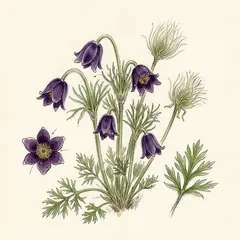
[PULSATILLA NIGRICANS, WIND-FLOWER. NATURAL ORDER,
RANUNCULACEiE.l
This is a perennial flower which blossoms in May, and the second time in August and September. It has a short and thick root; the flower stalk is smooth, beset with soft hairs, from six to eight inches high, and terminating at the top in a lancinated involucrum. Leaves radical, bipinnate ; no calyx ; six petals, oblong, hairy, of a blackisli- purple color ; with their apices turned backward ; numerous fila- ments. The flower is called nigricans on account of the dark color of its petals.
We make a tincture from the whole plant without the root, of a greenish-brown color and having an acrid taste.
The plant, even when dry, has an extremely smarting action upon the tongue and fauces. The name "wind-flower," is given to it because it is generally found in exposed situations.
This plant was known to Dioscorides who describes three species of it. Pliny recommends it for headaches and inflammation of the eyes.
It was upon the authority of Baron Stoerck that this plant was received into medical use. He recommends it as an effectual rem- edy for most of the chronic diseases affecting the eyes, particularly for blindness, cataract, and opacity of the cornea from various causes. The baron himself, who had for two years suffered much from a violent contusion of one eye, took this remedy, which he soon found occasioned a severe lancinating pain in the part affected ; this he considered as a favorable omen in the specific action of the plant, an opinion which was afterward confirmed in a great number of patients. Two cases of amaurosis, three of cataract, and seven cases of affection of the cornea were either entirely cured or gener-
0*66 PULSATILLA.
ally benefited by the exhibition of this remedy. Other physicians have nsed it with success in the same affections ; others again have not been successful, doubtless for no other reason than because the drug was used in affections to which it is not homoeopathic.
The active principle of anemone is an alkaloid, " anemonine," somewhat analogous to camphor ; it crystallizes in white flakes, is easily pulverizable, inodorous except when evaporated ; it then emits a pungent and penetrating odor which excites tears ; when dry, the alkaloid is tasteless ; when in a state of fusion, it is biting and cor- rosive, causes insensibility of the tongue and white blisters : in a common temperature it is not volatile ; when exposed to heat it melts, and burns with a bright flame. It is very little soluble in water, but dissolves readily in boiling alcohol or in ethereal oils. The boring and cutting pain which pulsatilla causes in the nervous tissue of the eye, proceeds from the action of this alkaloid.
Pulsatilla seems to act principally upon the skin, the mucous membrane, more particularly upon the mucous lining of the eyes,, stomach and small intestines, urinary and sexual organs, and upon the synovial membrane.
It seems to be principally adapted to subacute irritation of a catarrhal, rheumatic and gastric character and having a remittent type. It is particularly suitable to persons of a quiet, gentle, and somewhat emotional disposition. Women seem to be more favor- ably acted upon by pulsatilla than men.
Small doses of this drug are antidoted by arsenic and china; large doses by vinegar.
CEPHALIC GKOUP.
Pulsatilla causes vertigo as if intoxicated, with heat in the head and pale face, especially in the evening ; vertigo when looking up ; heaviness and a gloomy feeling in the head, with a painful feeling in the eyes ; especially in the evening. Throbbing, pressive head- ache, relieved by external pressure. Pulsating pain in the head. Heavy, throbbing headache, with a bursting sensation in the temples.
Headache in the forehead, above the eyes and in the temples. Stitching pains in different parts of the head. The pains are worse in the evening, after eating, during repose, and when rolling the eyes upward ; better from motion and from being in the open air ; they are often one-sided ; usually, the face is pale.
Headache EN
Pulsatilla is a most important remedy in the treatment of various types of headache. These headaches depend
PULSATILLA. 667
upon a disturbance in some other part of the organism, and may be gastric, bilious or menstrual headaches. In gastric headaches we will find nausea, vomiting, greasy taste in the mouth, acrid risings from the stomach ; they are usually caused by eating rich, indigest- ible food, such as pastry, fat pork, etc. In UUous headaches the patient complains of a stupid feeling in the head, and of a sensation in the forehead as if the brain had been bruised. Menstrual head- aches will be accompanied by such disturbances in the sexual system as will direct our attention to pulsatilla.
The following cases will serve as illustrations :
A woman of thirty years, of an obstinate, fault-finding disposition, fleshy constitu- tion, nervous and irritable temperament, experienced both in the beginning and toward the termination of her period an aching, boring or grinding pain on the top of the head.
The pain almost drove her mad.
She could not bear to have anything on her head ; the place felt sore as if there had been a boil : nevertheless, she invol- untarily placed her hand on that spot very frequently.
Stool not hard, but its expul- sion required a great effort.
No appetite ; relished her food while taking it ; but afterward she felt quite faint about the stomach.
Fell asleep immediately after going to bed ; but was tormented by dreams, and lay as if she had been murdered.
Felt chilly all the time without any thirst.
In the paroxysm of pain I exhibited puis.'200, which left no trace of it after half an hour had elapsed.
(Drs.
Gross and Stapf, N.
A.
Jour.
Horn., February, 1 880.)
A girl, eight years of age, of gentle and sad disposition, has suffered, for six months, with one-sided headache, usually on the left side.
The pain is situated in the anterior left temporal region, is beating and stitching, alternately early in the morning after rising and in the evening after retiring, is relieved by external pressure and in the open air; is worse in the room, from lying down or stooping, and from moving the eyes.
It continues several hours, increases until it becomes almost un- bearable.
As the pain decreases, violent gastralgia and sour and bilious vomiting set in.
Then pinching, contractive, cramping pains in the bowels.
At times these three types of pain appear in alternation ; and again every second day.
After taking Pulsatilla* the whole difficulty disappeared, and permanently, by the fifth day.
(Pleyel in Archiv. f. d.
Horn.
Heilkunst, vol. v.)
A man, twenty-five years old, has suffered two months from a stitching, boring headache, which becomes terrible toward evening, involves the right temporal region, extending from there to the occiput, into the ear, and even into the cervical region.
There is also a dull, stupid feeling in the head, his mental faculties are fairly para- lyzed ; he is utterly unfit to do anything.
One dose of pulsatilla24, every morning, cured him within a week.
(Rampal in Allg.
Horn.
Zeitg., xxxvii., 96.)
A single lady, twenty-nine years old, of' sanguine temperament, reasonably strong, usually in good health, with scanty but regular menstruation, has suffered for some time from general weakness and occasional one-sided headache.
At the same time cessation of the menstrual flow, a slimy leucorrhcea appearing instead.
Tearing headache on the left side, extending from the left forehead to the entire half of the face; occasional pain in the left inner ear and in the left lower teeth ; periodical, and worse at night; aggravated by sudden changes in the weather, thunderstorms, ex- ternal warmth and when in bed ; better in the cool, open air.
Countenance paler blue rings around the weary-looking eyes ; heat in the head with pale face.
During the headache violent roaring in the ears ; no thirst ; taste and appetite are normal when she is free from pain.
Profuse, milky leucorrhcea.
Palpitation of the heart and backache when she exerts herself.
Weariness, lassitude, spells of shivering ; restless, sleepless nights.
One drop of pulsatilla3 every three hours.
Prompt im- provement and after twelve days complete cure with appearance of the menstrual flow accompanied by pain in the abdomen and in the back.
(Rueckert's Klinik.)
668 PULSATILLA.
VERTIGO, with feeling of tension in the upper eyelid ; it seems as if every object were seen through agitated water; luminous vibrations, circular, or serpentine, or like flashes of lightning. Characteristic gastric symptoms.
A cure of this very annoying disorder is reported in Hufeland 's Journal, which I will briefly relate.
A gentleman of thirty-four years, of feeble constitution and sanguine temperament, who had been addicted to sexual excesses from his boyhood, had ruined his nervous system by his irregularities and by spending his nights in studying.
His eyes and digestive apparatus were very weak.
At the age of seven- teen, he was attacked with the so-called spurious vertigo, the attacks being generally accompanied with vomiting of sour fluid, and a violent hemicrania which some- times lasted twenty-four hours.
In consequence of a change in his mode of living, the vertigo left him in about two years, without resorting to any special treatment ; but returned again a few years after, after a night's carousal with his friends.
The paroxysms recurred at irregular intervals, and with increasing violence.
The eyes, head and digestive organs were principally affected.
A number of celebrated physi- cians were consulted, who exhausted their skill and knowledge during six years without doing him any good.
The most fashionable springs were likewise resorted to, and a distinguished magnetizer tried his powers upon him, all without the least favorable change in the condition of the patient.
The disorder grew upon him, the paroxysms came on every other day, and even slight convulsions made their appear- ance during the attack.
Dr.
Lowenhardt, who reports the case, finally prescribed the extract of pulsatilla in doses of two-thirds of a grain, morning and evening, for four days in succession.
From the very first day of the treatment, the attacks ceased as if by magic, and the patient now is satisfied with his health.
He has never had another attack, and all he did afterward was to take some bitters, in accordance with the general prevailing notion that bitters stimulate the digestive apparatus and nervous system.
IRRITATION AND INFLAMMATION OF THE BRAIN,
depending upon metastasis, may demand the exhibition of Pulsa- tilla ; this is especially the case in scrofulous children.
A scrofulous but blooming girl of five years, who has often had abnormal vaginal discharges, had a similar secretion which was at first slimy, then purulent, accom- panied with redness and swelling of the parts.
Slse took a cold and the discharge became suppressed ; she was taken at once with a violent chill, followed by high fever, headache, nausea and vomiting of a sour, bitter liquid.
On the following morning : great heat of the head, inability to hold the head erect, dryness of the skin, scantiness of the urinary secretion, sopor with frequent starting, sensitiveness to light, dilatation of the pupils, moderately high fever.
She keeps her hands on the genitals.
The vaginal mucous membrane looks tumefied, reddened, excoriated in parts, secreting but little slime, and rather dry.
Aconite and belladonna, in alterna- tion, gave but little relief.
Pulsatilla6, every hour, brought about a rapid recovery, with a reestablishment of the vaginal discharge.
(Altschul, Prager A/on.
Schrift,'\.
II.)
A boy, aged fourteen years, was taken with a violent fever, vertigo, roaring in the head, stitching and tearing pain in the forehead, temples and vertex, burning in the eyes, shivering and heat.
He is so weak, that he cannot raise himself in bed.
Sleepless nights; the face is bloated, now pale, then vivid; mouth dry; absence of thirst.
Pulse rapid and small, expression of the countenance weary, stupid, dis- torted.
Dry cough.
During the night he is delirious, sees spectres; during the day he lies in a feverish sleep, the eyes half closed, turned upward ; the head is hot; the lips are dry.
Veratrum failed to relieve.
Epistaxis.
Pulsatilla12, eight doses, cured him in three days.
(Schelling in Allg.
Horn.
Zeitg., liii., 116.)
NEEVOUS GEOUP.
EPILEPSY. — Baron Stoerck, the first prover of this drug, pro-
PULSATILLA. G69
posed it for epilepsy, and, by his request, experiments were made in the public hospitals of Vienna, upon a number of epileptic patients, but without the least benefit. Nevertheless, we may remember Pul- satilla in epilepsy arising from disturbances of the uterine system, in those forms of epilepsy which Schoenlein describes as "uterine epilepsy."
The following symptoms indicate pulsatilla : "Fits more frequent the day before the menses ; swelling of the abdomen before the menses ; menses too light and scanty ; sensation as if a lump were rising in the throat, which caused nausea while eating; headache, principally above the right eye.
(Pulsatilla headache is more usually on the left side) ; pain in the apex of the scapula." (Dr.
G.
W.
Cox in the Am.
Jour.
Horn.
Mat.
Med.)
Girl, aged eighteen, good constitution, no heredity, cause : amenorrhoea for six months, venesection.
Duration six months.
Aura ; downcast, cadaveric paleness, masticating motions.
Instead of menses a fit.
Pulsatilla 6th cent., one dose daily.
Next month menses returned, and for the last four years no relapse.
Girl, aged fourteen, robust, no heredity ; cause : delaying menses.
Duration one year; aura: obstinate, irritable, stands fixed in one place, looks vacant, stamps with the feet; grand mal once a month, petit mal daily; screams, cadaverous paleness, biting of tongue, micturition, continues in the work which occupied her at the begin- ning of the fit.
Pulsatilla, 30th cent., every eight days one dose.
A year afterward no grand mal yet, the petit mal more rare.
Pulsatilla, 30th cent., continued, and even the fits of petit mal extremely rare.
Ten years passed and no relapse.
(Dr.
Bojanus, JV.
A.
Jour.
Horn., November, 1880.)
The pains which very frequently indicate pulsatilla are of the following order : Shifting pains, also with redness and swelling of the joints.
Pains as if braised or as if the parts were ulcerated.
Pains and ailments on one side of the body.
Pains accompanied by chilliness, dyspnoea, paleness of the face, trembling of the limbs.
The pains are generally worse every other evening.
The pains in the muscles of the extremities are tearing, drawing or jerking pains, worse at night or in the evening when lying in bed.
ISCHIAS NERVOSA
Pulsatilla has cured ischias nervosa with violent stitching and tearing pain down to the knee, the patient had to limp all the time.
In
HYSTERIA, when complicated with menstrual suppression, pulsa- tilla may prove very useful, especially in the case of quiet women of a brooding mood, leu co -phlegmatic habit ; they look pale and bloated, seem to be dreaming, like to sit alone, are averse to conversation, weep without any apparent cause. In
PROSOPALGIA we may find pulsatilla a very useful remedy when the pain is pressing, pinching, contractive, throbbing, one-sided,
670 PULSATILLA.
extending over one entire half of the face, with copious now of tears and discharge from the nose. The paroxysms are irregular, worse in the evening and at night, better in the open air.
A rheumatic person was taken with infra-orbital neuralgia in consequence of met- astasis.
Symptoms : Every day, at 1 1 A.
M., he was taken with a violent pain in the left infra-orbital region, followed, soon after, by greatly increased secretion of mucus from the left nostril, thick, white, fetid.
At 4 P.
M., pain and discharge from the nose disap- peared.
The pain was relieved in the open air.
Cured by pulsatilla1.
(Vehsemayer. )
A girl, phlegmatic, and given to frequent spells of weeping, has suffered for several weeks from terrible jerking-tearing pains in the face.
The attack invariably appears at 6 p.
M. and grows in intensity until midnight.
Aggravation from lying down and when in bed; amelioration from getting up and from cold.
Prescribed pulsatilla'; immediate cure.
(Stens., Therapeutics of Our Times, p. 176.)
INFLAMMATORY GROUP.
GONITIS — Pulsatilla is principally adapted to subacute irrita- tions, but it may likewise prove useful in acute inflammations, especially in gonitis, inflammation of the knee-joint, more particu- larly in the case of scrofulous' individuals; the inflammation develops itself suddenly, the knee-joint swells up, is exceedingly painful to the touch, and the patient complains of great soreness and lancinating pains in the joint; the joint has a pale, rose-colored appearance, and fluctuation is very soon perceived in the parts round the patella. In all such cases of acute gonitis, fever is invariably present. There are many cases reported in our journals where the tincture of pulsatilla has been employed, with signal advantage, effecting a cure in a few days ; in other cases the attenuations have been equally efficient. In
CHRONIC SWELLING- of the knee-joint, remaining after acute inflammation, in the case of scrofulous individuals, pulsatilla may likewise be resorted to. Even in
WHITE SWELLING, coming on gradually as the result of a scrofulous dyscrasia, pulsatilla may be used as an intermediate remedy to control pain, soreness, and to promote the action of the absorbent vessels.
RHEUMATISM OF THE DORSUM OF THE FOOT
Pulsatilla causes rheumatism of the foot; hence we use it to advantage in this condition, when the muscular covering is swollen, inflamed, and the pain keeps increasing until it becomes agonizing especially at night. I have seen an inflammation of this kind yield to the 12th attenuation of pulsatilla in the space of thirty-six hours, without a trace of it remaining visible.
Scrofulous and arthritic individuals, of a leuco-phlegmatic habit,
PULSATILLA. G71
are especially benefited by pulsatilla in acute rheumatism, whicb is generally in the character of
ARTHRITIC RHEUMATISM; the feet, for instance, are red, hot, swoolen, with a tensive and burning pain which increases to a stitching pain by standing.
The rheumatic and arthritic pains which pulsatilla causes may be generalized as follows : Sticking pains in the shoulder-joint and nape of the neck, especially when moving the parts. The joints and long bones seem to be principally acted upon by this drug. The pains which pulsatilla causes in the joints are sticking, tearing and tensive pains, aud pains as if the joints had been bruised and sprained, they feel sore. The shoulder, elbow, knee, and tarsal joints seem to be the chief localities where the pulsatilla-principle delights to manifest its disturbing agency.
A gentleman, subject to rheumatic attack, of stout, full-blooded make, called one morning last fall, with his left arm in a sling, and .desired me to prescribe for a rheumatism in the wrist which had troubled him for ten days.
On examining the arm I saw that the wrist was a little swollen and slightly reddened.
He told me that the pain came on at about 3 P.
M., continued to increase in violence, and was accompanied by swelling and redness, until about midnight, entirely preventing sleep.
It then diminished and he felt but little inconvenience from it, except pain and stiffness on motion, until the next afternoon, at about the same hour.
I gave him a drop of pulsatilla3, in six powders.
A single dose was followed by an entire cessation of the paroxysms, the arm regaining its natural appearance and motion before the time for the afternoon attack.
There was a slight threatening on the next day, but it passed off on taking the remaining powders.
(Dr.
Metcalf in Arorth Am.
Jour.
Horn., February, 1853.)
A lady of exceedingly mild and gentle disposition consulted me for a pain in the calf of the right leg, following upon a moderate attack of influenza.
The pain was aching drawing, came on in the evening, and was much aggravated by the heat of the bed ; cloths dipped in cold water gave some relief, but she had been nearly sleep- less from the pain for two entire nights.
During the day she was comparatively comfortable.
Prescribed pulsatilla3 in water, a dose every two hours.
The next morning I found that she had passed another sleepless night, that the pain was not relieved at all and that she had an additional twinge in the right cheek manifesting itself already.
Prescribed tinctura pulsatillse in water, a dose every two hours.
The pain did not return at all. [Ibid.)
Pulsatilla also causes drawing pains in the muscles of the thigh, obliging the patient to move the part constantly to find relief.
RHEUMATIC PERIOSTITIS
The tearing and drawing pains may likewise be felt along the bones, showing that the fibrous cover- ing of the bones may become involved in the pulsatilla rheumatism.
Hence we may recommend pulsatilla in rheumatic periostitis, and likewise in
RHEUMATISM OF GOUT OF THE HEEL, for this drug- causes cutting and boring pains in the heel, and a pricking and sore pain in the soles of the feet.
672 PULSATILLA.
CHILBLAINS
Pulsatilla causes a burning-pricking pain in the ball of the little toe, accompanied by itching as in frozen limbs ; the pain is much aggravated by the warmth of the bed.
Hence we find pulsatilla useful in chilblains, when these pains occur.
OIIBITAL GBOUP.
The action of pulsatilla upon the eyes deserves our attention.
The pro vers of this drug have experienced a pressure in the eyes, as if they would be pressed out of the head, with discharge of tears.
Also a pressure as if the eyes were full of sand.
Baron Stoerck ex- perienced cutting and boring pains in the eyes.
Bergius informs us that a child which happened to be exposed to the vapors of pulsatilla, while the extract was being prepared, was attacked with inflammation and swelling of the eyelids, and obscura- tion of sight. Orfila states, in his Toxicology, that an apothecary, while pounding the dry leaves of pulsatilla, was attacked with colic, vomiting, and with itching of the eyelids.
CONJUNCTIVITIS. — In accordance with these indications we have used pulsatilla in conjunctivitis with profuse lachrymation, burning, stinging and itching pain, when caused by a cold.
BLEPHAROPHTHITIS, or inflammation and swelling of the lids, of a catarrhal character, especially in scrofulous individuals, with much itching and secretion of purulent gum, scurfy desicca- tion. Also in chrouic cases pulsatilla may still be useful.
STYES, especially in the case of scrofulous children, with pale, rose-colored inflammation, furious itching, sensitiveness to light, may readily yield to pulsatilla; if recurring frequently, as the result of a scrofulous diathesis, sulphur, the iodide of mercury, and other drugs, will have to be used for the purpose of eradicating the causa- tive principle.
SCROFULOUS OPHTHALMIA — In scrofulous ophthalmia of the milder type, especially when inclining to become chronic, with occasional paroxysms of inflammation, the conjunctiva having a rose-colored appearance, with much itching, burning and secretion of tears and purulent gum, pulsatilla may prove very serviceable.
ARTHRITIC OPHTHALMIA.— In arthritic ophthalmia, with cutting and boring pains in the eyeball, pulsatilla is eminently use- ful ; in this affection a pain may be experienced as if the eyeball were being scraped with a knife.
In ophthalmia remaining after measles, an occasional- dose of pulsa- tilla may be necessary.
PULSATILLA. G73
A boy, aged thirteen, suffered from ophthalmia with considerable pain throughout the eye : the sclerotica was traversed by tine blood vessels, which formed a rose- colored circle around the cornea, with slight inflammation of the conjunctiva, simulta- neous affection of the iris, oedema of the upper eyelids and profuse secretion of pus.
Prescribed two doses of Pulsatilla30.
After forty-eight hours all the symptoms had disappeared with the exception of a very slight conjunctivitis.
(Prot. d.
L.
V.
Link.)
A weakly girl, aged fifteen, of a scrofulous habit, has suffered for twelve days with catarrhal ophthalmia. The inner surface of the lids is reddened and swollen, the conjunctiva of the eyeball shows a large number of blood vessels converging toward the cornea, beneath the vessels uniform, intense redness of the sclerotica, on the cornea of both eyes several phlyctenulse ; iris and pupil normal. With it, increased secretion of mucus and of tears, marked photophobia, and severe pain in the eyes, -forehead and temples, worse from the evening until midnight ; scanty menstruation every three weeks ; has formerly had eruption on the skin ; she had been blistered without receiving help.
Cured by pulsatilla6. (Diez, 87.)
A man, aged thirty, has had a catarrhal ophthalmia for six or seven day.
Symp- toms : Feeling of dryness and burning pain in the eye, worse in the evening, the margins of the lids are red and swollen ; the canthi are filled with pus, causing agglutination of the lids ; the conjunctiva looks as if loosened, lustreless and red- dened unevenly, as if dotted here and there.
Pulsatilla3, morning and night, cured him within three weeks; two years previous he had a similar attack, received ortho- dox treatment, and was sick for three months.
(Horn.
Tracts by Dr.
Y., p. 99.)
AMAUROSIS
Pulsatilla causes a dimness of sight, as if some- thing were hanging over the cornea that can be wiped off.
It also causes fiery circles and obscuration of sight.
Hence we may find Pulsatilla useful in amaurosis of scrofulous individuals, when caused by excessive use of the eyes during nightly mental labor, or when coming on gradually in consequence of a progressive development of the scrofulous dyscrasia.
If co-existing with menstrual sup- pression, in impoverished conditions of the system, pulsatilla may prove so much the more useful.
Baron Stoerck relates a case of this' disorder which was so far cured as to enable the eye to see objects and to distinguish colors.
WEAK EYES. — In weak eyes, with sensitiveness, pain in the eyeballs, and redness when using them, pulsatilla internally, and externally in the form of a wash, has proved an efficient means of relief in the hands of Kopp.
AUKICTJLAR GEOUP.
OTITIS
Pulsatilla causes a group of symptoms in the organ of hearing which resembles very closely otitis or inflammation of the ear.
It causes acute lancinating pains in the ear, excessive sensitiveness to noise, discharge of pus and blood from the ear, noises in the ear, swelling and inflammatory redness of the ear.
The pain often causes delirium and agonizing distress in the head.
If accompanied by, or arising from, menstrual suppression, pulsa- tilla is so much more specifically indicated.
VOL. II. — 42.
674 PULSATILLA.
A woman, fifty years old, was taken with otitis, after having a severe attack of erysipelas of the face.
Symptoms : The auditory canal and the external ear were perfectly closed by an erysipelatous condition of the parts, causing serious loss of hearing.
Violent, stabbing, tearing pains in both temples, in paroxysms which return every minute and which seem to originate in the ear ; these pains leave a feeling in the head, as if all life had left it — a state of stupidity.
No sleep on account of the pain and anxiety, and a feeling as if all the blood were rushing to the heart.
Starts in the sleep, delirious.
Heat with much restlessness ; dryness in the mouth and throat with a frequent desire to drink a little water.
Urine red; stools hard and dry; apprehension of death.
Prescribed pulsatilla12, followed by early improvement and cure.
(Hartmann in Arch. d. h.
Hlk., vol. v.)
OTALGIA
In otalgia pulsatilla may effect much good, if the patient is scrofulous, of a delicate constitution, the pain comes on at every change of the weather, a hard aching pain as if the ear would be pulled out.
The patient cannot bear noise.
A woman was suddenly taken with such violent pain in the left auditory canal, that she was almost driven to distraction.
The pain was stabbing and tearing ; it seemed as if a large body were forcibly driven into the left inner ear and were crowd- ing into the throat, making deglutition painful.
There was lachrymation of the left eye, spasmodic movement of the eyelids, and profuse flow of saliva of acrid taste.
Prescribed pulsatilla, three drops in water; one spoonful every hour.
Cured in twenty-four hours.
(Moor in the Allg.
Horn.
Zeitg., vol. xl., p. 203.)
OTORRHCEA. — Pulsatilla is indicated in otorrhoea with dis- charge of a fetid, yellowish pus, especially when coming on after measles or scarlet fever, or in delicate girls of a scrofulous habit, who have not yet menstruated.
A girl of twelve years had measles ; the rash disappeared suddenly, and she was taken with tearing pains in the head, but especially in, and back of, the right ear.
There has been, for several days, a yellow, watery discharge ; active inflammation and swelling back of the ear, deafness.
With it : thirst and fever ; pulse no in the minute.
Pulsatilla12 cured within three days.
(Bethmann, Archiv., vol. viii.)
DEAFNESS. — It will prove useful in deafness, if resulting from exposure to a keen wind, or from water getting into the ear, with various noises, such as blowing, chirping, etc., or accompanied with conditions and symptoms already mentioned as within the curative range of the remedy.
NASAL GKOUP.
CATARRHAL DISCHARGES
Pulsatilla will be found useful in catarrhal discharges from the nose, green and fetid, the more so if the borders of the nostrils are ulcerated.
Remember that the presence of the scrofulous element in such cases constitutes a char- acteristic indication.
A girl, aged eighteen, of slight figure and of quiet, gentle disposition, had chronic catarrh. Symptoms : Discharge of yellowish-green, pus-like, offensive matter from the nose, slight swelling of the nose; with violent itching in it. toward evening. Loss of appetite, eructations tasting of the food taken ; giddiness in the head, as if she were intoxicated, better in the open air, worse in the room ; menses tardy, scanty,
PULSATILLA. 675
pale, and followed by leucorrhcea ; heaviness in the limbs ; shivering tow:ird evening, without thirst ; pale, sickly look ; anxious, sad, weeping mood.
Prescribed one drop of pulsatilla'.
Improvement commenced on the following day, and after a short time she was cured of the catarrh and of its concomitant symptoms.
(Stapf, Archiv., i., 2, 127.)
DENTAL GROUP.
TOOTHACHE. — Pulsatilla causes stinging pains in the gums, and a toothache as if the nerve of the tooth were suddenly put upon the stretch, and then let loose again.
The pulsatilla-toothache is excited by Avarmth, and relieved by cool air.
It is also excited by eatiug.
The toothache of pregnant women may be relieved by this agent.
Symptoms worse toward evening.
CHTLO-POIETIC GEOUP.
The action of pulsatilla upon the chylo-poietic system constitutes this drug one of our most valuable agent in the treatment of gastric derangements. Among the effects of pulsatilla in this direction wo distinguish the following : Bad smell from the mouth ; tongue lined with a tenacious mucus ; bitter taste ; pungent taste ; taste as of foul flesh ; loss of appetite (anorexia) ; loss of thirst (adipsia) ; waterbrash ; vomiting of bile ; vomiting of saltish or sour mucus, in the evening or at night ; eructations tasting of the ingesta ; bitter, bilious eructations; sour eructations; nausea while eating ; eructa- tions, tasting of rancid tallow.
INDIGESTION OR DYSPEPSIA.— Many of these symptoms may occur in a case of bad digestion or dyspepsia, of which Hahne- mann himself has left us the following interesting example :
A weakly man, aged forty-two years, of pale complexion, gentle and quiet dispo- sition, and whose business was of a sedentaiy nature, had been very sick for five days.
On the first evening he began to feel sick at the stomach, and dizzy without any apparent cause.
In the following night he was attacked with sour vomiting.
The next two nights he had violent eructations.
This last night he had had eruetations of a fetid and sourish taste.
He felt as if the food were lying raw and undigested in his stomach.
Sensation as if the head felt enlarged, hollow, gloomy, with sensi- tiveness of the brain to the least noise.
Pulsatilla being homoeopathic to all these symptoms, the patient took a single drop of the 12th potency belore bed-time, and awoke in perfect health on the following morning.
OARDIALG-IA
The pains which pulsatilla causes in the stomach show that it may be eminently useful in cardialgia.
It causes a drawing pain in the stomach, with a feeling of pressure, a throbbing in the region of the stomach, with a crampy and contractive sensa- tion.
Pulsatilla is especially indicated if the cardialgia is excited by eating fat pork.
In
COLICODYNIA pulsatilla may be of great use ; it causes cutting
676 PULSATILLA.
and pinching pains in the bowels, and a painful sensitiveness of the abdominal walls. The bowels may be either bound or loose, with discharge of blood and mucus.
A woman, aged twenty-four, has frequently suffered from cardialgia, and has now been troubled with it for three months.
She is greatly exhausted.
Drawing pain in the epigastrium, often extending into the back, worse from eating, continuing until vomiting of food sets in, which is occasionally mixed with blood.
Accumulation' of water in the mouth, with severe pain, usually in the morning.
The pain is always lessened during menstruation.
Tongue white, appetite and stool good.
Pallor of the countenance ; dark rings around the eyes.
Cured by pulsatilla3.
(Pope, Brit.
Jour.
Horn., 1855.)
A woman, thirty-six years old, has suffered with indigestion ever since she was confined last, a period of nine years.
Symptoms : Pressive, beating headache ; tor- pid color and worn expression of the face ; almost every day she has attacks of cardi- algia, early in the morning before eating ; in the pit of the stomach, continuous pain as from soreness or ulceration, worse from eating and from external pressure; pinch- ing, cutting, colicky pains, sometimes every day for weeks ; constipation ; tenesmus of the bladder; menstrual flow scanty, with dark, blackish discharge; every morning and night shivering along the entire back with yawning and stretching of the limbs, and burning in the palms of the hands.
She made a full recovery after a few doses of pulsatilla*.
(Horn.
Tracts by Dr.
Y., p. 46.)
GASTRO-ENTERITIS Small doses of pulsatilla cause consti- pation, larger doses irritate the intestinal mucous lining, causing a condition resembling gastro-enteritis, with discharge of mucus which is sometimes mixed with blood, or watery discharges with cutting in the bowels. Properly speaking, pulsatilla does not cause gastro- enteritis, but rather a catarrhal irritation of the lining membrane the principal symptom of which is
DIARKECEA, the discharges consisting of soft fecal matter and mucus, or a yellowish-white mucus mixed with blood, or white mucus without any admixture of blood.
A young, intelligent, mild-looking blonde of sixteen applied for relief from chronic diarrhoea.
About three months previously she had had a violent attack of cholera morbus, for which she took calomel.
She got her feet wet, and ever since has been subject to attacks of mucous diarrhoea, occurring more or less every week, and some times lasting a week.
She had one of these attacks the night before applying at the dispensary; the discharges occur nearly every hour; she was obliged to stop on the way down, and has had an evacuation since reaching there ; she passes sometimes a tumblerful of slime at once ; the evacuations are accompanied by nausea, faintness and sometimes vomiting of mucus ; there is no colic, pain in the back, straining, nor blood; they generally begin to be more severe and more frequent about bed-time.
Prescribed pulsatilla3. a dose every hour until relieved.
She had no evacuation after the first dose, and continued radically cured.
(Dr.
Metcalf in N.
A.
Jour.
Horn., February, 1853.)
A characteristic indication for pulsatilla is nocturnal dtarrhceu, when the discharges consist of green mucus or are of a watery con- sistency.
There is at times chilliness after the discharge, and the stool may be preceded or followed by cutting pain ill the bowels.
Frequent urging tov stool is likewise often present.
PULSATILLA. 077
SUPPRESSED PILES
Pulsatilla causes soreness of the rectum and anus, with bliud piles, hemorrhoidal tumors.
Hence in sup- pressed piles, with stiffness of the back, and abdominal and cerebral congestions incident to such a condition, Pulsatilla may prove very efficient.
A concomitant of this derangement may be
CONSTIPATION", or the constipation may exist as an element in some other group of symptoms, especially in a case of hysteria or in connection with menstrual suppression. The bowels may feel distended and the patient may be troubled with frequent urging and, at most, discharge a spoonful of white mucus.
UEINARY GEOUP.
Pulsatilla causes frequent but ineffectual urging to urinate ; cut- ting pain while urinating.
Tenderness to pressure in the region of the bladder.
Involuntary discharge of urine, drop by drop, at night, when walking, coughing, or when making an exertion.
Pro- fuse flow of watery urine ; scanty urine, dark brown, with a red or brownish deposit.
Bloody urine.
CHRONIC CYSTITIS— These symptoms indicate the use of Pulsatilla in chronic cystitis, or in simple
CATARRHAL IRRITATION OF THE BLADDER with
corresponding symptoms, characteristic pains in the region of the
kidneys, through the back and in the bladder ; restlessness, and,
occasionally, burning at the urethral orifice. An excellent remedy in
the case of pregnant women with characteristic urinary difficulties.
A large, strong, lymphatic woman, aged twenty-nine years, has had, for three weeks, frequent desire to urinate.
Redness of the inner thigh and of the genitals.
Violent itching in the genitals.
The copious urine voided is of a pale-yellow color and deposits large amounts of mucus.
Cantharides gave no relief.
Cured in a short time by pulsatilla6.
(Cramoisy in Allg.
Horn.
Zeitg., lvii., 183.)
A woman, in the fourth month of her pregnancy, has had frequent repetitions of constant desire to urinate, passing a small amount with severe burning; worst in the evening.
Cured in a few days, by pulsatilla12.
(Ganz in Allg.
Horn.
Zeitg., lix., page 83.)
HYSTERIA, with frequent voiding of large amounts of pale urine.
CHRONIC DYSURIA, and
CHRONIC STRICTURE, especially in cases of mismanaged gonorrhoea, with whitish, slimy urethral discharge; frequent and painful urination, with burning at the meatus urinarius. The urine escapes in a thin stream.
HEMATURIA, especially in chronic cases with characteristic constitutional indications.
678 PULSATILLA.
A man of fifty years of age had gonorrhoea twice, and was treated successfully in each instanee.
Bleeding haemorrhoids.
Of sedentary habits.
He has suffered from urinary difficulties for a period of seven months now and has been treated for cal- culus by a regular physician.
Symptoms : Constant desire to urinate ; violent burn- ing, stitching pains in the neck of the bladder; very slimy urine, which becomes clear after the mucus has settled to the bottom of the vessel. 'The sediment adheres closely to the vessel.
Must urinate every hour, and has always pain which continues for several minutes.
Perfectly well otherwise.
Cured by pulsatilla18.
Before being discharged received a few doses of calcarea.
Remained well.
(Ivanowich in Arch.t xviii., 3, 88.)
A married lady of slender figure ; nervous.
Pain in the region of the kidneys, thighs and umbilicus.
Painful voiding of large amounts of bloody, dark-red urine.
Anxious restlessness, numbness in the thighs, constipation.
Several months ago she had an attack of Bright's disease ; cured by arsenic, and bryonia.
Prescribed Pulsa- tilla3, three times each day.
Cured.
(Altschul in Prager Mon.
Schriften, iii., 129.)
SEXUAL GROUP.
Pulsatilla affects both the male and female sexual organs.
It causes tearing pains in the testicles.
It also causes drawing and drawing-tensive pains from the abdomen through the spermatic cord into the testicles, which are very much relaxed.
These symp- toms may lead us to prescribe pulsatilla in
ATKOPHY OF THE TESTICLES, a condition which may occur in consequence of onanism. Pulsatilla also causes frequent erections with increased sexual desire and emissions ; hence it may prove useful in
NOCTURNAL EMISSIONS with excited sexual appetite, erections, amorous fancies. In
ORCHITIS, especially when arising from suppression of gonor- rhoea, pulsatilla may afford relief.
Pulsatilla causes this symptom : " the right testicle is drawn up and swollen, the spermatic cord is swollen, with tensive pain, whereas the left testicle is hanging down."
This retraction and swelling of one testicle is not an uncommon symptom. The patient experiences a tensive pain in the testicle ; this conditiou may have been caused by self -abuse, or by a strain.
Dunham thus describes the effect of pulsatilla on the female geni- tals: In the hypogastric zone, drawing, pressing, or constrictive pains, like labor pains, converging toward the pudenda.
Such pains are relieved by crouching forward.
They come, generally, just be- fore the menstrual period, are attended by a feeling of weight, like a stone, in the hypogastrium, and accompanied by chilliness, stretch- ing and yawning.
The menses are delayed, difficult and scanty, or even fail altogether.
Before the menses, labor-like pains as above.
During the menses, many symptoms, such as weight and downward
PULSATILLA. 679
pressure in the abdomen and sacral region ; nausea ; getting black before the eyes; stomachache and faintings; all worse in the warm room and by much exertion ; better in the open air.
Leucorrhoea, of a thick mucus resembling cream.
It is sometimes scant, pro- ducing a burning pain, sometimes bland ; most profuse after menstruation.
We use pulsatilla in the treatment of a large number of diseases peculiar to women ; among them we call your particular attention to the following :
LEUCORRHOEA of thick, creamy consistency; usually bland, at times acrid ; most profuse after the cessation of the menstrual flow ; burning, stinging pains in the vagina and labia. In scrofu- lous women.
AMENORRHOSA with nausea, coldness, trembling, chilliness of the feet, anxiety, mental depression, burning and stinging in the vagina.
Frequent paroxysms of the characteristic headache and toothache.
In consequence of getting the feet wet.
Pulsatilla is useful when the first appearance of the menstrual flow is interrupted and we get congestion to the face, chest, lower abdomen and uterus, as if a stone were pressing there ; at the same time shivering, yawning, stretching, and feverish excitement. (Hartmann, Therapie., ii., 212.)
Pulsatilla is especially indicated when at puberty the menses fail to appear, caus- ing no apparent physical disease, but giving rise to a very irritable state of mind, with a tendency to peevishness, ill-humor, and a timid habit ; pale countenance, flabby, feeble muscles. {Ibid., 213.)
DYSMENORRHEA AND UTERINE OOLIO, with cutting, bearing-down pains in the lower bowels.
Discharge of thick, black blood from the uterus ; the flow is more active during the day and Avhen walking.
Chilliness ; labor-like pains converging toward the pudenda, relieved by crouching forward.
Characteristic headaches and gastric difficulties.
UTERINE HAEMORRHAGES of black blood mixed with mucus; ceases, and then returns with redoubled force, at the critical period.
Better in the open air.
The use of this remedy is only justified when the constitutional symptoms point to it with unerring distinctness, and is undoubtedly rarely to be thought of in sudden, violent haemorrhages.
DISORDERS OF PREGNANCY
Pulsatilla is an excellent remedy in various disorders of pregnancy, among which we may men- tion gastric difficulties, difficult urination, leucorrhoea, pains in various parts of the body, labor-like pains, etc.
The totality of symptoms will, of course, indicate the choice of ' the remedy.
680 PULSATILLA.
A delicate lady, aged twenty-eight years, in the fifth month of pregnancy, suffered repeatedly from sudden stitches in the lower abdomen, following each other in rapid succession, obliging her to scream ; after disappearing for two hours they would re- turn, day or night, during rest or motion.
Also : frequent desire to urinate, with scanty urination and burning in the urethra.
Sepia did her no good.
Two doses of Pulsatilla7 cured her.
(Diez, 173.)
Fluor albus during pregnancy was promptly cured by one dose of pulsatilla; as were also the false or rheumatic pains in the uterus, which are apt to come on shortly before confinement, when they were severest during the evening and night and break up sleep.
(Society of Physicians at Leipzig, Allg.
Horn.
Zeitg., i., 147.)
A woman, thirty years old, of delicate constitution, mild disposition, brunette, pregnant, was taken ill after being broken of sleep, excitement and care.
Symptoms : For twenty-four hours past, constant chilliness, pulse small, countenance changing, now flushed, then pale; eyes dim, sunken; tongue coated white, loss of appetite, constipation, stitching pains in the chest.
Labor-like pains in the bowels, below the umbilicus, in the uterine region, with slight discharge of blood from the vagina ; motion increases the pain, which is more quiet during rest, but is again increased by motion.
For several days she has had nausea after eating, without vomiting.
Cured immediately by pulsatilla12.
(Tietze in Annalen, i., 260.)
INERTIA OF THE UTERUS.— Clinical experience shows that pulsatilla stimulates the action of uterus during labor ; it is then constantly, and most successfully, used in inertia of the uterus, to hasten normal delivery when retarded by weak, ineffective uterine contractions, and to hasten the expulsion of the placenta when abnormally delayed by similar causes. Oroserio claims that Pulsa- tilla may change an unfavorable abnormal position of the child into a normal and favorable one ; although we are not ready to endorse this claim, we must admit that its justice has been strongly urged by respectable practitioners.
Primipara, aged twenty years, very robust, delivered one hour ago after a tedious labor ; then violent haemorrhage, which ether, cinnamon, etc., failed to control.
One hour later she presented the following symptoms : Profuse haemorrhage saturating the bedding; the patient lies motionless, the countenance which is usually florid, is pallid and covered with cold perspiration; she is only able to articulate: "Roaring in the head ;
I cannot see." There is an entire absence of uterine contractions.
The placenta is high up in the fundus, adheres, and cannot be removed by moderate traction.
The flooding is extreme, the eyes of the patient move convulsively ; there is twitching of the facial muscles.
Prescribed pulsatilla12.
Within three minutes the haemorrhage lessened, within six minutes the uterus regained its hardness, within ten minutes the loss of blood is almost normal, after twelve minutes a feeble labor pain, followed by a pain sufficiently severe to force complaint from the patient.
A part of the placenta was expelled at once; the remainder was removed.
Cessation of haemorrhage and satisfactory recovery.
(Bethmann in Annalen, iii., 22.)
LABOR-PAINS. — From the above remarks we are prepared to look to pulsatilla for favorable effect in so-called spurious, false labor-pains, with constant, heavy pressure in the hips and groius, drawing pains downward ; cramp-like, colicky pains ; absence of normal, expulsive pains.
In the case of one patient the labor pains, at first regular and .effective, became feeble, irregular and finally cramp-like, assuming the type of shifting, keen pains in vorious parts of the abdomen, so that the labor remained at a stand-still and the con-
PULSATILLA. C81
siderably dilated mouth of the womb refused to dilate further for some ten hours.
Three doses of Pulsatilla brought on effective pains, and labor was completed in forty- five minutes.
(Diez, 175.)
PHLEGMASIA ALBA DOLENS, or milk-leg, demands the exhibition of pulsatilla when there is suppression of the lochial dis- charge, suppression of milk, and pale swelling of the affected limb.
GALACTORRHCEA
Pulsatilla causes a swelling and painful tension of the breasts, as if they were gorged with milk.
The symptom was experienced by one of the female provers of pulsatilla while she was nursing her infant We may avail ourselves of this symptom for the purpose of regulating an excessive secretion of milk in the case of nursing women.
AGALACTIA. — On the other hand, pulsatilla may be usefully employed in cases of agalactia or suppression of milk, in the case of nursing women, when the breasts become hard but the infant seems unable to obtain a sufficient supply.
CHLOROSIS, finally, may be considered under this group. Pul- satilla is not often called for in the treatment of this disease, but it may be prescribed when we find present ameuorrhoea, or scanty, tardy menstruation with discharge of black, clotted blood mixed with slime, characteristic constitutional and nervous symptoms ; weakness and sluggishness of the circulation ; palpitation of the heart ; soft, weak, irregular pulse ; dizziness when rising. The remedy will be found applicable to the first stage of chlorosis.
A girl, aged seventeen, weakly : has not yet menstruated.
Symptoms : Pale, bloated countenance ; loss of appetite ; coating of the tongue ; slimy taste in the mouth; frequent eructations; breathing short, especially during motion; action of the heart more rapid and somewhat stronger than normal ; nun's murmur.
Pulse feeble, slow.
Weariness of the entire body.
Prescribed pulsatilla4, one dose each day.
Cured in four weeks.
(Fleishmann, Hygea, xviii., p. 472.)
CATARRHAL GROUP.
CATARRH. — Pulsatilla causes a catarrhal irritation of the Schneiderian membrane, sometimes with ulceration of the nostrils and loss of smell and taste ; hence, in catarrh, with stoppage of the the nose, loss of smell and taste, pulsatilla may be of some service, 1 especially if there are present characteristic headache and gastric symptoms.
Pulsatilla causes a scraping and dryness in the throat, and various kinds of cough, such as : Dry, nightly cough, which is relieved by sitting up ; cough with expectoration of yellow mucus, and also of lumps of dark, coagulated blood ; cough, with stitches in the back while couching.
C82 PULSATILLA.
It may seem, therefore, as though pulsatilla might be of use to us in the treatment of catarrhal affections of the air passages. As a general rule, however, these indications are secondary, and are of value only when constituting elementary parts of a higher, more comprehensive pathological process. In measles, chicken-pox, hys- teria, and other eruptive or nervous disorders to which pulsatilla is homoeopathic, these catarrhal symptoms may prove valuable acces- sory indications.
A boy, aged seven, scrofulous, patient, sad, had whooping cough two years ago, and since then has had a chronic cough.
Symptoms : Cough increased by talking and by walking about, severest at night, sounds moist, but he expectorates little, although there is much wheezing and rattling in the chest.
Soreness in the chest; expectoration at times yellowish, thick ; again white and thin.
Restless sleep, with groaning and moaning ; light perspiration on the face in the morning ; slight inflam- mation of the left eye ; the nose is dry and stuffed up ; occasional nosebleed ; deaf- ness in one ear ; lips and gums are swollen, the former fissured slightly, the latter are black; swelling of the submaxillary glands.
Prescribed sulphur; .very slight im- provement.
Prescribed calcarea ; no improvement.
Prescribed pulsatilla ; cure in three weeks.
(Elwert, Allg.
Horn.
Zeitg., xix., 311.)
Pulsatilla affects the respiratory process in various ways.
It causes an asthmatic constriction of the chest, especially in the even- ing, with cough, suffocation, retching, cold feet, cold sweat in the face.
This group of symptoms justilies the use of pulsatilla in
ASTHMA, coming on in nightly paroxysms, with a feeling of constriction across the chest, as if the lungs could not be inflated, dreadful feeling of suffocation, wheezing, "coldness of the extremities, cold sweat on the forehead ; the attack terminates in cough, expecto- ration of mucus. If it arises from menstrual suppression, the indi- cation for pulsatilla is so much more marked.
Pulsatilla causes ulcerative pains in the region of the sternum; it feels sore to the touch. These ulcerative pains are peculiar to pulsatilla.
In catarrhal affections of the lungs, with great soreness of the sternum, pulsatilla may afford much relief. In
ULCERATION OF THE STERNUM pulsatilla may prove of value to us.
Pulsatilla affects the heart more or less.
It causes rush of blood to the chest, with oppression and bad dreams, such as about being immured alive.
It causes palpitation of the heart, with obscuration of sight.
It causes stitches in the region of the heart.
These symptoms show that pulsatilla may prove serviceable in
VENOUS CONGESTION of the heart, even when amounting to hypertrophy of the right ventricle, whether this affection is trace- able to rheumatism or to suppression of the menses.
PULSATILLA. G85
EXAXTHEMATOUS GROUP.
Pulsatilla causes an itching and burning of the skin, which may constitute a valuable indication in various nervous or menstrual disorders.
MEASLES. — It produces a measle-shaped eruption, in conse- quence of which we may use Pulsatilla in a case of measles if the eruption is too slow in making its appearance, and the catarrhal and gastric symptoms are very troublesome.
VAKICOSE ULCERS
The burning-stinging pains' which patients sometimes experience in varicose ulcers, are often relieved by pulsatilla.
Varicose, readily-bleeding ulcers, have been healed by pulsatilla.
Its power to produce venous congestion, renders it valuable in the treatment of such sores.
Hence in
VARICOSE VEINS, with which women are so often troubled in consequence of frequent pregnancies, pul ^atilla proves useful.
By applying the bruised root to a rheumatic limb, pulsatilla has caused inflammation and gangrene of the parts.
It seems to possess a peculiar power of disorganizing veins and embarrassing the venous circulation.
In
GANGRENA SENILIS, with coldness of the limbs, and partial suspension of the venous circulation, we therefore give pulsatilla with occasional advantage.
FEVER GROUP.
Pulsatilla induces a derangement of the circulation, characterized by venous congestion.
The venous circulation is embarrassed by this drug ; hence chilliness must be a predominant symptom in derangements of the circulation occasioned by pulsatilla.
In accord- ance with these indications we give pulsatilla in
INTERMITTENT FEVERS where the chill predominates; there is little or no thirst, but vertigo, stupefaction and headache during the chill ; symptoms of mucous derangement, such as furred tongue and vomiting of mucus, are present.
A gentleman had been sick, for more than a week, with an aggravated form of bilious intermittent, which had steadily increased in the severity of both chill and fever paroxysms in spite of all that had been done.
The night on which I first saw the case, the patient went into a congestive collapse, where there was no pulse for hours; complete paralysis of the throat; paralysis of the optic and auditory nerves; cold, blue nose ; cold hands, feet and limbs.
Veratrum and nux were given through the night, but the case looked unpromising enough at daylight.
He had taken large doses of quinine.
The gastric symptoms had been quite pronounced.
Remembering how his paroxysm had set in at 6 P.
M., we decided to give him pulsatilla, and had the satisfaction of seeing a prompt arrest of the disease.
(Dr.
G.
N.
Brigham in the Am.
Homtxopathist, October, 1878.)
684 PULSATILLA.
ACUTE SWELLING OF JOINTS
Pulsatilla is occasionally prescribed in acute swelling of joints, with tense, drawing pains in them, which increases until it is very acute, and then lets up with a snap; relieved by motion and in the cool air; aggravated toward night.
Chilliness, shiverings, absence of thirst.
Characteristic mental and gastric symptoms.
GASTRIC FEVER, characterized by foul tongue, bad taste in the mouth, fetid, sour or bitter eructations, fetid flatulence, dis- charges of foul-smelling mucus, headache, nausea, chilliness, shiver- ings, absence of thirst.
MENTAL GROUP.
HYSTERIA
Pulsatilla causes depression of spirits, hypochon- driac anxiety, sadness, disposition to weep.
Hence we may use Pulsatilla in hysteria, especially when caused by suppression of the meuses or of the flow milk ; or in
MELANCHOLIA or mania, when arising from similar causes, with taciturn, brooding mood. In
HYPOCHONDRIA of delicate, nervous women, when arising from, or complicated with, such gastric derangements to which Puls- atilla is homoeopathic, this agent may be of use.
A woman, forty-five years old, who has not menstruated recently, was seriously annoyed and has, for several weeks, shown symptoms of mental disturbance. She is in constant fear, has palpitation of the heart, is afraid of everybody and will not let anyone see her; she thinks everybody is her enemy; she distrusts everybody weeps easily, thinks everybody bad. With it she has a pale, earthy countenance with a moody, discouraged expression; no appetite; much thirst; the limbs feel as if they had gone to sleep ; she is tired and weary — cannot sleep nights for anxiety and fear. One dose of pulsatilla12 cured her in a few days. {Ruckerf s Annalen, vol. i., p. 62.)
A chlorotic young girl of eighteen, who had not yet menstruated, became depressed and tired of life after receiving a slight.
Symptoms : Frequent ache in the fore- head ; earthy color of the countenance, blue rings around the eyes ; bitter, flat taste in the mouth.
Dislike of meat and bread ; nausea with pain in the stomach and occasional vomiting of bilious matter and mucus ; at times severe epistaxis ; cough with stitches in the side and expectoration of foamy blood ; palpitation of the heart, labored respiration ; constipation and small stools ; quite often pain in the bowels, heaviness of the limbs; the limbs feel as if they had been pounded; swelling of the dorsa of the feet; anxious dreams ; likes to think of " drowning." Sad mood, weeps easily.
Dissatisfied with everything; irritable; refuses to talk.
She is easily frightened, full of fear, weary of life.
Pulsatilla15 brought on menstruation in a few days and, with it, her former happiness.
( Aitomyr in Archiv. f. d.
Horn.
Heilkunst, vol. xii., p. 99.)