 Ομοιοπαθητική Βιβλιοθήκη
Rhus Toxicodendron
Hempel - Materia Medica and Therapeutics · Charles Julius Hempel · 53,897 χαρακτήρες
 Όλα τα βιβλία για Rhus Toxicodendron →
Αντιδοτείται απόAmmonium CarbonicumAnacardium OccidentaleAnacardium OrientaleAngustura VeraAnthracinumApis MellificaArgentum NitricumBelladonnaBryonia AlbaCamphora
Όλα τα βιβλία για Rhus Toxicodendron →
Αντιδοτείται απόAmmonium CarbonicumAnacardium OccidentaleAnacardium OrientaleAngustura VeraAnthracinumApis MellificaArgentum NitricumBelladonnaBryonia AlbaCamphoraGeneral EN
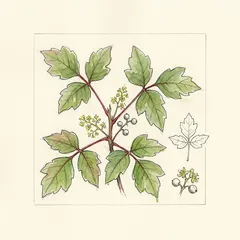
[POISON" OAK. NATURAL OEDEK, ANACARDIACE.E.]
Erect, or decumbent; leaves pubescent; leaflets three, broadly oval, acuminate, angular or sinuate dentate ; flowers in racemes, axillary, subsessile panicles ; drupes smooth, roundish. Canada to the uplands of Georgia. A small, weak shrub, one to three feet high, young branches and leaves beneath downy. Leaflets two to six inches long, two-thirds as wide, petiolate, the common petiole four to five inches long. The flowers are small, dioecious. Drupes pale-brown. (Wood.)
This plant was first described by Cornatus in his history of Cana- dian plants, and was first introduced to the notice of the profession in 1798 by Dr. Dufresnoy, a physician, in France. His attention was directed to it by the case of a young man who had been cured of an herpetic eruption on the wrist, of six years' standing, by being accidentally poisoned by this plant.
Orfila made six experiments on dogs with the extract of this plant. In the first two no effect was produced ; in the others it exerted a stupefying action on the nervous system, with local irrita- tion and more or less intense inflammation, with vertigo, and dilated pupils. After death, the blood was found fluid, of a very dark pur- ple color, in the cavities of the heart ; the lungs were r.ed and very crepitant. Lavini made the same experiments on guinea pigs and
.RHUS TOXICODENDRON. 709
birds, with the same effects. His experiments are described in the Journal de Cliemie Medicate, June, 1825.
Fontana states, in his celebrated treatise on poisons, that having touched tbe leaves of the rhus toxicodendron at different times and at intervals of several days, in four to six days after, the eyelids and the extremities of the ears and many other parts of his face became tumefied, and appeared filled with an aqueous fluid. The intervals between the fingers became red and covered with little vesicles full of pellucid humor, and the epidermis fell off in small scales. Vio- lent smarting of the skin continued for fifteen days, and the pulse was inordinately agitated.
Lavini applied the juice of rhus toxicodendron to the index-finger and left it there for two minutes : in about an hour it produced two small dark-colored spots. Twenty-five days afterward, he was sud- denly seized with the following symptoms : Great heat in the mouth and throat ; rapid swelling of the left cheek, of the upper lip and eyelids; the following night, swelling of both forearms to double their natural size, with coriaceous skin, insupportable itching and violent heat.
Four days after, there appeared on the hands and forearms pustules like those of the itch ; some of them, on bursting, discharged a limpid humor. Upon inoculating the forearm with this liquid, fresh pustules were produced. The places on the finger, to which the juice had been applied, presented two small tumors, about the size of peas, which afterward disappeared without opening them. After eight days, the forearms were covered with squamous scales ; the itching lasted several days.
These symptoms at last disappeared after the application of ice.
The following interesting cases of poisoning by the California poison oak (rhus diversiloba), a shrub which resembles the rhus toxicodendron in nearly every sense of the word, are related by Dr. J. Murray Moore. (Am. Observer, October, 1878.)
In February, 1876, E. B. M., a slight, brown-haired, but not fair- complexioned lady of twenty-five, walked up a hill at San Eaphael, fifteen miles north of San Francisco, on a warm morning, and, while perspiring freely, gathered ferns which grew among the poison oaks. She did not handle the leaves of the latter, though she must have often touched them.
About this time of .the year the young leaf- shoots are beginning to sprout, and the California sun-rays being as powerful in February as in July, their virus is energetically developed. E. B. M. proved very much infected — quite unknown to herself — for on the next day, Saturday, having returned to the city, she felt
710 KHUS TOXICODENDEON.
in the afternoon chills and feverishness by turns, and general ma- laise. Next day, Sunday, she awoke feeling really ill. She had a dull frontal headache, anorexia, nausea, stiffness of the limbs, ex- treme languor, and an eruption of itching red papules behind each ear and on the neck. On Monday, these papules enlarged and became more numerous, and the eyelids were red and oedematous.
Face was red and swelled ; the cervical glands became tumid and slightly tender. On rising from bed she fainted, and again later in the day syncope came on. On Tuesday the rash had extended all over the face, over the hands, between the toes and the thighs. The itching was becoming more and more intolerable and partook of a burniug character; the nausea continued, aud vomiting occurred this day.
During this day and the two following, the urine was scanty, high colored, and passed with a feeling of heat in the urethra. Bowels were costive all through the attack. About the fifth day from their first appearance the papules had become vesicles which rapidly coalesced on the face and burst, emitting an acrid serum, which, on drying, formed a crust so dense as to make the movement of the facial and buccal muscles painful. The nose and lips were much swollen.
The oedema of the eyelids was so great as to close up the left eye entirely and the right partially. The burning and itching were somewhat relieved after the breaking of the vesicles. The acute stage was now over (six days after the commencement,) but the cracking of the crusts over the face, etc., occasioned such disfigurement that the lady was confined to the house for a fortnight more ; by that time all traces of the skin erysipelas had disappeared, only an unusual irritability (to flannel, etc.,) of the integument remained, and a hypersensitiveness to cold air.
The treatment was mixed. On the third day an homoeopathic physician was called in, who prescribed sulphur200, and a weak arnica lotion, neither of which relieved any one of the symptoms. A very low diet was ordered and adhered to throughout, when the acute stage was over, steam-baths were taken, the first two being followed by a sulphur and bran bath. These baths relieved the itching temporarily, but extended the vesi- cles over the body and legs.
She felt very weak afterward.
A second attack in August, 1876, from a slight exposure to the shrub at Menlo Park, an open flat country, thirty miles south of San Francisco, abounding in scrub oak, poison oak, tarantulas and gophers (a kind of mole), was promptly checked by the local use of camphor dissolved in arnica tincture. The erysipelas of the face, however, was very intense for four or five days, and rhus200 materially relieved it.
A third and fourth attack in September, 1876, were promptly checked, (as to the face symptoms) by the same lotion ; and, so far, it has proved the only abortifacient of the rhus erysipelas I have known or heard of ; but it is too strong for many people's skins, and must be used with great caution. The virus must have remained in her system for about five months afterward, when in
RHUS TOXICODENDRON. 711
the city, namely, in February, 1877, a fifth attack came on, without any fresh exposure, shortly after taking a hath rather too hot. One of the earliest symptoms this time was the peculiar rheumatism of rims, affecting the legs chiefly, a stiffness of all the joints on first moving them ; aching pains in the joints, constant feeling of lame- ness in the legs. The vesicles that appeared during the first two days were few and scattered, and strongly resembled the eruption of chicken-pox.
There was a slight amount of pyrexia. Clematis erecta200, and afterward sulphur200 were prescribed by her homoe- opathic physician without benefit. After an illness of nearly three weeks, during which the rheumatism and derangement of the whole digestive system was very much marked, a course of four Turkish baths rapidly restored the health and the smoothness of the integu- ment. Since that time, no exposure having taken place to the rhus emanations, this lady has remained free from any sign of its baleful influence.
John W., a light-haired, robust Englishman, of twenty-three years, with pock-marked face, was travelling as colporteur in Napa Valley during the middle of January, 187(3. The weather being warm in the intervals of the showers, he got much heated while carrying his pack up and down the hills, on which the poison-oak was abundant ; he lay down among them while sweating, and once or twice relieved the bladder there, quite ignorant of the risk he was running. On the 13th day of January, the day after he had been last among these bushes, heat and itching of the scrotum and inner adjacent surface of the thighs commenced, worst on the hairy parts.
Next day the characteristic papules, on a base of diffused redness and oedema, appeared on the forehead and neck, rapidly spreading in all directions, and accompanied with heat, itching and burning, but with very little general pyrexia. The urine was not high-colored, but felt "hot" when being passed. The digestive system was not disturbed much, only loss of appetite being experienced. The itch- ing was relieved by cold, but aggravated by heat, warmth, rubbing or scratching ; his head felt hot, but did not ache.
He consulted me for erysipelas, but I was by this time familiar enough with the phenomena of poison oak to identify the nature of this " erysipelas." The patient made a recovery under the use of veratrum viride internally and the external use of a solution of half a drachm of sulphate of magnesia to one ounce of tepid water.
It will be found that the foregoing corroborate the following symptoms, as given in Hull's Jahr, edition 1862 : General. — Chilli- ness, followed by feverish heat ; languor ; debility. Great languor of the whole body. Sudden paroxysms of faintings. Weariness of the lower limbs. Stiffness of the limbs on first moving them. Lameness in all the joints, worse on rising from a seat after having been seated for some time. Skin. — Itching of the body. Burning
712 RHUS TOXICODENDRON.
itching here and there. Burning, itching eruptions, particularly on the scrotum, prepuce, eyelids, and eyes, with swelling of the parts, and small yellowish vesicles, which ran into each other, and became moist. Confluent vesicles, most of them containing a milky or watery fluid. Face
Erysipelatous inflammation of the face, with swelling also on the neck. Swelling of the face, particularly of the eyelids and lobules of the ears. Pale swelling (of the face), with burning closing of the "lids and lachrymation, followed by an erup- tion of vesicles filled with a yellowish liquid.
It is asserted by von Mons, and others, that the active principle of this plant is a hydrocarbureted gas, mixed with an acrid vapor, which acts most powerfully upon certain organs. Some individuals are exceedingly sensitive to the action of this principle. In the Vienna Zeitschrift, January, 1841, we read of a Creole with an exces- sively delicate skin and irritable nerves, who was made sick and attacked with erysipelas, whenever he came in the remotest degree in contact with the exhalations of the poisonous sumach.
At the distance of even a mile he began to be affected with the emanations proceeding from this plant, and at the distance of two hundred paces he became stupefied and fainted away. If a person carried a twig of the sumach tree past him, even without his knowing any- thing about it, he was attacked with convulsions, and the skin of the whole body became inflamed, with itching and tumefaction.
If small doses of rhus tox. are taken internally, the cutaneous and urinary secretions become more abundant, the action of the intestinal canal is stimulated, and in paralyzed parts a return of sen- sitiveness and motor power is perceived, accompanied by a sensation of burning and stinging. Large doses cause pain in the stomach, nansea, vomiting, vertigo, dullness and stupefaction of the head, general loss of strength in the extremities, spasmodic twitchings, feverish symptoms, numbness and inflammatory swelling of para- lyzed parts.
From the provings which Hahnemann has instituted with this drug, we infer that it affects the cerebro-spinal system of nerves, including the cerebral, sentient and motor nerves; it affects the ganglionic nerves, the serous and mucous membranes, the skin, the arterial and venous apparatus. The organism is affected by this plant both materially and dynamically. Dynamically, the rhus poison tends to produce depression and even paralysis ; materially, its action results in the decomposition and dissolution of tissues.
KHUS TOXICODENDRON. 713
According to Hahnemann, rims acts most powerfully while the body is in a state of rest, whereas the effects of bryonia become aggravated by motion. This is quite natural. The affections to which bryonia is generally homoeopathic are principally characterized by inflamma- tory irritation ; hence the pains which bryonia excites in a part must necessarily be aggravated by motion. Rhus, on the contrary, has a laming, stupefying action upon the tissues ; hence these effects of rhus are necessarily diminished by motion.
The provings which Hahnemann has instituted with rhus, and toxicological experience, show that rhus is homoeopathic to a variety of affections, which are best studied under the following categories :
CEPHALIC GROUP.
Nervous vertigo and arthritic hemicrania, when the brain feels as if it were shaking in the skull, with burning pains either in the fore- head or occiput, also with swelling of the head and even face, may yield to rhus.
NERVOUS GROUP.
PARALYSIS. — We need hardly repeat that rhus has been suc- cessfully used in the treatment of painless and cold paralysis of the extremities, or in paralysis depending upon concussion or organic disease of the spinal marrow ; or in rheumatic paralysis, with heavi- ness, tearing, drawing and benumbing pains in the paralyzed limb.
A male nurse, forty-five years old, small, thin in flesh and of a choleric tempera- ment, was well until a year ago, when he had typhus ; was treated, allceopathically, in the hospital for seven weeks, dismissed when still very feeble ; since then the fol- lowing condition gradually developed itself: he sits on a wooden stool and is, with it, in constant motion; the head and trunk incline forward, the former being in con- tinual motion ; the extremities tremble violently ; the patient cannot straighten him- self or remain quiet for a moment ; cannot keep anything in his hand and must be fed.
Attempts to walk show a high degree of insecurity in the use of his limbs ; he can remain standing, for a short time, with a constant shaking of the knees ; but he can walk only a few steps, with a constant grasping for support, and, a number of times, he has stepped with one foot upon the other, tumbling down and unable to help himself on his feet again. When in a horizontal position, the trembling is less severe; he starts spasmodically in his sleep, without realizing it. The muscles are extremely relaxed, and he is emaciated.
With this, the appetite is normal ; the tongue clean ; the bowels do not, at times, move for several days ; the urine clear, like water. Pulse small, soft, 70. Cold baths and the topical use of strychnine and phosphorus has done him no good. Diagnosis: paralysis agitans (Parkinson).
Treatment : Every morning and night three drops of the third decimal dilution of rhus. In two weeks he used half a drachm, and was much better. The improve- ment commenced in the lower extremities, the trembling disappeared, showing itself only, to a slight degree, after exhausting efforts to stand on his feet for some time ; by leaning on a supporting arm, he can cross the room as if his limbs had never ailed ; the trembling in the arms is much better. Prescribed rhus10, two doses a day.
After two months he walked a distance of about eleven miles (two hours) to see his physician. With the exception of a continued inability to hold his head erect, the paralytic symptoms have disappeared ; he is also in better flesh. Two years later he worked steadily as a mason. (Payr in Hirsch.
H. Ztschr., vol. iii., p. 138.)
714 RHUS TOXICODEXDltON".
W. H., aged seventeen years, had the itch in his childhood. He was carried to me on October 2, 1848, and gave me with the aid of his father the following state- ment : " I went, two and a half years ago, into the forest to help load a tree, and per- spired freely while at work. When the tree was loaded I was tired and, to rest, sat down upon the hindmost part of the tree.
On the road home, we were overtaken by a snow storm, with rain and violent wind. I remained on the tree. On my arrival at home I alighted — being stiff — from the tree, and discovered that the right leg, especially in the hip, was lame, and pained me on motion. All possible means were used,; but the evil, instead of getting better, was aggravated, and I am lame with the leg to this day." Symptoms : a drawing pain, with crepitation in the hip-joint; pains increased by leaving a chair, after sitting on it long; by sitting down in the cold; by exertion of the leg during walking; in the autumn and by change of weather.
The pains are eased by sitting near a warm stove, in the sun, and by con- tinued gentle motion. The leg is so lame, that he is obliged to take hold of his pants' leg in the knee, in order to lift it up and move it on, when he wishes to walk, or- rather, to limp. While limping, the leg has always been bent in the knee-joint and every attempt to extend it caused pain, and complete extension was not possible. The limb is stiff in the hip-joint, and every motion is painful and imperfect.
Pre- scribed one dose rhus tox.12. Eight days later, the patient reported again, having walked the whole distance to the Doctor's office (five post-miles). The patient stated that he noticed improvement on the first morning after taking the medicine, consisting mainly in a feeling of animation in the leg. On the second day he could raise the leg without being obliged to take the hand for support and the long walk, just taken, was not at all troublesome.
He still limped somewhat and received a second dose of rhus19, followed by a complete cure. [This remarkable case is well authenticated Ed.] (Dr. Bolle in the Allg. Horn.
Zeitg., vol. xlvi.)
L. S., Chicago, aged forty-seven years, dark hair and eyes; bilious temperament;, carpenter. Twenty-two years ago he had typhus fever, which was followed by ery- sipelas of the face and wrist. Eight or nine years ago he used an external applica- tion, which removed the external evidences of the disease.
He has always been, and is now, troubled with sore eyes, the lids having been granulated. The eyelashes are almost gone, especially on the lower lid. About three years ago he was taken with a numbness through the body, which settled in his left hip. While working at his trade he was exposed continually to drafts and changes of temperature.
The numbness came on gradually, and was felt most on going to bed at night. He had a peculiar pain which would begin in the left foot, and pass up that side of the body and across the shoulders to the right side ; thence down to the right hip, and across the pelvis to the left or lame hip again. This pain was at times so acute that the bed clothes falling upon it would cause most intense agony, and even render the limb powerless. When the pain was at its worst, the hair of his head and his mous- tache seemed to stand erect, and his leg would feel as though it was coming off.
The numb feeling usually began to come on about seven to eight o'clock in the even- ing, at which time there would be a " dripping as of water, which would choke the whole system." After the dripping sensation the mind would become dull and stupid. As the pain passed around the body as described, it left sore spots on the way. As soon as perspiration set in, these sore spots became icy cold. Sometimes there is a drawing sensation in the hands, when, if he takes hold of anything, he cannot let go.
The feeling in the hips is as cold marble, and when it goes through some parts, it "nips," just as though done by a pair of pincers. The patient's mind was rendered almost useless by the stupefying effects following the severe paroxysms of pain. He was a wreck, bodily and mentally, although giving evidence of having at one time been above the average in both. The bowels were inactive, moving but once or twice a week with artificial help.
Some palpitation of the heart, aggravated by excitement or fright. He now feels worse about nine or ten o'clock in the morn- ing. His pains are, and have always been, relieved by gentle motion ; better in dry,, clear weather ; worse before a storm and about midnight. He could foretell the coming of a rainstorm sometimes as long as three days ; pain somewhat relieved when the storm had fully set in.
On January 30th, rhus tox.200 was given him, once in two weeks until April 10th, when he reported steady improvement. May 15th, the patient reported himself well, except a slight headache. The remedy was repeated but once or twice. (Dr.
W. J. Hawkes' clinic. {U. S.
M. Invest., May 15, 1879.)..
RHUS TOXICODENDRON". 715
Dr. Alderson, in his essay on rhus toxicodendron, gives several cases of recovery from paralysis affected by means of the dried leaves, in doses of from half a grain to a grain three times a day, and he says that the first feeling of amendment was a sensation of tingling and twitching in the affected limb. Noack and Trvnks report several cases of paralysis of the feet which were cured by rhus toxicodendron. One is a case of painless paralysis of the feet ; the patient was a man whom Hahnemann had treated unsuccessfully for three years; he took the tincture of rhus in increasing closes, in all four ounces of the drug, until his cure was completed, without experiencing any bad effects whatsoever from the medicine.
In another case both feet were paralyzed, with complete inability to move them, to walk or stand ; the patient was a girl of fourteen years, and was entirely cured by consuming two ounces of the tinc- ture in increasing doses; she had remained perfectly well for the last two years when the case was reported.
RHEUMATISM. — Ehus causes coxalgia with tearing and stitch- ing in the hip-joint down to the bend of the knee, with heaviness of the legs, paralysis of the legs and feet, feeling of numbness in the feet. The symptoms recommend rhus as an excellent remedy in violent rheumatic and arthritic affections. It has likewise been employed in
ISCHIAS NERVOSA. — Rhus is most useful in rheumatism characterized by stiffness and lameness of the joints and stinging pains in the tendons and muscles, also tingling and feeling of sore- ness, or as if bruised. The pains are generally worse on first moving the part ; they abate after moving about a little.
A woman, forty years old, of phlegmatic temperament, has been sick, for five days,. with rheumatism after taking cold. Symptoms : Straining, tearing pain, which prevents her from being quiet in bed for a minute ; she is constantly moving hands and feet. There is a drawing, straining, tearing pain all over her, worst when she is quiet, relieved if she continues motion. The limbs, however, feel numb and dead upon being moved; and the limbs easily "go to sleep," when she rests upon them.
The involved parts are red and shining, sore and painful to touch. She has pressive pains in the joints, with a sensation of stiffness, especially when she rises after sitting down, and these pains are aggravated when she comes in contact with open air. There is stitching in the small bones of the foot upon stepping, and the ankle feels as if sprained. Great exhaustion, which is noticed more when sitting still than during walking ; but she staggers and reels as she walks ; and standing on her feet is still more difficult, from lack of strength in the legs.
The hand trembles if she attempts to grasp anything. The body is nearly always warm and moist with a little thirst ; the pulse beats fuller and quicker than usual ; breathing is short ; the lips and tongue rough and dry. The passages from the bowels are not constipated, but do not occur as often as usual, the urine is hot and dark. She has no appetite ; she relishes nothing, and yet, there is at times an insatiable appetite.
In the night, there is much moisture of the skin with heat and thirst, and much restless tumbling about ; the pains are then much aggravated. Toward morning she perspires freely with some
716 RHUS TOXICODENDRON.
amelioration of the pain. Her mind is disturbed with anxiety and apprehension. Prescribed rhus tox.24, one drop. After an aggravation of the symptoms on the first and second day, she recovered entirely on the fourth. (Gross in Archiv. f. d. Horn. Heilk., vi., i, 61.)
ORBITAL GROUP.
. OPHTHALMIA. — Rhus has undoubtedly a marked effect upon the eyes. Scrofulous ophthalmia has frequently been cured by means of rhus ; the symptoms are : burning in the eyes, lachryma- tion, photophobia, swelling and inflammation of the lids, inflamma- tion of the canthi, smarting sensation and pressure in the eyes. The first who recommended rhus for scrofulous ophthalmia, was a homoeopathic physician in Vienna, Dr. Ritter von Lichtenfels ; since then, it has been extensively used by alloeopathic physicians. In
SCROFULOUS BLEPHAROPHTHALMIA, inflammation of the lids, even when chronic, with redness, swelling and scurfy formations of the lids, dryness of the eyes, itching and burning of the lids, rhus may be of great service.
Hartmann says : The inflammation to which rhus is adapted, is never active, nor is the stabbing pain in the eye itself always very acute, but it is aggravated by the exposure of the eye to the light. The inflamed Meibomian glands cause a constant adhesion of the eyelids. With the inflammation we find also swelling, not only of the lids, but of the entire region which surrounds the eye. Rhus has been frequently, and with advantage, used in ophthalmia neonatorum.
A scrofulous child of six months was sick with fully developed ophthalmia neo- natorum. The inflamed and swollen eyelids were firmly closed, permitting, how- ever, the occasional discharge of pus-like mucus. A copious discharge of water accompanied a forcible opening of the eyes, and the spongy, granulated inner sur- faces of the lids formed a dark-red swelling, which hid the bulb of the eye from view. Prescribed a spoonful per diem of a solution of rhus6 in water internally, and drop- ping of the same solution into the eye once a day.
The trouble disappeared on the fourth day. (Gross, Arch. Horn. Heilkst, xvi., 2, 94.)
AURICULAR GROUP.
OTALGIA. — Rhus may prove useful in otalgia, with throbbing pains in the ear and swelling inflammation and desquamation of the external ear. Also in
PAROTITIS after scarlet fever, if the gland is hard as stone ; or in chronic induration of the parotid gland ; or in epidemic parotitis (mumps).
FACIAL GROUP.
VESICULAR ERYSIPELAS.— We have seen that swelling and
RHUS TOXICODENDRON". 717
inflammation of the face, with effusion of serum under the epi- dermis, are a common effect of rhus. All the signs of vesicular erysipelas are distinctly developed by rhus. We have likewise used this agent in
CRITSTA LACTEA and in
ACNE EOS ACE A, with more or less success, but more particu- larly in the chronic variety of these eruptions.
DENTAL AND PHARYNGEAL GROUPS.
TOOTHACHE. — Rhus has been recommended in some forms of arthritic and rheumatic toothache, with fine prickling pains in the tooth as if a pin were stuck in ; also for a tingling pain in the teeth, which is felt from time to time, as if they would go to sleep.
This agent has been successfully used by Dr. Paine in the inflam- matory stage of diphtheria, "if the inflammation was of a dark-red, or if there were dark crimson patches scattered over the inflamed surface."
CHTLO-POIETIC GROUP.
The gastric symptoms of rhus are not of a common order. It causes a flow of water from the mouth, and dryness of the tongue ; it causes a bitter taste in the mouth ; food likewise tastes bitter. The appetite is either gone, or disappears after partaking of the smallest quantity of food ; it causes a pressure in the pit of the stomach as if swollen.
DYSPEPSIA. — These symptoms may indicate the use of rhus in some forms of dyspepsia, characterized by flow of water, dryness in the mouth, little or no appetite, or a capricious appetite which is satisfied after partaking of the smallest quantity of food, with pressure in the epigastric region as if the parts were swollen.
Rhus causes a continual urging to stool, with nausea, also with tearing in the intestines ; the urging sometimes results in a watery discharge. Rhus also causes bloody stools, or red and yellow stools, mixed with mucus, of a jelly-like and fluid consistence. The stools sometimes are involuntary. It may therefore be used with advan- tage in
DIARRHG5A of a dysenteric character, accompanied by discharge of blood and cutting pain. In
TYPHOID INFLAMMATION OF THE BOWELS AND PERITONEUM, rhus seems to possess specific powers to arrest or favorably to modify the disorganizing process which is going on in
718 RHUS TOXICODENDRON.
the mucous surface of the intestines, in the blood, and in the peri- toneal exhalations.
INCARCERATED HERNIA Dr. Mueller professes to have
used it with success for the typhoid inflammatory symptoms and the tympanitis developed during an attack of incarcerated hernia.
PHYSCONIA PERITONEALIS— Rhus has also been used in physconia peritonealis. Gauwerki reports three cases, with swelling and hardness in the right iliac region, extending toward the tinea alba and dipping deep into the pelvis. There was some local in- flammation in the inguinal region, with pressing, pulsating pain and a feeling of pressure and weight in the lower abdomen. The symp- toms were worse when sitting and upon extending the right limb ; impossibility of lying on the left side ; relief from lying on the back with the right leg drawn up, and relief of pain from pressure with the hand from below upward.
URINARY GROUP.
Rhus causes an increased secretion of urine, and even incontinence of urine. Hence it has been given with success for
PARALYSIS OF THE SPHINCTER OF THE BLADDER in the case of old people and scrofulous or hysteric women, and even for paralysis vesicas et ani combined. In
NOCTURNAL ENURESIS of feeble, rickety, strumous children, who are likewise troubled with weak bowels, rhus proves very useful.
SEXUAL GROUP.
ERYSIPELAS OF THE SCROTUM.— The action of rhus upon the sexual organs is very marked. It causes swelling of the parts, and a furious itching of the scrotum, with a distressing break- ing out on the parts ; also violent erections and, in women, violent labor-pains as if the menses would make their appearance. We may recommend rhus for erysipelas of the scrotum in new-born in- fants ; for
VIOLENT ITCHING OF THE SCROTUM, with which many persons are sometimes afflicted ; for
MENSTRUAL SUPPRESSION when arising from wet feet, when the suppression is attended with violent pressing pains in the uterine region ;
UTERINE HAEMORRHAGE brought on by a strain, restless- ness, seeking relief by constant change of position ; dryness of the mouth and lips; violent biting pain in the vulva; and perhaps for
PUERPERAL FEVER.
RHUS TOXICODENDRON. 71 -J
CATARRHAL AND THORACIC GROUPS.
In affections of the chest, rhus is not to be despised. It causes spasmodic sneezing, hoarseness and roughness in the throat, cough with titillation in the bronchial tubes, generally of a dry character and sometimes with the taste of blood in the mouth. It causes likewise acute stitches flying through the chest at night, waking the patient out of her sleep ; shortness of breath and dyspnoea. Hence we have used rhus with some advantage in
. TYPHOID PNEUMONIA, with dry, glazed tongue, bland delirium, cough with stitches and foul or bloody expectoration.
EXANTHEMATOUS GROUP.
VESICULAR ERYSIPELAS.— In vesicular erysipelas rhus seems indispensable. In some
HERPETIC ERUPTIONS, with burning and itching, and exu- dation of a serous fluid, rhus may prove invaluable. In
HERPETIC ERUPTIONS ON THE SCROTUM AND PREPUCE, with swelling of the parts, exudation of serum, furious itching and smarting, rhus is a capital remedy. Do not neglect rhus in
TINEA CAPITIS, with exudation of fetid and yellowish matter under the scabs, itching, burning and inflammatory redness of the scalp.
In a case of poisoning by rhus, related by Dr. Neidhard, vesicular tubercles caused a great deal of annoyance to the patient. The eruption developed itself in the following manner :
First day Small vesicular tubercles, resembling bites of insects, showed themselves in the joints of the hands, feet, particularly around the inside of the ankles. In the evening, excessive, almost intolerable itching at the same time, with a kind of voluptuous feeling in the skin, followed by a burning after the skin has been scratched to bleeding. Scratching aggravates the itching and burn- ing.
Second to fifth day Swelling and redness of the upper and lower lids of the right eye and all around it to such an extent that the patient could only see with difficulty. A similar swelling around the left eye, but to a less extent. Tubercles appeared in different parts of the body; they appeared also on the knees, hip, and shoulder- joint ; this action on the joints was a characteristic symp- tom.
On the inside of the ankles, where the itching was most severe, dark-brown marks have remained to this day, now five years. In this case the poisonous action of rhus seemed to communicate itself to several persons who were in contact with the patient. A decoc- tion of sasaf ras relieved the itching ; the greatest relief was expe-
720 EHUS TOXICODENDRON.
rienccd from small doses of mercurius praecipitatus ruber used externally as well as internally. In
PAPULAE ERUPTIONS of this character, in papular itch or herpes, rhus will prove eminently useful.
ANTHRAX Rhus should not be forgotten in pustula maligna
or anthrax, and in
PURPURA HEMORRHAGICA, especially if the patients have a sallow, cachectic appearance, with great debility, tendency to paralytic weakness of the bladder and bowels, foul discharges ; loss of appetite, appearance as if the blood would turn to water.
Rhus causes pains as if sprained or bruised, and as if the flesh had been detached from the bones by blows ; hence its use is frecpiently resorted to in sjarains ; but it proves useful only in lesions of the tendinous and ligamentous tissues when resulting from blows or strains. If symptoms of true inflammation develop themselves,, aconite should be used.
GLANDULAR SWELLINGS.— In hard and old glandular swellings, more particularly of the parotid and sub-maxillary gland, rhus has been found eminently useful.
FEVER GROUP.
Rhus is eminently adapted to typhoid conditions of the blood and other vital fluids ; hence it will commend itself to your attention in acute eruptive diseases, such as
MEASLES, SCARLET FEVER, SMALL-POX, if a process of decomposition should appear, as indicated by foul discharges from the bowels, livid color of the skin, fading away and unhealthy char- acter of the eruption.
A girl, eighteen years old, was taken sick with small-pox after nursing a patient sick with typhus. She had the following symptoms on the fourth day : Burning fever ; extreme exhaustion ; burning thirst ; roaring in the ears ; dry, hard tongue ; the lips and teeth covered with tough, brown slime ; the abdomen meteoristic ; the eruption looked dried and shrunk ; many of the pustules were livid instead of having the healthy bright-red. I prescribed one-eighth of a grain of the extract of rhus tox. every three hours.
When I saw the patient on the next day but one, I was surprised at the favorable change ; the typhoid symptoms had disappeared, and the pustules were healthy. The disease ran its normal course, and the patient made a good recovery. (Mayrhofer in the Hygea, vol. xviii., p. 494.)
TYPHUS. — In typhoid inflammations of the bowels and peri- toneum, or in abdominal typhus, as it is termed by pathologists, or in bilious or gastric typhus, rhus may prove a most valuable remedy.
In these forms of typhus we find the following symptoms : The usual pain in the region of the ileo-coec.tl valve, sensitiveness or per-
KHUS TOXICODENDRON. 721
haps uumbness of the abdominal walls, symptoms of general decom- position of the vital fluids, discharge of fonl urine, fetid, watery and bloody, sometimes involuntary discharges from the bowels, clammy and husky skin, empty and rapid pulse ; foul taste in the mouth, tongue thickly coated with a blackish-brown mucus, thirst, epistaxis, bleeding of the gums, petechias.
In the epidemic typhus of 1813, where thousands of soldiers fell victims to the disease, Hahnemann did not lose a single patient out of one hundred and eighty-three whom he treated in Leipzic with alternate doses of rhus and bryonia. This naturally excited great astonishment among the officers of the Russian government whose troops occupied Leipzic at that period, but was taken no notice of by the medical authorities. This fever had two principle stages. During the first stage the patient was affected with an intolerable bad humor, sensation of heat in the body and especially in the head, dry feeling or actual dryness in the mouth, causing constant thirst, bruised feeling in the limbs, restlessness, etc., but in the second period the patient did not complain of any of these symptoms ; he was hot, did not desire to drink, ho knew not whether to take this thing or that ; he did not know those about him, or he abused them ; he gave irrelevant answers, talked nonsense with his eyes open, did foolish things, wished to run away, cried aloud or moaned without being able to say why he did so, had a rattling in the throat, the countenance was distorted, the eyes squinting, he played with his hands, behaved like a madman, passed feces and urine without con- sciousness, etc.
To these groups of symptoms bryonia and rhus proved homoeopathic.
But there sometimes occurred a third state, a sort of lethargy, or semi-paralysis of the mental organs. The patient remained indo- lently lying on his back without sleeping or speaking; he scarcely ever answered any questions ; he appeared to hear without under- standing what was said ; he only whispered a few words which had no bearing upon the question ; he appeared to be almost without the power of motion or sensation, without being actually paralyzed.
In this case the sweet spirits of nitre were administered. The nitre should be so old, or so thoroughly sweetened, that the cork of the bottle is no longer reddened by it.
One drop of this was shaken with an ounce of water, and con- sumed within twenty-four hours. In the course of a few days this paralytic prostration was followed by recovery.
VOL. II.— 45.
722 RHUS TOXICODENDRON.
M., forty-eight years old, robust, tall and strong, who has never been sick before, worked very hard some three weeks ago and was taken with dizziness, aching in the limbs, nausea, etc., culminating in a nervous fever, which was treated alloeopathically. After three weeks he presented the following symptoms : Vertigo, when raising himself up or moving, but not when lying quietly ; forgetfulness ; he demands a drink, receives a glass of water, holds it in his hand and does not know what to do with it.
Headache, delirium. Staring, glassy, dull, stupid eyes. Dry tongue, stiff and hard like a board ; trembling of the tongue as it is protruded ; deafness ; dry- ness of the nostrils. Much thirst for very cold drink.
Loss of appetite, nausea with eructations ; hardness of the abdomen, constipation ; frequent emission of light- colored urine, depositing a sediment like the dregs of beer; hot fever, with anxiety and dryness of the surface of the body; he cannot perspire; he wants to sleep all the while ; he lies in bed, sleeping, snoring and muttering ; if he is called loudly, he inquires what is wanted, and sleeps on ; his hands are in constant motion, feeling about the bed and picking the cover.
He cannot stand on his feet; if he is helped out of bed, to arrange its furniture, he faints away from utter exhaustion. Pulse small, hard, eighty beats per minute. Prescribed aconite, with relief; after twenty- four hours, rhus tox. followed by a general aggravation of all the symptoms, continu- ing a day and a night; after three days, the fever, thirst, delirium and deafness improved; on the sixth day he could leave the bed and sit up for hours, and an entire recovery followed soon.
(Gaspary, Ann. d. Horn. Klinik., vol. ii., p. 196.)
MENTAL GROUP.
Khus causes peevishness, anxiety, a feeling of fright, oppression, apprehension, restlessness with a desire to move about, and delirium of a muttering character.
We prepare the tincture from the green leaves ; it is of a dark- yellow color.
ANTIDOTAL TREATMENT It is stated that occasional doses of rhus toxicodendron act as a prophylactic, and protect sensi- tive people against the effects of exposure. The following have been used locally : A decoction of the grindelia robusta, camphor, arnica, vaseline, salt-water, bran-water, sulphite of soda. Among the remedies used internally we may mention rhus toxicodendron (high), arsenicum album, sanguinaria, sulphur, graphites, clematis erecta, etc.
Dr. Murray has used veratrum viride with encouraging success. Eomentations of warm milk and sweet oil on the swollen and inflamed parts are very useful. If the sexual parts are swollen and inflamed, they may be bathed in a decoction of sassafras.
Acon- ite and belladonna may be given internally. The internal and external use of lobelia inflata has been found efficient by some prac- titioners. The mercurius prgecipitatus ruber internally, and ex- ternally in the shape of a mild ointment, likewise affords great relief.
RHUS VEXENATA. 723
EHUS VEjN~Ej^ATA.
[poison sumach, dog- wood, natural order, anacardiace^e.]
Very glabrous ; leaflets seven to thirteen, oval, abruptly acuminate, very entire ; panicles loose, axillary, pedunculate ; drupes greenish- yellow, smooth. A shrub or small tree of fine appearance, from ten to fifteen feet high, in swamps, in the United States and Canada. Trunk several inches in diameter, with spreading branches above. Petioles wingless, red, six to ten inches long.
Leaflets about three inches long, half as wide, sessile, except the odd one. Panicles axillary ; staminate and pistillate flowers on separate plants, those of the barren ones more diffuse. Flowers very small, green. Drupes as large as peas.
June. The whole plant is very poisonous to the taste and touch, and even taints the air to some distance around with its pernicious effluvium. (Wood.)
Like its kindred, the rhus vernix, a native of Japan and equally poisonous, this plant furnishes a milky juice, which, upon being boiled, makes a very good varnish. It is exceedingly poisonous, pro- ducing violent symptoms which resemble those of the poison oak and poison ivy ; it seems to affect with particular intensity persons of sensitive organization and of light complexion and it is said, that the symptoms are apt to recur at the same time of each succeeding year.
The poisonous effects of sumach are described, as follows, by John Bigelow. He states :
"The most formidable cases in persons subject to this poison usually commence within twenty-four hours after exposure, some- times longer, more frequently shorter. The symptoms generally begin by itching and tumefaction in the hands and face, the swelling gradually spreading over different parts of the body like erysipelas. The inflamed parts became elevated, of a livid redness, with a burn- ing sensation ; they contain a transparent fluid, which by degrees becomes yellow, and then assumes a purulent appearance.
A dis- charge takes place from the vesicles, giving rise to a yellowish incrustation, which afterward becomes brown. An insupportable itching and burning is felt ; the parts become excessively swollen ; not ^infrequently the eyes are closed, and the face has a cadaverous appearance like that in malignant small-pox. It usually reaches its height the fourth or sixth day, after which the skin and incrusta- tions begin to separate from the diseased parts, and the symptoms gradually subside ; no scars or permanent traces usually remain.
I never knew of a well authenticated case terminating fatally.
724 RHUS VENENATA.
"In October, 1814, Dr. A. L. Pierson accompanied me to collect the juice of the rhus venenata.
He had always supposed himself exempt from liability to the poison. The day was warm ; the effluvi- um from the incisions we made in the trees was very powerful ; we were exposed an hour, he less than myself. His own account of the symptoms is as follows : 'I felt no unpleasant effects for six or seven hours, when I perceived the backs of my hands were swollen and puffy, without pain or itching ; my forehead and upper lip were soon in the same state. The following morning the tumefaction had •increased, and other parts were infected; the backs of my hands and wrists began to show small, watery vesicles.
No applications were made till about noon ; I then applied cloths dipped in lead- water to one hand and wrist, and a spirituous solution of corrosive muriate of mercury to the other. From this and subsequent trials I prefer lead. The parts began to itch ; the tumefaction increased ;. vesication began to take place on the swollen surface ; small pustules formed and ran into each other, and at last some were as large as nutmegs.
Next day my eyes were nearly closed from the swelling of my forehead, eyebrows and cheeks. The contents of the vesicles- were perfectly limpid ; inoculation from them to other parts had no effect, nor at any other stage. The next evening the inflammation was at its height ; the burning and itching intolerable. The follow- ing day the pustules began to appear a little milky, and by night the inflammation was evidently on the decline.
This day I applied stramonium ointment. In a fortnight. I was able to leave my chamber, and had a new cuticle from the roots of my hair on the forehead to my breast, and on the arms and inside the thighs. During the first five days the pulse was increased from ten to twenty strokes.
The poison seemed to have a considerable effect in relieving me from dyspeptic symptoms, and also benefited a chronic inflammation of my eyes.'"
Dr. Bigelow adds: "The following circumstances have consider- able influence in varying in the same person the aptitude to the reception of the poison : 1. A warm or cold climate ; in southern more active than in northern. 2. Different seasons of the year.
The rhus vernix never affects me in the smallest degree, except on very hot days in summer. 3. Infancy or manhood ; child ren are more readily poisoned than adults. 4. Exposure before or after a meal. Dr.
Barton, in his edition of Cullen's Materia Medica, states that the plants more readily poison immediately after than before a full meal. 5. The presence of moisture. Country people generally believe that the effluvia of plants when combined with moisture are apt to produce the eruption. 6. A state of increased perspiration, at the time of exposure, has a most powerful influence in favoring the eruption ; if my skin was perfectly dry, while collecting the juice of the rhus vernix, it had not the least effect upon me."
Provings with rhus venenata have been made by Drs. P. B. Hoyt,
RHUS VENENATA. 725
Burt, F. G. Oehme and others. Among the symptoms experienced we have the following :
Head and Face — Fulness ; heaviness ; dizziness worse in the evening, dull, heavy frontal headache, aggravated by walking and stooping. Troublesome deafness ; vesicular inflammation of the ears, with exudation of a yellow, watery serum and with much itch- ing. Smarting and burning in the eyes ; the eyes are swollen and inflamed ; slight dimness of sight ; profuse lachrymation ; constant dull aching in the eyeballs ; swelling of the cellular tissue around the eye. The nostrils feel dry and inflamed as if a cold had been taken ; discharge of water from the nose.
The face is red, swollen and covered with vesicles, which are filled with yellow serum ; itching and burning of the face, relieved from the use of cold water.
Mouth And Throat EN
Flat, slimy, rough taste in the mouth.
White slimy coating of the tongue.
Soreness of the tongue, as if scalded.
Eedness of the mouth and of the sides of the tongue.
Dryness of the root of the tongue and fauces, with dull, severe aching in the throat, soreness of the throat, frequent inclination to swallow; painful and difficult deglutition.
Stomach, Abdomen and Stool
Loss of appetite.
Thirst.
Distress and pain in the stomach.
Constant rumbling in the bowels, with dull, aching distress, followed by soft, diarrhoeic stool.
Griping pain in the abdomen, with bloating and tenderness upon pressure, followed by light-colored stool.
The pains are worse before stool.
Discharge of blood from the rectum after stool.
Urinary and Sexual Organs
Frequent voiding of small quantities of urine ; burning in the urethra.
Intense itching and burning of the scrotum and penis.
The scrotum is much swollen, of a deep red color and covered with vesicles.
Swelling and sore- ness of the glans penis.
Inflammation of the cuticle of the penis and scrotum.
Back and Extremities
Stiffness of the back ; dull pains in the cervical, dorsal and lumbar region, aggravated by stooping or walking.
Violent itching on the back.
Severe drawing pains in the elbows, wrists, hands and fingers, worse during motion.
Swollen condition of the hands and fingers.
The hands are hard, rough and tender.
The cellular tissue is greatly swollen, of a deep red color, and covered with watery vesicles, which itch intolerably.
Vesicles on the hands and fingers ; desquamation ; cracks in the ends of the ringers, which bleed easily.
Dull drawing pains in the knee and in
726 EHUS VENENATA.
the leg below the knee.
Constant aching in the knees and ankles, with cramps in the calves of the leg at night, followed by great soreness.
Weakness of the knee and ankle.
Kedness, and trembling of the limbs.
Large watery blisters on the sides of the feet.
Itching and burning.
Skin EN
Heat and dryness at night, with great restlessness. Fine vesicular eruptions on the forearms, wrists, back of the hands, between and on the fingers, on the scrotum and ankles. The vesicles are situated upon an inflamed erysipelatous base, and ac- companied with most intolerable itching, especially in the evening, in a warm room, and in . bed ; after scratching and rubbing the parts (which cannot be resisted) the itching is intolerable, large quantities of serum run from each vesicle after it is scratched.
Large, watery vesicles on the ankles, which are very painful night and day. Swelling of various parts of the body, with vesicles from which exudes a yellow serum. Three boils came on my face, and eight on my right thigh ; one was very malignant and sloughed for four weeks; when the core sloughed out, a cavity was left into which you might easily put the end of your index-finger; when healed, they left the surface bluish-red ; they were very painful. Incrustation on the inside of the thighs, extending down one-half the length of the femur.
Slight inflammation and swelling, with soreness on pressure apparently near the bone, with itching and burning. The epidermis, on the place of application, can easily be removed with the finger nail ; on this denuded surface little scabs form in a short time. A fold of skin on the affected parts is at least six times thicker than normal. The redness is not circum- scribed, but passes over into an eruption like measles ; the surround- ing parts itch more than the rest of the disease.
The part has a livid color, the appearance of severe phlegmonous erysipelas ; soon after rising, the burning and itching reappeared, which was presently followed (without scratching) by increased redness, inflammation and an eruptiou of blotches, vesicles, small pimples and spots like measles; the efflorescence more around the newly inflamed parts, forming a border between that and the skin ; this border itches most. The swelling was greater than the inflammation ; erythema on the right side of the neck, red irregular spots on the left cheek and face.
Eruption on the face, head and chest, resembling the rash in typhoid fever, disappearing on pressure.
Fever Continual shivering down the back. General feeling
RUMEX CRISPUS 727
of lassitude.
Increase of the pulse from ten to twenty strokes.
The inflamed skin is nine degrees hotter than the healthy skin.
Mind EN
Inability to connect one's ideas ; forgetfulness ; dull and stupid feeling; sadness; absence of mind. Mental labor increases the pain.
Sleep EN
Great restlessness; the sleep is disturbed by dreams. The sleep is disturbed by pains in the wrist, ankles and feet.
Characteristics — All the symptoms were increased on a damp day ; aggravation just before a rain.
Continued motion relieves the pain ; rest and mental labor aggravate.
The skin symptoms are ■worse in a warm room and in bed, relieved by bathing in cold water.
We have very little clinical experience with this remedy.
It is considered more active than rhus toxicodendron, and has been given successfully where the poison oak was indicated, but failed to act.
We use a tincture of the sreen leaves.