 Ομοιοπαθητική Βιβλιοθήκη
Thuja Occidentalis
Hempel - Materia Medica and Therapeutics · Charles Julius Hempel · 30,974 χαρακτήρες
 Όλα τα βιβλία για Thuja Occidentalis →
Αντιδοτείται απόBryonia AlbaCamphoraCastor EquorumChamomillaCocculus IndicusColchicum AutumnaleMercurius SolubilisNux VomicaPulsatilla PratensisRicinus Communis
Όλα τα βιβλία για Thuja Occidentalis →
Αντιδοτείται απόBryonia AlbaCamphoraCastor EquorumChamomillaCocculus IndicusColchicum AutumnaleMercurius SolubilisNux VomicaPulsatilla PratensisRicinus CommunisGeneral EN
[ARBOR vit^e. natural order, CONIFER^.]
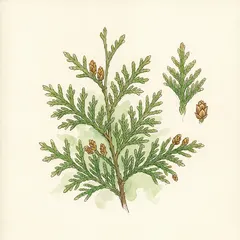
The thuja occidentalis, so named by Linnaeus in contradistinction from the Eastern thuja, thuja orientalis, which was brought to Europe from northern China, is found in the West Indies, in the United States, and in Canada.
Torrey, in his Elora of the State of New York, furnishes the fol- lowing description of this plant: "A tree with a narrowly conical and tapering head, seldom more than thirty to thirty-five feet high and to twelve inches in diameter, much branched; the ultimate divisions flattened and covered with numerous obtuse shining leaves, each furnished with a little vesicle which (as in white cedar) is filled with a thin aromatic turpentine. Sterile aments minute at the ex- tremity of the branchlets, consisting of a few concave, scale-like anthers. Cones about five lines long, yellowish-brown ; the scales loosely imbricating, opening to the base. Seeds conspicuously winged, emarginate, one under each scale.
" Rocky banks of rivers and hill-sides, also in swamps ; abundant and very conspicuous on the Hudson above Newburgh, Oriskany swamp, and various parts of the northern and western counties of the state of New York. The wood is light, of a reddish color and, though soft, is very durable. It is not much used for lumber, as its trunk does not afford pieces of sufficient length. It is often planted about houses and in pleasure grounds.
In some parts of the country it is called white cedar, and in New England it is often called hack- mattack."
Thuja acts, especially, upon the genito-urinary organs, producing wart-like excrescences which will be fully described hereafter. The remedy affects also the skin and other parts of the body.
The following analysis of the action of the remedy, as obtained from the provings of Hahnemann and others, is based upon the ex- haustive article of Dr. Mayrhofer.
General. — 1. Thuja stands in an intimate relation to (a.) the genito-urinary system, (b.) to the cutaneous system in all its ramifi- cations. The sexual organs are affected sympathetically. The fibro- serous and mucous membranes bear the stamp of primary effects ; the external skin, of the secondary.
2. The general character of the pathological condition, which
THUJA OCCiDENTALIS. 857
thuja sets up in the attacked parts, is that of irritation. This irrita- tion, which may even increase to inflammation, causes in the secret- ing organs (mucous membranes, urinary apparatus and glands) an increased and altered secretion. In the external skin the irritation is concentrated in single spots, and manifests : inflammation, sup- puration, formation of warts and excrescences.
3. The affections of thuja present the following peculiarities : (a.) They attack only a single organ, limb, joint or spot at a
time; and these local affections usually cease when morbid symp- toms arise in a different province.
(b.) They come on for the most part in abrupt paroxysms, begin suddenly, and end as though they were snapped off.
(c.) They make their appearance especially during rest, and either diminish or disappear by movement ; nay, the pains which appear in circumscribed spots often instantaneously disappear on touching the affected spot, and return immediately on quitting the contact. They come on consequently, for the most part, in the evening in bed, and in the morning on waking ; they are aggravated, too, by passing from a cold into a warm temperature, and are diminished by the opposite. The pains in the joints only are aggravated by movement, and violent affections or febrile symptoms remain the same whether in rest or motion.
(d.) They more frequently affect the left side of the body, though they do not on that account neglect the right.
4. The most constant kinds of pain which thuja excites in its most extensive sphere of operation in the different organic struc- tures, are : drawing and tension in the limbs and joints, burning in the urinary organs, itching and crawling on the skin.
5. The course of the thuja-sickness is partly acute, partly chronic. The symptoms of the primae via? go off in a short time, but those of the secundge vise run a very irregular course, and are characterized by great mutability and caprice. They return after intervals of hours, days, weeks, continue sometimes shorter and sometimes longer, and appear now in this, now in that part of the body.
The cutaneous excrescences, finally, as the concluding products of thuja, are as slow in disappearing as they are in coming, and remain for months.
6. The true attendants of a thuja fever are strongly marked, predominant cold, and gloomy, depraved state of mind. To express the physiological character of the arbor vitse in the shortest manner,
858 THUJA OCCIDENTALIS.
it is : exaltation of the cutaneous system, with disposition to dermatic excrescences.
Nervous System EN
(a.) Nerves of sensation : Flying stitches through the brain ; vertigo ; drawing, sticking or boring, screwing, dull, stunning headache; drawing, tearing, sticking in the head, frontal eminences and zygomata, etc. As special nervous affections of the head, we have : the feeling as though a convex button were pressed upon the head, especially in the neighborhood of the sutures, or a needle or a nail repeatedly thrust in ; hemicrania in the fore- head, the pains extending by radiation into the brain. Belonging to the spinal marrow : drawing, tensive, sticking, tearing, creeping, itching, burning, laming, digging, boring pains in the nape, back, sacral region, nates and limbs.
(&.) Nerves of motion : Frequently-recurring involuntary twitch- ings.
Sleep and Dreaming
The symptoms afforded by the sleep under the action of thuja are simply signs of febrile action, and consist of sleeplessness, unrefreshing dosing, or restless sleep with dreams ; frequently, they indicate the action of the drug upon the genital system, as voluptuous dreams, ending with pollution.
They rarely point to any irritation in the brain.
Mind And Disposition EN
The principal action of thuja upon mind and disposition is of a depressing sort, i. e., anxiety, ill-humor and disgust of life ; difficulty in recollecting thoughts and things, and in finding the proper words ; slow speech, etc.
Eyes EN
1. Subjective : Sensation as if the eyes were swollen, or were pressed forward out of the head ; drawing, pressing, burning- in the eyes ; burning in the eyelids and canthi ; feeling of dryness in the eyes.
a.
Objective : Swelling of the upper lids ; twitching of the eye- lids ; congested appearance and watering of the eyes, the latter especially in the open air.
Dimness of sight; obscuration of sight as if there were a veil before the eyes ; appearance of bright spots, of bright discs with a dark center, of hovering clouds and streaks.
Ked itching eruptions between the eyebrows ; suppurating tubercles on the borders of the eyelids and on the eyebrows.
These symptoms .come and go suddenly, are irregularly periodical, are aggravated by rest, better in the open air and by motion, and show a preference for the left side ; they always occur in connection with disturbances in other parts of the body.
THUJA OCCIDENTALIS. 851)
Ears EN
Hammering, tearing, sticking pains in various parts of the ears ; ringing and roaring in the ears ; feeling as though the im- pressed through the Eustachian tube into the ear, on opening and shutting the mouth ; creaking in the ear during empty deglutition. Suppurating tubercles and moist warts in the neighborhood of the ears.
Nose EN
Pressure at the root of the nose ; crawling, itching, burn- ing in the nostrils. Symptoms of acute catarrh, coming and going ; hard scabs in the nose ; itching eruptions.
Mouth EN
Twitching, sticking toothache on first entering a room.
Dryness and soreness of the soft tissues ; dryness of the throat; sen- sitiveness of the gums.
Painful, swollen gums.
Salivation and swelling of the salivary glands.
White coating and soreness of the tongue.
Unnatural taste (sweet, sour, rancid).
Peter
Changeable and capricious.
The cold stage is very prom- inent.
The chill commences generally from the spinal marrow, is especially felt in the limbs, more particularly in the feet, at times only on one side or only internally, and, in its highest developement, is attended by trembling of the heart, momentary pulselessness and deadness of the fingers ; it either passes immediately over into the sweating stage, or alternates several times Avith heat ; nay, the ex- tremities are often cold after the body has become hot.
The hot stage seldom attains much intensity, and is generally first perceived in the face while the rest of the body is still cold.
It comes on morning and evening, more seldom in the course of the day ; thirst is generally altogether absent, or comes on with the hot stage, and seldom of any account.
The general weakness and prostration is remarkable.
Respiratory Organs
Symptoms produced here of little thera- peutic value.
Dull stiches in various parts of the chest, aggravated by sneezing, deep breathing, coughing; internal sensation of soreness in the chest; sensation as though the chest were compressed from without, and the corresponding part of the lungs from within.
Hoarseness; short, dry cough, with straining; short, accelerated breathing.
Heart EN
Palpitation and trembling of the heart ; uneasiness, anxiety, pressure in the scrobiculus. Turgescense of the hgemor- rhoidal vessels.
Muscles. — Twitching and jumping of isolated muscular parts, perceived especially in the body of the muscles, in the extremities,
860 THUJA OCCIDEN TALIS.
lips and chin, rarely in the trunk.
The twitching appears almost exclusively during rest, in short, repeated attacks which rapidly dis- appeared on movement.
Symptoms of therapeutic value.
Stomach EN
Nausea ; flatulence ; pressing and griping ; heart- burn; cramps.
Abdomen EN
Eumbling, rolling, cutting in the bowels; flatulence. Pressing in the liver as from a stone.
Stool and Anus Constipation or diarrhoea ; Sticking pain in
the rectum, while at stool ; after stool, burning and itching at the anus ; swelling of the hsemorrhoidal vessels ; moisture of the anus ; excretion of bloody slime from the anus.
Urinary Organs In order to aid the memory we divide the
phenomena into subjective and objective.
In the first class we have : burning in the renal region ; drawing along the ureters to the bladder ; sensation of inflation and fulness in the bladder, with urgency to urinate ; frequent urging to urinate; pressure on the neck of the bladder ; painful stitches from the anus to the orifice of the urethra, or in the reverse direction ; stitches hi the fossa navicularis ; voluptuous itching or tickling in the urethra ; cutting in the region of the neck of the bladder during urination and at other times ; burning toward the bulbus of the urethra ; burn- ing in the urethra and at the orifice during, after, and without urina- tion ; itching at the point of the urethra ; itching without and also during urination through the whole urethra ; drawing and cutting in the urethra and bladder; deceptive sensation as if a tenacious fluid were passing forward in the urethra, or as if there were still some drops of urine left after urination, etc.
To the second class belong : frequent, copious emissions of limpid, straw-colored urine ; at times, interrupted urine ; scanty discharge of dark urine, with inflammatory irritation of the urinary organs ; red sediment in the urine ; discharge of glutinous mucous from the male urethra ; discharge of prostatic fluid ; mucous discharge from the female urethra, etc.
Sexual Organs EN
Subjective symptoms in the male organs : sticking and itching in the glans ; single flying stitches at the point of the glans ; burning, itching sensation of soreness at the glans ; great sensibility of the whole glans ; painful stitches on the inner surface of the prepuce ; tickling, itching and biting at the glans and prepuce, alternating with flying stitches in the anus ; twitching pain in the penis; burning stitches in the penis as far as the testicles ;
THUJA OCCIDENT ALIS. 8G1
drawing, sticking in the testicles and seminal cords ; crawling and itching on the hairy parts of the genital organs and the inner side of the thigh ; sticking in the perineum ; tension and drawing in the groins.
In the female organs: pressing and constriction of the parts; tight pain in the parts and perinseum ; pain as if sore ; itching in the pudenda; biting and burning in the vagina; sticking in the groin (extending through the thigh into the knee).
Objective symptoms in the male orgaus : swelling of the prepuce; red spots on the glans and prepuce ; erosions on the inner surface of the prepuce and on the furrow of the glans which become moist and purulent ; a red excrescence on the inner surface of the pre- puce (like a condyloma), a granular elevated spot on the external surface of the prepuce which suppurates, forms a scab, itches and burns ; small elevations on the corona glandis, smooth, red excres- cences at the point of attachment of the prepuce, on the glans ; a flat, foul burning ulcer with a red margin on the corona glandis ; moistening of the glans ; blennorrhoea of the glans ; moist eruptions on the scrotum ; profuse sweat of the genitals and perineum ; retrac- tion of the testicles toward the inguinal ring ; purring and projection of the perineal raphe ; suppurating tubercles on the perineum ; swelling of the inguinal glands, etc. ,
In the female organs : swelling of both labia ; leucorrhoea from one period to another, mild, and leaving greenish-yellow spots on the linen.
Functional symptoms: In men, pointing to an excitement of the sexual system ; excessive sexual impulse ; frequent erections ; nocturnal emissions ; seminal emission with sensation as if the urethra were too narrow; indicating a lowering of the sexual impulse; indifference to the other sex; unfrequent desire for coition ; inability to perfect copulation.
In women, retardation and diminution of the catamenia.
The ruling kind of pain produced by thuja in the urinary organs is burning.
Its seat for the most part is the fossa navicularis, less frequently the orifice of the urethra, still less frequently the region of the prostrate gland and neck of the bladder, and least frequently of all, the uterus and kidneys.
It is manifested especially during and after urinating, and without that is often replaced by volup- tuous itching.
The urine generally runs freely without any delay, but urgency to urinate soon comes on; the stream is seldom
863 THUJA OCCIDEXTALIS.
interrupted by cramp. By this means thuja is distinguished from its closely allied drugs, cantharides, sabina, cannabis, petroselinum, and others, which hinder the urine more or less.
The feeling as if some drops were still running forward in the urethra, is frequently developed after urination. In quality, the urine remains about the same, its quantity is almost always increased.
There is no special violence in the irritative condition which thuja induces in the urinary organs, as is evident from the fact that the mucous flow from the urethra (as an inflammatory product) is mostly wanting or is very slight ; in this respect it is far inferior to other remedies, for example hemp. On the other hand, thuja more frequently excites inflammation and bleimorrhoea of the glaus than other remedies.
In relation to the several functions, we find alternating effects pointing now to excitement and now to depression of the sexual appetite. On taking a general view, however, of all the provings, it becomes evident that the diminution of the sexual impulse is the more constant, and there-fore the reliable therapeutic effect; and this is especially corroborated by the deficient catamenia which thuja occasions, for deficiency of the menses and weakness of the sexual impulse are as constant companions as excessive menstruation and increased venereal desire.
The most important peculiarity of thuja is excitement of the cuta- neous system of the sexual parts and their neighborhood.
Genital sweat, balanorrhoea, suppurating tubercles, swellings and excrescences of the skin, which must be regarded partly as crises, are speaking evidences of this tendency ; and in this property thuja yields to no other remedy. The symptoms of the testicles and in- guinal glands are consensual effects.
We have also the following characteristic effects of the operation of thuja upon the uro-genital system : Burning and itching in the urethra, especially in the fossa navicularis, urgency to urinate, with increased, uninterrupted urine, slight thickish mucous discharge from the urethra, balanorrhoea, cutaneous excrescences, diminution of the catamenia and of the sexual impulse, moderate leucorrhoea.
Subjective: Crawling, itching, biting, burning, pricking and sticking in different spots on the skin; occasionally gurgling and running under the skin, as from single dribbling drops of blood. The most constant and most frequent kind of pain produced by thuja upon the skin, is itching and, in a higher degree, burning.
THUJA OCCIDENTALS. 863
Objective. — (a.) Red smooth spots (maculae) which appear singly or several at a time ; they itch, burn after being scratched, and in a few hours, or during the night, disappear as quickly as they come. (b.) Burning vesicles (papulae) which were only noticed upon the mucous membrane of the tongue, on the palate and glans. (c.) Moist and suppurating erosions on the mucous membrane, glans and prepuce, (d.) Tubercles (nodi) of different sizes which appeared sometimes several together, as on the scalp, sometimes single, in the neighborhood of the parts of generation, on the limbs, on the face, etc., commonly surrounded by a reddish or brownish base, itching, and rapidly passing into suppuration on the summit; the smaller ap- peared like an eruption, the larger resembled chicken-pox (varicella?).
(e.) Warts (verrucae) which assumed various shapes ; either as small red excrescences on the genitals, or as the common dry warts on the hands, which are either conical or roundish ; in their commence- ment they show a smooth surface, but in the course of their growth become cracked, and resemble mulberries ; or as moist, sweating excrescences, which were observed at the anus, on the perineum, in the furrow between the nates, and on one ear. As indications of cutaneous excrescences, fulness of the perineal raphe and of the anus are to be remarked.
These cutaneous symptoms appeared after a longer use of the thuja, and, on that account, we must set them down as among its secondary effects.
The notable peculiarities of thuja-warts and tubercles are: (1).
Their broad, conical shape.
(2.) Their situation in the superficial cutaneous tissues.
(3.) The splitting and cracking in the superficies of the older warts.
(4.) The disposition to suppurate, or to be moist, especially in the warty tubercles which make their appear- ance in the neighborhood of the sexual parts.
(5.) Their chronic course which, with warts, may last many weeks and months.
Osseous System
The symj)toms which indicate the operation of thuja upon the osseous system, or periosteum, are but few.
The gnawing and boring pain which is characteristic of affections of the bones, seldom appears in the provings.
But a sure indication of a periosteal affection is the frequent, painful feeling in the articular extremities of the hollow bones, aggravated by movement, and fre- quently accompanied by swelling of the painful spot.
The above study of the action of thuja is sufficiently exhaustive to give us a fair understanding of its probable value as a therapeutic
804: THUJA OCCIDENTALIS.
agent. The following clinical data will complete our drug-picture.
Headache EN
Nervous, sycotic, tearing, boring headache ; pres- sing in the vertex as from a nail ; better from motion and after sweat ; worse from tea, sexual excesses and overeating. Dissatisfied, quarrelsome, angry mood ; warty excrescences on the body.
September 28, 1876, a gentleman called at my office, whose wife suffered from in- tense headache.
The pains are so severe, that she screams constantly and keeps the whole house awake.
She nearly loses her consciousness and is unable to speak.
Aggravation of the pains and vomiting when rising up.
Rest and horrizontal posi- tion bring some relief, although the paroxysm is at its height about midnight.
Another peculiarity is that the pain prevents the eyes from closing, and thus she had passed nearly two weeks with hardly any sleep, and the few snatches of sleep failed to refresh her.
She felt weak and exhausted, especially as she is also troubled with habitual excessive menstruation, appearing too often and lasting too long.
Although only twenty-five years of age, she has already passed through five puerperne.
Thus there is a state of anremia with its consecutive painful nervous affections.
The present attack of headache began with great debility and lassitude, so that she had to go to bed.
During the first week the neuralgia was bearable, but steadily in- creased during the second week.
The forehead, the region of the eyes and ears, felt as if stabbed with knives or, as she said, as if knives went tearing round in her brain.
She also complained of being chilly.
She wanted to be covered up, as her feet and knees felt cold.
After short intervals the pain always increased.
There was no thirst, but nausea and vomiting when rising up, and frequent eructations.
Palpitations were frequently complained of.
Prescribed thuja100.
Cured.
(Dr.
Goullon, Jr., Hirschel's Klinik, iii., 1871.
Lilienthal's translation.)
PROSOPALGIA with severe burning pain; the motion of the mouth in talking or chewing is quite painful.
Sycosis.
Especially adapted to women.
Left side of the face.
Madame T., a young and beautiful blonde of twenty-five years, had suffered for several years from fearful and almost constant neuralgia, seated in the left side of the face.
I could not think that the trouble was miasmatic, nor was there any reason to presume the existence of a cerebral tumor.
It was neither the effect of an unsound tooth, of excessive privation or indulgence, nor the sequence of a repressed or con- stitutional disease.
Her physician had tried in turn a tonic treatment, quinine, mer- curials, hypodermic injections of various kinds, electricity, etc.
The patient continued to suffer, and nothing in her face betrayed the terrible and almost constant pain which she experienced on a level with the left zygomatic process and malar bone.
One of her friends advised her to sacrifice her beautiful hair.
She consulted me in the spring of 1871.
Remembering the location of the pain, I gave thuja3, four times each day, resulting, within two days, in a permanent cure.
(Dr.
A.
Claude in New Eng.
Med.
Gazette. .)
EHEUMATISM
Tearing pains in the neck, hip, loins ; worse from being quiet, warmth, aud after midnight.
Numbness.
Chilli- ness.
Perspiration of parts not covered ; dryness of covered parts of the body ; sensation as if the body were delicate and thin.
DIARRH03A, with flatulence ; yellow, watery stools, with burn- ing at the anus ; drink enters the stomach with an audible gurgling sound.
Exhaustion.
Emaciation.
Diarrhoea after breakfast.
CONSTIPATION of syphilitic and of sycotic persons; warts; condylomata ; mental depression : irritability ; chilliness.
THUJA OCCIDENTALIS. 865
HAEMORRHOIDS, very painful and sensitive to touch ; fissure ani; warts around the anus. Warty and other excrescences at the anus.
G., aged forty years, had a pediculated sycotic excrescence, about one-third of an inch in length, on the verge of the anus, secreting a fetid mucus, so much so as to require the changing of his clothes during the day, and the necessity for frequent ablutions.
From its protrusion it was a great source of irritation and annoyance.
I immediately concluded to exsiccate and cauterize it; but the case presented such a marked indication for thuja, not only in the topical affection, but in a general sycotic diathesis, that I determined to give him the benefit of the constitutional effects of that remedy.
One drop of the tincture of thuja cured the case in a short time.
(Dr. .Geo.
Kellogg in the U.
S.
Jotir of Horn., February, i860.)
CHANCRE, resembling, in appearance, a wart cut in two horri- zontally, discharging an offensive ichor, and healing with tolerable rapidity
CONDYLOMATA, in connection with gonorrhoea. Especially serviceable in the cauliflower excrescence.
A number of chancres, on the glans penis, prepuce and penis proper, rapidly gain- ing in size, secreting a bloody, excoriating ichor, were cured by thuja, both internally and topically, in sixteen days.
(Rosenberg in AUg.
Horn.
Zeitg.)
M., aged twenty-four years, had gonorrhoea several weeks ago; the discharge was stopped, after which condylomata appeared.
Symptoms : The prepuce is much swollen in its entire circumference ; it is much reddened and is full of deep, moist fissures, covered with pus ; there are scattered about small ulcers on a hard base, burning and biting, covered with whitish pus.
The whole scrotum and the anus were covered with a large number of raised and, sometimes, diy warts and hard bunches, while the skin itself was sore and chafed ; even the inside of the thigh was sore, reddened and seemed excoriated ; it smarted and burnt so severely, that it was difficult to walk about.
Prescribed thuja*0.
Aggravation of pain and increased secretion of pus during the first, two days.
Improvement on the eight day ; dis- charged cured on the eighteenth day.
(Schelling in the Hygea, iv., 433.)
OOPHORITIS, left-sided, with severe pains runniug into the left thigh ; motion aggravates the pain, motion from riding more par- ticularly. Premature and scanty menstruation, aggravating the pain in the ovary ; vaginismus.
ULCERATION OF THE UTERUS, with cauliflower excres- cences, which are offensive and bleed easily ; leucorrhoea ; vaginis- mus, making embrace painful ; premature and scanty menstruation ; sycosis.
POLYPI and warts of the uterus and vagina.
A woman, thirty years old, became infected a year ago, and since then has been a sufferer from condylomata.
Symptoms : A circle of broad, soft, moist condyloma around the anus.
The entire perineum is studded with a mass of growth, attached to each other, and thus forming a large, broad condyloma.
A row of them extended on each side between the external labium and the thigh to the mons veneris.
The labia majora were inflamed, swollen, covered with fig-warts.
The inner thighs also were covered with them.
There was irritating leucorrhoea; burning of the warts.
Mercury had been used in vain.
Prescribed thuja2, three doses each day.
This treatment was continued with constant improvement for two months.
Matters came to a standstill, and a weak solution of nitric acid was given twice each day, without
&GG THUJA OCCIDE-KTALIS.
much improvement. Thuja, however, operated much better now, and the fig- warts disappeared in a few weeks.
Mrs.
S. suffered from a polypus with a stem of about one and a half inch in length growing from the neck of the uterus.
I learned about two years previous a polypus had been removed, which was also attached to the uterus.
She was of a sallow com- plexion, spare of flesh and very irritable and also easily moved to tears.
She had distressing pains extending from within the pelvis up to the left ovary and back to the loins, aggravated by riding in a carriage and by walking.
She was worse at the menstrual crisis.
Prescribed thuja200 once in two days.
She discharged the polypus at the second period thereafter, and it has not returned during a period of six years.
(Dr.
G.
N.
Brigham in Am.
Hoiiiozopathist, June, 1879.)
INCONTINENCE OF TJKINE.—
G., farmer, aged thirty-six years, suffers since three months from a sub-paralysis of the sphincter vesicse.
He complains that especially in day-time he cannot hold his urine, when riding or taking long walks.
He has such a constant pressure to urin- ate, that he is obliged to give way to it; but there are days when he can resist the pressure.
He has never observed this incontinence at night, although sometimes he has also to hurry up at night to pass his water.
He enjoys otherwise the most per- fect health.
There is no special disease, his legs are strong and he is able to travel a great deal on foot without getting tired.
Prescribed thuja1, one powder every second evening.
Amendment in a week and a perfect cure in three weeks.
(Dr.
Polle in Am. your.
Horn.
Mat.
Med., vol. iii., p. 29.)
WAETS.—
A boy, fourteen years old, had twenty, or more, warts on the right hand ; some of them were hard, like corns ; others were softer, rough on the surface, others small and smooth.
He had also on the posterior surface of the right forearm, near the wrist, a pale-red hepatic spot of the size of a two-penny piece, covered with dry, scaly skin.
Prescribed thuja1, five drops each day.
The diluted tincture was used exter- nally.
In six weeks all the warts had disappeared.
(Schindler in Archiv., xv., 1, I43-)
TITMOKS—
M., aged thirty-four years, tall, somewhat bloated, has had tumors for two years.
The first were removed with the knife, and contained cheesy matter ; the present tumors he has had for two years.
He works in a mirror-factory, has worked in the cellar over the quicksilver, and has had the itch twice. * *. * One tumor is located over the first dorsal vertebra; the second is on the center of the spine of the left scapula.
They are round, purple, yield slightly to pressure, have a diameter of about two inches, and are attached by a pedicle.
They are painless, even under pressure, with the exception of a bruised, burning sensation when lying on the back at night, which disappears soon after rising.
Constant thirst.
Prescribed on August 27th, thuja15, one dose per day.
On October 1st the tumors had disappeared, leaving the skin sunken, pale, wrinkled.
Prescribed thuja30.
No trace of the disease for six months.
(Gueyrard, Allg.
Horn.
Zeitg., xlii., 203.)
FUNGUS ON THE LOWER JAW.—
On Dec. 27, 1878, Mrs.
K., brought to me her daughter, aged ten years, apparent- ly a blooming young girl.
She had a fungus in her left lower jaw, the location being that of the first molar tooth.
It looked purplish, bled easily and had a stem.
I knew the father to be sycotic ; the mother was well.
The fungus became more angry in damp weather.
In addition, the girl had herpes.
Appetite good, sleeps well.
Pre- scribed thuja6, one dose morning and night.
The girl improved until the middle of February, when the mother insisted upon the additional use of caustic potash, caus- ing a rapid increase in the growth of the tumor.
Thuja was now given about three times each week, resulting in a permanent cure.
(Dr.
T.
Meurer in Am.
Homceopa- thist, May, 1879.)
VERATRUM ALBUM. 867