 Homeopathy Library
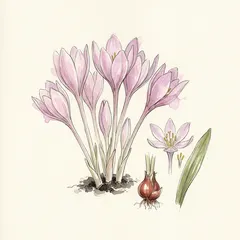
Colchicum Autumnale
Tyler - Homoeopathic Drug Pictures · Margaret Lucy Tyler · 18,566 chars
 All books on Colchicum Autumnale →
Antidoted byAceticum AcidumAmmon MurAmmoniacum GummiBelladonnaCaincaCamphoraCastoreum CanadenseCocculus IndicusCopaiva OfficinalisLedum Palustre
All books on Colchicum Autumnale →
Antidoted byAceticum AcidumAmmon MurAmmoniacum GummiBelladonnaCaincaCamphoraCastoreum CanadenseCocculus IndicusCopaiva OfficinalisLedum PalustreGeneral
IN the scheme of things remedies seem to be placed where and when they are wanted. Dulcamara climbs the hedges in the time of hot days and cold nights. Arnica grows in the Andes, and mountainous regions, where it eases and helps to remedy the effects of great fatigue, and falls, and bruises, — Fall-kraut, " Fall-herb ", as the Germans call it.
The snake remedies come in especially for snake bites, and for the violent and rapid diseases of tropical climates. And not for nothing does Colchicum autumnale flower in the autumn, for it is a grand remedy for the diarrhoea and dysentery of autumn, as well as for the acute rheumatism of that season.
Hering (Guiding Symptoms) tells us that it was proved by Hahnemann and many others, but his proving is not to be found either in Materia Medica Pura, or in the Chronic Diseases. . . . It would doubtless be found in Stapf Archiv.: but it has probably never been done into English, since Allen (Encyclopedia) quotes none of its symptoms from Hahnemann .
Old School has greatly used — and abused — this drug : and this is what Hale White (Materia Medica), teaches students and the medical profession in regard to Colchicum. He heads his small chapter : ` The sole value of this drug is that it is a specific for gout."
He speaks of its action (which we know to be its curative action, given in small doses, and when symptoms in patient and drug agree). . . . Loss of appetite : purging : nausea : colic. Great abdominal pain. Vomiting. Profuse diarrhoea with passage of blood. Great prostration, the skin cold and bedewed with sweat. Respiration slow. Death due to collapse. (These, as we shall see, are exactly its homoeopathic uses.)
In regard to its therapeutics, he says, " Colchicum is hardly ever used except for gout. . . . It is often very useful for dyspepsia, eczema, headache, neuritis, conjunctivitis, bronchitis and other conditions occurring in those suffering from gout, and probably related to it.
" It is a true specific ; how it acts is not known."
But one seldom sees the real old-fashioned gout of our grandfathers. One remembers meeting it once, in a woman who begged for help one Sunday, when she could not get her regular doctor. She showed a swollen, red, shiny foot ; intensity greater about the big toe ; with much pain and tenderness. For a moment one thought of some septic condition, but was enlightened and relieved when she said that she " got these attacks of gout ".
The remedy that put her right (by the next day, as one learned) was not Colchicum at all, but Burnett's beloved Urtica urens, — tincture of stinging nettles. It was because of his successful use of this simple herb in gout, that he won the name, so one is told, of " Dr. Urtica ", in the London clubs of his day. He used to give some five drops of the strong tincture several times a day, in hot water.
One gleans at once, by glancing down the Black letter symptoms of the provings that the great spheres of Colchicum, besides joints (which it inflames and stiffens ; wandering from joint to joint, often), are stomach and intestines.
It has the most intense nausea, excited by the sight, or smell, or even thought of food (Ars., Sep., Cocc.). This characteristic symptom has led to its successful use, as in Dr. Nash's classical case, of the old lady collapsed and dying of diarrhoea, with sixty-five stools in the twenty-four hours, passed into the bed ; so weak that she could not lift her head from the pillow (also a Colch. symptom) ; and so nauseated by the smell of food that all doors had to be kept shut between her and the kitchen.
A dose of Colch. 200 (she never needed a second) stopped the drain, and, incidentally, taught Nash the value of potentized drugs.
Diarrhoea, then, and dysentery, especially of the Autumn, and colitis, especially membranous colitis, in which it is so often useful.
Colch. is a remedy of metastases, as when gout leaves the joints and attacks heart or stomach : of such cases we hear less in these days ; but in rheumatism or heart or kidney troubles of the children of gouty parents, or grandparents, it should be useful — symptoms agreeing.
In common with Dulc., another autumnal remedy, it is useful in ailments from cold damp weather and from suppressed perspiration.
In common with Bry. it dare not move : and its temper is irritable in the extreme.
In pleurodynia it compares with Arnica : as also in its bruised sensations.
Let Nash speak :
This remedy has one of the most positive and reliable characteristic symptoms in the whole materia medica, and one which cannot be accounted for from any pathological standpoint that I know of — " The smell of food cooking nauseates to faintness."
I mention this here because there is a seeming desire on the part of some to base all their prescriptions on pathological indications. I have no objection to their doing so if they can, and succeed in curing their patients.
But I claim full recognition for the value of those subjective, sensational symptoms and the modalities which cannot be accounted for. Indeed, I feel quite sure that the well-verified subjective symptoms 'are oftener to be relied on in curing our patients than all the pathological conditions we know." And he gives the case, alluded to, of his old lady.
He points out that Colchicum has two opposite symptoms, viz. burning and icy coldness in stomach.
He and Kent both point out the value of Colch. for great meteoric distension of abdomen. " In the 200th potency it is a good remedy for the bloating of cows that have eaten too much green clover."
In regard to its use for rheumatism, articular, migrating, and gouty, Nash has often found it less successful than our other rheumatic remedies.* [* Other doctors esteem it greatly in acute rheumatism ; with a red blush over affected joint ; with tendency to wander from joint to joint : with hyperesthesia, and pains worse from cold and damp.]
But , in any of these troubles, or others, " should I find its prime characteristics present " (nausea from smell of 200th and cooking) " I should certainly give it and confidently expect good results."
Farrington , on the contrary (Clinical Materia Medica), says : " I am persuaded that Colchicum has not the place in practice it deserves. True it comes to us from the allopathic school as a remedy highly recommended for gout. We ought not, however, from the exorbitant use of the drug by that school, go to the opposite extreme, and neglect it as a remedy altogether."
He speaks of its use in debility, particularly debility following loss of sleep . . . can hardly drag one leg after the other — appetite gone, bad taste in mouth, nausea : — the debility starts from or involves digestion as a result of loss of sleep. In typhoid : pupils wide, almost insensitive : cold sweat forehead : when patient attempts to raise head, it falls back again, the mouth wide open. Face cadaveric : features sharp and pointed, nose looks squeezed, tongue heavy and stiff, protruded with difficulty (Lach.), may be bluish especially at base.
Almost complete loss of speech and breath cold. Restlessness and cramp in legs. But it has not the fearfulness and dread of death of some other typhoid drugs.
Allied to Carbo veg. in coldness of breath, tympany and great prostration.
Tympanites : stools watery and frequent, and involuntary :contain " shreds " ; — watery, bloody.
In dysentery, if there is tympany, Colch. is far preferable to Cantharis or Mercurius.
Then Colch. in joints and gout — extremely sensitive to slightest motion.
The patient exceedingly irritable and oversensitive to every little external impression — light — noise — strong odours : and pain seems unbearable (Cham.).
Then metastasis of gout or rheumatism to chest.
In valvular heart disease or pericarditis following rheumatism, it is indicated by violent cutting and stinging pains in chest, especially about heart, with great oppression and dyspnoea. Chest feels tightly bandaged. . . .
Guernsey (" Keynotes ") says this remedy is to be thought of when we see a patient suffering from the effects of nightwatching (Cocc. is classical here. — Ed .) from the effects of hard study :
. . . Arthritic pains in joints, especially when knocking the joints makes the patient scream with pain, or when stubbing the toes hurts exceedingly.
Affects largely the periosteum and synovial membranes of joints : small joints.
Redness, heat and swelling of parts affected. . . .
After evacuation, relief ; but sometimes a terrific spasmodic pain of the sphincter ani comes on after stool. . .
Kent — we will briefly epitomize. He says, it is singular that traditional medicine used Colchicum so much for gout : in all old books it was recommended for this malady. The provings corroborate the fact that Colchicum fits into many conditions of gout . . . but traditional medicine does not tell us what kind of gout to give it in, or what kind of rheumatism.
It was merely a medicine of experience. " If it is gout, try Colchicum." What to do with the patient when the remedy failed never came up. It was, " Give the prescription and keep at it," and drugs were administered till the patient, growing steadily worse, passed from one doctor's hands into another.
Colch. is aggravated by cold, damp weather, by the cold rains in the Fall . . . it has also a summer rheumatism. Heat will slack up the flow of urine or the quantity of solids in the urine.
A striking feature running through the remedy is its tendency to move about from one joint to another, from one side to another, from below upwards, or from above downwards : — with swelling, or without swelling : first here, then there.
Another striking feature is, the general dropsical conditions. Dropsy when hands and feet swell and pit : dropsy of abdominal cavity : of pericardium, pleurae, of serous sacs . . . with pale urine. 'Whether copious or scanty, still it is pale.
Rheumatic conditions that have gone on some time and end in cardiac troubles . . . the cardiac condition is but a continuation of the rheumatic state.
Colchicum has cured dropsy after scarlet fever.
All complaints — of head — bowel — liver — stomach — are worse from motion : he dreads to move : almost as marked as we find in Bryonia. Chilly, sensitive to cold (rev. of Ledum). Colch. is better for heat, for wrapping up, for being warm. . . .
A curious symptom, touch and motion bring on a painful sensation in the body as of electric vibrations.
Is almost constantly sweating, even with fever, and sometimes the sweat is cold.
Then, the nausea, gagging and retching at the bare mention of food . . . he is so sensitive to odours that he smells things which others do not smell (just as Coffea hears sounds that others cannot hear).
He smells odours from which he gets sick . . . in typhoid, prostrated beyond the usual, he cannot take milk, cannot take raw eggs, cannot take soup, because he gags at the mere thought of them. He has gone on for days, and his family are afraid that he is going to starve. . . . This enters into his very life, because it involves hatred to odour, and becomes a general . . . Do not say " food " in the presence of a Colchicum patient, but give him Colch. first, and pretty soon he will want something to eat.
It removes that hatred of food. What a vital thing it must be when a man hates that very thing that will keep him alive.
He may have much thirst, or no thirst, or these may alternate. . Nausea and inclination to vomit by swallowing saliva.
He describes the bloating of the farmer's cows that have got into a fresh clover patch, and become so distended you are afraid they are going to explode. Farmers have been known to put a knife into the pouch of the cow between the last short ribs to let the wind out : but put a few pellets of Colch. on the tongue of each cow, and it will be but a few minutes before that wind will get out of there — to your surprise and the farmer's. When the abdomen is violently distended and tympanitic, Colch. is often a suitable remedy.
Then the diarrheic stools that are like jelly — they form in the pan a solid mass of jelly . . . putrid, dark, bloody mucus, watery, jelly--like mucus, passes as a thin watery flow, but soon as it cools, forms a jelly.
Young doctors, poring over We provings of Materia Medica, often think that everything comes under every drug : — they are so much alike — how to distinguish ?
But, get their characteristics and peculiarities of action, and each one stands out distinctly as an entity — almost a personality : and when you have once grasped that personality, and as it were made friends with the drug, you will recognize, as with your friends, not only what he looks like, but his little tricks of manner and speech, how he will behave on all occasions — in regard to noises — foods — friendly overtures rudeness — sympathy — his restlessness or placidity — his extreme neatness and order, or the opposite — his easy emotion — chilliness meteoric reactions — his attitude, in short, to environment physical and mental. You will see him in friends and patients, when prescribing becomes comparatively easy, and successful.
Black Letter Symptoms
Memory weakened, ideas not so clear as usual: forgetfulness, absence of mind.
External impressions, bright light, Strong Odours , contact, misdeeds of others, make him quite beside himself.
Strong odours make him quite beside himself.
Aversion to Food ; loathing the sight, and still more the smell of it.
No thirst.
Smell of cooking nauseates to faintness.
Nausea, eructations and copious vomiting of mucus and bile.
Violent retching, followed by copious and forcible vomiting of food and then of bile.
Violent burning in epigastrium.
Very painful urging to Stool .
Only a little feces passed, then followed transparent, gelatinous, and very membranous mucus, with some relief of the pain in the abdomen.
Extremely painful stools.
Discharge from bowels like gelatine.
Watery, jelly-like mucus passes from anus with violent spasm in sphincter.
Bloody stools with scrapings from intestines and protrusion of anus.
Autumn dysentery, with discharges of white mucus and violent tenesmus ; bloody stools, mingled with a slimy substance.
Bloody discharge from bowels with deathly nausea from smelling cooking.
Tenesmus in rectum.
Discharge from bowels containing a large quantity of small white shreddy particles.
Pain in region of Kidneys .
Urine like ink.
Stinging and tearing in muscles of Chest : pleurodynia.
Oppression of chest, dyspnoea, a tensive feeling in chest, sometimes high, sometimes low down.
Oppression of chest with violent palpitation.
Hydrothorax with cedema of hands and feet.
Pulse thread-like, imperceptible.
Effusion into pericardium after inflammatory affections of heart.
A paralytic pain in the Arms , so violent he cannot hold the lightest thing firmly.
Lameness after suddenly checked sweat, particularly on Feet , by getting wet all over.
At the beginning of Acute Rheumatism , before fully developed.
Pains in shoulder and hip joints, and in all bones, with difficulty in moving head and tongue.
Great weakness and exhaustion, as after exertion, cannot move head from pillow without help.
Fall dysentery.
Constant chilly feeling, even when sitting near the stove ; with
flushes of heat.
Pain goes from left to right, in gout.
Rheumatic pains excited by or worse for cold, damp weather.
Acute dropsy with renal affections.
Uric acid diathesis.
Gout in persons of vigorous constitution.
Notable Symptoms, In Italics, Or Peculiar
Can read, but cannot understand even a short sentence : cannot understand the words : vision is heightened, but intellectual faculties dulled.
His sufferings seem intolerable : external impressions, light noise, strong smells, contact, etc., disturb his temper.
Smell morbidly acute ; odour of meat broth causes nausea and that of fresh eggs nearly fainting : excessive sensitiveness of smell to cooking.
Tongue : bright red : heavy, stiff and numb : cold : moved and projected with difficulty.
Enormous appetite — for different things : but as soon as he sees them, or still more smells them, he shudders from nausea, and is unable to eat anything.
Obliged to bend himself up and lie quite still the whole day without the slightest movement, else he was seized with the most violent vomiting.
Epigastrium pierced by a knife.
Stomach deranged after eating too many eggs.
Colic, worse by eating ; after flatulent food, great distension ; better when bending double.
Distension of gas under short ribs.
In inflammatory irritation of abdominal viscera, by metastasis from gout.
Profuse watery stools, in hot damp weather, or in the autumn.
Long-lasting, agonizing pain in rectum and anus, after stool, causing screams and crying.
Hemorrhage from anus in autumnal cold damp weather.
Child falls asleep on the vessel as soon as the tenesmus ceases.
Nephritis : bloody, ink-like, albuminous urine.
Urging to urinate ; discharge of hot, highly coloured urine ; burning and tenesmus.
Night cough with involuntary spurting out of urine.
Stinging pain, or knife pains region of heart.
Serous effusion in chest, in rheumatic or gouty persons.
Hydro pericardium.
Heart disease, following gout or acute rheumatism.
Violent writhing in region of loins and urinary passages.
Knees strike together ; can hardly walk.
Feet feel heavy : difficult to lift feet or go upstairs.
Cramps feet, especially soles. Heels contracted.
Pain in ball of left big toe.
Violent pains in arms and legs : cannot use limbs.
Drawing, tearing pains in limbs, changing places.
Stiffness joints, and swelling hands and feet.
Attacks of rheumatism break forth suddenly and disappear suddenly : Pains shifting : acute attacks merging into chronic form, or during chronic form acute attacks set in.
Pains in joints, especially if knocked : stubbing the toes hurts exceedingly.
Great irritability with the pains : very sensitive to touch : the least vibration makes pain unbearable.
Metastases to internal organs.
Dropsy of internal organs and cavities — hydro pericardium — hydrothorax — ascites — hydrometra.
Stands in close relation to fibrous tissues : redness, swelling, heat, etc., not tending to suppuration ; quickly changing location.
Inflammation of joints with excessive Hyperesthesia , slightest concussion of air, floor or bed renders the pains unbearable. . . Large joints intensely red and hot . . . acts more on the small joints.
It hastens relapses of gout if abused.