 Homeopathy Library
Dulcamara
Hering - Guiding Symptoms of our Materia Medica · Constantine Hering · 44,137 chars
 All books on Dulcamara →
Antidoted byBaryta CarbonicaBelladonnaCamphoraConvallaria MajalisCuphea ViscosissimaCuprumCuprum AceticumCuprum MetallicumIpecacuanhaKali Carbonicum
All books on Dulcamara →
Antidoted byBaryta CarbonicaBelladonnaCamphoraConvallaria MajalisCuphea ViscosissimaCuprumCuprum AceticumCuprum MetallicumIpecacuanhaKali CarbonicumGeneral
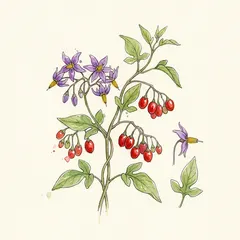
Bittersweet. Solanacese.
A climbing shrub, from six to eight feet high, flowering in clusters, berries- oval, bright scarlet; grows in moist places through Europe and North America.
The tincture is prepared from the fresh stems and leaves, gathered before flowering.
Introduced by Hahnemann, and extensively proved by him and others, among whom were Gross, Nenning, Riickert, and Stapf, later by Kockwith (tinc- ture), Berrige and Kobinson (high potencies). See Allen's Encyclopedia, vol. 4,. p. 178.
CLiNiCAii Atjthobities Gaspary, Eiick. Kl. Erf., vol. 1, p. 176;
Chronic- headache, Small, Raue's Eec, 1874, p. 258; Ophthalmia neonatorum, (2 cases), Wes- selhoeft, Eiick. Kl. Erf., vol, 1, p. 252;
Allen & Norton's Oph. Therap., p. 59^ Blepharophthalmia and adenitis, Caspari, Dunham's Lectures on Mat. Med., vol. 2, p. 292; Hay fever, Boyce, Hom.
Clinics, vol. 1, p. 112; Facial neuralgia, O. W. Smith, Organon, vol. 1, p. 481;
Swelling of tonsils (2 cases), Hofrichter, Eiick. Kl. Erf., vol. 5, p. 238; Catarrhal angina, Zeller, Eiick.
Kl. Erf., vol. 5, p. 238; Biar- rAosa, Small, Eaue's Eec, 1873, p. 119; Hartmann, Eiick.
Kl. Erf., vol. 1, p. 831 j Gross, Eiick. Kl. Erf., vol. 1, p. 832;
(7 cases) Gross, Sonnenberg, Schindler, Sei- del, Tietze, Schreter, Eiick. Kl. Erf., vol. 1, p. 832-3; Diarrhoea and catarrh of stomach, Kafka, Eiick.
Kl. Erf., vol. 5, p. 414; Bloody diarrhoea, Sonnenberg, Eiick. Kl.
Erf., vol. 1, p. 832 ; Dysentery, Gouwerky, Euck. Kl. Erf., v. 5, p. 444 ;
Cholerine with urticaria, Billig, Allg. Hom. Ztg., v. 101, p. 109 ; Incontinence of urine, Gouwerky, Eiick.
Kl. Erf., vol. 2, p. 43; Urinary difficulty, Eiickert, Euck. Kl.
Erf., v. 2, p. 16; Herpes preputialis, Gilchrist's Surgery, p. 532; Influenza, Payne, Eaue's Eec, 1870, p. 182; Cough, Hrg., Eiick.
Kl. Erf,, v. 3, p. 11, 78; Whooping-cough Schron, Kreuss, Eiick, Kl. Erf., v. 3, p. 78;
Catarrhal affections of chest, Battmann Euck. Kl. Erf., v. 5,p. 739; Myelitis, Hirsch, Euck.
Kl. Erf, v. 5, p. 8C9; Spinal meningitis following poorly developed eruption, Eiick. Kl.
Erf., v, 3, f. 468; Warts
167 DULCAMARA.
on ^ ant/s, Stapf, Dunham's Lectures on Mat. Med., v. 2, p. 306; Pains in shin-bones, Shephard, Organon, v. 3, p. 361 ; Rheumatism (3 cases), Eiick.
Kl. Erf., v. 5, p 897; Rheumatic pains (4 cases), Gaspnn', Rumnael, Riick. Kl.
Erf., v. 3, p. 516 Pain in limbs, Goullon, Eiick. Kl. Erf., v. 3, p. 17 ; Scarlet fever, Hartmann, Buchner.
Eiick. Kl. Erf., v. 4, p. 49; Typhoid fever, Bart]., Dunham's Lectures on Mat, Med., V. 2, p. 306 ;
Glandular enlargements, "Wood, Eiick. Kl. Erf., v. 4, p. 369 Adenitis, Hartmann, Dunham's Lectures on Mat. Med., v. 2. p. 294 ;
Anasarca. Mschk., Eiick. Kl. Erf, v. 4, p. 345 ;
Urticaria, Knorre, Sonnenberg, Eiick. Kl Erf., V. 4, p. 198; Sonnenberg, Dunham's Lectures on Mat. Med., v. 2, p. 305 Herpes, Trinks, Knorre, Eomig, Gross, Eiick.
Kl. Erf., v, 4, p. 239 ; Crusta lactea, Eomig, see Dunham's Lectures on Mat. Med., v. 2, p. 306 ;
Mehlflechte {lichen) on ^wee. Gross, Dunham's Lectures on Mat. Med., v. 2, p. 306; Eruption of itching pustules, Nottingham, Eaue's Eec , 1874, p. 293;
Pemphigus, Bethmann, Dunham's Lectures on Mat. Med., v. 2, p. 305, Eiick. Kl. Erf, v. 4, p. 165.
^ Mind. iCaniiot find the right word.
iMental confusion, cannot concentrate his thoughts.
I I Delirium at night witli the pain, and during fever-heat.
Imbecility more frequent than insanity.
I Asks for one thing or another, rejecting it when proffered.
■ Depressed; solicitude concerning the future.
■ Quarrelsome, irritable mood; easily angered.
■ Great restlessness and impatience.
■ Inclination to scold, without being angry.
^ Sensorium. Momentary vertigo; vertigo when walking, with darkness before eyes.
■ On awaking in morning, dizzy, dark before eyes. I I Dulness of senses.
, ■Dulness and painful stupefaction of head.
■ Heaviness of head.
^ Inner Head. ' i Sensation as of a board pressing against the forehead.
■ Boring, burning in forehead, with digging in brain; <
from motion, even talking; head heavy; increased flow
of saliva, with dryness of tongue and thirst; pulse hard
and tense; great weakness and prostration in limbs. I I Boring headache from within to without, in the temples
and forehead; < before midnight and when lying
quiet. I I Pressing, stupefying pain in forehead, with obstruction
of nose. I I Bursting pains extending from forehead to bridge of
Nose
■Stupefying ache in occiput, ascending from nape of neck.
■ Chilliness in cerebellum and over back, returning every
evening; cerebellum as if enlarged;
< in cold, damp weather;
< until 2 p.m;
> better lying down.
■ Congestion to head, buzzing in ears, dull hearing; <
from getting feet wet.
DULCAMARA. 168
I Feeling as if head was enlarged.
I Continual dull pain in head, chest, and stomach, with great uneasiness, depression of spirits, labored respira- tion, mental confusion, and inability to concentrate thoughts. ^Chronic headache.
llCatarrhal and rheumatic headaches, < in damp, cold weather.
* Outer Head, l Sensation of chilliness in cerebellum and
over back ; feeling as if hair stood on end ; recurs every evening.
■ Ringworm of scalp; glands about throat swollen.
■ Thick crusts on scalp, causing hair to fall out.
■ ■Scald-head, thick, brown crusts with reddish borders on
forehead, temples, and chin, bleeding when scratched.
■ Tinea capitis, crusta lactea and dandruff, < by change
of weather.
* Sight and Eyes, i i Aching in eyes when reading; sight
dim'; scintillations;
< at rest.
I 1 Threatened amaurosis in scrofulous children.
■ Dim sight, sees as through a gauze. I I Sparks before eyes.
( I Sensation as if fire were darting out of eyes, when walk- ing in sun or in room. I I Pupils greatly dilated.
■ Idiopathic iritis after exposure in damp weather; < at
night, also in cold air; > during motion and from warmth.
■ Ophthalmia; scrofulous, from every exposure to cold.
I I Ophthalmia neonatorum (often accompanied by consti- j)ation), with chemosis of conjunctiva.
■ Scrofulous blepharophthalmia and adenitis; crusty erup-
tion on margin of eyelids and swelling and induration
of cervical glands.
I I Twitching of eyelids in cold air.
I i Paralysis of upper lids.
■ Eruption of yellow vesicles under eyes ; bluish-red cheeks. ^ Hearing and Ears. ■ Buzzing in the ears.
■ Dull pains, humming in ears, obtuse hearing.
■ ■Earache; nausea; buzzing; < at night and when still.
■ ■ Earache the whole night, preventing sleep. ■Stitches in auditory meatus and parotid gland.
■ Swelling of parotids; also after measles.
'^ Smell and Nose. ■Nosebleed, hot, clear blood; pressure above nose; < after getting wet.
■ Coryza, dry;
> during motion;
< during rest; renewed
by slightest exposure, and < in cold air. ■Severe coryza, skin hot, dry; limbs cold, stiff, numb and painful; general offensive sweat; coryza with children.
169 DULCAMARA.
I Nostrils entirely filled up, preventing breathing through nose, constant sneezing, profuse discharge of water from nose and eyes, < in open air, > in closed room, < on awaking in morning, in evening, eyes sometimes swelled and full, at one time nose most affected, then again eyes, cannot be near cut grass or newly mown hay, > at sea- side. ^Hay fever.
■ Stoppage of nose; discharge suppressed from least con-
tact with cold air.
I I Nasal catarrh dry, in a dry atmosphere. ■* Upper Face, l Complexion pale, watery or milky.
I I Face pale, with circumscribed red cheeks.
■ Face bloated; dropsy.
I Facial neuralgia on 1. side, involving temple, ear, orbit
and jaws; usually seemed to start from malar bone; paroxysms preceded by the parts becoming very cold, and attended by canine hunger ;
< or excited by slightest exposure to cold;
> by external warmth., iFaceache and asthma, after disappearance of tetters in face.
I I Humid eruptions on cheeks.
I I Pimples and little ulcers around mouth, with tearing
pains when moving the parts.
I I Thick brown-yellow crusts on face, forehead, temples and chin; crusta lactea.
■ Thick brown herpetic crusts on face, with reddish borders,
bleeding when scratched.
■ Impetigo faciei.
■ ■Warts and eruptions on face.
I I Convulsions beginning in face. ^ Lower Face. ' l Twitchings of lips when in the cold air.
■ Toothache with salivation. Teeth feel blunt.
■ Mouth distorted; drawn to one side.
^° Teeth and Gums. ■Toothache from cold, especially with diarrhcea; confusion in head; profuse salivation ; teeth feel blunt, or as if asleep. I Scurvy from cold.
■ Receding, spongy gums; ptyalism. ^^ Taste and Tongue. ■Bitter taste.
I I Itching, crawling on tip of tongue.
■ Mouth and tongue dry; dry, swollen tongue.
I I Dryness and roughness of tongue, with much thirst and increased flow of saliva.
■ Swelling of tongue, hindering speech and impeding
breathing.
■ ■Inarticulate speech from a swollen tongue, but talks in-
cessantly.
DULCAMARA. 170
I Tongue and jaws become lame, if cold air or water chills
him.
I I Tongue paralyzed from cold.
^" Inner Mouth, i Saliva tenacious, soap-like; gums spongy.
■ Increased flow of saliva ; rheumatic. I I Mouth dry, without thirst.
iStomacace, rheumatic, also after abuse of mercury, with ptyalism and swollen cervical glands.
iMucous membrane of mouth greatly swollen and very red ; throughout its whole extent here and there raw, ex- coriated and very painful spots denuded of epithelium; talking, chewing, and swallowing greatly impeded ; teeth thickly coated with tenacious, foul mucus, deeply im- printing cheeks and edges of tongue; constant flow of saliva, which as well as the breath, has a fetid, putre- factive odor; attack preceded by paleness of face, heavi- ness of eyes, and lassitude of limbs. 6'Stomacace.
I Ulceration trivial, but swelling extreme, with spongy,, loose gums and swollen tongue; holds cold water con- stantly in mouth, as pain and heat is > thereby. ^Can- crum oris. 13 Throat. ' i Much mucus in fauces.
I I Continual hawking up of very tough saliva, with much rawness in fauces.
I Tonsillitis from every cold change.
■ Pressure, as if uvula were too long.
■ Catarrhal angina after catching cold; hypersemia of soft
palate and uvula; swelling of tonsils; difficult deglu- tition. ^^ Appetite, Thirst.
Desires, Aversions. ■ Hunger, without appetite. ^Pemphigus.
Hunger, after the fever.
■ Great thirst for cold drinks.
■ Unquenchable thirst.
■ Aversion to food ; shuddering as though he would vomit. ^^ Hiccough, Belching, Nausea and Vomiting, i i Empty
eructations, with shuddering as from disgust. I I Frequent eructations while eating. 1 I Nausea, loss of appetite. ^Cholerine.
■ Nausea, vomiting, disgust for coffee, great thirst.
■ Nausea accompanies the desire for stool ; general prostra-
tion. 6'Diarrhoea from cool change of weather.
■ Great chilliness during vomiting.
■ Vomiting, early in morning, of tenacious mucus.
■ Vomiting: of greenish, yellow, slimy substances, together
with the liquid drank; after cold drinks. " Scrobiculum and Stomach. ■ Retraction and burning in epigastric region.
171 DULCAMARA.
I Sensation of inflation in pit of stomach, with disagree- able sensation of emptiness in abdomen.
I I Diaphragmitis, with simultaneous rheumatic affections of spinal cord.
I Indigestion with chilliness, < every cool change of weather. ^^ Abdomen, l Cutting pain about navel.
I I Violent pinching in abdomen, as if worms were crawl-
ing up and down in it and were gnawing and pinching the parts.
I I Colic, as if diarrhoea would occur, with rumbling in bowels and pain in small of back.
iColic after a cold; griping, nausea, followed by diarrhoea. 1 1 Colic, such as is usually caused by cold and wet weather.
■ Dropsy of the abdomen.
iSwelling of inguinal glands from a cold. ^° Stool and Rectum, l Vomiting and diarrhoea, with great inclination to chilliness during vomiting ; copious mucous, or watery yellowish evacuations, expelled with much force; faintness when at stool. ^Influenza.
iDesire for stool, in evening, w4th griping in whole lower abdomen, followed by a large, moist, at last very thin, sour smelling stool, after which relief, but feeling of weakness.
iNightly stools w^ith colic, especially in umbilical region; loss of appetite, thirst, nausea, vomiting, pale face, lan- guor, restlessness.
■Severe cutting in abdomen, < about umbilicus, followed by nausea, cold sweat, watery diarrhoea and occasional vomiting; at night, stools follow each other in rapid succession, nausea is constant, with eructations and vio- lent thirst; biting in rectum as from salt; evacuations often green, bilious. t^After exposure.
lAlternately watery, or slimy, or dark-brown fecal diar- rhoea, preceded by cutting in abdomen and followed by burning in anus; tongue coated, no appetite; abdomen bloated. ^Diarrhoea and catarrh of stomach.
B Bloody diarrhoea of fifteen months duration, brought on by exposure to cold and dampness; violent cutting around navel, < at night; unceasing, unquenchable thirst; pain and diarrhoea allow no sleep at night; rectum protrudes; biting at anus, as from pepper.
■ Diarrhoea with great prostration or colicky pains around
umbilicus; < after every change of cold weather.
■ Drawing and tearing in limbs, stiffness of limbs; painful
stiffness of nape of neck; pain in small of back; diar- rhoea without much pain; little urging; slimy, bloody discharges. ^Dysentery.
DULCAMARA. 172
iProfuse diarrhoea with severe cutting in abdomen ; evac- uations mucous and bloody with tenesmus and pain in back; chilliness alternating with heat, great thirst.
I Patient lies in a constant drowsy condition, cheeks slightly flushed, soft and painless bloating of abdomen, great emaciation of body, aversion to all food ; painless, thin, yellowish, greenish, watery stools, sometimes pass- ing involuntarily, and containing flakes of mucus; urine turbid with white sediment; neither speaks nor eats; at night, moaning and restless tossing about.
IPatient pale, weak, emaciated and without least desire for food; after eating, morning, and frequently in even- ing, and particularly in damp weather, watery, slimy, lienteric stool, preceded by pains in abdomen and fol- lowed by tenesmus. ^Chronic diarrhoea.
I Thin stools, several afternoons in succession, with flatu-
lence.
I I Yellow watery diarrhoea twice a day, with tearing cut- ting colic before each evacuation, as after taking cold.
I I Slimy diarrhoea with faintness.
I Slimy, alternate yellow and greenish diarrhoea. iSlimy, brown, liquid stools. ^Pemphigus.
■ Intestinal catarrh with mucous stools and tenesmus.
i I Chronic, bloody diarrhoea, with biting at anus, or with vomiting, eructations and thirst.
iStools: frequent; scanty; corrosive; whitish, watery; with flocculi; slimy, mucous, watery, yellow-green; change- able, white, yellow or green; watery; sour smelling ; nau- sea, with desire to evacuate; < at night and in wet weather.
I I Diarrhoea: from cold, or change from warm to cold, especially cold, damp weather; in morning, profuse thin stools; of rheumatic origin; during dentition; with colic, particularly in summer; with prolapsus recti.
iDj'sentery, from cold, damp weather; increased flow of saliva; burning, itching of rectum; heat of skin; thirst.
■ Cholera infantum, relapse from an unusually cold night
or caused thereby.
■ Constipation and painful strangury.
^^ Urinary Organs. ■Dropsy, with pain in region of kidneys, and albumen in urine. I iBright's disease from exposure to cold and dampness.
■ Constant desire to urinate, felt deep in abdomen. 6'Cystitis.
■ Constant desire to urinate, with an unpleasant sensation
of bearing down towards the vesical region and urethra.
■ Retention of urine; strangury from cold, or cold drinks.
■ ■Urine passed involuntarily. ^Paralysis of bladder.
■ Catarrh with strangury, followed after six weeks by in-
173 DULCAMARA.
continence of urine ; very impatient, scolding and irrit- able mood. • Painful pressing about bladder and urethra, discharge of a few drops of urine, with mucous sediment.
■ Burning in meatus urinarius while urinating.
lUrine: scanty, fetid, turbid; on standing, oily ; contain- ing a tough, jelly-like, white or red mucus mixed with blood; milky; fetid or muco-purulent; reddish, burning.
■ Emission of urine, drop by drop; slimy sediment.
■ Urine offensive, turbid when passed, and excoriating the
Skin
^Pemphigus.
■ Catarrh of the bladder from taking cold in damp weather. ^^ Male Sexual Organs. ■ Impotence; herpes on genitals.
Herpes: preputialis, bleeding; brown, dry, humid or fur- furaceous; painful; red, pale-red, or with a red areola; round, scaly and small; suppurating, yellow. ^^ Female Sexual Organs. ■Heat and itching in genitals, with desire for an embrace, < by a cold change in the weather.
■ Menses too late and too short; blood watery, thin; sup-
pressed by cold.
■ Dysmenorrhoea in those taking cold easily ; has blotches
all over, especially in cold, damp weather; liable to take cold in head.
■ Rash before menses.
■ As a forerunner of catamenia, a rash appearing on skin,
with extraordinary sexual excitement during rash and catamenia.
■ Herpetic eruptions on vulva, < by ever}^ cold change of
weather, or by exposure in cold, damp situations.
■ Catarrhal ailments in damp, cold weather.
■ Mammse engorged, hard, sore and painful, with leucor-
rlioea or amenorrhoea. '^ Pregnancy.
Parturition.
Lactation. ■ Threatened mis- carriage induced by exposure in a damp, cold place, as in a spring-house or cellar.
■ Lochia suppressed by cold or damp.
■ Mammse swollen, inactive, painless, itching, in conse-
quence of a cold which seems to have settled in them.
I I Suppression of milk or lochia, from taking cold.
I I Herpes on mammse ; nursing women.
I I After weaning, mother has eruptions on the skin; sore
nipples. ^^ Voice and Larynx. Trachea and Bronchia. 1 1 Rough,
hoarse voice. ^Catarrh after measles.
■ Constant titillation in larynx, with desire to cough.
■ Trachea full of mucus, tough, greenish expectoration with
moderate cough. ^Laryngo tracheitis.
DULCAMARA. 174
I Influenza.
I Bronchitis of children, caused by cold, damj) air, with offensive smelling night-sweats. ■^^ Respiration. ' l Labored respiration.
1 Asthma, with faceache, after disappearance of tetters in face.
■Asthma humidum, dyspnoea, loose rattling cough, co- pious sputa ; < during wet weather.
I I Oppression of chest, from mucus. •^' Cough. I Cough dry, hoarse, and rough, or, loose, with co- pious expectoration of mucus, and dull hearing. ^Ca- tarrhal fever.
I iCough from damp, cold atmosphere, or from getting wet; must cough a long time to expel phlegm, especially in- fants and old people ; threatened paralysis of vagi.
■Spasmodic cough, with profuse secretion of mucus in larynx and trachea.
■ Barking cough after a deep breath.
■ Panting cough, like whooping cough, < from each deep
inspiration. I I Whooping cough ; attacks excited by excessive secretion
of mucus in larynx and trachea ; during each attack
easy expectoration of tasteless mucus, often streaked with .
Blood
I I Chronic mucous cough after measles.
■ Cough: < lying down, from warmth of room, or deep
inspiration;
> in open air.
During cough: stitches in sides; hoarseness.
■ Tough, greenish expectoration, with moderate cough;
diarrhoea; great disposition to catch cold. ^Phthisis. I I Easy expectoration of tasteless mucus, often streaked
with blood. I I Expectoration of bright blood. ^ Inner Chest and Lungs. ■ Mucus on chest, must cough long
before raising it; suffocative catarrh.
■ Bronchitis; offensive smelling night-sweats.
■ Catarrhal affections of chest, with or without mucous rales ;
cough with either easy or difficult expectoration ; pulse excited.
■ Tuberculosis in scrofulous subjects; < in changes from
warm to cold; sputa tough, green; cough moderate; stitches here and there in chest; diarrhoea.
■ Phthisis mucosa.
■ Rheumatic pleuritis and pleuro-pneumonia, with tough,
difficult, discolored sputa. 1 Continuous irritable states from rheumatic pleuritis and pleuro-pneumonia, with tough, difficult, discolored ex- pectoration ; simultaneously hypersemia of cord.
175 DULCAMARA.
iPneumonia notha, when the morbid condition has lasted some time, and has almost developed into a chronic affection, a preponderance of inflammatory symptoms being present.
iHydrothorax, < in wet weather.
■ Haemoptysis, bright red; tickling in larynx; < at rest;
caused by a cold or protracted loose cough.
I I Deep cutting pain in 1. side of chest, close below clavicle, > by pressing on part.
I Dull stitch in chest below r. clavicle from within outward.
I Pain in 1. chest, as if lung moved in waves.
I I Dull stitching pain in r. side of chest, in region of third rib, especially when pressing on part, wdien the pain went to small of back and extended between the shoul- ders; with stitches in border of 1. scapula, during in- spiration.
I I Pain in 1. side of chest in region of fifth and sixth ribs, as if a blunt knife were thrust in.
I 1 Lancinating pain from middle of sternum to the dorsal spine, when sitting, goes off when rising. '^^ Heart, Pulse and Circulation. 1 1 Palpitation at night.
Pulse: small, hard and tense, especially at night; soft, full, slow, bounding; slower than beat of heart; frequent at night, slow during day, collapsed.
iPulse full, hard, somewhat accelerated. ^Diarrhoea. ^'^ Outer Chest. Stitching pains here and there in chest.
Small pimples on chest and abdomen. ^^ Neck and Back, i Xeck stiff, back painful, loins lame, after taking cold.
I Pain in nape, as if head had been lying in an uncom- fortable position.
iSwelling of glands on neck.
I Adenitis, glands swollen, often very painful and sensitive ; cervical and submaxillary lymphatic glands (with a sub-inflammatory condition), painful every turn of head.
iChilliness with dull pain in region of lower cervical and upper dorsal vertebras; difficulty in raising head or turn- ing about in bed ; at night, fever, sleeplessness ; in morn- ing motion of arms greatly impaired, as if thej^ were of wood, numbness and formication in r. hand, cannot close the hand; pulse 100, hard; temperature of skin elevated; tongue dry; loss of appetite; urine scanty, dark, offensive, ammoniacal; stool absent; spine not sensitive to pressure; cervical portion of spinal column stiff, any motion thereof causing disagreeable tension and dull pain deep in, which extends toward both shoulders. ^Myelitis.
■ Lassitude, pains like those brought on by a cold; dryness,
DULCAMARA. 176
heat and burning of skin; restlessness; delirium at night; nausea and vomiting of mucus; sensation of in- flation at pit of stomach ; white mucous diarrhoea; diar- rhoea with faintness; oppression or tightness of chest; pinching or deep cutting pain in chest; constrictive pain as if in muscles of back; drawing in muscles of thigh; bloatedness and swelling of leg ; burning in feet; < at night, from cold, while lying down and from washing. ^Myelitis.
■ Spinal meningitis during scarlatina or measles, eruption
does not develop, i i Myelitis after taking cold during menstruation. iHypertemia of the spinal cord.
■ Rheumatic affections of spinal cord.
I I Dull stitches in both loins, with sensation as of squeezing from within outward, at every inspiration, while sitting bent (after a short walk.)
■ Deeply cutting pain in r. loin, transiently disappearing
upon pressure.
■ Drawing pain from small of back down thighs, during
rest; stitches when moving, > by pressure.
■ ■Pain in small of back, as after stooping a long time. ■Severe rheumatic stitching pressing pains in arms and
back, after catching cold while sweating; pains < at night and while resting; > from motion; slight fever, much thirst.
■ Burning in head, with stupefying headache, red face, dry
tongue, burning heat in gums, unquenchable thirst for extremely cold drinks; anorexia; urine very red, with painful burning on urination; sleepless; skin dry and hot, burning sensation in skin ; severe rheumatic stitch- ing, drawing in small of back, shoulders, and arms; after getting wet whilst warm.
■ ■Lameness in the small of the back, from a cold.
■ Cold chilly feeling in small of back.
■ Sacrum feels cold.
^^ Upper Limbs. ■Paralysis of arms; they are icy cold, es- pecially during rest.
■ Paralytic, bruised pain in 1. arm. I I Herpes on arms and hands.
■ Exostosis on the arm, from suppressed itch.
■ ■Warts on hands, on backs of fingers. ■Sweat in palms of hands.
^ Lower Limbs. ■ Drawing-tearing pain, or constant pain, at one time sticking, at another pinching, in both thighs, disappearing on walking, then changing to weariness, and immediately returning while sitting.
■ Drawing from small of back through thighs, during rest,
177 DULCAMARA.
with stitches in parts during motion, which are > by
pressure.
I I Herpetic eruption on knee.
I Exostosis on upper part of r. tibia, with bluish-red spots ;:
suppurating lumps. • Intolerable (non-syphilitic) pains in shin-bones, < at
night, from rest, obliging him to walk the floor, and in
damp weather.
■ Swelling of calf of leg ; scrofula.
I Gout in big toe ; first left, then right.
I I Tingling and burning in feet.
I I Erysipelas of feet; skin peels off; itching. ^ Limbs in General. ■ Cold limbs.
I Rheumatism after acute eruptions, or when chronic forms; alternate with attacks of diarrhoea.
■ After getting wet, tearing in limbs, particularly in feet;-
restless sleep, profuse sweat. iStitching-drawing and tearing pains in limbs after an acute eruption or after catching cold ; < at night, or during evening, when there is an exacerbation of fever.
■ Rheumatism after exposure to wet; parts as if beaten;
severe pains when remaining in one position, subside only when he moves about.
■ Pains in the joints on exposure to cold.
I I Sharp shooting pains in 1. toes and thumb.
■ Sudden swelling of body and puffiness of limbs, at times
painful, or accompanied by a sensation as if going to sleep, i I White blotches with red areola on arms and thighs. ^ Rest.
Position.
Motion.
Worse lying on back, > on side.
Worse when stooping, > when erect.
Worse bending diseased part backwards.
Worse dancing.
At rest: scintillations < ; buzzing in ears < dry coryza <; tickling in larynx <; drawing pain from small of back down thighs; arms icy cold; intolerable pains in shin bones; rheumatism <.
Lying quiet: headache < ; cerebellum as if enlarged, > ; cough <; myelitis <.
Sitting: pain from sternum to spine; dull stitches in both loins; drawing tearing pain in thighs.
Rising: pain from sternum to spine >.
Walking: vertigo; sensation as if fire were darting out of eyes; after short walk dull stitches in both loins; draw- ing tearing pain in thighs disappears; pain in shin bones forces him to walk; must get up and walk at night.
Motion: headache <; iritis > ; dry coryza >; pimples.
VOL. V. — 12.
DULCAMARA. 178
and ulcers around mouth painful ; cervical and submax- illary lymphatic glands painful ; stitches in back ; pain in back > ; stitches in thighs ; drawing in small of back; rheumatism >. ^ Nerves, l Great general uneasiness, restlessness.
■ Weariness, prostration, languor.
■Trembling, particularly of r. arm. ^Urinary difficulty.
I I One-sided spasms ; speechlessness.
I I Convulsions beginning in face.
■ Paralysis: of different, single parts; from suppressed
eruptions; from cold; of upper and lower limbs and tongue; the paralyzed arm feels icy cold. ^^ Sleep. ■On falling asleep in evening, starts as in affright.
■ During sleep, mouth open, snoring.
■ Uneasy sleep, confused dreams, frequent sweat; tosses
from side to side.
■ Sleep restless after 12 a.m. ; worst after 3 a.m.
I I Uneasy sleep after 4 a.m., no matter how he lay.
\ I Sleeplessness.
I Fearfully confused dreams; she has to get up at night
and walk about the room; a sinking sensation all over;
she fancied she would sink through the bed.
■ On awaking in morning giddy and dizzy; dark before
eyes, trembling and weakness. .^8 Time. Morning : on awaking dizzy, dark before eyes ; hay fever <; vomiting; watery, slimy stools ; profuse thin stools; motion of arms greatly impaired; offensive sw^eat.
Day: pulse slow; sweat on back; sweat in axillse ; sweat on palms.
Until 2 p.m.: cerebellum as if enlarged.
Evening: hay fever <; desire for stool; watery, slimy stools, preceded by pains in abdomen and followed by tenesmus; tearing drawing pains in limbs < ; on fall- ing asleep, starts as if in affright; chilliness over back towards evening; cold shuddering up back.
Night: delirium; idiopathic iritis <; buzzing in ears <; earache the whole night ; stools with colic; stools follow each other in rapid succession ; violent cutting around navel < ; pain prevents sleep ; moaning ; restless toss- ing about; palpitation; pulse small, hard and tense; pulse frequent; fever; sleeplessness; myelitis <; pain in back <; intolerable pain in shin bones; stitching drawling pains in limbs < ; must get up and walk about the room ; sleeplessness ; offensive sweat.
Before midnight: headache <.
After midnight: sleep restless.
After 3 a.m. : sleep very restless.
179 DULCAMARA.
^^ Temperature and Weather. Warmth : idiopathic iritis > ; facial neuralgia > ; cough < ; chill not > ; nettle rash <.
Cannot get warm near hot stove.
Closed room : nostrils stopped up ; constant sneezing < ; profuse discharge of water from nose and eyes <.
Dry air : nasal catarrh dry.
Open air : nostrils stopped up ; constant sneezing ; profuse discharge of water from nose and eyes ; cough > ; chil- liness.
Cold : ophthalmia from exposure ; twitching of eyelids ; dry coryza < ; discharge from nose suppressed from least contact with cold air ; facial neuralgia < ; twitching of lips; toothache; diarrhoea; scurvy; tongue and jaws become lame from contact; tongue paralyzed by; ul- ceration in mouth > by holding cold water in it; ton- sillitis from cold change of weather ; great thirst for cold drinks; diarrhoea from cool change of weather; vomit- ing after cold drinks ; dysentery < ; strangury from cold drinks; pains in joints; paralysis of different parts from cold; exposure causes urticaria; nettle rash > ; herpetic eruptions < by applications of cold water.
Damp weather: watery, slimy stools, preceded by pain in abdomen and followed by tenesmus; asthma <; hydrothorax < ; intolerable pain in shin bones.
Change of weather : tinea capitis, crusta lactea, and dan- druff < ; tonsillitis; diarrhoea from cool change; indi- gestion with chilliness <; diarrhoea and colic < by cold change; heat and itching on genitals < ; herpetic eruption on vulva < ; cold change, tuberculosis < ; in- sensible painless ulcers <-
Getting wet feet : dull hearing < ; pressure above nose < ; cough ; rheumatic pains in small of back getting wet whilst warm ; tearing in limbs ; rheumatism.
Cold, damp weather: cerebellum as if enlarged ; catarrhal and rheumatic headache _< ; idiopathic iritis; bloody diarrhoea brought on by exposure; dysentery; Bright's disease; catarrh of bladder; dysmenorrhoea with blotches all over < ; herpetic eruptions on vulva < ; catarrhal ailments (female sexual organs); threatened miscarriage by exposure ; bronchitis of children; cough; fever caused by exposure; dropsical affections ; retroces- sion of eruptions from exposure ; insensible painless ul- cers < ; ^ Fever. Chilliness of back, without thirst, in open air, but especially in a draft.
Chilliness, mostly towards evening, over back, nape of neck, occiput, with sensation as if hair stood on end.
DULCAMARA. 180
Shaking, with a feeling of coldness, or actual coldness over whole body, cannot get warm near hot stove, with shud- dering from time to time.
llChill commencing in or spreading from back, not > by warmth ; mostly towards evening.
Chill : with pains ; with violent thirst ; without thirst.
I Chilliness alternating with fever, mind dull, face red, skin dry and hot; nausea with anxiety; sleeplessness at night ; pulse feels hard, somewhat accelerated ; gen- eral prostration. ^Diarrhcea.
I General dry burning heat all over.
iHeat: burning in back; with delirium ; without thirst.
Burning in skin of whole back as if he were sitting by a hot stove, with sweat in face and moderate heat.
Double tertian fever.
■ Scarlet fever, particularly in scrofulous subjects, pain in
limbs, cold shuddering up back in evening, vomiting followed in many cases by sopor; dry burning heat of skin ; frequently, suppression of urine. As the case progresses, the pains become particularly severe in head and feet; eruption assumes a miliary character, although light-red spots can also be detected; redness of gums and throat, with difficult deglutition ; great swelling of the glands of neck and of those about ears; at times the inflammation extends to larynx, causing a croupous cough; high fever with delirium and thirst; urine tur- bid and offensive. Cases where the eruption is scanty and does not develop properly, looking very much like a nettlerash, with slight anginose symptoms, but severe pains in limbs, which often cause crying and are fre- quently followed by cedematous swelling of whole body; extremely tardy desquamation.
■ Typhoid fever, when patient distinctly remembers hav-
ing taken cold; tongue clean, stools yellow, liquid, with rumbling, cutting, digging and griping pain in umbili- cal region or whole abdomen.
B BFevers caused by exposure ; living in damp rooms, sleep- ing in a damp bed; during cold, rainy, changeable weather.
iFetid sweat, with skin diseases; copious limpid urine.
■ Offensive sweat, night and morning, over whole body;
during day, more over back, in axillse and palms.
■ Sweat suppressed and entirely wanting. "
■ Conditions arising from sudden cooling of body whilst
sweating. *^ Attacks, Periodicity.
Frequent: sweat; suppression of urine.
Attacks : of whooping cough.
181 DULCAMARA.
Twice a day : yellow watery diarrhoea.
From time to time : shuddering.
Every evening: chilliness in cerebellum; feeling as if hair stood on end.
Several afternoons in succession : thin stools, with flatu- lency. ,
Six weeks: incontinence of urine.
Fifteen months: bloody diarrhoea. *^ Locality and Direction. Left : facial neuralgia on side ; deep cutting pain in side of chest; pain in chest as if lung moved in waves; stitches in border of scapula; pain in chest as if knife were thrust in ; bruised pain in arm ; sharp shooting pains in toes and thumb.
Right: dull stitch in chest below clavicle ; dull stitching pain in chest; numbness and formication in hand; deeply cutting pain in loin ; exostosis on upper part of tibia; trembling of arm.
From left to right: gout in big toe.
From within to without: headache; dull stitch in chest below r. clavicle; dull stitches in loins with sensation of squeezing from within outward.
I Rending pains upward. ^Rheumatism. *^ Sensations. iPains in many parts, as if from cold; bruised feeling.
Sensation as of a board pressing against forehead; as if head were enlarged; as if hair stood on end; as if fire were darting out of eyes ; teeth as if asleep ; pressure as if uvula were too large; shuddering as though he would vomit; sensation of inflation in pit of stomach; sensa- tion of emptiness in abdomen; as if worms were crawl- ing up and down in abdomen; as if diarrhoea would occur; biting in rectum as from salt; as if lung moved in waves; as if a blunt knife were thrust into chest; as if head were lying in an uncomfortable position; as if arms were of wood; sensation in loins as of squeezing from within outward; pain in back as after stooping a long time; limbs as if beaten; limbs as if going to sleep; heat in back as if he were sitting by hot stove; as of needles over whole body ; burning itching like crawling of insects.
Pain: in limbs; in spots in mouth; in small of back; in back; in abdomen; in region of kidneys; inchest; in 1. side of chest ; in nape of neck ; in cervical glands ; in shin-bones ; in joints.
Lancinating pain : from middle of sternum to dorsal spine.
Tearing pains: around mouth; in limbs; in abdomen; in thighs.
Cutting pain : about navel ; in abdomen ; in chest ; in r. loin.
DULCAMARA. 182
Shooting pains : in 1. toes and thumb.
Stitching pain: in r. side of chest; here and there in chest;
in arms and back; in thighs.
Stitching sensation : over whole body.
Stitches: in auditory meatus; in sides; inchest; in one
border of 1. scapula; in both loins; in thighs.
Constrictive pain : in muscles of back.
Pinching : violent, in abdomen ; in chest ; in thighs.
Colic : in umbilical region.
Griping : in abdomen.
Bursting pains : from forehead to bridge of nose.
Drawing pain : from small of back down thighs.
Boring: in forehead; in temples.
Neuralgia : of face ; temple ; ear ; jaws.
Tensive pain : in cervical and inguinal glands.
Bruised pain : in 1. arm.
Rooting digging pains : in brain ; in abdomen. Burning: in forehead; in epigastric region ; in anus; in
rectum ; in meatus urinarius ; in feet; in gums ; in back ;
in skin of back.
Tingling : in feet.
Pressing pain : in forehead; about bladder and urethra;
in arms ; in back.
Aching : in eyes ; in ears ; in teeth.
Dull pain : in head ; in chest ; in stomach ;. in ears ; in
region of liver ; deep in spinal column.
Rheumatic affection : of spinal cord.
Stupefying ache: in occiput from nape of neck.
Stupefaction : painful, of head.
Pressure : above nose.
Bearing down : towards vesical region and urethra.
Rawness: in fauces.
Dryness : of tongue.
Roughness: of tongue.
Drawing: in limbs; in muscles of thigh.
Heaviness: of head; of eyes.
Dulness : of senses ; of head.
Heat: dry and burning all over; in genitals.
Biting: in rectum, as from salt; in anus.
Sinking sensation ; all through body.
Prostration : of limbs.
Lassitude: of limbs.
Blunt feeling: in teeth.
Stiffness: in limbs; of nape of neck; in cervical portion
of spinal column.
Lameness: of loins; in small of back.
Numbness: in limbs; in r. hand.
Oppression : of chest.
183 DULCAMARA.
Buzzing : in ears.
Formication : of r. hand.
Crawling : on tip of tongue.
Titillation : in larynx.
Tickling : in larynx.
Itching : on tip of tongue ; of rectum ; in genitals ; in mammse ; over skin of body.
Chilly feeling : in cerebellum. ^Tissues. I Hemorrhages; blood watery, or bright red.
I Skin inactive; mucous surfaces overactive, especially from suppression of eruptions by cold.
I iCatarrhal troubles, caused by exposure to damp, cold weather.
Acts especially on mucous membranes and muscular tissues, giving rise to catarrhal inflammations, the symp- toms like those which result from exposure to damp, rainy weather; it also acts upon lymphatics and skin, producing glandular enlargements, cellular effusions and eruptions.
Chronic rheumatism, < from a little exposure to cold, or any change of temperature from warm to cold ; rheu- matic pains after acute cutaneous eruptions, or when chronic form alternates with attacks of intestinal catarrh.
iCold swelling of glands, also inflammation and indura- tion of cervical and inguinal glands; tensive pain.
Induration of cellular tissue.
I Dropsical affections after suppression of sweat by damp, cold air, and from taking cold; the neck stiff, the back painful, the loins lame.
■ Paralysis of tongue, internal organs, and of limbs.
■ Anasarca after fever and ague, scarlatina, or rheumatic
Fever
■ Scrofula; exostoses; emaciation.
"^ Touch.
Passive Motion.
Injuries.
Touch : eruption sen- sitive.
Pressure : pain on 1. side of chest > ; dull stitching in r. side of chest < ; dull stitches in loins > ; stitches in back > ; drawing in small of back > ; stitches in thighs and small of back >. i 1 Small furuncles on places hurt by concussion. '" Skin. ■Skin hot and dry.
■Sticking itching in various parts of body.
■ Sticking sensation as of needles, over whole surface of
body. (^Urticaria.
Burning itching, like the rapid crawling of insects.
Skin delicate and sensitive to cold ; has urticaria or some other eruption every time she takes cold, or is long ex- posed to cold.
DULCAMARA. 184
I Vesicular eruption, large as a pea, containing yellow, translucent fluid, and on a red, inflamed base, covering whole body, except face. ^Pemphigus.
1 Vesicular eruption on face and extremities, oozing a watery fluid.
1 Tetter, oozing a watery fluid, bleeds after scratching.
lEruption of itching pustules, ceasing to itch after scab- bing over ; sensitive to touch ; < from washing.
Bright red acuminated pimples, filling with pus.
■ Small furuncles on places formerly injured by concussion. I I Red spots, as from flea-bites.
■ I Nettle-rash over whole body, without fever.
■ Nettle-rash : with much itching ; after scratching it burns ;
< in warmth, > in cold ; with gastric fever. Eczema scrofulosum; tettery crusts over whole body; glan- dular enlargements; exudating vesicles on face and ex- tremities; eruption of itching vesicles, which pass into suppuration, and become covered with a crust, espec- ially on lower limbs and posterior surface of body.
■ Impetiginous eczema of scrofulous children.
■ Thick brown herpes, red border; glands swollen.
■ ■Thick crusts all over body.
■Round, scaly and small herpes; suppuratingyellow herpes.
■ Herpetic eruptions associated with fetid perspiration;
skin affection < by application of cold water. Herpes prejjutialis, easily bleeding, brown, dry, humid or furfuraceous, red, pale-red or with a red areola.
■ Lichen (mehlflechte) on knee; old, obstinate, size of a
dollar.
■ ■ Retrocession of eruptions, from exposure to damp, cold air.
■ Suppressed itch.
■ Skin callous.
■ ■Warts, fleshy, or large, smooth; on dorsa of hands and
on face.
■ Insensible, painless ulcers, hard, sensitive; < at night,
from wet or cold and when weather changes. I I Painful ulcers ; discharge scanty.
■ Swelling and induration of glands.
*^ Stages of Life, Constitution. ■ Phlegmatic, torpid, scrofu- lous patients, who are restless and irritable; take cold in cold damp changes.
Dark hair: skin delicate, sensitive to cold; liable to erup- tions from being exposed to cold.
Child, set. 13 mos., no teeth, old-looking face, great emaci- ation; pemphigus.
Boy, set. 13 mos., delicate, weak; pemphigus.
Girl, set. 5; diarrhoea and cata,rrh of stomach.
Boy, a^t. 12; weak, pale, ill-nourished, poorly developed, with constant tendency to diarrhoea; severe diarrhoea.
185 DULCAMARA.
Girl, set. 16, not yet menstruated; strangury followed by incontinence of urine.
Wm. Baker, set. about 18 ; hay fever.
Girl, set. 20, choleric tem]3erament, sparely built, but strong; diarrhoea after cold.
Man, set. 24 ; urticaria.
Man, set. 27, headache for two years.
Woman, frail constitution; diarrhcea.
Woman, cook, slender build, after exposure of heated body to cold ; cholerine with urticaria.
Shepherd, who had been in habit of watching flocks by night; bloody diarrhoea.
Man, set. 30, choleric temperament, energetic, strong; diar- rhoea for 3J years.
Woman, set. 35, another, set. G3; muscular rheumatism.
Unmarried woman, set. 36 ; for six days, severe diarrhoea.
Healthy woman, set. 40, during a damp, rainy day, sud- den loss of consciousness, from which she recovered wnth a severe headache ; headache.
Woman, set. 40, choleric temperament, strong, after catch- ing cold from washing during a cold day; diarrhoea.
Man, set. 60, after catching cold; urinary difficulties.
Man, set. 72, gouty, with tendency to marasmus, after catching cold; myelitis. '^ Relations. It antidotes : Cuprum, Mercur.
Antidoted by: Camphor, Cuprum, Ipec, Kali carb., Mercur.
Compatible after: Bryon , Cole, ostr., Lycop., Blms tox., Sepia, Veratr.
Incompatible : Bellad., Laches.
Complementary
Baryta carb.
Compare
Aeon., Act. rac, Arsen., Bellad., Bryan., Calc. ostr., Chamom., Cuprum, Helleb., Ipec, Kali carb., Lycop., Mer- cur., Nitr. ac, Pulsat., Bhus tax., Sepia, Staphis., Stannum, Sulphur and Veratr.
ELAPS CORALLINUS. 186