 Homeopathy Library
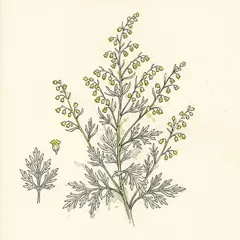
Cina Maritima
Cina · Dunham - Lectures on Materia Medica · Carroll Dunham · 73,153 chars
 All books on Cina Maritima →
Antidoted byBryonia AlbaCamphoraCapsicum AnnuumCinchona OfficinalisHyoscyamus NigerIpecacuanhaPiper NigrumSantoninum
All books on Cina Maritima →
Antidoted byBryonia AlbaCamphoraCapsicum AnnuumCinchona OfficinalisHyoscyamus NigerIpecacuanhaPiper NigrumSantoninumGeneral
THE Wormseed or Tartarian Southernwood, of which the unexpanded flower-heads are used in medicine, is found in Asia Minor, the Levant, Africa and Persia. The flowers have a strong odor, and a bitter, camphoraceous taste.
Sensorium. Head. Vertigo, with blackness before the eyes, faintness and staggering, imme- diately relieved by lying down ; occurring on rising from the bed.
Confusion, as a result of headache, as if the whole head were screwed together.
Headache
General. Violent headache, with feeling of general illness ; headache the whole day, a tearing pressure which extends also to the zygoma ; pressing headache all day ; in the evening it occupies the forehead also ; headache as if the whole head were screwed together, with confusion; immediately after a meal, dull drawing internal headache, increased by reading and by mental labor; headache alternating with pressing pain in the abdomen.
Special.
Forehead.
External pain, a pressing
368 CINA.
from above downward, as if a weight were gradu- ally sinking down there; benumbing internal headache, especially of the sinciput, but also of the occiput. Externally, a pressing, benumbing pain in the forehead and temples, which finally involves the whole head; pressure upon the frontal bone, and at the same time, internally, an undulation as of waves dashing; pain above, as if the frontal bone were violently compressed from both sides.
Left Forehead.
Confusing drawing from the left frontal eminence to the root of the nose.
In the left frontal eminence a paralytic tearing, with benumbed sensation in the head, and immediately afterward the same in the right side.
Temporal Region.
Pinching tearing, increased by pressure.
Left side: Drawing pressure, like fine tearing, relieved by moving the head.
Right side: In the forehead, above the temple, powerful dull stitches, deep in the head, which threaten to benumb one.
Vertical Region.
Right side: Numbness in a small spot.
Left side: Dull stitches in the brain.
Conditions
The headache is increased by reading and reflection, but relieved by stooping.
Review.
The sensorium is indirectly affected by Cina; the vertigo resulting evidently from changes induced in the vegetative system.
The vertigo appears to be connected with an anaemic condition, occurring with faintness on rising from the bed, and immediately relieved on lying down.
The headache corresponds to the vertigo in its
CINA. 369
anaemic character, as is seen by the relief which resuhs from stooping, notwithstanding the aggrava- tion from mental exertion and the character of the pains, which would lead one to suspect congestion. Hence Cina corresponds well to that anaemic con- dition of the brain — the result of depletion, and which is yet so often mistaken for congestion — described by Marshall Hall. The pains in the head are located chiefly in the frontal and temporal regions, as much externally as internally, and point strongly to affection of the cutaneous nerves of sensation distributed to these parts.
The pains are pressing, screwed-together pressure from above downward and tearing. Similar pains in the roots of the nose, the eyelids and eye, and in the zygoma and face, point to the efficacy of this remedy in neuralgia.
General. Dull headache, with affection of the eyes.
Orbit. Convulsive motions of the corrugator supercilii.
Eyes
General. Dull headache, with affection of the eyes ; dull pain in the eyes on reading and mental labor.
Aspect. A sick appearance around the eyes and in the face.
Lids.
Weakness of the upper lids, so that the eyes can scarcely be opened (Dulcamara).
Burning and itching in the canthi and margins of the lids, compelling to rub them, with a scanty
secretion in the inner canthus in the morning.
370 CINA.
Globe. Pressing pain internally in the eyes, generally with dilatation ; dryness of the lids and pressing, as if sand were in the eye ; pressing pain on reading a little.
Vision.
In the evening, when reading by a candle, everything appears as if seen through a veil ; relieved for a short time by wiping the eye.
On reading, dullness of vision, relieved for a short time by violent rubbing of the eye.
Review.
Blue margins around the eye, indica- tive of abdominal disease.
The nerves of the lids, as well as that of the special sense, are evidently involved, weakness of vision resulting from the latter.
A moderate degree of conjunctivitis and blepharitis is also induced, aggravated by using the eye and compelling to rub it frequently.
Rubbing removes the dimness for a short time.
Ears
Spasmodic jerkings in the external ear, like earache. Below the mastoid process dull sticking, like a pinching pressure, aggravated by external pressure, as from a blow or shock.
Nose
Boring in the nose until blood comes.
Face
Infra orbital region. Dull pressure, excited or aggravated by external pressure.
Zygomatic Region.
Pain, as if both zygomata were seized with a pair of tongs and compressed; aggravated by external pressure.
Cramp-like jerkings in the zygoma, a pain which even when gone may be re-induced by external pressure, by which, however, it is induced as a continuous pricking or paralytic pain.
Periodic twisting, tear-
CINA. 371
ing pain in zygoma, wandering from one part to another.
Inferior Maxillary Region.
Right side.
Dull sticking pain in the ramus, increased by pressure.
Left side.
Fine stickings as with needles in max- illa, increased by pressure with the hand.
Jerking pain in maxilla.
Inferior Maxillary Glands. Pressing pain.
Expression and Aspect.
Pale, and livid around the mouth; puffed and bluish face.
The child leans its head on one side.
Cervical Region.
Paralytic feeling in the nape of the neck.
Boring stitches in the right cervical muscles, synchronous with the pulse ; relieved by motion of the neck.
Review.
A variety of prosopalgia is distinctly represented by Cina.
The supra and infra orbital nerves and that portion of the facial nerve which is distributed over the zygoma, are involved in this affection ; and it occasionally extends to the infra- maxillary region.
It differs from that of Graphites in not involving the malar region.
The pain is a compression and pressure more or less acute, some- times as with tongs, and is always increased and frequently re- induced by external pressure.
Toothache, as from soreness. Inhaled air and cold drinks penetrate painfully the teeth.
Mouth
Dryness and roughness of the mouth, and especially of the palate, with qualmishness.
Deglutition. Inability to swallow ; drink rolls around audibly in the mouth a long time.
372 cinA.
Worms. Lumbricoides are passed from the mouth of a child.
Appetite
Great hunger shortly after a meal. Thirst.
Gastric Symptoms.
Eructations.
In the morn- ing, before eating, empty eructations.
After a meal, eructations tasting of the ingesta, and gulp- ing up of a bitter- sour fluid.
Epigastric Region. Qualmishness, with chill.
Nausea; with empty feehng in the head.
Frequent hiccough.
After a meal, straight across the epigastric zone, a pinching or cramp-like pressure.
A pain which embarrasses respiration.
A digging, crowding pain, as if beaten.
Left Side.
Dull sticking, increased by external pressure, and diminished by deep inspiration.
Pressing pain in the navel.
Umbilical Region. Above the umbilicus, boring pain, relieved by external pressure.
Left Side.
Intermitting, fine stitches, like grip- ing, while sitting.
Sudden, deep, sharp stitches, especially when inspiring, and at the same time stitches in the inner side of scapula ; p. m.
Violent pain as if navel were forcibly pressed inward, or had been struck; increased by respiration.
Twist- ing pain increased by pressure.
Odious feeling of warmth in abdomen, which became cutting pain.
Abdomen
Hypogastrium. Just over the pubis an internal pulsation.
Flatus. Constant noiseless motion of flatus.
ciNA. 373
Rectum
On discharge of flatus, violent stitches in rectum.
Urine
Frequent desire to urinate, with copious discharge. Urine is turbid as soon as discharged.
Uterus. Metrorrhagia of a girl ten years old during the use of Cina.
Review.
A depraved state of the digestive organs is set forth by the few symptoms we have touching the intestinal tract.
Dryness of the mouth ; affection of the apparatus of deglutition ; canine hunger shortly after a meal ; qualmish dis- tress at the epigastrium, and winding and sticking pains around the umbilicus, with peculiar sickish pressure in the epigastric zone.
These symptoms correspond remarkably to those of helminthiasis, as do also the sickly, pale and livid expression of countenance and the constant disposition to bore in the nostrils.
Nasal Membrane.
Left nostril.
Burning deep within, as if haemorrhage would ensue or as if produced by brandy.
On the septum, a burning pain as if a scab had been torn away.
Worse when touched.
Violent sneezing, with bursting sensation in the head and temples, which continues for some time.
The same, with bursting feeling in chest, which continues, especially on the right side.
Coryza. Constant pressure of movable tenacious mucus in the nose; discharge of purulent matter; coryza in the forenoon, obstruction in the evening.
Review. No clearly defined inflammatory coryza; but a disposition to ulceration corresponding to
374 ciNA.
that of helminthiasis, and a tendency to hyper- secretion of mucus and to formation of pus.
Larynx and Trachea.
Sensations: Tickling irritation, rather deep in the trachea, disposing to cough, which is followed by white mucus sputa.
The same in trachea under the manubrium of the sternum, with a similar discharge.
Secretion.
Dryness.
Feeling of dryness poste- riorly in the throat ; a catarrhal sensation ; increase of mucus in the larynx, ejected by voluntary cough- ing and hawking; mucus hangs in the larynx in the morning on rising, compelling to frequent hawkings, and soon re-appearing again.
In the morning, constant production of mucus, compelling to hem and hawk, etc.
Respiration, Difficult, loud respiration; short, rattling (in the throat) respiration.
On walking in the open air, short, ratding respiration, as if much mucus were upon the chest, yet no disposition to cough ; very short respirations, with occasional interruptions ; child, very short- breathed with loud rattling in the chest.
A kind of constriction of the chest ; the ster- num seems to lie too close, and respiration is embarrassed ; dyspnoea, with anxiety and much sweat.
Sounds of Chest. Rattling in throat and chest; a loud whistling purring, heard only during inspi- ration.
Cough
Exciting Cause. Deep inspiration ; tickling deep in the trachea, and just under the
ciNA. 375
manubrium of the sternum; feeling as of down in the trachea on inspiration.
Character.
Violent paroxysms from time to time.
Hoarse cough (with disposition to vomit), the paroxysm consisting of but few coughs, and recurring after a considerable pause in the evening.
The same in the morning, provoked again by inspiration.
In the morning after rising, violent hollow cough toward the upper part of the trachea, by which mucus is slowly loosened.
Morning cough, so violent as to bring tears into the eyes.
Before coughing, the child suddenly rises up in bed and looks wildly around; the whole body becomes somewhat rigid; she is unconscious, as if an epileptic spasm were coming on, and then cough ensues.
After coughing, the child cries out "au! au!" and gurgling downward is heard; she is anxious, bites at the air for breath, and is very pale in the face ; the paroxysm lasts two minutes.
When coughing, pain in the upper part of the chest under the sternum, and when after a time mucus has been loosened and discharged, sore and burning pain in this part as if something had been torn away.
Chest
Sternal Region. Pain under the sternum, a cramping pain when running ; a spasmodic dig- ging, as if the chest would burst.
Painful digging superiorly under the sternum.
Left Side. Sudden, spasmodic, constrictive pain ; an outward pressing pain, now in the left chest, now in the loins ; the latter as if from much
3 7^ CINA.
stooping, worse on expiration; pinching pain, increased by every inspiration.
Between the second and third ribs, pinching pain ; pinching, sticking pain ; pricking, burning, intermitting, fine stitches in the side on one of the true ribs; dull stitches near the sternum, upon the costal cartilage, increased by pressure and by expiration ; diminished by inspiration ; sudden jerk- ing stickings between fifth and sixth ribs.
Clavicular Region. Near the sternum, under the clavicle, on deep inspiration, two dull, piercing stitches in quick succession; on expiration, nothing is felt; on pressure, very painful.
Right Side. Between the sixth and eighth ribs, jerking sticking pains, not affected by respi- ration or pressure ; in the middle of the right side, under the ribs, a boring, sticking pain, relieved by pressure.
Heart
Palpitation ; great anxiety in the prse- cordia, as if he had suffered some evil in the heart; when walking in the open air.
Review. The symptoms of the respiratory organs indicate a catarrhal affection of a light grade, with nervous excitement, quite dispropor- tioned in its great severity to the former; and not merely local, but involving also the whole cerebro- spinal system. Indicative of the catarrhal state, we have accumulation of mucus in the pharynx, larynx and head of the trachea, with loud rattline in the upper part of the trachea and rattling respiration, the catarrh being confined to these organs and the
ciNA. 2>n
primary bronchi ; while the excessive nervous irri- tability is exhibited in the undue violence of the exertion made to remove this mucus ; the cough so violent as to bring tears into the eyes, as to pro- duce pain under the sternum and soreness, and also in the susceptibility to cough on unusually deep respiration, a state of things analogous to that irritability of the cutaneous tissues which induces pain when pressed upon. Hence, probably, the dyspnoea, which is one of the symptoms of Cina, and the feeling of constriction of the chest. The participation of the general nervous system in this over-excitement is shown in the spasmodic affection which precedes a paroxysm of coughing, and which simulates so closely a paroxysm of whooping-cough. This preponderance of the ner- vous over the local affection indicates the role which Cina plays in whooping-cough and in spas- modic asthma.
The external chest is affected by varieties of dull and fine stitches, generally increased by press- ure and by inspiration. So far as defined they resemble intercostal neuralgia.
Back
Lumbar Region.
Pain as if beaten, not increased by motion.
Paralytic pain.
After a meal, sensation as if the loins just above the hips were constricted by a tight band.
A sensation of fatigue as from long standing, felt also in the whole spine on bending sidewise or backward.
Spinal Column Generally.
Pains and sensa- tions.
Tearing, jerking pain ; sticking pain, relieved
378 ciNA.
by motion but returning on repose. Even in bed, when lying on the back or side, pain as if broken.
Scapulce, Right.
Tearing, sticking in the upper part of the spine toward right scapula.
Pain in scapulse when they are moved.
Sticking pain on external margin.
Extremities
Upper.
Drawing, digging, tear- ing pain in all parts of the extremity, from the top of the shoulder to the hand, not affected by pressure or motion, or if relieved by pressure returning again when the pressure is removed.
Paralyzed feeling in the whole arm and hand, it sinks by one's side.
Paralyzed feeling, as if the arm, hand and fingers were asleep.
Paralyzed feel- ing through the middle of the arm, one can hardly venture to move the arm; soreness on pressing the affected spot.
Contracted sensation like cramp in the forearm and hand, relieved by motion.
Little jerking stitches in the hands.
Spasmodic contrac- tion of the flexors of the fingers and thumbs.
Extremities
Lower.
Hips.
Iliac Region.
A boring, from within outward, below the glutsei, while sitting, relieved by pressure and motion, but returning again (characteristic in the muscular affec- tions of Cina).
Glutaei pain when sitting, as if fatigued thereby.
When walking, pain in great trochanter, as from a fall.
Spasmodic cramp and drawing tearing in the right thigh, relieved by violent motion.
Paralytic pain near the knee.
Stitches near the knee and upon the patella.
ciNA. 379
Hot flashes, not unpleasant, as from a hot coal near the knee.
Sticking and cutting pain in the toes, as if they were loosed, and in the leg, not relieved by motion.
Spasmodic motion of the foot in a child.
Clonic spasm of the left limb, followed by paralytic exten- sion of it.
Review. The pains in limbs and back appear to be of a neuralgic nature ; and when more pro- nounced this affection shows itself under the form of paralysis or convulsions, thus corresponding with the spasmodic affection of the larynx and respira- tory muscles, and indicating the appropriateness of this remedy in certain forms of chorea. The pains are in general not affected by motion or pressure, or if relieved by pressure return again.
Skin
Burning, fine stitches in various parts of the body, relieved by scratching.
Pricking, itching, crawling sensation in various parts of the body, relieved by scratching.
Violent itch- ing at night ; eruption of red, itching pimples, which quickly disappear.
Transparent, miliary eruption.
General Symptoms, involving several parts of the body. Dull stitches here and there, now in limbs, arms, feet and toes ; now in the side or back ; now in the bones of the nose, but especially on the posterior part of the crest of the ilium (on the hip) ; dull stitches, sometimes like pinching, pressing or shocks or itching ; the spots feel sore and as if beaten when pressed upon.
380 CINA.
Spasmodic stitches and tearings in various parts of the muscular system, often only instantaneous, involving also the head and chin.
Convulsions. Convulsive movements of the limbs ; paralytic jerkings in various parts of the body, especially in the limbs.
Epileptic convulsions, with consciousness (eclamp- sia). In the afternoon, an attack of spasmodic extension of the body ; then trembling of the whole body, with blue lips and whining complaints of pain in the chest, throat and all the limbs ; para- lytic pain in arms and legs.
Characteristics
The child is very feeble, lax and ailing; painful sensibility in the limbs of the whole body on motion and touch. The attacks are worse early in the morning and in the evening, and the symptoms are most violent always after eating.
Review. The disposition to that amount of nervous erethism of the nerves, which expresses itself in neuralgic pain, is exhibited in the pains felt in various parts of the body. It is character- istic of these pains that they pass quickly from one part of the body to another, are much aggravated and re-provoked by pressure. The convulsions correspond also to the erethism of the nerves of motion already remarked.
In the convulsions thus produced, it is to be remarked that the sensorium does not at all participate, even the epileptic (so- called) convulsions being unattended by uncon- sciousness.
Sleep
Frequent yawning, as if one had not
CINA. 381
slept enough. While sitting, great sleepiness ; he must lie down ; sleepiness the whole day long ; invincible sleepiness; restlessness at night, frequent tossing and discomfort in every position ; sleepless- ness; tossing during sleep, with pitiful outcry and complaint of bellyache; awaking with cries, groan- ing and hiccough, with restless motions; dreams ; anxious, tiresome, unpleasant, busy dreams.
Febrile Symptoms. General groups: Fever, vomiting of food, then chilliness over the whole body, followed by heat with great thirst ; daily fever at the same hour; chill, followed by heat with great thirst; daily fever at the same hour; chill, followed by heat without thirst ; daily fever at the same hour with very short respiration ; fever daily, afternoon ; several attacks of chill, with thirst and coldness of the hands and feet; followed by heat of the face, which, however, is pale, but espe- cially heat of the hands and feet, with cutting pain in the abdomen.
Special Parts of the Paroxysm.
Chill.
Gen- eral.
Yawning, trembling of the body, with a shuddering sensation ; shivering over the upper part of the body toward the head, with horripila- tion, even by the warm stove ; shiverings run over the body, so that one trembles even by the warm stove.
Partial. Coldness of the face with warm hands ; cold cheeks ; pale, cold face, cold sweat of the forehead; of the forehead and hands; of fore- head, nose and hands.
382 CINA.
Heat.
General.
Chill over the whole body, with hot cheeks without thirst ; strong fever, with vomiting and diarrhoea; heat in the evening, and during the night.
Partial. Heat, mostly of the head, with yellow complexion and blue rings around the eyes ; feeling of heat, and heat with redness of the face ; burning heat over the whole face, with red cheeks and thirst for cold drinks; palpitation.
Review.
The intermittent of Cina is evidently not of a type to which violent paroxysms belong.
The paroxysm is often preceded or attended by vomiting of food or pain in the abdomen.
It recurs at the same hour daily.
The chill is not very severe, is sometimes partial, and if so, confined to the upper part of the body, and is not relieved by external warmth.
It is sometimes attended by thirst, but the relation of thirst to the members of a Cina paroxysm is not well defined.
It is sometimes attended by short respiration.
The chill is often accompanied by warm hands and by hot, though pale, cheeks (calor mordax?), and by cold sweat of the forehead and nose and hands, either or all.
The chill presents more characteristic features than the heat.
Heat.
The heat may be general or partial.
If general, it is attended by red cheeks and desire for cold drinks, and occurs at night.
It is often partial, confined generally to the head; the face being at the same time yellow, with blue rings around the eyes.
CINA. 383
Sweat. Beside the cold sweat of the fore- head, nose and hands, which accompany the chill, no mention is made of sweat.
We thus see the type of intermittent in the paroxysms of which reaction is very imperfectly established. This accords well with the disposi- tion of Cina to produce a cachexy, the stress of which falls upon the abdominal organs — a cachexy closely resembling probably that of hel- minthiasis.
Disposition.
The child is very whining and peevish and complaining; weeps piteously if one go to handle or lead him.
Great earnestness and sen- sibility ; cannot take a joke.
Indifference to all impressions.
Restlessness.
Greediness.
Cannot be composed by things at other times agreeable, or by caresses.
GENERAL OBSERVATIONS.
Action on the Vital Power.
Cina does not exercise any very strongly marked action on the general vitality.
The sensorium is in no special manner directly affected.
It is involved secondarily in the anaemic cachexy which Cina produces.
Of the special senses that of vision alone is affected, the power of the visual organ being simply re- duced in degree.
A similar action is exerted upon the voluntary muscular system, paralytic sensations and partial temporary paralysis occurring in the extremities; but this paralysis is not pure and simple, but is complicated with convulsive muscular
384 CINA.
contractions, the co-ordinating power appearing to be in abeyance, a state of things which at once calls to mind the disease, chorea.
Action on Organic Substances.
Of this we know little.
That Cina, however, does strikingly im- pair the nutrition is shown by the yellowish, livid complexion, the paleness about the mouth, and the blue margins about the orbits ; and the locations of these phenomena point to the abdomen and the digestive canal as the primary seat of the organic alterations, whatever these may be.
They suggest those which result in the cachexy of helminthiasis.
The sphere of action of Cina is not very extensive. The nerves of sensation, especially about the face and extremities, are affected, as the neu- ralgias show ; those of motion, as the convulsions exhibit ; those of special function, in connection with those of sensation and motion, as the con- vulsive action of the laryngeal and respiratory organs show, together with the hypersesthesia of the laryngeal mucous membrane. The distress in the epigastric region, the frequent vomiting of food in other affections, pains in the abdomen, and the peculiarities of the intermittent fever parox- ysms, chill, with vomiting of food and imperfect reaction, show the influence of Cina upon the abdominal organs.
Peculiarities of Pain. The abnormal sensitive- ness of individual nervous filaments is aggravated by external pressure, and the pain generally is so aggravated or reproduced.
CINA. 385
Aggravations. The symptoms of Cina are all worse after a meal, at night and early morning.
Periodicity.
Marked in the febrile symptoms.
The paroxysms of intermittent recur at the same hour every day.
THE ART AND MODE OF PRESCRIBING.
THE spirit of homceopathic practice requiring the administration of a single remedy at a time, there is no room for the compounding of drugs in prescriptions. When it is required to order a dose of any quantity of a remedy from a pharmaceutist, it suffices to inscribe the name of the drug and to add in plain English the form in which it is desired, with the potency and the quantity.
Nevertheless, the venerable antiquity of the art of rightly marshaling drugs in the serried ranks of a complex prescription, demands a passing notice at our hands.
The writing of a prescription involves two things :
1. That we know what drugs we desire to associate together, and in what relative quantities.
2. That we know how to express our desires in the terms of the art.
The first demands scientific knowledge of a high order, embracing a full acquaintance with the chemical and physiological actions and reactions of drugs.
THE ART AND MODE OF PRESCRIBING. 387
The second requires an acquaintance with the language in which prescriptions are written (gen- erally, but not necessarily, the Latin), and with the symbols of the apothecary.
It is not a matter of indifference what drugs are mixed in a prescription.
Drugs of which the united or joint action might seem desirable, may yet be chemically incompatible in such way that through their mutual action a third and altogether different substance may be formed.
This third substance may be simply inelegant and inert, or it may be noxious and poisonous.
Of the former we have an example in the following prescription :
^ Tinct.
Ferri chloridi ff ss.
Quiniae sulphatis gr. xx.
Syrupi rosae Gallicae ff ijss, Misce.
Signa.
Sumat seger cochleae magnum quaque hora in apyrexiam.
By the action of the iron upon the tannic acid of the roses ink is formed and a precipitate occurs.
The object of adding the syrup of roses, viz., to give a fine color, is completely frustrated by the addition of the iron.
But this is not noxious, though inelegant.
Again, the incompatibility may spring from the tendency of the ingredients to form a noxious prod- uct, as in the following effervescent draught, which has twice, in New- York, caused instant death :
388 THE ART AND MODE OF PRESCRIBING.
5;
Sodse Bicarbonatis gr. xx.
Potassii Cyanidi gr. iv.
Aquae destillatae f3ijss.
Solve.
Deinde adde — ■
Succi limonis recentis f3j. Misce. et bibat seger, mistura effervescente.
In this case the citric acid decomposes the cyanide of potassium, and hydrocyanic acid is formed as the draught is taken. It proves fatal.
Again, the incompatibiHty may come from the ingredients being physiological antidotes, e. g.., morphine and strychnine.
% Morphise acetatis gr. viij.
Strychnise sulphatis, gr. ij.
Panis q. s.
Fiant pillulae minimae quadriginta.
It is probable that these pills might be taken freely without the physiological effect of either of these powerful alkaloids being experienced, because they antidote each other.
It is requisite, therefore, for success, in writing prescriptions, that one know the chemical and physiological properties and relations of drugs.
Again, it has been found by experience that certain combinations of drugs possess properties not known to be possessed by any of the ingre- dients.
The Dover's powder, or pulvis ipecacu- anhse composita, is an example of this.
Such
THE ART AND MODE OF PRESCRIBING. 389
knowledge is hit upon by chance, and is a matter of memory.
Presupposing the possession of knowledge to select the drugs suitable to be associated in a prescription, the form of composition of the pre- scription is merely technical.
It may be done as well in English as in Latin.
The following is an instance of a correct and quite harmless prescription :
Carminative for an infant.
?s Cretse praeparatae.
Sacchari albi aa3j.
Acacise pulveris §ij.
Aquae cinnamoni f^iv.
Misce.
Signa.
Suraat cochlear panoim bis vel ter die, pro re nata.
As an example, at one and the same time, of the mode of writing prescriptions, and of the pedan- tic and nonsensically stilted language and manner in which simple and familiar beverages are sometimes ordered, let the following serve:
Agreeable refrigerant.
5j Succi limonis recentis ff ij.
Corticis limonis recentis magnopera tenuis 3ss.
Sacchari albi ^iv.
Aquae Crotonis glacialis Oiij.
Misce.
Cola.
Divide in amicis.
Sumat quisque quantum libet.
Or the following:
Haustus stimulans calorifaciens et roborifaciens.
390 THE ART AND MODE OF PRESCRIBING.
5;
Spiritus frumenti Borbonica ffiv.
Aquse buUientis Oij.
Succi limonis recentis ff iss.
Corticis limonis recentis magnopera tenuis 3ss.
Sacchari albi '^iv.
Infusi these sinensis |ij.
Misce.
Teneatur mistura calleda.
Divide in poculis octo. Sumat quisque amicus unum in animum oblectandum.
The whole art of prescribing consists first in knowing exactly what you want to give the patient, and in what doses ; and then in writing your direc- tions so clearly and intelligibly that the apothecary may fully understand you.
HOMCEOPATHIC PHARMACY AND POSOLOGY.
The preparation of drugs in the homceopathic pharmacy is simple.
We have: i.
Triturations.
Tinctures
From each of these forms prepara- tions are made, called, indifferently, dilutions, atten- uations or potencies.
Metals, chemical salts and some dry vegetable substances are prepared by trituration with an inert substance, such as milk sugar, which is especially suitable from the hardness and sharpness of its crystals, and from its non-hygrometric properties.
Vegetable substances that are prepared in the form of tinctures may be divided, according to their mode of preparation, into three classes.
I, Roots, barks and leaves that are dry. These
THE ART AND MODE OF PRESCRIBING. 39 1
are coarsely powdered, and a tincture is prepared by the process of percolation.
2.
Plants which contain a large quantity of juice.
These are bruised, mixed with an equal weight of alcohol, the mixture kept in a cool, dark place for a day or two, and then subjected to pressure and filtered.
3. Plants which contain but a small quantity of juice are bruised, mixed with double their weight of alcohol, and then treated as class No. i.
The alcohol and milk sugar used must be care- fully purified.
The attenuations, dilutions or potencies (as they are variously called) are prepared by triturating the preparation obtained as above with milk sugar, or by mixing them with alcohol, according to one of two different scales, known as the decimal and centesimal, respectively. Thus, if one grain of metallic gold be triturated with one hundred grains of milk sugar, this forms the first centesimal tritu- ration. A grain of this first trituration, triturated again with one hundred grains of milk sugar, forms the second centesimal trituration ; and so on.
If with ten grains instead of one hundred, they are the first and second decimal triturations. With alcohol instead of milk sugar they are dilutions or attenuations ; all are called potencies.
These attenuations or potencies have been car- ried to very high numbers. In the way I have described, I know them to have been carried to the two hundredth ; of higher, prepared positively in this way, I have no personal knowledge.
PATHOGNOMONIC SYMPTOMS AND CHARACTERISTIC SYMPTOMS.
DR.
VEIT MEYER, of Leipsic, in 1850, told me an anecdote of Hahnemann, which, so far as I know, has never appeared in print.
It was related to him by Dr.
Franz Hartmann, then recently deceased, who in his early days had been a pupil of Hahnemann, and was present at his consultations with patients.
Hartmann relates* that one day a patient came to consult Hahnemann.
The malady was condylo- mata (figwarts).
Hahnemann examined them and then questioned the patient for a half- hour, noting symptoms in his record book.
He then closed his book, consulted the "Materia Medica" for a few moments, went into the next room, brought out three powders, and said: "Take a powder every three days ; come again the fourteenth day, and pay now four dollars." The man paid and retired.
*In this paper (written for spoken of as haemorrhoidal tu-
delivery before the Onondaga mors, and the patient as a
County Homoeopathic Medical female. Its present version is
Society, October i8, 1864), taken from a note-book written
the disease here designated as by Dr. Dunham, at Leipsic,
"condylomata" (figwarts) was dated 1856. — [H.
E.
K.
D.]
PATHOGNOMONIC SYMPTOMS. 2>93
" What then did you give, Herr Hofrath ?
" "What!" replied Hahnemann, "have you hstened to the examination and do you not know?
You must study the * Materia Medica ' !
" So Hartmann said no more, for Hahnemann never told his pupils what remedy he gave, fearing to encourage routine practice.
The fourteenth day the patient came again, the warts were but one-third their previous size.
Hahnemann gave him two more powders, to be taken every fifth day.
" Come again the fif- teenth day; this time you pay nothing." Hartmann, surprised at the rapid diminution of the warts, said again, " But, Herr Hofrath, what did you give ?
" " Do you not yet know ? study then 'Materia Medica.'"
The fifteenth day the man returned; no trace of the warts was to be found.
Hartmann could not contain himself He came to Hahnemann's study at an earlier hour than usual and opened his record book to learn the remedy given.
It was Chamomilla 3° ; three powders.
The two on the second day were sugar of milk alone.
More astounded than ever, Hartmann could not contain himself, and when Hahnemann came in;
"Herr Hofrath," said he, "I have committed a great crime.
The desire to know with what remedy you cured the figwarts so burned within me that I opened your book and ascertained it, and now I pray you, on what grounds did you give Chamomilla?" "Ah, have you done that?" said Hahnemann ;
" then take the book and read
394 PATHOGNOMONIC SYMPTOMS AND
further, read the 'Symptomen- codex' and see if it were possible to give any other remedy than Chamomilla, when such symptoms were present." And so it was. Even Hartmann was satisfied that Chamomilla was the only suitable drug.
And yet the prescription was made without any regard being had to the chief objective symp- tom, to the very feature which, from a pathological point of view, was the central, pivotal fact of the case. To make such a prescription might seem " like play- ing ' Hamlet' with the part of Hamlet left out."
A great many most brilliant cures have been made by prescriptions precisely similar to this one of Hahnemann's. Nay, an entire class of cases, and, by no means a small one, must be cured in this way, if they are cured at all.
What are generally called organic diseases, well- defined and tolerably far advanced structural modi- fications of the nobler organs, we can never expect to see produced in any proving. Much less can we look for provings that shall exhibit analogues of the various forms of chronic organic disease, benign or malignant. Occasional accidental prov- ings, in the way of cases of poisoning which come to our knowledge in a medico-legal way, may chance to throw light on these spheres of action of drugs; but these sources of information are infrequent, and always very imperfect and impure.
The science of therapeutics would be forever most imperfect, were we compelled to rely on the knowledge we can gather from such data.
CHARACTERISTIC SYMPTOMS. 395
For example, a proving can hardly be expected to be carried so far as to exhibit unequivocal signs of pneumonia. And although some cases of acci- dental provings in the shape of poisonings have shown us that certain drugs which we know to be curative agents in treating pneumonia do actually produce the organic phenomena of pneumonia, yet this knowledge, while it may confirm our faith in these drugs as proper remedies in cases of pneu- monia, to which they correspond, would nevertheless lead us astray and ensnare us if we should allow them to withdraw our attention from other drugs which have not as yet been known to produce the organic signs of pneumonia. If, for example, because it is known that Tartar emetic, Phospho- rus, Aconite and Bryonia have produced actual pneumonia, we should allow ourselves to look upon these as the sole remedies for this disease, we should be in danger of neglecting other remedies, such as Lycopodium, Sulphur, Chelidonium, Cepa, and a number of others which, though never known to produce the organic symptoms of pneumonia, have yet shown in practice a power to cure that disease speedily and completely when their general symptoms corresponded to those of the particular case in which they were given.
If this be true of a disease which is, pathologi- cally considered, so simple as pneumonia, how much more likely is it to be the case with regard to affections which depend upon more complex and elaborate changes in the processes of assimi-
39^ PATHOGNOMONIC SYMPTOMS AND
lation and nutrition ; such as tubercle, cancer, lupus, and many others ; or (not to go so far) as the benign affections of the skin and glands, or even as the exanthematous fevers. It is manifest, that while symptoms resembling the general, con- stitutional symptoms that accompany all of these complaints, may be produced in provings of drugs, yet the organic phenomena which are pathogno- monic of the malady, and in the absence of which the disease could not be diagnosticated, cannot be looked for in the pathogenesis of remedies.
But these organic phenomena, these pathogno- monic symptoms, for such they are in most cases, are the very ones on which the diagnosis depends. If, therefore, the diagnosis and the prescription are to be worked out by the same method, and are to be made on the basis of the same symptoms or series of symptoms, then an accurate homoeopathic prescription would be a rare thing, and in the majority of grave and serious affections, it would be an impossible thing; yet so many successful prescriptions have been made in such cases as to show that it is not impossible, nor indeed always very difficult.
But a prescription is always based upon a cor- respondence of the symptoms of the drugs with the characteristic symptoms of the case in hand. It follows, therefore, that those symptoms which the prescriber regards as characteristic symptoms, are not at all the same which the diagnostician regards as pathognomonic symptoms ; they are not
CHARACTERISTIC SYMPTOMS. 397
the phenomena from which the malady gets its name, those which depend upon, and indeed con- stitute, its pathological anatomy.
In the case related by Hartmann, the symptom pathognomonic of the case was the tumor.
This was the "pathological anatomy" of the case.
By this symptom the case was classified.
From this, it takes its name, and this was the symptom of chief importance to the diagnostician.
But the proving of Chamomilla did not contain this symptom.
Consequently, had Hahnemann regarded this symptom as a characteristic symptom from the point of view of the prescriber, he would not have been able to select Chamomilla as the remedy.
He did not so regard it.
The symptoms which he regarded as charac- teristic of the case, and for which he sought and found in Chamomilla corresponding symptoms, were the general constitutional, for the most part sub- jective, symptoms, — the symptoms of mind and disposition, and the conditions of time and circum- stance, such as aggravation, amelioration, etc.
Cases still further illustrating these facts are to be found in the clinical records. It happens some- times that cases , of disease are cured by drugs that had not, at the time they were so used, been known to produce the pathognomonic symptom of the malady they seem to have cured, whereas subsequent more extensive provings, or accidental observations in cases of poisoning, have shown that these drugs are capable of producing and do
39^ PATHOGNOMONIC SYMPTOMS AND
produce these organic changes, these pathogno- monic objective symptoms.
A considerable number of cases of albuminuria, some of them, no doubt, cases of Bright's disease, have been recorded as cured by various remedies.
Some of these remedies are not yet known to have produced albuminuria in the healthy subject. Others are known to have done so.
One of them, Arsenic, has cured a number of cases. It has almost always been selected because of the correspondence of its general constitutional symptoms with those of the cases in hand. And indeed the correspondence, in this respect, with the general symptoms of Bright's disease, is very striking, I myself once cured with four doses of Arsenic ^°°, a most severe case of post-scarlatinal dropsy, which had already lasted ten days before I was called to it, growing steadily worse until death seemed imminent, and in which the urine in the test-tube became nearly solid on applying heat, the entire quantity of urine passed in twenty- four hours being less than two gills. In this case, of course, the pathognomonic symptom for the diagnostician would have been the albumen, the blood discs, and the casts in the urine (they were all there).
The symptoms which guided my choice in the selection of the remedy were the general symp- toms, the character of the pains, their aggravations and ameliorations, the prostration, thirst, tempera- ture, posture, etc., etc., all of which were so char-
CHARACTERISTIC SYMPTOMS. 399
acteristic of Arsenic that I could not hesitate a moment.
I did not know at that time that although Hahnemann's proving does not contain this pathog- nomonic symptom, albuminuria, yet this symptom has been produced by Arsenic, together with all other objective signs of Bright's disease, in healthy cats in numerous instances, by Dr.
Quazlio of Munich ; and again it was observed, with equal minuteness, in two remarkable cases of arsenical poisoning recorded by Dr.
Maclayan in 1852.
(Editor " Medical and Surgical Journal.")
Phosphorus has been found to produce Bright's disease ;
Mercury has produced albuminuria.
Can- tharides have produced objective symptoms corre- sponding to, at least, the first stage of one form of Bright's disease.
Now if we had a case of Bright's disease to treat, how should we select a remedy ?
The fact of the drug having produced albuminuria in the healthy subject is common to these four drugs, and is perhaps true of several others.
How should we choose among these drugs?
Why, by the general subjective symptoms.
But these symptoms alone, without the objective symptom, albuminuria, have already, in a great number of cases, been suffi- ciently good guides, to enable us to select not merely this group, but the exactly appropriate drug in the group.
Thus it appears that these general constitu- tional symptoms are not only a sufficient, but they
400 PATHOGNOMONIC SYMPTOMS AND
are a more accurate guide, than the objective pathognomonic symptom.
They are also a more comprehensive guide. They enable us to employ, and direct our attention to, remedies that we should not be led to employ if we confined our attention to the pathological anatomy of the disease under treatment.
For example : Apis has cured many cases of albuminuria.
The general symptoms of Apis cor- respond well to some cases of this disease.
Yet we find no record of albuminuria in the proving of Apis.
Nor is it likely that we shall ever have toxicological data to complete our proving in this respect, because Apis is not a substance likely to be employed as a poison.
It is possible that as Arsenic and Phosphorus and Mercury have accidentally been found to be capable of producing pathologico-anatomical con- ditions corresponding to those which they have cured, so Chamomilla may have been, or may some day be, found capable of producing hsemor- rhoidal tumors. If so, the fact will be interesting; but it will not make it one iota easier to prescribe Chamomilla for haemorrhoids. For the prescrip- tion, if we would have it an exact one, must be based on the correspondence of the general and subjective symptoms, and on the times and condi- tions of their occurrence and aggravations.
Upon these slightly desultory remarks three propositions might be based.
I. The point of view from which the pathol-
CHARACTERISTIC SVMl'TUMS. 40I
ogist and diagnostician regard a case of disease, and that from which the therapeutist or prescriber regards it, are radically different. And inasmuch as therapeutics, as a science, have hardly received any systematic cultivation, while great and suc- cessful attention has been paid to pathology and diagnosis, it has happened that the manner in which disease has been studied, discussed and described by medical authors, — contemplating it rather as a natural phenomenon to be studied and classified, than as a condition of the individual patient, for which an individual specific is to be found, — has been unfavorable to the purposes of the prescriber, obscuring rather than elucidating those points which are to be his chief guides, and exalting into a position of prominence features which are to him only of subordinate value.
2. The arrangement of materia medica on the basis of a pathologico-anatomical schema, as is desired by some, would be, first, impossible, second, useless, third sure to mislead.
3. It is probable that while to the diagnosti- cian, the pathological anatomy of a case is the fact of prime value ; to the prescriber the diathesis, general and special, is that to which he is chiefly to look for his indications.
VALEDICTORY ADDRESS
To the Graduating Class of the New-York Homoeopathic Medical College, by Professor CARROLL Dunham, M.
D., Dean of the Faculty.
February 29th, 1872.
Gentlemen of the Graduating Class:
THE immediate object of your patient endeavors is attained.
You have completed one stage in that curriculum of medical study which must end only with your lives.
The officers of the college formally attest this evening that you have mastered the rudiments of medical knowledge.
The faculty, who have directed your labors, and who have wit- nessed with no ordinary pleasure your faithful industry, now bid you a kindly farewell as pupils, and at the same time extend to you a hearty wel- come and fraternal greeting as members of the medical profession.
You are eager to enter upon the life for which you have become fitted by the years of training which close to-night; and to-morrow's sun will see you speeding in various directions toward the scenes of your respective future labors. The career upon which you are about to enter is so peculiar in its nature and in the demands which
VALEDICTORY ADDRESS. 403
its honorable and successful prosecution will make upon you, that you will bear with me, I am sure, if I ask you to tarry a moment and survey it with me, as it lies before you glowing in the morning radiance wherewith the hopefulness of youth ever gilds the future.
Hitherto, you have been encouraged and stimu- lated in your work by the companionship of fellow- students, and aided and directed by the counsels of preceptors. In your essays in practice, you have felt that older and wiser men were beside you to guard you from error and to supply your deficiencies. But from the present moment, you must depend upon yourselves. You must trust to your own knowledge and resources to meet whatever emergencies may present themselves, with rarely a friend at hand to counsel and encourage, with none to share your responsibilities, however great, unless you resort to a formal consultation, which a young physician sometimes hesitates to do, since it is often, though wrongly, regarded by the pub- lic as a confession of incapacity.
This isolation in responsibility is peculiarly oppressive, because a physician cannot select his case according to his own estimate of his knowl- edge and ability. He settles in a neighborhood, offers his services to the inhabitants, and he must take the cases as they come, however trivial or however serious they may chance to be, and do his best. It is not with us as with our cousins of the legal profession, a neophyte in which may
404 VALEDICTORY ADDRESS.
decline to grapple with a capital case until he has proved his weapons upon smaller game. And the newly fledged priestling would scarcely aspire to a metropolitan charge, preferring to warble his first tremulous notes over the brink of a rural pulpit.
But no liberty of choice is available for you. Your very first case may be the most difficult you will ever encounter, and, if you be placed in charge, you must meet the difficulties, calling what aid may be within reach ; but, aided or not, never flinching from the responsibility so long as the patient demands your services. For the cases which are intrusted to us brook no delay. If the lawyer be not ready for trial, an accommodating judge may grant a postponement.
But if you be not ready in a case of cholera or of haemorrhage with the right expedients, at the right time, the laws of nature move on in their destructive course, — the case is closed against you, and from this judgment there is no appeal.
While your inevitable isolation involves difficul- ties, it brings also dangerous temptations peculiar to our profession.
The advocate conducts his case in open court, subject to the wisdom of the judge and the criticisms of the bar.
By them are tested the faithfulness of his work, the thoroughness of his researches, and the soundness of his conclu- sions.
The preacher has always in his flock at least a dozen critics, keen to detect a heresy, prompt to denounce a backsliding, and swift to lay charges before the presbytery or the bishop.
VALEDICTORY ADDRESS. 405
But you will be seldom observed by any save the anxious relatives, who believe in your skill but have no means of testing it; who hang in confi- dence upon your words, but rarely comprehend them ; asking only that you bring the loved one back to health, and ready to give you all the credit of the restoration. Or if they be distrustful, they are still almost helpless in their position toward you, inasmuch as they have little or no knowledge to direct them in seeking out or weigh- ing evidence in medical matters. For, although every one in the community knows a little law, and all of us are so instructed in theology that the minutest arrangements and relations of this world and the next are as familiar to us as the affairs of last week, yet the laws of life and health, and the simplest principles of medical science, are as a sealed book to almost the whole non-medical com- munity.
Who, then, shall know it if you err in diag- nosis, if you fail to detect disease at the time when it is curable, — if you let the decisive moment glide away without the remedy which it requires? No watchful expert will stand beside you as you sit idly at the bedside while life ebbs away, though you might stay the tide ; none tarries to note that you were at fault when you left your patient for your slumbers, and Death came while you slept. The desolate hearth and the motherless children may be witnesses against you before the judgment- seat of the All- Seeing, calling you to answer for
406 VALEDICTORY ADDRESS.
neglected opportunity, for love of ease, for sloth- fulness of judgment and tardiness of action. But in most instances, if your conscience accuse you not, you go in peace.
Realize, then, how tremendous are the respon- sibilities involved in your isolation.
Cherish the tenderness of your conscience ; never allow yourself to disregard its warnings.
The more you are withdrawn from observation and criticism, the more you become a law unto yourselves.
Act always then as under the immediate eye of the Omnis- cient.
Wherever you live, you will have professional neighbors, who will be, of necessity, your rivals or competitors, and who yet ought, for every reason, to be your friends. For they are those upon whose aid and counsel you would rely in cases of great difficulty or danger, and you should not lightly do anything to alienate their regard.
As homoeopathic practitioners, members of a branch of the medical profession which is still a decided minority, you will find in your neighbor- hood practitioners outnumbering you as six to one whose relation to you will be, at the best, one of armed neutrality, — or, if the past be any criterion of the future, one of uncompromising hostility ; men who will deny you the ordinary courtesies of professional intercourse, who will not hesitate to injure you as a practitioner at every turn, and who hold themselves absolved, as toward you, from every obligation of medical ethics, — acting
VALEDICI'ORY ADDRESS. 40/
apparently upon the principle that a homoeopath has no rights which a "regular" is bound to respect.
Demeanor of this kind from members of your own profession, whose interests and aims are one with your own, and from whom your only ground of difference is that you have perceived the advantage of a better way of curing than theirs, will be hard to bear.
Remember, however, the provocations they receive.
Your medical faith and practice are a direct contradiction of theirs.
Whereas they bind upon the people burdens grievous to be borne, your expedients are positively pleasurable to the sick.
You parry as with airy nothings the dread reaper's scythe, which their ponderous battle-axe so often fails to beat aside.
Every patient who recovers under your gentle ministrations is a public protest against their harsh and damaging procedures.
As regards the conduct of physicians toward their colleagues in the various contingencies of professional life, medical associations in this coun- try have framed and adopted codes of medical ethics which define the duty of practitioners toward each other, toward their patients and the public. I commend these codes to your careful study. But I know of no general rule more likely to guide you aright in your dealings, both with members of your own school and equally with those of the opposing school, than that which is, taken as the basis of the code of ethics adopted
408 VALEDICTORY ADDRESS.
by the National and all the State and County Homoeopathic Societies in the United States, and which is no other than that which is the basis of the great Christian code of ethics: "As you would that men should do to you, do ye even so to them." If you add to this golden rule the aphor- ism also expressed in our code of ethics : " The paramount object of the physician in all that he does should be the greatest good to the patient ; " and if you plan your professional life intelligently upon these great principles, you will not often go astray.
Consistently with these principles, you will find our code of ethics somewhat more liberal than those of other schools. Whereas the latter forbid consultations or associations with physicians who adhere to a certain or to any system or "dogma" of medical practice (as though the man who has no coherent system, no faith in any principle, could be a safer practitioner than he who has a system and a reason for his faith), our code enjoins upon us to consult with any honorable practitioner of good reputation as a man, no mat- ter to what school he may belong ; and this because the patient has the right to enjoy the benefit of whatever knowledge or skill may exist within his reach, and we have no warrant for circumscribing ;this right by declining the consultation.
Our code forbids the adoption of special creeds as tests of orthodoxy in medicine, on the ground that our present knowledge is as nothing compared
VALEDICTORY ADDRESS. 409
with what remains to be found out, and that creeds as tests of orthodoxy are barriers to progress in knowledge, and are allowable only when we have learned all that is to be known and when progress is merged in possession.
These very precepts must make you tolerant of your " old-school " neighbor, though he be intolerant of you.
Govern your demeanor toward him by the strictest observ- ance of the golden rule.
Never let a word of aspersion, detraction, or unbrotherly reproach escape your lips.
Give him full credit for his profes- sional knowledge, and for his achievements.
You can afford to await the verdict of the court of final appeal, the common sense of the people.
Gentlemen, you will encounter sundry little unpleasantnesses at the outset of your career as physicians. Some patient will object to you on the score of your youth, — most unreasonably as it may appear to you, conscious, as you are, that the wisdom of gray hairs reposes underneath your waving locks. But a patient intrusts to a physi- cian the present facts of his case and their possible sequences, and he may be pardoned if he feels some hesitation at confiding these to the inexpe- rienced hand of youth.
This objection is, however, often urged with unseemly persistence, for it is obvious that the patient need not employ you if he do not choose. A professional friend of mine once lost his temper when a patient for the twen- tieth time objected to his youth, and retorted: " Sir, you must have lived your long life to little
4l6 VALEDICTORY ADDRESS.
purpose if you have not learned that there may be old fools in the world as well as young ones."
You will be apt to find great difficulty in col- lecting your bills, in proportion to your youth. This seems peculiarly unjust, for the young doctor is usually straitened in means, and has greater need of prompt returns than his seniors. In this, as in many other concerns, you will realize how true is that scriptural axiom which seems to be a statement of what is rather than of what oiLght to be : " Unto him that hath, shall be given." When you shall have acquired so large a practice as to have no longer any great pecuniary anxiety, you will find those prompt to pay their bills who, in the early days of your poverty, were very neg- lectful.
Then, again, in your first years of practice, you will be sorely tried by a want of confidence in your professional skill. In a case of no great real gravity, friends will become alarmed, require a consultation, and ascribe to your older colleague the credit of a cure which you were abundantly competent to effect unaided. Or, what is still more trying, when you have carried a patient safely through a dangerous illness and he is just on the ver^e of convalescence, a panic may arise in the house, counsel may be demanded, or the case withdrawn from your charge and placed in other hands. You will have the chagrin of feeling that your honest and good work has been unappreciated and your reputation for skill has been damaged.
VALEDICTORY ADDRESS. 4I 1
These trials certainly are difficult to bear, and there may be a deal of injustice involved in them ; scarcely so much, however, as you would at first suppose. Remember the golden rule, which is to be your guiding principle, and in imagination put yourself in the place of the public, and then ask whether you would not act much as they do. It is not the way of the world, nor js it a good way, to pay a bill unless vouchers are presented, nor to yield to authority unsupported by credentials.
What do you ask of the public when you offer them your professional services ? You invite them to confide to your skill the health, cpmfort, — it may be, the lives, — of themselves and their fami- lies ; to admit you to their houses on terms more intimate and confidential than those on which any- other human being enters ; to suffer you to observe their most secret ways, their holiest joys, their hidden sorrows, their carking cares. Can you expect them to do this easily, willingly or unreservedly, until anxious observation of your character and conduct shall have satisfied them that you deserve this confidence ?
Win the confidence of the community in which you live, and the little unpleasantnesses which mark your early career will cease to vex you.
For if one should object to your youth, a dozen zealous clients will reply, "It is an old head on young shoulders ;
" and will tell of the great men of history who have reached the acme of their fame before their heads were gray.
If your bills
412 VALEDICTORY ADDRESS.
are called exorbitant, another will remark, "Capac- ity and devotion are cheap at any price." Or, if a patient's friends speak of a consultation, or of placing the case in other hands, they will hear, " I would sooner trust one good head than a half dozen divided minds ; " or the more homely aphorism, " It is not wise to swap horses while crossing a stream." Your first business, then, must be to win the confidence of the community in which you seek your practice.
But you will say to me, is not this unfair? for have you not just said, the public are not compe- tent to judge of professional skill, and often through ignorance discharge a physician who is on the verge of a great success ? This is so ; and if there were no other means of winning confidence than by the methods of strictly medical and surgi- cal procedure, you might well despair of being rightly estimated. But, though the public are not competent judges of your prescriptions, they are in the main very good judges of your qualities and acquirements in certain other matters which are almost as important to your success in the care of the sick.
To these, I wish to call your attention in the few moments which remain to me.
I assume that you will be unceasing in your labors to master your profession, to keep fully acquainted with all that is achieved by its many workers in various lands, and to add something yourselves to the common store of knowledge.
Your clients can
VALEDICTORY ADDRESS. 413
witness your industry, though they cannot measure the results.
They will closely watch your doings to note whether you faithfully devote yourself to those who seek your aid.
Among your first patients will surely be many poor persons, who seek the new doctor, hoping, perhaps, to be treated at less cost.
There will be many chronic cases who, having despaired of help at the hands of the old doctors, catch at the straw of a new man's coming.
It is not so pleasant to take care of the poor as of the rich.
Their houses are cold and untidy, the atmosphere is unsavory and the patients are uncouth.
Now, if you undertake these cases at all, you are bound to bestow upon them the same unwearied attention and faithful study and tender care that you would give your wealthiest patient.
Their health and lives are as precious to them as ours to us.
You have no right to set a lower value upon them.
If you assume the respon- sibility of the cases, you must fulfill the obligation.
This is your duty ; and I dislike to adduce any other and less elevated consideration.
It is, how- ever, a fact that nothing will more surely introduce you to the most desirable and lucrative practice than a faithful, honest and successful treatment of the poor.
For every pauper knocks and takes alms at the gate of a dozen of the benevolent rich ; and the grateful commendations of the pen- niless widow whom you have freed from pain, will reach the heart of those whose good word is a passport to success.
As you advance in years and
414 • VALEDICTORY ADDRESS.
in knowledge of the world, few things will surprise you more than the intimate relations which exist among all classes of society.
No act of yours, praiseworthy or blamable, can remain hidden.
Even in this world, your good or evil deeds will find you out.
From the very beginning, then, let every case be treated with your utmost skill and' with untiring fidelity.
You will further win the confidence of your patients and of the community by showing that you understand not only how to treat the diseases and injuries of the sick, but that you understand the nature of that which is the subject of your ministrations, the body and mind of man. Recollect that, while you are studying your patient, you are yourself the object of study, and frequently by persons accustomed to observe keenly and weigh the characters of men ; and demean yourselves accordingly.
You will succeed in this just in proportion as you possess and cultivate what is called tact, which may be defined as the power of adapting your speech and behavior to the mind and circumstances of those with whom you are dealing. It is an every-day affair to you to be called to a patient; but to each patient the calling a doctor is a momentous matter, and the sickness which requires it is a thing of prime consideration. Act, then, as though the case were equally important in your mind, and give it your undivided attention. Let neither word nor action show that your thoughts
VALEDICTORY ADDRESS. 415
wander from the patient in whose behalf you are called.
Give ample time for a full understanding of the case, bearing with your patient's prolixity of statement if it amount even to garrulity, and withdrawing as soon as your directions are given and clearly understood.
For, however welcome you are as the bringer of relief, when that has been accomplished, your presence can be only a restraint.
Even if friends, or attendants, or the patient himself would fain beguile you into general conversation, break it up as soon as you can court- eously do so.
You impair your usefulness as a physician by establishing any other relations with the patient, at least during his illness.
Do not regale your clients with the incidents and experience of your European tour, or the sufferings of your cousin who was in the war; with the performances of your new microscope, or the wonderful acquirements of your children.
How- ever polite may be your patient, she will surely give a sigh of relief as you go, and will dread the next visit.
Never introduce into conversation with your patient, or in his presence, subjects connected with politics or theology, nor allow yourself to be drawn into such discussions in the sick-room.
On these subjects people differ widely and feel deeply.
Your professional duties will bring you into contact with patients of all parties and sects, and you should be equally acceptable to all.
Do not mis- understand me.
As no man is more contemptible than he who, to gain business, is non-committal in
4l6 VALEDICTORY ADDRESS.
matters of principle, if your opinions be squarely- asked for, state them without passion, but so explicitly that there can be no mistake. If, when led to the subject, you can, by an effective word, kindle in your patient's soul the love of country, of liberty, of justice, you will have done your duty as a citizen, and not exceeded your privileges as a physician. And it may be your good fortune to sustain, by a word of encouragement in the hour of extremity, the Christian's hope and faith ; but if you have seen many of differing creeds meet death, you will hardly venture to obtrude the halting dogmas of theology between the flitting soul and its expectant Maker.
Never talk about your patients to anybody, least of all to other patients.
Even when narrating a case to a professional brother, conceal the name and identity of the patient.
No fault is so inex- cusable and so offensive as neglect of this duty of silence.
There is sometimes a great temptation to cite to a patient the case of another, as an illus- tration or a warning, to enforce our precepts, or perhaps to give proof of our skill and penetration in diagnosis or treatment.
But see what comes of it.
No sooner have you left the house than our patient says, "What a shocking case is that of Mrs.
B !
How badly would she feel if she knew that we know it !
But if Dr.
S. talks so freely of her case, what, think you, will he say of me and my case ?
I think, my dear, I cannot have Dr.
S. any more.
Let us send for Dr.
Blank." So you
VALEDICTORY ADDRESS. 4I7
are dropped from this family, and wonder that they can have failed to appreciate your skill; when in truth they think very highly of your skill, but deplore your carelessness of speech, which is the only reason of their ceasing to employ you.
You who are fresh from your studies of anat- omy know that the outer ear of ordinary men is a blind tube, through which the waves of sound flow in and impinge upon the tympanum ; but the ear of the doctor should always have an extra tube, leading from the tyinpanum to a bottomless pit of forgetfulness.
If you would do for your patient the best that could be done, you must study his nature, the effect of his occupation upon mind and body, his partic- ular relations public and private. The diversions, often more valuable than medicine, which you recommend to the student worn with plodding among his books, must be very different from those which you advise for the statesman or the merchant, weary of the concourse of men and the rush of affairs. In every case, you must appre- ciate the immediate circumstances of the patient.
Whereas, at a time of ease and quiet in business circles, you would keep your patient at home in bed; if there is a panic abroad, it might be the highest wisdom to take the risk of encouraging him to go to business, for to remain at home hourly expecting tidings of his failure might drive him mad. Your greatest skill will often be dis- played in a judicious balancing of risks.
41 8 VALEDICTORY ADDRESS.
Again, it will tax your insight into human nature to come at the remote causes of the dis- ease which you are called to treat.
You may wonder why a mother has not long ago been cured of an ailment apparently so amenable to treatment.
You will understand it when you learn how heavy a heart she bears for the wildness of her eldest son.
The pallid face and drooping form of the maiden is due, of course, to impover- ished blood.
You may wonder that the iron she has taken has not brought back the roses to her cheek.
They will bloom again with a glory that will gladden your heart if, perceiving the remote cause of her disease, you can induce her parents to withdraw their opposition to the suitor who has won her heart.
You may suppose that you have done with the dry bones now that you have left the dissecting room. But, gentlemen, the proverb teaches us that "there is a skeleton in every house," and the skeletons in your patients' houses will often intrude themselves between you and your cure, and must be the subject of your anxious study if you would do all the good you may in your profession ; for whatever in the occupations, relations or circum- stances of your patients may in any way affect their health or perpetuate their maladies, becomes a legitimate object of your investigations.
And if, comprehending these things, you, in perfect honor and respect for your patients, with "saving common sense," advise them wisely, you
VALEDICTORY ADDRESS. 419
will command their confidence and fasten them to you as "with hooks of steel."
Such are some of the difficulties, duties and obligations of the profession which you have chosen.
Need I tell you of its glories and its pleasures?
The subject of your life-long study will be, — not fabrics, nor wares, nor stocks, the works or machinations of men, but the noblest of God's creation, — that which he made in His own image, — the body and mind of man.
And your labors will consist not in strife of wits with your fellows, wherein he who is worsted gets hurt; nor in bargainings, wherein, too often, the gain of one is the other's loss; but in the endeavor so to comprehend and put in operation the forces of nature that, under your guidance, the higher may be set in conservative opposition to the lower and destructive forces.
It is not possible to conceive of a purer and keener pleasure than attends success in this endeavor.
May you enjoy it in full measure !
And at the close of long and busy careers, may you have the pleasant consciousness, not only that you have made some permanent additions to the common stock of knowledge for the common good, but also that many men and women have been the happier for your lives.