 Homeopathy Library
Pulsatilla Pratensis
Pulsatilla · Dunham - Lectures on Materia Medica · Carroll Dunham · 30,745 chars
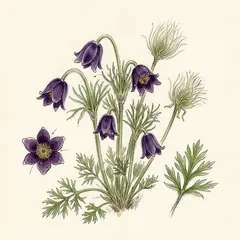 All books on Pulsatilla Pratensis →
Antidoted byAconitum NapellusActaea RacemosaAmbra GriseaAngustura VeraAnthracinumAntimonium TartaricumArgentum NitricumArum TriphyllumAsaf EtidaBelladonna
All books on Pulsatilla Pratensis →
Antidoted byAconitum NapellusActaea RacemosaAmbra GriseaAngustura VeraAnthracinumAntimonium TartaricumArgentum NitricumArum TriphyllumAsaf EtidaBelladonnaGeneral
ANEMONE PRATENSIS. PULSATILLA NIGRICANS.
I HAVE chosen this drug to commence a course of lectures on materia medica, as well because it has been very thoroughly proved and verified by clinical experience, as also because it is one of our chief polychrests.
Polychrest is a term applied to a number of the remedies that are the most frequently used in practice, and that have an extensive range of application.
It would be an error, however, to suppose that a polychrest, which is called for every day, is any more useful in any given case than a drug that we are required to give only once a year will be in the case which requires it. It must never be forgotten that every case requires just the identi- cal remedy which is most homoeopathic to it, even if it be a rare and seldom used remedy ; and that no other remedy, however popularly or however constantly in use, can be as good as, or can take the place of, this homoeopathically indicated remedy.
But just as some diseases are very common, being met with every day, such as dyspepsias,
58 PULSATILLA,
bronchial catarrh, diarrhoea, ephemeral fever, etc., so there are certain remedies which produce, when proved upon the healthy, series of symptoms simi- lar to those of these frequently recurring diseases. It is obvious that these remedies will be frequently indicated in practice, will be often used and in many cases. These remedies are our polychrests. We must know them well ; although it is of great importance that, in bending ourselves to the study of them, we neglect none of the other remedies of out materia medica.
In studying Pulsatilla and all other remedies, we shall follow Hahnemann's anatomical order, stating the symptoms of each region in succession; and calling attention to the conditions of aggrava- tion and amelioration, and to the simultaneous manifestation of groups of symptoms in different regions. We shall then take a general view of the remedy, endeavoring to appreciate its charac- teristics and its special spheres of action. Finally, we shall consider its more obvious applications to diseased conditions frequently met with, its resem- blance to other remedies, and the differences between them.
We begin with the
Sensorium. Pulsatilla produces vertigo or dizzi- ness, which occurs while sitting, but is relieved while walking or sitting in the open air; dizziness when directing the eyes upward, and especially when stooping, when it seems as though the head were too heavy ; a drunken dizziness, the head
PULSATILLA, 59
feeling hot inwardly, and the face pale. The ver- tigo occurs or is worse in the evening or after eating. We here meet conditions which we shall find to pervade the Pulsatilla proving, and to be characteristic of the drug, viz. : occurrence or aggravation of the symptoms in the evening, after eating, during repose, and amelioration from motion and from being in the open air ; also paleness of the face, even with sensation of internal heat.
Head
The headache is chiefly in the fore- head and supraorbital region, and in the temples.
The pains are a heaviness, a bursting sensation in the temples, and throbbing.
These sensations are aggravated by stooping, by mental exertion, and in the evening, and by rolling the eyes upward.
Occasional stitching pains in different parts of the head, frequently confined to one half of the head.
Indeed, this is a peculiarity of Pulsatilla pains gen- erally, that they are often confined to one half of the body, like those of Ignatia, Thuja, Spigelia, Valeriana and Silicea.
[Helonias dioica has a pressing pain in one or both temples (in a small spot), a "burning sensa- tion" in the top and front of the head, which is entirely dispelled by motion and mental exertion.
It comes on immediately when either the motion or mental exercise is desisted from
S.
A.
Jones, M.
D.]
It may be added that a Pulsatilla headache is generally coincident with disturbances in other regions of the body, as, for example, the digestive
6o PULSATILLA.
tract, or the genito-urinary organs, especially the latter in females.
Eyes, Eyelids.
The margins are inflamed; hor- deola form upon them.
Further, the lids are dry and scurfy — in the morning they are agglutinated.
In the eyes themselves the pains are : stitching, and especially itching and severe aching, with a sensa- tion as if a foreign body were in the eye, or a veil before it which could be winked away.
There is great lachrymation in the open air, and consider- able photophobia.
Vision is obscured, but it is to be noted that this obscuration is conjoined with vertigo and nausea, whence we may infer that it is functional and not dependent upon organic lesions of the eye. The same may be said of the other symp- toms of vision ; fiery circles, and starry apparitions, and double vision. Nevertheless, these symptoms are not to be ignored, for they individualize and characterize the disturbance in other organs and systems with which they coincide in occurrence.
Ears
Internally, itching, stitching and tear- ing sensations; also, violent pain like a distending or outward-pressing ache.
The external ear is hot, red and swollen.
Discharge of pus from the ear.
Deafness as though the ear were stopped. Murmur and rushing noise isochronous with the pulse.
In front of the ear an eczematoid eruption, with a burning-biting pain, and swelling, of the cervical glands. Stitching pain in the parotid.
PULSATILLA. 6 1
In ordinary catarrhal otitis, Pulsatilla is our best remedy ; i. e., the symptoms of such cases most frequently indicate Pulsatilla. Silicea resem- bles it closely.
In deeper-seated inflammation of the cellular tissue, Mercurius or Silicea or Rhus is called for. Tellurium corresponds to a peculiar affection of the meatus auditorius externus and the external ear.
Chamomilla indications differ from those of Pul- satilla in the symptoms of the disposition, and especially in the great intolerance and impatience of pain.
The same may be said of the Arsenicum ear- indications.
Nose
Superiorly near the inner canthus of the eye, an abscess like a lachrymal abscess.
The alae nasi are ulcerated, so have the nares internally a sensation as if ulcerated.
There is in the nose a smell as of an old catarrh.
(It is perhaps this symptom which first induced a trial of Pulsatilla in ozaena simplex.)
Mouth
Tongue covered with tenacious mucus. A white-coated tongue is an indication for Pulsa- tilla.
Yellow coat at the base of the tongue, Mercu- rius protoiodatus.
Teeth
Two varieties of pain — a stitching or digging, worse in the evening or early night; and a drawing, tearing sensation, as if the nerve were drawn tense and then suddenly let go.
62 PULSATILLA.
The toothache is renewed always after eating, and whenever anything quite warm is taken into the mouth. Aggravation by eating and by warmth.
Chamomilla toothache is aggravated by cold or warm food or drink,
Coffea toothache is controlled by ice-water con- stantly in the mouth. (Published by Hale, confirmed by me).
Mercurius toothache is aggravated by cold water in the mouth, but relieved by warm.
Carbo vegetabilis. The whole row of teeth too long and very tender ; he cannot bite.
Causticum. Gum swollen ; feeling as if the tooth were being crowded out of the alveoli ; tooth too long, aggravation in the evening and by eating.
Lachesis.
Swelling corresponding to the external fangs of the upper molar, with swelling of the cheek ; the skin feels tense, hot and crisp, as if it would crack; throbbing in the cheek.
Periodontitis.
Throat
Sensation, on deglutition, as though the uvula were swollen.
Apart from the degluti- tion, a feeling as if raw and sore in the throat, as if the submaxillary glands pressed inward and were sore.
Sensation of great dryness of the mouth, palate and lips ; these parts coated with tenacious mucus ; a bad taste in the mouth.
Digestion.
Manifold symptoms.
The taste is variously perverted and altered — seldom bitter, except just after eating or drinking.
More fre- quently a sour taste.
But more characteristic of Pulsatilla is the taste of the food returning to and
PULSATILLA. 63
remaining in the mouth long after eating. In fact, Pulsatilla makes digestion very slow.
Hahnemann gives us a symptom in parentheses: (Food tastes as if too salt). On the strength of this symptom I gave Pulsatilla ^°° with entire success to a patient convalescent from Chagres fever who had become well enough to sit up and walk about his room, but had a slight chill every afternoon, followed by a flush of fever and a sweat at night; no appetite, depression of spirits, little thirst, irri- tability and peevishness in place of his usual amiability, and a perverted taste so that all food prepared for him tasted as if saturated with salt. A single dose of Pulsatilla removed the latter symp- tom, and within six days all the others had vanished, and he rapidly regained strength and vigor, and has as yet (ten years) had no return of fever.
Appetite
Moderate ; often a gnawing sensation in the stomach as from hunger, and yet no desire for any special kind of food.
Thirst.
An almost complete absence of thirst is characteristic of Pulsatilla;
Sabadilla resembles it in this absence of thirst.
Nausea or qualmishness at the thought or smell of food, especially of fat or rich food, or on attempting to eat. The sensation is somewhat as if a worm were crawling up the oesophagus ; the nausea comes up from the stomach.
Vomiting of food, especially at night or even- ing ; waterbrash and gulping up of water or of food into the mouth (regurgitation).
64 PULSATILLA.
Epigastrium.
Feeling as if a stone lay there.
(Bryonia has the same.)
Throbbing in the epigastrium, perceptible to the hand laid thereon. A contracting sensation in the oesophagus, as if one had swallowed too large a morsel of food ; the same sensation extends over the hypochondria, then up over the chest, and impedes respiration.
Abdomen
Sensation of tension and fullness throughout the abdomen, and involving the thorax up to the mammary region. Pinching and cutting pains, especially around the umbilicus, worse toward evening.
Much flatulence, as might be expected where digestion is so slow as under the action of Pulsa- tilla. Flatus moves about in the intestines, causing pinching pains, and with rumbling noise ; worse on waking or just after supper.
Externally. The abdominal walls are tender to the touch, when sitting, or when coughing, espe- cially after an alvine evacuation.
Stool
A twofold action (which yet we are hardly justified in designating as primary and sec- ondary effects). Difficult stool, with much back- ache and urgency, or frequent desire for stool with insufficient evacuation or no faeces, but instead thereof, yellowish mucus, sometimes mixed with blood. On the other hand, Pulsatilla produces diarrhoea at night ; stool consisting of green and acrid burning mucus, preceded by commotion in the bowels.
PULSATILLA. 65
In the frequent desire and effort for stool, and the difficulty of evacuation, Pulsatilla resembles Nux vomica. The difference is found in the gen- eral symptoms.
The diarrhoea of green mucus occurring at night resembles that of Dulcamara, which likewise is noc- turnal, and but slightly painful.
It, however, is ascribable to dampness, and is accompanied by rheumatic symptoms ; while that of Pulsatilla fol- lows errors of diet, especially pork and fat food generally.
It is not a free purgation, but rather a catarrh of the intestine, with spasmodic action of the muscular coat.
Pulsatilla has painful blind haemorrhoids, with itching and sticking pains and soreness.
Urinary Organs
Pressure upon the bladder, as if from flatus.
Frequent pressure to urinate, and cutting pain during the act of micturition.
(This differs from Cantharides in that the latter has pain after micturition.) Involuntary discharge of urine, drop by drop, at night, or on making exertion, as walking, coughing, etc.
The urine is sometimes clear and abundant, and again, scanty and with a red or brownish deposit.
Burning in the urethra during micturition.
Genitals, Male.
Itching of prepuce and scro- tum.
Testes swollen, hanging low, and painful ; tensive and tearing pains.
Mucus discharge from the urethra, with burn- ing during micturition. Increase of sexual desire.
Pulsatilla has been of service in hydrocele, also
66 PULSATILLA.
in gonorrhoea! orchitis, but it is not so often called for in orchitis as Rhododendron, Clematis, Spon- gia, Aurum, or Belladonna.
Sometimes indicated in gonorrhoea by general symptoms rather than local ones.
Genitals, Female.
The decided action of Pulsa- tilla upon the female genital system has been shown by a large clinical experience.
In the hypogastric zone, drawing, pressing or constricting pains, like labor pains, converging toward the pudenda.
Such pains are relieved by crouching forward.
They come, generally, just before the menstrual period, are attended by a feeling of weight, like a stone, in the hypogastrium, and accompanied by chilliness, stretching and yawning.
The menses are delayed, difficult and scanty, or even fail altogether.
Before the menses, labor-like pains as above.
During the menses, many symptoms, such as weight and downward pressure in the abdomen and sacral region ; nausea ; getting black before the eyes ; stomachache and faintings ; all worse in the warm room and by much exertion, better in the open air.
Leucorrhoea, of a thick mucus resembling cream. It is sometimes acrid, producing a burning pain, sometimes bland ; most profuse after menstruation.
Pulsatilla appears to stimulate the action of the uterus during labor, when the pains dimin- ish and become* inefficient.
Comparisons. Cyclamen and Sepia resemble
PULSATILLA. 67
Pulsatilla in relation to the menstrual function. Nux vomica, which is so analogous in many respects to Pulsatilla, resembles it in the scanti- ness of the flow, but, true to the spasmodic char- acter which distinguishes it, brings on the flow too early, and keeps it up for too many days, although the total amount of fluid lost is not excessive.
The aggravation of Sepia is before menstrua- tion ; of Pulsatilla, during menstruation.
Under Nitric acid, menstruation gradually passes into a leucorrhcea which is brown and thick, and finally in a few days becomes a thin, watery, flesh- colored, offensive discharge, sometimes acrid.
Kreosote has a leucorrhcea for five days suc- ceeding menstruation, thick mucus, exceedingly acrid, causing the pudenda to swell and itch, and excoriating the thigh.
Micturition exceedingly painful.
The leucorrhcea smells like fresh green corn.
Borax is indicated by leucorrhcea, acrid, just midway between the menstrual periods, with swell- ing of the labia and inflammation, and discharge from the glands of Duvernay.
Respiratory Organs.
Coryza.
From the first, a discharge of thick yellow mucus from the nose.
Sometimes it is green and offensive.
Loss of taste and smell.
Throat
Roughness and dryness. Sudden hoarseness, without much oppression or cough, and equally sudden relief.
68 PULSATILLA.
The hoarseness for which Pulsatilla is so effica- cious is capricious, coming and going, and without apparently adequate organic cause.
That of Caus- ticum comes on, or is much worse, from five p. m. to midnight, and is accompanied by a teasing, dry cough.
That of Phosphorus is more constant, and conjoined with soreness and rawness of the larynx and behind the sternum, and a weight upon the chest.
That of Carbo vegetabilis has ulcerative soreness in the larynx, and a burning pain in the lungs after a hard cough.
[I do not say that these are all the conditions and concomitants, but . they are frequently met, and are characteristic]
Pulsatilla produces two varieties of cough ; one with abundant sputa, consisting of thick yellow mucus, sometimes bloody, often of a bitter taste ; the other dry, occurring chiefly at night.
The feeling which provokes the cough is a tickling in the trachea.
I have, for years, hesitated to give Pulsatilla for a loose cough, even though it seemed well indicated, it seeming to change the loose cough into the dry, hard night cough.
It produces dyspnoea and asthmatic oppression, especially at night, with palpitation, especially when lying on the left side.
The sensations in the chest are chiefly tension and constriction, in conjunction with the dyspnoea and asthmatic symptoms. In the middle of the thorax a pain, which frequently occurs in the Pul- satilla proving : that of an internal ulcer.
PULSATILLA. 69
The mammary glands are swollen and tense. Itching of the nipples.
Back
In the sacral region, pains on assuming the upright posture, or on bending backward, as well as after sitting, so that one can hardly stoop or straighten up.
Aching as from fatigue, and a pressing as from within outward.
Finally, in this region, a pain as if luxated when moving ; and when sitting, a bruised pain, relieved by motion.
Considering the action of Pulsatilla upon the female sexual organs, causing weight and bearing down, with leuQorrhcEa, etc., it is reasonable to ascribe the aching and some other sacral pains to this action, and experience justifies this view. Other pains are analogous to the rheumatic pains of the extremities.
In the back, drawing, tensive and stitching pains, which seem to impede respiration and inter- fere with free motion.
Extremities generally.
First, we note tearing pains, as for example, in the shoulder-joint, where it compels one to move the arm, and is relieved by lying on the painful side.
Again, in the muscles and bones of the arm, and even in the fingers, where it seats itself in the tensor tendons.
In the lower extremities it appears as a jerking, tearing pain, from the hip-joint to the knee when lying in bed, or only in the knees when sitting ; or in the ankles and extending to the heel, the sole and the great toe, where it is a tearing pain.
Observe the characteristic: compeUing the prover
70 PULSATILLA.
to move the affected part, which is equivalent to relief by motion ; and by pressure, which is analo- gous to motion.
Then,* drawing pains, affecting the whole length of the extremities, occurring at night and during repose (often associated with chill).
Stitching pains occur in the upper extremity, especially on moving the arm, as- in the shoulder- joint and in the deltoid muscle.
Likewise a feeling of heaviness and paralysis in the arm when trying to raise it.
Indeed the tired, heavy, aching sensa- tion, such as comes from fatigue, and yet is not relieved by repose, but is rather aggravated thereby, is marked in the Pulsatilla proving.
Burning itching in the soles of the feet after getting warm in bed.
This symptom led to the successful use of Pulsatilla for effects of frost-bite.
See Petroleum and Agaricus.
Fever
Pulsatilla produces many symptoms akin to one or other stage of fever.
Chilliness predom-r inates.
It accompanies the evening pains of what- ever kind, as well as the abdominal pains, the gastric disturbances, and especially those of the female sexual system.
It occurs frequently after a meal, and early in the morning.
But, in and by itself, as an independent symptom, chilliness occurs generally in the evening.
It may be general or partial, affecting the extremities.
When heat fol- lows the chilliness, if it be only a sensation of heat with no objective warmth, there is no thirst ; but if the heat be, as it sometimes is, both object-
PULSATILLA. 7 1
ive and subjective, it is then attended by thirst.
Remember this, because absence of thirst is said to be a characteristic of Pulsatilla, and presence of thirst, therefore, to contra-indicate.
This is true, with the limitation stated.
Frequently the fever symptoms are complex, and much mixed up ; chilliness and heat rapidly succeeding each other, or occurring simultaneously in different parts of the body, or on the different sides of the body ; but these complex symptoms occur almost always in the evening or at night.
Riickert calls attention to the fact that though the Pulsatilla symptoms generally are not attended by thirst, yet sometimes thirst is present when the hot stage is strongly marked; and he has had excellent success in puerperal fever and other fevers when thirst was present, the mass of the symptoms having indicated Pulsatilla.
Moreover, the cheeks are often hot and red while the back is chilly and the feet cold — a state of things often observed when the menses are retarded in young women.
Again, flashes of heat over the whole body, producing great discomfort and anxiety.
In short, a condition of erethism such as may co-exist with a depressed nutrition, — an approach to the erethistic form of chlorosis.
Sweat is abundant, chiefly in the early morn- ing, sometimes throughout the night; often, like other symptoms, the sweat is semilateral.
Sleep
Certain peculiarities of sleepiness and sleep are characteristic of Pulsatilla. Sleepiness
72 PULSATILLA.
in the afternoon, such not being the habit of the prover.
Sleepiness after even a moderate meal.
The prover does not feel sleepy in the evening ; on the contrary, wide awake ; ideas throng, the fancy is brilliant; he (or she) does not wish to go to bed, and, on going to bed, does not fall asleep for a long time.
The sleep is somewhat troubled and restless, with talking, frequent waking, with frightening dreams, until toward morning, when sleep is more quiet and profound, and is most sound just when the time is come to get up.
The prover wakens dull and inert, although not with aggravation of any other symptoms.
This is a great characteristic of Pulsatilla, and is almost always present when Pulsatilla is clearly indicated by other symptoms. When, therefore, a doubt rests upon the selection of Pulsatilla, it is safe to be inclined toward it if the sleep symptoms are such as have been described, viz. : wide awake in the evening; does not want to go to bed; first sleep restless; sound asleep when it is time to get up; wakes languid and not refreshed.
Pulsatilla contrasts strongly with Nux vomica in the sleep symptoms, as in some others. Under Nux vomica, the prover is very sleepy and dull in the evening, cannot sit up long ; goes to bed early, and goes to sleep immediately ; sleeps well until about three a. m., then wakes and lies awake, thinking, etc., with mind quite clear and active till five a. m. ; then dozes and sleeps an hour, and
PULSATILLA. 7Z
wakes more tired than when he woke at three A. M., and often with a headache.
Sulphur, again, has the evening sleepiness of Nux vomica, but the night is full of unrest, toss- ing, nervous excitement, orgasm of blood; pains of various kinds, and but little sleep throughout.
The sleeplessness of Cocculus is from pure mental activity, chiefly of memory, and is well described by Walter Scott. ("Lady of the Lake,"
Disposition. The disposition is affected by Pulsatilla in a very characteristic manner. The prover complains of anxiety or distress, as though some great evil were impending, and this distress appears to him to come from the epigastrium ; and with these symptoms come palpitation, chattering of the teeth, and flashes of heat; also, undue anxiety about the health or about household duties. In addition, there is a marked irresolution, the prover cannot determine which of two is the better course to pursue; this is akin to the well-known charac- teristic of Pulsatilla, the yielding disposition, which gives way under slight opposition, and manifests its conscious feebleness by the readiness with which tears come to the eyes on slight provo- cation.
The disposition to weep is certainly a strong indication for Pulsatilla, but two errors must be guarded against, in accepting and applying it. In the first place, it must not be considered that a lively disposition, and even a considerable amount
74 PULSATILLA.
of spirits and will, contra-indicate Pulsatilla; laugh- ter and tears come often with equal readiness.
Again, let us remember that the desolate sen- sation of utter prostration which ushers in many a serious dyscratic disease disposes to tears, espe- cially when it comes to a man or person in the midst of business or family cares, which he knows not how to neglect nor to delegate. If, then, a patient, in the incipience of a severe typhoid or a diphtheria, can hardly answer the doctor's ques- tions for the tears and choking that come, these must be looked upon as the physiological result of utter prostration of body and desolation of soul, coinciding with the consciousness of responsibilities and cares too heavy to bear and too precious to neglect. They are not especial symptoms of the morbid state, nor must they be taken as indica- tions of Pulsatilla. I have dwelt upon these points because the error referred to is often made, and time is thus wasted which can never be regained.
GENERAL ANALYSIS.
I.
The most marked disturbances of functional activity produced by Pulsatilla are : In the digestive apparatus ; the genito-urinary of both sexes, but more especially the female ; the respiratory, at least as regards the mucous membrane ; and the articular synovial surfaces.
The mucous membrane through- out the body is affected ; as, for example, in the middle ear, the eye, nose, throat, bronchi, stomach,
PULSATILLA. 75
intestines, bladder, urethra, vagina, and uterus (probably).
2. Changes in the organic substance are effected chiefly in the secretions, and chiefly in those of the mucous membrane. The conjunctiva, chiefly the palpebral, secretes copiously, and the tears are augmented if not modified. The nasal membrane, after a brief period of unnatural dryness, secretes abundant mucus, which becomes thick, yellow or green, and offensive.
It is probable that the secre- tions of the stomach and small intestines are modi- fied, since digestion is so decidedly retarded by the action of Pulsatilla, and presents so many abnormal features ; such as perverted taste, regurgitation of food or its flavor, flatus, pain, etc. ; as well as that of the lower intestine, as witness the stool covered with mucus, and the mucous diarrhoea.
So, likewise, the mucous discharge from the bladder — as shown by the jelly-like sediment in the urine — and the discharge from the urethra, as well as the leucorrhoea, attest the modification of secretion.
The special function of menstruation is retarded in time, and the secretion (?) diminished in quantity. We shall be better able to explain this when we understand more about the pathology of chlorosis.
The testes are the seat of inflammation, pain and enlargement, and, although the ovaries were not similarly aflected in any prover, yet, from anal- ogy, Pulsatilla has been successfully used in ovarian affection, the symptoms otherwise corresponding.
76 PULSATILLA.
The swelling and heat of the knee and ankle- joints, as well as of the small joints of the fingers and toes, together with the drawing, tense pain in them, and the accompanying symptoms of the digestive tract, suggest that Pulsatilla acts upon the synovial membranes and upon the nutrition much as one form of rheumatism does, and have led to its successful use, particularly in rheumatic gout, so called. The itching and biting tingling of the skin resemble those of measles.
Peculiarities and Characteristics. Our knowl- edge of Pulsatilla being derived wholly from provings on the healthy with moderate doses, we have no records of the effects of poisonous doses, and have therefore no data for constructing a theory of its pathological action on an anatomical basis ; but, on the other hand, through the action of these moderate doses, under the clear observation of Hahnemann and his pupils, we have a quantity of characteristic symptoms, chiefly subjective, which furnish us indications for the selection of Pulsatilla more positive and precise than those of almost any other remedy.
Character of Pains.
The pains are drawing, tearing pains, pains as of an internal ulcer, aggra- vated by touch ; but the most peculiar pain is a tension, which increases until very acute, and then lets up with a snap.
The pains occur or are much worse at night, before midnight.
They are accompanied by chilliness, but with- out thirst.
PULSATILLA. "]*]
As the pains increase, the peculiar mental and moral Pulsatilla state is more pronounced ; the patient loses courage and gets despondent, and inclines to tears, and as the pains diminish the spirits rise.
• Certain parts of the body become very red or purple, without heat, the vessels becoming con- gested. This has led to the successful use of Pulsatilla in varicose conditions of veins.
As a general rule, the pains are relieved by motion and by cool air, but the abdominal pains are relieved by warmth.
The symptoms which occur when lying still on the back are relieved by sitting up and by motion. This relief is gradual, however, for the act of rising often for the moment increases the pain, and the more decidedly the longer one has been sitting still.
Long-continued motion also, like long sitting, provokes symptoms, which yet are, for a brief period, more evident on first coming to repose.
The general group of symptoms most charac- teristic of Pulsatilla, next to those of the disposi- tion, is that of the sleep, which has been already detailed.
Clinical experience has shown Pulsatilla to be an excellent remedy for disorders produced by eat- ing pork and fat food generally.
It is often indicated when the menses are scanty and delayed.
Very frequently, when it fails to bring them on.
Sulphur will succeed.
yS . PULSATILLA.
• It is noteworthy that the pains of Pulsatilla often occur on one side of the body only.
Antidotes
For the sleepiness, lassitude, etc., C ham om ilia.
For the restless anxiety, etc., Coffea.
Other symptoms, according to their similarity, may call for Ignatia or Nux vomica.
THERAPEUTIC APPLICATIONS.
In earache, toothache, headache, ophthalmia, palpebrarum, hordeolum, nasal catarrh, bronchitis, dyspepsia, nocturnal mucous diarrhoea, gonorrhoea, orchitis, vaginitis, prolapsus, rheumatic gout, vari- cose veins, measles and continued fever, — in all of these diseases when the symptoms correspond.
Remedies analogous to Pulsatilla may be named as follows :
As to its action on the eye, nose, bronchi and skin — ^ Euphrasia, Dulcamara, Sulphur.
As to its action on the digestive organs — Nux vomica, Ignatia, Silicea, Sulphur.
As to its action on the female sexual organs — Sepia, Murex, Cyclamen, and, above all, Sulphur.
As to its action on the joints and ligaments — Rhus, Sulphur, Ledum palustre.
As to its action on the veins — Hamamelis, Zincum.