 Homeopathy Library
Apis Mellifica
Farrington - A Clinical Materia Medica · Ernest Albert Farrington · 122,780 chars
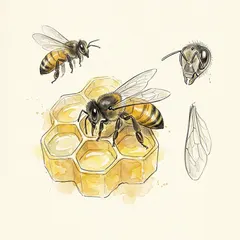 All books on Apis Mellifica →
Antidoted byAmmoniacum GummiAnthracinumCantharis VesicatoriaCinchona OfficinalisDigitalis PurpureaIodiumIpecacuanhaLachesisLachesis MutusLactuca Virosa
All books on Apis Mellifica →
Antidoted byAmmoniacum GummiAnthracinumCantharis VesicatoriaCinchona OfficinalisDigitalis PurpureaIodiumIpecacuanhaLachesisLachesis MutusLactuca VirosaGeneral
For this remedy we have two names, according to the manner in which the preparation is made. It is either Apis mellifica, the honey- bearing bee, or Apium virus, the poison of bees. The original prepar- ations of the remedy were made in the following manner: A large white dish was placed under a bell jar, in which there was a perfora- tion through which a stick was inserted. Several hundred bees were then placed beneath the jar.
The stick was then moved about, and, irritating the bees, caused them to sting the jar and the dish. After a while the bees were allowed to escape, and on the bell jar and plate were seen numerous specks. Alcohol was poured over these, and thus was obtained a powerful extract of the poison of the bee. This is Apium virus.
Subsequently the whole bee was used. Triturations were made of the entire insect. Thus we obtain Apis -mellifica. The symptoms of the two preparations have not been separated.
Apis mellifica is an invaluable acquisition to our Materia Medica. In order to understand its symptomatology let us look at its toxi- cology. Take, if you choose, a sting on the hand or finger as an illustration. Just after the sting, which causes a sharp sticking or
HYMENOPTERA. 99
burning pain, there commences, very promptly, swelling of the part, with extreme soreness. The part feels as if it had been bruised or pounded. The swelling is at first of a rosy pinkish hue. It spreads very rapidly; the pains become intense.
They are of a burning, sting- ing or shooting character, seldom throbbing. Heat of the part in- creases with the burning and stinging pains. This may end very speedily in resolution or it may go on. If it pursues the latter course, you will notice that this ros>r appearance becomes more intense, in fact, assumes an erysipelatous appearance.
Still later, it changes its color and takes on a pale but bluish hue, and the swelling pits on pressure, showing that the parts are cedematous. After a while, if the condition of the system is such as to permit it, gangrene of the part takes place.
Experience teaches us that some such dermal or cellular symptoms are usually present in ever}' case for which Apis is the remedy. They, therefore, deserve to be emphasized. The soreness is as important as the more frequently described burning, stinging pains, and varies from a bruised, sore feeling to an exquisite sensitiveness to contact. The swelling is the result of a rapid serous effusion into the cellular tissues. It is a universal symptom.
The inflammation produced by Apis is, therefore, not of a sthenic type. It is not, for instance, such as would be cured by Aconite, wTith sudden swelling of the part coming on rapidly and ending in resolu- tion; nor is it such as would be cured by Belladonna, with bright red swelling accompanied by throbbing pains and ending either in resolu- tion or suppuration. The Apis inflammation is distinctly asthenic, with whitish discoloration and a tendency to gangrene and destruction of tissue. In one case, where the sting was on the hand, the patient suffered also from a carbuncle on the back of the neck.
The vitality is speedily and sometimes alarmingly reduced by the action of Apis. This is shown in the severe prostration, desire to lie down, deathly faint feeling, premonition of approaching death, nerv- ous trembling, coldness and loss of consciousness, especially in erup- tive diseases. The heart is weak, beats slowly or almost impercep- tibly, with pulselessness at the wrists.
In the majority of cases calling for Apis the nervous system is irri- tated notwithstanding the accompanying prostration. The patient is excitable and dances with excessive joyousness; she laughs at the greatest misfortune as she would at a comedy; she is always changing her occupation, and will not keep steadily at anything.
IOO A CUNICAL MATERIA MEDICA.
As will be inferred from the symptoms mentioned, Apis may be em- ployed in states of mind resembling hysteria. The fidgetiness, rest- lessness, excitability and ill-timed laughter, together with fickleness at work, have led to its successful use for nervous girls. In addition, it has been observed that they are awkward, dropping things and then laughing in a silly way at their clumsiness. The sexual passion is too active, and they are prone to jealousy.
The confusion of mind and unconsciousness just noted indicate the remedy in severe adynamic forms of disease, such as malignant scar- latina, diphtheria, typhoid fever, etc. A complete stupor after apo- plexy is said to have yielded to Apis when Opium failed.
In scarlatina the fever runs high, and the attending restlessness is one of nervous agitation. The mouth and throat are very red, with blisters on the borders of the tongue, and swollen puffy fauces; there are burning, stinging pains and a scalded, raw feeling in the mouth and throat. The skin pricks as from needles, the rash being inter- spersed with a miliary eruption. There is always puffiness of some part of the surface. Prostration comes on early, with scanty or sup- pressed urine, high fever and drowsiness.
In meningitis or in meningeal irritation Apis holds a prominent posi- tion as a curative agent. It is often the remedy, no matter what the^ ailment, when shrill outcries in sleep lead to the suspicion of cerebral irritation. Such cases frequently begin with the nervous fidgetiness so characteristic of the bee poison, and advance to more serious condi- tions. In tubercular meningitis, or in acute cerebral effusions, a sup- pressed or undeveloped eruption is a good guide to the choice of Apis.
We may profitably compare Apis here with Bellado?ina, Helleboius, Arsenicum, Bryonia, Zincum, Sulphur, Cuprum, Glonoine, Lachesis, Rhus tox., Hyoscyamus, Natrum mur., Bovista, etc.
Belladonna is doubtless frequently employed when Apis would suit better. A little care, however, will enable the practitioner to distin- guish the fidgety nervousness of the latter from the more intense cere- bral irritation of the former. The congestions of Belladonna are more violent, with throbbing of the carotids, injected red eyes, and drowsi- ness broken by starts and frightened outcries. The adynamia is much less than in Apis.
If the disease is scarlatina, the rash is smooth and bright red, but not miliary. The skin is hot and the face red, or, in some cases, pale; but not pale and cedematous as in Apis. The cer- vical glands may be swollen, but there is not the cellular infiltration, with an erysipelatous blush, as in the bee-poison.
HYMENOPTERA. IOI
If there is meningeal irritation, Belladonna is needed when the con- gestive symptoms are intense; Apis, when the nervous agitation pre- dominates, with the shrill cry, which betokens stabbing, piercing pains or excitement. In meningitis Belladonna is decreasing^ indicated as the symptoms of effusion increase, while Apis is increasingly indicated as long as symptoms of irritation obtain and the cephalic c^ is marked.
Helleborus claims precedence when the irritation of Apis gives place to mental torpor, with want of reaction. The forehead is wrinkled, the pupils dilated, and the lower jaw tends to drop; the sopor is com- plete. There are automatic motions of one arm and one leg; the fore- head is bathed in cold sweat. In such cases Helleborus may bring about reaction so that another remedy will cure.
In typhoid fever they differ widely. Apis, although it has great weakness, apathy and stupor, has a dry, blistered tongue and exquisite soreness of the abdo- men. Helleborus has complete sensorial apathy, dark, sooty nostrils, slow pulse, and no response to touch or pressure.
Bryonia bears some slight resemblance to Apis, especially as it may be needed, like the latter, for cerebral effusions following suppressed exanthemata. The sensorium is benumbed, but the senses are not so perverted as in either Apis or Helleborus. There is a constant chewing motion; the face is dark red, the lips parched; when offered a drink it is taken hastily and impatiently. If the child is moved, it screams with pain.
Later, when the sensorial depression amounts to sopor, Helleborus follows well, even if the chewing motion and hasty drinking continue. Apis follows if the sopor is accompanied by a more shrill cephalic cry than in either of the other remedies.
Cuprum compares with Apis when meningitis results from a sup- pressed exanthem, but the symptoms are very diverse. Cuprum causes loud screaming, followed by violent convulsions; the thumbs are clenched, and the face is pale with blue lips; the eyeballs are con- stantly rotating. If convulsions occur in the Apis case, they are less violent, consisting of restlessness and twitching of one-half of the body; the other half is lame and trembles.
Much more closely related in suppressed eruptions is Sulphur. The two follow each other well.
Glonoine, like Apis, has the cephalic cry; there is a sensation as if the head were enormously expanded. Spasmodic vomiting of cerebral origin is most prominent in the former, as is also intense congestion and throbbing.
102 A CLINICAL MATERIA MEDICA.
Zincum produces cerebral irritation; the child awakes with fear, rolls the head ; cries out and starts in sleep. There is constant fidgety mo- tion of the feet. The drug is indicated in anaemic children who are too enervated to develop an exanthem. In typhoid states the prostra- tion is very great, with impending cerebral paralysis. Unconscious- ness develops, with blue hands and feet, coldness, weak pulse; lower jaw dropped. Here the Oxide has been successfully employed.
Rhus tox. , though incompatible with Apis, has many similar symp- toms. In scarlatina, for instance, both suit in adynamia, swollen throat, erysipelatous inflammation of the skin of the neck, miliary rash, drowsiness and oedema. In Rhus, however, the eruption is darker, the erysipelas dusky red, and there is great bodily restlessness — not the fidgetiness of Apis.
Arsenicum is similar to Apis in many respects. Both have anxious change of place, fear of death, restlessness, great weakness. (See also in several instances below.) Irritability of mind occurs in both, but it is more an anxiety and fear in Arsenicum; more a nervous restless- ness in Apis.
If they meet in cerebral affections, as possibly they may, especially in hydrocephaloid, Arsenicum is to be selected by hot skin, pale and hot face. The child lies in a stupor; suddenly it twists its mouth and a jerk goes through the body; or the child lies as if dead, with half- open eyes, dried mucus on the conjunctivae, and no response to touch upon the eyelids.
Hyoscyamus and Lachesis are similar in jealousy.
Natrum mur., Bovista, Lachesis, ALthusa, Ignatia, Nux vom. have awkwardness; the first is most similar to Apis.
I have already hinted that Apis may be of use in dropsies. The symptoms calling for it are briefly these. In general dropsies we find it indicated by the peculiar appearance of the surface of the body. The skin has a transparent, waxen look, with a whitish or perhaps slightly yellowish tinge.
The urine is scanty, and there is almost always absence of thirst. The characteristic symptoms are the trans- parency of the skin and the thirstlessness. Now as to cause. Apis is especially useful in dropsies of renal origin, whether the result of scar- latina or not.
The urine is scanty and highly albuminous, and con- tains casts of the uriniferous tubules. There is a swelling about the eyelids. The surface of the body feels sore and bruised; in some cases the pain is of a burning character. If the dropsy is of cardiac origin,
HYMENOPTERA. 1 03
the feet are cedematous, especially after walking. This is attended with almost intolerable soreness and burning.
Even when the dropsy has invaded the chest and we have hydro- thorax Apis may be the remedy, especially when the trouble is of car- diac origin. The patient is unable to lie down. He has the same constrictive feeling about the chest that we find under Lachesis. He has a dry cough, which seems to start from some place in the trachea or larynx, usually the trachea, the cough not ceasing until a small quantity of phlegm is loosened.
Thus far the remedy is exactly like Lachesis. But Apis has, in addition to these symptoms, a mental symptom which conies from the chest, namely, a constant feeling as though he could not live. It is not a feeling of dyspnoea, but appears to be a sort of anguish of mind; the patient cannot understand how it would be possible for him to get another breath, so great is this suffo- cative feeling. Associated with these chest symptoms, the patient often has a strange feeling as though he were going to die, but there is not the intense fear and sthenic fever of Aconite, nor the great rest- lessness of Arsenicum, but more of a fidgety anxiety.
In pleuritis with exudation Apis is one of the best remedies we have to bring about absorption of the fluid. Apis and Sulphur will cure the majority of these cases.
Apis also acts on the synovial membranes, giving a perfect picture of synovitis, particularly when it affects the knee. It is indicated when there are sharp, lancinating, stinging pains shooting through the joint, with aggravation from the slightest motion.
Bryonia affects the joints and their synovial membranes, but the pains are stitching in character, w7ith tension, and they are better from the warmth of the bed, while the Apis pains are better from cold ap- plications.
Iodine is useful in dropsy of the knee, and has followed Apis well, especial^ in scrofulous children (compare also Kali iod.).
We have still another form of dropsy in which Apis is a remedy, namely, dropsy of the brain, a condition which used to be called hy- drocephalus. It is not so often indicated in true hydrocephalus, that is, when from some mechanical cause there is inflammation set up in the membranes of the brain, followed by accumulation of serum; but it is in tubercular meningitis that this remedy is useful. Apis is here indicated in the first stage. The symptoms which call for it are these.
The child bores its head backward into the pillow, and rolls it from
104 A CLINICAL MATERIA MEDIC A.
side to side; every little while the child arouses from sleep with a shrill, piercing cry. This peculiar shriek is due to pain. One side of the body twitches and the other lies as if paralyzed. Strabismus is usually present.
The pulse is rapid and weak, and the urine scanty. There is no remedy which can do any good in this stage if Apis does not. Apis has a peculiarity which I should mention, and that is slow- ness of action. Sometimes you will have to wait three or four days before you notice any effects from its administration.
The favorable action of the remedy is first shown by increased flow of urine.
In dropsies, Apis may be compared first of all with Arsenicum^ which has the same transparency of the skin, and is also of use in dropsies of renal, cardiac or hepatic origin. The differences between the two remedies are the.se. Arsenicum has intolerable thirst, but the patient usually drinks only a small quantity at a time, because water annoys the stomach. Eating and drinking both cause vomiting.
I have seen cases in which even a single teaspoonful of medicine pro- voked vomiting. The patient exhibits marked restlessness.
Another remed}T for comparison is Apocynum canabinum. This is much used in the West for general dropsies, swelling of any part of the body, ascites, hydrothorax, etc., usually without any organic dis- ease as a cause. The patient cannot tolerate any food. Food or water is immediately ejected. There is a sunken, gone, exhausted feeling at the pit of the stomach.
The next remedy similar to Apis is Acetic acid. This is useful in dropsies when the face and also the limbs have this waxen or alabaster appearance. It is especially indicated when the lower parts of the body, that is, the abdomen and limbs, are swollen, hence it is useful in ascites. Thus far it is similar to Apis.
But it has thirst, which Apis has not, and gastric disturbance is almost always present; sour belching, water-brash and diarrhoea. Acetic acid is an undeservedly neglected remedy in dropsy. You see how it stands between Apis and Arsenicum. It differs from both of these remedies in the preponder- ance of gastric symptoms.
In hydrocephalus, the most similar remedy to Apis in the stage of exudation is Sulphur. Sulphur is indicated more on general principles than for its particular affinity for the meninges. Tubercular menin- gitis cannot occur in an otherwise healthy child. There must be a diathesis at the bottom of the trouble. Sulphur helps in the same stage as Apis when Apis fails to bring about a reaction, particularly
HYMENOPTERA. IO5
when the child is scrofulous aud has other Sulphur symptoms The child lies in a stupor, with cold sweat on the forehead, with jerking of the limbs, particularly of the legs, with spasms of the big toes and sometimes of the thumbs also. The urine is suppressed. Sulphur is all the more indicated if there has been a retrocession of some erup- tion before the disease displayed itself.
Helleborus is also similar to Apis in hydrocephalus. Apis is useful while there is still some irritation of the brain, as indicated by the cephalic cry. Helleborus comes in when torpor predominates and the child lies wholly unconscious. The eyes do not react to light.
The urine is suppressed. There is automatic motion of one side of the body. You will notice, too, a peculiar corrugation of the muscles of the forehead, particular^ the occipito-frontalis. In milder cases, be- fore the stupor is profound, you will find Helleborus indicated by these symptoms.
This corrugation of the muscles of the forehead is pres- ent, together with a constant chewing motion of the mouth. The child seems to have no wants. It asks for nothing; yet, when given water, it drinks with avidity.
Now, a word respecting the difference between Belladonna and Apis. Belladonna is not usually indicated in tubercular meningitis. It is the remedy above all others for simple meningitis, but not for the tubercular form of the disease. Belladonna has the very essence of acuteness in its symptomatology.
Every symptom appears suddenly and with great intensity. But tubercular meningitis is a slowly de- veloped disease. If the premonitory symptoms are violent, however, you may use Belladonna in tubercular meningitis in the stage of hyper- emia with acute pains, restless tossing about, crying out in sleep, and boring the head into the pillow; but it ceases to be a remed)^ when the exudation is established. The range of action of Belladonna is at an end when that of Apis begins.
There is another remedy which sometimes comes in between Bella- donna and Apis, and that is Bryonia, which acts on serous mem- branes, causing copious exudation. It is indicated after Bcllado?ina. The child becomes more stupid from increased pressure on the brain. The face suddenly flushes and then pales, usually a bad symptom.
The child cries out, particularly when moved, even the least bit; this is a characteristic symptom. The abdomen is distended and the tongue is usually coated white down the middle. So much for Apis and its concordant remedies in dropsies.
106 A CLINICAL MATERIA MBDICA.
The next use we may make of Apis is in erysipelas. It is useful particularly in erysipelas of the face, when the eruption commences under or about the right eye, and spreads thence across the face to the left side, the parts quickly becoming cedematous, and at first assum- ing a pinkish rosy hue. The soreness soon becomes severe, and burn- ing stinging pains follow. There is high fever, with dry skin and usually no thirst.
Now, if the disease is not checked, and the face assumes a purplish livid hue, as in phlegmonous cases, in which the inflammation involves the deeper structures, causing destruction of tissue, Apis may still be the remedy.
There are several concordant remedies in erysipelas. First of all, Belladonna. The difference lies in this: Belladonna is required when the swelling of the face is smooth, bright red, streaked red, or, from intensity, deep dark red. There is not much tendency to oedema or to the formation of vesicles.
The pains are always acute, with throb- bing in the affected parts. The brain almost always sympathizes markedly, causing throbbing in the head and visions as soon as the patient closes his eyes. The patient jerks in his sleep. The pulse is full and hard.
Another remedy, more similar to Apis even than Belladonna, is Rhus tox. You should be particular in differentiating these two remedies, because they are inimical, and one cannot be given after the other. Under Rhus tox. the color of the face is dusky red and not the bright red of Belladomia, nor the rosy or purplish livid hue of Apis. There is almost always a formation of blisters, which burn and sting.
They are distinguished from those of Apis by the preponderance of itching. Under Rhus tox. the disease usually travels from left to right when attacking the face. Apis stands between Rhus and Belladonna in nerv- ousness, partaking somewhat of the former's restlessness, with the latter' s cerebral excitement. Neither produces exactly the livid or blue-red hue noticed in some Apis cases.
Here Lachesis is nearest. The other symptoms will enable you to decide.
When the nose is mainly attacked Apis compares with Cautharis, but the latter has larger blisters and more burning.
When the face, after a spell of erysipelas, is sensitive to cold, com- pare Rhus tox., Belladonna, Hepar, Silicea, Sulphur, etc.
Apis may be of use in urticaria when there suddenly appear on the surface of the body long pinkish- white blotches raised above the skin. The itching, burning and stinging are almost intolerable. The
HYMENOPTERA. 107
eruption may come as a result of cold or during the course of intermit- tent fever.
Here Apis is similar to Arsenicum, which also produces hives, and to Urtica urens. This latter remedy is indicated in hives when the welts are smaller than in Apis. The itching and burning are intolerable. It is especially indicated when the disease has been produced by eating shellfish.
Terebinthina and Copaiva are also useful in urticaria after eating shellfish.
Kali bromatum is indicated when the hives occur with nervous dis- eases.
Rhus tox. is to be thought of when they are an accompaniment of ague or rheumatism.
Bovista is required when they are attended with diarrhoea, the stools being followed by tenesmus and burning.
Pulsatilla comes in when the hives are of gastric or uterine origin.
Calcarea ostrearum is especially suited to chronic cases, and Sepia and Rumex are indicated when the trouble is worse in the open air, the latter especially if worse while undressing.
Apis may also be given in variola when there are intense itching and swelling.
Apis may be used in rheumatism, whether of articular or muscular origin, but it is more frequently indicated in the articular type, com- monly called acute inflammatory rheumatism. The affected parts feel very stiff and exceedingly sensitive to pressure. There is often a sen- sation of numbness. The joint or joints affected are swollen and give the patient a kind of ' ' stretched-tight feeling. ' ' The swelling is rather pale red in color, and some fluctuation may be detected about the joint.
There are burning, stinging pains, worse on any motion.
Apis has often been successfully employed in paralysis following de- vitalizing affections, such as diphtheria or typhoid fever, and also when meningeal effusions remain after inflammations. In all such cases sup- pressed or preexisting exanthemata constitute a leading indication for the bee-poison, and the re-appearance of skin symptoms calls for its discontinuance as long as the improvement thus instituted lasts. Sul- phur is a great aid here.
In these cases of prostration the patient is either nervous, restless and oversensitive, or hot and drowsy, whether thirsty or not.
Apis produces an intermitting type of fever, and is therefore of
108 A CLINICAL MATERIA MEDIC A.
service when this type is found in the sick. The chill occurs charac- teristically at 3 P.M., and is accompanied by thirst and an oppression of the chest as if it were too full, which may be actually the case on ac- count of congestion of the thoracic viscera. The chill is worse in the warmth. It is followed by burning heat of the whole body, with an increase of the oppressive feeling of the chest, drowsiness, but usually no thirst, and the warmth of the room becomes intolerable.
Then comes the sweat, which may, however, be imperfect. There is never any thirst during the sweat. This is characteristic.
During the apyrexia many characteristic symptoms are present. The patient often complains of pains under the ribs on either side. The feet are swollen and oedematous, the skin is sallow or waxen, the urine is scanty, and urticaria breaks out. Such symptoms are found in rather severe forms of this affection when excessive use of quinine has spoiled the case, and in chronic forms which have undermined the general health and produced disease of the liver, spleen, etc.
The most similar concordant of Apis here is Natrum mur. This is indicated in exactly the same type of intermittent fever as Apis; the chief difference between the two remedies lies in the time of appear- ance of the chill; at ten o'clock in the morning in the case of Natrum murt, and at three o'clock in the afternoon in the case of Apis.
In typhoid types of fever Apis is to be selected primarily by the mental state. The delirium is not of an active type; the patient lies in a stupor, with muttering; the face is either flushed red, or, more frequently, pale and waxen, wearing a look of anxiety as from visceral disease or a happy expression. The skin in this type of fever is burn- ing hot in some places, while in others it is unnaturally cool; it is almost always dry; should there be sweat it is usually of a transient character; the prostration is so great that the patient slides down in bed; he cannot exercise sufficient muscular force to retain his position on the pillow.
The tongue is dry, cracked and red, and, like that of Lachesis, it catches on the teeth when the attempt is made to protrude it, and it trembles; there is often a whitish or darker coating on the dorsum of the tongue, while the edges, especially about the tip, are red and covered with little blisters and vesicles. Very important is the bruised soreness of the swollen abdomen.
In these cases Apis resembles Muriatic acid, which has this prostra- tion, but with the characteristic acid diathesis.
In scarlatina most of the indications for Apis have already been
HYMENOPTERA. IO9
given. Here, too, we find the same defective effort on the part of nature to produce a fever. The body is very hot in some places and cool in others. The rash is deep-red in color, very much like that of Belladonna, but differing from that remedy, you remember, in the presence of this miliary eruption which Belladonna does not have.
The child is drowsy, sleeping most of the time, or he is drowsy but cannot sleep. This symptom you must remember because it is iden- tical thus far with one of Belladonna. Associated with this sleepy or wakeful state the patient is fidget}' and restless. You notice, too, that he is peevish, and manifests every symptom of being very irritable.
This restless state of Apis must be distinguished from those of Rhus tox. and Belladonna. In Rhus tox. it is a general restless state of the whole body, and of the mind as well. The patient lies first on one side and then moves to the other, but is not affected with anxiety as in Arsenicum. In Apis the restlessness or desire to move comes from a general nervous feeling.
The inabilit}' to go to sleep in Belladonna comes from inflammation or congestion of the brain. The hyperemia produces this drows}^ state, and the brain is so exhausted that the patient cannot go to sleep.
In addition to the symptoms already mentioned for scarlatina, we have Apis further indicated when the condition advances to effusion of serum about the brain. The throat symptoms are unimportant. You often find patches on the tonsils. The throat inside is swollen and rosy-red, while externally it is engorged, with an erysipelatous blush to it. Apis may also be used late in the disease for the sequelae — that is, when the kidneys become affected and dropsy appears with albu- minuria.
Again, we find Apis of service in diphtheria. The disease advances so insidiously that its presence is not suspected, or, from the very be- ginning the child is thoroughly prostrated, with high fever and drow- siness. The pulse is rapid, but not strong. At first the throat has a varnished appearance, as though the tonsils and fauces were coated with a glossy red varnish.
The membrane forms on either tonsil, oftener on the right than on the left, and it is thick, looking like wash-leather. The tongue is often swollen, so that the child can scarcely swallow. If the child is old enough, he will complain of a feeling of fulness in the throat which necessitates swallowing, but makes it very difficult. The explanation of this is found in the next symptom, that is, the uvula hangs down like a sac of water, and
IIO A CUNICAI, MATERIA MEDICA.
consequently there is a feeling of fulness. If you examine the throat thoroughly, you will find the rim of the glottis swollen, red and oedematous, and breathing is labored owing to the narrowing of the entrance of the larynx. In some of these cases the breath is very foetid, while in others there is little or no foetor. In still other cases you will find as characteristic of Apis a red rash over the surface of the body, making the case appear like one of scarlatina.
The exter- nal throat is swollen and erysipelatous. The above symptoms may in- dicate Apis in non-diphtheritic oedema of the glottis also.
Now, there are several remedies similar to Apis in diphtheria. One of them is Arsenicum. Arsenicum is indicated, as you might expect, in rather severe cases of diphtheria when the throat is very much swollen inside and outside, the membrane has a dark hue, and there is great foetor. There is a thin, excoriating discharge from the nose.
The throat is oedematous, just as it is in Apis; the patient is restless, especially after midnight; the urine is scanty, and the bowels are either constipated or else there is an offensive, watery diarrhoea.
In still other cases, when, despite the dark purplish hue of the throat, and the marked swelling and great prostration, there is not much pain, Natrum arseiiicosum is the remedy. Here, also, the uvula is infiltrated with fluid.
Still another remedy is Kali permanganatum. This remedy, which is seldom used in the high potencies, is indicated when the throat in- side and outside is swollen and oedematous, the breath is horribly offensive, and a thin discharge issues from the nose. The great char- acteristic is the extreme foetor.
Apis causes an irritation of the mucous lining of the larynx and trachea, and also soreness in the chest-walls.
It has been found most useful when laryngeal symptoms accompany erysipelas, oedema of the throat, glottis, or larynx, or suppression of eruptions; less often in simple laryngitis or laryngeal catarrh.
Difficult breathing, and especially the unique symptom, " he does not see how he can get another breath, ' ' has led to the successful em- ployment of the drug in hydrothorax, hydropericardium, oedema pul- monum and asthma.
The lancinating, darting pains, palpitation, orthopncea, etc., render Apis valuable in cardiac inflammations and dropsy. The essential symptoms seem to be oedema or sudden mucous swelling, dyspnoea, sudden, lancinating or stinging pains, restlessness and anxiety.
HYMENOPTERA. Ill
Compare
Lachesis, Arsenicum, Sulphur, Belladonna, Kali card., Spig- elia, Digitalis, Aspai'agus, Apocynuvi cannabinum .
Arsenicum and Apis have many resemblances.
So apparently alike are the restlessness, changing of place, and dyspnoea, that one remedy is often given when the other should be.
The best distinction lies in the fidgety restlessness peculiar to Apis.
If dropsy obtains, both may be needed in pale, tensely swollen limbs, but Apis often has redness, itching or an erysipelatous condition present, as well as thirstlessness.
Belladonna is too often mistaken for Apis in laryngeal affections. The latter has more oedematous swelling, with consequent dyspnoea; the former more spasmodic constriction.
In cardiac affections Arsenicum, Apocynum cannabinum, Digitalis , and Aspai'agus bear some similarity to Apis, especially in great debil- ity, and dropsy. Apocynum cannabinum is needed when the pulse is small and weak, the heart-beat irregular, now weak, now stronger; and there is sinking at the epigastrium. Asparagus suits in the aged, with weak pulse and pain about the left acromion. Digitalis causes a doughy appearance of the skin; the pulse is slow or weak, quickening with every bodily movement; a gone, deathly sick feeling develops in the epigastrium soon after eating.
The cough of Apis is frequently encountered in cases where this remedy is needed. It resembles, more or less, Lachesis, Carbo veg., Rumex, Belladonna, Chamomilla, Crotalus horridus, Nux vomica, Bryonia, Ignatia, Arsenicum, Hyoscyamus.
Lachesis, Nux vom., Bryonia and Hyoscyamus agree in adherent mucus.
But Lachesis has intolerance of touch, even clothing, about the neck, a symptom not marked in Apis, except with the sense of suffocation.
Rumex has a teasing, persistent cough, aggravated by cool air, or by anything which increases the volume or rapidity of the inspired air.
Chamomilla differs mentally.
Nux vo??iica cures cough from adherent mucus high up in the tra- chea; but there is a rough, scraped feeling in the throat.
Bryo7iia adds epigastric irritation to the suprasternal, and the pains in the trachea and chest-walls are sharp, stitching, as well as bruised, aching.
Ignatia induces a nervous cough, and the more the patient coughs, the more annoying is the irritation.
Arsenicum causes more of a burning tickling, referred to the
112 A CLINICAL MATERIA MEDICA.
suprasternal fossa; but since it so often concurs with Apis, it should be compared with the latter, especially when the cough accompanies dropsy, heart disease, etc.
Belladonna may be misapplied for Apis, but can be distinguished by its greater constriction of the throat, and deeper inflammatory red- ness.
Carbo veg. agrees in hoarseness, rawness, and tickling cough, but the irritation is as from vapor of sulphur.
Now, the action of Apis on the genital organs.
Apis is often indi- cated in diseases of the female organs.
Nearly all the provers experi- enced symptoms referable to the uterus and ovaries.
There is in- creased sexual desire with stinging in the ovaries.
This is sometimes a symptom in widows, and Apis will often relieve it.
Tendency to abort at or before the third month.
Apis produces and will check abortion when the symptoms agree.
Therefore it must be given cau- tiously during pregnancy, because if given in low potency and fre- quent dosage it may bring about a miscarriage, especially before or at the third month.
We may use it in amenorrhcea when we have con- gestion of the head as a result of the suppression of the flow, bearing down in the uterine region, thirstlessness, and intolerance of heat.
Particularly is it indicated in girls with this amenorrhcea at the age or puberty.
They are nervous, hysterical, awkward and silly.
It is not a natural awkwardness, but one that comes from incoordination of the muscles.
With these s3'mptoms there is flushing of the face.
We may also use Apis in affections of the ovaries, especially of the right side.
It holds the same relation to the right ovary that Lachesis does to the left.
It is indicated in ovaritis with extreme soreness in the right ovarian region, together with burning or stinging sensations, and some tumefaction, detectable either over the pelvis or, more char- acteristically, through the rectum or vagina.
In ovarian cysts, Apis is an excellent remedy to control the growth, especially in the incipient stages.
We have here, in addition to the burning and stinging pains, numbness down the thigh and over the right side of the body, and a feeling of tightness across the chest, with cough.
This is not a symptom of lung disease, but is reflex from the uterus.
Now there is a combination of honej^ with salt, known as Mel cum sale.
This was for years a popular remedy in Germany for bladder troubles and for diseases peculiar to women.
I have used this remedy
HYMENOPTERA. 113
in prolapsus uteri and even in chronic metritis, especially when asso- ciated with subinvolution and inflammation of the cervix. The spe- cial symptom which leads to the selection of the remedy is a feeling of soreness across the hypogastrium from ilium to ilium.
Apis may be of use in diseases of the eyes.
I have seen several cases of asthenopia cured by this remedy, when reading caused smart- ing in the eyes, with lachrymation and itching of the eye-lids and some burning and stinging.
Apis is also a remedy for staphyloma, whether of the cornea or sclerotic coat.
In external diseases of the eye, it is not without value.
The eyes are over-sensitive to light.
The conjunctiva is reddened or puffy and chemotic.
But this swell- ing of the palpebral conjunctiva under Apis is more from congestion than from a true chemosis, as under Rhus tox., which is very similar, especially in cedematous swelling of the lids, chemosis, hot, gushing lachrymation; erysipelas.
But Apis has less tendency to the forma- tion of pus — a symptom highly characteristic of Rhus tox.
In the former the pains are stinging, the time of exacerbation is the evening, and cold water relieves the inflamed lids.
If erysipelatous, the lids are a bluish red, looking watery, as if semi-transparent.
In the lat- ter, the pains are worse at night, particularly after midnight; warmth relieves; the erysipelatous lids are of a dusky red, and, together with the cheeks, are studded with small watery vesicles.
The pains in Rhus tox. are usually of a drawing, tearing character, although in erysipelas they may be burning or stinging, but with more itching than in the bee-poison.
The eyelids often feel heavy and stiff.
Arsenicum compares with Apis in hot tears, violent pains and cede- matous lids.
But the lachrymation is more acrid.
The cedematous lids are pale, not bluish-red.
The palpebral conjunctiva and the edges of the lids are very red.
The restlessness is more pronounced.
Relief is usually obtained from warm applications, though the scrofulous patient can open his eyes in the cool open air, but not in the room, even if dark.
The symptoms are worse at and after 12 p. m.
To return to the eye symptoms of Apis, the lids are swollen, red and cedematous.
There is burning of the tarsi, with agglutination of the lids.
Sudden and very severe pains shoot through the eyes, and these are relieved by the application of cold water.
The eyes are generally worse in the first part of the night.
Apis is often indicated in scrofulous ophthalmia, in which affection it is often followed by Kali bich rom icum .
114 A CLINICAL MATERIA MEDICA.
It now only remains for me to speak of the intestinal symptoms of Apis. It may be of value in diarrhoea, such, for instance, as comes on during the course of typhoid fever or scarlatina, or as the result of the debilitating influence of continued heat.
You will find it useful in the diarrhoea of children who are very much debilitated.
Irritability of the brain is generally present with the condition known as hydrocephaloid.
The symptoms are much like those indicating Apis in hydrocephalus.
The child wakens with a scream.
The stools are thin, watery, yellow in color, and usually worse in the morning.
At every motion of the body the bowels move, as though the sphincter ani had no power.
The stools may or may not be offensive.
Apis differs from Bryonia, which has morning diarrhoea, worse from motion; in the diarrhoea of Apis the motion aggravates, not because of its general effects, but because the sphincter ani is so uncertain.
In bad cases you will find the urine scanty.
Apis may also be thought of in panaritium. The finger swells rapidly, with tense, glossy-red surface and violent burning, stinging pains.
In this respect it is very similar to Stdphur, and may be followed by Sulphur when its action is imperfect.
Modalities
Apis has general relief from cold applications.
Many complaints are worse evenings and night, though diarrhoea increases in the morning.
Motion generally aggravates, as does a wrarm room.
Apis is antidoted by Plantago and Lachesis, and is complementary to Natrum mur.
Ledum was proposed by Teste as an antidote for the stings of in- sects.
Dr.
Drysdale has cured nightly itching of the feet with it.
In closing, let me ask you to remember the relation of Apis to Arsenicum, Acetic acid, Belladomia and Sulphur. Remember, also, its inimical relation to Rhus tox.
LECTURE IX.
MOSCHUS.
The order of Ruminantia furnishes us with an article called Musk, which is obtained from the Moschus moschiferus ■, or musk-deer. It is found in a sac just behind the umbilicus, and probably consists of a secretion from the preputial follicles.
The second word, " moschiferus," is a necessary qualification, since several species of the musk-deer, as the Tragulus Javanicus and the Meminna Indica, are unprovided with the musk-bearing pouch.
So penetrating is the odor of this substance, that it is with great difficulty removed from a room, even after extensive cleansing and alterations.
Moschus is of some value in nervous affections, and also in several grave forms of disease.
Injected into the veins of animals, it has produced narcotism with muscular spasms, bloody stools and finally death.
Wood regards its action on man as feeble and uncertain, though he admits its clinical worth when the nervous system is ex- hausted, with accompanying restlessness, etc.
Ringer regards it as ill-adapted to medicine on account of its sickening odor.
Bartholow, Flint, Hammond and Rosenthal do not use it in hysteria.
German writers, Jolly, for instance, admit a temporary benefit from its use in hysteria.
Like some American authorities, they employ it more con- fidently in pneumonia and in spasmus glottidis.
Trousseau, with characteristic conservatism, rejects the overdrawn laudations of older writers, and proceeds, in his own unique fashion, to define its accurate application to diseases.
In our own school, precise prescribing has had its influence in more clearly defining the power of Musk, and in thus limiting its action within reasonable bounds. The experiments of Joerg and Sunderlin, which Allen has seen fit to incorporate in the Encyclopaedia, are con- sidered by some to be contradictory. Still, they are not opposed to other provings obtained with potencies or by inhalation, and so are of value and deserve to be retained.
Homceopathically employed, Moschus is of use in various affec- tions when the nervous symptoms predominate. The disease, in
Il6 A CIvINICAIv MATERIA MKDICA.
consequence, does not follow its normal course, but remains uncured or develops serious symptoms, indicating nervous exhaustion. It is also sometimes called for in hysteria and hypochondriasis.
Moschus, then, produces numerous symptoms referable to the nervous system. The following are especially worthy of note:
Excited as from alcohol; pulse full and frequent; temperature slightly elevated; congestion of the brain; raves, speaks rapidly and con- fusedly; scolds until her lips are blue, her face pale, and she falls uncon- scious; anxiety; starts at any noise; anxious about death. Anxiety, with fainting; faints, with coldness, pale face, complete unconscious- ness; hysteria; cries one moment and bursts into uncontrollable laughter the next; delirium; sleeplessness; muscular twitching; ataxia; the face wears an expression of surprise; convulsions, more tonic than clonic.
Accompaniments: palpitation of the heart, as from anxious ex- pectation; nervous, busy, but weak; soon drops things; tremulous nervousness; fainting spells, with pale face and coldness; sleepy dur- ing the day; rush of blood to the head, with staring eyes; dizzy un- steadiness, as of something rapidly moving up and down; vertigo; headaches and pains in the back and limbs, which are described as a sensation of tension, stiffness, pressure or drawing; the muscles and skin are tightly drawn (tonic spasm).
She frequently complains of nausea, and there is cramping about the navel, or a jerk-like clawing. Uneasiness in the legs, worse while she is sitting; great tympanitis, with fainting; copious watery urine; spasmus glottidis. The menses are too early and too profuse, preceded by the tense, drawing sensa- tions, and also a drawing and dragging towards the genitals. Sexual desire is increased, with local titillation.
Sudden sensation in the upper part of the larynx, as if it closed upon the breath.
A kind of "cramp" in the lung, beginning with an inclination to cough, gradually increasing* and making him perfect- ly desperate.
Suffocative constriction in the chest.
The most important hysterical symptoms of Musk are: attacks even to fainting or unconsciousness; coldness of the surface; pale face; suffocative paroxysms; scolding until she falls unconscious.
Compare Castoreum, Nux moschata, Asafcetida, Gum ammo7iiac) Valeriana, Ignatia, Magnesia muriatica.
Camphor antidotes many of the symptoms of Musk, especially if unconsciousness and coldness are present.
MOSCHUS. 117
Castoream is derived from the preputial sacs of the beaver.
Like Musk it causes nervousness, twitching, and deranged menses.
But it is more adapted to the nervous symptoms which precede fully de- veloped hysteria.
It suits women who suffer from irritable weakness, abdominal symptoms predominating.
Charge, for example, employs it for women who, during convales- cence from a prostrating disease, as typhoid fever, suffer from spas- modic affections, twitchings of muscles, with extreme exhaustion. The want of nervous reaction, therefore, tends to prolong convales- cence unduly, and Castoreum, by strengthening the nerves, hastens re- covery.
Trousseau employs this remedy for nervous colic with pallor, cold sweat, and sudden loss of strength, caused by emotions, chilling the feet, etc.
Also for amenorrhcea, with painful tympany; the menstrual blood, owing to uterine tenesmus, escapes only in drops.
Teste agrees with him in the main.
The provings develop a train of symptoms quite consistent with these clinical effects.
The woman is nervous, apprehensive and sad, growing fitful during the menses.
Tearing pains, better from press- ure or rubbing.
Tearing pressure in different parts during menses.
Abdomen distended with flatus; dragging in the groins, inclina- tion to stool during menses. Cutting about the navel.
Stools of bloody mucus, or of wmitish water, with burning in the anus.
Green mucous stools, which burn.
Cutting colic before stool, better from pressure or bending double.
A Spanish physician has confirmed the modality of Castoreum, re- lief of pains from pressure, and we may profit by French and Spanish authorities in their treatment of nervous affections, since from national peculiarities they have ample opportunities to treat such cases.
The similarities between Musk and Castoreum are rather in the kind of affections in which they are indicated than in special symptoms.
Still Trousseau places them together in nervous attacks, when the aura starts from the abdominal viscera.
But only the Musk has clear- ly developed hysterical attacks, with pulmonary and laryngeal spasms and unconsciousness.
And we may say, in passing, only Castoreum has cured watery or green mucous stools in delicate, nervous children, who weaken under summer heat or during dentition, and who will not rally under the usual remedies.
Il8 A CLINICAL MATERIA MEDICA.
Nux moschata exerts a very novel influence upon the mind.
The state varies from a bewilderment, in which the surroundings are strange, dreamy, or fanciful, to a condition of absentmindedness, sleepiness, and finally deep stupor, with loss of motion and sensation.
Mental states may alternate.
At one time she laughs, as if everything partook of the ludicrous.
She jests even about serious subjects.
Suddenly her mood changes to sadness, with w7eeping and loud cry- ing; or her expression grows stupid, all ideas vanish, and she appears as if overwhelmed with sleep.
There are, likewise, errors of percep- tion; a momentary unconsciousness she regards as having been of long duration.
Her hands look too large.
Objects gradually diminish in size as she looks at them steadily.
The bodily functions come under the same influence; great weakness and bruised feeling of the small of the back and the legs; the knees feel weak, as after a long journey; pros- tration; tendency to faint; oppressed breathing, rush of blood to the heart, skin cold and dry.
So relaxed that pulse and breath are scarce- ly discernible.
Head drops forward, the chin resting on the breast.
Head rolls about as if bulky.
Bowels enormously distended with wind, as from weak digestion.
Even soft stools are evacuated with difficulty.
It is this mental and bodily atony which has led to the ex- cellent cures made with Nux moschata, not only in hysterical weakness, but in typhoid fever and cholera infantum.
The hystero-spasmodic symptoms of the drug are intimately commingled with the above symptoms; head jerked forward; jaws clenched; heart as if grasped; sudden oppression of the heart, with choking sensation; tonic, fol- lowed by clonic spasms; unconsciousness or fainting.
Accompaniments are: great dryness of the mouth and throat, which, on account of her tendency to magnify, she complains of ex- tremely.
The least emotional excitement renews the symptoms, in- creases the distension of the abdomen, etc.
Skin dry and cool, no disposition to sweat.
Palpitation of the heart; heart-beat and pulse changeable.
Valeriana is so much abused as an antispasmodic that Homceopathi- cians are too apt to neglect it.
But it occupies its definite place in the treatment of hysteria, differing from Musk, Asafcetida, and all other "nervines." It is not so much adapted to hysterical spasms, with unconsciousness, like the drugs already considered, as it is to a general state of nervous and vascular excitement.
Both mind and body are in a condition of irritation.
The patient is livety, joyous, talking
MOSCHUS. 119
rapidly, with rapid sequence of thoughts.
Sometimes she imagines she is beset with dangers, or surrounding objects seem strange.
She suffers from headache, giddiness and restlessness.
Her muscular organism is so irritated that she cannot keep quiet; she must move.
The same state influences her pains.
The provings show twinging, drawing, cramp-like, stinging, or darting-tearing pains, all worse when she sits and better when she walks.
The circulation, too, is ex- cited; her head feels full to bursting; constant heat and uneasiness; dry heat in the evening while sitting, flushes of heat.
She is wide awake and restless all night, falling into a dreamy sleep toward morn- ing.
Digestion is disturbed.
Before dinner she has a taste as of foetid tallow, while early in the morning, on awaking, the taste is flat or slimy.
Nausea, as if a thread wrere hanging in the throat; nausea beginning in the region of the umbilicus, and gradually rising to the fauces.
Bloated abdomen.
From the order of Umbellifer<z we derive two gums which have often been used in nervous affections. I refer to Gum ammoniac, and, especially, to Asafcetida.
The latter acts most prominently upon the abdominal ganglia, and thence upon the whole nervous system. Its most characteristic effects are as follows: reversal of the peristaltic action of the bowels, stomach, and particularly of the throat; rancid eructations, with pro- fuse saliva, greasy taste; the head feels dull and compressed; burning in the stomach and oesophagus; enormous meteorism of the stomach; stools papescent, brown, offensive; spasmodic tightness of the chest, as if the lungs could not be fully expanded; oppression to an agoniz- ing degree; heart congested and distended, with small pulse.
Draw- ing and tightness, here and there; pulse small, contracted, with shiver- ing in the lumbar region. Pressure in various places, usually from within outward. Cutting, labor-like distress in the region of the uterus. Urine brown, of pungent odor.
Later, as the patient weak- ens, there are malaise, yawning, shuddering from time to time, verti- go, vanishing of sight and cold sweat.
Clinically, it has been determined that Asafcetida is suited to nerv- ous patients, when their condition is the direct sequel of the checking of habitual discharges, such as the external healing of running ulcers, the sudden suppression of a diarrhoea, etc.
Also after abuse of mercury, when, besides the nervousness, affections of the bones and periosteum, such as caries, are likewise present.
There are extreme
120 A CUNICAL MATERIA MKDICA.
sensitiveness in the region of the carious ulcer, and severe pains at night.
Women are sometimes helped by Asafcetida when a habitual expectoration is checked and hysterical symptoms, together with op- pression of the chest, follow.
Here the drug displays a family re- semblance to Gu?n ammoniac, which has frequently been given for such a condition of the lungs.
Musk and Asafoetida agree in producing globus hystericus, spasm of the chest, and palpitation.
The former is best adapted to a full- fledged hysterical spasm, with fainting or unconsciousness.
The latter has more offensive discharges, and the globus is part of an extensive reverse peristalsis.
Fainting has not been noted (except in one case, when the intensity of the pain caused it).
Tympany is also well marked.
Magnesia muriatica resembles the last remedy and also Musk. . Like other Magyiesia preparations it affects the stomach and bowels and the nervous system. Thus the Carbonate and Phosphate are indicated in neuralgia, especially in cases subject to repeated attacks by reason of nervous debility. The Muriate, however, has been proved to be emi- nently useful in hysteria.
We observe prominent abdominal symp- toms; nausea, with accumulation of water in the mouth; liver en- larged; tongue large, flabby and yellow; she must hurry to stool, which is crumbly as if burnt; and, as if to show a combination of ab- dominal and nervous symptoms, there are rumbling in the abdomen, with dragging, griping, cutting, tension, and then pain as if the bowels were cut to pieces; feeling of something rising into the throat like a ball, almost taking her breath; relieved by eructations.
Flatus collects in the stomach and abdomen, causing reflex spasmodic symp- toms through irritated nerves.
This is still further confirmed by the following: attack of faintness during dinner; anxiety with nausea and pale face; trembling of the body; relieved by eructations. Or, again, sudden heaviness on the chest during dinner, nausea, water in the mouth; heat mounting to the face; it seems as if eructations or vomiting would relieve her.
Illusions of fancy have been observed.
Very important is the head- ache; griping and raging in both temples, sensation as though she would become dizzy and lose consciousness, disappearing on pressing the head with both hands.
Headache relieved by wrapping up the head.
The menstrual flow is black, clotted, with pains in the back while
MOSCHUS. 121
walking and in the thighs when sitting.
Uterine spasms, with ten- sion in the groins (Hale thinks in the broad ligaments); cutting in the lower abdomen during menses.
Cramps in the abdomen, with pressure upon the rectum and genitals.
Palpitation of the heart, not, like Musk, "as from anxious expecta- tion," but, nonetheless, non-organic, for it comes on while sitting and on rising from a seat, and disappears on moving about. This has been several times confirmed.
Briefly, by way of summary: Moschus, excited, scolding, fainting; coldness; spasm of the glottis and lungs.
Castoreum, exhausted, pains better from pressure; menstrual colic with pallor and cold sweat.
Nux moschata, errors of perception, drowsy; faints; enormous tym- pany; oppression of the heart and throat; skin dry, cool.
Valeriana, nerves irritated, cannot keep still; tearings, cramps, better when moving; taste of tallow or slime.
Asafcetida, reverse peristalsis, rancid eructations, offensive flatus; tightness of the chest; checked discharges.
Magnesia muriatica, faints at dinner; relief from eructations; head better from pressure and wrapping up; palpitation better on moving about; stools crumble.
Moschus, has been employed by allopathic physicians when, in the course of pneumonia, a purely nervous delirium obtains. The brain is violently excited and the patient talks nonsense with furious viva- city (Trousseau).
We need remedies for just such cases, remedies which will calm the irritable weak nerves, and permit the disease to proceed in its normal course.
The following may prove beneficial in diseases embarrassed by a con- dition of non-reaction from irritable weakness: Musk, Ambra grisea, Asafcetida, Valeriana, Castoreum, Coffea, Scutellaria, Cypripedium, Coca, Zincumox., China, CampJwra, Agaricus, Tarentula.
LECTURE X.
SEPIA.
Belonging to the Mollusca is an animal called the Sepia, or cuttle- fish.
A hard calcareous substance belonging to the cuttle-fish is, you all know, used for the feeding of birds.
The animal itself possesses a little sac or pouch which contains a dark brown, almost black, fluid.
When pursued by larger fish it ejects this fluid, thus clouding the water and protecting itself from its foe.
This was for a long time supposed to be the only use for this fluid.
It was supposed to be en- tirely inert when taken into the human system.
Since Hahnemann's experiments have shown the fallacy of this belief, it is safe to suppose that the cuttle-fish uses it also to kill the smaller fry upon which it preys.* The name Sepia is the common term used to designate this remedy in our Materia Medica, the juice just referred to being the part employed.
This juice is used by artists.
The history of the in- troduction of this substance into our Materia Medica is as follows:
It is stated on the authority of Dr.
Hering that an intimate friend and patient of Hahnemann, an artist, was in the habit of wetting his brush, containing India ink, with his saliva.
Failing to cure him of his chronic ailments, Hahnemann suggested the ink as the probable cause of his persistent symptoms.
The artist doubted this, but never- theless modified his custom by covering the lips with a thin layer of sponge moistened with water, the mouth being protected by an imper- vious though pliable shield, and his obscure illness shortly passed away.
Hahnemann then instituted provings with the Sepicz succus.
All the symptoms observed by him have since been confirmed.
In 1874 the American Institute of Homoeopathy, acting under the notion that our old remedies should be reproved, performed this task for Sepia.
There were made some twenty-five provings of the drug in the third to the two-hundredth potencies.
These were reported at the meeting of the Association in 1875.
They testify to the fact that the provings left us by Hahnemann cannot be improved upon.
Sepia is a remedy of inestimable value.
It acts especially on the female' organism, although it also has an action on the male.
It is particularly adapted to delicate females with rather fine skin, sensitive
*See also Teste, Materia Medica, page 299.
SEPIA. 123
to all impressions, usually with dark hair, although not necessarily so; the face is apt to be sallow, and the eyes surrounded by dark rings.
It acts upon the vital forces as well as upon the organic substances of the body.
It very soon impresses the circulation, which becomes more and more disturbed as the proving progresses.
Even as early as the fourth hour there are developed flushes of heat and ebullitions.
These flushes end in sweat, with a weak, faint feeling.
Any motion or exertion is followed by hot spells and free sweats.
Hand in hand with this orgasm is an erethism of the nervous sys- tem, causing restlessness, anxiety, etc.
These two sets of symptoms indicate the disturbing influence of the drug upon the nervous system of animal life, and also upon the vaso- motor nerves. Thence arise headaches, various local congestions, etc.
Quickly following these symptoms are those marked by relaxation of tissues and nervous weakness.
The prover becomes languid, pros- trated, faint.
The joints feel weak, as if they would easily become dislocated.
The viscera drag downward, and thus originate the well- known goneness, etc.
Venous congestions still continue, and, indeed, on account of vaso-motor weakness, increase.
The prolapsed uterus becomes more and more engorged, the portal stasis is augmented and the liver is heavy and sluggish.
The bloodvessels are full, "and hence the limbs feel sore, bruised and tired.
The general depressing influ- ence upon the vital powers is further displayed in great weakness, faintness and trembling.
The limbs feel heavy, as if paralyzed; stiff- ness and unwieldiness of the legs, especially after sleep.
The sphincters, as well as all structures depending for power upon non-striated muscles, are weak. Hence the rectum becomes pro- lapsed, evacuations of bowels and bladder are tardy and sluggish, and yet there is no complete paralysis.
Organic changes are produced as exhibited in the complexion, which is yellow, earthy; in the secretions, which are offensive, sour, excoriat- ing, etc.; in the condition of the skin, which has offensive exhalations, and is disposed to eruptions, discoloration, desquamation, ulcers, etc.
Among the conditions which modify the Sepia case, none is so im- portant as the effect of motion.
Two or three provers experienced decided relief of the symptoms (one prover excepting horseback rid- ing) from violent exercise.
But man}7 symptoms are made worse from exertion.
How, then, are we to discriminate?
Since many of the symptoms arise from lax tissues, with torpidity, and, above all, with
124 A CLINICAL MATERIA MEDICA.
surcharged veins, exercise, by favoring the return of blood to the heart, relieves.
The aggravation from horseback riding or from the motion of a ship, since it jars the sensitive parts and even tends to in- crease venous fulness, necessarily augments the troubles.
But the headache, faint, exhausted condition, the sacro-lumbar pains, and often, too, the prolapsus uteri, are naturally intensified by walking.
Briefly, it has been found that Sepia acts well in menj or, more often, in women who are puffed and flabby, less frequently emaciated; who have a yellow, or dirty yellow-brown blotched skin; who are in- clined to sweat, especially about the genitals, armpits and back, suffer with hot flashes, headaches in the morning, awaken stiff and tired, and are the subjects of diseases of the sexual organs. The man has sexual erethism, but without energy, and coitus induces great exhaus- tion (neurasthenia).
The woman is erethistic, with hysteria, or with prolapsed uterus, palpitation, orgasm of blood, faintness, etc. In both cases, there may be portal stasis, with imperfectly acting liver, with atonic dyspepsia, sluggish bowels, uric acid deposit in the urine, and attending evidences of impaired digestion and assimilation. The general attitude is never one of strength and healthful ease, but rather of lax connective tissue, languor, and easily produced paresis.
It is to be further remembered that the Sepia symptoms are notably worse in the forenoon and evening, the afternoon bringing a time of general mitigation. Of this fact there are numerous confirmations.
We are now prepared to review the symptoms in detail, and to de- termine whether they sustain the assertions thus far made.
To understand the symptomatology of so prominent a drug as Sepia, which has in its pathogenesis some two thousand symptoms of more or less importance, we must consider the action of the substance upon the various tissues. First of all the blood. Sepia causes great dis- turbance in the circulation; many of its symptoms seem to depend upon venous congestion, and this is especially noticeable in the portal circulation. Reviewing some of the symptoms based on this patho- logical condition, we find flashes of heat which seem to begin about the trunk and go upward to the head, with anxiety, and, of course, an oppressed feeling, ending in perspiration; throbbing all over the body, particularly in the epigastrium, in the hepatic region, in the uterine region, and in the small of the back.
This symptom is very common in hysteria and chlorosis. Nose-bleed, either from mechan- ical causes, as a blow or a fall, from being in a hot room, or from
SEPIA. 125
suppressed menses.
Throbbing pain in the uterus; the uterus when examined is found to be swollen, engorged with blood, sensitive to the touch, and as we shall see when speaking of the local symptoms, dis- placed.
The hands are hot and the feet are cold; or, as soon as the feet become hot the hands become cold.
This is an excellent indica- tion for Sepia.
If we look at the symptoms of the skin, again we find the action of Sepia due to defective venous circulation.
We know that when the vaso-motor nerves are inactive the skin is more sensitive to the effects of irritation, and is particularly apt to develop herpetic eruptions, especially about the elbow and knee-joints.
Ulcers may form about the joints, particularly about the joints of the fingers.
Under Sepia these are generally painless.
There are only two other remedies that I know of with this symptom, namely, Borax and Mezereum.
Sepia has been many times confirmed as a remedy in herpes circinatus.
Sepia also causes yellowish-brown spots, itching, redness, vesicles, humidity and rawness, scaling pustules.
The warm room makes the urticaria patient feel comfortable; but the warmth of the bed aggra- vates the pricking of the skin.
Dunham, guided by the tendency to scaling, recommends the drug as an antidote to Rhus \ oisoning.
Sepia stands well in the treatment of psoriasis, though inferior to Arsenicum and Arsenicum iodatum.
These yellowish-brown spots have also been removed by Lycopodium, Nux vomica and Sulphur.
Curare is used by Dr.
Baruch, of New York.
Besides Sepia, Calcarea ostrearum, Baryta carb. and Tellurium have been recommended for ringworm.
Baryta carb. has never been suc- cessful in my hands.
Tellurium is useful for ringworm over a great portion of the body in intersecting rings.
In scabies Sepia is indicated after Sulphur, when pustules intersperse the itch-vesicles.
Sepia has a marked action on connective tissue, weakening it, and thus producing a great variety of symptoms.
Thus, there is weakness of the joints, which give out readily when walking; weakness about the pit of the stomach, not relieved by eating and evidently the result of a sagging down of the viscera.
This effect of Septa may be utilized in cases in which the joints are readily dislocated.
Now, taking up the organs seriatim, we find Sepia to have a marked action on the mind. It produces a mental state which' is quite
126 A CLINICAL MATERIA MEDICA.
characteristic, and which ought to be present when Sepia is the remedy.
The patient, usually a woman, is low-spirited, sad, and cries r:adily.
This sadness is usually associated with irritability.
It will not do to find fault with the Sepia woman.
At other times she manifests a con- dition of perfect indifference.
She does not care for her household affairs or even for her own family.
This mental state of Sepia is to be distinguished from that of Pul- satilla, Natrum mur. and Causticum.
Pulsatilla is without doubt the nearest analogue.
Like Sepia, it de- velops a state of weeping, anxiety with ebullitions, peevish ill-humor, solicitude about health, etc.
But only the former has the mild yield- ing disposition, clinging and seeking consolation.* There may be moroseness and peevishness, or irresolution, but there is the angry irri- tability and the cool indifference of the latter.
Natrum muriaticum is complementary to Sepia; they agree in caus- ing weeping mood, depression of spirits, persistent recalling of past unpleasantnesses, irritability, indifference, loss of memory, and alter- nation of mental states. The former has prominently, "worse from consolation." Clinically, we may say the same of Sepia. Both rem- edies, too, have ailments aggravated by vexation or anger. The two are evidently similar in causing weak and irritable nerves, but their complemental relation consists in the fact that Sepia causes more vascular erethism; hence it is that under Sepia, disturbed feelings in- duce congestion of the chest and head, animated conversation causes hot face, and sweats follow excitement.
In Natrum mur., the symp- toms point more to nervous excitement or weakness alone, hence emo- tions induce headache, and drawing up the spine; and unpleasant thoughts cause sadness, paralytic weakness, or irritability without ebullitions. If hypochondriacal, it is a state of melancholy from men- tal depression, caused by inert bowels; while in Sepia the same state depends also upon portal stasis, and therefore is more persistent and associated with more irritable temper. Natrum mur. may be called for when the mental state depends upon uterine disease or menstrual irregularity, but this will be only a prolapsus, never the uterine en- gorgement of Sepia.
The indifference of Natrum mur. is born of hopelessness and mental languor; while that of Sepia includes an un- disguised aversion to those nearest and naturally dearest.
Causticum induces sadness, especially before the menses.- The face is yellow; but the anxiety is more a timid, fearful state. She is full
SEPIA. 127
of forebodings. She dreads the possibility of accidents to herself and others.
Lilium tigrinum stands very near to Sepia.
It affects the circula- tion, particularly of venous blood, and, as reflex symptoms from uterine and ovarian irritation, there are nervous irritability; desire to be busy, yet cannot do much; hurried manner.
Depressed, full of apprehension of incurable disease, of accidents, etc.
Feels that she will go crazy; weeping mood.
Both remedies suit the weakened system, especially that of the female; fearful about one's health; hurried, nervous, fidgety; so nervous that the least excitement causes cold, clammy hands, palpita- tion, etc. In both, the cause of debility seems to be a relaxation of the ligamentous structures, serous sacs and veins. The first two ac- count for the empty, gone feelings; weak knees (even cracking in Lilium, from deficient synovial fluid); prolapsi, etc. The last ex- plains the readiness to portal stagnation {Sepia), fulness of the chest, heart, and the veins of the extremities.
There is, however, an essential difference in this, that the Lilium patient finds relief in diverting her mind by busying herself; while the Sepia patient has many nervous symptoms relieved by violent ex- ercise. It is, in the former case, a sexual erethism which is thus re- lieved; in the latter, relief is general, by favoring venous circulation, nervous erethism being buL slight, and being associated with lessened venereal passion, and aversion to coitus. Moreover, Lilium has a marked remission of its symptoms in the forenoon, while Sepia is more apt to find relief during the afternoon.
Hepar develops a mood which it may not be inappropriate to con- sider. Sadness; unpleasant events return to mind; sad in the evening, even with thoughts of suicide; peevish: the slightest thing makes him break out into violence; he does not wish to see the members of his own family.
But this latter condition is not quite the indifference of Sepia.
It arises more from a contrary mood.
And, further, only Hepar has such violent outbursts of passion.
Platina is similar in its depressed moods. "Indifference; he does not seem to care whether his absent wife dies or not." But the digression is into haughtiness; or into anxiety, with fear of imminent death; or into that contracted mental state akin to the feeling of per- sonal superiority, in which "everything seems too narrow; with
128 A CLINICAL MATERIA MEDICA.
weeping mood." And, besides, as we shall see anon, the uterine symp- toms differ materially.
Iyet us now consider the head symptoms of Sepia.
There is a dis- ease of the head called hemicrania, for which Sepia is one of our main remedies.
The symptoms which indicate it here are the following: pains over one eye (usually the left), of a throbbing character; deep, stitching pains which seem to be in the membranes of the brain; the pains almost always shoot upward or from within outward; they are so severe as to extort cries, and frequently culminate in vomiting.
The paroxysms are renewed or aggravated by motion, light noise or by a thunderstorm and are relieved by sleep or rest in a dark room.
Usually, with women, there are soreness of the face, uterine malposi- tion, or disturbance of menstruation.
We find, too, that the patient may have a jerking of the head backward and forward, worse while sitting and in the forenoon.
This has been utilized in nervous women (with hysteria for instance), and also in children with open fonta- nelles.
In these cases you should not give Sulphur, Calcarea, or reme- dies of that type.
Study the symptoms and you will find that Sepia is indicated.
Sepia is also useful in arthritic headaches, especially when, like those of Nux vomica, they are worse in the morning, with nausea and vomiting.
The liver, of course, is affected, and the urine^ is loaded with uric acid.
In headache from brain-fag Sepia is to be selected by its general cachectic condition.
It is said to be particularly efficacious when a one-sided occupation has led to brain exhaustion.
Compare Natrum mur., Nux vom., Sulphur, Picric acid.
In hemicrania you may compare Sepia with Belladomia, Sanguinaria, Iris, Pulsatilla, Nux vomica, Arseiiicum, Theridion, Silicea and Thuja.
Belladonna is to be selected in hemicrania when there are violent hy- peremia, with throbbing carotids, red face, intolerance of the least jar, light or noise. It is indicated, you will see, in plethoric patients, and not in the cachectic, as with Sepia.
Sanguinaria produces a right-sided headache, the pains coming over from the occiput.
They increase and decrease with the course of the sun, reaching their acme at mid-day.
The paroxysms end with pro- fuse urination (as in Silicea, Gelsemium and Veratrum albuni).
They recur every seven days.
Sa?iguinaria also has a menstrual headache which attends a profuse flow.
In Sepia the menses are scant}^.
In Sangui?iaria the pains are on the right side; in Sepia they may occur on either side.
SEPIA. 129
You will use Iris versicolor in hemicrania when the attack begins with blurring of sight and the paroxysms are attended with sour, watery vomiting. The pains involve the infra-orbital and dental nerves, with stupid or stunning headache.
Pulsatilla is very similar to Sepia.
Both are indicated by scanty menses; bursting, throbbing, boring or stitching pains on one side of the head; obscuration of sight, white tongue, nausea and vomiting.
Pulsatilla has more vomiting, and a thickly-furred tongue with clammy mouth, and relief from cold air.
The pains are shifting in character, and are associated with chilliness.
They are worse in the evening.
In Sepia the pains recur in shocks or flashes, with proportionate in- crease of heat in the head; the blurring of sight is associated with heavy eyelids; and the face, though red with headache in either rem- edy, is ordinarily yellow with Sepia and pale with Pulsatilla.
Nux vomica is more suited to men than is Sepia.
It cures a draw- ing, aching feeling as of a nail driven into the head, or as if the brain were dashed to pieces.
The face is pale sallow, or sallow on a red ground.
The attacks commence early in the morning, and generally increase to a frantic degree.
As under Sepia, the exciting causes may- be haemorrhoids, abdominal plethora or brain fatigue.
In general,, however, the two drugs are very different.
Arsenicum will cause a throbbing, stupefying headache over the left eye.
In this particular it resembles Sepia, but the prostration and restlessness of the two drugs are very different, as is also the intensity of the angry irritability, even to swearing, which Arsenicum induces.
The Arsenicum headache exceptionally derives a temporary relief from the application of cold water to the head.
Theridion has, more accurately speaking, nickering before the eyes, then blurring The nausea of this remedy is made worse by closing the eyes, and also by noise.
The effect of noise is more intense than in Sepia.
It seems to intensify the pains, and, as it were, penetrates to the teeth, so sensitive are the nerves to this sort of vibration.
Silicea may be needed after any unwonted exertion, if moderate. The pains excite nausea and fainting, and are followed by obscuration of vision.
Sepia is very useful in diseases of the eyes.
You will find it indi- cated in asthenopia attending uterine diseases.
You may differentiate Sepia from other remedies by the time of its aggravation, the patient generally being worse in the evening; in the morning and afternoon she is quite free from symptoms.
130 A CLINIC AL MATERIA MEDICA.
In conjunctivitis you will find Sepia indicated when the inflamma- tion is of a sluggish type, occurring generally in scrofulous children.
The symptoms are subacute.
There is muco-purulent discharge in the morning.
The eyes feel comparatively comfortable during the day, while in the evening there is an annoying dryness of the conjunctivae.
The remaining eye-symptoms of Sepia we may summarize as follows: cataract; trachoma, with or without pannus; scaly lids; pustular lids with eruptions on the face; eyes irritable to light, lids close in spite of him; eyelids droop; aching, sticking pains, worse from rubbing. Causes: uterine or liver diseases, scrofula, tea drinking. Worse morning and evening, in hot weather; better from cold washing, and in the afternoon.
I have for years employed Sepia in blurring of sight, etc., with pro- lapsus uteri.
I have likewise found it efficient in asthenopia, associ- ated with exhaustion dependent upon loss of semen, whether of volun- tary or involuntary occurrence.
In these respects the drug is similar to Natrum mur.} Lilium tig . , Jaborandi , Kali carb.
The first of these superadds muscular weakness (internal recti), stiff sensation in the muscles of the eyes on moving them, etc.
There is running together of letters or stitches, but not the sudden vanishing of sight so marked in Sepia.
Lilium tigrinum causes smarting of the eyes; blurring with heat in the eyelids and eyes; sharp pains over the left eye; thus symptomati- cally resembling Sepia.
It has also burning, smarting in the eyes after reading, better in the open air, like Pulsatilla.
Spasm of accom- modation (study Ja borandi).
Cyclamen and Pulsatilla may also be considered with Sepia in sudden vanishing of sight; the first with profuse and dark menses, the second with scanty dark flow. But the Cyclamen blindness accompanies a semi-lateral headache of the left temple, with pale face, nausea referred to the throat, and weak digestion.
Under Pulsatilla, which you may also use in conjunctivitis, there is a discharge of muco-pus, but it is bland and is worse at night, with agglutination of the lids in the morning.
There are fine granulations on the lids.
The patient is subject to repeated highly-inflamed styes.
Graphites you may employ when the canthi crack and bleed, and the edges of the lids are pale and swollen as well as scaly.
Thuja is indicated in eye affections of tea drinkers. Brown, bran- like scales accumulate about the cilia, and there are little tarsal tumors like warts.
SEPIA. 131
Nux vomica will be called for in eye affections associated with liver diseases. The symptoms are worse in the morning, and some of them are relieved by cold bathing.
Natrum mur., like Sepia, is indicated in eye affections reflex from uterine disease; the lids droop. But under Natrum mur. there is more spasmodic closure of the lids in conjunctivitis; the discharges are thin and acrid; there are cracks in the canthi and also in the corners of the mouth; pains over the eyes are present, worse when looking down.
Alumiiia likewise has falling of the lids, dryness, burning, dim sight; but Alumi?ia has aggravation in the evening and at night. The inner canthi are affected.
Next we shall consider the action of Sepia on the abdominal or- gans. It is indicated in the form of dyspepsia mentioned above, and also in the dyspepsia incident to uterine diseases, when it is asso- ciated with a gone, empty feeling in the epigastrium or the abdomen, with sour or bitter taste in the mouth, and with a longing for acids or pickles, which seem to relieve these symptoms. The tongue is coated white, the bowels are usually constipated, the stools are hard, dry and insufficient, or, even if not indurated, they are expelled with difficulty.
The abdomen is swollen and distended with flatus, and there is almost always soreness in the hepatic region. On making a physical explora- tion you find the liver enlarged, not from fatty or amyloid degenera- tion, but from congestion.
Haemorrhoids are also an indication for Sepia when there is bleeding at stool, with a feeling of fulness in the rectum as though it were dis- tended with some foreign material, which seems to excite an urging to stool.
The urine has a peculiar fcetid odor, and is very turbid.
When standing it deposits a uric acid sediment, which adheres tenaciously to the side of the vessel.
Lycopodium is a worthy rival of Sepia in the condition just de- scribed. The distinction between the two remedies may be given in a very few words.
A sensation of emptiness in the epigastrium is more characteristic of Sepia; repletion after eating, of Lycopodium.
Indeed, with the last- named drug, the repletion overshadows the other symptoms, often ex- isting without any alterations in the appearance of the tongue.
Sour taste and sour or burning eructations are, however, very common.
The abdomen is in a state of ferment.
After eating, the circulation is disturbed, with irresistible drowsiness.
The urine contains a sediment
132 A CLINICAL MATERIA MEDICA.
of free red sand.
The bowels are constipated, with urging and constriction of the anus.
The urine, however, is not so offensive as under Sepia.
Sulphur resembles Sepia in. many respects.
Both are suitable in torpid cases with defective reaction.
There are abdominal plethora, congested liver, piles, constipation, hunger about n A. m. ; bitter or sour taste; eructations, sour or tasting like bad eggs; fulness from little food, etc.
In Sulphur the face is more blotched, red, and at times spotted.
Saliva nauseates him.
He vomits food.
He craves brandy or beer and sweets; but they disagree.
He experiences hunger at n a. m.; while in Sepia it is more of a gone, faint feeling.
The constipation is attended with ineffectual urging like Nux vomica.
For gone, empty feeling in the epigastrium, compare Sepia with Calcarea ostrearum, Cocculus, Kali carb., Stannum, Ignatia, Carbo an., Sarsaparilla , Niccolum, Oleander, Ipecac, Thea, Slap hi 'sag ria, Actea rac. and Hydrastis.
Cocculus has the weakness extending all over the abdomen and chest.
It tires her to talk.
The feeling is renewed by over-exertion and especially by loss of sleep.
Kali carb. has empty feeling before eating, out of proportion to the feeling of vacuity caused by hunger, with undue bloating after eating, especially after soup in small quantity.
Under Stamium, the sensation continues after eating, and extends all over the chest.
With Ignatia, it is attended by sighing.
Under Carbo animalis, it arises from loss of vital fluids.
Sarsaparilla has it associated with rumbling in the abdomen.
Niccolum, without desire for food.
Oleander, with sensation of distended abdomen; the chest feels empty and cold.
Actea racemosa is excellent when, with the faint, empty feeling in the epigastrium, there is a trembling, wavy sensation spreading from the stomach over the body.
Hydrastis relieves when there is sinking sensation, palpitation of the heart, and mucus-coated stools.
Thea produces a gone, faint feeling; sick headache radiating from one point, and pains in the left ovary.
LECTURE XL
Sepia — {continued) .
Let us resume our study of Sepia.
Going still lower in the abdo- men, we find it exhibiting a very marked action on the uterine or- gans, causing, as I mentioned the other day, engorgement of the uterus with displacement.
In a well- advanced Sepia case the uterus is enlarged and the cervix is indurated.
The organ is either pro- lapsed or retroverted.
Leucorrhcea is a very prominent symptom, the discharge being of a yellowish-green color and somewhat offensive.
With these objective symptoms we find bearing-down pains in the ab- domen and in the small of the back.
This is so extensive at times that it seems to interfere with breathing.
Sometimes the patient feels as if everything would be forced out through the vulva.
This feeling is relieved by sitting with the limbs crossed.
With the bear- ing down there is associated a backache, referable to the lumbar or sacral region.
It is decidedly worse when the patient is standing or walking.
There are burning pains in the uterus, and sometimes pains of a sharp character shooting upward; or there may be a sen- sation as if the uterus were clutched by a hand, a symptom to be found also under Cactus and Lilium tigrinum.
The menses are usually late and scant}7, although exceptionally they may be early and profuse.
The most similar remedy to Sepia is Lilium tigrinu?n, for the prov- ings of which we are indebted to Dr.
William Payne, of Bath, Maine.
He was led to make the provings after learning that the flowers of this plant had caused convulsions in a child.
He thought that it might prove to be a valuable remedy in the convulsions of children.
In his provings he was assisted by Dr.
Dunham and a number of ladies.
He observed convulsions in the course of the provings, but in almost every instance some alteration in the functions of the uterus and ovaries was noticed.
The uterine symptoms of Lilium tigrinum are those which often accompany or follow pregnancy and labor.
It is indicated in cases of subinvolution.
The uterus does not regain its normal size after confinement and the lochia lasts too long.
When the patient rises to walk, the uterus falls by its own weight.
134 A CLINICAL MATERIA MEDICA.
The patient complains of a heavy, dragging sensation, principally in the hypogastric region.
She feels the need of some support to hold up the abdominal organs.
This is very similar to Sepia.
In Sepia, as stated, the woman sits with her legs crossed, thus giving an artificial support to the uterus.
The leucorrhcea, too, is very similar.
Under Sepia it is yellowish-green or mill^, somewhat foetid, and often ex- coriating.
Under Lilium I think the most characteristic leucorrhcea is watery, yellowish, or yellowish-brown, and excoriating.
This ex- coriating property of [Jlium is characteristic.
The provers of Lilium had in two cases prolapsus, and in one, retroversion of the uterus.
There is urging to urinate under Lilium; when the urine passes it causes burning and smarting, the same kind of feeling at the meatus urinarius as the leucorrhcea causes at the vulva.
Then, too, you will find urging to stool; morning diarrhoea, hurrying the patient out of bed, the stool being yellow, papescent, and causing an excoriating feeling at the anus.
Here Lilium rubs against Sulphur, which has characteristically early morning diarrhoea.
The Lilium symptoms are usually worse in the afternoon, while those of Sepia are worse in the forenoon.
Lilium has some chest symptoms which are worthy of note.
Pa- tients experience a full, crowded feeling in the chest, as though there were too much blood there; they want the windows open, as fresh air gives them relief.
This oppression of the chest is caused by venous stasis.
With it there is a taste as of blood in the mouth, reminding one of Pulsatilla and Hamamelis , both of which have that symptom.
There is a feeling as of a rivet or a bullet in the mammary region; also a feeling of coldness about the heart.
Natrum mur. cures this last symptom when it appears during mental exertion;
Lilium, when it occurs as a result of uterine disease.
Kali bichromicum , Kali chlora- tum, and Carbo animalis also have it and Dr.
Richard Hughes reports a case in which he cured it with Petroleum.
" Helonias," according to Dunham, "produces profound melan- choly; deep, undefined depression, with a sensation of soreness and weight in the womb; ' a consciousness of a womb.' Lilium dulls the intellect, produces a sensation of hurry, with debility, and distress based on an apprehension of having some fatal or serious malady." And, further, Helonias is an excellent remedy when there is a tired, aching feeling, and some burning in the back and legs. This is com- mon enough with women, and no remedy, unless it is Picric acid,
sepia. 135
relieves more promptly.
The debility of Helonias is the result of im- paired nutrition.
Experiments have clearly demonstrated the fact that a diminution of red corpuscles and a general impoverishment of the blood results from its use.
Sulphur is often needed to aid Sepia in a chronic case.
The comple- mentary relation lies in the common power of the two drugs to cor- rect abdominal congestion and other vascular irregularities.
Some- times, when the latter is in use, a- forenoon "goneness" becomes marked as an eleven o'clock faint, hungry feeling; or, flushes of heat persist.
Again, a one-sided headache persistently returns and weakens the patient.
Piles grow worse.
The bearing down becomes continu- ous, with a weak feeling in the genitals.
Then Sulphuris substituted, and improvement is at once noticed.
After awhile, however, the symptoms shift pointedly Sepia-ward; and so the two alternate.
Several such cases have been observed.
One patient from the West was entirely cured with these two drugs, and remains well.
She had been an invalid for years.
Murex, also a mollusc, bears a family resemblance to Sepia.
The provings are, as yet, meagre, but clinical experience has confirmed some of the symptoms.
Dr.
Dunham, and after him, Dr.
B.
F.
Betts, have made comparisons between Murex and Sepia which are sufficient guides in their differentiation.
Murex, like its relative, causes uterine congestion, epigastric " goneness," cystic irritation, muscular debility, and mental de- pression.
It differs, however, in that it causes sexual excitement; desire so violent as to fatigue the reason; venereal desire renewed by the slightest touch.
The secretions are more copious than is usual with Septa.
Thus the menses are profuse instead of scanty.
There is copious urination at midnight with pale urine; the patient wakes with a start, and a violent desire to urinate.
This is not so marked in Sepia.
Both, however, have intermittent menses.
Both remedies are useful in affections of the uterine cervix.
Murex when there is a sensation of soreness, or " a feeling as though some- thing was pressing on a sore spot in the pelvis" — (Betts).
Lancinat- ing pains extending upward to the abdomen or thorax; thick, green or bloody leucorrhcea.
Murex agrees rather with Lilium and Platina in sexual erethism; and with Kreosote in the urinary symptoms.
136 A CIvINICAIv MATERIA MEDICA.
Clinically it has been used for polyuria, with frequent urging at night. Kreosote has sudden urging; he cannot get out of bed quickly enough; he urinates with great haste, and passes a large amount of offensive urine.
Kreosote, moreover, bears some relation to Sepia. Both have inter- mittent menstrual flow, dragging downward in the back, and pressure outward in the genitals; painful coitus; vomiting of pregnancy; the urine deposits a red sediment, and is turbid and offensive.
But the menses are usually copious.
They are accompanied by somewhat different reflex symptoms from those belonging to Sepia, notably, difficult hearing, with humming and roaring in the head.
The dragging in the back is relieved by motion, not aggravated as in Sepia, and the leucorrhcea is more acrid and irritating; it excoriates the parts over which it flows.
Sometimes it is yellow, and has the odor of fresh green corn.
This acridity of the leucorrhcea marks clearly the divergence of Kreosote from Sepia, as well as from Murex. This led to the employ- ment of the drug in cancerous and other ulcerations of the cervix uteri. And we now choose it when there are burning, sensitiveness and tumefaction of the cervix, with bloody ichorous discharges; sen- sitiveness to touch or to coitus; and a putridity, which is foreign to the other remedies mentioned.
Stannum resembles Sepia in simple prolapsus uteri et vaginae, with "goneness," bearing down and melancholy.
But its characteristic is falling of the uterus and vagina during hard stool.
Dr Hughes writes approvingly of its use in relieving the sensation of bearing down so common with womankind, and adds: " I have been astonished at its power over prolapsus.
It seems to strengthen the uterine liga- ments." (Pharmacodynamics, 4th edition).
Nux vomica agrees with Sepia in causing portal stasis; uterine con- gestion; haemorrhoids; urging to stool; backache, worse from motion; awakening at 3 a. m.
But Nux produces a peculiar irritability of the tissues, rendering the patient over-sensitive, while the functions are performed fitfully, spasmodically, and inharmoniously.
Gastric symp- toms predominate and they are just those which result, in a nervous person, from abuse of stimulants, highly seasoned food, etc.
Thus, after a meal the clothing feels uncomfortable; retching predominates over actual vomiting.
There are nausea, weakness, and a faint feel- ing after eating, as if produced by a strong purgative, but never the
SEPIA. 137
4 ' goneness ' ' of Sepia or Murex.
There is frequent but ineffectual urging to stool, not inertia of the rectum.
The menses come too early, bmt are not very profuse, and are accompanied by more spasmodic pains and spasmodic movements in the abdomen than in Sepia, and by less steady bearing down and dragging.
Nux has one symptom, common after lacerated perineum, namely, internal swelling and burn- ing of the vagina like a prolapsus.
Aloe acts on the liver, increases the bile, causes griping in the bowels, and diarrhoea.
Its action on the bowels and uterus reminds one of Sepia, for it causes a determination of blood to the parts, wTith repletion of the veins and consequent irritation.
But the relaxation, which is expressed in Sepia by dragging and " goneness," with weak- ness of the sphincters, is described by the Aloe patient as a more com- plete atony — a paresis.
It is expressed as heaviness, weight, with dragging down.
This heaviness belongs to the pelvis, uterus, peri- neum, rectum, sacral region and the lower bowels.
In fact, it is uni- versal, characterizing even the headache; dull headache across the forehead, with heaviness in the eyes and nausea — she must make the eyes small with the pain — weight on the vertex.
That the head- aches belong to bowel and uterine affections is proved by the fact that they alternate with symptoms of the latter (like Podophyllum').
Coupled with heaviness and congestion, there is a weakness of the sphincters. The patient feels a lack of confidence in them; she fears lest some stool will escape with flatus — the faeces and urine will pass together — every time she passes urine, there is a feeling as if some thin stool would escape — sudden urging in the morning.
Aloe, then, is needed when, with uterine congestion and prolapsus, there are heaviness in the abdomen and back, and uncertain control of the rectum.
The woman frequently suffers from loose bowels.
With- out any warning, she feels faint, with a sensation as if she were about to have diarrhoea.
If the bowels move, there is more wind than sub- stance, and she becomes prostrated and covered with a clammy sweat.
If she has haemorrhoids, they protrude, and are relieved by cold ap- plications.
Podophyllum suggests itself here. It, too, acts on the liver, causes diarrhoea and prolapsus of the uterus and rectum; hollow feeling in the epigastrium; pains in the ovaries (right) and down the anterior crural nerve; burning in the hypogastrium and sacral region, with re- tarded menses.
138 A CLINICAL MATERIA MEDICA.
The prolapsus uteri of this remedy, however, is nearest akin to that of Stanmim, with bearing down as if the genitals would come out dur- ing stool. But in Stannum it is recorded as occurring during hard stool; hence Podophyllum causes the more relaxation in the pelvic region.
Podophyllum, it would seem, affects first the stomach and liver, and then the uterus and rectum.
We find it, therefore, most effective when its gastric symptoms concur with those of the uterine region.
While it resembles Sepia in causing bearing down in the hypogastric and sacral regions, relieved by lying down; aching in the ovaries, etc., it differs in gastro-hepatic symptoms; fulness, weight, and dragging about the liver, soreness, better from rubbing.
Diarrhoea only early in the morning or during the day; sometimes the passages are wholly fsecal, but they are too frequent.
Watery, gushing diarrhoea, con- tinuing from 3 A. m. into the forenoon.
Prolapsus ani before stool.
After stool a weak, faint feeling in the abdomen, weak rectum and prolapsus ani.
This weakness resembles Aloe.
It is the paresis of a violent purgative, not the general relaxation of Sepia.
Pulsatilla nigricans is very nearly related to Sepia.
It cures scanty y late menses; bearing down; uterine cramps; backache; fainting; hemi- crania; clavus.
It is especially suitable for women who are irresolute, yielding and lachrymose, or silent, peevish and difficult to please.
There is anxiety, which seems to come from the epigastrium or from the heart, with qualmishness.
Anxiety as if in a hot atmosphere; also at night, as from heat.
The patient is faint, she must have air.
She is chilly, yet is generally better in the open air; chilly with the pains; anaemia; chlorosis.
The uterine pains of Pulsatilla are cutting and pressing, with a feel- ing of heaviness, converging toward the pudenda.
The weighty sen- sation is compared to that of a stone, and is observed in the hypogas- tric and sacral regions.
Constrictive, colicky, cramping pains pre- dominate; actual bearing down is not so marked.
Hence we employ it frequently in delayed menses and in labor.
It acts fitfully; hence the uterine pains come by fits and starts, as does the menstrual flow; labor-pains are spasmodic, irregular, and finally end in complete inertia.
Thus there is want of power from the very beginning, shown in the fitful character of the contractions, and in their final utter fail- ure.
Sepia causes more bearing down with the cramp.
If indicated in labor, it is when an indurated and unyielding cervix retards progress.
SEPIA. 139
There uia3T be spasmodic contractions of the os and upward-shoot- ing pains. Here it favors Gelsemium and Calcarea carb.; while Pulsatilla favors Caalophyllum and Sccale.
In temperament, Pulsatilla is tearful, mild, or peevish, whimsical, cross; Sepia is tearful, depressed, but easily irritated and excited, or indifferent.
As already intimated, Sepia is of use in a congested or indurated state of the cervix uteri, with soreness and burning.
Aurum met., Aurum mur. and Aurum mur. natronat. are similar.
Gold causes hyperemia, but it acts very differently from Sepia.
On studying its effects one is impressed with the prominence of two sets of associated symptoms, namely, nervous excitation and vascular irritation; and yet the first no more represents innervation than the second does true plethora.
They indicate irritable weakness.
Hepatic, renal and uterine congestion appear to arise secondarily to a cardiac irritation with hypersemia.
The prolonged action of Gold develops a fever not unlike that of Mercurius, with profuse sweat, salivation and copious urine.
There is also a tendency to an overgrowth of fibrous tissue, whence result cir- rhoses.
The glands, at first stimulated, eventually become enlarged and indurated.
The periosteum is diseased, and finally the bones be- come carious.
In keeping with these changes are its characteristic symptoms.
Under its influence the emotions become greatly affected; the patient is easily enraged by trifling contradiction; there may be cheerfulness, but the most persistent state is one of melancholy and disgust for life, with a tendency to suicide She imagines she has lost the affections of her friends; the fates are against her; she is no longer fit for this world, and she longs to die.
She is seized with precordial anxiety and tremulous fearfuluess.
Rush of blood to the chest develops when walking fast or for a long time, with bursting fulness.
There is bruised pain in the uterine region.
She is oversensitive to pain, nerv- ous, tremulous, and agitated.
The uterus is congested and prolapsed by its very weight.
Sexual desire is increased.
While, then, there are congestions, prolapsus and melancholy in Aurum, as in Sepia and Murex, the course of the symptoms is differ- ent, and the mental symptoms differ especially.
In Aurum there is melancholy with depression, because of supposed loss of friendship; in Sepia there is indifference to friends.
Anxiety in the former is
140 A CLINICAL MATERIA MEDICA.
precordial; she must move from place to place (as in Arsenicum)-, a mere noise makes her anxious.
Anxiety in the latter comes, it is true, with disturbed circulation, but it is not especially cardiac, and is ac- companied by flushes of heat.
Both produce weariness of life, with desire to die, even amounting to suicidal tendency;
Aurum, because she has lost the affections of her friends (Talcott);
Sepia, from sheer loathing of life.
Platina favors on the one hand Amum, and on the other Sepia.
All three have weariness of life.
Platina, however, has with the weariness, a great dread of death, which the patient believes to be near at hand.
As in Aurum, the Platina patient feels as if she were alone, but she has a peculiar state of mind, which finds a physical parallel in her power of vision.
She is out of sorts with the world, for everything seems too narrow.
Things in her own home look strange on her re- turn after a short absence.
Persons are looked down upon as pitiful, insignificant and very inferior to her.
And similarly, objects about her appear S7naller than natural.
Neither Aurum nor Sepia compares with Platina in the pronounced nymphomania and voluptuous irritation of the genitals. The men- strual flow in the latter is profuse and clotted instead of scanty.
Platina and Sepia have uterine cramp, but in the latter it is clutch- ing, as if suddenly seized and then released; in the former it is a de- cided cramping followed by numbness — a symptom which is universal in this remedy.
The carbons should be compared with Sepia. They come into use when induration or ulceration is present, with "venosity," offensive excoriating discharges, and with gastric disturbances characterized by accumulation and passage of offensive flatus.
Carbo animalis has proved itself equal, if not superior, to Sepia in indurations of the cervix, with burning, tearing pain across the pubes. There are labor-like pains in the pelvis and sacrum; the leucorrhoea stains yellow; the menses are followed by great weakness, she is so weak that she can hardly speak; there is " goneness," not better from eating. She desires to be alone; she avoids all conversation; she is oppressed with anxiety and orgasms The carbons act on the veins, favor offensive flatus, offensive discharges and excoriations, the latter being superficial and irregular in outline. Inflammations are sluggish, and tend to suppuration or death of the parts, with burning pains, great weakness and collapse.
Carbo a?iimalis causes violent pressing in the back, groins, and
SEPIA. 141
thighs during the menses, with unsuccessful urging to eructate.
It is distinguished from Sepia by a throbbing headache, which follows the menses.
It has also copper-colored acne on the face.
Carbo veg. has caused bearing down in the rectum and vagina; the os is usually open; there is a feeling of weight in the uterus and right ovary; the menses have a strong odor; the leucorrhcea excoriates; the genitals are sore in places, and they smart, itch, burn, and are aph- thous. Anxiety, with distended veins; a wretched, nervous feeling in the uterus, which culminates in the thighs; nervous, fidgety. Mental depression before the menses.
Carbo veg. may cure varicose veins of the genitals, with blueness and burning — bluish tumors {Carbo animalis being preferable if they are indurated), ulcers or fistulae.
The vaginal discharges are excori- ating, thin, and ichorous, while in Sepia they are less excoriating and are thicker.
There is burning across the sacrum, dragging from the abdomen to the small of the back.
Burning pain deep in the pelvis, increasing and decreasing (L,eadam).
Graphites is an impure carbon which contains traces of iron. It combines the offensive secretions, flatulency, and skin symptoms of the carbons, with anaemia.
According to Dunham the onset of the menses is accompanied by a variety of accessory symptoms, as with Sepia.
The remedy is not often required for prolapsus uteri, but it is clear- ly indicated when there is a feeling as if the womb would press out the vagina; the patient complains of a heavy load in the abdomen, and of lancinating-like electric shocks down the thighs (Leadam).
The leucorrhcea is profuse, coming in gushes, and is excoriating. The remedy affects the ovaries more decidedly than does Sepia; the left ovary is indurated and swollen, and pains are felt when the parts are touched.
Like Sepia- it causes the nipples to inflame and crack. It is very useful to soften or remove cicatricial tissue in the mammae (like Phyto- lacca ) .
But Graphites is best adapted to women who are anaemic, though obese, who are constantly cold, constipated, and subject to a rough, herpetic condition of the skin.
The eruptions are moist, and the sweat is offensive, as in Sepia, but glueyness of the secretions is well- marked only in Graphites.
The skin grows hard, cracks and bleeds.
There is less desquamation than in Sepia.
142 A CLINICAL MATERIA MBDICA.
Graphites, by virtue of its effect upon cicatricial tissue and indura- tions, ought to prove useful for softening the cervix, when, as is often the case, a laceration has remained unhealed, acting as a source of irritation.
Natrum carbonicum and other soda salts are complementary to Sepia.
The carbonate is needed when there is bearing down as if all would come out.
The patient is melancholy, apprehensive and over-sensi- tive to music.
There is backache very much like that of Sepia; heavi- ness, worse sitting, better moving; bruised pain over the back at night, tension, boring from the tip of the left scapula forward through the chest.
The skin is dry and rough.
Clinically, it has served when the cervix is enlarged, with ill-shaped os.
Dr.
Betts has had good results with it in congenital defective growth of the anterior vaginal wall, and this ill-shaped os.
Natrum muriaticum is suited to anaemic women, with thin worn face and general emaciation.
They are melancholy; easily angered; suffer from nervous weakness, with palpitation, trembling, anxiety, and pre- dominant chilliness; inclined to sweat; sweat in the axillae with chilli- ness over the back; prolapsus uteri; cramps, scanty menses, urine with red sediment; painful coitus.
It therefore resembles both Pulsatilla and Sepia.
But consolation aggravates {Pulsatilla is easily pacified, and rather seeks consolation); the headaches are congestive, pseudo- plethoric, with bursting pains, worse from the least motion, even of the eyeballs; the mucous membranes smart as under Sepia, but there is an abnormal dryness; thus, the tongue feels dry, the eyelids are dry, the rectum feels dry and smarts, etc.
With this dryness there is a tendency to erosions, with smarting burning; thus the tongue is sore and ulcerated; the gums are sore and bleed.
The skin is unnaturally dry.
The prolapsus uteri is worse in the morning; she must sit down to prevent it, with backache, which is relieved by lying on the back.
She complains of tension in the hypogastric and inguinal regions as if the skin were tight {Apis).
There is greenish leucorrhcea with smart- ing and a feeling of dryness.
Cutting in the urethra, which is most marked after urination.
Menses scanty, or scanty a day or two and then copious.
Natrum hypochlorosum differs somewhat from its congeners.
Ac- cording to the prover, Dr.
R.
T.
Cooper, it is useful in debilitated persons, of lax fibre and rather sluggish mentally and physically.
SEPIA. 143
The debility is accompanied by emaciation, nervous exhaustion and other evidences of deep-seated changes in the organism.
There are vertigo with falling, associated with aching across the forehead and uterine bearing down; swimming feeling as if the top of the cranium were about to float off.
Pains across the forehead and eyes or on the vertex, with uterine symptoms.
The brain feels paralyzed, also the limbs; the fingers feel numb; fainting spells.
The tongue is large, and takes the imprint of the teeth; flatulency, constipation, bloating after meals, flatulent asthma — all indicating abdominal plethora.
These symptoms are met with in connection with uterine diseases.
Black clotted menses; sleepiness; dark circles around the eyes.
Bear- ing down in the uterus, which may be congested, enlarged and sensi- tive; constant oozing of blood, worse from any exertion.
The womb feels as if it opened and shut, thus not precisely the clutching and re- laxing of Sepia.
She feels as if the womb were pushed up when she sits down (a symptom of Ferriim iod. also).
Swelling low down in the abdomen, going up to the chest, and causing dyspnoea, worse after eating.
A weight seems to fall from the chest to the abdomen, with aching on the top of the head.
Swelling in the left ovarian region at the menstrual period.
The drug appears to cause the prolapsed uterus to rise into its place, reminding one of the experiments of Dr.
Jackson with Sepia.
Pruritus; weak feeling about the chest; easily overcome with heat.
The latter is also a symptom of Sepia, as well as of Nat rum mur. and Natrum carb.
Actea racemosa is invaluable in the treatment of women.
It is espe- cially adapted to those who are predisposed to muscular rheumatism and myalgia.
It causes hypersemia of the brain and cord, and even inflammation in the cervical and dorsal spine.
Hence come its occipital pains, lightning-like pains, delirium, etc.
(see below).
Here it resembles Absinthe, Abrotanum, and Gelsemium; the last named remedy, however, has more drowsiness and muscular paresis with less excitement.
Sepia also causes fulness of the spinal vessels, but it is less marked than in Actea, more passive, more torpid.
The sensory nerves are excited in Actea, while, at the same time, they are weak, like the motor nerves and the muscles.
The heart acts feebly and nervously, the pulse is either very quick and feeble or slow and inter- mittent.
With this there is scanty urine, depositing a red or }Tellow sediment.
There is a general feeling of uneasiness, restlessness and fidgets; or tremors, nervous chills.
The muscles feel sore, bruised and
144 A CLINICAL MATERIA MEDICA.
stiff; there are severe myalgic pains, with numb feeling.
The pains are violent and dart like lightning.
Phillips recommends it even for anasarca, with the above condition of heart and urinary secretion, " even when Digitalis failed."
Actea, then, is preeminently a remedy for "irritable weakness." As with Sepia, there are nervousness, restlessness, melancholy, scanty menses with bearing down, etc.
But Actea produces a more decided nervous excitement, amounting to delirium, with hallucinations of rats, etc. ; it develops an overwhelming apprehensiveness — without ap- parent cause — which the patient cannot overcome, and which reduces her to despair.
In her excited state she feels as if the top of her head would fly off, and she would go crazy.
She becomes suspicious, irri- table and is dizzy, as if intoxicated.
All these symptoms form a part of the general nervous state, which depends upon an irritated condi- tion of the uterus and ovaries; or is, at least, perpetuated thereby.
The disturbed state of the uterus seems to be based upon a rheumatic diathesis.
She suffers more from neuralgia than the Sepia patient; dull aching from the occiput to the vertex; aching soreness in the eye- balls, sharp pains thence to the vertex, with red, congested eyes — all associated with flexed or irritable uterus.
Very important, too, are neuralgic pains in and about the latter organ; the uterus is sensitive to touch, pains shoot across from side to side; there is bearing down, with tightness around the hips; scanty menses, with pain continuing after the flow begins.
The epigastric faintness is not quite the ' ' gone- ness " of Sepia.
It is accompanied by nervousness; tremors; waves spreading from the epigastrium all over; a feeling as if frightened.
Sepia may be needed in asthenopia, reflex from the uterus;
Actea rather in hyperesthesia of the retina or in ciliary neuralgia, reflex from the uterus.
Both are very useful at the climacteric;
Sepia for the flushes of heat;
Actea, according to Hughes, for irritability, pain at the vertex, and sinking at the stomach.
Kali fei'rocyanidum has relieved bearing down; pus-like leucorrhcea, profuse but not irritating; sadness even to tears; sinking sensation at the epigastrium; passive uterine haemorrhages with consequent de- bility (Bell, McClatchey).
But these effects ought not to be confounded with those of Sepia.
For the drug is an intense poison, acting on the muscles and heart, etc.
The epigastric sinking is connected with weakened heart, the heart-beats becoming diminished in number and force, with consequent
SEPIA. 145
coldness, sinking, vertigo, numbness and tremors.
The remedy, then, suits debilitated cases in which the heart is failing.
It is closely- allied to Kalicarb. in weak heart.
Calcarea ostrearum causes a pressure in the lower abdomen on phy- sical exertion.
Bearing down, worse standing; aching in the thighs.
Sore pain, tension when standing erect or bending backward.
Stinging in the cervix; stitches.
But the menses are profuse and too early, and the general symptoms are, as is well known, very different from those of Sepia.
Calcarea phosphorica (like Phosphorus) produces a weak, sinking feeling in the hypogastrium; empty sinking sensation at the epigas- trium.
The uterine prolapsus is worse during stool or micturition,, with a sense of weakness and distress.
Aching in the uterus.
Cut- ting through to the sacrum.
Cream-like leucorrhoea.
Burning in the vagina, with pain on both sides of the bladder and uterus.
Burn- ing like fire up into the chest.
Flushes of heat, anxiety, faintness,. debility; she sweats easily.
But the menses are profuse and there is sexual excitement.
She is weak and emaciated, perhaps tuberculous; she suffers from partial profuse sweats, but they are not offensive as in Sepia.
Every ex- posure increases her rheumatic pains, and, with these, her distress in the uterus.
Among the remaining remedies I may briefly refer to the following:
Mitchella repens has engorged, dark red, swollen cervix.
This is as- sociated with an irritation at the neck of the bladder, with urging to urinate.
There are, however, no general resemblances to Sepia.
The remedy is rather to be classed with Eupatorium purpureum in vesical irritability in women (Hughes); with Hydrocotyle in irritation of the neck of the bladder, with heat and itching of the vagina and red cervix uteri (confirmed by Dr.
Mitchell); with Vespain ulcers around the os; and with Apis in dysuria.
Sepia ought not to be confounded with Secale cornutum or Ustilago; for although the three cause bearing down, congestion, aching dis- tress, and prolapsus uteri, the conditions are quite different.
The last two act on the muscular coat of the bloodvessels and on in- voluntary muscular fibres in general.
Secondarily, from undue re- laxation, they favor tumefaction and passive haemorrhages.
Their "bearing down" is prolonged, and marked (like Caulophyllum) .
Ustilago has relieved uterine haemorrhage; also vomiting of blood in a
146 A CLINICAL MATERIA MKDICA.
lady with uterine disease; passive flow of blood; the examining finger detects a soft, patulous cervix, and is stained with blood (Woodbury).
Viburnum opulus has caused and cured pains, occurring as in Sepia, around the pelvis and uterine region; also " goneness;
" empty feeling at the stomach; bearing down; nervousness.
But the bearing down is much more violent, and culminates in the uterus in intense cramp; thus favoring Caulophyllum, Actea rac., Secale, etc., rather than Sepia.
Inula and Hedeoma have been proved, but clinical experience is wanting. Iyike Sepia, they cause uterine pains and bearing down; the first, dragging in the genitals and spine; urging to stool and to micturition; the second, bearing down with great weakness in the legs.
Sepia, in a few instances, has relieved choreic symptoms; sudden jerking of the head backward and forward; twisting pain in the stomach rising to the throat.
Among similar remedies we should not forget to include Zizia.
It causes an increase of blood in the uterus, with backache, smarting, burning in the back, spasmodic movements of the face and limbs.
The mind is at first exhilarated, then depressed, and finally a state of indifference obtains.
The most marked characteristic, however, is restless, choreic movements, worse during sleep.
When prolapsus uteri is a symptom of general defective nutrition, with little or no local congestion, Sepia yields to Aletris, Caulophyllum, Abies Canadensis, Lac defloratum, Calcarea phos., Natrum mur., Helonias, Natrum hypochlor.
In threatened abortion, Sepia is indicated not so much by the pains as by the evidence of disturbed circulation.
This, together with irri- table nerves and laxness of tissue, makes up the cause of the impend- ing catastrophe.
It will be noticed that there are, or there have been, fulness and pressure of blood to the head and chest, feeling of heaviness in the abdomen, flushes of heat, with faintness and momentary at- tacks of blindness — observed especially when the patient is in a warm or close room, kneeling in church, when using the eyes steadily, etc.
A common attendant, clearly expressive of the nature of the Sepia case, is the excellent keynote of Dr.
H.
N.
Guernsey: sense of weight in the anus like a heavy ball.
This last symptom is unique, differing materially from the urging of Nux and Sulphur, the pressure of Lilium, and the fulness and weight of Aloe. The latter has also a sensation of a plug wedged in between the symphysis pubis and os coccygis.
LECTURE XII.
NOSODES.
This class of remedies, as I have already intimated in my introduc- tory lecture, consists of disease products.
Many of them have been demonstrated to possess medicinal properties, and hence they are use- ful in the treatment of diseases of the human frame.
The field here is certainly an immense one.
As yet, we hardly know the commence- ment of our labors in this direction.
I think that the time will come, when the medicines composing the group, will prove themselves to be of immense service in the treatment of chronic diseases.
Some of the nosodes have been derived from the diseases of animals, others from those of plants.
Great objections have been made to the nosodes as remedies in homoeopathic practice. It is well that you should understand the prejudices which you will meet, both among the laity and in the pro- fession. Objections have been made to Psorinum, which you know is obtained from the itch eruption and also to Syphilinum^ the syphilitic poison, on the ground that they are nasty and filthy. This objection is certainly absurd, because nobody would for one minute entertain the idea of administering these substances in a low potency; and this being the case, no one will maintain that there is anything nasty or disagreeable to one's feelings in administering to a patient Psorinumy for instance, in the two hundredth attenuation.
Another objection that has been raised against the nosodes, and one which apparently carries some weight with it, is, that the use of these substances interferes with the progress of Homoeopathy by confusing it with Isopathy.
We may reason as much as we will, but we must always keep in view the facts of the case.
We must fall back on the tribunal before which all our prescriptions must go, and that is expe- rience.
Now, I do not know how far I should care to go into these nosodes.
Correctly applied, they are not isopathic remedies.
What I call pure Isopathy is the practice proposed by Dr.
S.
Swan, of New York.
For example, if a patient is so constituted that he cannot eat strawberries without being made ill thereby, Dr.
Swan potentizes the strawberry and administers it to the patient and claims that thus the
I48 A CUNICAI, MATERIA MEDICA.
idiosyncrasy is destroyed.
Isopathy rests on the bold assertion that what causes disease will cure it when administered in a high potency.
The use of the nosodes in homoeopathic practice differs from this be- cause in Homoeopathy we start with an experimental fact.
We have taken these substances, proved them on the healthy, and have admin- istered them at the bedside.
We have found them efficacious, there- fore we have the same right to claim them as medicines as we have any molecular substance.
We will now proceed with their symptom- atology, beginning first with