 Homeopathy Library
Staphisagria
Farrington - A Clinical Materia Medica · Ernest Albert Farrington · 85,927 chars
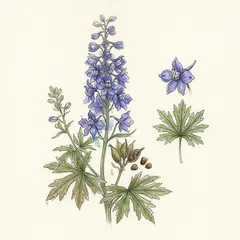 All books on Staphisagria →
Antidoted byAmbra GriseaCamphoraCinchona OfficinalisMercurius SolubilisScilla MaritimaTheridion Curassavicum
All books on Staphisagria →
Antidoted byAmbra GriseaCamphoraCinchona OfficinalisMercurius SolubilisScilla MaritimaTheridion CurassavicumGeneral
Actea racemosa (Cimicifuga).
Staphisagria. <
V
Colocynthis. Causticum.
( i. Blood.
Sycosis, Scurvy.
Organs
Similar to Nux vomica,
Mercurius,
Thuja,
Cistus Canadensis,
Colocynthis, Chamomilla.
Staphisagria is indicated in patients who appear pale, and are worn out and exhausted, especially as regards their nervous system.
Both brain and spinal cord are weakened under its influence.
The face is rather sunken, the nose is peaked and pointed, and the eyes are sunken and surrounded by blue rings.
Mentally, the Staphisagria child is rather impetuous and irritable, reminding one strongly of Chamomilla; the adult Staphisagria patient is hypochondriacal.
There may be one of several causes producing this last-named mental state.
First, sex- ual excesses: it is called for in these hypochondriacal moods after self-abuse, and also when this mental state occurs in young men and young women as a result of permitting the mind to dwell too much on sexual subjects.
Owing to his bad habit the boy becomes apathetic and gloomy, and has the complexion and sunken face that I have de- scribed.
He rather prefers solitude, and is shy of the opposite sex.
Locally, there is to be noted an irritability of the prostatic portion of the urethra.
This state of affairs usually follows self- abuse; it is sel- dom the result of excessive sexual intercourse.
STAPHISAGRIA. 339
Platina was recommended by Grauvogl as a drug capable of curing spasms or convulsions, emaciation, and that train of symptoms which follows prepubic abuse of the sexual organs.
Still another remedy, Caladium, is to be thought of when, from masturbation, the glans penis is as flabby as a rag.
The prepuce, when it is withdrawn behind the glans, remains there, not having con- tractility enough to replace itself.
Nocturnal emissions occur either without dreams or with dreams that are foreign to sexual subjects.
Other remedies indicated in this condition are Dioscorea, Gelsemium, and that well known group to which I have already referred in a pre- vious lecture, Nux vomica^ Sulphur, Calcarea ostrearum and Lycopo- dium.
Among the new remedies, Bromide of Potassium or Kali bromatum has been suggested.
I have seen it do good when there was mental depression and weakness of the legs after self-abuse.
In the female, in whom masturbation is not so common, we find ovarian symptoms resulting from the habit.
Staphisagria becomes the remedy when these organs are in a state of irritability, especially in nervous excitable women.
It ma}' also be used in women of this class when these symptoms occur in the prolonged absence of their hus- bands.
When pruritus vulvae is also present, Caladium often helps.
Staphisagria has another set of mental symptoms of a different t}7pe from those just mentioned. The patient is easily excited to anger, sensitive to the least impression, and takes offence at every little meant or unmeant insult.
We find Staphisagria indicated in what I have already termed a mental colic; that is crampy pains in the abdomen following a fit of anger, just as we found present under Chamomilla and Colocynth.
Chamomilla is called for in these cases when hot face, red cheeks and hot perspiration are associated with the colic; and Colocynth, when the severe pains cause the patient to double up for relief. Staphisagria is here complementary to Colocynth, stepping in to complete the cure when Colocynth is insufficient.
We find Staphisagria indicated also in diseases of the skin and of the bones.
This drug has long been used as a local wash to destroy lice or vermin.
You may use it internally when an eczematous erup- tion appears on the skin.
This may occur on any other part of the body, but it is especially apt to be found on the head and face.
The eruption is usually dry, and formed of very thick scabs, and itches violently, this last being an indication for the local application of
34-0 A CUNICAL MATERIA MKDICA.
Staphisagria.
The peculiarity of this itching is that when scratching stops it in one place, it goes to another.
At other times these scabs are moist, and are yellowish in color and very offensive, even breeding lice.
Thus you see Staphisagria is suited to crusta lactea or eczema capitis.
Again this drug may be indicated in children who are weak and broken down as the result of a syphilitic or sycotic inheritance.
In such children you almost always find the teeth decaying rapidly.
The milk-teeth are scarcely full grown before they become black in creases or spots and crumble away.
In this respect Staphisagria rivals Kreosote, which is one of the best remedies for premature decay of the milk-teeth, when they first become yellow, then dark and finally de- cay.
In Thuja, as you will remember, the teeth decay at the edge of the gums.
Next to these remedies you may think of Antimonium crudum, and in other cases still, Chamomilla and Cojjea.
In the Staphisagria patient the gums are unhealthy, swollen, spongy and bleed easily when touched by food or by the finger, this condition being associated with painful swelling of the submaxillary glands. It is especially indicated after the abuse of Mercury.
Staphisagria is useful in children suffering from inflammation of the eyes, particularly of the lids with hardened styes.
For those little cystic tumors which form in the eyelids midway be- tween the inner and outer surfaces, Graphites is the best remedy. Baryta carb. also cures tarsal tumors.
The Staphisagria children have an eczematous eruption composed of yellow scabs about the ears.
The exudation from these is bloody and seems to cause rawness of the skin.
Still further, we find Staphisagria affecting the bones.
It causes swelling of the periosteum with subse- quent suppuration.
It also produces fig- warts or condylomata on the skin; these are usually pediculated.
This symptom places Staphisagria among the sycotic remedies.
Thus we find it a suitable companion of Thuja, be- ing preferable to that remedy when there are present the form of erup- tion already mentioned, the crumbling of the teeth and the pediculated condylomata.
In some cases we find it indicated in syphilitic ulceration after the abuse of Mercury, the discharge being thin and acrid. An examina- tion with the probe reveals diseased bone beneath.
STAPHISAGRIA. 341
We have several remedies similar to Staphisagria in bone affections, whether of syphilitic or scrofulous origin.
One of them is Stillingia.
This is ,of great use in syphilitic affections of the long bones, such as the femur, tibia, humerus, etc., and in periosteitis or in osteitis, the pains being worse at night and in damp weather.
In addition to this you almost alwa37s find an excoriating coryza, the well-known syph- ilitic ozaena.
Another remedy is Mercurius. Still another is Kali hydriodicum, especially when there is a combination of syphilis and mercury in the case.
Strontiana carb. is suited more to the scrofulous constitution.
It is indicated in osteitis, particularly of the femur, with ulcers which dis- charge more or less broken-down bone.
With the bone trouble there is apt to be a profuse exhausting diarrhoea almost like that accom- panying hectic fever.
Another remedy is Chloride of Gold and Platinum which is useful for either caries or necrosis.
Gettysburg Salts, which owes its effectiveness to the lithium carbon- ate it contains, is useful especially in caries of the vertebrae and of the hip-joint.
Another use of Staphisagria is found in its application to gout. It is not so useful for the acute paroxysms as it is when gout becomes systemic, and the sodium urate, instead of being eliminated by the kidneys, is deposited in the various joints and organs of the body, pro- ducing arthritic nodes.
It is also indicated in arthritic ophthalmia.
The eyes burn and feel very dry, notwithstanding which there are smarting and profuse lach- rymation.
The pains go from the eyes into the teeth.
In these gouty affections of the eyes, Colocynth is also a good remedy.
Upon the stomach Staphisagria seems to produce a relaxation, so that the organ appears to hang down and is flabby and weak.
This same symptom you will find under Ipecacuanha and Abrota?ium.
In Staphisagria there is a desire for brandy, wine or something stimulat- ing.
Such patients are subject to colic, which greatly resembles that of Colocynth.
You must also remember Staphisagria as a remedy in colic following operations about the abdomen. It is also efficacious when an incised wound, whether inflicted by the surgeon or by accident, is unduly sensitive.
342 A CLINICAL MATERIA MBD1CA.
In diarrhoea in children Staphisagria is indicated when the disorder is associated with a peculiar form of stomacace; the tongue and gums are white and spongy, while there are cutting pains before and after stool, with a great deal of tenesmus of the rectum during stool, and escape of flatus, which is usually hot and smells like rotten eggs (here being similar to Chamomilla) , stool being renewed by any attempt to take food or drink.
In its action on the female organs, Staphisagria causes prolapsus uteri, and this prolapsus is almost always associated with a flabby con- dition of the stomach.
The whole abdomen — contents and parietes — feels as if it would drop, so relaxed is it.
If you investigate thor- oughly, you will find that disappointed love or permitting the mind to dwell on sexual subjects has favored this relaxation.
The leucorrhcea which accompanies this condition is yellow and excoriating.
LECTURE XXXIV.
PULSATILLA PRATENSIS.
Pulsatilla. {
f Blood-vessels.
Mucous membranes.
Synovial membranes. ^ Organs.
Compare with Bryonia, Nux vomica, Antimonium crudum, Ipecac, Sulphur, Sulphuric acid, Arsenicum, Colchicum, Kali bichromicuvi , Caulophyllum , Ignatia, Actea racemosa, Helonias, Hamamelis, Sepia.
To-day we shall study Pulsatilla.
The species which we shall con- sider is the Pulsatilla of Hahnemann, the Pulsatilla praiensis, and not the American plant, the Pulsatilla Nuttalliana.
There is some little difference in the action of the two drugs.
The " pratensis" has been better proved.
The concordant remedies of this drug are almost with- out number.
The reason for this is that it is a well-proved remedy, and one, too, that is often indicated.
Its complementary remedies are Sulphuric acid and Lycopodium.
Its antidotes are Chaviomilla, Coffea, Ignatia and Nux vomica.
The relation of Pulsatilla or Sulphuric acid calls for particular notice.
The latter remedy follows the former in gastric troubles.
Pulsatilla is also antidotal to Sulphuric acid.
When this acid has been used for the cure of the appetite for liquor, Pulsatilla has been proposed as the remedy best suited for the diarrhoea which ensues.
Pulsatilla pratensis is a pretty little flower belonging to the anemone.
It has been called the wind-flower, and its name is in keeping with its symptoms, as they are as fickle as the wind.
Changeableness of the symptoms is characteristic of the drug.
This is especially marked in the haemorrhages, which apparently stop and in a few hours return.
It is also true of the diarrhoea, the stools continually changing their appearance — at one time being green, at another mixed with yellow, and at still another slimy.
The mental symptoms are of the same fickle nature, the patient now being irritable, then tearful, and again mild and pleasant. These are illustrations of the changeableness that I have described.
344 A CUNICAI, MATERIA MKDICA.
Pulsatilla seems to be especially adapted to the female organism, although it affects men as well as women.
It is one of those remedies which we are apt to select by the predominance of the mental symp- toms.
It is especially indicated in patients of a mild, tearful disposi- tion, having a rather slow, phlegmatic temperament.
They are never irascible, although at times peevish.
Thus, in the case of a child with some gastric ailment, Pulsatilla may be used when it is peevish, pale, chilly, and satisfied with nothing.
This is not the Nux vomica con- dition, nor is it like Chamomilla, both of which remedies have decid- edly more violence with their anger.
The Pulsatilla woman is tearful and easily discouraged.
Sometimes she is full of anxiety, with forebodings of some impending disaster.
This anxiety comes from the epigastrium and is very likely to be asso- ciated with indigestion.
It is often accompanied by chattering of the teeth, palpitation of the heart and flushes of heat.
These are the main mental symptoms of Pulsatilla.
They are present, more or less, in every disease in which it is the remedy.
In these mental symptoms you should compare Sepia, which, you will recall, has a similar mental state; but it differs from Pulsatilla in the presence of irritability and anger. There is also indifference to her household affairs, to which she was formerly attentive.
Natrum muriaticum also has tearful disposition similar to that of Pulsatilla, but consolation under Natrum mur. aggravates, while un- der Pulsatilla the patient seeks consolation.
Stannum metallicu?n likewise has this tearful disposition.
The pa- tient is very much discouraged, or is tearful over his chest symptoms.
He fears that he will go into a decline.
The Ignatia patient is sad, but she hides her grief from others.
Pulsatilla is especially suitable for chlorotic or anaemic women, when they complain constantly of a feeling of dulness, but in spite of this find relief for many of their symptoms in the open air.
They cannot tolerate a close room.
The pains from which they suffer seem to be accompanied by chilliness.
This chilliness is more marked the more decided the pains are.
The mental symptoms already mentioned are present.
Especially is Pulsatilla the remedy when chlorosis has been complicated by the abuse of iron and quinine.
Chlorotic patients, coming to you from allopathic hands after iron and quinine have failed to relieve, thus showing you that these remedies are not suitable to the case, will find their first, if not their only remedy, in Pulsatilla.
PULSATILLA PRATENSIS. 345
You will frequently find this hint of service to you in practice, not only in chlorosis, but in other affections as well, when they arise, not so much from local disease, as from a general defective state of nutri- tion; the whole system is worn out; ever}' tissue is relaxed. The woman suffers from mal-position of the uterus. The menses are late and scant}', dark, clotted or changeable in character. Pulsatilla does not always cure after the abuse of iron, but it stands in the same rela- tion to this substance that Nux vomica does to the abuse of drastic purgatives, and Camphor to cantharides.
To understand how these phenomena of Pulsatilla are caused — whether in women, where they are most frequently met with, or more exceptionally in men — you must remember that the drug acts upon the vascular system, especially upon the right heart, and upon the veins and capillaries. Thus we find that whatever weakens the venous portion of the circulation, whatever retards the return of blood to the heart, must of course provoke just the class of symptoms for which Pulsatilla may be indicated.
We know, for instance, that a warm, close room will provoke these symptoms. If a person sits in a close room or in one where the temperature is too high, the veins will be- come tortuous and there will be some oppression about the chest and retardation of the heart's action. When these symptoms occur in dis- ease they suggest Pulsatilla. It acts on the right heart more than on the left, consequently, despite the chilliness which arises from the anaemia, the open air acts as a stimulus to the venous circulation, and this improves the symptoms depending upon the sluggish flow of blood.
You will find many symptoms throughout the entire body calling for Pulsatilla when there is this disturbance in the venous cir- culation.
In the chest there is a feeling of soreness referred to either the right or the left sub-clavicular region, or to the apex of one or the other lung.
This soreness is felt when the patient lies on the affected side or presses against the chest.
It seems to involve the muscular structures about the shoulder and even down the arm of the affected side.
This symptom indicates venous congestion, or, at least, sluggish circula- tion through the upper part of the lung.
It has been a valuable symp- tom to me and to many physicians in the incipiency of tuberculosis, especially in women of the Pulsatilla temperament.
Along with this soreness in the lung there may be some cough with expectoration.
Although there may be no symptoms indicating the positive existence
346 A CUNICAL MATERIA MEDICA.
of tuberculous infiltration we will have other symptoms indicating the onset of the disease. Pulsatilla has several times relieved these cases.
Then, too, we have Pulsatilla indicated in varicose veins, whether occurring on the limbs or about the testicle (varicocele). The affected parts are bluish and annoy the patient by the soreness and stinging pains in them.
The epistaxis of Pulsatilla is of a passive character.
The flow comes steadily, but it is not .bright red and does not come in gushes as it does in epistaxis dependent upon arterial lesions.
It often occurs vicariously, taking the place of the menses.
The same is true of the blood-spitting or haemoptysis, which is either associated with this soreness or passive congestion of the chest or is dependent upon sup- pressed menstruation.
Pulsatilla has an important analogue, namely, Hamamelis, in these venous symptoms.
Before Hamamelis was proved Pulsatilla was the only remedy we could depend upon in the class of symptoms enumer- ated.
Hamamelis is the preferable drug in varicose veins unless con- stitutional symptoms call for Pulsatilla, especially in the case of vari- cocele.
Varicocele has been cured by Ha?namelis applied externally and taken internally.
The great characteristic of this drug, and that which makes its choice certain, is soreness of the affected part.
It is a soreness which is not exactly the bruised feeling of Arnica; it is not the sensitive soreness of Lachesis; nor the stinging soreness of Apis; but it is that sore feeling which belongs to venous congestion.
You may apply Hamamelis successfully in any condition in which that is pres- ent.
I have often made use of the drug in pregnancy, when varicose veins appeared over the abdomen, and when the patient could not make any motion without experiencing a bruised sore feeling.
Hama- melis is not the panacea which druggists would have us believe.
It does not cure everything, sprains, etc., but it does cure the class of symptoms I have mentioned.
Another concordant remedy of Pulsatilla is Lilium tigrinum, which, like the former, affects the right heart', producing engorgement of the veins, relief in the open air, scanty menses, and taste of blood in the mouth. But it differs from Pulsatilla in the decided tendency to pro- lapsus uteri, with bearing down, relieved by supporting the abdomen, or by crossing the limbs; and in the mental state, which is one of irri- tability and restlessness with constant desire to hurry. Furthermore, when Lilium is indicated, a sharp pain, extending from the left nipple through the chest to the back, is apt to be present.
PULSATILLA PRATENSIS. 347
Another analogue is Sepia, which has many of the Pulsatilla symp- toms.
Sepia, also, is indicated in anaemia and chlorosis, and it also has the mild tearful temperament, but there is a difference in the men- tal symptoms.
With Sepia there ma}^ be irritability or at times ve- hemence.
The Sepia patient has complete aversion to her usual household duties.
Let us now consider the action of Pulsatilla on mucous membranes.
This is easily remembered.
It produces a catarrhal inflammation of the mucous membrane, which ends in the production of bland yellow or yellowish-green mucus.
You have here an indication which you may apply to any mucous membrane.
Conjunctivitis calls for Pulsatilla when the discharge is thick, yel- low or yellowish-green, and bland; hence it is not indicated in the be- ginning of the disease, but later in its course, when the symptoms have matured. It is an invaluable remedy in ophthalmia after measles, in purulent ophthalmia, and in ophthalmia neonatorum (whether these troubles are of gonorrhceal origin or not), when the discharge is of the character just described. Its analogue here is Argentum nitricum, which has precisely the same symptoms in more marked degree, and is to be used after the failure of Pulsatilla. The latter in turn some- times serves as an intercurrent to spur on the action of Arge?itum nitricum.
Mercurius corrosivus is suitable in cases which, despite the use of Argentum nitricum, threaten to ulcerate and perforate the cornea.
These are not by any means the only eye symptoms of Pulsatilla.
Dr.
George S.
Norton, of New York, published in the Hahnemannian Monthly, some years ago, a paper on the use of this remedy in diseases of the eye, which covered some six or eight pages.
In addition to the conjunctival inflammation just noticed, Pulsatilla causes obscuration of vision, with vertigo and nausea, diplopia, starry apparitions, circles of fire, etc.
(these generally being reflex symptoms); pustules on the cornea, with very little dread of light, but with lachrymation, worse in the open air; pressing, stinging pains in the eye; swollen lids; styes, relieved when in the open air; margins of the lids inflamed and swollen, but not excoriated.
In ophthalmia, with very little photophobia, it resembles Graphites, but has not the cracks along the lid-edges.
Pulsatilla is also an excellent remedy in small central corneal ulcers,
348 A CUNICAI, MATERIA MEDICA.
with no vascular supply, especially when occurring in scrofulous sub- jects. It may still further be used in lachrymation from disease of the lachrymal duct when the symptoms just enumerated are present, and for lachrymation worse in the wind.
Pulsatilla also affects the nasal mucous membrane, developing here symptoms which indicate it in the advanced stages of a cold. It should not be given in the beginning of a cold unless the temperament and other symptoms decide, because sneezing and serous excoriating discharge are not characteristic Pulsatilla symptoms. But when you find a nasal catarrh "ripened," that is, when the nasal discharge is thick, muco-purulent, yellowish or yellowish- green, and not in the least excoriating, you have a perfect picture of Pulsatilla.
In chronic nasal catarrh you may give Pulsatilla if the discharge is of this character.
You must give the drug frequently and persistently, in order to cure.
In addition to the symptoms already enumerated, there is still another symptom, namely, loss of taste and smell.
There is a remedy known as Cyclamen, which is very similar to Pulsatilla in its symptomatology.
It seems to be suited to nasal catarrh when there are loss of taste and smell, and this thick discharge just like that of Pulsatilla; but it has, in addition, spasmodic sneezing and aversion to the open air.
Pentkorum sedoides is useful in the incipiency of coryza when there is rawness in the nose and throat.
The patient complains of a con- stant wet feeling in the nose, but without coryza.
I^ater, there is a formation of thick purulent discharge, just as in Pulsatilla.
Spigelia is one of our best remedies for catarrh of the posterior nares.
The symptoms indicating it are profuse discharge of mucus through the posterior nares; nasal mucus passes off only through the posterior nares.
This drug has accomplished some good cures in the hands of Dr.
Aug.
Korndoerfer, who also recommends Theridion for this affection.
Hydrastis is also suited to post-nasal catarrh. The discharge is of a thin watery character, and is attended with a great deal of burning and rawness, together with a sensation as of a hair in the nostrils.
Pulsatilla is an invaluable remedy in affections of the ears. In otitis externa you may use it when the external ear is hot, red, and swollen, and there are darting, tearing, pulsating pains, which are worse at night.
In otitis media also it is useful when there is a profuse thick yellow or yellowish-green discharge from the ear.
PULSATILLA PRATENSIS. 349
Pulsatilla is one of our leading remedies in catarrhal otitis.
There is deafness, with a feeling as if the ears were stopped up, with rushing noises in the ears, isochronous with the pulse.
Silicea is the nearest remedy to Pulsatilla in catarrhal otorrhcea.
Belladonna and Mercurius have a deeper action than Pulsatilla, act- ing on the cellular tissues.
Chamomilla is similar to Pulsatilla in the ear symptoms, but the pains are more violent, and are attended with red cheeks; the patient cannot bear pain.
Plantago major is to be thought of when earache is associated with toothache.
Tellurium causes catarrh of the middle ear, which may penetrate into the cells of the mastoid process and establish an abscess there, or may even involve the internal ear or the brain.
Pus forms in the middle ear, and finally, perforating the membrana tympani, escapes externally.
The resultant discharge is thin and acrid, causing blis- ters wherever it touches, and smells like fish-brine.
In catarrh of the throat you will find Pulsatilla sometimes, though not frequently, the remedy.
It would here be indicated by the ap- pearance of -the parts.
There are a marked redness of the tonsils and a varicose condition of the blood-vessels of the parts, and the fauces have a dark red or purplish hue.
There are also stinging pains in the throat (here reminding you of Apis), worse usually from swallowing saliva or after eating food.
Leaving the pharynx we next come to the stomach, where we find Pulsatilla indicated in catarrhal conditions.
The tongue is coated with a thick rough white fur.
The mouth feels dry, and yet there is not much thirst, thirstlessness being a characteristic of the remedy.
There are also nausea, and sometimes vomiting, the vomited matters consisting either of food or mucus, and also of bile.
The food vom- ited may have been that eaten a long time before, thus showing the weak digestion of the remedy.
There is a feeling of fulness and heavi- ness in the stomach after eating, sometimes associated with a feeling of rawness in the stomach as from ulceration.
The latter is merely a subjective symptom and is a common sensation in Pulsatilla.
Usually there is diarrhoea, with slimy or watery stools, worse after midnight.
Attending these gastric symptoms is heartburn and sometimes, though rarely, water-brash.
When water-brash calls for Pulsatilla there is a putrid taste in the mouth in the morning, better after drinking.
The
350 A CLINICAL MATERIA MKDICA.
patient craves lemonade.
He may complain that his mouth is dry, yet it seems to contain plenty of mucus.
Other symptoms experienced are: feeling of weight in the epigastrium an hour after eating, relieved by eating again; feeling in the oesophagus as if food were lying there (also China, Abies)-, throbbing in the epigastrium; much flatulence which moves about, causing pinching pains and rumbling, worse on awaking or just after supper.
Now these are the symptoms calling for this remedy in gastric catarrh.
What are the exciting causes ?
First of all and most important, Pulsatilla is called for when the trou- ble has arisen after partaking of fatty food or of pastry.
It is also in- dicated in gastric catarrh arising from a mixed diet, as turkey, vege- tables, coffee, etc., especially if eaten at night; also after chilling the stomach with ice-cream or ice-water, especially if the stomach is warm.
In still other cases it may be indicated after getting wet, especially after getting the feet wet when suppression of the menses ensues.
Let us now differentiate this remedy from the others commonly used in these dyspeptic symptoms. The most important remedies besides Pulsatilla, having aggravation from eating fatty foods, are Ipecac, Thuja and Carbo veg. Arsenicum and Carbo veg. have aggravation from eating ice-cream, and Nux vomica and Ipecac, from partaking of a mixed diet, or aggravation from eating at night; in this condition^ you may think also of Cinchona. In desire for lemonade, compare Cyclamen, Sabina and Belladonna; nausea at the thought or smell of food, particularly if rich or fat, Sepia and Colchicum; in vomiting of food long after eating, Kreosote.
Bryonia produces a catarrh of the stomach with white coated tongue, putrid taste in the mouth and a feeling as of a heavy load in the stom- ach.
It may also be indicated in gastric catarrh brought on by chilling the stomach, although it is more suitable when the trouble has been brought on by the heat of summer weather.
Bryonia usually, how- ever, has constipation as an accompanying symptom, or if it has diar- rhoea, it has not this yellowish-green or watery stool.
Instead of this, the stools are papescent and have a putrid odor like old cheese.
Nux vomica resembles Pulsatilla.
Both are serviceable in catarrh of the stomach arising from overeating or from a mixed diet.
Espe- cially is Nux indicated after indulgence in alcoholic drinks.
Dryness of the mouth with little or no thirst and uncomfortable feeling about the stomach, are also found under Nux vomica.
The bowels are con- stipated.
Comparatively speaking, we may say that heartburn is
PULSATILLA PRATENSIS. 35 1
more characteristic of Pulsatilla and water-brash more characteristic of Nux vomica. The mental symptoms of the two remedies differ widely, and they should be easy to distinguish on this account.
Antimonhim crudum resembles Pulsatilla, but the tongue under this remedy is coated white as though it had been whitewashed.
Vomit- ing predominates over the other symptoms.
A slight quantity of food excites nausea and vomiting.
It is an excellent remed}^ in children.
Ipecacuanha is a first-class remedy in these gastric catarrhs caused by chilling the stomach with ice- water or by eating pastry, confec- tionery or other indigestible substances.
Usually the tongue is clean.
It seldom has the thick coating belonging to Pulsatilla or Antimonium crudum, and nausea predominates over every other symptom.
Arse?iicum is complementary to Pulsatilla when gastric catarrh arises from chilling the stomach with ice-cream or ice-water.
Under Pulsatilla there is a sensation as of a stone in the epigastrium. You will find a similar symptom under Abies nigra, which has been successfully used in gastric troubles when the patient experiences a sensation as of a hard-boiled egg in the stomach after eating.
You may use Pulsatilla in constipation occurring in pregnant women or following the abuse of Cinchona and its preparations.
The stools are large, with much urging and backache, or they are insufficient and finally consist of nothing but yellow mucus.
You may also use it for diarrhoea when the stools are of a greenish-yellow color or are very changeable.
The trouble is usually caused by partaking of a mixed diet late the night before, and the symptoms are apt to be markedly worse after midnight.
Here you should compare Iris versicolor, which is one of the best remedies we have for cholera morbus, coming preferably at two or three o'clock in the morning with vomiting of food and sour, bilious matters, accompanied by purging. It differs from Veratrum album in the absence of coldness and symptoms of collapse.
In cystitis or catarrh of the bladder we find Pulsatilla indicated when there is frequent urging to urinate from pressure on the bladder as if the bladder were too full.
There is pain in the urethra.
The urine itself is often turbid from the admixture of mucus.
Clinically, we have not found Pulsatilla a first-class remedy in cystitis, but we have found it almost always the remedy in cystic symptoms accompanying pregnancy.
It yields to Cantharis, Equisetum and Dulcamara in cys- titis.
352 A CUNICAI, MATERIA MEDICA.
Gonorrhoea calls for Pulsatilla when the discharge is thick, bland and yellow or yellowish-green.
There are usually pains in the groins when this drug is indicated, and I have noticed, too, pains going across the hypogastrium from side to side, a symptom that has some- times been produced by overdosing with Pulsatilla.
After giving it a few times in these cases, the patient returns, complaining of this ach- ing across the stomach.
This symptom occurring thus, calls for the lengthening of the intervals between the doses, or else for its stoppage altogether.
In suppression of gonorrhoea, Pulsatilla is indicated if orchitis, or rather epididymitis, ensues.
The testicle is retracted, enlarged, very sensitive to the touch and the skin of the scrotum is dark red.
There are sharp dragging pains following the course of the spermatic cord.
Unless some other symptoms contra-indicate it, Pulsatilla will restore the discharge and relieve the distressing pain, but the patient must be kept quiet and the scrotum must be supported in a suspensory.
In some cases I have used hot water locally as an adjuvant.
While it seems to increase the swelling, it relieves the pain.
In some of these cases there appears to be an absence of symptoms of a subjective character.
All you can observe is that the testicle is swollen and exquisitely sore to the touch.
The gonorrhoeal discharge has almost if not entirely ceased.
In these cases Hamamelis is your remedy.
Clematis is an excellent remedy for gonorrhoeal orchitis when the testicle is indurated and is "as hard as a stone."
Rhododendron also is a useful remedy when the orchitis becomes chronic and the testicle is indurated exactly like Clematis.
Under Rhododendron, however, the testicle tends to atrophy.
There is also a feeling in the gland as if it were being crushed.
In induration of the testicle you may compare Conium, Arnica, Staphisagria, Spongia, Aurum metallicum, besides the remedies already mentioned. You may give Oxalic acid when there are terrible neu- ralgic pains in the spermatic cords, worse from the slightest motion, and even on thinking of them.
Ustilago and Hamamelis also cause neuralgia of the testicle.
Mercurius is called for when the glands are swollen, and when what little discharge remains is greenish, and when there is phimosis.
Pulsatilla is of use in enlargement of the prostate. It is indicated by the mechanical symptom, faeces, when they escape, are small and flat.
PULSATILLA PRATENSIS. 353,
Hydrocele, especially the congenital form, may yield to Pulsatilla:
Next let us study Pulsatilla in its relations to synovial membranes- Pulsatilla has not an affinity for the true serous membranes, as we found under Aconite and Bryonia, but it acts on the synovial sacs, which are slightly different from the pure serous membranes.
The remedy is indicated in rheumatism of the joints, and in gouty, gon- orrheal and traumatic synovitis.
The joint is, of course, swollen, and the pains are of a sharp stinging character, and are accompanied by a feeling of soreness or of subcutaneous ulceration about the affected joint.
The pains in these joint inflammations are usually erratic, now- here and now there.
The tearing pains in the joint force the patient to move the affected part.
Pressure relieves.
These tearing pains often extend down the limb, and are accompanied by jerking, probably through irritation of the muscular nerves, and are relieved by slowly moving about.
I dwell upon these pains because the}7 so frequently call for Pulsatilla.
They are usually worse from warmth, and are re- lieved by cold.
They are worse in the evening.
Pulsatilla rivals Apis in synovitis, but the latter drug has more effu- sion than the former, and is indicated when there is a great deal of oedema about the joint.
Ledum and Lac caninum have pains worse from warmth. In the former they travel downward; in the latter they shift from one limb to the other and back again.
In rheumatism with erratic pains, you may compare Kali bichromi- cum, Sulphur and Bryonia.
Chamomilla has stitching pains, jumping from place to place, worse in the knees and ankles, but they are accompanied by numbness and a sense of weakness. The temperament is totally unlike that of Pulsatilla.
Kali bichromicum is called for in gonorrhceal rheumatism. The- pains are better in a warm room.
By reason of its action on the digestive organs, Pulsatilla becomes of value in gout or in the gouty diathesis, especially when the trouble has been brought on by indigestion. If the disease persists despite its- use, Colchicum follows well.
Now let us consider the action of Pulsatilla on the various organs.
We have already studied the mental symptoms of the drug. We have
yet to speak of its headaches. These we may summarize as being
mostly frontal and supra-orbital. They are generally of uterine,.
354 A CLINICAL MATERIA MKDICA.
neuralgic, rheumatic or gastric origin.
They are aggravated by men- tal exertion and by warmth.
They are usually worse in the evening, although the gastric symptoms are worse in the morning.
When of rheumatic origin, the pains are sharp and seem to go from the head into the face and almost drive the patient mad, so severe are they.
In other cases they may be erratic, wandering from one part of the head to the other.
In some cases the headache accompanies menstrual suppression.
The head is hot.
The pain in the head is better in the open air and * is often accompanied by nose-bleed.
In these headaches you should compare Pulsatilla with the follow- ing remedies:
Ranunculus bulbosus, headache on the vertex as if the head were be- ing pressed asunder, worse in the evening and on going from cold to warm air and vice versa.
Ranunculus sceleratus, gnawing in the vertex in a small spot.
Cocculus Indicus, pain in the occiput as if it were opening and shut- ting.
Spigelia, sensation as if the head were open along the vertex.
Carbo animalis, feeling on the vertex as if pressed asunder; must 'hold it together.
Veratram album, pressure on the vertex, with pain in the stomach; head relieved by pressing the vertex, and aggravated by motion.
Menyanthes , compressive headache in the vertex and sensation when ascending steps as if a weight pressed on the brain, better from press- ure, and accompanied by cold hands and feet.
Phellandrium, pain as from a weight on the top of the head, with .achixig and burning in the temples and above the eyes, which are con- gested; eyes water; can bear neither light nor sound.
The eye symptoms of Pulsatilla, and some of those of the ear, have already been considered.
We shall now proceed with the remaining ear symptoms.
Pulsatilla has long been known as a remedy for otitis externa or inflammation of the external auditory meatus.
The pains are very severe, as indeed they must be from the confined nature of the canal, surrounded as it is by bone.
The external ear is swollen and red.
The pains are usually worse at night.
The trouble may end with otorrhoea, which has the character already described.
We come next to the action of Pulsatilla on the female organism.
It is here that Pulsatilla has won its laurels.
WTe find it indicated in
PULSATILLA PRATKNSIS. 355
•girls at the age of puberty, when the menstrual flow has not estab- lished itself normal^, or has not appeared at all.
It is especially at this time that 3Tou may find soreness of the apices of the lungs, calling for Pulsatilla, and you know that unless you remove this symptom and establish the menstrual flow, your patient will have some form of phthisis.
When the menses are established the}T are apt to be too late and too scanty.
The flow is fitful in its character, now coming on and now stopping, now appearing as dark clotted blood, and again as an almost colorless watery flow.
It is preceded by menstrual colic.
The pains are of a crampy, griping character, and so severe that the patient can hardly bear them.
She almost smothers if the room is close.
She has the Pulsatilla temperament well-marked.
Amenorrhcea ma3' call for Pulsatilla when it occurs during the ordinary period of menstrua- tion, or as a result of wet feet, and when nose-bleed acts vicariously for the menses.
In some of these cases a single dose will bring on the menstrual flow, while in others you are obliged to give the drug re- peatedly.
During pregnane)' you may find use for Pulsatilla. Soreness of the uterus and of the abdominal walls may call for it as well as for Hama- melis.
Then again it may correct malpositions of the foetus in utero, if the cause is not mechanical.
Now I know that in making this statement I am venturing on debatable ground.
I do not mean to say that Pul- satilla will make the foetus turn around.
But I do mean to say that Pulsatilla will act on the muscular walls of the uterus, and stimulate their growth.
Sometimes the uterus in its growth during pregnancy develops more on one side than another.
Hence there is irregularity in its development, and the foetus must assume an irregular position.
Pulsatilla, by alteriug the growth of the uterus, permits the foetus to assume its proper position.
During labor Pulsatilla is called for when the pains are slow, weak and ineffectual.
Then, again, we may find the pains spasmodic and irregular, and they may even excite fainting, as in Nux vomica.
The patient feels as if smothering, and calls on you to open the windows.
Again Pulsatilla may be called for after labor when the placenta re- mains adherent.
In these cases it wTill not only bring about release of the placenta, but will so tone up the uterus as to avoid post-partum haemorrhage.
Cantharis and Gossypium are also useful in this con- dition.
356 A CUNICAI, MATKRIA MKDICA.
Again Pulsatilla is many times the remedy in simple retained pla- centa, which allies it with Sepia, Sabina, Secale and Caulophyllum.
Pulsatilla may also be used for after-pains, the temperament agree- ing.
These pains, however, call more frequently for Chamomilla, Caulophyllum and Xanthoxylum.
The last two remedies are particu- larly useful.
Cuprum metallicum is a good remedy for severe crampy after-pains in women who have borne many children.
Pulsatilla may also be used for scanty or suppressed lochia.
It may also be indicated as frequently as Hamamelis in phlegmasia alba dolens, or "milk-leg."
The mammary glands are affected by Pulsatilla before, during, and after pregnancy.
It is indicated when mechanical irritation, as, for instance, carrying school-books, excites the flow of milk.
After labor you may still give this remedy when the breast is swollen and painful and the flow of milk scanty or absent, the patient being gloomy and tearful.
In this connection I may mention several remedies that are more important than Pulsatilla. I think that Urtica urens is the best rem- edy for non-appearance of the milk without any other symptoms, there being no apparent reason for the agalactia.
Still another remedy is Ricinus communis or castor oil.
This has, when used externally, developed milk.
It may also be successful when given internally in low potency.
Agnus castus is useful in agalactia when the mind is greatly de- pressed.
Causticum is called for in women of a rheumatic diathesis. The face is usually sallow and the patient gloomy and depressed.
In its relation to diseases of women, Pulsatilla has a great many allies.
First of all we may mention Actea racemosa or Cimicifuga.
This remedy resembles Pulsatilla because it acts on the uterus.
Both remedies favor normal labor.
Here Actea is probably the superior of the two.
It also resembles Pulsatilla in its action during labor, being indicated for labor-pains which are very distressing.
The symptoms, however, are not intermittent, but rather continuous, and as to tem- perament, we find Actea racemosa differing from Pulsatilla.
For in- stance, it is indicated in a high degree of nervousness, both during labor and out of labor, during which the woman has an intensely apprehensive mood.
She has a dread or fear of something about to
PULSATILLA PRATENSIS. 357
"happen, and this haunts her from day to day.
At other times she has a dread of undertaking anything, even ordinary work.
Actea race- mosa is also indicated in any deviation from normal in the position of the uterus when there are sharp cutting pains across the hypogastrium from side to side.
It is also to be used for neuralgia reflex from uter- ine irritation, and that, too, whether it be the nerves of the head, chest or limbs that are involved.
Another remedy to be compared with Pulsatilla is Caulophyllum .
This is a remedy that we have not had many years, and yet it is so useful that we would not now be able to get along without it.
Its main characteristic is intermittency of pains.
If they are neuralgic and reflex from uterine disorder, they are intermittent in character.
They are usually sharp and crampy, and appear in the bladder, groins and lower extremities.
During labor Caiilophyllum is indicated when there is extreme uterine atony.
The pains may be as severe as ever, yet there is apparently no expulsive effort.
It is often indicated in nervous women in whom pain seems to be intolerable.
The pains are spasmodic and fly about from place to place, now in the groins, then in the abdomen, and next in the chest, never going in the direction of the normal pains.
The patient seems to be exhausted.
There is great exhaustion of the whole system.
She can scarcely speak at times, so weak is the voice.
These are symptoms which indicate Caulophyllum.
It has been used here by most physicians in the low potencies, although all potencies may be used.
It may also be indi- cated during the last weeks of pregnancy when the patient suffers from false labor-pains, these consisting of painful bearing-down sensa- tions in the hypogastrium.
I have known a single dose to stop them after they had lasted for hours.
I have next to speak of Helonias dioica, or the false unicorn, one of the order of Liliaceae.
This is one of the new remedies, and it is one which has proved itself worthy of a place by the side of the well-tried Pulsatilla.
It is serviceable in females who are run down as to their nervous system; who are easily fatigued by any work and who com- plain of a tired backache, this tired feeling extending into the limbs.
They seem to feel better when they are working than they did when they commenced to work.
Now this is not the Rhus tox. condition.
It is not due to a limbering up of stiff joints as under the latter rem- edy.
The reason for the symptom is, that some of the languor passes off as the patient continues her labors.
The backache is usually
358 A CLINICAL MATERIA MEDICA.
situated in the lumbar region just over the site of the kidneys, or it may appear lower down and affect the sacral region.
Pain in either of these locations may accompany uterine disturbances.
You will find also that Helonias is useful for suppression of the menses (here it is closely akin to Pulsatilla) , when the kidneys are congested.
It seems as if the monthly congestion, instead of venting itself as it should through the uterine vessels, has extended to the kidneys, giving rise to albuminuria.
The urine is scanty and turbid.
Then, again, you find Helonias called for after confinement, when there is a tendency to prolapsus and other malpositions of the uterus.
The patient complains of heaviness and dragging in the pelvic region.
There is a sensitive- ness which has been expressed as ' ( consciousness of the existence of a womb." You know that we are not conscious of our internal organs.
They move and perform their respective functions without any sensa- tion.
The minute our sensations tell us that we have a stomach or liver, that minute we begin to have disease there.
Accompanying these symptoms of prolapsus and of uterine over-sensitiveness is apt to be too long-lasting lochia, if I may -use that term.
To be more ex- act, I should say that there is a sanguineous discharge, which con- tinues for weeks after confinement.
I can recall a case which I treated last winter.
It was that of a lady who gave birth to a very large child, and suffered afterward from prolapsus uteri.
I gave her sev- eral remedies without relieving her, so that at the end of three months she was still uncured.
About this time she began to complain of tightness across the chest, with cough and some little bloody sputum.
Her mother had died of phthisis after giving birth to twins, so I feared serious lung affection.
Phosphorus did no good;
Nux did no good.
I studied up the case more thoroughly.
She told me that she felt as though there were a heavy weight over the chest on the sternum, and a feeling as though the chest had been gripped in a vise with the sore feeling which follows.
This annoyed her when she awakened at night.
These symptoms were symptoms which had been noticed only in the male provers of Helonias.
Nevertheless I gave that drug, and it entirely removed both the chest symptoms and the prolapsus.
Then, again, under Helo?iias you frequently find a tendency to inflam- mation of the vulva and vagina with formation of pus.
You may also use it in ulceration of the cervix uteri.
With this there is a leucor- rhoea which has a bad odor, and every little exertion tends to produce a flow of blood.
With these symptoms there is almost always.
PULSATILLA PRATEXSIS. 359
persistent itching about the genitals with or without the formation of blisters or sores. We know little or nothing concerning the value of Helonias during labor.
A drug to be placed by the side of Helonias is Senecio aureus.
This drug causes inflammation of mucous membranes, hence it is useful when there is a tendency to catarrh of the nose, throat and lungs, par- ticularly in women.
It is especially suited to nervous, excitable women who suffer much from sleeplessness, traceable to uterine irritation, as from prolapse or flexion of the uterus.
The patient suf- fers from scanty menstruation, and she is apt to be tearful.
There is dry teasing cough, with stitching pains in the chest and blood-streaked sputum.
The bladder sympathizes with the uterine disease.
There is much pain at the neck of the bladder causing burning and tenesmus.
After the onset of the menstrual flow the chest and cystic symptoms become modified or cease, thus showing how intimately they are re- lated to the irregularity in the menstrual effort.
Another drug is Aletris farinosa.
This is one of the most bitter substances known.
It is closely allied to Senecio and Helonias.
In allopathic parlance it is a "tonic." It is especially useful in women who, in addition to uterine trouble and leucorrhoea, have extreme con- stipation, great effort being required to effect an evacuation from the bowels.
There is great accumulation of frothy saliva.
Aletris is a remedy also for weakness of digestion; food distresses the patient and lies heavily in the stomach.
Cyclamen is very similar to Pulsatilla.
The}- are both suited to chlorotic and anaernic women, and they both have some trouble with the digestion, and intolerance of fatty foods.
The menstrual colic and irregularities are almost identical in the two drugs.
The same kind of melancholy is common to both.
Cyclamen may be distinguished from Pulsatilla by the following symptoms.
Generally, but not always, there is more thirst with the Cyclamen patient.
The Pulsatilla patient feels better in the open air, the Cyclamen does not.
The Cyclamen patients suffer from a peculiar kind of torpidity, both of mind and bod}-, with languor.
They cannot think.
They are better when aroused and forced to exercise, something like Helonias.
When they get up in the morning they feel so heavy and languid that they feel as though they could scarcely go through the day's duties, but when they once get to work they go on tolerably well until night time..
That is Cyclamen, and it is very much like Helonias.
They suffer,
360 A CLINICAL MATERIA MEDICA.
too, from dulness of the senses with flickering before the eyes.
You often find this in weak anaemic women.
They see various colors be- fore the eyes, very much as under Sa?itonin, Conium, Kali bichromi- €um} etc.
Sometimes the}^ have half-sight.
The indigestion with which they are troubled has this to characterize it: formation of flatus which causes colic at night, forcing the patient to get up and walk about till the flatus passes and gives relief.
It yet remains for me to speak of Hydrastis Canadensis.
This is a remedy which acts even more powerfully on mucous membranes than does Pulsatilla.
It causes catarrh of the mucous membranes of the nose, stomach, bowels, bladder, uterus and vagina, the discharge, how- ever, being more acrid than it is under Pulsatilla, and of a thick yellow or bloody appearance; in uterine affections Hydrastis is indicated for prolapsus uteri with ulceration of the cervix.
The leucorrhoea is watery at times, and a,t other times thick, yellow and excoriating; this condition being associated with gone, weak feeling at the pit of the stomach and well-marked palpitation of the heart.
The tongue is moist, and coated a dirty yellow color, and takes the imprint of the teeth.
The face is sallow, and the eyes are sunken and surrounded "by dark rings.
The bowels are apt to be constipated, the stools being coated or intermixed with mucus.
lastly may be mentioned Lilium tigrinum, which helps in uterine complaints when there are sharp pains across the abdomen from one ilium to the other; in addition there are marked bearing-down pains, making the patient cross her limbs. She places her hand over the vulva to support the viscera.
Pulsatilla cures a fever with these symptoms: the head is hot and the lips are dry; the patient is constantly licking his lips to moisten them, yet he does not wish to drink.
It may also be used in intermit- tent fever after the abuse of quinine when thirst appears at two or three o'clock in the afternoon; then comes chill without thirst, and anxiety and oppression from venous congestion of the chest.
The patient is sleepy, yet she cannot sleep.
Sometimes one hand is hot and the other cold.
Pulsatilla acts on the larynx, causing hoarseness which comes and goes capriciously.
Such a hoarseness frequently marks the termina- tion of a " cold," and this remedy may prevent its becoming chronic.
It also cures purely nervous hoarseness appearing with every emotion.
In the chest we again have symptoms of a catarrhal nature.
PULSATILLA PRATENSIS. 36 1
Bronchitis with thick yellow expectoration; or dry, tickling cough from irritation in the trachea, worse in the evening and on lying down, with dry air passages or a scraped, raw feeling. Occasionally there is dyspnoea or constriction of the chest.
I warn you not to select Pulsatilla for a loose cough unless you are sure that all the symptoms of the case call for it. It often tightens such a cough without curing it.
Bloodspitting has already been mentioned.
This may be vicarious or it may belong to incipient consumption.
In the latter case there may be added soreness in the chest, worse under the clavicles; burn- ing in the chest, especially in the region of the heart; stitches in the sides of the chest.
Pulsatilla Nuttalliana has sharp pains below the left arm-pit near the back.
In dry night-cough compare Hyoscyamus, Comum, Actea racemosa, Laurocerasus , B?yo?iia, etc.
Pulsatilla is indicated in measles, but I think that it is often given in the wrong place.
It is indicated when the catarrhal symptoms are prominent and we have coryza and profuse lachrymation.
The cough is usually dry at night and loose in the day time.
The child sits up in bed to cough.
It may also be used when there is earache.
Do not give Pulsatilla in the beginning when the fever is high.
You should begin the case with Aconite or Gelsemium.
The eruption may come out to its full extent or it may have a dusky appearance.
Kali bichromicum is to be used when, instead of simple catarrh of the eyes, you have pustules developed on the cornea. The throat is swollen and pains go from the throat into the ears; the saliva^ glands are swollen, and there is catarrhal deafness.
In neuralgia, Pulsatilla is indicated when the pains are jerking, er- ratic and paroxysmal, and as they continue they become more and more unbearable.
Spinal irritation is also an indication for the drug.
The neck, and in fact the whole body, feels as stiff as a board.
The small of the back feels as if tightly bandaged.
There are pains in the sacral region, worse on sitting and when bending backward.
The joints feel weak, as if they would become readil}* dislocated.
Rest relieves these symp- toms, hence the patient is better after sleep.
In backache, worse from sitting, you may think of Zincum, Cobalt, Sepia, Cannabis I ndica, Agaricus, Berberis, Rhus to x., Valerian, etc.
362 A CLINICAL MATERIA MEDICA.
The sleep symptoms of Pulsatilla are very characteristic. The sleep is restless with frequent waking and troubled dreams; on waking the patient is dull and listless.
In sleep symptoms Pulsatilla and Nux vomica differ very much.
While the former is wide awake and full of ideas in the evening, Nux is sleepy in the evening.
The Nux patient awakes at three or four o'clock in the morning feeling rested.
Then he goes to sleep again and awakes at the usual time feeling a great deal worse.
Cocculus has sleeplessness from pure mental activity. Ailments fol- low very slight deprivation of sleep.
Sulphur has " slightest noise at night awakens the patient."
LECTURE XXXV.
RUBIACE^.
Cinchona.
Ipecacuanha.
Coffea.
Rubiacese. { Rubia tinctoria.
(Madder.) Galium.
(A red dye. ) Mitchella. i Gambier.
To-day, gentlemen, we have before us an order of plants from which we derive three very valuable drugs, Cinchona, Ipecacuanha and Coffea. This order also gives us Gambier (a drug not used in our materia medica) and Mitchella, besides several dyes, as the famous Madder and Galium.
From the fact that these dyes are red, the order derives its name.
The first drug on the board is the Cinchona, frequently, although improperly, called China in our nomenclature. ' We shall now proceed with its consideration:
Cinchona Rubra.
Cinchona. ■<
'Ipecac, Arsenicum, Ferrum met., Veratrum album,. Carbo veg.
Phosphoric acid, Phosphorus, Rhus tox., Bryonia, Pul- satilla.
Nux vomica, Podophyllum, Eupatorium perf., Natrum mur.
Chininum sulph., Aranea diadema.
Eachesis, Cornus florida, Eucalyptus.
> Pulsatilla, Arsenicum, Ipecac, Veratrum album.
< Selenium, Digitalis.
364 A CUNICAL MATERIA MEDICA.
Iyoss of fluids.
Anaemia.
Ill-effects of sudden or acute diseases.
Haemorrhage.
Fevers: malarial, intermittent, hectic.
Digestive organs.
Rheumatism.
Neuralgia.
Cinchona.
Cinchona is certainly a wonderful drug, wonderful in the many va- rieties of its species, wonderful in its composition and wonderful in its effects. It also has a historical value to homoeopathists as being the drug which led Hahnemann to the discovery of the law of cure and enabled him to establish Homoeopathy as a fixed science. It is not a little singular that the natives of Peru, especially in the early days, would not permit the Cinchona tree to be touched, as they believed it to be poisonous and under the charge of special gods.
They were, therefore, greatly astonished when Europeans became engaged in the occupation of stripping the bark from the trees and exporting it to Europe. The Cinchona industry has now grown to such an enormous extent as to demand certain restrictions in its gathering and exporta- tion lest the species become extinct. New trees are being continually planted, so that there is no danger of extermination of the drug.
There are several varieties of the Cinchona bark, of which, however, I can mention but three, namely, the pale bark, the Calisaya or yellow bark, and, lastly, the red bark, or Cinchona rubra. There are some thirty other species known.
A physician in the West, the value of whose experiments I am in- clined to doubt, claims to have discovered in Cinchona rubra a certain specific against intemperance, or the thirst for liquor. He gives the bark in appreciable doses, and claims that in a time varying from one to four weeks it will cure the most confirmed inebriate of his per- nicious appetite.
In publishing the accounts of his observations in the journals, he says that he was led to his discovery on treating an "old sot " who had never known a sober day until he had chills and fever, which was cured by red bark.
Cinchona contains a number of alkaloids which are closely related chemically; in fact, many of them are isomeric. They are associated with various organic acids peculiar to the group.
RUBIACE^. 365
The most important of the Cinchona alkaloids are given below:
Quinine, C20H24N2O2.
Quinidine, C20H24N2O2.
Cinchonine, C20H2iN2O.
Cinchonidine, C20H24N2O.
Quinamine, C20H24N2O2.
Quinic acid, CtH12Oe.
Cincho-tannic acid.
Ouinovic acid, C24H3804.
It now remains for us to study the general effects of Cinchona before we proceed with our consideration of its symptomatology.
It has been determined that a solution of Quinine of one part to ten thousand acts destructively on bacteria and infusoria. Thus it will destroy the poisons that propagate many of the contagious diseases, as puerperal fever, scarlatina, etc. You may make use of this prop- ert}' when going from one case of puerperal disease to another, for if you bathe your hair and whiskers in a solution of Quinine \n bay-rum, this will destroy all danger of carrying the contagion and will not prove a source of annoyance to yourselves. On the contrary, it will aid the growth of the hair and beard.
Qui?iine and its salts when topically applied to a denuded surface or to a mucous membrane, act as decided irritants.
Quinine also has a toxic action upon all protoplasm.
It is particu- larly active in preventing amoeboid movement, which, as you know, is possessed by the leucocytes.
This is one reason why allopathic physicians have used it to prevent inflammation.
Quinine also inhib- its enz3Ttne action, thus retarding tissue metabolism.
That is one ex- planation of its tonic effect.
You will see, however, that this prop- erty of retarding waste is still more marked in Coffea.
Quinine also acts upon the heart substance, weakening that struc- ture. Thus there is impaired circulation.
Another effect of Qui?iine is that large quantities injected subcuta- neously destroy the oxygenating power of the blood.
Furthermore it has the ability to reduce hyperpyrexia.
This appears to be accom- plished mainly by a direct action on the heat-producing foci.
It also tends to act on the spleen, producing congestion, inflamma- tion and enlargement of that viscus.
There is still one other property of Quinine which it may be well to
366 A CLINICAL MATERIA MEDIC A.
remember, and that is its power of abolishing reflex action when taken in large quantities.
Now let me give you the symptoms of cinchonism, that is, the symptoms which follow the excessive use of Cinchona bark or of Qui- nine.
You will find prominent among these symptoms an increase of appetite from stimulation of digestion.
Soon nausea and vomiting appear, and even diarrhoea may be added to the gastric disturbances.
Then the head becomes affected.
There is a peculiar sensitiveness to external impressions, to noises, to bright lights or to anything that is apt to render the patient irritable.
There is experienced a peculiar form of headache, which is characterized by dull aching and at other times by throbbing in the head.
There are well-marked ringing or roaring sounds in the ears, a very characteristic effect of Cinchona.
Vertigo still further complicates the case.
If the use of the drug is still persisted in, deafness follows.
In other cases there appears a sort of Cinchona intoxication which is not unlike that produced by alcohol.
This is followed by delirium, dilated pupils, then complete stupor with difficult respiration and finally convulsions, these convulsions arising from anaemia of the nerve centres and not from congestion, as is the case with Belladomia.
In extreme cases collapse and death from paralysis of the heart end the patient's life.
These, then, are the general effects of Cinchona, when that drug is given persistently in increasing doses and at short inter- vals.
They may vary in severity from a simple ringing in the ears to all the symptoms of complete poisoning.
Hahnemann has taught us that Cinchona is useful only when de- bility or anaemia comes from loss of fluids.
In the allopathic school it is used in all forms of debility, given either alone or in combination with iron or sherry wine.
But, as I have said before, we have learned from Hahnemann that it is useful only in the anaemia which results from loss of fluids.
Hence, you may use it for the results of haemor- rhage, whether it be from the mouth, lungs or uterus.
You may use it when long-lasting diarrhoea has exhausted the patient.
It may even be used when the condition has proceeded further than a simple debility, and that horrible disease known as hydrocephaloid has de- veloped.
In such cases, when Cinchona is the remedy, the child has these symptoms: after violent or long-lasting cholera infantum, it becomes drowsy; the pupils may be dilated, the breathing is very rapid and
RUBIACE^. 367
•superficial; the diarrhoea may have ceased, or the movements may be involuntary; the surface of the body is rather cool, especially the prominent features about the face; thus, the ears, nose, and chin are cold. In just such cases as this, Cinchona will, if there is any vitality remaining, restore the patient to health.
If it should fail, you may still fall back on Calcarea phosphorica, a similar but more deeply-acting drug.
In applying Cinchona to the debility resulting from sexual excesses, remember that it is only curative for the debility resulting from the excessive loss of semen. If there are constitutional troubles it is worse than useless.
Now let us pause and stud}^ the relation which Cinchona bears to other drugs applicable to debilitated and anaemic conditions.
Ferrum is indicated in pure anaemia, with an appearance of plethora.
Arsenicum is the remedy for debility resulting from overtaxing of the muscular tissues, such as follows prolonged exertion, climbing mountains, etc.
Phosphorus is preferably indicated in prostration which is very sud- den in its onset, when the nervous system is exhausted.
Hence, we may have to use this drug in a variety of diseases, in scarlatina, in measles, in diphtheria, and, in fact, in any disease in which the nerv- ous system seems to have sustained a sudden shock or blow.
This is not a Cinchona case, remember.
Phosphoric acid is somewhat different from Phosphorus .
It is to be thought of in debility of nervous origin, when it is not connected with an}7 pain except, perhaps, a simple burning in the spine or in the limbs.
The mind is rather apathetic, and the patient is inclined to be drowsy and sleepy.
The characteristic of this sleepiness is that he is easily aroused from it and is wide awake.
Zincum is good when the brain becomes affected in the course of nervous diseases, scarlatina or summer complaint of infants. Espe- cially is it useful in scarlatina when the child has not sufficient strength to develop an eruption.
You may use Cinchona for haemorrhages, and here you can scarcely do without the drug. The haemorrhage ma)7 come from any orifice of the body; the blood is apt to be dark and clotted; the flow is so pro- fuse as to have almost produced exsanguination of the body; there is coldness of the face, of the whole body in fact; the features show the presence of collapse; there is gasping for breath; the patient demands
368 A CLINICAL MATERIA MEDICA.
to-be fanned. Now, this fanning is desired, not for the purpose of cooling the patient, but is called for because of the instinctive demand for more oxygen, which the fanning produces by changing the strata of air about the patient's head. Cinchona is frequently called for in ante-partum and post-partum haemorrhages; in such cases you do not give it in a single dose, but repeatedly, at short intervals, until the consequences of the hsemorrhage have been removed.
There is another condition in which I would recommend Cinchona, and that is, when retained placenta is attended with haemorrhage- Pulsatilla does no good. I know that it has been recommended in these cases to take away the after-birth by manual interference, but it has been my practice to administer Cinchona until the tonicity of the uterus is restored, and then remove the placenta.
The nearest remedy to Cinchona in these symptoms is Ipecacuanha > which is useful when there is profuse bright red flow of blood, usually accompanied by nausea, and sometimes by very hard, labored breath- ing.
Sometimes there is coldness of the surface of the skin, which is covered with cold sweat.
It is one of our best remedies in the haemop- tysis of incipient phthisis.
Belladonna is useful when the haemorrhage is of bright blood, coagu- lating rapidly, and feeling hot to the parts over which it flows.
Trillium controls haemorrhage when the flow is either bright red or dark, and occurs in women who flood after every labor.
Millefolium is suited for a profuse, bright red flow, unattended with pain; it is much like Aconite, but it lacks the restlessness, anxiety and fever of that remedy; it has, also, continuous flow after an injury.
Sabina is to be used when the flow is bright red with clots, and is worse from any motion. The haemorrhage is attended with pain ex- tending from the pubes through to the sacrum, and with pains in the legs.
Carbo vegetabilis is to be given when there is a continuous dark passive haemorrhage.
The patient wants to be fanned.
The skin is cool and bluish, and the pulse rapid and weak.
Secale is said to be best adapted to thin scrawny women.
The flow of blood is passive; it is attended with tingling in the limbs.
Although the surface of the body is cold, the patient persistently expresses her desire to be uncovered.
Erigeron is said to be useful in profuse haemorrhage similar to that of Sabina, but associated with irritation of the bladder and rectum.
RUBIACKiE. 369
Hamamelis is suited to passive venous haemorrhages, especially when the part from which the flow of blood proceeds feels sore and bruised.
Acalypha Indica is useful in haemoptysis after fits of dry coughing.
Cinnamomum, profuse haemorrhage from a strain or misstep.
Cyclamen, profuse haemorrhage, with dizziness and obscured vision, as from a fog.
This is different from the natural syncope resulting from excessive or sudden bleeding.
It may follow slight losses of blood in women of a delicate build, whose weakness is cerebro-spinal.
You may also compare Ledum, Vinca minor and Phosphorus if the haemorrhage is caused by uterine polypi.
When reaction has been established after haemorrhage, you may still give Cinchona if there is headache with violent throbbing of the caro- tid arteries.
This is not a Belladonna symptom.
It is here an indica- tion of anaemia, whereas under Bellado?ina, this symptom is indicative of hyperaemia.
It is a general characteristic of Cinchona to produce a nervous ere- thism with its symptoms of debility, a fact which allies it more with Arsenicum than with the torpid Carbo veg.
The mind is over-active, although lacking endurance.
Ideas crowd on the mind in unwelcome profusion, preventing sleep.
On closing the eyes he sees persons and figures.
The surface of the body is sensitive to the touch.
This susceptibility is more imaginary than real.
If the patient has a slight pain he feels it unbearably, and he dreads the slightest attempt to ap- proach him lest you touch him, yet firm pressure or rubbing relieves.
He exhibits a similar sensitiveness to a draught of air, which always makes him worse.
These hints are appropriate to neuralgic and other pains.
Arnica has this fear of being approached in gout;
Spigelia has an actual sensitiveness of the whole surface, the least touch sends a sudden shock through the entire frame.
You may have to use Cinchona to cure asthenopia, but only when it occurs as the result of haemorrhage or loss of fluids.
An examination with the ophthalmoscope shows the disk to be pale and anaemic.
The pupils are apt to be dilated; the eyes ache on attempting to use them, as in reading or writing, and objects appear blurred.
We now come to the study of the action of Cinchona on the digestive organs.
It is very useful for dyspepsia occurring especially after loss of fluids.
Digestion is so weak that the stomach cannot tolerate any food at all.
Should the patient's supper come to him later than usual
370 A CUNICAI, MATKRIA MKDICA.
he is sure to suffer in consequence.
The stomach is distended with flatus, but belching relieves only momentarily or not at all.
The least food or drink taken increases this symptom, so that after taking but a small quantity, he feels full, as though he had eaten an enormous meal.
He complains often after eating of a sensation as of a lump in the mid-sternum, as though food were lying there.
This is situated higher up than is the "hard-boiled egg" sensation of Abies nigra.
Pulsatilla also has the same sensation in the same locality.
This state, when Cinchona is the remedy, is often the result of loss of fluids, drink- ing tea to excess, and beers, fruits, etc.
The appetite is often vora- cious when not capricious; thirst for cold water; drinks little and often; longs for acids, brandy, sweetmeats; buzzing in the ears.
Aconite has anxiety, relieved by very cold water or ice.
Veratrum album desires ice-cold water.
The following also crave cold water: Pulsatilla, Plumbum, Scilla.
Cinchona is an excellent remedy in the gastric troubles of children who are continually asking for dainties, but who reject substantial kinds of food.
On awaking in the morning they are cross and irrita- ble.
They have a bad taste in the mouth and a white-coated tongue.
Cinchojia is useful in some diseases of the bowels, especially when associated with marked tympany.
The abdomen is enormously dis- tended; when you percuss it, it gives forth a sound almost like that caused by striking the tense head of a drum.
It is particularly when this tympany occurs early in the disease that Cinchona does good; then this symptom shows early debility.
I^ater in the course of the disease, when it results from decomposition, Cinchona is less valuable, and you must resort to such remedies as Terebinthina, Colchicum, etc.
The diarrhoea of Cinchona is very characteristic.
The stool is lien- teric in character.
It is worse at night and after eating.
This is attended with rapid exhaustion and emaciation.
In appearance the stools may be yellow, watery or brown, and very offensive.
Cinchona is one of our best remedies for diarrhoea occurring in hot weather after eating fruits.
The nearest allies to the drug here are Ferrum metallicum, Arseni- cum album, Phosphoric acid, Oleander, Iris versicolor and Podophyllum.
Arsenicum and Ferrum both have profuse lienteric diarrhoea, com- ing on during or after eating.
Phosphoric acid differs from Cincho7ta in that, while the stools are frequent and copious, they are not attended with much debility.
RUBIACE^. 371
Iris versicolor is indicated in summer diarrhoea.
The stools, are co- pious and are associated with vomiting.
The patient is worse at about two or three o'clock in the morning.
It differs from Veratrum album in the absence of coldness.
Podophyllum . is to be used for profuse gushing diarrhoea, coming on in the morning, or more during the day than at night. The stools ma}^ contain undigested food and often, in children, deposit a mealy sediment.
The Oleander diarrhoea is also lienteric. The patient passes in his stool the food which he had eaten the day before.
Cinchona, as you all know, is a valuable remedy in the treatment of chills and fever.
It is useful either in fevers of the tertian or of the quartan type.
The chill is unaccompanied by thirst, but there is thirst either before or after the chill.
During the chill the patient sits as near as possible to the fire or wraps himself warmly in blankets; but the warmth thus obtained does him no good.
The chill is followed by long-lasting heat, during which the patient desires to uncover.
He is then usually without thirst.
His face is fiery red, and he is often delirious.
The sweat which follows is profuse and debilitating, with intense thirst.
The apyrexia is by no means free from symptoms.
The face is sallow, dingy yellow, from bilious complications, the spleen is enlarged, and there are aching sore feeling in the splenic region and either total loss of appetite, or canine hunger.
The feet become oedematous, sometimes from disturbance in the composition of the blood, but mostly from interference with the hepatic and splenic circu- lations.
Sleep is greatly disturbed, and the patient, as soon as he closes his eyes, sees figures, etc., before him.
The Sulphate of Qui?ii?ie has these same symptoms, with this in ad- dition, the chills recur with clock-like regularity, usually at 3 A. m., with blue nails, and pain in the dorsal vertebrae.
But both drugs may be indicated in an anteponing type of fever.
The heat is accompanied by excessive thirst and red face.
The tongue is yellow down the cen- tre, with pale edges.
The heat gradually breaks into a sweat which relieves.
The patient is very weak between the periods.
Cinchona and its preparations have been so much abused in the treatment of in- termittent fever that it is necessary to differentiate them carefully from their concordant remedies.
First of all may be mentioned Coryius florida . This drug has sleepi- ness long before the chill; the patient feels chilly, but is warm to the
372 A CUNICAI, MATERIA MEDICA.
touch; the heat is associated with drowsiness, and is followed by pro- fuse sweat.
Menyanthes is excellent when the chill predominates, with icy cold- ness of the tips of the fingers; in fact, all peripheral parts of the body get cold.
In Capsicum the chill begins in the back, with thirst. The patient feels better from heat applied to the back and from wrapping up, just as under Ignatia.
Eupatorium perfoliatum is useful when the chill comes in the morn- ing, or in the morning of one day and in the afternoon of the next; the usual time, however, is nine o'clock in the morning.
The chill is often preceded by thirst and bitter vomiting.
The drinking of water makes the patient chilly.
The fever is usually followed by very slight sweat.
Lachesis may be used after the abuse of Quini?ie, when the chills return in the spring.
Canchalagua is indicated in spring ague, with severe chill; the hands are puckered up like a washerwoman's.
Eucalyptus is a remedy which has been highly recommended in malarial fevers, but I must say to you that I know little or nothing about it.
Ipecacuanha is useful in intermittent fever when the type has been spoiled by Quinine.
You can obtain no clearly defined picture of the case.
Everything is confused.
Ipecacuanha seems to have the prop- erty of developing the symptoms and of curing the case, or it provides you with sufficient data to enable you to select the appropriate remedy.
The characteristic symptom of Ipecacuanha during the paroxysm is short chill, followed by long fever.
Usually we find gastric symptoms, with a preponderance of nausea.
Sepia is also to be thought of in cases that have been spoiled by Quinine or by bungling administration of Homoeopathic remedies.
Another remedy which may be utilized for the removal of the bad effects of Quinine is Arsenicum album.
It is called for when the parox- ysms occur more or less periodically.
Thirst is great.
The spleen is swollen.
Dropsical symptoms appear.
Paroxysms of neuralgia ap- pear in the face, and recur regularly.
Arsenicum may be indicated when almost any form of disease assumes the malarial type.
In these cases you will find the ordinary remedies of no value whatever.
Still another remedy in severe cases is Carbo veg. This is especially
RUBIACE^S. 373
of service after the abuse of Qui?iine, when there is thirst during the chill; when the body is icy-cold, and especially is this coldness noticed from the knees down; and when there is lack of reaction. You will be surprised to see how nicely an apparently hopeless case will rally under one or the other of these remedies.
There is a constitution developed by the marsh miasm for which it is necessary to use deep-acting remedies.
Foremost among these stands Aranea diadema.
This drug is suited to persons who may not have any distinct type of fever, but who suffer at every cold or damp change in the weather.
The symptoms seem to be ill-defined.
At one time they feel dyspeptic, at another they ache all over; but in all cases the constitutional taint is at the bottom of the whole trouble.
Aranea diadema will so change the type of constitution that the pa- tient will escape any further injury when exposed to dampness.
Malaria officinalis should be compared in this condition.
In some cases you will have to use Ferrum metallicum as an antidote to Quinine, especially when we have the masked anaemia peculiar to this drug.
The face is easily flushed, and the bloodvessels throb.
The spleen is enlarged, and dropsical symptoms are manifested mostly about the feet.
Cinchona — to return to that drug — is also of essential service in the treatment of hectic types of fever, such types of fever as indicate a long-lasting suppurative process.
The surgeon is called upon to em- ploy this drug very frequently when, after emptying an abscess, symp- toms of hectic fever develop.
The cheeks are red.
The patient is excessively nervous, the nervous irritability being greatly dispropor- tionate to the patient's strength.
He is so greatly prostrated by the fever that he can scarcely raise his head.
Diarrhoea adds to his weak- ness.
Copious night-sweats also exhaust him.
Along with Cinchona in this connection you must place in your mind its analogues, which are chiefly Arsenicum album and Carbo veg.
You will often meet with a severe case in which Cinchona runs its course, and no longer produces improvement.
You will then have to select Arsenicum or Carbo veg., according to the symptoms of the case.
Carbo veg., as well as Cinchona, is to be remembered as a remedy to prevent collapse following the opening of a cold abscess, such as occurs in spinal caries. The symptoms of the two remedies are almost identical, and your choice between them may be difficult unless you find other symptoms in the case pointing distinctly to one or the other drug.
374 A CLINICAL MATERIA MBDICA.
Psorinum, like Cinchona, is useful in some cases of night-sweats.
It is indicated when profuse sweats occur after acute illnesses, as typhoid fever, etc.
The patient is very despondent, hopeless of re- covery; remains weak, with trembling of the hands and weak back and joints.
Sulphur is very similar.
Another form of suppurative trouble in which you may use Cinchona is in suppuration of the lungs, particularly in drunkards, when the trouble is associated with hectic fever.
You may also be called upon to use Cinchona in disorganized states, either of the external tissues or of the lung substance.
In the latter case the remedy is indicated by the hectic symptoms and by the foetid breath.
Here Cinchona vies with Arsenicum, Secale, and Lachesis.
Do not confound the foetid breath just mentioned with that arising from certain forms of bronchitis, in which the sputum is retained a long time and undergoes decomposition in the lungs.
While the pa- tient is breathing quietly you can notice no extraordinary odor.
As soon as he gives a deep cough the breath becomes horribly offensive.
This kind of cough calls for Capsicum, and, perhaps next in import- ance, for Sanguinaria Canadensis.
You will find Cinchona often indicated in inflammatory rheumatism, not in the beginning of the disease, but later when the fever has be-^ come intermittent in its character.
The joints still remain swollen.
The characteristic pains in these cases are jerking and pressing.
The patient will not permit you to approach, crying out with pain if you touch the affected parts, so exquisitely sensitive is the surface.
Qui- nine sulphate is also useful in a similar condition.
Ci?tcho?ia is also a neuralgic remedy.
It is especially suited to neu- ralgia of the infraorbital nerve on either side when the symptoms are typical in their return, and when the slightest touch or draught of cold air makes the patient worse.
If the neuralgia is of malarial origin Cinchona is increasingly indicated.
You may here compare Cedron, which is applicable to malarial neuralgia, usually supraorbital, when the attacks return with clock- like regularity.
In jaundice you should use Cinchona when the surface of the body and the sclerotica are yellowish.
The liver is swollen and sensitive to the touch, and there is a feeling in the right hypochondrium as of sub- cutaneous ulceration.
The stools are whitish, and are accompanied by foetid flatus, or else there is diarrhoea.
It is especially indicated in
RUBIACE^. 375
jaundice arising from sexual excesses, from loss of animal fluids, from abuse of alcohol, and from gastro-duodenal catarrh.
The antidotes to Cinchona are Arsenicum album, Ipecac, Carbo veg.y Lachesis, Pulsatilla, Ferrum metallicum and Verat7'um album. The in- dications for most of these have already been given you.
Cinchona and Morphia are antagonistic in brain symptoms.
Cinchona and Belladoiina are antagonistic in heart symptoms, tem- perature, etc.
LECTURE XXXVI.
IPECACUANHA AND COFFEA.