 Homeopathy Library
Dulcamara
Hempel - Materia Medica and Therapeutics · Charles Julius Hempel · 27,098 chars
 All books on Dulcamara →
Antidoted byBaryta CarbonicaBelladonnaCamphoraConvallaria MajalisCuphea ViscosissimaCuprumCuprum AceticumCuprum MetallicumIpecacuanhaKali Carbonicum
All books on Dulcamara →
Antidoted byBaryta CarbonicaBelladonnaCamphoraConvallaria MajalisCuphea ViscosissimaCuprumCuprum AceticumCuprum MetallicumIpecacuanhaKali CarbonicumGeneral
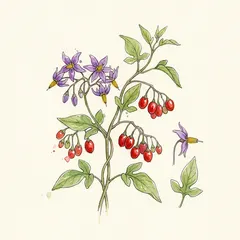
[SOLANUM DULCAMARA, BITTER-SWEET. NATURAL ORDER, SOLANE^E.]
It grows in hedges and thickets, especially in watery situations. Stem shrubby, zigzag, climbing along trees ; leaves petiolate, cordate- ovate, opposite; the flowers form cymes, with violet petals and orange-colored anthers. The stems are collected in the fall after the leaves have fallen. When fresh, these stems have an unpleasant odor, which they lose by drying.
Their taste is at first bitter, after- ward slightly acrid and sweet ; hence the name. It bears clusters of bright-red berries, which are picked off by birds. Of the stems we prepare a tincture which is of a dark brownish-green color and bitter- sweet taste.
From this plant we obtain an alkaloid, termed solanin, which is an opaque, whitish powder, readily soluble in alcohol.
CEREBROSPINAL GROUP.
Headache, even of a stupefying character, with coldness of the whole body, and disposition to vomit ; headache, boring, or digging as if the brain would expand, or headache as if a board were pressing against the forehead. Acute pains, swelling and insensibility in the affected parts.
F. P., aged twenty-seven years, has complained for two years of a continuous, dull pain in his head, chest and stomach, attended by great uneasiness, depression of spirits, labored respiration, with mental confusion and inability to collect his thoughts. For a year he had been treated for torpid liver and impaired digestion. Phosphoric acid, third dilution, in water, seemed to relieve the case at first, but soon ceased to give the patient any relief.
At last he received dulcamara, the third centesimal, in water, twice a day for a week, the administration of the remedy being followed by an entire cure. (Dr. Small in the U. S.
Med. and Surg. Jour, of October, 1873.)
A little boy, eighteen months old, swallowed a quantity of the berries of dulcamara ; among other symptoms, they caused a convulsive shock like the shock caused by an electric machine, which extorted piteous cries from the little patient; he was unable to walk or stand without support ; at the same time he picked at something in the air ; the pupils were very much dilated.
In the case of a young man of nineteen years, who was subject to cramps in the calves, and who had swallowed a large quantity of the extract of dulcamara, the cramps became excessive, so that the calf of the leg touched the thigh ; the hands likewise became cramped. During this attack, the pulse became slow and intermittent, the skin Mas covered with a cold, clammy sweat, and all his limbs trembled.
DULCAMARA. 83
CEAMPS. — We may avail ourselves of this indication for the pur- pose of prescribing dulcamara for cramps from various causes, but especially from rheumatic exposure, sudden suppression of the per- spiration, drying up of a sore, etc.
ORBITAL GROUr.
Dulcamara may cause amaurotic symptoms. The young man to whom allusion was made in the previous paragraph, after swallow- ing half an ounce of the extract at one dose, woke next morning with heat of the head, dizziness, obscuration of sight, hovering of black spots before the eyes. After this, he felt as if his eyes had protruded from their sockets ; they seemed immovable, a feeling of dryness and tension was experienced in them ; the pupils were very much dilated. Guided by such symptom, we may recommend dul- camara for
EHEUMATIO AMAUEOS1S, or for amaurosis consequent upon the sudden retrocession of some acute rash, to which dulcamara is homoaopathically related.
AURICULAR GROUP
EHEUMATIO DEAFNESS.— We have likewise given dulcamara for rheumatic deafness, or for deafness arising from the retrocession of some acute eruption, with buzzing and singing in the ears.
CHTLO-POIETIC GROUP.
In the case of the little boy just mentioned, dulcamara caused frequent but unsuccessful efforts to vomit, inability to swallow, inar- ticulate speech with continual attempts to talk. He kept thrusting his hand into his mouth as if he wanted to grasp at something, spit all around, took no notice of any body, heeded not what was said to him, attempted to scratch his father, and could scarcely be con- trolled.
Li the case of the young man, the tongue was swollen, rigid as if paralyzed ; the patient was unable to utter a word, and had to ex- press his wishes in writing. In
EHEUMATIO PAEALYSIS of the tongue, with swelling of the tongue, dulcamara may afford relief.
According to Linne and Starke, large quantities of dulcamara cause eructations, nausea, vomiting accompanied by heat and anguish ; dulcamara likewise causes a soapy taste in the mouth ; if these symptoms should occur as the result of a cold, dulcamara will prove the remedy
84 DULCAMARA.
DIARRlkEA, — Dulcamara causes a derangement of the intestinal functions resembling a catarrhal irritation, terminating in diarrhoea; a diarrhoea of this kind is generally accompanied by pinching or cutting pains in the bowels; the discharges may be watery, slimy or of a yellowish color. It has even been employed in bloody diarrhoea It may prove useful for the watery catarrhal diarrhoea of children in the summer.
The diarrhoea in which dulcamara exerts surprisingly prompt cur- ative effects is brought on by exposure" to dampness, lying on cold, damp ground, and, if chronic, is always aggravated by a change from warm to cold weather.
Dr. W. Gallupe \_Medical Investigator, April, 1874,] mentions the case of a lady, who was apt to suffer from diarrhoea at night, whenever she had taken cold or when the weather turned cold. The stools were watery ; she had much griping and shoot- ing pains through the bowels, and suffered from marked prostration when she labored under these attacks, which frequently continued four weeks. Rest here relieved some- what. Two doses of dulcamara, thirtieth dilution, taken on two successive evenings, cured her.
URINARY GROUP.
GONORRHOEA. — Dulcamara causes retention of urine (ischuria) with burning at the orifice of the urethra, anal has been found use- ful in gonorrhoea, especially from suppressed tetter.
BRIGHT'S DISEASE— Altschul recommends it in Bright's disease. Dulcamara causes a sedimentous urine similar to the urine which is secreted in Bright's disease of the kidneys, a granular de- generation of this organ, accompanied by dropsical symptoms and albuminous deposit in the urine. Considering that Bright's disease is always ^accompanied by catarrhal and gastric derangements, Altschul opines that dulcamara is worthy of our regard in this dangerous malady.
SEXUAL GROUP.
HERPETIC ERUPTIONS— Dulcamara has been employed for herpetic eruptions on the labia majora ; also for itching and pains in the pudendum; hence Hahnemann proposes this medicine as a remedy which may possibly be useful in the first stages of
NYMPHOMANIA, in which affection dulcamara may perhaps be indicated, if the retrocession of a tetter on the labia has given rise to it.
RESPIRATORY GROUP.
WHOOPING COUGH. — Dulcamara has caused a catarrhal cough;
DULCAMARA. 85
(according to Oarrere it causes bloody cough) ; it may be useful in whooping-cough, with expectoration ; also in HOARSENESS, and likewise in
ASTHMA from repelled eruptions ; it is recommended ra PLEURISY with effusion (plenritis serosa) ; also in PITUITOUS PHTHISIS and in bronchio-pneumonia (inflam- mation of the walls of the finest bronchial ramifications, with sero- albuminous purulent exudation) ; there may be stitching pains in the lungs when breathing, fever, headache. In the dogs upon which Orfila experimented with dulcamara, the lobules of the lungs were found with purple-red spots which crepitated less than the other parts of the lungs that had preserved their rose color.
EXANTHEMATOUS GROUP.
According to Oarrere. dulcamara causes: violent itching all over the body ; elevated red spots, like flea-bites, red spots all over ; tetter on the back of the hands ; tetter on the labia majora ; tettery crusts all over the body. It causes swelling of the inguinal glands; humid tetter with itching. In the case of the little boy above-mentioned, a rash broke out over the whole body, with an increased temperature of the skin. We may therefore recommend this drug for
CHRONIC URTICARIA, with itching, an eruption consisting of red spots, tips or blotches ; also for
HUMID HERPES under the arms and herpetic eruptions over the whole body. Frank mentions a case of herpes of- this sort, which was cured perfectly by means of a decoction of dulcamara.
EEVER GROUP.
It is especially in catarrhal and rheumatic fevers that dulcamara may prove useful ; such fevers are catarrhal and rheumatic irrita- tions with a feverish character ; they are marked by gastric symp- toms, white coating on the tongue, red and burning urine, drawing pain in the limbs, soreness of the flesh, headache of a stupefying character, dizziness. In
INTERMITTENT FEVER of a mild type, with heat predomi- nating over the chilly stage, gastric disorders, constipation, bloating of the bowels during the paroxysm, pappy mouth, slimy coating on the tongue which feels dry and looks inflamed, dulcamara may be a very useful agent.
86 ELAPS CORALLINUS.
'^LAPS OOKALLIK~TIS.
[BRAZILIAN" CORAL SNAKE.]
Higgins says (Ophidians, p. 108), "toxical effects of the elaps cor- allinus poison are less violent than those of the crotalus or elaps cuprocephalus, but are none the less worthy of study, as its action is very marked on particulars and viscera. The respiratory organs, those of deglutition and the brain, are first affected. Sudden and excrutiating pains present themselves in a particular organ or viscus or the muscles, are felt for a short time, and as suddenly cease, to re-appear in some other organ or part.
A flow of venous blood (the mixture of poison with the blood causes the latter to change its color to a very dark purple red) in coagula, presents itself from the mouth, eyes, ears, urethra, and from the wound or bite ; pains in the abdomen ensue; there is extreme sensibility to the touch in the whole body ; an almost total extinction of the pulse ; colic, diarrhoea; tremors in the muscles ; excessive thirst and subsequent oedema in the bitten part, succeeded by vomiting and fainting fits.
Death does not always ensue, and this poison is undoubtedly less virulent than that of the crotalus.
" The following expresses, at a glance its entire action : The intel- lectual faculties are clouded by illusions, accompanied by eruptions on the skin and a feeling of insensibility to the touch in certain parts. The preceding symptoms developed throughout the entire proving. The functions of the nervous system are excited, sensation in some is increased, and afterward diminished.
"The respiratory apparatus is very strongly affected from the first to the third day ; a feeling of insensibility in the penis from the first to the fourth day ; difficult deglutition from the first to the fifth day; derangement of the digestive functions from the first to the sixth day ; the abdominal regions being strongly affected at the same time ; the organs of the throat and abdomen, and the entire trunk are affected during the whole proving, with particular insen- sibility of the organs of the trunk ; eruptions in the cutaneous tissue from the first to the sixth day ; the matrix is notably affected from the third to the sixth day. The symptoms develop more par- ticularly on the right side of the body during the entire proving."
We use the trituration of the venom received on sugar of milk. The remedy is little known and but little used.
ELAPS CORA.LLINUS. 87
CHRONIC INFLAMMATION Dr. A. Clifton, of England, (British Jour, of Horn., Oct., 1873,) reports satisfactory cures made with it in chronic inflammation of the naso-pharyngeal mucous mem- brane.
The case was one of long standing. The characteristic symptoms were : sore throat, offensive discharge from the nose, occasional epistaxis. The posterior wall of the throat was covered with a dry, greenish-yellow membrane, wrinkled and fissured, which extended into the nares. Occasionally portions of this would become detached and expelled, leaving the surface raw or corrugated ; stuffi- ness about the root of the nose and a dull aching pain from there toward the forehead ; when swallowing, pain extended into the ears ; loss of sense of smell ; headache in the occiput after mental exer- tion ; face of a dull, yellowish color ; digestion weak ; catamenia every second week, generally dark and profuse ; skin hot and dry ; pulse 40, hard and full.
Elaps6, in half-drop doses three times a day cured the patient in a month.
CHRONIC OTORRHCEA, with high febrile condition ; offensive discharge from the right ear, of three years standing, with deafness in that ear ; constant buzzing noise in the diseased ear ; skin hot and dry; pulse, 126. Under the use of elaps cor., 6 and 12, the patient made a perfect recovery.
CHRONIC ULCERATION OF THE THROAT, with difficulty of swallowing, occurring five to six times a year, and lasting from two to three weeks at a time ; the attacks are brought on by exposure to rain or wind. Lachesis and sulphur had given temporary relief only ; elaps cured permanently.
CHRONIC STUFFING OF THE NOSE, with stoppage high up in the nostrils, of very long standing ; always worse in wet weather; occasional bad smell from the nose; absence of offensive discharge ; occasional bleeding on violent blowing of the nose ; there was no loss of smell ; swallowing caused a pain which extended from the root of the nose to the ears. The continued use of elaps, sixth dilution, removed the whole train of symptoms.
OTITIS MEDIA SUPPURATIVA CHRONICA.— Dr. Rounds [Halm. Monthly, Nov., 1877,) recommends it in otitis media suppur- ativa chronica when there exists a greenish-yellow or a watery dis- charge. Much itching in the ear. The nostrils are plugged with lumps of dry mucus. The patient breathes through his mouth when asleep.
EXCESSIVE ITCHING IN THE EARS.— Dr. C. A. Cochran
88 ELAPS CORALLIiSriJS.
{Halm. Monthly, March, ] 871,) relates a case of excessive itching in the ears, in a man, aged fifty, who had also suffered from an irrita- ble throat, which was broken out with red blotches, about as large as the half of a split pea, extending over the soft palate and the inner cheek, and bleeding upon the slightest irritation. The use of acid, fluoricum30 relieved the itching, but this suppression was fol- lowed by a watery, yellow discharge from both ears. Elaps cor.200 cured the case.
AMBLYOPIA Dr. E. W.
Berridge claims to have succeeded in greatly relieving with one globule of elaps200 a case of amblyopia, when other remedies failed. The following symptoms caused the selection of the remedy : " Sometimes dark spots, as large as a penny, before the open eyes ; by keeping the eyes still, they gradually diminish and disappear ; they do not move with the eye ; they last two or three seconds at a time. Sometimes, for two or three seconds, there is a dirty-red spot before the open eyes, of half the size of a hand, square or pointed.
Sometimes when the eyes are closed, there is a dirty-red appearance, covered with black spots."
" It appears to be especially curative in paralysis of the nerves of the organs of the senses, with accompanying hypereesthesia of the trigeminus (chronic headache), which must be of great importance in the innumerable cases of nervous dysecoia dependent on paralytic states of the auditory nerves. A man who was amaurotic in the left eye for three years, and now got blind in the right eye also (every- thing appeared to him white, even at night ; he could scarcely dis- tinguish between light and dark); he likewise complained of violent headache, with drawing, sometimes shooting pains from the forehead to the occiput.
He was completely cured of his headache by elaps, and of the amaurosis so far as to be able to resume his work. A rheumatic diathesis was evidently present in this case and in many others cured by elaps. Elaps cured a right-sided hemiplegia (with numbness of the whole of the right side of the body, great weakness and coldness in it), difficulty of swallowing saliva, blackness before the eyes and vertigo, and shooting pains, increased by movement and the heat of the bed." (Mr. A.
Clifton.)
H2EMOPTYSIS. — Dr. Charge recommends elaps for haemoptysis, when the expectorated blood is very dark, almost black, its expecto- ration preceded by a taste of blood in the mouth, and when there is, with the cough, a feeling of laceration in the region of the heart. Laryngeal or pulmonary phthisis.
ELATERIUM. 89
MENORRHAGIA of black blood, with weight in the uterus and in the vagina, with bearing down, itching in the vagina and irritation on the valva may call for elaps, when accompanied with vertigo, rush of blood to the head, spots before the eyes and great mental depression.
Elaps is curative in the following diseased conditions of the skin : Boils on the arm . Crusty eruption on the ears and cheeks. Pimples, full of serum. Furfuraceous tetters on the scalp. Vesicular erup- tion on the feet. These are accompanied by a feeling of itching, pricking soreness and excoriation.
ELATEEIUM.
[wild cucumber, squirting cucumber.]
Dr. T. K. Chambers gives the following description of the physio- logical action of the wild cucumber: "It causes an enormous flow of watery serum from the first mucous membrane that absorbs it.
If its vapor be drawn, up into the nostrils for a short time, it is a powerful errhine, and is followed by the secretion of floods of water from the Schneiderian membrane ; if it is dissolved in the oesophagus it causes such a deluge of the gastric fluid, that the stomach cannot contain them, and they are rejected by vomiting ; if it succeeds in passing the pylorus, a choleraic diarrhoea gushes forth, stripping the membrane of its epithelium just like its morbid prototype." (Hughes Pharmacodynamics, page 274.)
Elaterium has caused : copious liquid stools, painless, very liquid and of a dirty color ; watery discharges from the bowels of a frothy character. Also : nausea, vomiting ; exceedingly severe and pro- tracted nausea ; vomiting of dark brown fluid mixed with food, accompanied with much prostration ; vomiting of a small quantity of clear liquid. Vomiting and eructations of the odor of bad eggs. Pain in and oppression at the epigastrium. Elaterium has cured
CHOLERA, characterized by the above symptoms. It resembles veratrum in its action, and has been given successfully in cases in which veratrum seemed indicated but failed to cure ;
CHOLERA INFANTUM, with frequent, frothy, watery or pea- green stools.
It has caused : increased flow of limpid urine ; high-colored urine of acid reaction. Fugitive, sticking pains in the right lumbar
90 ELATERIUM.
region ; slight aching in the region of the left kidney. It has been made use of in
URETHRITIS, CYSTITIS, acute and chronic, and other de- rangements of the urinary organs, which might find their simile in the above, n<5t very pointed, symptoms. Eclectic physicians speak of it highly in urinary disorders. It produces a very free discharge of urine ; hence its occasional use in
DROPSICAL EFFUSIONS, general anasarca, etc.
Provers have experienced : chilliness with continued gaping, as if an attack of intermittent fever were approaching ; fever came on after a few hours and lasted until the following day. Depression of spirits. Offensive breath. Bitter taste in the mouth ; the tongue coated with a dirty-brown fur.
The above symptoms indicate its use in
INTERMITTENT FEVER— Dr. Francisco Firmat cured a well-developed type of a quotidian intermittent by the administration of elaterium, sixth dilution, given every two hours during the apyrexia. (Halm. Monthly, Feb., 1875.)
We find recorded : pains extending from the shoulder to the ends of the fingers, and shooting back up to the elbow. Dull pains in the right shoulder, forearm and hand, extending to the fingers. Sharp shooting pains in the axilla, near the insertion of the pectoralis major muscle. Shooting and dull aching pains in the left thigh, in the course of the sciatic nerve, extending down to the instep and out to the extremities of the toes. Pain in the right knee, extending to the instep and to the toes.
RHEUMATISM. — The above symptoms establish its homceopath- icity to certain forms of rheumatism ; and more particularly to
SCIATICA RHEUMATICA, of which at least one apparently re- liable cure has been reported.
We use the tincture of the green fruit and dilutions made from it. Also a tincture made from the juice of the fruit, diluted in alcohol.
ERIGERON CANADENSE. 91
ERIGERON OAl^ADEI^SE.
[CANADIAN" PLEABANE. NATURAL ORDER, COMPOSITE.]
This common plant, also called white-weed, is well known to you. Growing almost everywhere, its plain, unattractive white flowers are seen in nearly every meadow during the months of June, July and October ; the plant itself is a source of great annoyance to the thrifty farmer.
Popular belief has attributed to the plant certain medicinal virtues, particularly the power to arrest bleeding. Pereira and other emi- nent alloeopathic authorities fail to mention it, although it is spoken of in the Transactions of the Med. Phys. Society of New York, 1817, having then been in limited use for several years as a remedy for diarrhoea and dysentry.
Dr. Burt made a proving with the drug, using the tincture in light doses, triturations of the oil with sugar of milk and a decoction of the dried herb.
VESICAL CATARRH— Erigeron has been used for vesical catarrh with pain, irritation, profuse secretion of urine and occasion- ally more or less severe tenesmus of the bladder.
DYSURIA, especially in children, with symptoms like the above, sometimes the external organs are inflamed and swollen.
GONORRHOEA, with increase of urine, often offensive ; drawing pain in the back, running down to the right testicle.
DYSENTERY, when there is much irritation of the urinary orgaus, small passages of thin bloody stools, mixed with hard lumps of feces and accompanied by severe, colicky pains. "The more bloody the stools, and the greater the irritation of the urinary organs, the stronger is the indication for its use." (Dr. Douglas.)
Erigeron, used internally or topically, has a well-deserved reputa- tion as a leading remedy in haemorrhage from various organs. In
UTERINE HAEMORRHAGE it has become indispensable. It is alike useful in excessive menstruation, becoming a true haemorrhage, and in those exhausting attacks of uterine bleeding which form a most unpleasant feature of the so-called critical age of womanhood. In excessive flooding during and after miscarriage and confinement at full term its promptness has saved life in many instances. The flow itself is of a bright, red color and is increased by. every move- ment of the patient.
92 ERYNGIUM AQUATICUM.
In a report read before the American Institute of Homoeopathy (1874), Dr. Mercy B. Jackson relates the case of a woman, whose life was threatened by excessive uterine hemorrhage, during the critical period, which returned periodically. Con- siderable irritation in the rectum, tenesmus of the bladder and diarrhoea led to the use of erigeron canadense.
The sixth dilution of the remedy was given in water and a small piece of cotton, saturated with the solution, placed against the mouth of the uterus. In a short time the menorrhagia was checked, and disappeared entirely after a few days, instead of running its accustomed course of three weeks.
HAEMORRHAGE. — Erigeron is of use also in epistaxis ; haemor- rhage from haemorrhoidal tumors ; bleeding from teeth and gums.
We use the tincture of the whole plant and dilutions made from it. Also the oil of erigeron, which is of a yellow color, of very acrid taste and of a characteristic odor. Dilutions of this oil in alcohol, in the decimal scale, are frequently prescribed.
We have found a solution of one part of the oil in ten parts of alcohol, given in drop-doses in water, far more satisfactory than the higher attenuations.
ERYE~GIUM AQUATICUM
(Seu Yuccffifolium.) [BUTTON SNAKE- ROOT. NATURAL ORDER, UAIBELLIFER^.]
This is a perennial herb, which grows on the prairies and pine- barrens of the south and west. It grows from one to five feet high, is very glaucous ; erect and simple stem ; leaves are broadly-linear, ciliate with remote soft spines. The bracts are tipped with spines, those of the involucles entire, shorter than the ovate-globous heads. Its leaves are long and slender, often from one to two feet in length and from one-half an inch to one and a half inch wide.
The flowers are white, inconspicuous, and disposed in ovate heads which are pedunculate. (Wood.)
This remedy is known and used but little. Provings have been made which suggest its use in the followiug complaints :
COUGHS with irritation of the mucous membrane of the throat and larynx ; short hacking cough ; expectoration of small amounts of yellowish mucus.
CATARRHAL INFLAMMATIONS with nervousness; shifting, quick, rheumatic pains here and there; dizziness; frontal headache; soreness and congestion of the conjunctiva of the eye, with intoler- ance of light, ^watery and even pus-like discharge from the eye.
GONORRHOEA AND LEITCORRH03A.— Eryngium has caused stinging, burning pain in the urethra, behind the glans penis during
ETHEE. 93
urination ; severe pain in the left testicle, etc. It has therefore been given in gonorrhoea and leucorrhcea. Dr. L. S. Morgan attributes to it highly curative powers in gonorrhoea, especially if there is present great sexual irritability.
SPERMATORRHOEA— Dr. Parke reports, in Hill and Hunt's Surgery, several cases of spermatorrhoea successfully treated with it after other remedies had failed to cure. It has also been used in
RENAL COLIC, and seems to exert a truly curative effect in this painful malady. Dr. I. J. Whitfield relates the following cases :
Mrs. W., twenty-three years old, married, and of fine, health7 physique, has suf- fered from her childhood with renal colic, coming on once or twice a week, occasion- ally disappearing for some length of time. I prescribed for her over a year without giving any positive relief. At last she received eryngium aquaticum, first dilution in water, one dose every four hours.
About three months later she had a violent renal colic, followed by great urging to frequent urination, which was painful, and resulted in the expulsion of a calculus, of dark brown color, smooth on one surface, rough on the other surface and on the borders, and of the size of a hazel-nut. Since then, now a year and a half ago, she has been absolutely free from her old trouble.
Mr. D., aged forty years, of light complexion, fleshy, nervous temperament, had been under medical care for bilious colic and for stricture of the urethra. The colic attacked him every two or three weeks. Eryngium aquaticum, given as above, cured him in a month. Although he has not passed a calculus, he remains up to date (a period of ten months) perfectly free from his old annoyance.