 Homeopathy Library
Euphrasia Officinalis
Hempel - Materia Medica and Therapeutics · Charles Julius Hempel · 9,422 chars
 All books on Euphrasia Officinalis →
Antidoted byCamphoraCausticumHydrophyllum VirginianumPulsatilla Pratensis
All books on Euphrasia Officinalis →
Antidoted byCamphoraCausticumHydrophyllum VirginianumPulsatilla PratensisGeneral
[eyebrigiit. natural order, rhinanthace^e de cand.]
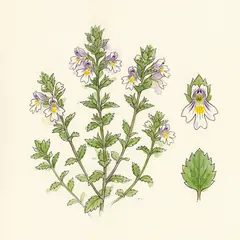
This little plant is found all over Europe and likewise in North America. It flowers annually from June until September. The stem is several inches high ; flowers axillary, solitary, mingled with the small leaves, and forming a leafy spike at the tops of the branches and stems of the plant. The corolla is most commonly white, with deep purple streaks. This flower is found on heaths, on mountainous meadows. We make a tincture of the whole plant, having a dark-green, almost blackish color.
Hahnemann's provings of euphrasia confirm the curative virtues with which this drug has been supposed possessed of in ophthalmic diseases. Among the symptoms which have been recorded by Hahnemann and his disciples, the following occupy a prominent place : Contraction of the upper and lower lids. Obscuration of sight for three days. The light hurts the eyes, as if one had not slept long enough.
Smarting in the eyes, a smarting liquid flows out of the eyes. Eye-gum in the canthi, even in the daytime. Troublesome dryness of the eyes.
According to Lobelius and Simon Paulli, quoted by Hahnemann, the use of euphrasia, in a case where it was continued for several months, caused such a violent catarrhal inflammation that the indi- vidual came near losing his sight.
CATARRHAL OPHTHALMIA These toxical and pathogenetic
effects indicate euphrasia in catarrhal ophthalmia, with profuse lach- rymation, congested appearance of the conjunctiva, catarrhal irrita- tion of the frontal sinuses and the Schneiderian membrane, sensitiveness to light. This seems to be the chief therapeutic range of euphrasia, an irritation of the mucous lining of the bulb of the
EUPnORBIUM OFFICINALIS. 109
oye and lids, which maybe continued to the frontal sinuses, the nose and even further down to the chest, giving rise to catarrhal cough, with expectoration of mucus and some dyspnosa. Even in
CHRONIC SORE EYES, resulting from a more or less acute, but mismanaged or neglected irritation of the mucous lining, euphrasia may still be in its place as a chief remedial agent. In this condition the eyelids may be swollen, and the cornea may have be- come dim, partially or entirely.
A man of forty-five years had been afflicted for several years in the hot summer- months with a troublesome catarrhal ophthalmia, which finally invaded the two eye- lids and resisted all treatment. After bathing the eyes with the water of euphrasia, the troublesome itching of the lids and the profuse secretion of mucus at once abated. Afterward, the tincture of euphrasia was taken internally at the rate of three drops every morning. A few hours after swallowing the first dose, a profuse quantity of mucus was discharged from the nose, as during a violent catarrh ; in the course of the day he experienced a good deal of movement in the bowels, as if he had taken cold, with an urging to diarrhoea, .which, however, did not take place ; in eighteen hours he had a regular motion of the bowels.
After the lapse of forty-eight hours the affection of the eyes was much worse ; he again took three drops of euphrasia ; the peculiar move- ment in the bowels, with a sensation as if diarrhoea would set in, again made its appearance ; moreover, he was attacked with sleeplessness about three o'clock in the morning, which lasted several hours, and was attributed by the patient to the action of the medicine. The stool was perfectly natural ; in a few days the eyes were en- tirely restored.
The provings show that euphrasia not only irritates the retina and the mucous lining of the eyes, but that its irritating action likewise extends to the Schneiderian membrane, to the mucous lining of the frontal sinuses, face, jaws, throat, bowels, extremities. Its influence over this vast mucous expanse seems to be continued through the agency of the ganglionic system which is undoubtedly acted upon by this drug. In these various regions of the body the catarrhal nature of the action of this drug is manifested by symptoms like the follow- ing: Boring pain in the right inner ear.
Stiffness of the left cheek when talking and masticating, with feeling of heat and single shooting stitches in the same. Prickings in the left lower jaw, dart- ing from behind forward, at dinner, and impeding mastication. Painless rumbling in the bowels, as one may experience when hungry and the bowels are empty. A sort of oppressed feeling in the bowels, a burning, pressing pain across the bowels, during rest and motion.
Short paroxysms of pinching in the bowels. These various symptoms have no therapeutic value except in so far as they belong to a group of symptoms denoting a general
CATARRHAL IRRITATION of the tissues, which may be like- wise characterized by a more copious emission of urine, to which the following symptoms reported by Langhammer and Wislicenus seem
11.0 EUPHORB1UM OFFICINALIS.
to refer: Frequent emission of urine, and frequent emission of a watery urine.
The relation of euphrasia to catarrhal affections is likewise made manifest by its action upon the respiratory lining membrane, and which is delineated in the following record : Sneezing, with profuse fluent coryza and copious discharge of mucus from the anterior and posterior narcs. Profuse fluent coryza and violent cough with expectoration. Fine stitches under the sternum during an inspiration.
The symptoms characterizing the action of euphrasia upon the back and extremities, fully confirm its use in catarrhal-rheumatic affections ; here we have : crampy pains in the back. Tearing in the elbow and wristjoints. Violent prickings in the anterior muscles of the thigh. Painful tension in the hamstrings as if too short. Boring stitches in the fibula, from below upward. Pain in the peri- osteum of the left fibula, moving up and down.
These symptoms might point to a number of other drugs; but in connection with a general state of catarrhal-rheumatic irritations of the organism, including the various regions which we have passed in review, our attention will necessarily be directed to euphrasia by the integral pathological group.
We have a right to suppose that the prominent and characteristic manner in which every portion of the mucous expanse is acted upon by euphrasia, is in a great measure owing to the fact that the gangli- onic system is powerfully affected by this drug. This theory is corroborated by its disturbing influence over sleep. One of the patients whose cases have been related in previous paragraphs, com- plained that the euphrasia he took, deprived him of sleep. A similar symptom is reported by Hahnemann, which at the same time shows euphrasia is possessed of some specific power of disturb- ing the nervous equilibrium; the symptom reads: "Paroxysm, three mornings in succession ; after three o'clock in the morning he wakes every few minutes ; at six he falls into a stupid sleep, without dreams ; he wakes with a pressure in the upper part of the chest, his head feels giddy and heavy ; he feels sick at the stomach, a per. spiration breaks out upon his whole body ; the giddiness increases from the least motion, as if he would fall to one side, all his limbs feel weak and trembling ; on rising, the trunk feels too heavy as if his limbs could not support the weight; gradually the paroxysm abates until noon ; his spirits feel dull."
This symptom shows that the catarrhal irritation to which
EUniORBIUM OFFICINALIS. Ill
euphrasia is homoeopathic, is not a simple catarrh, but a catarrh where the nervous system is considerably involved, partaking of the character of influenza, and most probably developing febrile symp- toms. Indeed our provers report : internal chilliness, the whole fore- noon ; chilliness all over; redness and heat of the cheeks, also with cold hands (without thirst) ; feeling of exhaustion, especially in the lower limbs ; itching stinging all night, in various parts, making him restless. "Thoughtful and taciturn, all day."
To sum up: Euphrasia is in homoeopathic specific rapport with catarrhal affections of the mucous surfaces, which result by a process of continuous action from a primary catarrhal irritation of the peripheral derivations of the ganglionic system. By grouping this general catarrhal irritation in accordance with such pathological forms as may happen to constitute more prominent elements of the series, we may recommend euphrasia for catarrhal headache, con- junctivitis and amaurosis, nasal catarrh, bronchial catarrh, influenza, catarrhal fever.
There are several varieties of euphrasia which are equally endowed with medicinal properties. Some have small, some large leaves, whose color likewise varies from a light to a dark-green hue, in con- sequence of which the alcoholic tincture, which should always be obtained of the whole plant, likewise varies in color, sometimes pre- senting a pale-green and at other times a deep brown -green appear- ance. If the tincture is obtained of the recent plant, it has the pleasant fragrance of fresh meadow grass.
This tincture becomes altered in time ; its color changes to a violet brown, and a glutinous substance of a similar color is deposited on the upper walls of the empty portion of the flask. Hence the tincture should be made fresh every year, and should not be exposed to the light or to exces- sive warmth of the room, for these influences favor its decomposition.
112 EBKEUM.