 Homeopathy Library
Gelsemium Sempervirens
Hempel - Materia Medica and Therapeutics · Charles Julius Hempel · 50,065 chars
 All books on Gelsemium Sempervirens →
Antidoted byActaea RacemosaAtropinumCinchona OfficinalisCoca Erythroxylon CocaCoffea CrudaDigitalis PurpureaMagnesia PhosphoricaMagnesium PhosphoricumNitro Muriatic AcidNux Moschata
All books on Gelsemium Sempervirens →
Antidoted byActaea RacemosaAtropinumCinchona OfficinalisCoca Erythroxylon CocaCoffea CrudaDigitalis PurpureaMagnesia PhosphoricaMagnesium PhosphoricumNitro Muriatic AcidNux MoschataGeneral
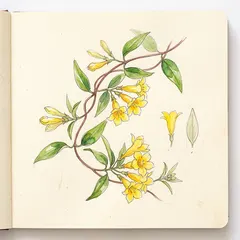
[YELLOW JESSAMINE. NATURAL ORDER, APOCYNEZB.]
Wood gives in substance the following description of this plant: It grows in the woods and on the banks of streams, from Virginia to Alabama and Florida. It is very abundant. A slender vine, twining and overrunning bushes and low trees and flowering pro- fusely. The leaves are coriaceous (leather-like), shining, revolute (rolled backward) at the edge, lanceolate, acute at each end, short- petioled.
The cor. tube is one inch long, of a rich, golden yellow. In one variety the stamens equal the corolla and the style is but half as long ; in the other, vice versa.
122 GELSEMIUM SEMPERVIRENS.
We make a tincture from the green root; from it, attenuations are prepared in the usual manner. Gelsemin represents the active principle of the drug and furnishes the base for triturations with sugar of milk.
Br. McCoy, in the Am. Eel. Med.
Journal of 1869, relates the fol- lowing : "A Mr. Eobinson had, by mistake, taken two large-sized teaspoonfuls of the fluid extract of gelsemium, without experiencing, for several hours, one unpleasant symptom, except a drooping of the eyelids. He took in the course of a few hours several cups of coffee, slept for more than an hour, and upon awakening took some refresh- ments. He had just finished eating and drinking," relates Dr.
McCoy, "when I entered the room. His eyesight, he said, was much improved ; he could open his eyes. But while the family were jocosely relating that, when he attempted to feed himself, in making the effort to bring the food to his mouth, his arm would straighten out, and carry his hand away from him. Mr.
R. remarked that he felt a tightness come across his throat. In a few moments his breathing was disturbed ; convulsive movements extended over his whole body ; his voice was suppressed ; the epiglottis would close with convulsive spasms, and he could only breathe or expire by a con- vulsive effort to throw the air up through the nostrils. He would raise himself in bed on his hands and knees, as the best position to breathe in. He was speechless for twenty minutes.
His skin be- came purple; his countenance spotted; his pulse would reel and quiver, and then intermit for five seconds or more, then bound off with more than natural vigor. The pupils of his eyes were dilated to the sclerotic. He said, persons appeared to him more like shadows than individuals.
"After applying a cold compress across the throat, we got some brandy down, which seemed to strengthen the pulse some. Ordered chloroform, with which we commenced rubbing his spine profusely, and frictions to the extremities. No sooner was the chloroform ap- plied than the respiration began to improve, and in ten minutes his breathing was natural ; his voice returned ; convulsions ceased, and all was going on well. With an occasional dose of brandy and quinine, Mr.
K. passed a good night, and was on his feet next morning."
In the Horn. World of November, 1873, three cases of fatal pois- oning with gelsemium are briefly mentioned. A boy, three years old, took by mistake about 50 minims of the tincture of gelsemium and died in two hours. The first symptoms noticed, were double-vision, then a staggering gait showed itself, followed by complete muscular relaxation.
The second case was that of a girl, nine years old, who was ordered a dessert-spoonful of the tincture of gelsemium every two hours. She was only slightly indisposed, but soon after taking the first dose she began to complain of dimness of vision, of seeing
GELSEMIUM SEMPERVIRENS. 1%'u
objects double and of the loss of muscular power. She died before the time for taking the second dose.
A boy, three years old, not ill enough to be in bed, was ordered a mixture containing ten grains of sulphate of quinine, one drachm of the tincture of gelsemium, and five drachms of syrup, a teaspoouful to be taken every two hours. After the Mist dose ho became pros- trated and staggering in his walk, but not enough to excite alarm until after the second dose had been taken. I saw him about half an hour after the second dose, and found him limps as a rag ; pupils dilated ; froth at the mouth, and the heart beating feebly and slowly ; pulse imperceptible at the wrist.
He could not swallow, but rallied slightly after stimulating enemas. He died in half an hour after I first saw him.
Dr. J. T. Main wrote to the Boston Med. and Surg.
Journal of April, 186U, that he took by mistake one drachm of fluid extract of gelsemium and started immediately to S3e a patient eight miles distant. Before arriving he became nearly blind ; lost entirely the control of the upper eyelids ; the flexor muscles of the hands and arms were paralyzed, and the extensors nearly so ; sensation in the hands and arms became blunted, but not in proportion to the loss of motion ; speech somewhat affected ; and a very disagrceble sen- sation in the head was felt soon after taking the drug, but the mind remained clear.
He was immediately relieved by the application of the galvanic current.
In the case of several deck-hands of a steamer, who helped them- selves freely to the tincture of gelsemium from a barrel, in the belief that it was whisky, it produced the following effects : " They looked very much like dead men ; their eyes were closed ; the circulation was very feeble ; the pulse imperceptible, and the breathing nearly so. Stimulants were given freely and the men made a prompt re- covery.
Gelsemium acts powerfully upon the nervous system. Its action upon the nerves of sensation shows itself in the shooting, darting pains experienced by pro vers ; these pains are now dull, then dis- tressingly severe, extending into the eyes and jaws, running up and down ; twitching and jerking ; at one time fastening themselves upon some particular spot, again, jumping from one place to another. The nerves of motion are still more powerfully affected ; they become utterly depressel, even paralyzed.
Wherever decided drug-effects are produced, we find the same loss of control over the voluntary move- ments of the body. In the case of a dog poisoned, reported by Dr. Hale, there existed paralysis of the posterior extremities and, later, paralysis of the entire voluntary muscular system. In one prover gelsemium caused paralysis of the flexor muscles of the hands and
124 GELSEMIUM SEMPERVIRENS.
arms and a semi-paralytic state of the extensor muscles; muscular weakness of the upper eyelids (drooping) is almost characteristic of the remedy. Profound prostration of the entire muscular system is so universally present, that it is considered one of the most reliable indications of the remedy. The mind also becomes affected ; there is dullness of the mental faculties ; inability to think, to concentrate one's thoughts upon any one thing. The action of the heart becomes depressed, and if the number of the heart-beats is not always lessened, the pulse becomes soft, frequent, feeble, fluttering and even imperceptible.
CEPHALIC GEOUP.
Constant pain in the head, generally dull, stupefying and pressive, more frequently in the forehead and temples. Braised pain above and back of the orbits. Tightness of the brain. Headache, accom- panied by nausea, giddiness, tendency to stagger; also blurred vision.
Headache aggravated by smoking. Heaviness of the head, better after profuse emission of watery urine. Dull ache on the right side of the head ; dizziness, followed by confused vision. On rising, a dull pain in the occiput, and slight tendency to throbbing in the right side of the head.
Headache, shifting about. Settled, dull, dragging headache, mainly in the occiput, mastoid and upper cervi- cal region, extending to the shoulders, relieved when sitting and by reclining the head and shoulders on a high pillow. (Dr. J. 0.
Morgan.)
A sort of mistiness within the brain, not much affecting the lucidity of thought, but confusing the power of perception. Brain feels as if bruised. Sensation of a band around the head.
HEADACHES. — Gelsemium acts curatively in headaches of nervous, excitable, sensitive persons, and in headaches depending upon a passive congestion of the brain, accompanied by symptoms resembling those just enumerated.
Miss M. G., twenty-six years old, has suffered for several years with a severe form of headache, characterized by a dull, heavy pain extending from the occiput in a straight line forward to the root of the nose, then branching off toward the right temple ; sometimes the headache was general, but it was invariably accompanied by great prostration, dizziness, slight nausea and aggravation of the pain from exertion. There was little disturbance of the pulse. Gelsemium 1st decimal dilution cured her in two months ; occasionally the remedy was given in the third trituration of gelsemin.
A gentleman, forty years old, of nervous temperament, a lawyer by profession and a life-long, hard student, has suffered for several years with an almost constant head- ache, characterized by fulness in the head, heaviness in the occipital region, indis- tinct vision and, occasionally, severe vertigo. There exists heaviness of the upper
GELSEMIUM SEMPERVIRENS. 125
eyelids, great muscular weakness, dullness of mind. During the last six months lie has been exceedingly nervous ; cannot sleep at night; twitching and jerking. Loss of appetite. Whitish, dirty coating of the tongue. Cured, in a short time, by gelsemium8, three doses each day.
Gelsemium has caused giddiness, feeling of intoxication, vertigo, even to falling down. It is a valuable remedy in the treatment of
VERTIGO, usually accompanied by dimness of vision, malaise, headache.
S. S., aged three years. Every two or three days he would have vertigo with blindness, causing him to fall down. At times the blindness comes on gradually, and he stumbles over every little thing in his way. He is troubled with worms. Prescribed gelsemium, 4th dilution, night and morning for a week. Cured. (Dr. C. H. Lee in Am. Observe?-, 1S65.)
Mrs. P , while walking would experience a dull feeling in the head, after
which there would be total blindness for ten or fifteen minutes. After the blindness was over she would be perfectly well. Is very seldom sick. Looks well and hearty. Gave gelsemium, 4th dilution. Cured. [Ibid.)
A lady, who had given birth to several children, was subject to serious attacks of vertigo, which were attended with dimness of vision and fever, during which she would appear like one intoxicated. The third dilution of gelsemium, given night and morning in drop-doses in water, effected a radical cure. (Dr. A. E. Small, U. S. Med. and Surg. Journal, July, 18 71.)
Gelsemium has been found of use in the following, more serious disorders
H YPERiEMIA of the brain, especially that form, which develops gradually during the period of dentition.
SUNSTROKE, followed by great prostration ; general malaise ; dull, heavy pain in the head ; vertigo with loss of sight.
MENINGITIS CEREBRO-SPINALIS EPIDEMICA (spotted fever) characterized by : great prostratiou , complete loss of muscu- lar power, of vision and speech ; pulse very feeble, respiration labored, feeble; nausea and vomiting. (Raue.)
NERVOUS GROUP.
Dr. Henry experienced : pains of a shooting character in the frontal sinus, extending to the eyes and jaws. The pain in the eye is of a pricking character, extending from the bridge of the nose to the eye. Violent shooting pain in the leg, which comes on in par- oxysms ; every one is more violent.
Pain in the left side of the hip, confining itself to the joint, extending sometimes to the outside of the thigh. The pain is of a drawing, sharp character and much worse on motion. Pains in the neck. On the right side the pain extends from the last back tooth up to the temple.
Short paroxysms of pain in the superior part of the right lung. A band-like pain, which surrounds the head, with shooting pain in each jaw and
126 GELSBMIUM SEMPERVIRENS.
parietal bone ; pain in the left side of the head, extending from the prominence of the parietal hone to the mastoid process of the tem- poral. It is periodical in its nature.
These symptoms correspond closely with various forms of neuralgia; the drug has been found of great value in the treatment of
TIC DOULOUREUX (neuralgia of the Trigeminus). The pains are darting and paroxysmal ; they may be located around the eye, or follow the course of the infraorbital nerve ; there will be twitchings of the muscles of the face ; great nervousness ; loss of control over the voluntary muscles. Dr. R. Ludlam says : it has been employed with marked success in periodical cases, especially of the quotidian type.
Other provers have experienced : shooting, keen pains in the upper part of the sterno-cleido muscles; dull, aching pains in the muscles of the back and along the spine, especially in the lumbar and sacral regions. Rheumatic pains in the muscles and joints of the arm and forearm, with weakness and numbness, paralysis of the flexors and extensors, coldness of the hands. Dull aching pains in the muscles of the limbs and in the joints ; sharp, shooting pains in the lower extremities, violent shocks of pain darting along the nerves; trembling of the limbs; fatigue of the lower limbs after slight exercise ; heaviness in the limbs, with unsteady gait, trembling and weakness, coldness of the feet and legs ; symptoms of beginning paralysis.
SPINAL EXHAUSTION.— The above symptoms justify the use of gelsemium in spinal exhaustion and in
POSTERIOR SPINAL SCLEROSIS with strabismus, ptosis, visual disturbances, involuntary urination, involuntary emissions without erection, cold and relaxed state of the genitals, keen, dart- ing pains in the extremities and back, paralysis.
PARALYSIS, especially of the nerves of motion without seriously affecting the nerves of sensation. Prickling, crawling, tingling in the muscles; trembling of the hands when lifting them up; great dullness of mind ; mental exertion causes a sense of helplessness from brain weakness. This remedy is very valuable in the treatment of paralysis which occurs as a sequela of diphtheria.
EPILEPSY. — Gelsemium has also been recommended in the treatment of epilepsy and of tetanus. Clinical evidence to substan- tiate this claim comes to us mainly from the physiological schools and is by no means convincing. Long-continued passive congestion
GELSEMIUM SEMPERVIRENS. 127
to the brain may result in cerebral disturbances, culminating in what might be taken for epileptic seizures; in such conditions gelsemium, if homoeopathic to the case, would act curatively. In true epilepsy its administration would be little more than a waste of time. There is very little in the pathogenetic record of gelsemium to suggest its use, upon homoeopathic principles at least, in the treatment of tetanus.
APHONIA. — Gelsemium has caused hoarseness and aphonia; also paralysis of the vocal cords and of the organs of deglutition. We may use it in aphonia, following diphtheria, and in
LARYNGISMUS STRIDULUS with long, labored inspiration with croupy sound and sudden, forcible expiration.
Dr. Horton (Hale's New Remedies, second edition,) relates the case of a woman, twenty-six years old, who had taken cold and suffered from hoarseness, cough and slight fever, but seemed to do well under the action of the indicated remedies. During the forenoon of the third day she was attacked with spasms of the glottis, which increased persistently, until the suffering of the patient was extreme. " The inspiration was so laborious that it required all the voluntary power she could exert, and was attended with a hoarse, croupy sound, which could be heard all over the house.
The excessive labor of breathing was attended with profuse perspiration; the face was livid, and she momentarily expected to die." She was given drop-doses of the tincture of gelsemium in water, every five, ten or fifteen minutes, went to sleep within three hours and made a good recovery.
INFLAMMATORY GROUP.
Gelsemium does not cause true inflammation ; nevertheless, it is a valuable remedy in certain inflammatory conditions. Pro vers have recorded: Dryness, irritation and soreness of the fauces; sensation of heat in the throat, difficulty of swallowing; a sensation as if something had lodged in the throat; escape of fluids through the nose when vomiting.
DIPHTHERIA.— The drug has been used in the treatment of diphtheria with "much tingling of the parts during the fever; in- cipient paralysis or angesthesia ; defective or impaired vision ; objects appear a long wTay off, are seen double or inverted." (Raue.)
CROUP. — In croup of the spasmodic type, with a well-marked tendency to spasmodic closure of the glottis and much twitching of the muscles, great nervous excitement, impaired vision, etc., it may prove an important remedy.
CEREBRO-SPINAL MENINGITIS has been successfully treated with gelsemium. Dr. A. W. Woodward gives the following indica- cations : The disease is epidemic, and relieved by free perspiration. Irritability, vivacity and vertigo, as if intoxicated, with heavy head- ache and blindness ; feeling as if a thin tape encompassed the head ;
128 GELSEMIUM SEMPERVIRENS.
heaviness of the eyes, dim sight, sudden deafness of short duration ; paralysis of speech ; weak voice ; trembling and weakness of the limbs, bruised piin in the flesh, great drowsiness, itching of the head, face and neck. {U. S. Med. and Surg. Jour., July, 1872.) The remedy is particularly useful in the case of children and young people, when the disease is periodical, the temperature not greatly increased, the pulse soft and rapid, or very slow, and the expression of the countenance stupid.
OIIBITAL GROUP.
Dr. Douglas recorded : Great heaviness of the lids ; difficulty of opening the eyes and of keeping them open ; the eyes close in spite of him, on looking steadily at an object; fulness and con- gestion of the lids; diplopia when inclining the head toward either shoulder, but vision single, when holding the head erect (in one case). Objects seemed double upon raising the head from a stooping position or on looking sidewise, but not when looking directly at them (in another case). Dryness of the eyes ; misty or glimmering appearance before the eyes ; pain in the orbits, sometimes excessive.
Dr. J. C. Morgan recorded : vertigo, followed by confused vision, especially of distant objects ; when turning the eyes, the sense of sight is tardy in following the movement, things appearing for sev- eral seconds to be blurred, and the eye remaining unfixed in its new direction, but no sensation of gauze or film.
This is accompanied by a disposition to partially close the eyes, as if to steady the balls by the pressure of the orbicnlares palpebrarum muscles. Confusion of sight, mi^h less when holding a finger vertically beyond the nose, also when either eye is closed.
Other provers add a multitude of symptoms, such as: "diplopia which I could correct by an effort of the will ; smoky appearance before the eyes, with pain above them. Total blindness ensued in a very short time after taking thirty drops, with great dizziness."
In inflammatory conditions of the eye, or in diseases of that organ which involve a structural change, gelsemium is of very little value ; but when the nervous structure of the eye is involved or when the muscular apparatus becomes deranged, causing disturbances of accommodation, then gelsemium is a remedy of prime importance. It has a strong tendency to cause relaxation of the ciliary muscles, thus giving rise to the dilated pupil, which is so characteristic of it ; it also affects the sixth and the third pair of nerves in a marked manner.
GELSEMIUM SEMPERVIRENS. 129
Gelsemium is vised in the treatment of the following abnormal conditions of the eye :
AMBLYOPIA or partial loss of vision, varying from a slight weak- ness of the eye to an almost entire loss of sight. It is of particular use when there is an appearance of mist before the eyes ; confusion of sight ; heavy look about the eyes with drooping of the lids ; gid- diness ; headache ; great desire for light, especially after apoplexy. These symptoms may be caused by over-exertion of the eyes.
PTOSIS or drooping of the eyelids.
ASTHENOPIA, depending upon disturbances of the recti or oblique muscles of the eye.
The late Dr. Woodyatt gives, among others, the following cases, depending upon insufficiency of the external rectus muscle. (Am. Horn., Feb., 1878.)
T. E. D., a boy, ten years old, complains of pain after using his eyes. The globes feel as if they would fall out.
The lids get heavy when the eyes ache. Gaslight is particularly unpleasant. Vision with each eye, separately, 20-40 ? with both, 20-30. No glass helps.
The ophthalmoscope shows only the slight hypersemia of the disk, that would be expected under the circumstances. Insufficiency of the external recti, two degrees. Gelsemium6, four times a day, was prescribed. No change was per- ceived until a week had passed, at the end of which the intolerance of the light had disappeared and the eyes were correspondingly easier, but the vision and muscular condition remained the same.
In two weeks more, vision was 20-20, easily and quickly. No insufficiency could be detected and the eyes were being used steadily at school without the least complaint.
D. E. F., aged twenty-five years ; medical student. Has been troubled with his eyes for ten years, the degree varying at different times.
The following were the subjective symptoms : Photophobia, in bright sunlight and after using the eyes by lamp- or gaslight for a few moments, followed by burning and full sensation with some pain and a desire to close the lids over the globe. In the day-time, continuous use for an hour would tire the eyes. Examination with prisms showed insufficiency of the external recti muscles of 2 degrees. Gelsemium30 was taken four times a day.
Within two days an improvement set in and after two week's use of the remedy the insufficiency disappeared.
DIPLOPIA AND STRABISMUS may demand gelsemium.
DIFFUSE KERATITIS— Dr. 0. P Hart recommends it in diffuse keratitis, when the case is attended with asthenopic symptoms and photophobia, especially when associated with marked hyperemia and hyperesthesia of the retina and ciliary nerves. Also in
GLAUCOMA SIMPLEX, with amaurotic symptoms and dilata- tion of the pupils ; disturbances of the power of accommodation ; pain in the eyes, either with or without lachrymation.
It is especially indicated in choroidal and venous congestions, either with or without serous effusion.
CATARRHAL CONJUNCTIVITIS.— Gelsemium may be called for in catarrhal conjunctivitis ; its indications must be found in
VOL. II. — 8
130 GELSEMIUM SEMPERVIRENS.
those characteristic eye-symptoms, which point to this remedy with unerring certainty.
W. B. O., aged thirteen. Complains that his eyes are gummed in the morning ; that his globes ache; that the lids are heavy and inclined to droop, particularly after use ; that gaslight hurts him and causes a sandy feeling in the conjunctiva to appear.
The conjunctiva was found to be reddened along the lower tarsal cartilage, along the tarsal edge of reflexial fold above and below, and toward the canthi of the upper lids. Domestic remedies and avoidance of reading would relieve the eyes for a time, but the trouble appeared again as soon as study was resumed. Insufficiency of each external rectus suggested the giving of gelsemium 6x, four times a day. It relieved all the symptoms and permitted him to take up school work inside of two weeks.
(Dr. W. H. Woodyatt in Med.
Cotinselor, January, 1880).
CHYLO-POIETIC GROUP.
Gelsemium has caused : Thirst during the sweating stage ; disa- greeable taste of the mouth ; clammy, feverish feeling ; great hunger. Frequent sharp, darting pain through the left hypochondriac region. After experiencing chills, headache, fever and prolonged sweating, seventeen hours after taking the drug, was awakened by severe moving pains in the lower abdomen, which were soon followed by a very large but natural stool, without relief from pain, and soon after, a deeply bilious discharge, with instant relief from pain.
Bumbling in the region of the umbilicus. (Douglas.)
Movement of flatus in the lower bowels, slight, colic-like feeling as if the bowels would be moved, and eructations of wind and bland fluid. Gastric oppression; had to loosen the waist-bands, after which, colic-like sensation to the left of the navel, as if a stool would shortly be passed. Pain behind the fifth rib, to the left of the sternum, from flatus, relieved by eructation. Papescent stool of a deep-yellow color.
Exciting news cause an urging to stool. Bad, sour taste and breath, with frequent need to rinse the mouth or spit. Light, whitish coat on the tongue. (J. 0.
Morgan.)
Sensation as if something were wanting in the epigastric region. (Stone.) Bumbling and rolling in the abdomen, with emissions of flatus above and below. Periodical pains in the abdomen, with yellow diarrhoea coming on in the evening. Yellow coat on the tongue. Bowels loose but great difficulty to discharge anything. (Hering.)
In spite of the above promising array of symptoms the curative range of the drug in diseases, which belong to this group, is quite limited.
GASTEALG1A. — Gelsemium may be utilized in the treatment of gastralgia, where there exists a "sensation as of a heavy load, or
GELSEM1UM SEMPERVIRENS. 131
weight; tension and dull pain; sometimes with empty, faint sensa- tions in the epigastrium, and a false hunger, a kind of gnawing." (Kaue.)
Nearly all of the provers recorded : light, yellow passages, papes- ccnt and, according to Dr. Morgan, aggravated hy exciting news. Eclectics use the yellow jessamine with good results in the treat- ment of
DIARRHCEA; and members of our own school have prescribed it successfully in cases of intestinal catarrh, especially if caused by sudden and violent emotion.
Dr. Ad. Lippe reports having cured several cases of diarrhoea, caused by fright, grief and depressing emotions, with a single dose of the 1000th dilution; and in the writer's own practice the remedy given in the third attenuation, cured a case of diarrhoea in a child nine years old. The stools were frequent, light yellow. The attack was brought on by fright.
A medical student swallowed, by mistake, two grains of gelsemium. He experienced tenesmus and had several bloody stools. This symptom might justify the use of the drug in
DYSENTERY. Such a case would be an exceptional one and, as in
CHOLERA INFANTUM, the use of gelsemium can only be justified if there exists a totality of symptoms, with a loss of control over the voluntary muscles without a perceptible change, in the temperature of the body, which points to gelsemium with unerring certainty.
NEURALGIA OF THE INTESTINES— It has been recom- mended for neuralgia of the intestines and for
STRANGULATED HERNIA. If employed in the treatment of the latter condition, it is done upon physiological principles, and must be given in large enough doses to produce decided relaxation of the muscular fibre. It may be useful in
JAUNDICE, when there exists: general depression of the system; a quick, light or a very slow pulse; headache; dizziness; great rest- lessness; visual disturbances; loss of muscular power; tendency to paralysis.
URINARY GROUP.
Gelsemium has caused : Profuse emission of clear, limpid urine (which follows the gelsemium headache, relieving the same) ; in- continence of urine from paralysis of the sphincter; urination with
133 GELSEMIUM SEMPERVIEENS.
interrupted stream ; frequent urging to urinate; tenesmus of the bladder. We find this remedy of use in
ENURESIS, depending upon a relaxed or paralytic condition of the sphincters, in old people and in young children; in the case of children, a dull, heavy sleep frequently accompanies this annoying condition and we may find a valuable indication in a marked weak- ness of the hips and of the lower extremities.
SPASMS OF THE URETERS.— Gelscmium has also been used in spasms of the ureters from the passage of calculi ; and in
SPASMODIC CONTRACTION OF THE BLADDER. Its use in these conditions is based upon its power to produce relaxation of the muscular fibre, a purely physiological effect, and, if given at all, it must be given in pretty large doses of the mother tincture.
SEXUAL GROUP.
Cclscmium does not only play an important part in the treatment of certain catarrhal inflammations of the generative organs, but is one of our most valuable remedies in those functional derangements of the sexual apparatus, which are due to excesses and are accom- panied by serious disturbances of the nervous system.
Provers have experienced : Irritability of and pain in the right testicle. (Morgan.) Involuntary emissions of semen, without an erection; disinclination to conversation. (Stone.) Dr. Hale gives "coldness of the genital organs," and says: One of the most careful and conscientious provers in our ranks writes me, "a seminal weak- ness, formerly removed by conium, returned during this proving, ami was the chief reason Avhy I discontinued it."
Gelsemium has been used in the following conditions:
IMPOTENCE, when there exists a state of constant muscular relaxation, which amounts almost to a paralysis, thus preventing an erection. When the cause lies in an affection of the brain or spinal marrow, other, and more specifically acting remedies must be used.
SPERMATORRHOEA, accompanied by great irritability of the nervous system; tendency to neuralgic pains and to aching of the lumbar region of the back, with heaviness of the legs; flabby state of the genital organs, with coldness to touch; lack of erectile power, caused by onanism.
Dr. Thomas Nichol relates the following case in the Am, Horn. Observer, 1800, p. 559*.
In January, 1S63, I commenced treating a young man who was suffering severely from spermatorrhoea induced by onanism. The disastrous habit had been persevered
GEI.SEMIUM SBMPEBVIBBN8. 133
in for years, till at length the sexual power became so completely exhausted that the most powerful stimulants failed to cause erection. On abandoning the habit he got a little better and then had hopes of marriage, but found that the slightest approach toward a caress produced an emission of semen. In despair he returned to his old course, and when he placed himself under my care he was a mere wreck both men- tally and physically. His face was pale and emaciated, with dark circles around the eyes.
His mind was very weak, the memory defective, and he was haunted by thoughts of suicide. He had emissions averaging four or five a week, and also while straining at stool. The penis was flaccid and relaxed, very seldom erections, and both testicles had become smaller. On passing a bougie down the urethra I found that there was great tenderness around the opening of the ejaculatory ducts.
I placed him on the use of the first decimal trituration of gelsemium, giving him one-third of a grain morning, noon and night, and in nine months I had the pleasure of seeing him restored to the most perfect health. No other remedy was used except- ing a few doses of aconite, when suicide pressed too strongly upon him.
GONOIiltlKEA. — Gelsemium is not a remedy of first importance in this specific inflammation. It has been used successfully in tedious, chronic cases, with slight and bland discharge. It is, how- ever, an important remedy in
G LEET; with frequent desire to urinate, an occasional acute symp- tom, caused by a suppression of the discharge ; heaviness in the back, head, limbs and eyes, chilliness, nervousness.
In women, gelsemium has caused: sensation of heaviness and pressure in the uterus with leucorrhoea; severe, sharp, labor-like pains in the uterine region, extending to the back and hips ; pain at the beginning of menstruation ; one day before the commencement of the menses violent sick-headache with vomiting and labor-like pains.
LEUCOIflilKEA. — We employ it in leucorrhoea with a bland, white discharge and a feeling of fulness in the hypogastrium ; aching across the sacrum. (Bane.)
DYSMEHGRKHOBA.— Prof. J. 0. Sanders gives the following indications: chilliness, beginning in the extremities; nervous rest- lessness ; fulness in the head with chilliness ; bound sensation of the head, and giddiness ; sense of heaviness in the uterus ; violent pains in the uterus ; violent lancinating pains down and in the thighs ; anxiety, agitation, occurring incident to and after fright ; sick-headache history.
THREATENED ABORTION.— General prostration and rigor, without coldness, with paralytic sensations in the extremities, fulness and dullness of the head, and obscuration of vision. The pain and haemorrhage are not very marked. It is indicated in the case of women, subject to depressing emotions, and in cases, where the symptoms were apparently brought on by fright or fear. (Hale.)
Gelsemium is an important remedy in the treatment of various complications, which arise during pregnancy and during the act of
134 GELSEMIUM SEMPERVIRENS.
parturition. Dr. Lilienthal [Horn. Observer, February, 1878,) gives the following summing up of the conditions which may call for it : "During pregnancy, double vision, headache, drowsiness, vertigo, pulsating carotids, small, slow pulse ; cannot walk, for the muscles will not obey ; cramps in the abdomen and legs ; convulsions with unconsciousness.
Labor-pains gone, os uteri widely dilated, com- plete atony; drowsy; albuminuria. Labor delayed by a rigid os; or, when pains go from before backward, the uterus seems to go upward. Sensation like a wave, from the uterus to the throat, ending with a choking feeling ; this seems to impede labor ; impend- ing spasms. Convulsions during labor, puerperal spasms, preceded by great lassitude, dull feeling in the forehead and vertex, fulness in the region of the medulla ; the head feels big, heavy, with half stupid look ; face deep-red ; speech thick, pulse slow, full ; from protracted labor ; rigid os uteri ; albuminuria.
Nervous chills, chatters during the first stage of labor." Rigidity of the os and cervix uteri is often the cause of severe and protracted suffering to the lying-in woman, and may even produce serious consequences to health and life. The prompt action of gelsemium in such cases is often so remarkable, that I quote a few cases.
Mrs. M., thirty-five years old, has had two children, and with her last child had a tedious confinement, owing to rigidity of the os uteri. * * * I was called to attend her in confinement, found the os uteri somewhat dilated, with the edge hard as a stout copper wire, and great rigidity of the perineum. The uterine action was strong, but irregular. I immediately gave her twenty drops of gelsemium in half a wine-glass of tepid water.
In about ten minutes the uterus began to yield, and the resistance of the perineum subsided. Previously to this, she was in an intensely nervous state, calling aloud for her husband, and declaring she should die. The skin was hot and dry, lips parched and a haggard, wild look of the eye. She was delivered of a boy within two hours.
(Dr. E. W. Alabone Horn.
World, Oct., 1874.)
Mrs. ■, only sixteen years old, and undeveloped physically, was brought to
labor at full term. Her physician, after a thorough examination, declared labor to be impracticable, and that a resort to embryotomy would be imperatively demanded. I was called in and found that the vagina and vulva were incredibly small, and the os rigid and cartilaginous to the touch. The pains were those proper to the first stage of labor, irregular and extremely tormenting.
I gave her of the first decimal attenu- ation of gelsemium three drops every twenty minutes for two hours consecutively. In consequence, the pains became more regular and forcible, and the os began to soften and to dilate. The remedy was now repeated every half hour. Olive oil was freely introduced into the vagina and applied to the vulva.
In twelve hours she was happily delivered of an infant which weighed eight pounds. Mother and child did well.
EEVEE GROUP.
Coldness of the surface of the body; chilliness along the spine; febrile chilliness, with cold extremities and heat of the head and face, with headache ; chilliness, followed by sweat, or faintncss, and brought on by reading exciting news; coldness of the extremities,
GELSEMIUM SEMPEEVIEENS. 135
especially of the feet. Chilliness, followed hy general heat, especially about the head and face, with full pulse, ranging from 80 to 100. Heat and dryness of the hands. Chilliness, followed by heat and perspiration.
Continued perspiration, with languor and prostration. Sweat, with external coldness of the body. A little cold sweat, chill, with streaks of heat running up and down the legs and burn- ing of the soles of the feet like fire, without thirst. The pulse soon becomes very feeble, in many cases scarcely perceptible, with chilli- ness, cold feet, heat and pain of the head.
Thirst, languor and aching in the sacro-iliac and lumbar regions and the lower part of the left thigh, as when a fever is commencing. The mind is listless and incapable of reflection, as after ague with a headache, not severe, lasting all day.
In the treatment of fevers gelsemium is a most valuable remedy. It must, however, be given with discrimination. Aconite is the great curative agent in synochal fevers, brought on by exposure to cold, especially to cold winds. Gelsemium is indicated when the fever is of a malarial type, when the patient is weary, nervous, stupid, has a hot face and cold extremities, dizziness and a dull, heavy head- ache.
A typhoid condition, with depravity of the whole system, which manifests itself in a dirty, stupid look of the countenance, cracked lips, sordes on the teeth, bleeding gums, thread-like pulse, dropping of the jaw and utter prostration, baptisia, apis and other remedies must be consulted.
The difference between aconite and gelsemium is great. Both drugs may have a pulse, resembling each other somewhat, although the aconite-pulse is usually hard, firm and full, while the gelsemium- pulse is full, but not hard. If the aconite-pulse becomes weak and irregular, it is due to its peculiar effect upon the capillary circulation, while gelsemium brings about a similar condition by the effect which it exerts upon the heart-muscle itself. The aconite-patient has irritability, anxiety and constant tumbling about ; the gelsemium- patient is languid, drowsy, nervous, but wants to rest.
In the one there is an incessant and tormenting thirst ; in the other you have no thirst, or but a moderate desire for drink. In the former the perspiration breaks out suddenly and profusely and in the latter it comes on gradually and is not so free. Aconite will shorten the one paroxysm of chill or fever, but will not materially affect the course of the disease ; gelsemium will do both. In
INTERMITTENT FEVER gelsemium is certainly one of our
13 G GELSEMIUM SEMPEKVIKEtfS.
very best remedies. It is of particular value in the earlier stages. The chill, which may he moderate or wanting altogether, is accom- panied by a feeling of lassitude, and a desire on the part of the patient to be left alone ; there is extreme coldness of the feet. The fever is characterized by a nervous restlessness, but less demon- strative than that 'of aconite ; does not want to see anybody ; heat in the face, which has a stupid expression ; dull headache ; sensitiveness to light ; muttering delirium ; aching in the legs ; dimness of vision ; weak, rapid, at times intermitting pulse : the fever is followed by a copious perspiration, which comes on gradually and relieves the patient greatly, or by copious emissions of urine, without much moisture of the skin.
Dr. Hoyne {Med. Investigator, 1873, p. 183) gives also : " chills run up the back from the sacrum to the base of the occiput" ; and "profuse sweat about the genitals."
Mrs. M , seventy-four years old. Yesterday forenoon the patient was attacked
with violent pain in the limbs, back and head. This morning the same symptoms continue after a restless night. The pulse is rapid, occasionally intermitting. This intermission is natural with the patient.
Tongue furred, not much thirst ; wants to be quiet and let alone ; does not want to talk or have persons about her in the room. I prepared the eightieth dilution of gelsemium in water, two teaspoonfuls to be taken every three hours. On seeing the patient next day, a favorable change was pre- sented, and the violence of the fever destroyed. (Dr.
Hall in the Hahn. Monthly, Vol. iv., No. io.)
I have cured with gelsemium a case of tertian ague in a single lady of twenty years. The case was one of two years standing. After exhausting a long list of homcepathic remedies, I gave the woman in all half a drachm of quinine in forty- eight hours without making any impression upon the chill and fever. In perfect despair I finally insisted upon the lady's reconsidering her case, reviewing all of its history and symptoms with the utmost care, hoping to find some symptom which she had failed to communicate to me and which might suggest' some remedy not yet tried.
Upon thinking the matter over, my patient was discouraged at her inability to assist me in my search for " something new." She had told all she knew, unless she had forgotten to mention the fact, that, while the paroxysm was on, she "had no con- trol over her lower limbs." Following this hint, as a last resort, I gave gelsemium 1st decimal, ten drops in a gobletful of water, two teaspoonful every two hours. The lady never had another chill, but regained her health perfectly. (Dr.
I. N. Eldridge.)
INTERMITTENT FEVER OF INFANTS In the intermittent
fever of infants (infantile fever) gelsemium is indicated, when in addition to symptoms described, the child is very restless, disturbed by the least noise, is afraid of falling and has a dark-red countenance.
TYPHOID FEVER— Dr. A. Charge recommends the use of gelsemium in typhoid fever and gives the following indications : adynamia, sensation of extreme weakness ; head thick, heavy, pain- ful, especially in the occiput ; internal chills, the articulations rough and unyielding. The patient desires to rest quietly or even to sleep. Lassitude, stupor, drowsiness ; the eyelids are heavy and close, although he is not sleepy. Delirium as soon as he falls asleep, inco-
GELSEMIUM SEMPERVIRENS. 13?
lierent speech. Vertigo, momentary loss of sight. Trembling from weakness, the knees tremble at every motion, also the upper ex- tremities when he tries to get up ; the muscles fail to respond to the will. Feeble and slow pulse during rest, but accelerated by the least motion.
Slight shuddering and chills oyer the whole body, the skin dry and hot. Epistaxis. The tongue, red, thick, inflamed in the centre, painful to touch and to motion ; it trembles when the patient is requested to put it out of the mouth ; pasty without thirst ; sensitiveness of the iliac fosa. Remission of the fever in the morning.
Patients under the action of this drug feel a par- ticular tingling and heat over the whole body and extremities at the time Avhen their strength begins to return : in fact under its action the trembling ceases and the patient enjoys a refreshing sleep.
EEBRIS NERVOSA AGITANS There is a peculiar type of typhoid fever of somewhat rare occurrence, the true febris nervosa agitans, in the treatment of which I believe gelsemium will prove efficacious. I have only seen three fully developed cases, two of them occurring in my own practice. All of them proved fatal.
But in the last case, which had been under the care of another phy- sician, I prescribed drop-doses of the mother-tincture of gelsemium, given in short intervals, with such satisfactory results, that I believe the patient would have recovered, had not her strength been utterly exhausted during previous treatment.
The following indications have proved especially trustworthy in the writer's experience : fever with pressive pains through the temples and frontal sinuses ; brilliancy of the eye ; heaviness of the eyelids ; loquacity.
EX ANTHEM ATOUS GROUP.
Gelsemium produces a peculiar and very marked eruption in most of the provings. It appears most on the face, less frequently and less conspicuously on the back, between the shoulders, etc. It is papulous, very much the color of the eruption of measles, which it considerably resembles ; but the papulae are larger, and more distant and distinct. Though very conspicuous, they are attended with little or no sensation, the subject being unaware of their existence until he happens to see himself.
Persons have frequently been asked what was the matter, if they had measles, when they were not aware of the eruption. This generally appears the second or third day of the proving, and would seem to be more constantly produced by the
138 GELSEMIUM SEMPERVIRENS.
2d or 3d dilution than by the tincture. The eruption continues one or two weeks or more. (Dr. Douglas.)
Dr. J. 0. Morgan experienced intense, but transient itching of small points on the face, and at the edge of the hair, on the fore- head, right side and elsewhere on the scalp. Itching about the elbows and forearms. Sore pimple on the left side of the neck. The pimple is sore, and has an areola embracing the diameter of a pea, quite red and inflamed (such eruption not experienced at any other time) — pimples like minute furnnculi, but thus far no sup- puration.
SCAKLATINA AND MEASLES.— Gelsemium may be indicated in scarlatina and measles. Drs. Hale, Douglas, Lodge, Sen., and others claim that it shortens the course of the disease, that it modifies many of its unpleasant features and favors the development of the rash. It is indicated by the symptoms described in the pre- ceding group. It is said to cure acne in young people who have been guilty of sexual irregularities.
CATARRHAL GROUP.
The pathogenesis of gelsemium shows well-developed catarrhal symptoms, such as : chilliness, feverislmess, hoarseness ; watery dis- charge from the eyes and from the nose ; shuddering ; cough, from tickling ; dry roughness of the fauces ; hacking cough, with inability to expectorate.
Clinical experience has not only verified these symptoms, but has demonstrated a far greater degree of efficiency of the remedy, than it was thought to possess in all catarrhal conditions, where there exists no serious local inflammation.
Dr. T. S. Hall, in a paper read before the Central Homoeopathic Association of Maine (January, 1869,) uses the following language : " I have cured with gelsemium cases presenting the following symp- toms: dryness of the pharyngeal cavity; soreness and painful feel- ing of erosion, commencing at the superior portion of the right tonsil, extending upward and forward to the soft palate, into and along the right nostril, with smarting, itching, sneezing and painful burning sensation on every inspiration of cold air, as if a stream of hot water were being forced through the nasal cavity of that side ; stoppage of the left nostril ; abundant secretion of transparent irri- tating mucus about the throat and nostril, rendering hawking and blowing the nose a very frequent necessity, painful burning and itching of the palate; heavy aching soreness in and around the
GELSEMIUM SEMPERVIRENS. 139
teeth of the upper jaw, extending to the cheek bones and frontal sinuses; continuous aching in the right ear, increased to a shooting pain on swallowing ; pain in the back and head (worse in the right side of the head) mitigated by pressure ; sensitiveness to cold air and great general fatigue."
BRONCHIAL CATARRH — In the first stage of bronchial catarrh gelsemium is an excellent remedy. It is well adapted to children and to adults, whose general health is feeble and who are, consequently, exposed to frequent and severe catarrhal troubles.
Dr. Douglas gives the following : Miss E., aged nineteen years, was suddenly seized with continued sneezing, with copious watery discharge from the nose ; hoarse in the throat, felt raw and sore, with ulceration in the larynx, trachia and bronchial tubes ; constant dry cough, very painful on account of the soreness in the chest ; sen- sation of faintness, chilliness, rapid feeble pulse, with a feeling of severe illness. After one drop of tincture gelsemii, perspiration set in and the soreness and the fever ceased ; after some hours, loose easy cough without much suffering.
I have treated several similar cases at the same time with the like result. In feverish attacks of cold I have employed it in a great many cases with equal success. It is particularly suitable even if the attacks come from other causes, with chill and pains in the head, back and limbs."
HAY-FEVER or hay-asthma has also been successfully treated with gelsemium. We have all the symptoms of acute catarrh, the sneezing in the morning, discharge from the nose and from the eyes general malaise, headache, fever, etc.
Dr. Ad. Lippe has found the very high dilutions of the remedy sufficient to shorten the course of this tedious difficulty and in many instances, if given when the first symptoms made their appearance, has, with a very few doses prevented the full development of hay- fever. (Halimmminian Monthly, September, 1867).
MENTAL GROUP.
Irritable, impatient ; incapacity to think or to fix the attention; confusion of mind; stupid, intoxicated feeling ; dullness of all the mental faculties. (Douglas.) General vivacity; languor; depression of spirits, with dull, uncertain pains in the head. The mind is list- less and incapable of reflection. (Morgan.) Dull and stupid for some days, with disinclination to conversation.
Aversion to study. (Stone.) Melancholy and desponding mood. (Henry.) Gloomy and indisposed to exertion of any kind. (Bigelow.) Inability to concentrate the mind upon any one tiling for any length of time.
(Clinical.)