 Homeopathy Library
Ignatia Amara
Hempel - Materia Medica and Therapeutics · Charles Julius Hempel · 23,802 chars
 All books on Ignatia Amara →
Antidoted byAceticum AcidumActaea RacemosaAmbra GriseaAngustura VeraArnica MontanaCaladium SeguinumCamphoraChamomillaCoca Erythroxylon CocaCocculus Indicus
All books on Ignatia Amara →
Antidoted byAceticum AcidumActaea RacemosaAmbra GriseaAngustura VeraArnica MontanaCaladium SeguinumCamphoraChamomillaCoca Erythroxylon CocaCocculus IndicusGeneral
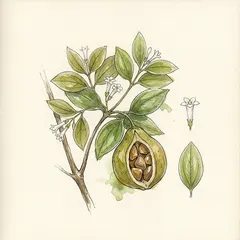
[ST. IGNATIUS' BEAK". NATURAL ORDER, APOCYNE2E.]
The beautiful tree, from which this beau is obtained, grows on the Philippine Islands in the East Indies ; it has large, ovate leaves ; its flowers are long, drooping, white. The fruit is of the size and shape of a middling pear ; the seeds, of which there are about twenty in the fruit, are an inch long, bitter ; they are horny, of a blackish gray outside, and whitish internally ; we cut them in thin slices, dry them by a moderate heat, pulverize them, and make a pale, straw-colored tincture, which is very bitter. In the cold the tincture precipitates crystals which dissolve again in Avarmth.
This drug was first introduced in European medicine by Camilli, a Jesuit, in the year 1699, and in honor of the founder of his order, the bean has been named St. Ignatius' bean. It is supposed by some authorities that this bean was known long before this period, and that it is probably the substance which, in the Latin translation of the Arabian Serapion, is denominated nux vomica. The active principle of this bean is strychnine, the same alkaloid which we find in nux vomica.
Hence these two drugs act similarly, although the action of each is characterized by peculiar symptoms.
Orfila's experiments with this drug upon animals, show that its primary action is upon the medulla oblongata, and that it destroys life by producing tetanic convulsions. Half an ounce of the powder of ignatia was given to a dog. In about five minutes he commenced to pant; fifteen minutes afterward, symptoms of convulsions appeared, and in about half an hour he fell down in an attack of tetanus, the intellectual faculties being unimpaired. The animal died asphyxiated in about twenty minutes after the tetanic symp- toms came on.
In the 21st volume of the Philosophical Transactions, Camilli
relates the following case of poisoning by ignatia: A man suffering
from dyspepsia, being attacked with vomiting and diarrhoea, took a
scruple of the powder of ignatia. He was soon seized with excessive
rritation and severe convulsive movements ; his jaws were closed ;
IGNATIA AMARA. 195
the muscles of the face were drawn in different directions, as if he had been convulsed with laughter.
In Hahnemann's Lesser Writings another case of poisoning is described : A youth of twenty years took an over-dose of ignatia. He was attacked with paralytic rigidity and involuntary twitchings of the lower limbs, great anxiety, coldness of the whole body; the pupils were dilatable and the head free ; he was completely restored by drinking eight ounces of vinegar in half an hour.
A man, forty years old, took, after tertian fever, half a bean of ignatia in brandy. He had numbness of his extremities, violent, general, convulsive cramps, with profuse perspiration.
Ignatia acts upon the medulla oblongata and the spinal nervous system with sufficient force to produce tetanus and, if given in fairly large doses, death. Upon the vital power its action is not so much exalting or depressing, although in certain organs each of these varieties of action is distinguishable ; but rather disturbing, destroy- ing the harmony of action between different portions of the organ- ism, perverting the co-ordination of functions. Thus, where we find heat of the body, and should anticipate such a condition of the nervous system as would make cool air agreeable, the contrary con- dition obtains; where we should, from the fever existing, expect thirst, we find none, and vice versa.
The great sensitiveness of the surface, instead of being aggravated by contact and by pressure, is relieved by it, etc. * * * And yet, singular as this state of things is, it finds its analogy in the natural history of disease. For if you analyze the phenomena of hysteria, you will find this " perversion of the co-ordination of functions" to be the fundamental principle of the malady. And of all our remedies none so completely corre- sponds to hysteria, and so often cures it, as ignatia.
(Dunham, Lectures on Materia Medica.)
CEPHALIC GEOUP.
Jcerg and his provers found that ignatia causes a painful pressure, an aching in various parts of the head. Most of the provers expe- rienced this aching or painful pressure in the forehead over the eye- brows ; others in the occiput, whence it would shift to the forehead ; some felt this aching all over the head, and some again at one time in one, and at other times in other parts of the head, the pressure shifting about from one locality to another.
This shifting of the aching pain from one part to another was not the only peculiarity observed by the provers. Another was the
196 IGNATIA AMAEA.
intermitting character of the pain. After the pain had lasted during the forenoon, it would intermit until evening, when it would be felt again violently for a time. In one case the paroxysms came on regularly every half hour.
CEPHALALGIA. — These symptoms suggest the use of ignatia in cephalalgia, distinguished by aching in one part of the head or in the whole head. The cephalalgia to which ignatia is homoe- opathic may be accompanied by symptoms of gastric derangement of a peculiar character.
One of our provers experienced a qualmish feeling in the stomach previous to the headache; the qualmishness was followed by an aching pain in the forehead, thence extending over the whole head, and succeeded by a sense of lassitude. This symptom shows that in headaches originating in gastric irritation, ignatia may be of great use.
GASTRIC NERVOUS HEADACHES We find the doctrine
that ignatia may be of great use in gastric nervous headaches, con- firmed by a remarkable symptom obtained by Professor Jcerg him- self, from the powdered substance. He experienced, from three grains of the pulverized bean, a "seated pressure in the region of the stomach, followed by a painful pressure or an aching in the forehead, shifting to different parts of the head and even cheeks ; urging to stool, with several natural evacuations, weariness ; the appetite was not materially disturbed, but there was a speedy feeling of repletion after eating."
The remarkable connection between the brain and the gastric functions, in the case of ignatia, is further evidenced by the follow- ing symptom, elicited from forty drops of the tincture mixed in an ounce of water: "Vertigo soon after swallowing the drug, so that the prover staggered and found it difficult to stand erect. Single stitches darted through his head, he felt a buzzing in the ears and objects before him seemed to waver. The prover was unable to fix his mind upon a single idea.
The vertigo continued until late in the evening. These symptoms were accompanied by a feeling of loathing, flow of saliva, loss of appetite. Next day a headache set in, which was made worse by eating, and continued off and on for several days."
HEMICRANIA — Upon a further examination of the symptoms, we shall find that ignatia is homoeopathic to hemicrania, a sort of semi-lateral nervous headache. Several of Joerg's provers have ex-
IGNATIA AMARA. 107
pevienced an aching pain, or a painful pressure, according to the literal text, in one side of the head, with pain in the right eyeball, aggravated by motion, and accompanied by sensitiveness to the light.
Professor Jcerg himself elicited this remarkable symptom : "A painful pressure in the head, with burning in the eyes, lachrymation, swelling of the lids, and a feeling of pressure in the right eye, as if it would be pressed out of the head ; this pain was accompanied by cutting-contractive pains in the lower bowels, and copious secretion of a frothy mucus."
These few but exceedingly interesting symptoms show most con- clusively that ignatia is one of our most useful agents in that dis- tressing class of headaches termed
NERVOUS HEADACHES, megrim, hemicrania, especially when the eyes are involved, more generally one eye, with burning and lachrymation, pressure in the eye from within outward, swelling and suppuration of the lids, photophobia. The pain in the head may be an aching or stitching pain, darting stitches flying through the head.
Jcerg' s provings confirm the symptoms obtained by Hahnemann in all essential particulars. Hahnemann's provers likewise expe- rienced this aching pain in the forehead, and in other parts of the head ; the pain was relieved by inclining the head forward, and resting it upon the table ; an aggravation of the pain was occasioned by in- tense mental labor.
One of Hahnemann's provers describes his headache in these terms: "Aching in the forehead, above the root of the nose, obliging him to incline his head forward; it is followed by a fueling of qualmishness at the stomach."
Another prover has this symptom : "headache on waking, as if the brain were smashed ; after rising, the headache passes off, and gives place to a similar pain in a tooth ; thence this pain shifts to the small of the back. The headache is renewed by thinking."
CLAVUS Ignatia has been employed by homoeopathic practi- tioners for the peculiar form of hemicrania termed clavus ; there is a symptom in the known pathogenetic series of this drug, which warrants its employment in clavus upon homoeopathic principles. The characteristic pains of ignatia in the brain, which we have learnt to kuow so far, are : Pressure as from too much blood in the brain. Stitches darting through the head.
And the accompanying pains are, " burning and pressure in the eyes, Avith lachrymation and pho-
198 IGNATIA AMARA.
tophobia," and gastric derangements, qualmishness, anorexia, cutting and spasmodic pains in the bowels, etc.
The symptom which suggests the use of ignatia in clavus is the following, recorded by Hahnemann: "Constrictive sensation in the hypochondria, as when the bowels are constipated, accompanied with semi-lateral headache as if a nail were pressed into the brain, early in the morning."
Hahnemann remarks in a foot-note to this symptom, that the sen- sation as if a sharp, pointed body were pressed in, is characteristic of ignatia. This pressure as by a sticking body is also experienced in the rectum, in the region of the sternum, in the region of the cervical vertebrae, and in other parts.
NERVOUS GROUP.
Our cases of poisoning have shown us that ignatia may cause lock- jaw, risus sardonicus and paralytic stiffness and numbness of the lower extremities. It has also caused twi tellings of these parts.
EPILEPSY. — Hahnemann recommends ignatia in recent cases of epilepsy, especially when occurring among children, in consequence of a sudden fright. In some of these cases it may prove efficient, but in many others it may fail.
Mary S., aged five years, was playing near a creek, which flowed through the vil- lage, when a mischievous boy suddenly pushed her into the water, which must have been very cold, since it was early in spring. In consequence of the fright and of the cold, she was taken with a high fever of a few days' duration. Two weeks after this occurrence, twitching of the extremities with trismus set in, lasting from fifteen to thirty minutes. The paroxysms came on irregularly, at all times of the day or night, after emotions or when having a disordered stomach.
Anthelmintics and narcotics were faithfully tried, but gave no relief. The paroxysms gradually lessened in fre- quency, but increased in severity and at last ran into epilepsy. Her physicians hoped that a favorable change would take place at puberty, but the menses appeared at the age of fourteen and were normal, but the fits returned regularly every five or six weeks. After two years she was placed under homoeopathic treatment.
She is now a well-developed young woman ; her organic functions are normal, but the counte- nance bears a look of despondency, most clearly marked before the appearance of a fit. Considering the fright, the cause of the nervous disorder, she received twenty-four powders of ignatia4, with directions to take the first twelve powders morning and evening, and then every third day. Coffee, spices, stimulants, etc., were forbidden. Years have passed, but the patient never had another fit. {HirscheFs Klinik, March, 1877.)
SPASMS AND CONVULSIONS. — We may expect good effects from ignatia in the treatment of spasms and convulsions, even tetanic convulsions, if they seem to depend upon gastric irrita- tions, caused by indigestible food, the presence of worms, or in con- vulsions of an hysteric nature.
SPASMODIC TREMORS— We shall find ignatia indicated in
IGNATIA AHAEA. 199
cases of spasmodic tremors of recent date, caused by fright or when sympathetically induced by a sadden derangement of the uterine functions, or as a symptom of acute hysteria.
Ignatia has caused : a feeling of lameness, a sensation as if the joints had been wrenched or bruised, without any perceptible symp- toms of inflammation or irritation. In others it has caused crampy pains, a seuse of rigidity, heaviness in the lower limbs, stitches in the larger joints, stinging, as by insects, in various parts of the skin ; itching, shifting from one place to another, after scratching ; acute pain at a small spot, here and there, only when touching the spot.
SPINAL IRRITATION.— The symptoms may indicate the use of ignatia in spinal irritation, when the medulla oblongata is the seat of the trouble, and in hysteria.
OEBTTAL GROUP.
OPHTHALMIA Professor Joerg's proving resulted in a species of ophthalmia, with burning pain, pressure in the eyeball as if pressed out of the socket, swelling of the eyelids and profuse lachry- mation, suppuration and photophobia. This condition came on in the train of a peculiar cephalalgia. Hence we infer that the ophthalmia caused by ignatia is of a sympathetic nature rather than an idiopathic affection.
It is probable, that in some forms of a purely nervous irritation of the retina and iris, ignatia may prove useful. According to Hahnemann's provings, it causes
PHOTOPHOBIA of a purely nervous character, without any apparent signs of inflammation ; a circle of luminous zigzag vibrations out of the line of vision ; the print upon which the eye happens to be fixed, becomes invisible, whereas the print by the side of it is more distinct. This is somewhat like spurious vertigo, a paroxysmal affection described by Herz under this name.
DENTAL AND BUCCAL GEOUPS.
When speaking of headache, I stated that a crusliing pain in the brain was experienced by one prover, and that this pain afterward shifted to a tooth. Hence we may recommend ignatia for
ODONTALGIA, as if the tooth were crushed or smashed into fragments. Ignatia also causes a digging pain in the molar teethr and a soreness in the teeth ; they also become loose.
Ignatia causes some interesting symptoms in the mouth and fauces; a feeling of soreness in the mouth, under the tongue, and secretion of a frothy saliva, also prof use ptyalism. btitches darting
200 IGNATIA AMAEA.
from the throat to the inner ear, especially behveen the acts of deglu- tition; also sensation as if a lump had lodged in the throat. Craiol- ing or tingling sensation in the fauces, and aching pain in the sub- maxillary glands.
HYSTERIA.. — These symptoms may indicate ignatia in various nervous affections. The lump in the throat, for instance, may be a symptom of hysteria; hysteric women may he troubled with this symptom.
ANGINA FAUCIUM. — Ignatia may also be useful in certain forms of angina faucium, where the patient is troubled with stitches between the acts of deglutition. In angina where an inflammatory character is decidedly prominent, ignatia will never be of much use. The character of an ignatia angina is, as the symptoms show, of a nervous type, an acute nervous irritation, the inflammatory symp- toms being secondary.
CHYLO-POIETIC GKOUP.
We find recorded : Flat, chalky, sour taste ; loathing of food, especially of warm food. Nausea with anxiety. Musty eructations. Hiccough after eating; feeling of weakness in the epigastrium.
Sensation in the stomach as if one had been fasting too long, as if the stomach were empty, with flat taste and languor in the limbs. Canine hunger, with qualmishness, followed by straining toward the rectum, pressure in the region of the vertex, thence shifting to the forehead, attended with burning in the eyes and lachrymation, swelling of the lids, secretion of mucus from the Meibomian glands ; the hunger was appeased immediately after commencing to eat. Drawing in the stomach, as if the walls of the stomach were pulled ; with alternate feeling of fulness and emptiness, the latter sensation accompanied by a feeling of canine hunger; afterward stitches in the pit of the stomach and burning in the region of the spleen.
Fine prickings in the epigastric region, with a sensation of emptiness. Pain and bloating in the umbilical region. Pressure in the region of the spleen and large curvature of the stomach, coming and going every half hour. Pressing pains in the epigastrium, especially in the region of the spleen, posteriorly near the spine, as if the abdominal walls were pressed outward and the diaphragm upward ; in the evening, the pain sometimes ascended toward the chest, changing there to a painful burning, with alleviating eructations ; afterward, sensation as if sweat would break out all over; a frothy mucus was secreted by the salivary glands all the time ; the mouth felt sore.
IGNATIA AMARA. 201
GASTRIC DERANGEMENTS.— These symptoms indicate the
use of ignatia iu gastric derangements, outlined in the pathogenesis
of the remedy and associated with characteristic nervous symptoms
or in persons of a nervous, sensitive organization.
An old lady of sixty years had been grieving for years about her son's death. For fifteen years past she has been troubled with a feeling of emptiness or goneness, as she termed it, in the epigastric region, accompanied by a sensation as if a number of pins were pricking her in this part. It was a most disagreeable feeling, and had brought on a state of the most deep-seated hypochondria. One globule of ignatia200, afforded her relief, for the first time in fifteen years.
For some three months she remained free from her trouble. After this period she had another but much feebler attack, for which I tried the tincture of ignatia. It made her sick; ignatia200 again relieved her perfectly. Under the use of ignatia200 she had perfect control of this dis- tressing trouble.
CARDIALGIA with painful pressure as from a stone ; feeling of goneness at the stomach, accumulation of saliva in the mouth, and other symptoms previously described.
A young widow, tall, slender, of dark complexion, has had constipation, a gnawing sensation in the stomach during the forenoon, relieved from eating. Bloating in the epigastric region, obliging her often to unfasten her dress. Frequently soreness in the throat a little below the head of the trachea and at a small spot on the left side of the throat, only when swallowing. Frequent accumulation of saliva in the mouth and throat.
Cured by ignatia3, one dose per diem. (Montgomery in Uirsc/iefs Areue Zeitschrift, ii., 37.)
A painter, aged sixty-eight years, of feeble constitution, sanguine temperament, of happy disposition, thin in flesh, hsemorrhoidal, has suffered, for a period of three years, from severe paroxysms of cardialgia, coming on between 7 and 8 p. M., still more frequently about midnight, continuing for two or three hours, and then disap- pearing gradually. Frequent vomiting of slime. Can only eat soup or liquid food.
Deranged digestion. Bowels moderately regular. Urine pale, watery, copious. Nausea with restlessness and anxiety, pressing pain, sickness at the stomach with pressure there and spasmodic oppression in the chest.
The pain at the stomach is greatly increased by pressure. At times, vomiting of ingesta with much nervousness and anxiety. Pain in the hsemorrhoidal tumors and severe backache. Nux and Pulsatilla failed to relieve.
Ignatia1, three times a .day, cured in one week. (Schlosser in Allg. Horn. Zeitg., xlix., 62.)
Ignatia has caused : cutting and contractive pain in the bowels, followed by liquid stools ; straining and pressing toward the rectum and anus ; stitching from the anus upward along the rectum, con- tractive, sore pain in the rectum after stool. Creeping and burning at the anus and also in the urethra during urination, with increased discharge of urine. Weakness of the rectum with inability to expel stool.
DIARRHOEA. — These symptoms indicate ignatia in diarrhoea of watery stools, preceded by cutting, spasmodic pains with character- istic disturbances and headache.
CONSTIPATION of a paralytic origin.
PROLAPSUS ANI in nervous persons and especially children, with characteristic constitutional symptoms.
202 IGNATIA AMAKA.
PROCTALGIA with shooting pains in the rectum, contractive and sore pain in the rectum.
AS 0 ABIDES with itching at the anus, increased discharge of urine.
URINARY GROUP.
HYSTERIA. — Ignatia causes the discharge of large quantities of watery urine, as a symptom frequently found in hysteria and nervous spasmodic affections generally.
SEXUAL GROUP.
IMPOTENCE. — Ignatia causes weakness of the sexual parts ; in impotence, with libidinous fancies, this drug may be useful. Large doses of ignatia cause this condition ; small doses seem to excite the erectile powers of the male organs and to excite the sexual instinct. In women, ignatia increases the menstrual discharge and brings it on prematurely. We use it in
METRORRHAGIA or menorrhagia, with severe violent bearing- down pains and discharge of black blood, of a putrid odor, and clotted.
DYSMENORRHEA with a similar offensive, dark menstrual discharge.
In various conditions of women, accompanied by a condition of the nervous system which is characteristic of this remedy. The
LEUOORRHCEA of ignatia is purulent.
CATARRHAL GROUP.
Ignatia causes a constant irritation in the throat-pit, as if one had to cough ; coughing does not relieve it, but the symptom may be voluntarily suppressed. This sensation sometimes amounts to an irritation as if dust had lodged there, and is made Worse by cough- ing. It also causes a constrictive sensation in the throat-pit, exciting a cough as from the vapors of sulphur.
NERVOUS COUGH. — Upon the strength of these symptoms we recommend ignatia for the nervous cough of some persons, women in particular, and also for the
BRONCHIAL CATARRH of old people where sjmsm is a promi- nent symptom.
EXANTHEMATOUS GROUP.
PRURIGO. — Ignatia causes itching all over ; we give it in prurigo when the itching shifts from place to pluce after scratching the parts.
'ipecacuanha. 203
fever group.
INTERMITTENT FEVER Ignatia is not a fever remedy in the common acceptance of the term ; nevertheless it is often and successfully used in the treatment of intermittent fever. The paroxysms come on at all hours. The chill is preceded by yawning, stretching and shuddering.
It is accompanied by great thirst for large quantities of water only during the chill, with redness of the face, coldness relieved in a warm room or near a warm stove, by external warmth. The hot stage is characterized by external heat and redness without internal heat ; redness, heat and burning of one side of the face. Itching and burning over the whole body, relieved by scratching ; it disappears with the sweat. Light sweat without thirst.
Ignatia is adapted to persons of a very sensitive organization, with characteristic constitutional symptoms. The ignatia patient is able to resume his occupation as soon as the paroxysm is over. Ignatia is indicated if the ordinary every-other-day type has become quartan after taking large doses of quinine.
In cases of poisoning we give an emetic and use acids, such as vinegar, lemon-juice, etc.