 Homeopathy Library
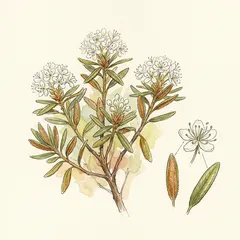
Ledum Palustre
Hempel - Materia Medica and Therapeutics · Charles Julius Hempel · 18,785 chars
 All books on Ledum Palustre →
Antidoted byAngustura VeraApis MellificaCamphoraCinchona OfficinalisParis Quadrifolia
All books on Ledum Palustre →
Antidoted byAngustura VeraApis MellificaCamphoraCinchona OfficinalisParis QuadrifoliaGeneral
[marsh tea. natural order, ericace^.]
This plant is a native of the north of Europe; it is also found in the northern parts of the State of New York. It grows in marshy places and bogs, as the name indicates.
This shrub, the stem of which is from one to three feet high, flowers from April to July. The branches are covered with a rusty- colored down. Leaves lanceolate, smooth, of a dark-green color on' the upper surface ; flowers numerous, in dense corymbs. The plant, when bruised, has a strong, aromatic, oppressive odor, like hops.
Some brewers used to adulterate beer with it ; it creates intoxica- tion and headache.
The discoverer of homoeopathy has left us a proving of this drug, which reveals its homoeopathicity to arthritic and rheumatic affec- tions with sufficient accuracy to deserve a careful study. It will be seen that the action of ledum upon the mucous membranes, upon the synovial lining of articular cavities, upon the periosteum and the sheaths of muscles, is characterized by symptoms which are strik- ingly similar to the symptoms of some forms of
CHRONIC ARTICULAR RHEUMATISM, and, to the careful beholder, reveals an inmost identity of the morbific force and the essential principle of the drug. By examining the pathogenetic effects of this agent under our usual heads, we shall obtain a logically-coherent view of the different groups of the series, and their bearing upon corresponding pathological states.
CEREBROSPINAL GROUP.
When taken in large quantities, ledum, according to the report of Linnaeus and Pallus, causes immoderate intoxication, loss of sense, and violent headache. Our provers report, among others, the fol- lowing characteristic symptoms : Violent vertigo the whole day,
394 LEDUM PALUSTEE.
3ven when sitting still, as if the prover was intoxicated, aggravated oy stooping, and increasing during a walk even to a sensation as if he should fall forward ; attended with a feeling of heat in the whole body, especially in the face, without thirst ; the cheeks and forehead are pale. The head feels stupefied, as during an attack of vertigo. Painful pressure over the whole brain, as from a weight, continuing for three days, with slight intermissions, day and night: Stupefying- aching pain in the forehead, externally, in any position, as if he had been carousing late at night.
The brain feels sensitive; if he makes a wrong step, his brain feels the shock painfully. Tearing pain in the head and eye ; the sclerotica and the conjunctiva are swollen, and highly inflamed ; the tearing pain in the eye is worse in a recumbent, and abates in a sitting posture ; the eyelids are not affected, but are agglutinated early in the morning, a badly-smelling humor is discharged between them ; these symptoms are attended with evening chills, followed by heat, thirst at night, rumblingin the bowels (although the appetite is good), heat of the head, within the head more than without ; perspiration on the back and in the hair of the head.
These symptoms are recorded by Hahnemann, and by two of his most careful disciples, Laughammer and Becher, and point to cephalic affections, which, invade more particularly one side of the head ; they are of an arthritic and rheumatic character, and a more or less prominent feature of the symptomatic group is a feeling of heaviness, dullness, or even stupefaction in the affected part.
In old-fashioned pathology an attack of this kind is often found described as a fluxion. One eye alone may be invaded, or one side of the head and forehead, or even the whole side of the head and face. The pains are tearing, dull-aching, stupefying pains, the parts feel very sore on pressure or even to contact ; the patient complains of chilliness, the face looks pale, the pulse is weaker and sometimes slower than in the natural state. The digestive functions are dis- turbed, the tongue is coated, 'the appetite impaired, the taste in the mouth altered, the bowTels may be loose, or a cathartic feeling is ex- perienced without any actual discharge ; the patient feels weak and most generally shows a depression of spirits or an irritable temper.
If the organ of hearing should be involved in the attack, the patient may complain of aching pains in the ear, and acute sensitivenes of the internal or external parts; the hearing itself is interfered witli by ringing or roaring noises in the ear.
LEDUM PALUSTRE. 295
Let us see what changes such a fluxion would occasion in the
ORBITAL GROUP.
These changes have already been partially described in the ceph- alic group. To these we add the following symptoms recorded by our provers : The pupils are very much dilated ; vibratory move- ments before his eyes, so that he was unable to see any object steadily ; secretion of acrid and smarting tears, excoriating the lower eyelid and the cheek ; violent itching in the internal canthus ; in- flamed eyes, with tensive pain; burning pressure in the eyes, they are agglutinated in the morning and weep in the day-time ; a pain- ful pressure in the eye-ball, as if it were to be pressed out of the socket, without inflammation.
DENTAL GROUP.
In the dental group this rheumatic attack may develop a pain like the following developed by our provmgs :
A few long stitches in the tooth are succeeded by an intolerable tearing pain on the right side of the face, head and neck, externally, and lasting the whole night; this pain disappears after another paroxysm of stitches in the tooth, but returns again from time to time, and finally terminates in an attack of shivering, accompanied with deep sleep, loss of appetite and with thirst.
PHARYNGEAL GROUP.
We may state that ledum is used in some parts of Germany as a domestic remedy for
MALIGNANT ANGINA PAUOIUM ; an infusion is made of it. The following pathogenetic symptoms show that this use is founded upon the homoeopath icity of its action in the case : Sore throat, with fine stinging pains ; sensation as of a plug in the throat ; when swallowing anything, she expei'ienced a stinging sensation in the throat ; hard pressure at the left lower jaw, interiorly.
CHTLO-POIETIC GROUP.
The rheumatic or arthritic affection to which ledum seems to cor- respond, has a few symptoms indicative of gastric derangements; we note the following : Qualmish feeling in the stomach ; musty taste in the mouth ; water-brash, with colicky pain ; colic, as if the bowels had been bruised ; a sensation similar to that which is ex- perienced after the action of a violent cathartic; colic, as if diarrhoea were to set in, this sensation is felt from the umbilicus to
296 LEDUM PALUSTEEi.
the anus, accompanied with cold feet and loss of appetite, although the taste is natural ; colic, with discharge of blood from, the anus ; fecal diarrlicea mingled with mucus ; papescent diarrhceic stools with- out pain.
These symptoms derive a more specific therapeutic value from their connection with other symptomatic characteristics of a general rheumatic attack, though they may likewise represent a rheumatic attack on the mucous lining of the abdominal viscera, in which we of course include the urinary and sexual organs.
UEINAEY AND SEXUAL OEGANS.
Most of our provers report an increased urging to urinate, and an abnormal exaltation of the sexual organs ; we read : For the first twelve hours he .has to urinate frequently and a good deal, even at night; frequent urging to urinate with scanty discharge; profuse flow of urine.
Some of the symptoms point to a paralyzing influence of ledum upon the contractile powers of the muscular fibres of the bladder ; we read: Freauent intermissions in the flow of urine, after the emission she experiences a stinging in the urethra. Hartmann and Teuthorn report : Diminished secretion of urine, the first twelve hours. Swelling of the penis ; the urethra seems swollen and feels as if closed in consequence ; he has to press hard in order to void the urine ; the stream is very thin, but the emission is painless.
Among the sexual symptoms we distinguish the following: Violent and continued erections ; nocturnal emissions of a bloody and watery semen ; profuse and premature menstruation.
LEUCORRHCEA, DYSMENORRHEA, UTERINE DIS- PLACEMENTS.— Besides the conditions clearly indicated by these symptoms, ledum has also been recommended for leucorrhoea, dys- menorrhoea, uterine displacements, with profuse urination and an aggravation of all the symptoms by heat. It has also been used in the treatment of
FIBROUS UTERINE TUMORS.— The following cases by Dr. Jousset are related by Dr. T. S. Hoyne (Am. Homoeopathist, October, 1871) :
M. C, aged fifty-eight years, has a fibrous tumor occupying the anteiuor face of the uterus. The chief symptom of this lesion is an habitual metrorrhagia, which has already continued for several years, and had resisted a great variety of treatment. August 27th, I precribed ledum1*, three doses a day for four days. The flow began to diminish after the first dose. The same remedy was continued, at the same dose, for two months, with intervals of repose of four days, and the flow, reduced to a
LEDUM PALUSTRE. 20?
trifling discharge, was entirely suppressed. The fibrous tumor, however, still con- tinued several years after the haemorrhage was cured.
M. B., aged thirty-three years. Menses profuse, constant sanguineous flow between the periods; pain in the kidneys and in the left iliac fossa. Enormous fibrous tumor occupying the anterior wall of the uterus, and perceptible through the abdominal wall.
Ledum12 at first very much diminished the flow; but the menses having returned profusely and prematurely, with violent pains, I substituted calcarea30, which produced a happy effect. After this improvement, which continued two or three weeks, the usual haemorrhage returned, in spite of the calcarea. Ledum12 and 30, continued for several months, with intervals of repose, finally checked the flow, and reduced the menses to their physiological measure. This partial cure held good for some months ; but it was necessary to recur, from time to time, to the ledum.
The patient is subject to rheumatic pains."
RESPIRATORY GROUP.
If the symptoms which our provers have recorded as effects of ledum can be depended upon, this drug causes very marked changes in the functions of the pulmonary apparatus. These changes speak for themselves and, without any further comment, point out the pathological states which they are designed to wipe out. The fol- lowing are worthy of special attention : Spasmodic inspirations and singultus, like the sobbing of children who have cried a good deal in a fit of passion ; oppressed, painful breathing ; asthmatic constriction of the chest, aggravated by walking and motion ; creeping sensation in the trachea, followed by quick and oppressed respiration ; cough preceded by suffocative arrest of breathing ; violent coughing fit preceded by expectoration of bright-red blood ; feeling of hoarseness and scraping roughness in the trachea ; cough at night, or early in the morning, with purulent expectoration ; pain in the chest, during an inspiration, a sort of painful uneasiness in the chest.
HAEMOPTYSIS, in the case of arthritic individuals, or in metas- tatic haemoptysis from suppressed haemorrhoids or menstruation. A phthisicky diathesis may prevail.
A young man was attacked with a violent stitching pain in the right hip. The pain gradually grew continuous, and was so violent, especially at night in bed, that he had to leave the bed and lie upon the floor ; sometimes it was relieved by washing the whole leg in cold water. After a while, the joints of the knees, then of the feet, and at last those of the hands commenced to swell. Some months later, when this inflammation had subsided, he was suddenly attacked by a violent cough and spitting of blood.
The spitting of blood was subdued, but the cough continued for several weeks, until again a violent attack of haemorrhage set in with profuse expectoration of thick, greenish, foul and fetid masses. Examination revealed a cavity in the left sub-clavicular region. Prescribed aconite2, one dose every hour. Great impiwe- ment.
Four days later : The cough still continued, the expectoration was difficult and consisted of thick, tough mucus. Prescribed tartar emetic*, every four hours. In about ten days the patient seemed well, but all at once, without any apparent cause, he was attacked again with inflammatory rheumatism of the hands. Bryonia1, every two hours, relieved within four days ; but ten days later another sudden attack of cough and haemoptysis set in and an examination of the chest revealed another vomica.
Aconite and tartar emetic, as before, did no good. The patient sank rap-
298 LEDUM PALUSTRE.
idly, with all signs of a galloping phthisis. Four globules of ledum30 were now given upon the tongue. The change was wonderful, and improvement continued for four days, when it ceased. Ledum200, finally, produced a rapid and permanent cure. (Dr. Stens, Sen., in the Characteristics of Ledum, by Dr. Hoyne, American Homceopatkist.)
FEVER GROUP.
The rheumatic affection to which the ledum rheumatism corre- sponds is characterized by predominant chilliness, as may be inferred from the following record : Chilliness and febrile motions in the limbs, without any subsequent heat. Chilliness, as if cold water were poured upon one or another part of his body. Cold shuddering for twenty-four hours, with goose-flesh, without any external cold- ness. He feels chilly in the forenoon and likewise early in bed, he cannot get warm.
Chill over the whole back, with hot cheeks and hot forehead, without flushes in the face and without thirst, the hands are cold. On waking from sleep his whole body is covered with a slight moisture. During a walk in the open air, a perspira- tion breaks out upon him very suddenly, mingled with chills. Badly-smelling perspiration over the whole body, even the hair on the head is wet.
A burning in the limbs, in bed, which renders the warmth of the bed intolerable.
We would advise the student and practitioner of homoeopathy to take cognizance of the pains which are peculiar to the ledum disease, and a knowledge of which is necessary to a correct appreciation of the various prominent groups of head, eye, chest, gastric and other symptoms which we have already mentioned. We transcribe the following from Hahnemann's original record : A tearing pain from the small of the back to the occiput, the left half of the brain and the left jaw, especially in the evening; the cheeks are hot and puffed up, and the eyes look inflamed.
Painful stiffness of the back and loins after sitting. Dull stitching pain and pressure near the dorsal vertebrse, more intense during an inspiration. Exceedingly painful stitch in the shoulder when raising the arm. Pressure and tearing, with a feeling of heaviness in the right arm, especially in the articulations ; the pain is much increased by moving the part.
This tearing pain, with pressure, is characteristic of ledum, or the pressure may exist without tearing. In the lower extremities we find the following pains recorded by our provers : Tearing, with pressure from the hip joints to the ankles, worse during motion. Pressure at the left thigh, posteriorly ; a sort of dislocation pain, in any position, which is increased by contact or motion.
LEDUM i> A LUSTRE. 299
Becher reports : Trembling of the knees and hands when sitting or walking.
Hahnemann has : Tearing rheumatic pains, flying about, during motion. Laming pains in all the joints, at night, in bed, when moving the body. The limbs and the whole body feel painful, as if sore and bruised. He feels a throbbing pain in the affecled joints, which impedes motion.
After a walk in the open air he feels a sort of pressure and tension, shifting from the side to the shoulder, thence across the chest, where he experiences a furious attack of pain in the sternum, as if hearing and sight would vanish ; he has to lie down, remains pallid for a fortnight, is anxious, and has cold hands and diarrhoea. Stinging-tearing pains in the joints. Pain, as if in the periosteum of the femur, during a walk, or when sitting or touching the parts, as if they were bruised, sore, or as if the flesh were detatched from the bones.
Cracking of the knee joints. Swelling, with a tensive-stinging pain in the knee, during a walk. Excessive feeling of weariness, in the feet, only when sitting or lying, not when walking. Feeling of coldness in the legs, when sitting ; yet they are not cold.
Obstinate swelling of the feet, with intoler- able pain in the tarsal joints, when stepping. Painfulness of the soles as if ecchymosed. The limbs feel numb and heavy, with bone-pains.
Mrs. M., a large, fleshy woman of thirty-five years, was taken at 3 p. m. with a severe pain in the right knee, extending upward to the hip joint. The pain came instantly, was aggravated by motion, but passed off after midnight just as suddenly as it came. On the next day, at 3 P.
M., the same thing occurred, and I was called. Gave belladonna200 in repeated doses. On the next day she was worse ; the pain did not leave as it did on the night before. She was suffering greatly and begged for morphine.
Gave ledum200. Amelioration in two hours, and a complete cure in twenty-four hours. (Dr. A.
L. Fischer in the Am. Jour, of Horn. Mat.
Med., July, 1873.)
This pathogenesis bears evidence of accurate and truthful observ- ation, and reflects certain forms of chronic rheumatism and arthritis in an unmistakeable manner.
EXAJSTTHEMATOUS GEOUP. .
The exanthema tous symptoms which characterize the action of ledum may likewise constitute, either partially or totally, elements of the rheumatic or arthritic disease with which ledum is in specific homoeopathic rapport. We will transcribe the most important of the symptoms which our provers have recorded in this direction : Itching of the whole body as if an eruption were to appear. Bluish spots covering the whole body, like petechias. Excessive aching of
300 LEPTANDRA""" VIRG1NICA.
the legs, worse in bed ; he has to scratch them sore. A species of chicken-pox on the chest and the upper arms; the eruption peels off in five days. Burning-itching of the thighs; or stinging-itching in various parts of the body.
This itching and gnawing of the skin, either partial or general, is somewhat peculiar to the action of ledum, and has led to the use of this agent as a specific antidote against the
BITES OF INSECTS, mosquito bites, for instance, the distress from which yields very readily to the tincture of ledum applied externally.
SLEEP AND MENTAL GROUP.
Kestless . sleep or wakefulness, with confused dreams, tossing about. Peevish, irascible, or dissatisfied ; he hates mankind.