 Homeopathy Library
Belladonna
Tyler - Homoeopathic Drug Pictures · Margaret Lucy Tyler · 25,894 chars
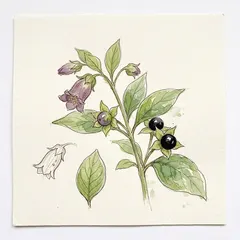 All books on Belladonna →
Antidoted byAceticum AcidumAconitum NapellusAngustura VeraAurum MetallicumBerberisCamphoraCitrus LimonumCoffea CrudaCoffea TostaColchicum Autumnale
All books on Belladonna →
Antidoted byAceticum AcidumAconitum NapellusAngustura VeraAurum MetallicumBerberisCamphoraCitrus LimonumCoffea CrudaCoffea TostaColchicum AutumnaleGeneral
This is another of Hahnemann's Polychrests — drugs of many uses — which has its place (for paramount utility in acute and violent conditions) in every homoeopathic medicine chest, however diminutive : — One of those medicines, " without which, we might indeed shut up shop "
Violence runs through Belladonna, violence and suddenness. We associate Belladonna in our minds with sudden violence — violent pain, violent headache, violent throbbings, violent delirium, violent mania, violent starts and twitchings, violent convulsions.
Bell. is a remedy of sudden, acute conditions, like Acon., yet very unlike A con. in its symptoms. Roughly speaking, Aconite is turmoil in circulation ; Belladonna turmoil in brain ; in the same way that Chamomilla provokes and cures ailments associated with turmoil in temper.
The cardinal symptoms of inflammation, as we are taught, are heat, redness, swelling, and pain. And all these Belladonna has in a violent degree ; therefore Belladonna is palliative to inflammations in general, and will modify them, if it does no more ; but it is curative only where the rest of the symptoms agree. For instance, in inflammations of lung and pleura, its disease picture, as we have shown, is easily distinguishable from that of Bryonia, Phosphorus, and other remedies.
It is the " totality of the characteristic symptoms " that have to be taken into account if sudden and striking cures are to result. Sudden cures in pneumonia ? — in herpes ?
How can you suddenly cure a pneumonia with consolidation ? — a herpes with wide vesicular eruption ? With the right medicine, early, the pneumonia should have been aborted, should not have gone on to consolidation. But even so, the sudden drop in temperature and pulse, the sudden possibility of rest and sleep, the sudden well-being of the patient, when he asks for food, the newspaper, and talks and smiles, announce the cure, even though the lungs may take days to resolve. In the same way with herpes, the pain and the redness, the inflammation, suddenly go, the vesicles are seen to be dried up, mere scabs ; the thing is dead, and will give no more trouble.
In acute sickness the needed homoeopathic remedy declares itself unmistakably and often almost suddenly. When you have hit it, there is no mistaking the fact.
Belladonna has been found to abort whitlows in the early stages, to abort an appendicitis, has doubtless aborted countless pneumonias. The typical Belladonna picture is unmistakable when you meet it : — the bright-red face, the dilated pupils, the burning skin, the throbbing pains, the intolerance of pressure and JAR. Those call for Belladonna, whatever the disease. Belladonna can abort and can cure (as we have seen elsewhere) where drug-picture and disease-picture match.
Of course there are drugs, aspirin, genasprin, etc., which abolish the sensation of pain only, and cure nothing. Such drugs may be dangerous in acute appendicitis, acute middle-ear disease, because they merely mask symptoms while the disease runs on, perhaps into a gangrenous appendix and general peritonitis, or an " acute mastoid " necessitating speedy operation to avoid cerebral abscess. Beware of analgesics. They are not safe.
Homoeopathic remedies that fit the symptoms only kill the pain by curing the condition that caused it.
An early experience, never forgotten, of Belladonna's rapid curative action was away in the country years ago, where a boy having been exposed to a very hot sun, came down suddenly with violent headache, flushed face, and a very high temperature — as high a one as I had met with in those days, and which filled me with awe — 105, or 106. He got some Belladonna — and was well by next day. These early striking experiences are not lightly forgotten.
In sunstroke, and in violent congestive headaches, Belladonna and Glonoine would seem to run almost neck and neck. Glonoine (potentized nitro-glycerine) also has throbbing, bursting headache — waves of throbbing, bursting headache, waves of intense pain. It has also the flushed, hot face and, like Belladonna, cannot bear the least JAR. The great difference between them seems to be, that Glonoine is markedly aggravated by heat — can't bear any heat about the head, may even be ameliorated by cold applications, whereas Belladonna is very sensitive to cold ; the Belladonna head is especially sensitive to cold, and Belladonna has complaints from getting the head chilled, or wet — even from getting the hair cut.
One has seen the extraordinary effect of Glonoine in the terrible pains of a badly fractured skull. The boy had been for days under morphia ; how was he to possibly exist without it ? Glonoine soon settled that question satisfactorily.
Belladonna is hypersensitive to LIGHT — with its hugely dilated pupils ! — to noise, to motion, to PRESSURE, to JAR, to cold and, as we said, to washing the head and to getting the hair cut.
GUERNSEY says about Belladonna," Manifested under this drug is a remarkable quickness of sensation, or of motion ; the eyes snap and move quickly ; pains come and go with great celerity ; a pain may have lasted for some time, then, in a second, it is gone ; may commence suddenly, slowly increase in celerity till the height is reached, then in a second be gone. Much twitching and jerking of the muscles. Dull and sleepy, half awake and half asleep."
In regard to the sudden come and sudden go of Belladonna pain, one remembers a capable and much appreciated little housemaid, who began to get sudden, very violent headaches, and, presently, occasional sudden convulsive attacks, for which no cause 'could be found. As to the headaches, she would go to bed all right, then, some nights, would come down to my room, where I was sleepily preparing for bed, swaying — waving tremulous hands before her head, " Oh, my head ! my head ! oh ! my head ! Oh ! give me something for my head ! "
A dose of Belladonna ; a few minutes' wait — then, suddenly, " It's gone now ! " and off she would go, happily, to bed. The matter ended, tragically, in a fit, when cleaning the drawing-room grate in the early morning. An under-housemaid discovered her lying forward with her head in the large fireplace, while a black mark across her throat, from the top bar, betrayed the cause of her death — suffocation.
The girl who found her made no attempt to pull her out, but ran off in a fright to tell someone else, and time was wasted before any attempt was made to resuscitate her. A post mortem revealed a " glioma " of the brain, a small tumour which accounted for the whole condition. But it was curious to see how Belladonna would always quickly, suddenly, relieve the severe head pains, even when dependent on such a condition.
Never think that Homoeopathy can cure everything : it cannot. But it can relieve even the incurable to such an extent that it is difficult to realize, at times, its incurability.
KENT has a wonderful lecture on Belladonna, from which we will proceed' to borrow . . .
Belladonna stands for heat — redness — intense burning.
The Belladonna throat burns like coals of fire : the inflamed tonsils burn like fire. The skin burns like fire to the patient, and is intensely hot to the doctor.
Put your hand on a Belladonna patient and you want to suddenly withdraw it : the heat is so intense. Kent says the sensation of heat may remain in your fingers for hours afterwards.
The heat is violent. " Heat intense. Violent heat."
With the Belladonna heat there is Redness : bright redness ; going on perhaps later to dusky appearance, or to mottling. But bright-red, shiny skin.
Belladonna has rapid swellings : " as if it would burst."
Then throbbings — violent pulsations : " a veritable turmoil : an earthquake. Everything is shaken when the patient needs Belladonna."
" One of the most painful of remedies " : pains come suddenly, and go suddenly.
Motion, with Belladonna, means violent suffering : feeling that the head will burst, that the eyes will be pressed out : hammering pains.
Worse for touch, which excites violent throbbing.
Worse for JAR. A patient worse if you jar or touch the bed, " will reveal to you the remedy — Belladonna ".
Intense pains, then, worse for light — for jar — for motion — for cold. Better hot : better wrapped up : worse draught.
Inflammations : especially of brain, lungs and liver.
Belladonna's pains, its inflammations and sufferings, its nightly attacks of delirium, are violent inflammatory attacks, and are attended by that violent heat.
Spasms : from the twitchings in sleep of teething babies, to the most violent convulsions.
Convulsion of infants, with hot skin and cerebral congestion : attacks which are brought on by light, by a draught, or if the infant gets cold.
Spasms, again, of circular muscles also, of the circular muscles of the bile duct, clutching a little stone. Kent says after a dose of Belladonna the spasm lets up and the stone passes, and the agony of gall-stone colic is relieved.
Violence, again, runs through all the mental symptoms which Belladonna can cause and therefore cure : " a wild state," says Kent , " perhaps relieved by eating a little food."
With the violent delirium of Belladonna there will be its heat, its redness, its burning. Brain burns : head burns : skin burns.
Bryonia, as we saw the other day, has the busy delirium of everyday, common things : the anxiety about business : the desire to get on with it.
Belladonna has the furious delirium that leaps at the bare wall : that tries to escape : that bites — spits — tears. Fears also, of an imaginary black dog — of the gallows, etc.
Kent says that Belladonna is not indicated in continuous fevers, such as typhoid. Here it will do actual harm. But here Hyoscyamus will come in. And Nash says that Hyoscyamus is the best remedy he knows for typhoid fever, or typhoid pneumonia, with delirium that lapses into stupor, carphology, silence or muttering.
Belladonna, Stramonium and Hyoscyamus are botanically related : and they are all " high-grade delirium drugs " in the order given, Belladonna being the most violent. They have much in common, yet much that distinguishes.
Belladonna and Stramonium have both redness of the face, but Stramonium lacks the intense, burning heat. The face of Hyoscyamus is pale and sunken. Belladonna cannot bear light : Stramonium cannot bear the dark, is terrified of the dark : must have light. Stramonium wants to pray : Hyoscyamus in its delirium or mania has lost all sense of decency and wants to uncover . . . and so on.
These are Nash's " trio of delirium remedies ". But of course it does not need delirium, or mania, or convulsions to call for one of these remedies in sickness.
These are their extremes of action.
Hahnemann says that a study of the symptoms of Belladonna shows that it corresponds in similarity to a number of commonly met with morbid states, and is therefore frequently applicable for curative purposes. That the small-souled persons who cry out against its poisonous character, and let their patients die for want of Belladonna, because they " have mild remedies for these diseases " only betray their ignorance, "for no medicine can be a substitute for another ".
And he teaches that the most violent poisons will become the mildest of remedies, " provided that They are given in appropriate smallest doses ". He says, by a hundred-fold experience at the sick bed during the last eight or ten years, he could not help descending to the decillion-fold dilution (the 30th potency). Besides its prophylactic powers in scarlet fever, he finds it the best preventive of hydrophobia, given at first every third or fourth day, and then at longer intervals. And indeed Belladonna has many of the symptoms of hydrophobia : the fear of water, the attempts to bite : the spasm of the throat that prevents swallowing, the mania, the delirium, in which he is " in terror of dogs" — "surrounded by dogs ", and so on.
ALLEN in his Encyclopedia, gives 2,545 symptoms, as caused by Belladonna. Of these the black-type symptoms, the much-caused and much-cured by Belladonna, are so numerous that we will only attempt to give some of them : they go to show the genius of the drug and its spheres of most-marked action.
Inclination to bite those around them.
She attempted to bite and strike her attendants, broke into fits of laughter, gnashed her teeth.
The head was hot, the face red, the look wild and fierce.
Inclination to bite those around him, and to tear everything about him to pieces.
Raging, violent fury.
Furious delirium.
She pulled at the hair of the bystanders.
Such fury (with burning heat of the body, and open, staring, immovable eyes) that she had to be held constantly, lest she should attack someone : and when thus held, so that she could not move, she spat continually at those about her.
The face was red, the head hot, the look wild and staring : pupils dilated : the arteries of the neck and head visibly pulsating.
In the evening he was seized with such violent delirium that it required three men to confine him.
His face was livid ; his eyes injected and protruding ; the pupils strongly dilated ; the carotid arteries pulsating most violently ; a full hard frequent pulse, with loss of power to swallow.
Great intolerance of light and noise.
He sought continually to spring out of bed.
When put to bed he sprang out again in delirium, talked constantly, laughed out, and exhibited complete loss of consciousness, did not know his own parents.
Rush of blood to the head : pulsation of cerebral arteries, and a throbbing in the interior of the head.
Very intense headache.
The pains in the head are aggravated by noise, motion, when moving the eyes, by shocks, by contact.
Afraid to cough on account of the increase of pain it causes.
Pressive headache, especially in forehead.
Painful pressure in head, especially lower part of forehead directly above the nose, intolerable on stepping or treading.
Three violent stabs, forehead to occiput, whereupon all previous headache suddenly disappears.
Violent throbbing in brain from behind forwards and towards both sides : throbbing ends on the surface in painful shootings.
Jerking headache, violent on walking quickly or going rapidly upstairs . . at every step it seemed as if the brain rose and fell in the forehead ; the pain ameliorated by pressing strongly on the forehead. (The only " better for pressure" of Belladonna ?)
Stabbing as if with a knife from temple to temple.
The head is so sensitive that the least contact gives her pain.
Eyes projecting and sparkling : pupils dilated.
A staring look. Distorted, with redness and swelling of face.
Eyes dry ; motion attended with sense of dryness and stiffness.
Burning heat in eyes.
Dilated pupils : dilated and immovable.
Everything he sees looks red.
Great sensitiveness of smell.
Great redness of the face : glowing red face, with inexpressible pains in the head.
Face, neck and chest much swollen.
Tumefaction and redness of face and lips.
Spasmodic action of the muscles of the face.
Convulsive movements of face, with distortion of mouth.
The tongue and palate dark-red.
Dryness of throat and difficult swallowing.
Dryness of tongue and throat, so great as to interfere with speech.
Dryness of fauces most distressing.
During deglutition, feeling in throat as if it were too narrow, as if nothing would pass properly.
Scraping raw sensation of epiglottis : raw and sore.
Nausea.
Long-lasting painfulness of the whole abdomen, as if it were all raw and sore.
Excessive tenderness of abdomen, which cannot bear the slightest touch.
Violent cutting pressure in hypogastrium, now here, now there.
Retention of urine, which only passes drop by drop.
Badly smelling hemorrhage from the uterus.
Violent pressing and urging towards the sexual organs as if everything would fall out there.
Menses too soon and very profuse, of thick, decomposed, dark-red blood.
Catarrh or cough with coryza.
Painful dryness in larynx.
Larynx as if inflamed and swollen.
Hoarseness.
Hollow, hoarse cough.
Pulse full and quick.
(Then numbers of black-type symptoms of extremities.) Thighs and legs, as if bruised all over, as if rotten.
Shootings and gnawings along the shafts of bones . . . tearing in joints . . .
Epileptic convulsions.
Every moment wished to get out of bed.
The boy wished to escape.
Great irritability and impressiveness of the senses.
Tastes and smells everything more acutely.
Taste, sight and hearing keener ; mind more easily moved and thoughts more active.
Excessive nervous excitability with exalted sensibility of all the organs.
The least noise — light — annoying.
Redness of the whole body with quick pulse.
Redness like scarlatina of the entire surface of the body.
Pustules break out on cheeks and nose . . .
He starts as if in fright and awakes, when just falling asleep.
Starts as if in a fright, feeling as if she were falling down deep (Thuja), which caused her to shudder violently.
Very restless sleep.
At night the boys became restless, spoke irrationally, and could with difficulty be kept in bed.
The child tosses about, kicks and quarrels in its sleep.
Temperature of the head very much increased.
The skin hot, dry, scarlet, especially intense on face and ears.
Burning heat within and without.
Whatever the ailment, headache, fever, inflammation, where there is burning heat, redness, pain that will not bear pressure, jar, or motion, think of Belladonna.
But, after all this, who would dream that Belladonna was one of the most commonly useful of nursery remedies ? — yet it is.
As FARRINGTON puts it, " The character of the (Belladonna) disease is acute, sudden and violent. The very rapidity of the onset should at once suggest Belladonna." [Or Aconite, he might have added : but their symptoms are very different, as we have seen.] " For example," he says, " a child is perfectly well on going to bed. A few hours afterwards it is aroused with violent symptoms, jerking of the limbs, irritation of the brain, and screaming out during sleep. All these symptoms suggest Belladonna." [But to complete the picture, he might have added, that in these cases the face is red, the head hot, the pupils big.]
One consults and quotes from several of our prescribing geniuses, because one man has more completely grasped the inwardness, and has had more experience with one remedy, another with another remedy. For the same reason it is well to read and study the same drug in several books, to get enlightenment always from the Irian best qualified to enlighten. Pick plenty of brains if you want to nourish and stimulate your own.
We will quote a little from Farrington (Clinical Materia Medica)
In Belladonna poisoning cases, the mouth and throat are distressingly dry, compelling frequent efforts to swallow, with suffocative spasms of fauces and glottis. Thirst is violent, yet water aggravates : vertigo, confusion, hallucinations and finally stupor. The pupils are so much dilated as to nearly obscure the iris. Strong coffee is the best antidote, — of course after efforts to get rid of the poison, or the berries that have been eaten.
. . . Our symptomatology from provings and poisonings enables us to employ the drug with mathematical certainty, so far as its selection is concerned . .
It is best suited to persons of a plethoric habit, subject to congestions, especially to the head more than to any other part of the body. Also suited to precocious children, with big head and small body . . . they learn rapidly ; sleep is unnatural ; hot head ; red cheeks ; screaming during sleep . . .
Belladonna is very often called for in the treatment of convulsions. Epilepsy is readily modified by it, and at times cured. And spasms of children during dentition, from repelled eruptions, etc., keep the remedy in almost daily demand. In all these cases the cerebral symptoms must be present, hot head, flushed face, throbbing carotids, starting from sleep in terror, etc., foam at the mouth having the odour of rotten eggs . .
Convulsions, particularly in children, are very violent, distorting the body in every conceivable manner, opisthotonos
predominating . .
On closing the eyes the patient is apt to see abnormal visions ; these usually disappear on opening the eyes . . . or a sensation of falling . . . as when a child, suddenly rouses from sleep, clutches at the air, and trembles as if from fear . . .
A peculiarity of Belladonna is the faculty it has of exciting constriction of the circular fibres of blood vessels, contraction of sphincters, etc. . exemplified in the constriction of the
throat, worse from liquids ; constriction of the anus, . . . the agony of gall-stone colic, where a small stone is spasmodically gripped in a narrow duct on its way out into the intestines . . . the spasmodic constriction of the os uteri, retarding labour ; ineffectual or frequent urging to pass water, with seamy discharge . .
In Inflammations, if they are violent and come suddenly, and are almost overwhelming in their intensity, Belladonna is again suggested . .
In abscess, whether this be an abscess of the tonsil, a boil, or any other kind of abscess, when pus develops with lightning-like rapidity.
Indicated by phlegmonous erysipelas, which goes quickly on to suppuration . . . the very suddenness of the attack suggests Belladonna . . .
Again in inflammation of the breasts. It is here indicated by the violence of the symptoms, by the radiating redness, by the throbbing and tendency towards suppuration . . .
In the female, Belladonna causes and cures constant violent " bearing down " with this curious modality, worse on lying down, relieved by standing . . . [The knowledge of 'such peculiarities of drug action are all-important, since they make prescribing sure and easy — comparatively ! Pulsatilla has something like this, " bearing down " worse lying.
Guided by this symptom one saw a nasty case of distress and fever, after an abortion, cure up rapidly with Pulsatilla. The more commonly useful drugs for " bearing down" , Sepia, Lilium tigrinum, etc., are worse from standing, have to sit down — to cross the legs — to support the parts.
One of our best remedies in acute and chronic rheumatism, pains are cutting, tearing, running along the limbs like lightning . . . one of the best remedies in rheumatic stiff neck, caused by cutting hair, getting the head wet, or sitting with head and neck exposed to a draught.
Belladonna is HOT. It may have hot sweat : in uterine hemorrhages the blood pours out and feels hot . . . In rheumatic fever, when the whole system seems involved, with pain in joints flying from place to place, and almost always profuse sour sweat which gives no relief whatever.
The patient seems to soak everything about him with the sweat, and the more he sweats the more he does not seem to get any better . . . [Thuja has the strange symptom, sweat only on uncovered parts, and this has led to brilliant cures, suggesting a drug that might not have been otherwise considered. Belladonna has the opposite, sweat only on covered parts.]" On raising the bedclothes there appears to issue forth hot steam."
Kent's picture of Belladonna in rheumatic fever is this . . . Inflammatory rheumatism when all the joints are swollen, or a great number of them, and they are hot, red, and burn. We have in the rheumatism the heat, redness and burning running through, with the same sensitiveness of the whole patient, and a sensitiveness of the joints to the jar of the bed.
He wants to lie perfectly still, is much worse from motion, and has considerable fever . . . It is especially suitable to those that are very sensitive to cold, who cannot bear the least uncovering, cannot bear a draught, very sensitive to the motion of the covers, and ameliorated by heat. " The very stamp and character of Belladonna is in its rheumatic state, like it is in all its other complaints. It is the patient that has given Belladonna that character in the provings ; it is the patient that gives disease that character when he has it, and it is only the fulfilment of the Law of Similars when these come together, and the remedy annihilates the sickness."
BELLADONNA " ALMOST SPECIFIC FOR SCARLET FEVER."
In March, 1933, we published, together with this Belladonna Drug Picture, the experiences during an epidemic of scarlet fever in his district, of a doctor who had attended our Post Graduate Course, and was minded to put what he had heard about Belladonna to the. test, as a cure and as a prophylactic.
His results were what one would expect, but amazing to the Sanitary Inspector who, meeting him in the street, asked how he was treating his scarlet fever cases ? saying that, when he called in to see them, they all looked very well, with only the merest trace of rash remaining, and subsequent visits showed how quickly they recovered. The doctor asked, and how were the other cases doing in comparison ? " Well, they just drag on as usual." The Inspector said also, that there were no complications and never more than one case in any household. It was all a mystery to him.
The doctor details some of his cases in patients whose ages ranged from eighteen months to twelve years. . .
No deaths. No complications even, e.g. kidneys, ears, throat, etc. ; while the disease was cut remarkably short, and there was practically no convalescent stage. In 80 per cent. Belladonna was the only remedy required.
He ends with, " I have never had such pleasant and happy scarlet fever patients to treat before." He also tells how he used Belladonna with success as a prophylactic (as was noticed by the Sanitary Inspector).
Only in one instance did a second case occur in the same house — four weeks later ! (the incubation period of scarlet fever being from one to eight days).