 Ομοιοπαθητική Βιβλιοθήκη
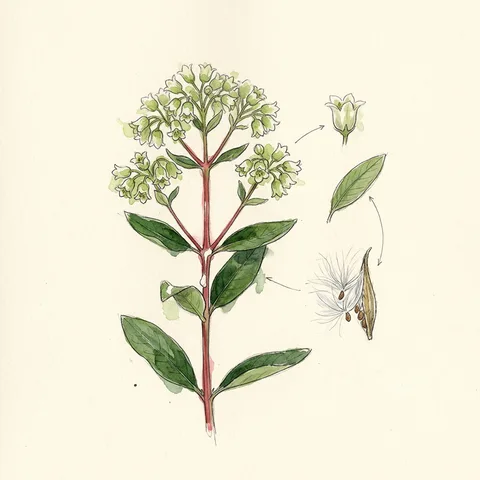
Apocynum Cannabinum
Λόγος χρήσης
Apocynum cannabinum was said by Pliny to be fatal to dogs, and from this circumstance its name was derived. It has a tough fibre, like hemp, which has been used for cordage.
Apocynum has a marked effect in increasing the flow of urine. It is not sufficient, however, in the present course, to study the drug simply as a diuretic, because it has such a decided action on the vital forces that it demands a more extended notice. It depresses the vital forces greatly, as evidenced in the relaxed sphincters, loss of muscular power, etc. This loss of power is an important general symptom, since it qualifies, as we shall see presently, the cardiac, renal and in- testinal symptoms.
In the last few years Apocynum has come into very extensive use in the treatment of many forms of dropsy. When I give you a resume of its symptoms, you will see that its indiscriminate use in dropsical conditions is by no means strictly homoeopathic. When not properly indicated symptomatically, it is necessary to exhibit it in large doses in order to produce any effect. Scoparius (broom-corn) and also the pods of some of the Leguminosae, cause increased functional activity of the kidne}'s and so aid in the elimination of the dropsical effusion. But we have to deal with an art that admits of no such prescribing. It aims at definiteness, not generalization. It teaches the selection of a similimum, not of a temporary palliative.
When indicated Apocynum demands that the following symptoms be present: bewilderment and heaviness of the head; drowsiness and de- bility or disturbed, restless sleep. The functions are sluggish. The
164 A CUNICAI, MATERIA MKDICA.
pulse is slow. The bowels are constipated, although the faeces are not hard. The kidneys are torpid, or else the urine is copious and urination is almost involuntary from relaxed sphincters. The nose and throat are filled with thick yellow mucus on awakening. The patient has a sense of oppression at the epigastrium and chest; he can hardly get breath to speak, even after lighter meals than usual; he must take frequent deep inspirations. There are also fluttering of the heart, and dartings and prostrated feeling in the cardiac region. The pulse is irregular, intermittent and at times feeble, then slow. The heart beats regularly, then flutters and becomes feeble, then slow and labored, now and then losing a beat. This is just the group of symp- toms characteristic of cardiac dropsy, and it shows what an affinity the drug has for the cardiac region. It will often palliate even in fatty degeneration of the heart, with dropsy, in old people.
Here you may compare several remedies: first, Arsenicum. This remedy has the same thirst and the same sinking at the epigastrium as has Apocynum, but it is indicated in more advanced cases, and the patient always presents more irritability of fibre.
I showed you the distinction between Apis, Acetic acid, and Apocy- num when I lectured on Apis.
Helleborus and Digitalis are similar to Apocynum in causing torpid- ity, slow pulse, etc. But I think that Apocynum, as a rule, is the pre- ferable remedy, unless the symptoms point very strongly to one of the other two.
Apocynum also has some action on the joints, producing a rheu- matic condition. The joints feel stiff, especially on moving in the morning.
You may recall that I mentioned Apocynum as a remedy in hydro- cephalus. The head is large; there is bulging of the frontal bones; the fontanelles are wide open; there is squinting, and, in extreme cases, the patient is blind; one side is paralyzed. The case closely re- sembles Apis, but lacks the cephalic cry. It is indicated in more ad- vanced cases than Apis. One or two cases have been cured by the continued use of the remedy.
There is a diarrhoea which may call for Apocynum. The stools are copious, yellow, watery, or brownish, and sometimes contain undi- gested food. They are discharged with an expulsive force like a cork from a bottle. The sphincter ani is so weak that stools escape un- bidden, or while the patient is passing flatus. After stool, he feels
THE VEGETABLE KINGDOM. 1 65
weak or has an " all-gone feeling" in the abdomen. The face is pale and covered with a cold sweat.
Aloe has a similar weakening effect on the sphincter ani, and great prostration after stool; but the stools under this remedy contain a jelly-like mucus, are apt to be worse in the morning, and there is a colic which is relieved by bending double.
Gamboge has stool preceded by excessive cutting about the navel. The stool is expelled " all at once" after considerable urging, and is followed by a feeling of great relief.
Apocynum also has haemorrhoids, which are associated with a feel- ing as if a wedge were being hammered into the anus.
Anaca?-dium is another drug which has a sensation as though a plug were being forced up into the anus.
Oleander Nerium.
The Oleander nerium is a native of Palestine, but it is also found wild in Southern Europe and is much cultivated in gardens and hot- houses everywhere; it thrives especially in damp places. As a plant it is highly ornamental, its large rose-colored flowers making it par- ticularly attractive. It is, however, very poisonous, causing a decided prostration of the nervous system with symptoms of narcosis. Do not fail to remember this depressing character of the drug. It produces weak memory and forgetfulness. Not only does it have this effect, but it also produces slowness of perception. The patient has great difficulty in catching the meaning of remarks. Accompanying these mental symptoms is a vertigo which is the result of weakness. Every- thing points to depression of the sensorium. Oleander is an impor- tant remedy when the symptoms just mentioned are the forerunners of paralysis.
Some years ago I succeeded in curing a case of headache with Oleander. The patient was a young lady. The headache was relieved by forcibly looking cross-eyed. While hunting for this symptom in the materia medica, I found that Olea?ider had pain in the head relieved by looking sideways. On that symptom I prescribed the remedy.
Studying the action of Olea?ider on the abdominal organs, we find emptiness and goneness in the pit of the stomach, even after eating, relieved by taking brandy. You will find this symptom indicating
1 66 A CLINICAL MATERIA MKDICA.
Oleander in very weak women who have infants at the breast. Im- mediately after nursing, the patient is seized with a tremor, and is so weak that she is scarcely able to walk across the room.
Car bo animalis is also suited to this condition.
Oleander is useful in diarrhoea. The stools are thin and contain undigested food, the characteristic symptom being that the patient passes, undigested, the food he had eaten the day before. This symp- tom you may notice in children with cholera infantum and marasmus. Another symptom calling for Oleander in infants and children is, "every time they pass wind they soil their diapers."
Here you must study Oleander in conjunction with Ferrum, Arseni- cumy Argentum nitricum, and Cinchona. Ferrum has diarrhoea with stool containing undigested food. The stool is unattended with pain, and is apt to occur during a meal.
Arsenicum is indicated in diarrhoea caused by chilling the stomach by the ingestion of cold substances. The stools are of a yellow color and are attended with pain of a burning character. The patient is worse after midnight, and there is the peculiar Arsenicum thirst.
Argentum nitricum is indicated in diarrhoea in which the bowels move as soon as the patient drinks.
Cinchona is useful in debilitating diarrhoea, with watery evacuations containing undigested food; caused or made worse by eating fruits. The stools may escape involuntarily after a meal.
Apis mellifica is a good remedy in cholera infantum with wide open anus and involuntary escape of faeces.
Phosphorus and Aloe also have involuntary escape of faeces; the symptom may best be expressed as a want of confidence in the sphinc- ter ani. With Phosphorus, the faeces pass as soon as they enter the rectum, as if the anus remained open.
In paralysis, Oleander is indicated when the disease invades one or the other limb; it is painless, and is usually preceded for a long time by vertigo. I think that Oleander, like Gelsemium, is indicated only in functional paralysis. I do not believe that it will cure paralysis of central origin. It goes further than Gelsemium, however, in implicat- ing the sensory as well as the motor nerves.
Oleander also has an action on the skin. It produces marked sensi- tiveness of the skin, so that very slight friction causes soreness and chafing, especially about the neck or between the scrotum and thighs. There is violent itching of the skin on undressing. It also produces
THE VEGETABLE KINGDOM. 1 67
an eruption on the scalp and behind the ears, simulating crusta lactea, and oozing a fluid which hardens into scabs beneath which vermin breed. It is just as important a remedy in this disease as Sulphur, Mezereum, Viola tricolor, etc. The distinction which you may make lies in the other symptoms, i. e., if the characteristic gastro-enteric symptoms are present, Oleander will be the remedy.
For symptoms produced by acute poisoning with this remedy, Cam- phor is the best antidote. For the chronic symptoms, particularly if there be any cutaneous disorder, Sulphur is probably the best remedy, because it is the most similar, but of the value of this last suggestion I am not positive. I merely offer it to you for what it is worth.
homeopathylibrary.com/el/remedy/apocynum-cannabinum