 Homeopathy Library
Aconitum Napellus
Aconitum · Tyler - Homoeopathic Drug Pictures · Margaret Lucy Tyler · 16,714 chars
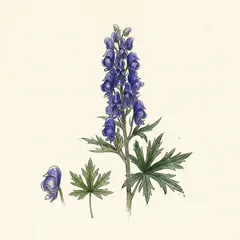 All books on Aconitum Napellus →
Antidoted byAcetanilidumAceticum AcidumActaea RacemosaAlcoholArnica MontanaBelladonnaBerberisBerberis VulgarisCaladium SeguinumCantharis Vesicatoria
All books on Aconitum Napellus →
Antidoted byAcetanilidumAceticum AcidumActaea RacemosaAlcoholArnica MontanaBelladonnaBerberisBerberis VulgarisCaladium SeguinumCantharis VesicatoriaGeneral
"My heart is disquieted within me : and the fear of death is fallen upon me.
" Fearfulness and trembling are come upon me : and an horrible dread hath overwhelmed me."
THE Sweet Psalmist of Israel, the Warrior King, who nearly three thousand years ago swept the strings of all human emotions and experiences : who has inspired a hundred generations with courage, reliance, confidence — repentance : who reached the sublimest heights, and fathomed the depths of suffering, bereavement, and remorse,. even he had his Aconite moment of solid, unreasoning Fear .
His words, above, are practically those of the provings of Aconite.
Kent says, " Aconite is like a great storm ; it comes, and sweeps over, and passes away." . . . " It is a short-acting remedy : a violent poison in large doses, either destroying life, or passing away in its effects quite soon, so that if the patient recovers, recovery is not delayed. There are no chronic diseases following it."
The very face of Aconite expresses Fear , and Aconite is curative in ailments from fright, mental, or physical, even to jaundice ; just as Chamomilla is curative of ailments, even to jaundice, caused by rage and anger, or Staphisagria of ailments caused by real, or imaginary, insults and grievances.
But the fears of Aconite are more or less intangible. The known, the definite, has no terrors for Aconite. It has not the fear of poverty of Bryonia , the fear of thunder of Phosphorus , the fear of dogs of Belladonna , the fear of approach of Arnica , the fear when alone of Arsenicum, Argentum nit.
But Aconite has the Fear Of Death , the fear of darkness, the fear of bed, .. he fear of ghosts.
Aconite has not only the fear of death, but it predicts the very hour of death. As Kent puts it, " If a clock is in the room, he will say that when the hands reach a certain point, he will be a corpse."
It is Aconite who calls his friends around, and takes leave of them. Aconite has thoughts of death, the presentiment of death, predicts the time of death. And such a mental state, occurring in the course of any illness, or after any shock, fright or operation, calls for Aconite.
Aconite is a quick-acting, superficial remedy, for acute and most distressing conditions, when the patient, getting Aconite, lies down, relaxes, and sleeps. The storm has passed.
It is homoeopathy that can administer to intangible, but torturing distress. And remember, Aconite is no dope, it is merely promptly curative of the conditions it has actually produced in poisonings and in provings.
Dr. Clarke once said, " If ever you come across a book by Henry N. Guernsey , buy it." And Guernsey has an illuminating article on Aconite.
He says :
" The genius of this highly useful remedy is through the mental sphere, and it is always important to consider the mental symptoms. Almost certainly this remedy should never be given in cases where the sickness is borne with calmness and patience. If Aconite is even to be thought of, we will find mental uneasiness, worry, or fear, accompanying a most trifling ailment, such as inflammation of the eyelids . . . Great and uncontrollable anguish, anxiety, and great fear, are characteristic of the Aconite disease. . . .
" Complaints caused by fright, and the fear remains. (Opium.) " Predicts the expected day of his death, is very characteristic. " In the delirium is unhappiness, worry, despair, raving, with expression of fear upon the countenance, but there is rarely unconsciousness. . . .
" Easy bleeding, of bright, pure, red blood, attended by a great fear of death. . . .
" Active hemorrhages from any part of the body, uterine or other, accompanied with fear of death and nervous excitability."
Fear of death may be so great, that people have actually killed themselves for fear of dying ! (I myself knew one such case.)
Shakespeare says that " There is nothing either good or bad, but thinking makes it so." And with Aconite, it is largely the thinking that makes it so.
It is the unreal, the intangible, that strike terror into Aconite, and failing Aconite, you may almost have to fake the clock, in order to save life.
Kent says, " The patients most in need of Aconite are the strong, robust people.
" The patient seems threatened with sudden, violent death, but recovery is quick. A great storm, and soon over."
Aconite is the remedy of cold, dry weather, like Hepar, Nux and a few others ; while cold, wet weather affects such people as need Dulcamara, Rhus, etc.
Nash gives Aconite as one of the greatest pain remedies : his trio here being Aconite, Chamomilla and Coffea.
But the pains of Chamomilla are accompanied by intense irritability, those of Coffea by excitement, by " a sensitiveness of the skin beyond comprehension ", and are curiously aggravated by noise, while those of Aconite, as said, are intolerable and accompanied by anguish and fear .
As Kent puts it, Aconite " screams with pain. Pains like knives. . . . Some awful thing must be upon him, or he could not have such dreadful sufferings. Predicts the day of his death, as a result of the awfulness that seems to be overwhelming him. And this mental picture is always present, in pneumonia ; in inflammations of the kidneys, of the liver, of the bowels, in any part of the body where Aconite is useful."
Nash says, " Aconite has great distress in the heart and chest, while with Belladonna everything seems to centre in the head."
And he quotes Hering as to the Aconite fever. " Heat, with thirst ; hard, full and frequent pulse, anxious impatience, in-appeasable, beside himself, tossing about with agony."
Aconite has been, perhaps, rather neglected in our day. The old homoeopaths knew how to-use it. But someone gave vent to the unfortunate platitude, which has been passed on, " By the time you see the case, it is already too late for Aconite." Rubbish !
The Aconite condition may come on at any moment, in any illness, after surgical interference, when Aconite will restore speedy peace, and leave no after-effects.
Aconite has been styled the Homoeopathic Lancet : for it was Aconite, that finished " bloodletting ", by the signal relief it gave in the onset of most inflammatory conditions (pleurisy, pneumonia, etc.) where, not to bleed was actually regarded as tantamount to murder.
Aconite is an example of the uselessness of getting your knowledge of drugs from their effects on animals. Clarke records an attempt to destroy an elephant, where a carrot was scraped out, and enough aconitine to poison 2,000 men was put in. The elephant ate it readily, but nothing happened, and three hours later a large dose of prussic acid had to be administered, which soon proved fatal.
As Clarke says, " Aconite is one of the deadliest and most rapidly acting of poisons, yet, through Hahnemann's discoveries, it has been transformed into the best friend of the nursery."
" Aconite is the remedy of the rosy, chubby, plethoric baby," says Kent . And one visualizes a scene — a small, healthy baby girl, with high fever, crying out and throwing herself about in her mother's arms ; anguished and unable to express her trouble except by bursts of crying : her mother almost frantic : — " I don't want to lose her ! "
And then, just a wee dose of sweet sugar medicated with Aconite, the potency immaterial, and the storm soon over.
For Aconite is at its most indispensable in households and in the nursery, for sudden, severe effects, following chills and frights, with restlessness, anxiety, fear, and exalted sensibility.
And this is what Hahnemann says. " Aconite is the first and main remedy, in minute doses, in inflammations of the windpipe (croup, membraneous laryngitis), in various kinds of inflammations of the throat and fauces, as also in the local acute inflammations of all other parts, particularly where, in addition to thirst and quick pulse, there are present anxious impatience, an inappeasable menial agitation, and agonizing tossing about. . . . In the selection of Aconite as a homoeopathic remedy particular attention should be paid to the symptoms of the disposition, so that they should be very similar." He points out that it is also " an indispensable accessory remedy even in the most obstinate chronic affections, when the system requires a diminution of the so-called tension of the blood vessels ".
Elsewhere, in Sir John Weir's paper, " Homeopathy, an Explanation of its Principles," will be found a case, which is worth repeating here. " At 10.30 p.m. one night, I was called to see a man suffering from urticaria--anaphylactic--after anti-tetanus serum. He was almost beside himself with fear and anxiety : very restless, couldn't keep still : certain he was going to die. Thirsty, felt hot, great fear of being alone.
Very apprehensive. Everything had to be done at once. Rheumatic pains intolerable : said they were driving him crazy.
" Here Aconite, in the 30th potency, gave almost instant relief, and in fifteen minutes the patient was quite himself again. This was one of the most dramatic things I have ever seen."
One could run on indefinitely with Aconite, its wonderful soothing effect in heart disease, where an acute condition has supervened, with palpitation, anguish, and great distress. Such as with a Belgian refugee during the early days of War ; a bad heart case, with condition dangerously, almost fatally aggravated, while waiting for days for embarkation, exposed on the quay to cold, exhaustion, and fear ; in Kidney disease, as with a boy in hospital, with general dropsy, better every time for Aconite, then permanently benefited by Sulphur — which is the " chronic " of Aconite.
It is well to remember that, where Aconite is too superficial for what has already become chronic, Sulphur, its " chronic " is generally the remedy, in the same way that Calcarea is the chronic of Belladonna.
Then, again, in inflammation of the bladder, in suppressed urine, or menses ; and endless other conditions resulting from, or accompanied by, chill, shock, fright, fear.
Aconite, remember, is a very great fever remedy : but is only the fever remedy of Aconite fevers.
Kent says, " Never give Aconite in blood-poisoning, such as we find in scarlet fever, typhoid, etc. We find nothing of the violent symptoms of Aconite in such conditions. The nervous irritability of Aconite is never present, but the opposite ; the stupor, the laziness, the purple skin : whereas Aconite is bright-red.
Aconite has no symptoms like the slow types of continued fevers.
The Aconite fever is generally one short, sharp attack. Some remedies have periodicities, or waves : Aconite has no such thing.
The most violent attack of fever will subside in a night if Aconite is the remedy."
The sensations of the various drugs are suggestive and helpful, as, for instance, Aconite tingles, Lachesis hammers, Arsenicum may stitch with hot needles, Bryonia, Kali carb., Spigelia stitch and stab, the first and the last on movement especially ; Kali carb. independently of movement also, and so on.
We will conclude with extracts from the actual provings of Aconite, given in black type by Hahnemann , in Allen's Encyclopedia and in Hering's Guiding Symptoms ; that is to say, symptoms again and again brought out in healthy provers, and again and again found curative in the sick of a like sickness.
Black Letter Symptoms ( Hahnemann and Allen )
Nightly raging delirium.
Variable humor, gay, then dejected.
He did all things hurriedly.
Great vexation about trifles.
Great anxiety : great internal anxiety.
Inconsolable anxiety.
Extremely disposed to be cross.
Fear of approaching death.
Lamentable fears of approaching death.
Apprehension : sadness .. solicitude.
Fear of some misfortune happening to him.
Inconsolable anxiety and piteous howling, with complaints and reproaches about (often trivial) evils.
Excessive restlessness and tossing about for hours.
Very restless nights.
Restless tossings in bed.
Palpitation of the heart and great anxiety, increased heat of body, especially in the face.
She is as if stupefied from flying redness in the face.
Unsteadiness of ideas : if she wants to pursue a train of thought a second chases this away, and a third again displaces this, until she becomes quite confused.
Want of memory, as if what he had just done were a dream, and he can scarcely recall what it was.
Weakness of memory.
Head in front as if nailed up.
Pain is intolerable, drives him crazy.
Fullness and heaviness in forehead, as if an out-pressing weight lay there, and as if all would be forced out at the forehead.
Heat in head.
Burning headache as if brain were agitated by boiling water.
Fullness in head.
Semilateral drawing in head.
Throbbing left side forehead : while strong beats occur in the right side by fits.
Vertigo : staggers especially to the right.
Vertigo with nausea, especially rising from sitting.
Vertigo worse shaking head, whereby complete darkness comes before the eyes.
Dilated pupils.
Photophobia.
Inflammation eyes with lachrymation, which causes so much pain and fright that he wishes for death.
Inflammation of eyes, extremely painful.
Great sensitiveness to noise .
Epistaxis.
Great sensibility of olfactory nerve.
Creeping pain in cheeks.
Sensation of the face growing large.
Penetrating fine stitches in tip of tongue.
Tongue swollen.
Dryness of mouth.
Burning in throat.
Great thirst.
Empty eructations.
Nausea.
Vomits lumbrici.
Inclination to vomit, as if had eaten something disgustingly sweet or greasy.
Violent vomiting.
Pressive pain, stomach , like a weight.
Tensive pressing pain like a weight in stomach and hypochondria.
Swollen, distended abdomen , like ascites.
Flatulent colic in hypogastrium as if he had taken a flatus producing purgative.
Burning in umbilical region.
Sensitiveness of abdomen to touch, as from slight peritoneal inflammation.
Burning in abdomen.
Cutting in intestines.
Great swelling of abdomen which is painful to touch.
White stool.
Pain in rectum.
Shooting and aching in anus.
Anxious desire to urinate.
Urine hot, dark-coloured.
Fetid breath.
Sensitiveness of larynx to touch.
Hoarseness.
Hoarse, dry, loud cough.
Expectoration of bright red blood. Haemoptysis.
Difficult respiration.
Squeezing pain in chest.
Creeping pain in chest.
Stitches in chest with cough.
Anxiety about heart.
Palpitation and anxiety.
Pulse contracted, full, powerful, febrile, exceeding 100 beats to minute.
Rheumatic pain nape of neck : only on moving.
Violent, shooting, digging pain left of spine.
Bruised pain in articulation of lowest lumbar vertebra with sacrum : sacrum feels hacked off.
Cool sweat on palms .
Creeping pain in fingers.
Coldness of feet.
Weakness and laxity of the ligaments of all joints.
Yawns often without being sleepy.
Light sleep .
Very restless nights : tossing in bed.
Excessive restlessness.
Anxious dreams : wakes with a start.
Chill of whole body, with hot forehead : hot ear lobe, and internal dry heat.
Slight perspiration all over body.
Very fine stinging, or stinging burning pain in many parts, skin.
Redness and heat of one, coldness and paleness of the other cheek.
Towards evening, burning heat in head and face, redness of cheeks and out-pressing headache.
Towards evening, dry heat in face with anxiety.
Notable, Or Queer Symptoms And Indications.
Constriction at throat.
Scratching and constriction.
Dryness, as if something had struck in throat.
He frequently pulled at the throat.
The abdomen seemed as if full of water.
Burning feeling from stomach up through oesophagus to mouth.
White faces and red urine.
Slight sensation of splashing in bladder when urinating.
Numb sensation, small of back into legs.
Whole body sensitive to touch : child will not allow itself to be moved : it whines.
Most of the symptoms are accompanied by shivering and anxiety.
Fine pricking, as from needles here and there on body.
Convulsions of teething children : heat, startings, twitching of single muscles.
Child gnaws its fists : frets ; cries.
Violent chills, dry heat.
After a violent chill, dry heat with difficult breathing, lancinating pain through chest.
Inflammatory fevers and inflammations, with heat, dry skin, violent thirst, red face, or alternate red and pale face ; groaning and tossing about ; shortness of breath ; congestion to head.
Bad effects from suppressed sweats, etc.
Pains intolerable.
Numbness : tinglings ; formications.
Measles ; dry barking cough ; painful hoarseness ; cannot bear light.
Tongue red.
Local congestions and inflammations.
Neuritis with tingling.
Gastric catarrh from chilling stomach with ice water when heated. (Ars.)