

 Ομοιοπαθητική Βιβλιοθήκη
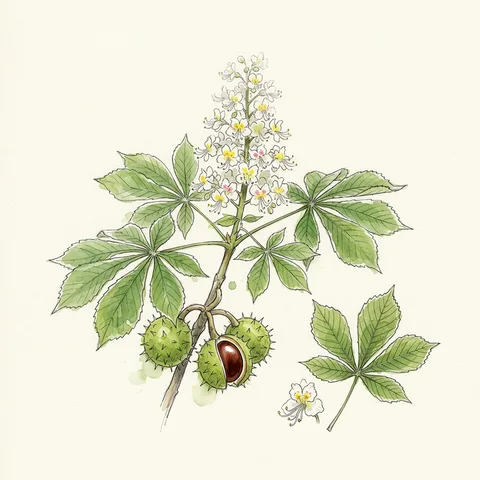
Aesculus Hippocastanum
Λόγος χρήσης
Aesculus Hippocastanum, L. Nat. order , Sapindaceae. Common names , Horse Chestnut; (Germ.) Rosskastanie; (Fr.) Le marronnier d'Inde. Preparation , Trituration or tincture from the fresh fruit without the shell.
Authorities. 1 , Cooley, N. Y. St. Trans., 8, 330 (took the tinct.); 2 , Buchmann, Viertl Jahrschrift, 10, 1 (took the powdered nut and tinct.); 3 , Augusta B. ibid. (nut and θ ); 4 , Miss W. Br., ibid. (nut); 5 , Miss W. N., ibid. (nut); 6 , Pastor R. H. ibid. (nut); 7 , Ed. B. ibid. (tinct.); 8 , Mrs. J., ibid. (tinct.); 9 , C. W. Boyce, Hale's New Remedies, 2d ed. (1st. dec. trit.); 10 , T. C. Duncan, ibid. (1st and 2d dec. dil.); 11 , W. Warren, ibid., and N. Am. J. of Hom., 10, 80, (1st and 2d dec. trit.); 12 , H. M. Paine ibid. (tincture); 13 , W. H. Burt, ibid. (crude nut and 1st dec. trit.); 14 , C. H. Lee, ibid, (3d dil. and tinct.); 15 , Dr. J. C. Raymond, N. Am. J. of Hom., 10, 90 (6th cent. potency).
Το πλήρες κείμενο (T. F. Allen), ανά ενότητα
Mind
Great repugnance to the drug, [9] .
Inward cheerfulness and placidity of temper, [5] . *Feeling very depressed an low-spirited , [13] . *Feeling very sad , [13] . *Feel dull, gloomy, and despondent , [10] .
Gloomy forebodings, [10] .
*Extremely irritable ; loses temper easy and gains control over it again but slowly, [10] .
Feels miserably cross, [12] .
Day before, when he had the darting pains in the trachea, he had a feeling as if death was impending; but this was followed by an exalted condition of brain and nervous system; thoughts flowed free, easy, and clear, [10] . [10.] Thoughts rapid, [10] . Mind clear, [10] . Mind very clear, with a light feeling of anterior lobes; posterior portion of head and cerebellum feel heavy and dull, [10] .
Mind cloudy, [10] .
Confusion of ideas; mind gets confused, [10] . Very dull and stupid, [14] .
Disinclination to perform any labor, [12] . Have not studied to-day, [10] . Feel disinclined to study, and wanting rest, [10] . Unable to fix his attention , [10] . [20.]
Loss of memory, [10] .
On waking (from sleep while sitting) cannot recognize what she sees; knows not where she is, nor whence came the objects about her, [3] .
Head
Confusion of head, [8] . Sensation in head as if intoxicated, [5] .
*Confused feeling in head, with giddiness , [11] .
Vertigo, quite troublesome, [12] . Vertigo, very annoying all the afternoon, [12] .
Slight vertigo, [12] .
Vertigo, with sense of balancing in the head, [11] . Headache general, throughout whole head, [12] . [30.]
Headache worse on stooping or getting up from a chair, [14] .
Heat in head, [4] .
Headache all over, as if it would burst (during fever), [14] . Pain and fulness in head, with stiffness in the neck and spine, [1] .
Fulness in head, [14] .
Severe headache, as if head would split, [14] . Dull headache, [13] . Brain feels dull and heavy, [1] .
Head feels heavy, dull, especially in region of right ear, [10] .
Dull pains in head, here and there, but principally in right temple and occiput, followed by dull stitches in the forehead and temple, [11] . [40.] Heaviness of head, [8] .
Lancinating headache, [1] .
Slight frontal headache (in one hour), [13] . Very severe frontal headache, all day, [13] .
Dull frontal headache , [13] . Dull, heavy frontal headache, [10] .
*Dull frontal headache, with constrictive feeling of skin of forehead , [13] .
Dull frontal headache, with fluent coryza, 13. Dull weight in forehead , [10] .
*Dull pressure in forehead, with slight feeling of nausea in stomach, followed immediately by stitches in right hypochondrium , [11] . [50.] Aching in forehead; feeling in it as during cold in head, [4] . Throbbing in right frontal eminence, [11] . Neuralgic pain in region of causality (right), darts towards the left, with a constricted feeling of the skin of the forehead, followed by flying pains in the epigastric region (right lower lobe of liver) (in one hour), [13] .
Slight uneasiness in region of left causality, [10] . Occasional neuralgic pains in forehead and apex of heart, [13] . Dull pain in forehead over right eye, [10] .
Headache over right eye (after one hour), [8] . Pressure of hat on forehead leaves a large, red spot, [10] . Frequent flying pains in forehead and temples all day, [13] . Frequent flying pains through temples , [13] . [60.]
Pain and soreness at temporal region, [10] . Sharp pressing pain in right temple, [11] . Dull pain in left temple, [11] . Quite severe pains in left temple, [1] .
Severe shooting pains in left temple, [14] . Fine stitches in left temple, with slight feeling of nausea in stomach, [11] .
Head feels dull over temple, [10] . Formication in the front of the temple, [8] . Feeling as if she had a board upon the head, [3] .
Sensation of fulness in all the upper part of the head, [12] . [70.] Headache in upper part of head; the pain is uniform and constant; the sensation that of fulness and pressure rather than acute pain, [12] . Quite severe pain in right side of head, above the temples, [9] . A sore spot in right parietal bone, which, upon pressure, felt as if a knife were piercing through, [14] . Back of head feels heavy, [10] .
Dull, heavy pressure on cerebellum, [10] . Bruised feeling in the occiput, with feeling of lameness in back of neck, [11] .
Dull pain in occiput, extending to ears, [11] . Dull pain in occiput, with flushes of heat in the integuments of the occiput , back of neck and shoulders, [11] .
Very severe lancinating headache at base of brain, as if too full, [14] . Hyperaesthesia of scalp, [10] . Soreness of right side of scalp (the side which rested on the pillow, [10] .
Eyes
[80.] Eyes dull, [1] . Eyes clear, [10] . Eyes of a pinkish hue, [14] .
Quivering of lids, [7] .
Twitching of lids, [10] .
Tries to keep from winking, [10] . Frequent twitching of muscles under left eye, [13] .
Heat in the eyes, [4] .
Severe smarting of the eyes, [13] . [90.] *Weight in the eyes , [3] . Eyes heavy , [10] . Jerking in right eye (after three and a half hours), [8] . Shooting pain in left eye, [10] .
Light and giddy pain in right eye, while near light, [10] . Burning and stinging deep in left orbit, as if the pain surrounded the ball of the left eye, with feeling of coldness in eye, [11] . Painful aching over left eye , [7] . Lachrymation, [7] . Eyes filled with tears, [10] .
Burning in inner canthi, [2] . [100.]
Soreness of balls of eyes, [10] . Pupils dilated; contract slowly, [10] . She can read well at a distance; can read without spectacles, which she could never do before, [8] . Flickering before eyes , [7] . Optical illusions, [10] .
Ears
Burning in the ears, [11] .
Fulness in both ears, [10] .
Pressure in region of right ear, [10] .
Nose
Dryness of posterior nares , [10] .
Posterior nares empty; used to be full of mucus in morning, [10] . [110.] Disposition to sneeze, [8] .
Sneezing , [7] , [9] . Thin mucus from nose, causing a frequent use of the pocket-handkerchief, [1] .
Increased flow of mucus from nasal passages, [10] . Profuse secretion of mucus in nostrils, with coryza, [13] . Fluent coryza, [5] . Much fluent coryza, [7] .
Frequent coryza, [1] .
Severe fluent coryza , [3] . (three hours after), [6] . Fluent coryza, with the dull frontal headache, [13] . [120.] Fluent coryza, with twisting sensation in the front part of the nose, [5] .
Coryza, with cool feeling in the nose on breathing in, [7] .
Coryza, profuse, with feeling of fulness in nose and forehead, as if had taken cold, [10] . Catarrh; fulness of nose, pressure in forehead, especially at root of nose, [10] .
Left nostril filled with thick mucus; right one empty, [10] .
Violent formication on the nose, [3] . Fulness at root of nose (frontal sinus), [10] .
Pressure at root of nose, [10] .
Shooting pain in nose, [3] .
Nose feels sore and full, [10] . [130.] Raw feeling throughout the whole nasal cavity, [1] . Pain in right nasal bone, [10] .
Pressure in bone on left side of nose, [10] . Burning in the nostril, [1] . *Stinging and burning in posterior nares and soft palate , [11] . Sensation of swelling of the nasal mucous membrane, as if from taking cold, [9] .
Posterior nares and palate feel dry, [10] . Feeling in nose as after a pinch of snuff, [4] . Sensitiveness of the nasal mucous membrane, which causes a feeling as of coldness in the nose, [6] . The nasal mucus becomes even more watery, the inspired air more felt, [6] . [140.] Drawing in right nostril, as in violent coryza, [8] . Dry feeling and sensation of heat in the nose, especially its tip, as when a severe coryza is about to come on, [1] .
Face
*Pale, miserable appearance , [3] .
Looks ill, [3] .
Flush of blood to face soon after rubbing it, [10] . Rubbing after washing the face produces red spots under the skin, [10] .
Flying heat and redness of left side of face, [3] . Flying heat in left side of face, [1] . Burning in left cheek, [3] .
Mouth
Pain in sound teeth, [10] . [150.]
Teeth feel as if covered with oil, [10] . Tongue coated white , [14] . Tongue slightly coated dirty-white, [10] . Tongue coated yellowish-white, [°] .
Yellow coating on the tongue , [1] , [14] . Tongue very much coated yellow, [13] . Tongue covered with a light-brown coat, [1] .
Tongue feeling as if had been scalded, with great constriction of fauces, [13] . Tongue feels as if swollen, [10] .
Soreness of tip of tongue, like that produced by ulcers, [9] . [160.] Sharp biting and stinging pain in tip of tongue and fauces, [11] . Mucous surface of mouth and pharynx dry, [10] . Dryness of soft palate, [14] . Palate and posterior nares feels dry, [10] . *A quantity of thick, yellow phlegm in mouth , [14] . Burning in mouth and oesophagus, [7] .
Flow of water into the mouth , [3] . Rush of water into the mouth, [5] .
Collection of water in mouth compelling him to swallow, [7] . Increase of saliva , [9] , [11] . [170.] Salivation, [9] . "I induced several other persons to make a few trials, but with no result, except increased salivation ," [9] .
Ptyalism, with an oily taste, [10] . Coppery taste in mouth, with increased flow of saliva (in ten minutes), [11] . Foul taste in mouth, [1] .
Sweetish taste, [1] .
Sweet taste, as after taking dulcamara, [3] . Sweet taste, like liquorice, [5] .
Sweetish taste, with dryness of larynx, [8] . Sweet, flat, slimly taste in mouth, [13] . [180.] The taste, which was at first bitter, becomes sweet, [6] . The taste of the drug is, at first, intensely bitter, and is peculiarly unpleasant and nauseous; the bitter taste is soon displaced by a pleasant, sweetish flavor, very similar to that of ordinary liquorice-root; this sweet taste remains about an hour [12] .
Bitter taste , [7] , [11] . Bitter, burning taste (of the drug), acting as an astringent on the mouth and oesophagus, [7] . Flat, bitter taste in the mouth, [13] .
Flat, slimy taste in mouth, [13] . Metallic taste in mouth , [9] .
The taste of the drug remained in the mouth several hours, [9] .
Unable to articulate long words distinctly; cannot control the tongue so as to form the words aright, [10] .
homeopathylibrary.com/el/remedy/aesculus-hippocastanum

