

 Ομοιοπαθητική Βιβλιοθήκη
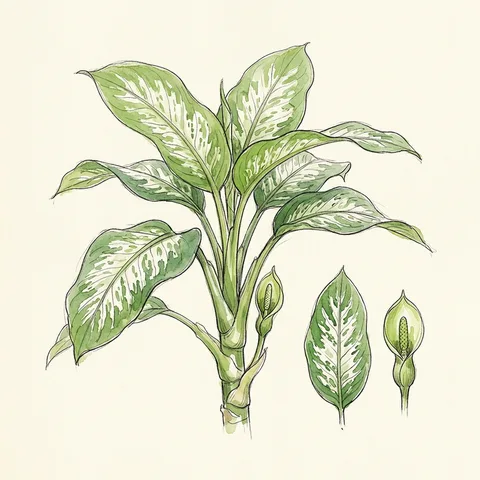
Caladium Seguinum
Λόγος χρήσης
Caladium is indicated in stout persons of flabby fibre who are sub- ject to catarrhal asthma; that is, asthma with the production of mucus which is not readily raised, but which, when raised, gives re- lief to the patient.
ARACE^. 215
It is a remedy to be remembered in spermatorrhoea or in seminal weakness, particularly in nocturnal emissions, when there is complete relaxation of the organs so that emissions occur without any dreams, or if there be a dream, it is entirely foreign to sexual subjects. So you see it is indicated in far advanced cases without erections.
Dracontium.
I bring this drug before you in order to say a few words concerning the remedies similar to it. Dracontium has never been proved in the high potencies. It produces symptoms similar in nature to those of Arum triphyllum, but its action is on the lower portion of the respira- tory apparatus. Arum produces a laryngeal cough. Dracontium acts on the trachea and bronchial tubes, giving rise to a violent attack of bronchial catarrh, with rapid formation first of a watery, burning dis- charge, and later, of pus or muco-pus; hence its symptoms are: yel- lowish purulent discharge, with great burning, rawness, and other symptoms of violent inflammation.
Beside Draco?itium I have placed on the board a list of reme- dies, some of which may be unknown to you. The Balsam of Peru should be remembered as an admirable remedy in bronchial catarrh when there is formation of muco-pus. When you place your ear to the chest you detect loud rales, and the expectoration is thick, creamy, and yellowish-w7hite. The Balsam of Peru is an excellent remedy, even though night sweats and hectic fever show the disease to be pro- gressing alarmingly. This drug I use in a low potency.
Next below I have placed Pix liquida, which is not only an excellent remedy in bronchial catarrh but also in phthisis pulmonalis. It is indi- cated by the expectoration of purulent matter, offensive in odor and taste, and accompanied by pain referred to the left third costal carti- lage (really in the left bronchus). This pain may or may not ap- parently go through to the back. In such cases Pix liquida is the remedy. It is especially indicated in the third stage of phthisis.
Next to this I have placed Guaiacum, which is also to be thought of in the late stage of tuberculosis, when there are pleuritic pains re- ferred to the left apex, and in addition offensive muco-purulent sputum.
Eryodiction Californicum (also called Yerba santa) has as yet a very limited symptomatology, but it has been used successfully in what we may call bronchial phthisis. The patient has night-sweats, and the
2l6 A CLINICAL MATERIA MKDICA.
body wastes away. There is great intolerance of food. It is called for in phthisis, the result of frequent bronchial catarrhs, and also in asthma relieved by expectoration.
Pothos Fcetida.
Pothos foztida is a remedy you should remember in asthma. It is useful for asthma that is worse from any inhalation of dust, as, for example, the inhalation of the dust in a hay-loft, and that is re- lieved by stool.
It also includes within its therapeutic range marked hysteria. Ab- sent minded, irritable; hysterical paroxysms resembling tetanus, with enormous bloating of the abdomen.
LECTURE XX.
ANACARDIACE^.
To-day I introduce to you for study a group of plants known as the Anacardiacecs . This is a valuable order, from which we ob- tain several very useful medicines, i. The Anacardium orientate, which comes from the East. 2. The Anacardium occidentale, the western Anacardium or cashew nut. 3. The Comocladia dentata, which is the Rhus common to the southern parts of the United States and Cuba. Upon the blossoms of this plant bees feed in certain seasons of the year. Those who partake of the honey at such times are liable to become affected with an eruption very much resembling that of erysipelas. The Comocladia is very similar to Rhus tox. Both remedies have pain with relief from motion; both may be called for in erysipelas; both cause scarlet redness of the body, with burning and itching; both produce weakness, numbness, restlessness, etc. They differ in their eye-S3'mptoms. Comocladia has pains in the right eye with a sensation as if it were larger or were being pushed out of the head. These eye-symptoms are worse near a warm stove; while those of Rhus are relieved by this influence. Apis has eye-symptoms aggravated from being near a warm stove. The ophthalmia of Mer- curius, Argentum nitricum and Antimonium crudum is also worse from radiated heat. Comocladia resembles Euphorbium officinarum in its skin-symptoms, even in the red stripes on the skin. 4. Rhus toxico- dendron or the poison ivy, which I will consider at length in my next lecture. 5. Rhus glabra, or the common sumach; it is not so poison- ous a variety of the Rhus as those already mentioned. It has cured occipital headache, and also epistaxis proceeding from the left side. 6. Rhus radicans, which is regarded by many as identical with Rhus tox. 7. The Rhus veneiiata, an exceedingly poisonous variety. It has a large blossom of a dark reddish-brown color. It is a small tree, growing sometimes to the height of ten feet, and very much resem- bling the Ailanthus.
All the plants of this order are poisonous; they affect the blood, and develop an eruption on the skin which is, at first, vesicular and finally pustular and eczematous. They may also produce an erythema
A CLINICAL MATERIA MEDICA.
ending in erysipelas. Despite the similarities thus far mentioned, there are great differences in their physiological action; in fact, these differ- ences may be so great that, in some points, they may bring some of the members of the group into an opposite relation to each other.
homeopathylibrary.com/el/remedy/caladium-seguinum

