 Ομοιοπαθητική Βιβλιοθήκη
Natrum Muriaticum
Λόγος χρήσης
Synonyms. — Sodium Chloride. Chloruretum Sodicum. Natrium Chloratum Purum. Sodii Chloridum. Chloride of Sodium.
IOO THE TWELVE TISSUE REMEDIES.
Common Karnes. — Common Salt. Table Salt.
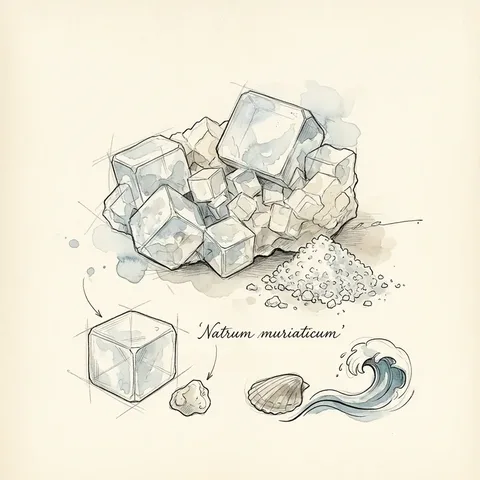
Chemical Properties. — Formula, Na CI. It occurs abun- dantly in nature, nearly everywhere. It crystallizes from aqueous solutions in colorless, transparent, anhydrous cubes ; it is soluble in three parts of cold water, scarcely more in boiling. It is insoluble in absolute alcohol. Its watery solu- tions dissolve several bodies insoluble in water, e. g., Calc. flhos., etc.
Preparation. — One part by weight of pure chloride of so- dium is dissolved in nine parts by weight of distilled water. Amount of drug power, one-tenth. Dilutions and triturations should be prepared according to Hahnemann's methods.
Physiologico-chemical Data. — This salt is a constituent of every liquid and solid part of the body. Its function is to regulate the degree of moisture within the cells.
This function of salt to regulate the degree of moisture within the cells is accomplished by virtue of its property of attracting water, which is imbibed as drink or in the food, and reaching the blood through the epithelial cells of the mucous membrane, whence it may finally reach ■ the various cells, giving them the needful degree of moisture. Every cell contains soda, combining with nascent chlorine, which is formed by the splitting up of the chloride of sodium contained in the intercellular fluids. This chloride of sodium within the cell thus produced has the property of attracting water ; in consequence of which the cell enlarges and is divided. Only in this way does division of cells for purposes of cell multiplication take place.
If no chloride of sodium is formed within the cells, the water destined to supply their moisture is retained in the intercellular fluids, and a hydremia results. The patient then shows a watery, bloated appearance, is languid, drowsy, lachrymose, chilly, especially along the spine and extremi- ties. He craves salt. Although a plentiful supply of salt may be offered in the food, the diseased condition is not re- moved, simply because the cells cannot take up the particles of salt unless offered in a very dilute solution.
NATRUM MURIATICUM. IOI
An oversupply of salt within the intercellular fluids often occasions a salty taste, due to the irritation of the glossophar- yngeal and lingual nerves. Such a condition also causes acridity of secretions of mucous membranes or of open wounds.
Chloride of sodium contained in the healthy epithelial cells of serous membranes regulates the osmosis of water from the arterial blood to the several serous sacs. A disturbance of the functions of these salt molecules is followed by a watery exudation within the sacs. By the therapeutic application of small doses of Natrum mur. the cells are enabled to reabsorb the exudation.
A disturbance of the molecular motion of this salt in the epithelium of the tear glands, or in the salivary glands is fol- lowed by lachrymation or ptyalism.
If the dental branch of the fifth nerve is irritated, and the disturbance reaches the lachrymal glands, which is done by means of the secretory fibres of the sympathetic, and which results in a disturbance of the function of the molecules of salt in these cells, we have a toothache accompanied by a profuse flow of saliva.
The epithelial cells of the intestinal mucous membrane transfer, by means of their salt, the water taken with the food into the blood contained in the branches of the portal vein. A disturbance of their function through any irritation results in a reverse flow. Serum enters the intestinal canal, and a watery diarrhoea results in consequence. And if the irritation reaches the mucous cells of the intestines, a watery, mucous diarrhoea results. The mucin of the mucous cells appears on the surface as a glairy, transparent mucus. The normal secretion of mucus is decreased if the mucous cells contain too little salt and mucin.
It is the sodium chloride particularly which regulates the quantity of water entering into the composition of the blood corpuscles, thereby preserving their form and consistence ; and it seems to perform an analagous office with regard to the other semi-solids of the body. (Dal ton.)
102 THE TWELVE TISSUE REMEDIES.
The Natr. mur. molecules contained in the epithelial cells of the peptic glands become split up by the mild action of the carbonic acid of the blood, its chlorine is separated, and the free soda unites with the carbonic acid, and this combination reaches the blood while the chlorine, united to the hydrogen and dissolved in water, reaches the stomach as hydrochloric acid. If on account of the want of salt in the epithelial cells of the peptic glands no HC1 can be formed, there arises an increase of the exudated alkaline mucus from the superficial epithelium of the mucous membrane of the stomach. Diluted hydrochloric acid, given in order to reduce the secretion of the superficial epithelial cell to the proper quantity, is but a palliative procedure ; a rational cure must be effected by re- storing the disturbed motion of the NaCl molecules which are found in the nourishing fluid of the epithelial cells of the peptic glands by means of administering homogeneous mole- cules.
This is also the function remedy of mucin, which is con- tained in the epithelial cells of all mucous membranes. It cures catarrh of such when its characteristic exudation is present ; just as the hydrochloric acid formed in the epithelial cells of the peptic glands reduces the increased alkaline mu- cous exudation of the superficial epithelium to the right quan- tity, so can the hydrochloric acid that is formed by splitting up of the chloride of sodium within the mucin of all mucous membranes limit the secretion of the mucus in the formative (nascent) stage.
It is a fact that hydrochloric acid is obtained from salt {Natr. mur.\ not only by means of carbonic acid acting upon the salt in a mass, but a similar result is obtained by the ac- tion of water. In the former the carbonic acid unites with the sodium which has lost its chlorine, and this combination reaches the blood ; in the other case, sodium hydroxyd results, which dissolves the mucin and increases the secretion of mucus. This explains the origin of catarrh in damp atmos- pheres.
In consequence of a marked disturbance of the function of
NATRUM MURIATICUM. 103
salt, blood serum may transude into the stomach and vomit- ing of a watery secretion (waterbrash) will result. If salt is lacking in a portion of cells (below) the epidermis, their proper amount of water cannot be received, and the epidermis rises in blisters, with clear, watery contents. Similar blisters, from corresponding disturbances, may arise on the conjunctiva.
In consequence of a disturbed function of salt we may find at the same time, though in different places, secretions either increased or decreased. For instance, a gastric catarrh with vomiting of water or mucus may exist, together with a con- stipation, caused by a lessened secretion of mucus in the colon.
Among the main effects of undue salt-eating we find :
1) A thickening and partial paralysis of the vocal cords and an almost continual sore throat.
2) A pale and waxy color, with dryness of the cuticle, which yet perspires too freely upon exertion.
3) Constipation or chronic diarrhoea.
4) Abnormal appetite.
5) Plethora and corpulence.
6) Retarded endosmosis and exosmosis.
7) Thinning of the blood, slow circulation and lowered temperature.
8) Dandruff, cutaneous affections, deposits and abscesses. — Medical Argus, Sept., '96.
General Action — Natr. mur. promotes the activity of tissue change and increases the excretion of urea, hence its use in chronic scrofulous ailments affecting the glands, bowels and skin. It acts upon the blood, lymphatic system, the mucous lining of the digestive tract and upon liver and spleen. It causes a deterioration of the blood and other vital fluids, par- taking of a scorbutic nature, giving rise to inflammation, going on to ulcerations and producing distinct dyscrasiae. It also produces, and hence cures, cachexia like that resulting from ague plus quinine. Malnutrition and emaciation. Anaemia, leucaemia, hydraemia, chlorosis and scorbutus. A serous dis- charge is the leader to this drug. It causes pains in any part
104 THE TWEEVE TISSUE REMEDIES.
of the body when they are accompanied by salivation, in- creased lachrymation, or by vomiting of water or mucus. Mucous membranes everywhere are affected, producing sponginess and swelling with venous hyperemia, bleeding and increased mucous secretion ; hence, catarrhs of all mucous membranes, with secretions of transparent, watery, coarse, frothy mucus. Vesicles with watery contents, which burst and leave a thin scurf. Watery vomiting, increased aqueous- ness of any part of the body, hydrocephalus, etc. The tongue has a clean, shiny appearance, or bubbles of frothy saliva extend along its sides, or is broad, pallid, puffy, with a pasty coat. Di- minished secretions of any part of the body, salty taste.
Dr. L,eon Rosenbusch, of Iyemburg, reports a most favora- ble experience in the use of Natr. mur. by subcutaneous in- jections in cases marked by danger of failing circulation. The following is a resume by the author of the indications for injection and the amounts to be used :
i. Sudden collapse (five to eight drams of a six per cent, solution).
2. Paresis of the heart muscles from any acute disease (five to eight drams at once, and then one to two drams daily).
3. Acute gastro-enteritis, great weakness after severe vomit- ing and diarrhoea (eight to twenty ounces of a tepid solution of six per thousand).
4. Hemorrhage from lungs, stomach or bowels (five drams, then one and a half drams daily).
5. Heart-failure in consequence of chronic disease and ca- chetic conditions (one and a half drams daily for several days).
Grinding- Symptoms and Characteristic Indications
Mental Symptoms. — Hopeless feeling about the future. De- jection of spirits, consolation aggravates ; fluttering of the heart follows. Delirium with starting, wandering delirium with frothy appearance of the tongue. Hypochondriacal mood with constipation. Excitement, excessively frolicsome, with inclination to dance and sing ; angry irritability with passion-
NATRUM MURIATICUM. 105
ate outbursts. Delirium tremens ; most cases will be cured by this remedy. Melancholia at puberty. Brain-fag.
Head and Scalp. — Dull, heavy headache, with profusion of tears, drowsiness and unrefreshing sleep. Head nods forward involuntarily from weakness of muscles of neck. Headaches with constipation, from torpor and dryness of a portion of the intestinal mucous tract, when the tongue is clean or covered with bubbles of frothy saliva. Headache with vomiting of transparent phlegm or water, also sick headache with this symptom {Calc. phos.). Hemicrania, loss of consciousness and twitching of limbs. Hammering: headache, generally worse in the morning. Headache of schoolgirls during menses, with burning on the vertex. This is the chief remedy in sun- stroke. Engorged venous sinuses with tendency to extrava- sation, temporary cerebral congestion. Itching eruption on margin of hair at the nape of neck with glutinous moisture. Dandruff, white scales on scalp sometimes co-existing with watery secretions from the mouth, nose or eyes. Falling off of hair.
Modalities
Generally worse in the morning, periodically; at the seaside and in cold weather. Backache is relieved by lying on something hard. Complaints after urinating; after abuse of nitrate of silver; from quinine
Το πλήρες κείμενο (Boericke), ανά ενότητα
Eyes
Dimsightedness. Blisters on the cornea, white spots on same. Useful for involvement of the vitreous humor. Gauze before the eyes, letters run together when reading. Scrofulous ulcers of the cornea with photophobia. Especially in scrofulous or tubercular patients. Discharge of clear mu- cus from the eyes, or flow of tears with obstruction of tear duct, worse after use of nitrate of silver. Conjunctivitis with white mucous secretion and acrid lachrymation. Granulated eyelids with or without secretion of tears. Tarsi much thick- ened and red. Useful in blepharitis, the thick and inflamed lids smart and burn, with acrid lachrymation. Dachrymation with eruption of small vesicles causing scalding of the parts. For muscular asthenopia we have no better remedy. Neuralgic pains in the eyes, periodical, with flow of tears and reddened conjunctiva. Ciliary neuralgia coming and going with the sun. Stricture of lachrymal ducts.
Ears
Deafness from swelling of the tympanic cavity, with characteristic tongue. Catarrh of tympanic cavity and Eus-
106 THE TWELVE TISSUE REMEDIES.
tachian tube {Kali sulph.). Roaring in ears. Purulent dis- charges from ears. Cracking when chewing. Itching and burning in the ear, stitches in the ear.
Nose
Old nasal and pharyngeal catarrhs with loss of smell and taste. Colds causing vesicular eruptions with watery contents, which burst and leave thin scurfs or crusts. Scabs in the nose. Influenza, hay fever. Chronic catarrhs of bloodless patients, mucus having a salty taste. Coryza with clear, watery discharge or alternating with dry coryza, with loss of smell and taste, posterior nares feel dry. Epistaxis from stooping and from coughing. General morning aggra- vation of catarrhs. Redness of nose with pimples, vesicles and painful nodules. Nose on one side feels numb. Cold commencing with sneezing.
Face
Sallow complexion, leaden. Faceache with consti- pation, with characteristic tongue or vomiting of clear water. Periodical neuralgia after quinine, with lachrymation. Greasy appearance of skin. Sweating while eating. Sycosis, whisk- ers fall out, with much itching, vesicles with watery contents. Pustular eruption on forehead.
Mouth
Blisters like pearls around the mouth, humid sores in the commissures. Thrush with salivation. Cracks in lips, burning and painful. Relaxed uvula. Follicular ca- tarrh of pharynx. Lips swollen. Eruptions on chin.
Tongue. — Coating slimy, clear and watery, sero-mucous, and when small bubbles of frothy saliva cover the sides. Loss of taste. Vesicles on the tip of the tongue. Mapped tongue. Tongue numb ; stiff. Children are slow in learning to talk. Sensation of a hair on tongue. Dryness of tongue and mouth, more a sensation.
Teeth — Sensitive, easily bleeding, ulcerated gums. Tooth- ache with involuntary flow of tears or salivation. Looseness of teeth. Ranula, chronic inflammation of the salivary glands. Teething with dribbling of saliva. Gumboils with throbbing and boring pains.
Troat. — Neck emaciated. Diphtheria, if the face be puffy and pale, with drowsiness, watery stools, flow of saliva, or
NATRUM MURIATICUM. 107
vomiting of water. Post-diphtheritic paralysis when food goes the wrong way and only liquids can be swallowed. Sore throat with transparent mucus covering the tonsils. Relaxed uvula, chronic sore throat, with feeling of plug or lump, and great dryness of the throat. Constriction and stitches in throat. Follicular pharyngitis, especially in smokers and after Nitrate of silver treatment. Swelling of sub-maxil- lary glands, lips, cervical glands and tonsils. Goitre with watery secretions (chief remedy, Calc. phos.). Mumps with salivation and frequent coughing of mucus, tasting salty. Uvula elongated. Inflammation of uvula. Offensive breath.
Gastric Symptoms. — Indigestion with vomiting of clear, frothy water or stringy saliva, or with pain and salivation. Offensive breath. Stomachache with above symptoms. Heaviness and fulness. Waterbrash, water coming up into the throat, not acid. Pressure and distension of the stomach, with longing for salt food. Longing for salty and bitter things. Violent thirst. Ravenous hunger. Heartburn after eating. Sour taste. Aversion to Dread. Loss of desire for smoking. Jaundice with drowsiness. Feeling of great weak- ness and sinking at stomach. Red spots on pit of stomach.
Abdomen and Stool. — Constipation when arising, from want of moisture ; dryness of the mucous linings with watery secre- tions ; in other parts, watery vomiting, watery eyes, saliva- tion, etc. Pain in region of liver and spleen. Hemorrhoidal constipation. Constipation accompanied with much weak- ness of the intestines. Great torpor but without pain. Dry stool producing fissure, burning pain in the rectum. Sting- ing hemorrhoids. Herpetic eruption around anus. Torn, bleeding, smarting feeling after stool, which is hard, difficult and crumbling, with stitches in the rectum. Proctalgia. Pain in abdominal ring. Diarrhoea with watery, frothy stool. Diar- rhoea alternating with constipation. Excoriating watery diarrhcea, involuntary, knows not whether flatus or faeces escape. Great weakness of abdominal muscles and viscera.
Urinary and Sexual Organs. — Polyuria, especially if accom- panied with waterbrash and with much emaciation. Hsema-
108 THE TWELVE TISSUE REMEDIES.
turia from scurvy ; cutting and burning after urination Spermatic cord and testicles painful, swollen and infiltrated. Catarrh of bladder with characteristic discharge. Involuntary urination while walking, coughing, etc. Gonorrhoea with scalding. Chronic gonorrhoea, transparent, watery slime, in- tensely itching ; urethra painfully sore to pressure ; cutting in urethra after urinating. Chronic syphilis, serous exuda- tion, loss of hair from the pubes. Seminal emissions followed by chilliness and lassitude with increased sexual desires. Scrotal oedema. Impotence. Discharge of prostatic fluid. Burning and soreness of vagina after urinating. Incontinence of urine. Menstruation, discharge thin, watery, bloody ; de- layed menstruation, with headache. Pruritus vulvae. Ach- ing in testicles. Violent itching on scrotum. Doss of hair from pubes. Terrible sadness during menses. Leucorrhcea watery. Copious catamenia with slimy, corroding leucor- rhcea ; watery, smarting discharges, after or between periods. Scalding, irritating discharges, causing itching and falling off of the hair on the pubes. Before menses sad and melancholic ; during and after menses, headache. Prolapsus, must sit down to prevent it. Great dryness of the vagina. Chlorosis, dirty look to the skin with palpitation, delaying catamenia. Uterine troubles relieved by lying: on back, on a pillow. Pressing and pushing towards genitals in the morning.
Pregnancy
Morning sickness with vomiting of frothy, watery phlegm. Loss of hair during childbirth or lactation.
Respiratory System. — Acute inflammation of the windpipe, with clear, frothy, watery phlegm, loose and rattling, some- times raised with difficulty. Dry, short cough day and night from irritation at pit of stomach. Bronchitis with cough from tickling behind sternum ; cough causes bursting headache, involuntary micturition, pain in abdominal ring and spermatic cord, lachrymation and palpitation and stitches in chest. Chronic bronchial catarrh, " winter cough," cough with bursting headache, tears stream down the cheeks, and invol- untary urination. Asthma with profuse watery mucus. Whooping cough with same conditions. Inflammation of
NATRUM MURIATICUM. IO9
the lungs with much rattling phlegm, serous and frothy, coughed up with difficulty. Pleurisy when serous exudation has taken place. (Edema of the lungs with characteristic expectoration. Hoarseness, pain, dyspnoea.
Circulatory Organs. — Pulse rapid and intermittent, worse lying on left side, felt all over the body, especially in the epigastrium, in hypersemic and scorbutic conditions. Flut- tering motion of the heart. Sense of constriction. Palpita- tion with anxiety and sadness, in anaemic conditions. Hyper- trophy of the heart, must lie down frequently, has cold hands and numb extremities.
Back and Extremities. — Emaciated neck in children. Back- ache relieved by lying on something; hard, spine and extremities oversensitive. Feeling of coldness in the back. Periodical attacks of gout. Great weakness and weariness. Chronic rheumatism of the joints. Joints crack ; rheumatic, gouty pains, involuntary jerking of legs, fidgets or jerkings dur- ing sleep. Stiffness and arthritic swellings, ankles weak. Pain in small of back on rising up. Blistering festers on the fingers, containing watery fluid. Hangnails. Skin of hands, especially about nails, dry and cracked. Warts in palms of hands. Pain in hip. Coxalgia. Sciatica — painful contrac- tion of hamstrings. Involuntary jerkings of legs. Weakness in knees and calves. Cracking of joints on motion. Syno- vitis, herpes in bend of knees. Urticaria about joints. Cracks between toes. Frequent falling asleep of the legs and feet, with weakness of ankle joints.
Nervous Symptoms. — Sensation of numbness in suffering parts. Paretic weakness in various muscular groups of the trunk and limbs. Spine oversensitive to touch or pressure. Spinal irritation. Restlessness and twitching of muscles. Paralytic pain in small of back. Paralysis. Neuralgic pains, especially biliary and infra-orbital, recurring at certain times, with flow of saliva or tears. Shootings along the nerve-fibre with watery eruptions. Chorea. Hysterical debility, worse in the morning. Hysterical spasms and debility. Takes cold easily. Easily fatigued. Singultus {Magnes. pltos.).
HO THE TWELVE TISSUE REMEDIES.
Sleep
Excessive sleep if traced to an excess of moisture in the brain. The natural amount of sleep is unrefreshing, and he feels tired in the morning on awaking. Constant and ex- cessive desire to sleep. Dreams of robbers in the house. Fre- quent starting during sleep. Sleep very restless and setting in late. Insomnia, with unusual general animation.
Febrile Symptoms. — Scarlet fever with drowsiness, twitching or vomiting of watery fluids. Profuse night-sweats. After the second remedy in rheumatic fever with chilliness and characteristic symptoms. Hay fever with watery discharges from the eyes and nose. Typhus fever when stupor and sleepiness are great. Intermittent fever after abuse of quinine, living in damp regions, or newly turned ground. Chill from morning till noon, about 10 A. M., preceded by intense itching, heat with increased headache and thirst, sweat sour and weak- ening, much backache and throbbing headache, great lan- guor, emaciation, sallow complexion and fever-blisters on the lips. Typhoid or malignant symptoms when such accompa- niments as twitchings, drowsiness and watery vomiting occur.
Skin
Chronic skin diseases, urticarious and miliary erup- tions. Eczema, fine scales or eruptions with water contents. Herpetic eruptions occurring in the course of a disease, blis- ters, blebs and watery vesicles on the skin. Herpes in bend of knee and elbow. Colorless, watery vesicles forming into thin scabs or crusts which fall off and readily form again. Intertrigo, soreness of the skin in children, with watery symptoms. Warts on the palms of the hands. White scales on the scalp, intertrigo between thighs and scrotum, with acrid and excoriating discharge. Pemphigus, watery blebs. Shingles or herpes zoster with characteristic symptoms. Herpes circinatus. Rupia, blisters, not pustular eruptions. Sycosis if watery symptoms correspond, beard falls out, dan- druff. Effects of insect-bites. Nettlerash, itching violently, appears after bodily exertion, tetter in bends of joints. Ooz- ing of an acrid substance. It is usually the second remedy in herpes zoster. Eczema from eating too much salt. Fungus hsmatodes. Greasy skin. Eczema of eyebrows, behind ears.
NATRUM MURIATICUM. Ill
Warts in palms of hands. Nettlerash in intermittent fever. Hangnails.
Tissues
Anasarca, accumulation of serum in the areolar tissues. Dropsy or dropsical swelling, puffiness of the tissues. Serous or watery exudations, serous secretions. Anaemic con- dition, blood thin and watery ; chlorotic conditions ; chlorosis. Ansemia due to abuse of salt ; emaciation pallor with dirty, flaccid, torpid skin ; hydraemic, adynamic conditions, varices. Basedow's disease. Addison's disease. Dryness of mucous membranes, going on to erosion. Emaciation while living: well; emaciation especially of the neck. Cachexia from ague plus quinine. Chronic swelling of lymphatic and sebaceous glands. Gout. Acts upon cartilage, mucous follicles and glands, salivary and mesenteric glands. Catarrhs of all mucous surfaces. All exudations and secretions are transpar- ent, slimy, like boiled starch.
Modalities
Homoeopathic Data. — This drug was first proved by Hahne- mann, and appears in vol. iv of the Chronic Diseases. It was also re-proved by the Austrian Society of Provers, and the pathogenetic effects recorded by Hahnemann and therapeutic results obtained by the use of the 30th potency brilliantly ver- ified. Its pathogenesis is found complete in the Chronic Dis- eases, but excellent resumes, together with added clinical experience since that publication, can be found in Hering's Guiding Symptoms, vol. vii, and Allen's Handbook of Materia Medica. An interesting and suggestive little book on Natrum muriaticum as a test of the doctrine of "Drug Dynamization" by Dr. Jas. C. Burnett, is also worthy of special mention. Published by B. Gould & Son, Dondon.
Administration — Schiissler recommends the 6th potency. The general experience of the homoeopathic school seems to be in favor of the higher potencies ; thus H. C. Allen, M. D., says it will cure more quickly in the attenuations above the
112 THE TWELVE TISSUE REMEDIES.
30th than below. Schiissler recommends also its external application in such diseases as the stings of insects, likewise as a gargle or spray in catarrhal affections.
Relationship
Compare Kali sulph. and Kali mur. in catarrhs of the Eustachian tubes and tympanum. In gastric and intestinal conditions compare Natr. sulph. In headache of young girls during menses compare Calc. phos. and Ferr. phos. Headache during catamenia, Kali sulph. when metror- rhagic symptoms preponderate. When the menses are scanty, Natr. mur. In bites of insects Ledum comes nearest, but Ferr. phos. and Kali phos. have also been successfully em- ployed. Natr. mur. has as a close analogue Lycop., which will often be needed to supplement its action. Natr. mur. regulates moisture exudation from the circulation, especially when from the arterial system, while Natr. sulph. is more in- dicated when from the venous system. Complementary drugs : Apis and Arg. nit. Natr. mur. often precedes Sepia and Sulph. in chronic diseases. For the excessive use of salt in food give Phosph. For the bad effects of sea-bathing Ars. For the bad results of cauterization of any mucous surface with nitrate of silver, Natrum is the antidote. For dryness of mucous membranes compare Graphite, Alumina, Bryonia. In ranula, Ambra.
homeopathylibrary.com/el/remedy/natrum-muriaticum