 Homeopathy Library
Aconitum Ferox
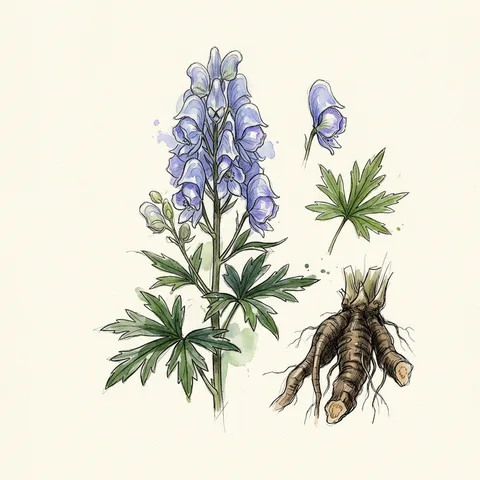
Reason for use
A. ferox, Wall. (A. virosum, Don.) Nat. order , Ranunculaceae. (The most poisonous species know; from the Himalaya Mountains.) Common names (Indian), Bisch, or Bikh, Ativisha. Preparation , Tincture from the root.
Authority. Dworzak, in Schroff (Reil and Hoppe Journ.) Took .01 gramme of the extract at one dose.
The full T. F. Allen text, by section
Mind
Mind very active; sequence of ideas rapid (in six hours). He talked constantly, remembered easily the minutest circumstances of his former experiment, compared them with the present one, and readily drew conclusions therefrom (in six hours). In the intervals of relief from distressing symptoms, he laughed and joked about his very comical condition; but when the dyspnoea, anxiety, etc., returned, he could not seem to endure them, and abused heartily Aconite and Toxicology in general (in four to six hours). Was incapable of any mental work, even the simplest addition (second day).
Comprehension and understanding were confused (second day).
Anxiety (in four hours).
Head
Confusion of head (in eighty minutes). On rising, at 6.30 o'clock, vertigo (second day).
Eye. Pupils dilated, sluggish to light (in six hours).
Face
[10.] The cheeks felt fuzzy (in forty minutes). Troublesome formication, mostly over face (in eighty minutes).
Mouth
Formication on upper surface of tongue, gradually involved whole mouth (in forty minutes). The tongue almost insensible; it feels like a piece of raw leather in the mouth (in six hours). Tongue covered with a thick, yellowish-white fur (second day). Violent burning in mouth (in two minutes).
Burning in mouth and throat increased by food (second day).
Drank often cold water to relieve the burning in mouth and fauces (in five minutes). The mouth felt fuzzy (in forty minutes). Salivation (in five minutes). [20.]
Taste flat, pasty (second day).
Throat
Violent burning in pharynx (in two minutes). Burning in throat an mouth (in two to four hours).
Drank often cold water to relieve the burning in fauces and mouth (in five minutes). Feeling of constriction of throat (in four hours).
Stomach
Very little appetite (second day). Frequent eructations (in eighty minutes). Transient nausea (third day). Nausea, eructations (could not vomit) (in four hours). At times, nausea and inclination to vomit (in eighty minutes). [30.]
After breakfast, nausea, pressure in stomach, with pain (second day).
Sensation of warmth in stomach (in two minutes).
Violent drawing pain in region of stomach and sacral regions, which soon spread over whole abdomen; on pressure at the epigastric region, the pain is increased (third and fourth days). Pressure in stomach after eating (for to eight days) (four day). On pressing in stomach, an internal, dull pressing pain (four to eight days).
Abdomen
Rumbling in bowels (in five minutes). Constant gurgling in bowels (in four hours).
Stool And Anus
Two half-watery, dark, not copious stools (second day).
Urinary Organs
Copious evacuation of urine every fifteen to thirty minutes; in twelve hours, more than five quarts of urine, and only two quarts drank (in forty minutes).
Frequent and copious urination (in seven hours). [40.] Urine straw-yellow for eight hours, afterwards became dark (in forty minutes).
Respiratory Apparatus.
Dyspnoea. Oppression of breathing (in four hours). Dyspnoea increased to such a degree that he was obliged to breathe half sitting up, with the head resting on the palms of the hands (in six hours). Anxiety increased to a high degree; he constantly feared he would suffocate from paralysis of the respiratory muscles (in six hours). Accelerated respiration (in six hours).
Heart And Pulse. Pulse slowed 11 beats (74), (in five minutes). Pulse small, weak, 60 (in two to four hours). Pulse weak and small (in six hours). Pulse 70, small and weak (second day).
Extremities In General. [50.]
Weakness and trembling of extremities (in eighty minutes).
Lower Extremities.
Walking difficult and uncertain, fatiguing (in eighty minutes).
Gait tottering; step regular, but powerless (second day).
Remarkable weakness in lower extremities, especially the right (third day).
Generalities
General sick feeling (in eighty minutes). Formication , spread over whole body, but affected very slightly, or not all, those parts that had been cold; worse, or caused by change of temperature and motion. From 7 to 7.30 P.M., this annoying sensation, having changed from one nerve to another, reached its greatest severity; it caused a painful unrest, so that he could not possibly lie more than a few minutes quietly; constantly changed his position; would attempt to get up, but a few steps exhibited marked weakness and prostration, with vertigo, blackness before eyes, trembling of whole body, inclination to vomit; relieved at once by lying down (in two to four hours). Sensation as though benumbed; on touching objects, it seemed a though he had on gloves; on pinching the cheek, no pain (in six hours). Touch all day blunted, as through gloves; and he seemed to walk on woollen carpets (second, third, and fourth days).
Weakness very great (in four hours). Very weak, even in bed (in four hours). [60.]
Weakness (fifth day). Lassitude and weariness suddenly attacked him (second day). Prostration from the sleepless night (fifth day). Weakness, anxiety, dyspnoea, restlessness, and excitement increased with intervals of relief (in four hours).
Fever
Sense of coldness (in eighty minutes). Icy coldness of body , especially of extremities, continued for several hours; he was wrapped in his gown and doubled covers, and three feather bolsters, and the room kept very hot, without effect (in four hours). Temperature objectively and subjectively lowered; he lay one and a half hours by the hot stove (second day).
So tired he had to go to bed and be covered up warm, because the skin was cold objectively and subjectively (in eighty minutes). Desire to get warm; he rose from the bed and tottered six steps to the stove; he remained by the stove a few minutes (half sitting, half lying, with the head supported); warmth caused a pleasant sensation, but there arose vertigo, flickering, trembling on limbs, oppression, and nausea, so that he had to go back to bed, which relieved these latter symptoms (in four hours). He could not divert himself of the idea that warmth would do him good; he went to the stove again, with the same result as before; on attempting it the third time, he could not stand up (in four hours). [70.]
Desire for warmth; not being able to leave the bed, he had heated bolsters laid on his chest and abdomen, and kept as quiet as possible (in four to six hours). Skin cold (second day). Skin cold, dry, rustling (temperature of room very high) (in two to four hours). Calor mordax on forehead, chest, and hands, with sensation as if numerous glowing hot wires were stuck into him; relieved by the perspiration (in four to six hours). In order to promote perspiration, he flexed and extended the arm as rapidly as possible; after a minute, copious sweat, with calor mordax but instead of relief, he was attacked with such weakness that he sank down exhausted; palpitation (in six hours).
Sleep And Dreams. Sleepy, and slept three-quarters of an hour (in six and a half hours).
Slept again one and a half hours (in eleven hours).
Night sleepless (fourth-day). On waking, violent burning in mouth and throat, warmth in stomach, dull sensation in head; weak, weary, relaxed (in seven hours).
Conditions
Afternoons better (third, fourth, and fifth days). [80.] The burning in mouth and throat renewed for a few hours by warm food (fourth day).
Coffee relieved the symptoms (in six hours).
SUPPLEMENT: ACONITUM FEROX.
Authority. 2 , C. D. Schroff, article entitled "An Extremely Dangerous Adulteration of jalap," Zeit. des Allg. Apothek. Ver., 3, p. 173, 1865.
German Aconitine (from Acon. napellus) always causes headache and faceache, which occur not only on the day of the proving, but during the succeeding weeks, and even for a whole year after the experiment; aggravated by every excitement in consequence of mental effort or by emotional disturbance; it also causes depression of mind, both on the day of the proving and on the succeeding days, leaden heaviness of the head, weakness, prostration, and a diminution of the frequency of the pulse lasting a long time. Dyspnoea and formication are entirely wanting. The symptoms experienced from the extract of the root of Acon. ferox were different, namely, the headache and faceache were entirely wanting; mental activity was greatly increased, and depression followed as a secondary effect after some time, and was so great that not the slightest mental work could be performed. In addition there were the following symptoms, especially marked; excessive dyspnoea, accompanied by a distressing feeling of anxiety; sensation of formication over the whole body; outbreak of perspiration accompanied by calor mordax; high degree of vertigo and muscular weakness; enormous increase of diuresis; extremely sharp burning taste; violent burning in the mouth and throat in spite of the fact that the extract was enveloped in a capsule; inclination to vomit, and actual vomiting; diarrhoea accompanied by pain. However small the dose of English Aconite it was able to irritate all the parts experimented upon. On frequently bringing it near the nose and taking a deep breath, in order to get the odor of the English Aconitine (Acon. ferox), there occurred frequent sneezing and a disagreeable boring feeling in the nose. After a few hours there developed violent burning on the tongue, throat, and palate, associated with inclination to cough, and especially on the lips, where it was particularly violent when anything hot was drank; these latter symptoms were observed on the day when I was working with the drug, but had not voluntarily brought it near the nose or lips. Once a particle happened to get into the eye; it very soon profuse lachrymation, violent burning, swelling and burning of the upper lid, photophobia, so that I could read only with the greatest effort, and was soon obliged to give up the attempt to look at anything; the pupils were not remarkably affected; cold applications relieved the symptoms, which returned as soon as the applications were removed; hence I was obliged to continue their use for several hours. On the next day the upper lid was red and somewhat swollen, and also the conjunctivae of the lids and ball were red, vision was unaffected, and on the third day the symptoms had disappeared, [2] .
homeopathylibrary.com/remedy/aconitum-ferox