Home / Remedies A–Z / Aconitum Ferox
Pocket card →
Plant · Ranunculaceae · simple

Aconitum Ferox

2 entries across 2 books
Aconitum Ferox
HabitatThe most poisonous species known, containing greatest proportion of Aconitine; from the Himalaya Mountains. PreparationTincture of root. Clarke
—
No dose stated in the library’s booksDose · Clarke

Reason for use

A. ferox was proved by Dworzack, who also proved Aconitine. The Ferox developed burning pains in greater intensity than the alkaloid; more intense mental activity followed by greater depression. The Aconite note of unendurability of suffering was marked. Anxiety and fear of suffocation from paralysis of respiratory muscles; obliged to breathe half-sitting up with head resting on palms of hands. Cold drinks >; sitting up >; warm food <; coffee >.

The full Clarke text, by section

General

Aconitum Ferox.

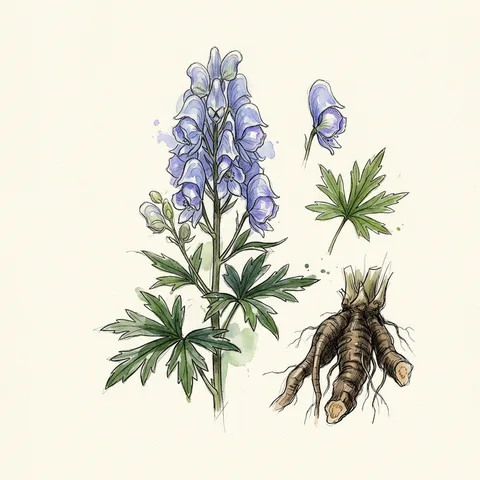
A. ferox, Wall. A. virosum, Don. Bisch, or Bikh, Ativisha. (The most poisonous species known, containing greatest proportion of Aconitine; from the Himalaya Mountains.) N. O. Ranunculaceae. Tincture of root.

Clinical

Burning pains. Cheyne-Stokes breathing. Chill. Dyspnoea. Gastralgia. Neuralgia. Numbness.

Relations

Compare: Curare and Phosph. (respiratory paralysis; Cheyne-Stokes breathing).

Mind

Mind very active; sequence of ideas rapid; talked constantly, remembered easily the minutest circumstances of his former experiment, compared them with present one, and readily drew conclusions (6 h.). In intervals of relief from distressing symptoms laughed and joked about his very comical condition; but when the dyspnoea, anxiety, &c., returned, he could not seem to endure them, and abused heartily Aconite and toxicology in general (4 to 6 h.).—Incapable of any mental work, even the simplest addition; comprehension and understanding confused (2nd day).

Mouth

Tongue almost insensible; feels like a piece of raw leather in mouth (6 h.).—Tongue covered with a thick yellowish-white fur.—Violent burning in mouth (in two minutes), renewed by eating (2nd day); > by drinking cold water.

Throat

Violent burning in pharynx.

Stomach

Pressure in stomach with pain.—Warmth in stomach.—Violent drawing pain in region of stomach and sacral region, soon spreading over whole abdomen; < by pressure on epigastrium.—On pressing in stomach, an internal, dull pressing pain.

Abdomen

Rumbling in bowels (5 m.); constant gurgling (4 h.).

Stool

Two half-watery, dark, not copious stools (2nd d.).

Urinary Organs

Frequent and copious evacuations of urine.

Respiratory Organs

Dyspnoea increased to such a degree that he was obliged to breathe half-sitting up, with head resting on palms of hands; constantly feared suffocation from respiratory paralysis.

Limbs

Gait tottering; remarkable weakness in lower extremities, esp. r.

Generalities

Formication spread over whole body, least noticeable on parts that had been cold; <, or excited by, change of temperature or motion. Having changed from one nerve to another, reached its greatest severity from 7 to 7.30 p.m. It caused a painful unrest so that he could not possibly lie quietly more than a few minutes. Getting up set up all the train of symptoms, which were > immediately on lying down.—Benumbed sensation, as if he had on gloves; on pinching cheeks no pain felt; seemed to walk on woollen carpets (2nd, 3rd, and 4th d.).

Sleep

Sleeplessness.—On waking, violent burning in mouth and throat, warmth in stomach, dull sensation in head.

Fever

Icy coldness of body (4 h.), objective and subjective, no amount of wraps and external warmth relieved. Desire to get warm drove him to get out of bed and sit near stove. Tottered to stove and warmth was pleasant, but vertigo, trembling, oppression, and nausea ensued and compelled him to return to bed. This experience was repeated.—Fierce heat (calor mordax) on forehead, cheek, and hands, with sensation as if numerous glowing hot wires were stuck into him: > by perspiration (4 to 6 h.).

Complete text of the Aconitum Ferox entry in Clarke - Dictionary of Practical Materia Medica; origin and preparation from Clarke. Historical text from the classical materia medica (1828–1950). Not medical advice, and not a claim that any remedy works.
homeopathylibrary.com/remedy/aconitum-ferox

More on Aconitum Ferox

Simple remedy · Plant

2 entries across 2 books · Family: Ranunculaceae

Remedies said to end or reduce the action of Aconitum Ferox, for example if it has caused an unwanted reaction. What is an antidote?

Antidoted byNo antidote recorded in these books

Entries

3 Clarke · shown above

Aconitum Ferox · John Henry Clarke · 3,644 chars

14 T. F. Allen

ACONITUM FEROX · Timothy Field Allen · 10,614 chars

Relations (this remedy →)

Other remedies of the Ranunculaceae

Research (18)

Papers in PubMed that mention this remedy together with homeopathy, newest first.

Show 18 papers
  1. Investigations on the morpho-anatomy and histochemistry of Aconitum napellus LArmstrong L, Machado CD, Dell'Avanzi GG et al. · Microscopy research and technique · 2024 · doi
  2. Ethnopharmacologically important highly subsidized Indian medicinal plants: Systematic review on their traditional uses, phytochemistry, pharmacology, quality control, conservation status and future prospectiveAnmol, Aggarwal G, Sharma M et al. · Journal of ethnopharmacology · 2024 · Systematic Review · doi
  3. Effects of homoeopathic ultrahigh dilutions of Aconitum napellus on Baker's yeast-induced fever in rabbitsAhmad S, Rehman T, Abbasi WM · Journal of integrative medicine · 2017 · doi
  4. Comparison of homeopathic globules prepared from high and ultra-high dilutions of various starting materials by ultraviolet light spectroscopyKlein SD, Wolf U · Complementary therapies in medicine · 2016 · doi
  5. Complementary and alternative medicine (CAM) use in an Italian cohort of pediatric headache patients: the tip of the icebergDalla Libera D, Colombo B, Pavan G et al. · Neurological sciences : official journal of the Italian Neurological Society and of the Italian Society of Clinical Neurophysiology · 2014 · doi
  6. Circadian aspects of hyperthermia in mice induced by Aconitum napellusde la Peña SS, Sothern RB, López FS et al. · Pharmacognosy magazine · 2011 · doi
  7. An exploratory study on scientific investigations in homeopathy using medical analyzerMishra N, Muraleedharan KC, Paranjpe AS et al. · Journal of alternative and complementary medicine (New York, N.Y.) · 2011 · doi
  8. Assays of homeopathic remedies in rodent behavioural and psychopathological modelsBellavite P, Magnani P, Marzotto M et al. · Homeopathy : the journal of the Faculty of Homeopathy · 2009 · Review · doi
  9. Test of a homeopathic dilution of Aconitum napellus. A clinical, randomized, double-blind, controlled crossover study in healthy volunteersPiltan D, Rist L, Simões-Wüst P et al. · Forschende Komplementarmedizin (2006) · 2009 · Randomized Controlled Trial · doi
  10. On: Piltan D, Rist L, Simões-Wüst A, Saller R: Test of a homeopathic dilution of Aconitum napellus. A clinical, randomized, double-blind, controlled crossover study in healthy volunteers. Forsch Komplementmed 2009;16:168-173Thurneysen A · Forschende Komplementarmedizin (2006) · 2009 · doi
  11. Activation of bone marrow cells treated with Canova in vitroAbud AP, Cesar B, Cavazzani LF et al. · Cell biology international · 2006 · doi
  12. Canova, a Brazilian medical formulation, alters oxidative metabolism of mice macrophagesde Oliveira CC, de Oliveira SM, Godoy LM et al. · The Journal of infection · 2006 · doi
  13. The anticancer homeopathic composite "Canova Method" is not genotoxic for human lymphocytes in vitroSeligmann IC, Lima PD, Cardoso PC et al. · Genetics and molecular research : GMR · 2003
  14. Bradycardia, reversible panconduction defect and syncope following self-medication with a homeopathic medicineGuha S, Dawn B, Dutta G et al. · Cardiology · 1999 · Case Reports · doi
  15. The homoeopathic treatment of otitis media in children--comparisons with conventional therapyFriese KH, Kruse S, Lüdtke R et al. · International journal of clinical pharmacology and therapeutics · 1997 · Clinical Trial
  16. [Toxicity of monkshood. Review.]Ingolfsdottir K, Olafsson K · Laeknabladid · 1997
  17. [Acute otitis media in children. Comparison between conventional and homeopathic therapy]Friese KH, Kruse S, Moeller H · HNO · 1996
  18. [The administration of homeopathic drugs for the treatment of acute mastitis in cattle]Merck CC, Sonnenwald B, Rollwage H · Berliner und Munchener tierarztliche Wochenschrift · 1989

Search PubMed directly →

Clinical (Clarke)