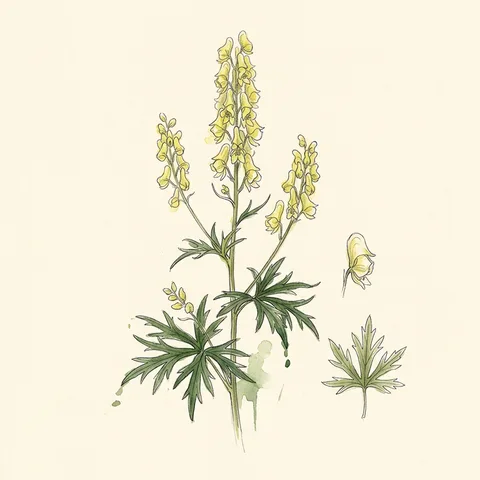
Home / Remedies A–Z / Aconitum Lycoctonum
Pocket card →
Plant · Ranunculaceae · simple

Aconitum Lycoctonum

2 entries across 2 books
Aconitum Lycoctonum
HabitatThe only aconite which does not contain Aconitine. PreparationTincture of fresh plant when coming into bloom. Clarke
—
No dose stated in the library’s booksDose · Clarke

Reason for Use

The symptoms of A. lycoct., whilst resembling those of the other aconites in some respects, show a marked absence of the cutaneous-nerve affections so prominent in their provings. The most notable symptoms are swelling of the cervical, axillary, and mammary glands. I have used it with good effect in cases of scrofulous glands, and even where Hodgkin's disease has been suspected. Diarrhoea after eating pork. Itching is prominent in the proving: of eyes, nose, anus, vulva. The skin of the nose is cracked. There is a cough leaving a taste of blood in the mouth. The symptoms are < in afternoon (like Lycop.); < from mental exertion; < during digestion, especially of pork, onions, and after wine.

The Full Clarke Text, by Section

General

Aconitum Lycoctonum.

A. lycoctonum, Linn. A. telyphonum, Reich. Wolfsbane. N. O. Ranunculaceae. Tincture of fresh plant when coming into bloom. (The only aconite which does not contain Aconitine.)

Clinical

Breasts, inflammation of. Constipation. Diarrhoea. Glands, enlargement of. Hodgkin's disease. Liver, disorders of. Pork, effects of. Strangury.

Relations

Compare: Cistus, Lap. alb., Con., Iod., Spo., Lyc., Carb. an.; Puls. (effects of pork).

Mind

Mania.—Ferocity.—Laughter.—Distraction.—Instability of ideas.—Dread of work.

Head

Vertigo with nausea.—Lancinating pain in head extending across eyes.—Sensation as if a nail were driven into head when moving it.—Hammering in temples.—Pain like rheumatism in scalp < by touch.

Eyes

Lancinating pain in eyes from without inward.—Painfulness of lids.—Itching in lids.—Pressure on lids and difficulty of raising them.—Smarting in canthi; dryness at inner canthus.

Ears

Purulent discharge from ears; redness behind them.

Nose

Itching on nose; sensitiveness; lancinations.—Compression at root of nose.—Skin of nose cracked.—Muco-purulent discharge from nose.

Face

Face pale; shining.—Pain of excoriation round mouth.—Pain in facial bones.—Tension in facial muscles.—Hard tuberculous pimples on face.—Pimples on lips.—Skin of face becomes light brown.—Numbness of jaw, like incipient paralysis, > by compression and by drinking wine.

Teeth

Burning pain in upper teeth.—Pressing in teeth.—Tearing in lower teeth when opening mouth.—Gums bluish; ulcerated.

Mouth

Taste, clayey; astringent.

Appetite

Strong relish for dainties, fruits, cabbage.—Increased relish for tobacco in a smoker.—Aversion to food in general esp. fatty things and milk; they cause uneasiness.—Keen hunger very soon satisfied.—Constant thirst even when drinking.—Burning thirst.—Thirst at night.

Stomach

Risings: rancid; like rotten eggs, acid with weight on stomach.—Painful eructations.—Hiccough.—Inclination to vomit after eating; with shivering; with vertigo.—Vomiting: of mucus on getting out of bed; yellowish after drinking; with copious urination.

Abdomen

R. hypochondrium: bruised pain; tearing pain; starting.—When breathing both hypochondria feel bruised. Sensation of compression referred to diaphragm.—Anxiety; beatings in abdomen.—Lancinating pain after milk.

Stool

Constipation; anus feels as if strongly contracted.—Diarrhoea, with violent cutting after eating pork.—Whitish stools.—After stool, pain in anus as if there was a crack there; shivering.—Cramp at anus.—Itching at anus.—Tenesmus during night.

Urinary Organs

Desire to urinate with copious emissions.—Urging with ineffectual efforts.—Urine: hot; turbid, depositing a white sediment.

Female Sexual Organs

Itching at vulva.—Menstrual blood fetid.—Excoriation of bend of thigh after menses.—Leucorrhoea: viscid.

Respiratory Organs

Difficult respiration.—Slight cough with watery expectoration.—After a slight chill, cough leaving a taste of, blood in the mouth.

Chest

Swelling of the mammary glands.

Neck And Back

Swelling of the cervical glands.—The neck seems to grow larger.—Swelling of the neck on one side only.—Pressing pain at the nape of the neck.—Shivering in the back.—Jerking in the region of the kidneys.

Upper Limbs

Swelling of axillary glands.—Pressure; lancinating pains in shoulder joints.—Tearing pain in elbow joints.—Stiffness in elbows and wrists.—Sensation of fulness in hands.—Sweat on hands.

Lower Limbs

On stretching legs ham-muscles feel as if much shortened.—Jerking in legs.—Itching at ankles in evening.—Lancinating pain at instep when standing.—Eruption of hot, red, slightly painful spots on legs and toes.

Sleep

Drowsiness; he sleeps too long.—Aberration of hearing during sleep.—During sleep, numbness of the parts he lies on.

Fever

Horripilation.—Chilliness of one side only as soon as he is uncovered.—In morning external coldness with feeling of heat.—Coldness alternating with heat, succeeded by sweat.—During heat, pale face, strong appetite, thirst, pain in bowels, restlessness.—Sweat continues after fever.

Complete text of the Aconitum Lycoctonum entry in Clarke - Dictionary of Practical Materia Medica; origin and preparation from Clarke. Historical text from the classical materia medica (1828–1950). Not medical advice, and not a claim that any remedy works.
homeopathylibrary.com/remedy/aconitum-lycoctonum

More on Aconitum Lycoctonum

Simple remedy · Plant

2 entries across 2 books · Family: Ranunculaceae

Remedies said to end or reduce the action of Aconitum Lycoctonum, for example if it has caused an unwanted reaction. What is an antidote?

Antidoted byNo antidote recorded in these books

Entries

3 Clarke · Shown Above

Aconitum Lycoctonum · John Henry Clarke · 4,888 chars

14 T. F. Allen

ACONITUM LYCOCTONUM · Timothy Field Allen · 5,982 chars

Relations (This Remedy →)

Other Remedies of the Ranunculaceae

Research (18)

Papers in PubMed that mention this remedy together with homeopathy, newest first.

Show 18 papers
  1. Investigations on the morpho-anatomy and histochemistry of Aconitum napellus LArmstrong L, Machado CD, Dell'Avanzi GG et al. · Microscopy research and technique · 2024 · doi
  2. Ethnopharmacologically important highly subsidized Indian medicinal plants: Systematic review on their traditional uses, phytochemistry, pharmacology, quality control, conservation status and future prospectiveAnmol, Aggarwal G, Sharma M et al. · Journal of ethnopharmacology · 2024 · Systematic Review · doi
  3. Effects of homoeopathic ultrahigh dilutions of Aconitum napellus on Baker's yeast-induced fever in rabbitsAhmad S, Rehman T, Abbasi WM · Journal of integrative medicine · 2017 · doi
  4. Comparison of homeopathic globules prepared from high and ultra-high dilutions of various starting materials by ultraviolet light spectroscopyKlein SD, Wolf U · Complementary therapies in medicine · 2016 · doi
  5. Complementary and alternative medicine (CAM) use in an Italian cohort of pediatric headache patients: the tip of the icebergDalla Libera D, Colombo B, Pavan G et al. · Neurological sciences : official journal of the Italian Neurological Society and of the Italian Society of Clinical Neurophysiology · 2014 · doi
  6. Circadian aspects of hyperthermia in mice induced by Aconitum napellusde la Peña SS, Sothern RB, López FS et al. · Pharmacognosy magazine · 2011 · doi
  7. An exploratory study on scientific investigations in homeopathy using medical analyzerMishra N, Muraleedharan KC, Paranjpe AS et al. · Journal of alternative and complementary medicine (New York, N.Y.) · 2011 · doi
  8. Assays of homeopathic remedies in rodent behavioural and psychopathological modelsBellavite P, Magnani P, Marzotto M et al. · Homeopathy : the journal of the Faculty of Homeopathy · 2009 · Review · doi
  9. Test of a homeopathic dilution of Aconitum napellus. A clinical, randomized, double-blind, controlled crossover study in healthy volunteersPiltan D, Rist L, Simões-Wüst P et al. · Forschende Komplementarmedizin (2006) · 2009 · Randomized Controlled Trial · doi
  10. On: Piltan D, Rist L, Simões-Wüst A, Saller R: Test of a homeopathic dilution of Aconitum napellus. A clinical, randomized, double-blind, controlled crossover study in healthy volunteers. Forsch Komplementmed 2009;16:168-173Thurneysen A · Forschende Komplementarmedizin (2006) · 2009 · doi
  11. Activation of bone marrow cells treated with Canova in vitroAbud AP, Cesar B, Cavazzani LF et al. · Cell biology international · 2006 · doi
  12. Canova, a Brazilian medical formulation, alters oxidative metabolism of mice macrophagesde Oliveira CC, de Oliveira SM, Godoy LM et al. · The Journal of infection · 2006 · doi
  13. The anticancer homeopathic composite "Canova Method" is not genotoxic for human lymphocytes in vitroSeligmann IC, Lima PD, Cardoso PC et al. · Genetics and molecular research : GMR · 2003
  14. Bradycardia, reversible panconduction defect and syncope following self-medication with a homeopathic medicineGuha S, Dawn B, Dutta G et al. · Cardiology · 1999 · Case Reports · doi
  15. The homoeopathic treatment of otitis media in children--comparisons with conventional therapyFriese KH, Kruse S, Lüdtke R et al. · International journal of clinical pharmacology and therapeutics · 1997 · Clinical Trial
  16. [Toxicity of monkshood. Review.]Ingolfsdottir K, Olafsson K · Laeknabladid · 1997
  17. [Acute otitis media in children. Comparison between conventional and homeopathic therapy]Friese KH, Kruse S, Moeller H · HNO · 1996
  18. [The administration of homeopathic drugs for the treatment of acute mastitis in cattle]Merck CC, Sonnenwald B, Rollwage H · Berliner und Munchener tierarztliche Wochenschrift · 1989

Search PubMed directly →

Clinical (Clarke)