Αρχική / Φάρμακα Α–Ω / Bryonia Alba
Κάρτα τσέπης →
Φυτό · Cucurbitaceae · simple

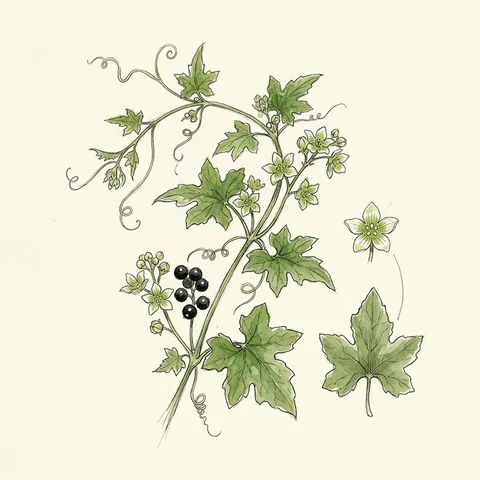
Bryonia Alba

Bryonia alba
BRY · 17 λήμματα σε 17 βιβλία
Bryonia Alba
ΠαρασκευήTincture of root procured before flowering. Clarke
1X–12X
Πρώτη έως δωδέκατη αραίωσηΔόση · Boericke

Λόγος χρήσης

Ξηρότητα των βλεννογόνων γενικά (χείλη, στόμα, στομάχι, επιθυμεί ποτό σε μεγάλες ποσότητες, σε μεγάλες αποστάσεις· έντερα, στερεά ξηρά κόπρανα σαν καμένα).

Εκκρίσεις στις οροειδείς μεμβράνες (μένιγγα, υπεζωκότα, περιτόναιο κ.λπ.).

Δυσκοιλιότητα (καμία επιθυμία) ή διάρροια, < πρωί με την έναρξη της κίνησης.

Σουβλιές, ιδίως στις οροειδείς μεμβράνες και στις αρθρώσεις.

Η καθιστή θέση προκαλεί ναυτία και αδυναμία/λιποθυμία.

▲ Χειρότερα

from motions, warm weather after cold.

▼ Καλύτερα

from quiet, lying on painful side

Το πλήρες κείμενο (Nash), ανά ενότητα

Modalities

Suitable to dry, spare, nervous, slender persons, of irritable disposition; rheumatic tendency. Complaints in hot weather, or exposure to dry, cold air, in wet weather (Rhus tox).

Cough, dry, hard, racking, with scanty expectoration; with splitting headache; delirium, about the business of the day; (typhoid) headache; < stooping; ironing; hot weather; coughing; motion, vertigo; with nausea, and faintness; < from sitting up after lying down. Pressure, as from a stone, at pit of stomach relieved by eructation.

Vicarious menstruation; nose bleeds when menses should appear (Phos.).

Mammae heavy, of a stony hardness; pale, but hard; hot and painful.

Rheumatism of joints, with pale swelling, great paint worse on touch or least motion.

As in Pulsatilla, so in Bryonia, the leading characteristic lies in its "modality." Three words express it -aggravation from motion.

What is aggravated on motion? Sufferings of almost any and every kind. We will not undertake to enumerate them. All that Hering says in his cards on that line is -"Joints red, swelling, stiff with stitching win from slightest motion," and this so far as it goes is genuine, but it is only the beginning of all the ailments that are < on motion.

Look in "Guiding Symptoms," under "Motion," and see the long list of symptoms aggravated by motion, and even these do not cover all. Now we begin to realize the value of this modality.

It makes no difference what the name of the disease, if the patient feels greatly > by lying still and suffers greatly on the slightest motion, and the more and longer he moves the more he suffers, Bryonia is the first remedy to be thought of, and there must be very strong counter-indications along other lines that will rule it out.

Nor does it make much difference what organ or tissue is the seat of the disease, mucous, serous or muscular, the same rule applies.

Another very valuable modality of Bryonia is again expressed in three words -amelioration from pressure. This is the reason the patient, much to the astonishment of the nurse, wants to lie on the paintful side or part. (Opposite Belladonna, Kali carbonicum).

No one can realize the value of these two modalities until he has often met them at the sick bed and witnessed the prompt relief from the use of Bryonia.

When writing upon Pulsatilla, we noticed the characteristic action of that remedy upon the mucous surfaces. Here Bryonia acts just as characteristically, but it is so different. With Bryonia it is excessive dryness or lack of secretion in them. It begins in the lips, which are parched, dry and cracked, and only ends with the rectum and stools, which are hard and dry as if burnt. The same condition is undoubtedly present in the stomach. which is evidenced by the excessive thirst; which can only be satisfied by large draughts of water; a little does not satisfy.

The same condition obtains in the lungs and bronchia, which causes hard, dry cough with little or no expectoration, and with soreness and pain in the chest when the patient coughs. (Natrum sulphuricum has loose cough with soreness). The urine is scanty and only exceptionally (or as I would express it reactionally) copious. We must remember that every remedy has a dual action. These two actions are termed primary and secondary. I think that the so-called secondary action is only the reaction of the organism against the first or primary (so-called) action of the drug. For instance -the real action of Opium is to produce sleep or stupor, the reaction is wakefulness; of Podophyllum, Aloes, etc., catharsis; the reaction constipation, and I think that the truly homoeopathic curative must be in accord with the primary (so-called) effects of every drug in order to get the best and most radical cure, but if given for the secondary (so-called) symptoms, the primary ones having passed by, we should carefully inquire for all the symptoms which have preceded those which are present; and taking both past and present, let them all enter into the picture whose counterpart is to be found in the drug which is to cure. Any other method is only palliative and not curative.

Bryonia has also a very decided effect upon the serous membranes. It is very useful in the second stage of inflammation, after the stage of serous effusion has set in. In most of these cases the first stage has been attended by symptoms calling for the exhibition of such remedies as Aconite, Belladonna, Ferrum phos., etc., but not always; and right here let me call attention to the most characteristic pains of this remedy. They are stitching pains. Now observe, the characteristic pains of inflammatory affections of the serous membranes are stitching pains; this is the reason why Bryonia comes to be such a regal remedy in pleuritis, meningitis, peritonitis, pericarditis, etc. The subjective symptoms corresponding to the remedy must go down before it, and the objectives must as surely follow. Only one remedy can equal Bryonia for stitching pains, viz, Kali carbonicum. (Stitching pains in chest are particularly found under Bryonia, Kali carb., Natrum mar., Squilla and Mercur. viv.). And there is this difference between them: The Bryonia stitches come on or are aggravated by the least motion, while those of Kali carbonicum will occur whether the patient moves or not, (Bryonia > by pressure, Kali carb., not). But in both remedies they cry out sharply with the pains. Apis has pains which cause the patient to cry out sharply, but they are stinging pains -like a bee sting. All these three are great remedies for effusions into serous cavities, and Sulphur precedes and follows equally well anyone of them.

A word right here in regard to interpolating Sulphur, when, as we express it, "the seemingly indicated remedy does not act." Some would stumble over that, and ask -as they would have a right to do- how about your similia, etc., in such a use of Sulphur? I answer -Sulphur is a remedy of wide range of action, and covers more perfectly those conditions and symptoms which are the outgrowth of psora than any other remedy; so it does meet the case complicated by psora very often, and either cures it or removes the complication so that the other remedies may act. But remember it will not always do it, and other antipsoric remedies must be chosen. It must be the simillimum for the psoric condition.

Bryonia stands alongside of Nux vomica and Pulsatilla for disorders of alimentation. All three remedies have a sensation as of a stone in the stomach, Bryonia and Nux vomica more so than Pulsatilla. Bryonia leads in thirst, Nux vomica less, and Pulsatilla little or none. All have bad taste in the mouth; Bryonia and Pulsatilla bitter and Nux vomica sour. All have nausea and vomiting; Bryonia worse on motion, as rising up, Nux vomica in the A. M. and after eating, Pulsatilla in the evening and also after eating.

The gastric derangements of Bryonia often occur as a result of dietetic errors, especially when warm weather sets in after cold. Those of Nux vomica more from continued over-eating and inactivity, the abuse of drugs, coffee, tobacco or alcoholics; Pulsatilla from too rich foods, pastries, fat foods and ice cream (in excess); a little ice cream feels good in the Pulsatilla stomach, but much overdose the matter, because it is too rich.

All three remedies have attacks of diarrhoea, although constipation is most characteristic of Bryonia and Nux vomica, and is only exceptionally found under Pulsatilla.

Bryonia diarrhoea is worse in the morning, on movement, and open occurs as an effect of over-eating in the heat of summer. Nux vomica diarrhoea is also apt to be worse in the morning, is mostly caused by over-eating and is apt to put on the dysenteric type. The Pulsatilla diarrhoea is more apt to occur in the night, from causes above mentioned, and is attended with great rumbling of the bowels.

All have white, sometimes very thickly-coated tongue, but taking into account the causes of these gastric and bowel troubles, temperament and modalities there should not be much difficulty in choosing the right remedy for any case.

So far as temperament is concerned, Bryonia is like Nux vomica, but Bryonia has much more of the "rheumatic diathesis." Both are easily irritated or angered, and are oftenest found indicated in spare, dark-complexioned subjects. Both are aggravated generally on motion, by Bryonia very much the more so, while Pulsatilla is sometimes like Rhus toxicodendron relieved by motion.

Now a few special indications for Bryonia and we will have it:

"Bursting headache, as if it would split the head open, aggravated by stooping; coughing; ironing; opening or moving the eyes; moving any way; in hot weather. Nausea and faintness when rising up, relieved when lying still."

"Epistaxis instead of menses (vicarious menstruation), also blood spitting."

"Mastitis; breasts pale, hot, hard, heavy and painful."

"Suppression of lochia with bursting headache."

"Suppression of milk, menses, measles or rash of scarlatina, or where all these are slow in appearing; of course the other Bryonia symptoms must be present."

"Frequent desire to take long breath; must expand the lungs. (Cactus, Ignatia, Nat sulph.)."

"Cough dry, < after eating, sometimes math vomiting; < moving; < coming from open air into warm room. (Nat. carb)."

"Cough hurts head and chest, holds them with hands." (Eupatorium perf., Natrum sulph.).

These are some of the peculiar symptoms which cannot be ranged under any general head, and are excellent leaders to the consideration of Bryonia, all and each of which will be found associated with the more general characteristics already noticed.

The dominant school do not know what they have lost in not being acquainted with the virtues of this remedy, as developed in our provings and clinical use, but we know what we have gained.

Πλήρες κείμενο του λήμματος Bryonia Alba στο Nash - Leaders in Therapeutics· προέλευση και παρασκευή από τον Clarke. Ιστορικό κείμενο από την κλασική materia medica (1828–1950). Δεν αποτελεί ιατρική συμβουλή ούτε ισχυρισμό ότι κάποιο φάρμακο δρα.
homeopathylibrary.com/el/remedy/bryonia-alba

Περισσότερα για Bryonia Alba

Απλό φάρμακο · Φυτό

17 λήμματα σε 17 βιβλία · συντομογραφίες: BRY · Οικογένεια: Cucurbitaceae

Φάρμακα που λέγεται ότι τερματίζουν ή μειώνουν τη δράση του Bryonia Alba, για παράδειγμα αν έχει προκαλέσει ανεπιθύμητη αντίδραση. Τι είναι το αντίδοτο;

Φάρμακα των οποίων τη δράση το Bryonia Alba λέγεται ότι τερματίζει ή μειώνει.

Λήμματα

1 Boericke

BRYONIA ALBA · William Boericke · 5,880 χαρακτήρες

2 Kent

Bryonia Alba · James Tyler Kent · 48,451 χαρακτήρες

3 Clarke

Bryonia · John Henry Clarke · 35,565 χαρακτήρες

4 Hering

Bryonia Alba · Constantine Hering · 100,246 χαρακτήρες

5 Allen

Bryonia Alba · Henry C. Allen · 3,413 χαρακτήρες

6 Nash · εμφανίζεται παραπάνω

Bryonia Alba · E. B. Nash · 10,412 χαρακτήρες

7 Hering

BRYONIA ALBA · Constantine Hering · 19,880 χαρακτήρες

10 Lippe

Bryonia alba · Adolph zur Lippe · 7,851 χαρακτήρες

12 Hahnemann

Bryonia Alba · Samuel Hahnemann · 87,629 χαρακτήρες

14 T. F. Allen

BRYONIA · Timothy Field Allen · 578 χαρακτήρες

15 Tyler

Bryonia · Margaret Lucy Tyler · 21,996 χαρακτήρες

16 Guernsey

BRYONIA ALBA · Henry Newell Guernsey · 5,034 χαρακτήρες

17 Cowperthwaite

Bryonia Alba · Allen Corson Cowperthwaite · 12,353 χαρακτήρες

18 Dewey

Bryonia Alba · Willis Alonzo Dewey · 6,427 χαρακτήρες

22 Roberts

Bryonia alba · Herbert Alfred Roberts · 6,282 χαρακτήρες

23 T. F. Allen

Bryonia Alba · Timothy Field Allen · 11,096 χαρακτήρες

33 Gladstone Clarke

Bryonia alba · A. Gladstone Clarke · 1,429 χαρακτήρες

Σχέσεις (αυτό το φάρμακο →)

Αντίστροφες παραπομπές (άλλα φάρμακα → αυτό)

σύγκριση 151Abies NigraAbrotanumAconitum NapellusActaea SpicataAilanthus GlandulosaAllium SativumAluminaAntimonium CrudumAntimonium TartaricumApis MellificaApocynum AndrosaemifoliumApocynum CannabinumAranearum TelaArbutus AndrachneArctium LappaArum TriphyllumAsclepias SyriacaAsclepias Tuberosa
+133 ακόμηAurum Muriaticum NatronatumBaptisia TinctoriaBelladonnaBellis PerennisBenzinumBlatta OrientalisBorax VenetaBovista LycoperdonCactus GrandiflorusCadmium SulfuratumCadmium SulphuratumCaincaCaladium SeguinumCalcarea OstrearumCalcarea PhosphoricaCalendula OfficinalisCannabis SativaCantharidesCantharis VesicatoriaCapsicum AnnuumCapsicum SosCarduus MarianusCarya AlbaCaulophyllum ThalictroidesChamomillaChelidonium MajusChininum SulfuricumChininum SulphuricumChionanthus VirginicaCimex LectulariusCina MaritimaClematis ErectaCocculus IndicusCoffea CrudaCoffee CrudaColchicum AutumnaleColocynthisCrampsCroton TigliumCuprum AceticumCuprum MetallicumDaphne OdorataDigitalis PurpureaDioscorea VillosaDirca PalustrisDulcamaraElaterium OfficinarumErythroxylon CocaEupatorium PerfoliatumFormica RufaGaultheria ProcumbensGelsemium SempervirensGentiana CruciataGinseng QuinquefoliumGossypium HerbaceumGrindelia RobustaGuaiacumHamamelis VirginicaHelleborus NigerHeparJuglans CinereaKali CarbonicumKali MuriaticumKalium CarbonicumLachesisLachesis MutusLachnanthes TinctoriaLaurocerasusLedum PalustreLeptandra VirginicaLobelia InflataMagnesia MuriaticaMagnesia PhosphoricaMalaria OfficinalisMenispermum CanadenseMentha PiperitaMillefoliumMorphinumMuriaticum AcidumMyrtus CommunisNaja TripudiansNatrum CarbonicumNatrum MuriaticumNatrum NitrosumNatrum SulfuricumNatrum SulphuricumNux VomicaOenotheraOleum Jecoris AselliOpiumParis QuadrifoliaPhellandrium AquaticumPhosphorusPhytolacca DecandraPodophyllumPodophyllum PeltatumPolyporus OfficinalisPsorinumPtelea TrifoliataPulsatilla PratensisPyrogeniumRanunculus BulbosusRanunculus SceleratusRaphanus SativusRhododendronRhododendron FerrugineumRhus ToxicodendronRobinia PseudacaciaRumex CrispusRuta GraveolensSabadillaSabinaSanguinaria CanadensisSaponinumScilla MaritimaSenecio AureusSenegaSinapis AlbaSquilla MaritimaStaphisagriaStramoniumSulphurTaraxacum OfficinaleThyroidinumTrifolium PratenseUpas TieutUstilago MaydisVeratrum AlbumVeratrum VirideViola OdorataViscum AlbumXanthoxylumYucca Filamentosa

Άλλα φάρμακα της οικογένειας Cucurbitaceae

Έρευνα (25)

Δημοσιεύσεις στο PubMed που αναφέρουν αυτό το φάρμακο μαζί με την ομοιοπαθητική, από τις νεότερες προς τις παλαιότερες.

Εμφάνιση 25 δημοσιεύσεων
  1. Enhancing Homeopathic Prescribing for Chronic Cough by Classifying the Reliability of Polar SymptomsKaur H, Rutten L, Eizayaga JE et al. · Homeopathy : the journal of the Faculty of Homeopathy · 2026 · Observational Study · doi
  2. Homeopathic Treatment of Chronic Low-Back Pain: A Double-Blind, Randomized, Placebo-Controlled TrialMuduli S, Sarkar S, Pal RK et al. · Journal of integrative and complementary medicine · 2025 · Randomized Controlled Trial · doi
  3. Homeopathic Medicines in Third (Omicron) Wave of COVID-19: Prognostic Factor ResearchManchanda RK, Miglani A, Kalsi A et al. · Homeopathy : the journal of the Faculty of Homeopathy · 2024 · Observational Study · doi
  4. Individualized homeopathic medicines in preventing the progression from pre-diabetes to diabetes: A double-blind, randomized, placebo-controlled, parallel-arm trialBanerjee A, Ganguly S, Saha S et al. · Explore (New York, N.Y.) · 2024 · Randomized Controlled Trial · doi
  5. Homeopathic Medicines in Second Wave of COVID-19: Prognostic Factor ResearchManchanda RK, Miglani A, Chakraborty M et al. · Homeopathy : the journal of the Faculty of Homeopathy · 2023 · Observational Study · doi
  6. Test of a Homeopathic Algorithm for COVID-19: the Importance of a Broad PerspectiveMiglani A, Manchanda RK, Kalsi A et al. · Homeopathy : the journal of the Faculty of Homeopathy · 2023 · doi
  7. Balanced cytokine upregulation by diluted ethanolic extract of Bryonia alba in Delta SARS-CoV-2 Spike protein RBD-induced pathogenesis in Gallus gallus embryoGoswami P, Chatterjee D, Ghosh S et al. · Bulletin of the National Research Centre · 2022 · doi
  8. Impact of Bias in Data Collection of COVID-19 CasesManchanda RK, Miglani A, Chakraborty M et al. · Homeopathy : the journal of the Faculty of Homeopathy · 2022 · Observational Study · doi
  9. Comparative Effectiveness of Pre-Identified Homeopathic Medicines in Asymptomatic COVID-19 Individuals Receiving Standard Care-An Open-Label, Randomized, Controlled Exploratory TrialVaranasi R, Tomar S, Gupta S et al. · Homeopathy : the journal of the Faculty of Homeopathy · 2022 · Randomized Controlled Trial · doi
  10. Homeopathic Medicines Used as Prophylaxis in Kolkata during the COVID-19 Pandemic: A Community-Based, Cluster-Randomized TrialMukherjee SK, Ganguly S, Das S et al. · Homeopathy : the journal of the Faculty of Homeopathy · 2022 · Randomized Controlled Trial · doi
  11. Homeopathic Remedies in COVID-19: Prognostic Factor ResearchManchanda RK, Miglani A, Gupta M et al. · Homeopathy : the journal of the Faculty of Homeopathy · 2021 · Observational Study · doi
  12. Clinical Characteristics and Remedy Profiles of Patients with COVID-19: A Retrospective Cohort StudyJethani B, Gupta M, Wadhwani P et al. · Homeopathy : the journal of the Faculty of Homeopathy · 2021 · doi
  13. Homeopathic Clinical Features of 18 Patients in COVID-19 Outbreaks in Hong KongTo KLA, Fok YYY · Homeopathy : the journal of the Faculty of Homeopathy · 2020 · doi
  14. Physiotherapy and a Homeopathic Complex for Chronic Low-back Pain Due to Osteoarthritis: A Randomized, Controlled Pilot StudyMorris M, Pellow J, Solomon EM et al. · Alternative therapies in health and medicine · 2016 · Randomized Controlled Trial
  15. No effect of a homoeopathic combination of Arnica montana and Bryonia alba on bleeding, inflammation, and ischaemia after aortic valve surgeryCornu C, Joseph P, Gaillard S et al. · British journal of clinical pharmacology · 2010 · Randomized Controlled Trial · doi
  16. Effect of homeopathy on analgesic intake following knee ligament reconstruction: a phase III monocentre randomized placebo controlled studyParis A, Gonnet N, Chaussard C et al. · British journal of clinical pharmacology · 2008 · Randomized Controlled Trial · doi
  17. Canova, a Brazilian medical formulation, alters oxidative metabolism of mice macrophagesde Oliveira CC, de Oliveira SM, Godoy LM et al. · The Journal of infection · 2006 · doi
  18. Activation of bone marrow cells treated with Canova in vitroAbud AP, Cesar B, Cavazzani LF et al. · Cell biology international · 2006 · doi
  19. Comparative efficacy of homeopathic and allopathic systems of medicine in the management of clinical mastitis of Indian dairy cowsVarshney JP, Naresh R · Homeopathy : the journal of the Faculty of Homeopathy · 2005 · doi
  20. Evaluation of a homeopathic complex in the clinical management of udder diseases of riverine buffaloesVarshney JP, Naresh R · Homeopathy : the journal of the Faculty of Homeopathy · 2004 · doi
  21. The anticancer homeopathic composite "Canova Method" is not genotoxic for human lymphocytes in vitroSeligmann IC, Lima PD, Cardoso PC et al. · Genetics and molecular research : GMR · 2003
  22. Can homeopaths detect homeopathic medicines by dowsing? A randomized, double-blind, placebo-controlled trialMcCarney R, Fisher P, Spink F et al. · Journal of the Royal Society of Medicine · 2002 · Clinical Trial, Randomized Controlled Trial · doi
  23. [Treatment of pain due to unwanted lactation with a homeopathic preparation given in the immediate post-partum period]Berrebi A, Parant O, Ferval F et al. · Journal de gynecologie, obstetrique et biologie de la reproduction · 2001 · Clinical Trial
  24. Can homeopaths detect homeopathic medicines? A pilot study for a randomised, double-blind, placebo controlled investigation of the proving hypothesisVickers A, McCarney R, Fisher P et al. · The British homoeopathic journal · 2001 · Clinical Trial, Randomized Controlled Trial · doi
  25. Plant adaptogens. II. Bryonia as an adaptogenPanossian A, Gabrielian E, Wagner H · Phytomedicine : international journal of phytotherapy and phytopharmacology · 1997 · doi

Αναζήτηση απευθείας στο PubMed →

Κλινικά (Clarke)

ΑλκοολισμόςΑμηνόρροιαΘυμός, επιπτώσεις τουΆφθεςΑποπληξίαΆσθμαΧολική κρίσηΕγκέφαλος, παθήσεις τουΜαστός, φλεγμονώδηςΒρογχίτιδαΚαρκίνοςΚρύωμα, επιπτώσεις τουΧλώρωσηΔυσκοιλιότηταΦθίσηΣυνάχιΒήχαςΟδοντοφυΐαΡευματισμός του διαφράγματοςΔιάρροιαΎδρωπαςΔυσπεψίαΈκζεμαΤυφοειδής πυρετόςΕξανθήματαΓαστρεντερίτιδαΑιμορραγίεςΧέρια, πρησμέναΚεφαλαλγίαΚαρδιά, φλεγμονή τηςΚήληΛόξιγκαςΥδροκήληΥδροκέφαλοςΓρίπηΕπαναλαμβανόμενοι πυρετοίΊκτεροςΑρθρώσεις, πόνος στιςΓαλουχία, διαταραχή τηςΉπαρ, διαταραχές τουΟσφυαλγίαΙλαράΜηνιγγίτιδαΈμμηνος ρύση, ετερότοπηΜιλιαρίαΠυρετός γάλακτοςΜυαλγίαΝεφρίτιδαΡινική αιμορραγίαΠεριτονίτιδαΛευκή φλεγμονή (phlegmasia alba dolens)ΠλευρίτιδαΠλευροδυνίαΠνευμονίαΕγκυμοσύνη, πρωινός βήχας της· ναυτία τηςΛοχείακός πυρετόςΠυουρίαΥποτροπιάζων πυρετόςΕκδηλώμενος πυρετόςΡευματισμόςΟστρακιάΚραυγέςΠόνος στο πλάιΎπνος, αγχώδη όνειρα στονΣπονδυλοσχίδηςΔυσκαμψία αυχέναΚατασταλμένα εξανθήματα, κακές επιπτώσεις τουςΔίψαΓλώσσα, επιχρίσματαΟδονταλγίαΤραχεία, πόνος στηνΊλιγγοςΞύπνημα, αναπηδά και ουρλιάζει στοΠυρορροίαΚοκίτηςΚίτρινος πυρετός

Ενδείκνυται για (Boger)

Κοιλιά, εναλλασσόμενο μεΚοιλιά, εναλλασσόμενο με το κεφάλιΚοιλιά, μουδιασμένηΚοιλιά, σουβλιέςΑέρας, θερμός, ως ναΛευκωματουρίαΑνάσαρκαΠλάτη, βήχας, επιδ.Λούσιμο, κρύο, βελτ.Αίμα, ορμές, προς τα πάνωΑιμοφόρα αγγεία, θερμότητα σταΈντερα, αποφραγμένα, παράλυσηΚάψιμο, ρίγος, μεΤυρώδες, παλιόΘώρακας, προς τα χέριαΘώρακας, προς τα πίσω μέσα από το αριστερόΘώρακας, βήχας, επιδ.Θώρακας, περιοχή, βαθιά μέσαΘώρακας, περιοχή, μεσοπλεύριαΘώρακας, περιοχή, δεξιάΡίγος, προβλέπειΡίγος, μερικός, ένα μέρος, με θερμότητα άλλουΡίγος, πίεση, βελτ.Κρυώματα, κατιόνταΣυμπίεσηΔυσκοιλιότητα, ολιγοκόπρανα, με άφθονη νυχτερινή ούρησηΣπασμός, αϋπνία καιΒήχας, κλαίει πρινΒήχας, επώδυνοςΒήχας, πρόδρομος, σε [[ως]]Βήχας, πλευρές, πιέζειΕπιθυμεί, αόριστα πράγματαΕπιθυμεί, ό,τι αρνήθηκεΕπιθυμεί, ό,τι δεν μπορεί να απολαύσειΣυνθλιπτικόςΠαραλήρημα, και αϋπνίαΔιάρροια· της φθίσηςΞηρός, εσωτερικάΕξίδρωση, καταθέσεις κ.λπ.Επιγάστριο, σφύξηΡινορραγία, έμμηνος ρύση, απούσαΡινορραγία, με εφίδρωσηΡινορραγία, πλύσιμο προσώπου, επιδ.Εξανθήματα, καθυστερημέναΕξανθήματα, που υποχωρούνΑποχρέμπτευση, πυώδηςΜάτια, κλείσιμο, επιδ.Μάτια, πάνω απόΜάτια, πάνω από, αριστεράΜάτια, κόκκινα, επιδ., έμετος ή λόξιγκαςΛιποθυμία, κατά το σηκώνεμαΠτώση, προς τα πίσωΠυρετός, επώδυνοςΠόδι, ράχες, πρησμένεςΧοληδόχος κύστη, σηπικήΓαστρίτιδαΒουβωνικές περιοχές, πληγωμένες, πριν από την έμμηνο ρύσηΟισοφάγος, κάψιμο, στον τυφοειδή πυρετόΑιμόπτυσηΑιμορραγία, αδυναμία, υπερβολικήΟπίσθιοι μηριαίοι τένοντες, βραχείς, τεταμένοιΚεφάλι, βήχας, επιδ.Κεφάλι, σύνθλιψη στοΚεφάλι, μάτια, κίνηση των, επιδ.Κεφάλι, θερμό, με κρύα άκραΚεφάλι, χαμηλά, βελτ. [[κατάκλιση]]Κεφάλι, γάλα, βελτ.Κεφάλι, κεφαλαλγία πλύστραςΛόξιγκας, με έμετοΙσχία, νόσος του ισχίουΒραχίονας, πονά (δεξιά)Πείνα, με κεφαλαλγίαΥποχόνδρια, μωλωπισμένα, επώδυναΥστερικοί, σπασμοί, κατά την έμμηνο ρύσηΓνάθοι, πήδημαΑρθρώσεις, συνοβίτιδαΠόδια, περιστροφή, επιδ.Ήπαρ, απόστημαΉπαρ, διάρρηξηΉπαρ, βαρύ+62 ακόμη