Home / Remedies A–Z / Aconitum Napellus
Pocket card →
Plant · Ranunculaceae · simple

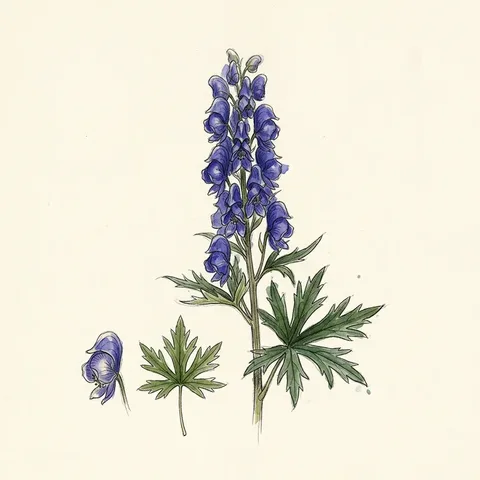
Aconitum Napellus

Common Aconite
ACON · 19 entries across 19 books
Aconitum Napellus
HabitatMoist pastures and waste places in mountainous districts, Central and Southern Europe, Russia, Scandinavia, and Central Asia. PreparationTincture of whole plant with root when beginning to flower. Clarke
6X, Ø
Sixth potency for sensory affections; first to third for congestive conditions. Must be repeated frequently in acute diseases. Acon is a rapid worker. In Neuralgias tincture of the root often preferable, one drop doses (poisonous), or again, the 30th according to susceptibility of patientDose · Boericke

Reason for use

Where are the original pathogeneses of Aconite to be found ?

In Hahnemann's Materia Medica Pura . It was also proved by the Austrian Society of Provers.

See also Millard's Monograph, Reil's Essay , and Hartmann's Practical Observations. Allen's Encyclopaedia. Hempel's Materia Medica .

Where does Aconite grow, and what is its common name ?

On the higher Alps of Central Europe, in damp, shady fields, along brooks and streams. Monkshood .

Name some other varieties of Aconite.

Aconitum Stoerkianum, Aconitum lycoctonum, Aconitum ferox, Aconitum variegatum .

What is the name of its Alkaloids, and what is the allopathic dose ?

Aconitine or Aconitia ; dose, one-hundredth to one-sixtieth of a grain. (1/100 to 1/16.)

From what part of the plant do we make our mother tincture ?

From the entire plant, except the root, gathered at the time of flowering.

How is the tincture prepared ?

Chop and pound the entire fresh plant to a fine pulp. Enclose in a piece of new linen and press out juice. Mix with equal quantities of alcohol. Pour in well stoppered bottle and stand for eight days in dark, cool place, agitating it daily and then filter. Drug power, 1/2. An imported tincture.

What, in brief, is the general physiological action of Aconite ?

It affects the sensory nerves, causing tingling , followed by numbness. It accelerates the heart's action, causes a rise in temperature, with chills, fever and sweat ; large doses producing paralysis of the heart and nerves, with collapse. Mental distress is an invariable concomitant condition.

Why do we not give Aconite merely to diminish the frequency of the pulse and thereby lessen the temperature ?

Because it is not Homoeopathy, but treating single symptoms ; there is just as much reason for giving a remedy to move the bowels, another to improve the appetite, another for headache, and still another for the liver, instead of giving the drug for the totality of the symptoms which it produces.

How does Aconite differ from Veratrum viride in fevers ?

Veratrum viride has more arterial but less nervous excitement than Aconite , and a characteristic of Veratrum viride is a bright red streak through the center of the tongue.

When should Aconite be given in neuralgias ?

When the parts are violently congested, hot and swollen ; when brought on by exposure to dry, cold winds ; and when the pains are tingling, with numb sensations ; driving the patient to despair. Pains worse at night.

What are the abdominal symptoms of Aconite ?

Shooting pains all over abdomen, which is very tender to touch ; beginning of inflammatory processes.

What are the stools of Aconite ?

In dysentery ; frequent scanty with tenesmus ; especially in autumn, when days are warm and nights cold. Diarrhoea of inflammatory origin from cold drinks or checked perspiration ; stools watery, slimy and bloody.

Differentiate Aconite from Gelsemium in fevers.

Aconite - hard, quick, bounding pulse.

Gelsemium - soft, flowing, compressible pulse.

Aconite - restless, anxious, tossing about.

Gelsemium - drowsy, quiet, tendency to stupor, countenance suffused.

What is the first of Aconite ?

Unquenchable thirst for cold water ; large drinks at long intervals, or drinks little and often.

What are the heart symptoms of Aconite ?

Pain in the heart extending down the left arm, with numbness, palpitation and lancinating stitches, full, hard and rapid pulse ; uncomplicated hypertrophy of the heart.

In what class of patients and diseases is Aconite found to be most useful ?

In he young and plethoric, who are attacked suddenly with illness of an acute character, such as sudden congestions, violent fevers, acute colds, desperate pains, benumbing tingling neuralgias, etc.

Why is Aconite more suitable for acute than for chronic diseases ?

On account of the suddenness of its symptoms and the short duration of its action.

Give four characteristics of Aconite.

1. The terrible anguish and fear of death ; the patient even predicts the day of his death ; with extreme restlessness and tossing about.

2. Complaints brought on by exposure to dry, cold winds, or from a sudden checking of perspiration.

The full Dewey text, by section

Hard, Full, Frequent Pulse

4. The symptoms are worse in the evening and at night ; come on suddenly and violently.

Give in brief the indications for Aconite in fevers.

Sthenic fevers, with chilliness on the slightest movement ; dry heat of skin, thirst, red cheeks, quickened respiration ; scanty urine and constipation ; full, bounding, rapid, tense pulse, with mental anxiety and aggravation towards evening. Every motion makes the patient chilly ; he is at the same time very restless from the mental anxiety.

When does Aconite cease to be of use ?

In the second stage of inflammation ; when it has localized itself.

What other drugs have numbness and tingling of the left arm in heart disease ?

Kalmia and Rhus tox .

In what affections about the chest is Aconite especially apt to be indicated ?

Pulmonary congestions, with hard, dry, painful cough, anxiety and restlessness, and perhaps a little blood-streaked expectoration.

Differentiate Aconite and Belladonna in congestions.

The cardinal points of Aconite are increasing restlessness and great anxiety.

Those of Belladonna are flushed face, delirium, throbbing carotids and bounding pulse.

What would indicate Aconite in suppression of the menses ?

When it occurs in plethoric patients from fear or fright, or after exposure to cold.

Complete text of the Aconitum Napellus entry in Dewey - Essentials of Homoeopathic Materia Medica; origin and preparation from Clarke. Historical text from the classical materia medica (1828–1950). Not medical advice, and not a claim that any remedy works.
homeopathylibrary.com/remedy/aconitum-napellus

More on Aconitum Napellus

Simple remedy · Plant

19 entries across 19 books · abbreviations: ACON, ACONITUM · Family: Ranunculaceae

Remedies said to end or reduce the action of Aconitum Napellus, for example if it has caused an unwanted reaction. What is an antidote?

Remedies whose action Aconitum Napellus is said to end or reduce.

Entries

1 Boericke

ACONITUM NAPELLUS · William Boericke · 9,156 chars

2 Kent

Aconitum Napellus · James Tyler Kent · 35,972 chars

3 Clarke

Aconitum Napellus · John Henry Clarke · 34,346 chars

4 Hering

Aconitum Napellus · Constantine Hering · 78,917 chars

5 Allen

Aconitum Napellus · Henry C. Allen · 3,065 chars

6 Nash

Aconitum Napellus · E. B. Nash · 7,768 chars

7 Hering

ACONITUM · Constantine Hering · 20,889 chars

10 Lippe

Aconitum napellus · Adolph zur Lippe · 7,251 chars

12 Hahnemann

Aconitum Napellus · Samuel Hahnemann · 56,868 chars

14 T. F. Allen

ACONITUM · Timothy Field Allen · 810 chars

15 Tyler

Aconitum · Margaret Lucy Tyler · 16,714 chars

16 Guernsey

ACONITUM NAPELLUS · Henry Newell Guernsey · 11,605 chars

17 Cowperthwaite

ACONITUM (ACONITUM NAPELLUS) · Allen Corson Cowperthwaite · 15,114 chars

18 Dewey · shown above

Aconitum Napellus · Willis Alonzo Dewey · 5,473 chars

19 Gross

Aconitum · Gustav Wilhelm Gross · 39,358 chars

20 Hempel

Aconitum Napellus · Charles Julius Hempel · 222,323 chars

22 Roberts

Aconitum napellus · Herbert Alfred Roberts · 6,722 chars

23 T. F. Allen

Aconitum Napellus · Timothy Field Allen · 5,661 chars

33 Gladstone Clarke

Aconitum Napellus · A. Gladstone Clarke · 1,121 chars

Relations (this remedy →)

similar 1Morbillinum

Backlinks (other remedies → this one)

incompatible / inimical 1Caladium Seguinum

Other remedies of the Ranunculaceae

Research (18)

Papers in PubMed that mention this remedy together with homeopathy, newest first.

Show 18 papers
  1. Investigations on the morpho-anatomy and histochemistry of Aconitum napellus LArmstrong L, Machado CD, Dell'Avanzi GG et al. · Microscopy research and technique · 2024 · doi
  2. Ethnopharmacologically important highly subsidized Indian medicinal plants: Systematic review on their traditional uses, phytochemistry, pharmacology, quality control, conservation status and future prospectiveAnmol, Aggarwal G, Sharma M et al. · Journal of ethnopharmacology · 2024 · Systematic Review · doi
  3. Effects of homoeopathic ultrahigh dilutions of Aconitum napellus on Baker's yeast-induced fever in rabbitsAhmad S, Rehman T, Abbasi WM · Journal of integrative medicine · 2017 · doi
  4. Comparison of homeopathic globules prepared from high and ultra-high dilutions of various starting materials by ultraviolet light spectroscopyKlein SD, Wolf U · Complementary therapies in medicine · 2016 · doi
  5. Complementary and alternative medicine (CAM) use in an Italian cohort of pediatric headache patients: the tip of the icebergDalla Libera D, Colombo B, Pavan G et al. · Neurological sciences : official journal of the Italian Neurological Society and of the Italian Society of Clinical Neurophysiology · 2014 · doi
  6. Circadian aspects of hyperthermia in mice induced by Aconitum napellusde la Peña SS, Sothern RB, López FS et al. · Pharmacognosy magazine · 2011 · doi
  7. An exploratory study on scientific investigations in homeopathy using medical analyzerMishra N, Muraleedharan KC, Paranjpe AS et al. · Journal of alternative and complementary medicine (New York, N.Y.) · 2011 · doi
  8. Assays of homeopathic remedies in rodent behavioural and psychopathological modelsBellavite P, Magnani P, Marzotto M et al. · Homeopathy : the journal of the Faculty of Homeopathy · 2009 · Review · doi
  9. Test of a homeopathic dilution of Aconitum napellus. A clinical, randomized, double-blind, controlled crossover study in healthy volunteersPiltan D, Rist L, Simões-Wüst P et al. · Forschende Komplementarmedizin (2006) · 2009 · Randomized Controlled Trial · doi
  10. On: Piltan D, Rist L, Simões-Wüst A, Saller R: Test of a homeopathic dilution of Aconitum napellus. A clinical, randomized, double-blind, controlled crossover study in healthy volunteers. Forsch Komplementmed 2009;16:168-173Thurneysen A · Forschende Komplementarmedizin (2006) · 2009 · doi
  11. Canova, a Brazilian medical formulation, alters oxidative metabolism of mice macrophagesde Oliveira CC, de Oliveira SM, Godoy LM et al. · The Journal of infection · 2006 · doi
  12. Activation of bone marrow cells treated with Canova in vitroAbud AP, Cesar B, Cavazzani LF et al. · Cell biology international · 2006 · doi
  13. The anticancer homeopathic composite "Canova Method" is not genotoxic for human lymphocytes in vitroSeligmann IC, Lima PD, Cardoso PC et al. · Genetics and molecular research : GMR · 2003
  14. Bradycardia, reversible panconduction defect and syncope following self-medication with a homeopathic medicineGuha S, Dawn B, Dutta G et al. · Cardiology · 1999 · Case Reports · doi
  15. [Toxicity of monkshood. Review.]Ingolfsdottir K, Olafsson K · Laeknabladid · 1997
  16. The homoeopathic treatment of otitis media in children--comparisons with conventional therapyFriese KH, Kruse S, Lüdtke R et al. · International journal of clinical pharmacology and therapeutics · 1997 · Clinical Trial
  17. [Acute otitis media in children. Comparison between conventional and homeopathic therapy]Friese KH, Kruse S, Moeller H · HNO · 1996
  18. [The administration of homeopathic drugs for the treatment of acute mastitis in cattle]Merck CC, Sonnenwald B, Rollwage H · Berliner und Munchener tierarztliche Wochenschrift · 1989

Search PubMed directly →

Clinical (Clarke)

Indicated for (Boger)

Abdomen, numbAlcoholism, acuteApoplexy, very irritable pulseBlood, rushes of, upwardBoils, nose, on tipBrain, burningBurning, shivering, withChest, backward thro' rightChest, burning, heat, etcChill, congestiveCirculation, stands stillClairvoyanceCongestion, suddenCraves, ice waterCrepitationCries, pains, withDays, hot, with cold nights [[agg.]]Dry, coldEars, crashingEars, menses, beforeEpilepsy, status epilepticusEpistaxis, menses, profuseEyes, bloodshotFace, terrified lookFear, deathFear, long lastingFingers, tips, redFlatulence, abdomen, lowerForeign bodiesFullGastritisGenitals, fumbles, graspsGroansHaemoptysisHaemorrhage, darkHair, bristlingHead, beats theHead, fear, withHeart, radiatingHeart, tumultuousHeat, exhaustionHeat, internal, with cold external partsHernia, strangulatedHips, morbus coxariusHot, days, and cold nights [[agg.]]Hypochondriae, band aboutHysterical, twitchings, during mensesKidneys, congestionKidneys, nephritisLarynx, grasps the, clutchesLegs, floatingLumbar back, cough, aggLumbar back, numbMammae, congestedMilk, amelMucous membranes, red, brightMusic, aggNails, bitesNaso-pharynx, hot, dryNose, abscess, tipNose, discharges, burning, hot, etcNose, numbNose, sensitive to inspired airPleurodyniaPneumonia, cerebral typePulsation, generalPus, scantyRespiration, kyphosis inRheumatismRobust habitSciatic nerve, numbness, withSciatic nerve, shootingsSelf, tortureShock, mentalShock, nervousShock, surgicalSkin, burning, heats, etcSleep, light, hears every soundSleepless, restless fromSore, pains, after+21 more