Home / Remedies A–Z / Aconitum Napellus
Pocket card →
Plant · Ranunculaceae · simple

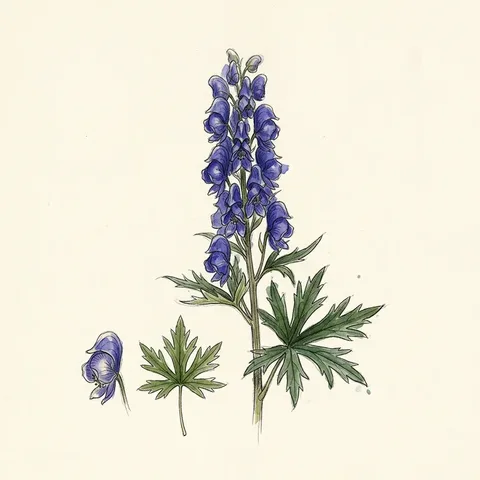
Aconitum Napellus

Common Aconite
ACON · 19 entries across 19 books
Aconitum Napellus
HabitatMoist pastures and waste places in mountainous districts, Central and Southern Europe, Russia, Scandinavia, and Central Asia. PreparationTincture of whole plant with root when beginning to flower. Clarke
6X, Ø
Sixth potency for sensory affections; first to third for congestive conditions. Must be repeated frequently in acute diseases. Acon is a rapid worker. In Neuralgias tincture of the root often preferable, one drop doses (poisonous), or again, the 30th according to susceptibility of patientDose · Boericke

Reason for use

Fear: of death; of crowds; of going out. Anything, always fearful.

Complaints from exposure to cold, dry cold.

Congestions and inflammations, acute, first stage with great anxiety, heat and restlessness; tosses about in agony; throws off covering. Inflammatory fever.

Pains insuppressable < at night, especially in the evening; neuralgic.

Face very red and flushed, but turns pale on rising up.

Favorite points of attack: Larynx (crop), bronchi (bronchitis), lungs and pleura (pneumonia and pleurisy), joints (rheumatism), heart and circulation (erethism).

▲ Worse

in the evening (chest symptoms and pains); lying on left side; in warm room or warm covering

The full Nash text, by section

Modalities

> uncovering; kicks the clothes off.

We will now take up what I call the trio of restless remedies; viz: Aconite, Arsenicum and Rhus toxicodendron.

All are equally restless, yet all are so very different that there is no difficulty in choosing between them. The Aconite restlessness is oftenest found in a high grade of synochal or inflammatory fevers. There is no better picture in a few words of the Aconite fever than is given by Hering -"Heat, with thirst; hard, full and frequent pulse, anxious impatience, inappeasable, beside himself, tossing about with agony."

The custom of alternating Aconite and Belladonna in inflammatory affections, which so widely prevails is a senseless one. Both remedies cannot be indicated at a time, and if a good effect follows their administration you may be sure that the indicated one cured in spite of the action of the other, which only hindered; or that the patient recovered without help from either. There are many cases of this kind where the doctor is congratulating himself on a cure which was only a recovery, for which he deserves no credit at all. Let us look for a moment at some of the diagnostic differences of these two remedies.

Both have great heat of the skin, but Aconite has characteristically dry, hot skin and no sweat; Belladonna has even greater surface heat, but sweats on covered parts.

Aconite tosses about in agony with great fear of death; Belladonna often has semi-stupor and jerks and twitches in sleep. Aconite has great distress in heart and chest; Belladonna everything seems to centre in the head. Aconite fears death without much delirium; Belladonna fears imaginary things, with delirium. Thus we might continue to give points of difference. No man who understands the homoeopathic art of healing will ever alternate these two remedies.

Aconite is also a great pain remedy. If we were to name the three leading remedies in this respect it would be Aconite, Chamomilla and Coffea. The Aconite pains are always attended by the extreme restlessness, anxiety and fearfulness of this remedy. The patient tosses about in agony, "cannot bear the pain, nor bear to be touched, nor to be uncovered." Well, you say, all remedies have pain. Not all, and not many so intense pain. Opium and Stramonium have painlessness oftener than pain. The Aconite pains are intolerable and generally worse in the evening or at night. Then we have often alternating with or sometimes even in conjunction with the pains numbness, tingling, or formication.

In this it resembles Rhus tox., but with Aconite the pains predominate, while with Rhus tox. the numbness, with dull aching and soreness, leads. The pains of Aconite are tearing, cutting pains, which drive the patient to desperation. Right here we may as well speak of the leading characteristic of this remedy, for it is almost always present when Aconite is clearly indicated. Just one word expressed it: Fear -fear of death especially, but fear to cross the street, fear to go into society, fear something is going to happen, ever present, undefinable, unreasonable fear. No remedy has it in such a degree as this one. It is the fear as much as the pain that makes the patient so full of that agonized restlessness. The Arsenic restlessness goes with extreme prostration and reduced vitality. Rhus tox., on account of the aching pains, which make him want to move for the temporary relief he gets from the movement. Arsenic wants to move from place to place, but is not relieved. Neither Aconite nor Arsenic get such relief from movement, nor does Arsenic fear like Aconite, or at least in any such degree. Aconite, as a fever remedy, has been greatly abused. Even the old school, astonished at the results of homoeopathic treatment, so superior to their so-called anti-phlogistic treatment, and finding Aconite so highly recommended and frequently used in inflammatory affections, concluded in accordance with their usual way of reasoning that Aconite could be squeezed into their pathological livery and made to do service in all kinds of fever simply because it was fever. But they soon found that however useful it might be in some cases of inflammatory fever, it was of no use in typhoids. Thus was generalization from a pathological standpoint again doomed to disappointment, as it always must be. Now many so-called homoeopaths have fallen into similar error by concluding that because Aconite did quickly cure in some cases having a high grade of fever, that therefore it was always the remedy with which to treat cases having high fever. They even fell into the routine habit of prescribing this remedy for the first stage of all inflammatory affections, and follow it with other remedies more appropriate to the whole case further on. If Aconite were the only remedy having inflammatory fever, perhaps we could do no better than to zig-zag the case to a cure this way. Dunham writes: "Aconite is never to be given first to subdue the fever and then some other remedy 'to meet the case,' never to be alternated with other drugs for the purpose, as is often alleged, of 'controlling the fever.' If the fever be such as to require Aconite, no other drug is needed. If other drugs seem indicated one should be sought which meets the fever as well, for many drugs besides Aconite produce fever, each after its kind."

True words, and as one reads them who has proved their truthfulness and remembers they great author, he feels like exclaiming, "Being dead, yet speaketh." Aconite has two very important modalities, viz., fright and dry cold air. We have already noticed the value of the fear of Aconite as a symptom, connected with acute inflammatory ailments. It is no less a remedy for ailments brought on by fright, either immediate or remote. The patient has received a fright in the dark and is always afraid in the dark afterwards. From fright vertigo comes on, or fainting; trembling; threatened abortion, or suppressed menstruation, Jaundice may be induced by it, and become chronic. There are other remedies for fright, prominent among which are Opium, Ignatia, Veratrum album, etc. Now in regard to the dry cold air. No remedy has more prominently acute inflammations arising from dry, cold air. Nineteen out of twenty cases of croup arising from exposure to dry, cold air will be cured by Aconite. I live in a locality where croup abounds and have had abundant opportunity to verify this. Pleurisy, pneumonia and rheumatism also come under this head, and they are, as would be expected, almost invariably accompanied by the high fever, anguish, restlessness and fear so characteristic of this remedy. Any local congestion or inflammation coming from such exposure also comes under the same rule, always providing the other symptoms corresponds The other leading dry air remedies are Bryonia, Causticum, Hepar sulph., and Nux vomica. Here are some wet weather remedies: Dulcamara, Nux moschata, Natrum sulphuricum and Rhus toxicodendron. Such things are well to remember, for one positive indication is worth two or three vague ones.

Complete text of the Aconitum Napellus entry in Nash - Leaders in Therapeutics; origin and preparation from Clarke. Historical text from the classical materia medica (1828–1950). Not medical advice, and not a claim that any remedy works.
homeopathylibrary.com/remedy/aconitum-napellus

More on Aconitum Napellus

Simple remedy · Plant

19 entries across 19 books · abbreviations: ACON, ACONITUM · Family: Ranunculaceae

Remedies said to end or reduce the action of Aconitum Napellus, for example if it has caused an unwanted reaction. What is an antidote?

Remedies whose action Aconitum Napellus is said to end or reduce.

Entries

1 Boericke

ACONITUM NAPELLUS · William Boericke · 9,156 chars

2 Kent

Aconitum Napellus · James Tyler Kent · 35,972 chars

3 Clarke

Aconitum Napellus · John Henry Clarke · 34,346 chars

4 Hering

Aconitum Napellus · Constantine Hering · 78,917 chars

5 Allen

Aconitum Napellus · Henry C. Allen · 3,065 chars

6 Nash · shown above

Aconitum Napellus · E. B. Nash · 7,768 chars

7 Hering

ACONITUM · Constantine Hering · 20,889 chars

10 Lippe

Aconitum napellus · Adolph zur Lippe · 7,251 chars

12 Hahnemann

Aconitum Napellus · Samuel Hahnemann · 56,868 chars

14 T. F. Allen

ACONITUM · Timothy Field Allen · 810 chars

15 Tyler

Aconitum · Margaret Lucy Tyler · 16,714 chars

16 Guernsey

ACONITUM NAPELLUS · Henry Newell Guernsey · 11,605 chars

17 Cowperthwaite

ACONITUM (ACONITUM NAPELLUS) · Allen Corson Cowperthwaite · 15,114 chars

18 Dewey

Aconitum Napellus · Willis Alonzo Dewey · 5,473 chars

19 Gross

Aconitum · Gustav Wilhelm Gross · 39,358 chars

20 Hempel

Aconitum Napellus · Charles Julius Hempel · 222,323 chars

22 Roberts

Aconitum napellus · Herbert Alfred Roberts · 6,722 chars

23 T. F. Allen

Aconitum Napellus · Timothy Field Allen · 5,661 chars

33 Gladstone Clarke

Aconitum Napellus · A. Gladstone Clarke · 1,121 chars

Relations (this remedy →)

similar 1Morbillinum

Backlinks (other remedies → this one)

incompatible / inimical 1Caladium Seguinum

Other remedies of the Ranunculaceae

Research (18)

Papers in PubMed that mention this remedy together with homeopathy, newest first.

Show 18 papers
  1. Investigations on the morpho-anatomy and histochemistry of Aconitum napellus LArmstrong L, Machado CD, Dell'Avanzi GG et al. · Microscopy research and technique · 2024 · doi
  2. Ethnopharmacologically important highly subsidized Indian medicinal plants: Systematic review on their traditional uses, phytochemistry, pharmacology, quality control, conservation status and future prospectiveAnmol, Aggarwal G, Sharma M et al. · Journal of ethnopharmacology · 2024 · Systematic Review · doi
  3. Effects of homoeopathic ultrahigh dilutions of Aconitum napellus on Baker's yeast-induced fever in rabbitsAhmad S, Rehman T, Abbasi WM · Journal of integrative medicine · 2017 · doi
  4. Comparison of homeopathic globules prepared from high and ultra-high dilutions of various starting materials by ultraviolet light spectroscopyKlein SD, Wolf U · Complementary therapies in medicine · 2016 · doi
  5. Complementary and alternative medicine (CAM) use in an Italian cohort of pediatric headache patients: the tip of the icebergDalla Libera D, Colombo B, Pavan G et al. · Neurological sciences : official journal of the Italian Neurological Society and of the Italian Society of Clinical Neurophysiology · 2014 · doi
  6. Circadian aspects of hyperthermia in mice induced by Aconitum napellusde la Peña SS, Sothern RB, López FS et al. · Pharmacognosy magazine · 2011 · doi
  7. An exploratory study on scientific investigations in homeopathy using medical analyzerMishra N, Muraleedharan KC, Paranjpe AS et al. · Journal of alternative and complementary medicine (New York, N.Y.) · 2011 · doi
  8. Assays of homeopathic remedies in rodent behavioural and psychopathological modelsBellavite P, Magnani P, Marzotto M et al. · Homeopathy : the journal of the Faculty of Homeopathy · 2009 · Review · doi
  9. Test of a homeopathic dilution of Aconitum napellus. A clinical, randomized, double-blind, controlled crossover study in healthy volunteersPiltan D, Rist L, Simões-Wüst P et al. · Forschende Komplementarmedizin (2006) · 2009 · Randomized Controlled Trial · doi
  10. On: Piltan D, Rist L, Simões-Wüst A, Saller R: Test of a homeopathic dilution of Aconitum napellus. A clinical, randomized, double-blind, controlled crossover study in healthy volunteers. Forsch Komplementmed 2009;16:168-173Thurneysen A · Forschende Komplementarmedizin (2006) · 2009 · doi
  11. Canova, a Brazilian medical formulation, alters oxidative metabolism of mice macrophagesde Oliveira CC, de Oliveira SM, Godoy LM et al. · The Journal of infection · 2006 · doi
  12. Activation of bone marrow cells treated with Canova in vitroAbud AP, Cesar B, Cavazzani LF et al. · Cell biology international · 2006 · doi
  13. The anticancer homeopathic composite "Canova Method" is not genotoxic for human lymphocytes in vitroSeligmann IC, Lima PD, Cardoso PC et al. · Genetics and molecular research : GMR · 2003
  14. Bradycardia, reversible panconduction defect and syncope following self-medication with a homeopathic medicineGuha S, Dawn B, Dutta G et al. · Cardiology · 1999 · Case Reports · doi
  15. [Toxicity of monkshood. Review.]Ingolfsdottir K, Olafsson K · Laeknabladid · 1997
  16. The homoeopathic treatment of otitis media in children--comparisons with conventional therapyFriese KH, Kruse S, Lüdtke R et al. · International journal of clinical pharmacology and therapeutics · 1997 · Clinical Trial
  17. [Acute otitis media in children. Comparison between conventional and homeopathic therapy]Friese KH, Kruse S, Moeller H · HNO · 1996
  18. [The administration of homeopathic drugs for the treatment of acute mastitis in cattle]Merck CC, Sonnenwald B, Rollwage H · Berliner und Munchener tierarztliche Wochenschrift · 1989

Search PubMed directly →

Clinical (Clarke)

Indicated for (Boger)

Abdomen, numbAlcoholism, acuteApoplexy, very irritable pulseBlood, rushes of, upwardBoils, nose, on tipBrain, burningBurning, shivering, withChest, backward thro' rightChest, burning, heat, etcChill, congestiveCirculation, stands stillClairvoyanceCongestion, suddenCraves, ice waterCrepitationCries, pains, withDays, hot, with cold nights [[agg.]]Dry, coldEars, crashingEars, menses, beforeEpilepsy, status epilepticusEpistaxis, menses, profuseEyes, bloodshotFace, terrified lookFear, deathFear, long lastingFingers, tips, redFlatulence, abdomen, lowerForeign bodiesFullGastritisGenitals, fumbles, graspsGroansHaemoptysisHaemorrhage, darkHair, bristlingHead, beats theHead, fear, withHeart, radiatingHeart, tumultuousHeat, exhaustionHeat, internal, with cold external partsHernia, strangulatedHips, morbus coxariusHot, days, and cold nights [[agg.]]Hypochondriae, band aboutHysterical, twitchings, during mensesKidneys, congestionKidneys, nephritisLarynx, grasps the, clutchesLegs, floatingLumbar back, cough, aggLumbar back, numbMammae, congestedMilk, amelMucous membranes, red, brightMusic, aggNails, bitesNaso-pharynx, hot, dryNose, abscess, tipNose, discharges, burning, hot, etcNose, numbNose, sensitive to inspired airPleurodyniaPneumonia, cerebral typePulsation, generalPus, scantyRespiration, kyphosis inRheumatismRobust habitSciatic nerve, numbness, withSciatic nerve, shootingsSelf, tortureShock, mentalShock, nervousShock, surgicalSkin, burning, heats, etcSleep, light, hears every soundSleepless, restless fromSore, pains, after+21 more