 Homeopathy Library
Apis Mellifica
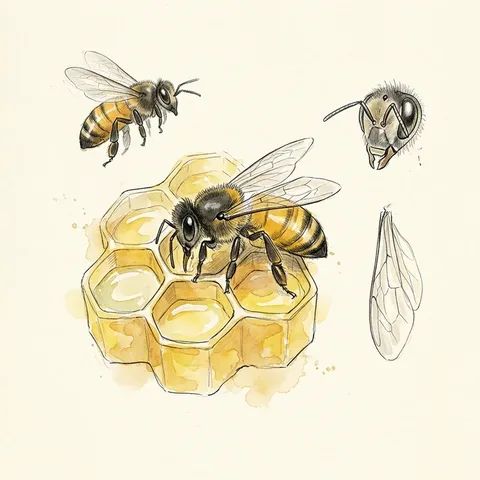
Reason for use
Burning, stinging pains (like bee stings); eyelids; throat, panaritium or felon, haemorrhoids, ovaries, (especially right one), breasts (mastitis), skin (erysipelas, urticaria, carbuncles).
Great oedema; general or local (face, ears, eyelids, especially lower); throat (diphtheria); genitals (especially scrotum); skin (erysipelas and urticaria); everywhere; general anasarca, abdomen. These oedemas are accompanied with the characteristic pains, or no pain at all.
Stupor, with sharp, sudden, shrill cries in brain disease (crie encephalique).
Thirstlessness, especially in dropsies and during heat of intermittents.
Skin alternately dry and perspiring.
Suffocative; feels as if every breath would be his last, especially in dropsical conditions or hot stage of intermittents.
▲ Worse
after sleep, on touch (very sensitive), from heat and warm room
▼ Better
cold room or air and cold applications
The full Nash text, by section
Modalities
Bad effects from suppressed or retrocedent exanthemata; measles, scarlatina, urticaria.
Involuntary diarrhoea, with sensation as if anus were wide open.
It seems to me that in this remedy also the leading characteristic is to be found in its sensation-burning, stinging pains. They are sharp and quick, like the sting of the bee. These pains are as characteristic of this remedy as are the itching-like chilblains of Agaricus, or the burnings of Arsenicum and Sulphur; but the burning of Apis are relieved by cold, while those of Arsenic are relieved by heat. The stinging appears in many diseases, and kinds of tissue. In the serous membranes or the brain coverings, when we get those "shrill, sudden piercing screams"-"cri cerebrale," which attend such dangerous affections as hydrocephalus, cerebro-spinal meningitis and typhus cerebralis, Apis is the remedy. Again we get these pains in the mucous membranes, as in the throat and haemorrhoids, and the burning is almost always more or less present at the same time. It is also found very prominent in the ovaries. It has proved a very valuable remedy in cancers, even open ones, when this stinging, burning pain was present; also in panaritium. I have seen rapid cures follow its exhibition in felon. Hering put it -"redness and swelling with stinging and burning pain in the eyes, eyelids, ears, face, lips, tongue, throat, anus, testicles." (> by cold applications ought to be added).
So we see how generally the system comes under the action of this remedy. In skin affections, especially the acute exanthems, this is the grand leading symptom, and is especially indicated in affections of the brain and meninges caused by a sudden suppression of skin diseases.
The next general condition for which this remedy seems to be as near specific as any remedy can be is an infiltrated cellular tissue; and oedematous or dropsical condition. This condition obtains almost from the beginning of inflammatory affections and extends to the stage of exudation, and even to chronic dropsical states. In those intensely violent and rapid cases of diphtheria in which the whole throat fills right up with oedematous swelling, the vulva hanging down like a transparent sac filed with water (Kali bichromicum, Rhus toxicod.), and the patient is in imminent danger of death by suffocation from actual closure of the throat and larynx, there is no remedy like Apis. The stinging, burning pains may be present in these cases; or what is more dangerous still, because there is no complaint until the case is far advanced, is an absolutely painless condition, Baptisia has painlessness in throat affections, but the swelling is not so rapid as Apis, and there is no oedema. A number of years ago I was called to Watkins Glen, N. Y., in consultation in a very bad case of diphtheria. One had already died in the family and four lay dead in the place that day. Over forty cases had died in the place and there was an exodus going on for fair. Her attending physician, a noble, white-haired old man, and withal a good and able man, said, when I looked up to him and remarked I was rather young to counsel him: "Doctor, I am on my knees to anybody, for every case has died that has been attacked." The patient was two rooms away from us, but I could hear her difficult breathing even then. Apis was comparatively a new remedy then for that disease, but as I looked into her throat I saw Apis in a moment, and a few questions confirmed it. I told the doctor what I thought and asked him if he had tried it. He said, no he had not thought of it, but it was a powerful blood poison; try it. It cured the case, and not one case that took this remedy from the beginning, and persistently, died. It was the remedy for the genus epidemicus. See my report of this in Vol. XII, Hahnemannian Monthly.
This oedematous condition of Apis may be found in almost any part of the body, but is especially prominent in mouth and throat, eyelids and face, around the eyes (Phosphorus, whole Face); lower lids hang down like bags of water. (Kali carb., upper lids). In erysipelas the swelling of the skin is of this oedematous appearance, and generally with stinging pains.
Sometimes the oedema increases until it forms large blister-like bags of water.
The dropsical effusion may be general or local. It is found in the thoracic cavity, in ovaries, in abdominal cavity, scrotum, and genitals of females. One peculiar symptoms which helps to choose between it and other remedies in dropsy is the almost absolute absence of thirst (with thirst, Acetic acid, Arsenic and Apocynum).
I will now, in addition to what I have written, call attention to some particular affections and symptoms in which Apis should be remembered. A very important symptom not yet mentioned is tenderness or sensitiveness to touch, as if bruised. This is particularly true in the abdominal, uterine, and ovarian regions, but is not by any means confined there, for we may find the whole surface of the body exceedingly sensitive to touch: even the hair seems sore (China officinalis). The condition is often found in cerebro-spinal meningitis and is a strong indication for Apis. In erysipelas this tenderness is often present, and is found under Hepar sulphur, as well as Apis.
The sleep of Apis is either very restless, or in brain diseases there is deep stupor, interrupted occasionally by piercing screams. Never forget Apis then. In all inflammatory affections and in intermittent fevers, if you find the patient alternately dry and hot, or perspiring, think again of Apis.
No remedy has this alternation so strong as Apis. Sensation as if every breath would be his last is very characteristic, and occurs not only in dropsical troubles of the chest, but seems also to be a nervous symptom. In scarlatina Apis is especially indicated if the eruption is retarded or retrocedent and serious brain troubles result, and it is no less efficacious in post-scarlatinal dropsies if the symptoms do not indicate some other remedies.
homeopathylibrary.com/remedy/apis-mellifica