 Homeopathy Library
Thuja Occidentalis
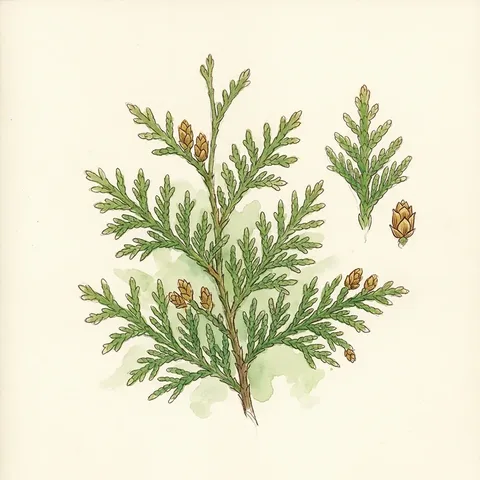
Reason for use
The general appearance of the Thuya subject, if he has a characteristic picture, is that of a waxy, shiny face, it looks as if he had been smeared over with grease; and is often transparent, he is a sickly looking individual, looks as if entering upon some cachexia.
This is often the case in the sycotic, constitution and the cancerous cachexia, weakly, cachectic, yellowish, or often very pallid.
The full Kent text, by section
Skin
The skin manifests many symptoms.
The perspiration is peculiar, it is sweetish honey, sometimes like garlic, strong and pungent.
A pungent odor emanates from the genitals, sweetish honey-like like odor to the sweat from the genitalia, he smells his genitals.
The odor is also like burnt horn, burnt feathers or burnt sponge. These peculiar strong odors are particularly present when there are fig warts upon the genitals such as Thuja cures.
The skin looks unhealthy everywhere about the body and there is a copious sweat on first going to sleep, like Arsenic. If you had only the waxiness such as Arsenic and Thuja produce, you might prescribe Arsenic. Arsenic is often the acute and Thuja the chronic. You remember that Arsenic is usually a chronic remedy.
Asthma: A peculiar asthmatic condition is found in sycosis and Arsenic appears to be indicated for the symptoms, but it only relieves, it does not control the predisposition, it acts like Aconite in acute diseases and only ameliorates for a moment. Asthmatic and many other sycotic conditions seem to call for Arsenic, but it will do nothing but palliate, the constitutionality is not reached by Arsenic, its fundamental symptoms are not similar.
In syphilis and psora Arsenic acts a long time and eradicates the complaints, when similar to them, but it is not similar to sycosis. Arsenic does not go to the bottom of the trouble, but Thuja and Natrum sulph. will take up the work and cure. Natrum sulph. and Thuja bring back the primitive manifestation that has been suppressed for years.
Warts: The tendency of the Thuja patient is to throw out wart-like excrescences which are soft and pulpy and very sensitive, they burn, itch and bleed easily when rubbed the clothing. Horny excrescences that form on the hands and split open form upon a pedicle and crack around the base.
Cauliflower excrescences upon the cervix uteri, about the anus (like Nitricum acidum), about the labia majora and mucous membranes generally.
Horny excrescences, more upon the skin. Warts of a brownish color, especially if upon the abdomen the body; great brown spots, like liver spots, form upon the abdomen.
Zona around the chest, herpetic eruptions everywhere, here and there, like Sepia, herpes labialis and preputialis. Zona is a herpetic formation, great vesicular patches come out upon the body called "shingles", here we should compare Thuja, Rhus, Graph, Kali hydr., and Mezereum.
This condition is attended with a great amount of suffering and neuralgic pains. In cases that are sycotic, Thuya is especially a grand remedy.
You will have a class of cases where the warts have been caused to disappear by calomel, which makes them shrivel up and off, such is the old school treatment. Sometimes a patient comes to you with erratic symptoms and you may study for hours over these symptoms, and see very little order in them, you will realize that the leading features have been left out and that something is lacking.
Some one has applied Nitric acid, calomel or something else, and driven these fig warts away. These condylomata could not come without having some constitutional basis, these warts have a cause, and that cause seems to be less able to make the patient sick if he has the warts, he feels better when he has the warts. Strange to say; when these warts have been suppressed, we get symptoms of Nitric acid, Thuja, Mercurius and Staphysagria.
Thuja leads all medicines for symptoms coming from suppressed fig-warts.
Thuja is pre-eminently a strong medicine when you have a trace of animal poisoning in the history, as snake bite, small-pox and vaccination.
There are probably several varieties of urethral discharges, there is one that is sycotic, and when that has been suppressed, it produced a miasm with soreness in the bottom the feet and in the knees and particularly through the back and loins and sciatic nerves, in the knees and ankle joints.
Sometimes it affects the upper extremities, but particularly the lower. Most violent aggravation when keeping still, like Rhus, great aching that increases so long as he keeps still, he is very often compelled to keep the bed, and then he constantly moves and turns. An antisycotic must be selected.
While this group of symptoms would be cured by Rhus when the case is not sycotic, when these symptoms come from suppressed gonorrhoea Medorrhinum or Thuja will cure.
Thuja enters into this particular sphere and takes hold of this particular case where sycosis is at the bottom. Sometimes when the discharge has been suppressed, orchitis comes on and then Pulsatilla will be the remedy, and very seldom Thuja.
Thuja affects the left testicle with intense squeezing pain, but most generally you will find Pulsatilla the remedy.
As we continue to study Thuja, we see that it has a profound action upon the glands, stitching, tearing pains in the glands, the pains are as if the gland were being torn to pieces. That may be true of glands in general, but one particular gland, the ovary, is more affected than any other and especially the left.
Women: This is so true, that if you meet a violent pain in the left ovary, coming on at the time of menstruation and continuing during the flow and extending down the thighs, but may be in every direction, it increases as the flow comes on, stinging, tearing, burning, bursting pains, as if the parts were being torn out, make her cry aloud, she goes into a hysterical state. This a very strong Thuja group. It has the opposite of Zinc., and Lachesis, for in these, relief comes with the flow.
Many women suffer from grumbling pains in the ovaries all the time, they have a sense of the organ, which they should not feel; pain from taking cold or in change of weather; the increase of the pain in the left ovary is the first sign; sometimes the pain is so severe that the right one suffers apparently, from sympathy. Where the ovaries have been affected for some time there will be mental symptoms, a most violent irritability, jealous, quarrelsomeness, ugliness.
This irritability is likely to been shown towards individuals about the house, toward the husband and the mother; she is yet able to control herself among strangers and the doctor may not be able to find out about it, because she has in her nature a disposition to cheat; she wants to be alone and takes upon herself fixed ideas; that she is pregnant, or that an animal is in her bowels, she is followed, or that someone is walking beside her, thinks that soul and body are separated.
Now, these are fixed ideas, and there is no use trying to reason them out of her. It seems to her that she is very delicate, that she is made of glass and that she will break. The idea is that she will break, and not that she is transparent.
Associated with this conditions, we have violent, intense, tearing headaches, tearing in the eye, ameliorated by heat. The eye-ball pains are better from heat and the rest are better in the cool open air.
Pain localized in small spots. A nail driven in the head, side of head and forehead, like Ignatia and Anacardium. These pains are intensified into tearing pains, and affect the eye-ball, making it so sore that it can hardly be touched; worse from heat and worse from lying down; worse in a warm room and better in the open air.
Rheumatic head symptoms are worse in damp air. They are worse from sour things and also from stimulating and exciting things.
Crude drugs do not impress the vital force, so lastingly, but an individual who is thoroughly sensitive and properly sensitive, as sensitive of contagion, then if you undertake to prove by giving it night and morning, you will rivet upon him a life-long miasm.
If you have given a medicine, wait for the symptoms to come and go in the natural manner. To a great extent t, this is the tendency with sycosis, the tendency is rather outward.
We see in the proving of a drug what we see in disease. When a gonorrhoea is contracted, it goes through the prodromal period and then comes the disease, which, if let alone, has in its nature a tendency to eradicate itself from the economy, and then the patients do not suffer from lasting conditions.
In the old school, they always suppress the discharge, and there are those in the new school who do little better.
The frequent repetition by which one is exposed, would not increase the gonorrhea itself, because the susceptibility is satisfied.
The taking of more of the drug to prove it does not do so much harm, provided the one who is directing the proving realizes when the symptoms begin to rise, and then stops the drug.
Now if we go on with the proving by repeating the doses after the symptoms come on, we force the drug into the economy when he is already poisoned, and by this means we get a confusion in the symptoms, the drug disease engrafted upon that individual for life.
Many of the provings of Thuja give us that kind of confusion, so that we see only now and then symptoms cropping out that are striking; in fact, the great bulk of the Thuja provings has been wasted, because there is so much confusion in the great number of symptoms, while the earlier provings brought out many of the characteristics, the Vienna provings, to a great extent, confused the image of Thuja.
So that, by clinical experience only, we have been able to draw out the finer features of Thuja. It requires more than a school boy to do that. The new provings must be carried on in a different manner.
Catarrhal conditions: Thuja has some striking bowel symptoms; gushing, watery morning diarrhoea, like water coming out of a bunghole.
There is also a general catarrhal condition running through the body; catarrh of the nose, ears and chest. In the catarrh of the chest it produces an intense hacking cough, with expectoration in the morning of greenish mucus, sometimes a copious expectoration. It is often suited to old cases of pneumonia, in such individuals as have suppressed gonorrhoea, fig-wart gonorrhoea.
The kidneys and urinary symptoms are also striking; congestion and inflammation of the kidneys, sharp pain in the kidneys; burning urine; inflammation of the bladder and urethra that is not gonorrhoeal; pus from the bladder; paralysis of the bladder, must wait a long time for the urine to start; retention of urine, continuous urging to urinate, tearing in the urethra, feeling as if the urine were constantly running along the urethra, like Kali bich. and Petros.
In the urethral disease of sycotic character, Thuja leads all other remedies. In the non-sycotic variety, Cannabis sativa is sufficient, but those cases that have proved to the sycotic Cann. sat. left uncured, it ameliorated the burning during and after urination and the thick yellowish green discharge, but some other remedy had always to follow, when they were shown to be sycotic. It is not so with Thuja, because it is capable of finishing the case.
In the most violent cases, with bloody urine, extreme salacity, great torment, bloody, watery discharge from the urethra and bladder, no rest day or night, Cantharis comes in, it is capable of finishing the case in a few days. Such a patient must be in excellent health, which is not generally the case. They are drinking men and smokers.
Tobacco is one of the most troublesome things you will run across, many cases will not recover promptly if they are tobacco users and great smokers, wine drinkers or convivial men, they run around a good deal mc and are high livers and with such you have a slow case on hand.
With the system so broken down front high living, you may not get a decided curative action until you have forced him to abandon his way of living. Put him on light diet, diminish his smoking, get rid entirely of the drinking, and put him on a perfectly bland living.
This is the first thing. If he is a man of family we have to contend with great mental distress, and not less so if a woman. So it may well be said, that usually the sycotic miasm is a troublesome one to begin with and one that will bother the young physician.
You cannot substitute the right method for a wrong one, which will make him a cripple for life.
The suppression of the disease, as usually tried, cannot be thought of by the sincere and earnest homeopath.
If he wants it checked suddenly, let him go somewhere else, but warn him what will take place, and he will have untold disease and suffering.
homeopathylibrary.com/remedy/thuja-occidentalis